
Reports
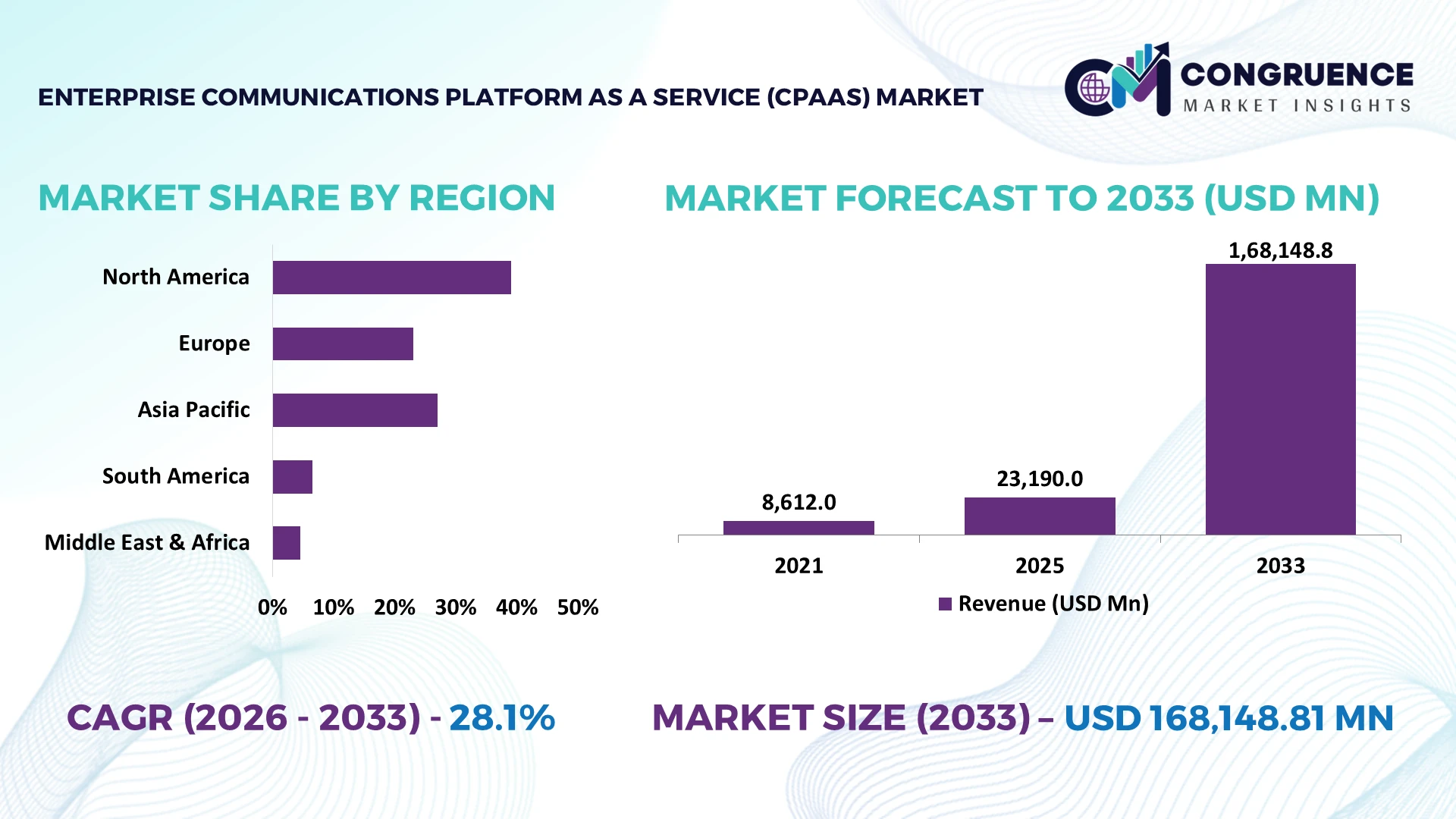
The Global Enterprise Communications Platform as a Service (CPaaS) Market was valued at USD 23,190.0 Million in 2025 and is anticipated to reach a value of USD 1,68,148.8 Million by 2033 expanding at a CAGR of 28.1% between 2026 and 2033. The market is driven by the integration of AI-enabled omnichannel communication APIs, automated customer engagement, conversational commerce, and cloud-based enterprise communication infrastructure.
The United States dominates the global market with an estimated 32.5% share in 2025, supported by substantial investments in cloud infrastructure, conversational AI, and enterprise messaging platforms. Approximately 70% of large enterprises utilize cloud-enabled communication solutions. Compared with Germany, the United States demonstrates broader enterprise API adoption across banking, healthcare, retail, and telecommunications, while FCC messaging regulations accelerate investment in authenticated communication infrastructure.
Enterprise technology providers must prioritize intelligent communication orchestration, regulatory compliance, and scalable API ecosystems to secure sustainable competitive advantages.
Market Size & Growth: USD 23,190.0 Million in 2025 to USD 1,68,148.8 Million by 2033, at 28.1% CAGR, driven by AI-enabled communications.
Top Growth Drivers: Cloud communication adoption (38%), omnichannel customer engagement (34%), and intelligent communication automation (28%).
Short-Term Forecast: By 2028, advanced communication automation targets a 25% reduction in customer interaction handling costs.
Emerging Technologies: Three major innovations include generative AI, Rich Communication Services (RCS), and intelligent API orchestration.
Regional Leaders: North America (USD 9,044.1 Million), Asia Pacific (USD 6,261.3 Million), and Europe (USD 5,333.7 Million) lead cloud, mobile, and compliant messaging adoption, respectively, in 2025.
Consumer/End-User Trends: An estimated 65% of digitally mature enterprises prioritize integrated omnichannel customer engagement.
Pilot/Case Example: In 2024, Klarna's AI assistant reduced repeat customer inquiries by 25%, demonstrating conversational automation efficiency.
Competitive Landscape: Twilio holds an estimated 18% share, competing with Sinch, Infobip, Vonage, and Bandwidth.
Regulatory & ESG Impact: U.S. A2P 10DLC registration requirements strengthen messaging authentication, with automated compliance targeting 20% fewer delivery disruptions.
Investment & Funding: Ericsson's USD 6,200 Million Vonage acquisition demonstrates strategic investment in programmable communication ecosystems.
Innovation & Future Outlook: Three strategic priorities include network APIs, agentic AI, and embedded conversational commerce, transforming enterprise communication monetization.
The Enterprise Communications Platform as a Service (CPaaS) Market supports customer authentication, automated notifications, digital banking, telehealth, and personalized retail engagement. Recent innovations integrate conversational AI, programmable video, intelligent routing, and RCS messaging, targeting communication workflow efficiency improvements of approximately 25%. Increasing carrier authentication requirements are encouraging enterprises to adopt verified communication channels, positioning intelligent orchestration as a strategic business capability.
Enterprise Communications Platform as a Service is becoming strategically important as businesses transition from fragmented communication infrastructure toward programmable, intelligence-driven customer engagement ecosystems. Enterprises increasingly integrate messaging, voice, video, and authentication capabilities directly into business applications, eliminating dependence on standalone communication systems. Cloud-native communication architectures target 20–30% lower integration and maintenance costs compared with conventional on-premises infrastructure, strengthening operational flexibility and accelerating digital service deployment.
The United States leads enterprise communication API innovation through established cloud ecosystems, while India demonstrates rapid adoption through mobile banking, digital payments, and conversational commerce. India's Unified Payments Interface ecosystem creates significant demand for automated transaction notifications and customer authentication. Between 2027 and 2029, digitally mature enterprises are expected to target automation of 40–50% of routine customer interactions through integrated communication workflows.
Financial institutions are deploying programmable messaging and voice APIs for transaction verification, fraud alerts, and automated customer assistance. Twilio, Infobip, Sinch, and Vonage are strengthening AI capabilities, carrier partnerships, and enterprise software integrations. Competitive differentiation increasingly depends on delivering secure, context-aware communication across multiple channels while maintaining consistent service quality, regulatory compliance, and measurable customer engagement outcomes.
The integration of programmable communication capabilities into enterprise applications is accelerating CPaaS adoption across banking, retail, healthcare, logistics, and digital services. Digitally mature enterprises increasingly target automation of 40–50% of routine customer interactions, while integrated communication workflows offer potential operational cost reductions of 20–30%. India's UPI-enabled digital payment ecosystem and expanding mobile commerce infrastructure generate substantial requirements for real-time transaction alerts, authentication, and customer notifications. Enterprises are replacing disconnected messaging systems with centralized communication APIs to improve customer journey continuity. Twilio, Infobip, and Sinch are expanding enterprise integrations, carrier connectivity, and industry-specific communication solutions. Embedded communications increasingly influence transaction completion and customer retention rather than functioning solely as operational support infrastructure.
Rising carrier messaging charges, country-specific telecommunications regulations, and inconsistent communication delivery standards constrain CPaaS deployment economics. Carrier fees can represent an estimated 30–50% of direct messaging delivery costs, while registration and compliance requirements can increase implementation expenditure by approximately 10–15% in complex deployments. The United States' A2P 10DLC framework requires registered enterprise messaging campaigns, creating additional onboarding obligations and potential delivery restrictions. India's Distributed Ledger Technology framework introduces separate sender identification and message template requirements. These fragmented regulations complicate multinational deployment and compress margins for high-volume messaging providers. Companies are strengthening direct carrier agreements, localized compliance infrastructure, and intelligent routing capabilities. Geographic diversification alone remains insufficient without country-specific delivery economics and regulatory expertise.
Generative AI, agentic automation, and programmable telecommunications network capabilities are creating new opportunities beyond conventional messaging and voice APIs. Intelligent communication workflows target reductions of 25–35% in routine service handling costs, while automated conversational platforms offer potential agent productivity improvements of 15–25%. The GSMA Open Gateway initiative is accelerating standardized network API development, enabling advanced services such as number verification, SIM swap detection, and network-based authentication. Financial institutions in Brazil and India represent attractive deployment opportunities for fraud prevention and conversational transaction services. Vonage, Infobip, and other communication providers are investing in telecommunications partnerships, AI orchestration, and developer ecosystems. Network intelligence enables CPaaS providers to monetize security and transaction assurance alongside traditional communication volumes.
Managing increasingly complex communication workflows across messaging, voice, video, and AI-enabled channels presents a significant long-term execution challenge. Enterprise-grade communication platforms frequently target service availability of 99.99%, while complex legacy integrations can account for an estimated 20–30% of implementation effort. Expanding conversational AI deployment introduces additional requirements for context preservation, response accuracy, identity management, and real-time security monitoring. Germany's stringent data protection environment reinforces the importance of secure processing and controlled customer information access. Enterprises require consistent communication performance during transaction surges and infrastructure disruptions. CPaaS providers must invest in distributed cloud architecture, automated failover, standardized APIs, and AI governance frameworks. Competitive scalability depends on maintaining reliable end-to-end communication outcomes rather than merely increasing API processing capacity.
Migration Toward Rich Messaging Formats: Enterprises are transitioning from conventional SMS notifications toward interactive RCS messaging incorporating branded interfaces, multimedia content, and actionable buttons. Apple's introduction of RCS support with iOS 18 expands cross-platform accessibility. Campaign deployments target 20–30% higher engagement and 15–20% improved conversion, prompting Sinch and Infobip to strengthen carrier integrations and rich messaging capabilities.
Centralization of Communication Delivery Operations: Multinational enterprises are consolidating fragmented messaging vendors into unified delivery management platforms, targeting 15–25% lower administrative expenditure and 20–30% faster campaign deployment. Centralized dashboards enable consistent performance monitoring across countries and communication channels. Twilio and Bandwidth are strengthening enterprise reporting, delivery analytics, and centralized account management capabilities.
Expansion of Usage-Based Procurement Models: Enterprise procurement teams are replacing rigid communication subscriptions with consumption-based contracts and committed-volume pricing arrangements. Negotiated deployments target 10–20% lower unit communication costs and 15–25% reductions in unused capacity expenditure. Providers are introducing flexible commercial structures, allowing customers to align communication spending with seasonal transaction volumes.
Localization of Communication Processing Infrastructure: Data residency requirements are encouraging enterprises to adopt geographically distributed communication processing environments. Localized deployments target 20–30% lower processing latency and service availability of 99.99%. Providers are expanding regional cloud infrastructure and localized processing capabilities, recognizing that data sovereignty increasingly influences enterprise vendor selection alongside communication performance and pricing.
Messaging APIs accounted for an estimated 42.5% of the Enterprise Communications Platform as a Service (CPaaS) Market in 2025, supported by extensive utilization of SMS, WhatsApp Business messaging, RCS, and automated enterprise notifications. Their dominance reflects broad device compatibility, straightforward application integration, and cost-efficient communication delivery across banking, retail, healthcare, and logistics. Voice APIs represent approximately 23.5% of market demand, supported by programmable calling, interactive voice response systems, and cloud-based contact center operations. Established messaging infrastructure enables enterprises to manage high-volume customer interactions without maintaining dedicated telecommunications systems.
Authentication & Verification APIs represent the fastest-growing type, driven by increasing digital transaction volumes, identity fraud prevention requirements, and migration toward passwordless authentication. Video APIs are gaining traction across virtual consultations, remote assistance, and customer onboarding, while Other Communication APIs support specialized communication workflows. Enterprises deploying integrated verification systems target 20–30% reductions in authentication-related operational friction. Twilio, Sinch, Infobip, and Vonage are expanding multichannel API portfolios, strengthening carrier integrations, and prioritizing secure authentication capabilities to capture higher-value enterprise workloads.
Customer Engagement & Support accounted for an estimated 32.5% of the Enterprise Communications Platform as a Service (CPaaS) Market in 2025, supported by increasing deployment of automated customer assistance, conversational messaging, and integrated contact center solutions. Enterprises are consolidating customer interactions across voice, messaging, and digital channels to maintain service continuity and improve response times. Marketing & Promotional Communications represents approximately 21.5% of market demand, driven by personalized campaigns, interactive messaging, and targeted customer outreach. Transactional Notifications & Alerts maintain substantial operational relevance across financial transactions, order tracking, and appointment reminders.
Authentication & Fraud Prevention represents the fastest-growing application, supported by increasing digital payment volumes, account takeover risks, and secure onboarding requirements. Enterprise Collaboration is expanding through embedded voice and video communication within business applications, while Other Applications address specialized operational requirements. Automated customer engagement deployments increasingly target 25–35% reductions in routine interaction handling costs. Providers including Twilio, Infobip, and Sinch are expanding intelligent workflow capabilities, customer data integrations, and authentication services, shifting investment toward communication applications with measurable operational and security outcomes.
BFSI accounted for an estimated 27.5% of the Enterprise Communications Platform as a Service (CPaaS) Market in 2025, supported by extensive requirements for transaction notifications, customer authentication, fraud prevention, and regulatory-compliant communications. Banks and financial institutions depend on reliable communication infrastructure to maintain transaction continuity and customer trust. Retail & E-commerce represents approximately 23.5% of market demand and is projected to be the fastest-growing end-user segment, driven by conversational shopping, personalized promotions, delivery notifications, and automated customer support. IT & Telecommunications companies maintain significant demand through embedded communication services and programmable network integrations.
Healthcare providers are adopting secure messaging, virtual consultations, and automated appointment management, while Travel & Hospitality enterprises are integrating real-time booking confirmations and itinerary updates. Government & Public Sector organizations increasingly utilize programmable communication platforms for citizen notifications and public service delivery, while Other End-Users support diversified industrial applications. Retailers implementing integrated engagement workflows target 20–30% reductions in customer service handling costs. CPaaS providers are introducing industry-specific API packages, flexible pricing models, and compliance-oriented solutions to strengthen adoption across specialized enterprise environments.
North America accounted for the largest market share at 39.0% in 2025 however, Asia-Pacific is expected to register the fastest growth, expanding at a CAGR of 31.5% between 2026 and 2033.
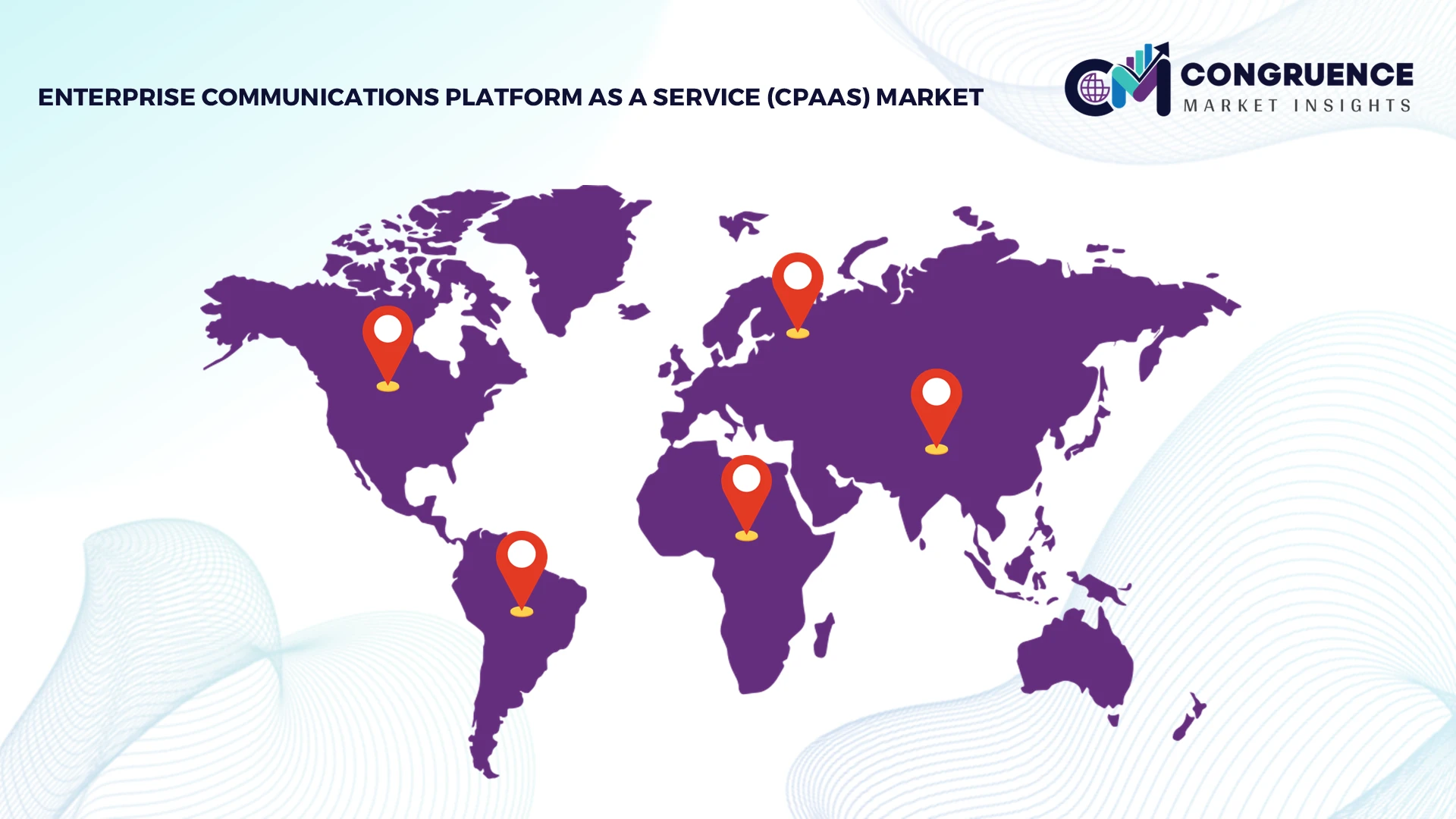
North America accounted for 39.0% of the global Enterprise Communications Platform as a Service (CPaaS) Market in 2025, supported by established cloud infrastructure, advanced enterprise software ecosystems, and extensive programmable communication adoption. Banking, healthcare, retail, and technology companies are integrating messaging, voice, video, and authentication APIs into customer-facing applications to improve operational responsiveness. Enterprises implementing centralized communication platforms target 20–30% reductions in infrastructure management and integration costs. The presence of Twilio, Bandwidth, and major cloud service providers strengthens regional innovation and enterprise deployment capabilities. Increasing requirements for authenticated messaging under the United States' A2P 10DLC framework are accelerating investment in compliant communication infrastructure. Providers are prioritizing intelligent routing, enterprise-grade security, and customer relationship management integrations, strengthening North America's position in high-value programmable communication services and sophisticated enterprise deployments.
United States Market Outlook: The United States accounted for an estimated 32.5% of global market demand in 2025, supported by its extensive financial services, technology, and digital commerce ecosystems. Enterprises are integrating programmable authentication and communication capabilities into payment platforms, healthcare applications, and customer service environments. Domestic providers are strengthening developer ecosystems and software partnerships, positioning the country as a central hub for communication API innovation and commercialization.
Europe accounted for 23.0% of the global Enterprise Communications Platform as a Service (CPaaS) Market in 2025, driven by enterprise communication modernization, stringent data protection requirements, and increasing adoption of cloud-based customer engagement platforms. Financial institutions, telecommunications operators, and industrial enterprises are integrating programmable communication services into existing digital infrastructure. The General Data Protection Regulation encourages investment in localized processing, secure messaging, and controlled customer data management. In 2025, approximately 53% of EU enterprises purchased cloud computing services, establishing a broader infrastructure foundation for communication API deployment. Companies including Sinch, Infobip, and LINK Mobility are strengthening carrier partnerships and enterprise communication portfolios. Regional competition increasingly emphasizes regulatory compliance, multilingual communication capabilities, and cross-border interoperability, encouraging providers to develop geographically distributed infrastructure and industry-specific deployment models.
Germany Market Outlook: Germany maintains a strategically significant position through its established manufacturing, automotive, banking, and enterprise software industries. Approximately 99% of German businesses are small and medium-sized enterprises, creating substantial opportunities for scalable communication platforms that reduce infrastructure ownership requirements. Industrial companies are integrating programmable messaging into supply-chain notifications, equipment maintenance coordination, and customer support systems, strengthening demand for secure and interoperable communication solutions.
Asia-Pacific accounted for 27.0% of the global Enterprise Communications Platform as a Service (CPaaS) Market in 2025, supported by expanding digital payment ecosystems, mobile commerce, telecommunications infrastructure, and enterprise digitalization. China, India, Japan, and South Korea demonstrate substantial demand for programmable messaging, authentication, and customer engagement solutions. India's Unified Payments Interface processed approximately 185.9 billion transactions during the financial year 2024–2025, illustrating the scale of digital activity supporting automated transaction communications. Enterprises are embedding communication APIs into mobile applications, online marketplaces, financial platforms, and logistics management systems. Providers including Route Mobile, Tanla Platforms, and Infobip are expanding carrier connectivity and localized communication capabilities. Diverse messaging ecosystems and country-specific regulatory frameworks encourage investment in channel interoperability, multilingual support, and scalable infrastructure capable of managing high-volume transactional workloads.
China Market Outlook: China represents a major communication technology ecosystem, supported by more than 1.1 billion internet users and extensive adoption of integrated digital platforms. Enterprises utilize embedded messaging, mobile authentication, and customer service capabilities across digital marketplaces and super-app ecosystems. Domestic cloud providers and telecommunications operators benefit from established infrastructure and localized application integration, creating substantial opportunities for programmable communication services within regulated domestic technology environments.
South America accounted for 6.5% of the global Enterprise Communications Platform as a Service (CPaaS) Market in 2025, supported by increasing smartphone penetration, digital banking adoption, and messaging-based customer engagement. Brazil, Argentina, Colombia, and Chile are witnessing expanding deployment of programmable communication services across retail, financial services, and logistics. Brazil's Pix instant payment system processed more than 60 billion transactions in 2024, demonstrating the operational scale of digital financial infrastructure supporting transaction notifications and authentication services. Enterprises increasingly utilize WhatsApp-based communication workflows to manage customer inquiries, order confirmations, and payment reminders. Providers are strengthening local carrier partnerships, Portuguese and Spanish language capabilities, and consumption-based pricing structures. Uneven connectivity and currency volatility constrain deployment economics, encouraging communication providers to prioritize lightweight integrations, efficient delivery routing, and flexible commercial arrangements.
Brazil Market Outlook: Brazil leads regional enterprise communication deployment through its extensive mobile internet ecosystem, digital banking infrastructure, and established e-commerce industry. With more than 180 million internet users, the country provides a substantial customer base for messaging-enabled commercial services. Financial technology companies and retailers are integrating programmable communication APIs into customer onboarding, fraud monitoring, and post-purchase support, strengthening demand for localized and secure communication infrastructure.
Middle East & Africa accounted for 4.5% of the global Enterprise Communications Platform as a Service (CPaaS) Market in 2025, supported by telecommunications modernization, government digitalization initiatives, and expanding mobile financial services. Saudi Arabia, the United Arab Emirates, South Africa, and Kenya represent significant deployment markets for programmable messaging, authentication, and customer engagement platforms. Sub-Saharan Africa accounted for more than 50% of global registered mobile money accounts in 2024, demonstrating substantial demand potential for transaction-related communication services. Gulf countries are investing in cloud infrastructure and digital government platforms, while African enterprises prioritize mobile-first communication channels. Providers are expanding telecommunications partnerships, localized hosting, and affordable messaging solutions. Infrastructure disparities and fragmented carrier networks encourage investment in resilient delivery systems, enabling communication platforms to support diverse enterprise requirements across developed and emerging digital ecosystems.
Saudi Arabia Market Outlook: Saudi Arabia's Vision 2030 initiative is accelerating enterprise digitalization, cloud infrastructure development, and technology-enabled public services. Internet penetration exceeds 99%, providing a strong foundation for programmable customer engagement and digital authentication services. Banks, healthcare institutions, retailers, and government agencies are integrating communication APIs into digital service platforms, encouraging providers to establish localized infrastructure, regulatory-compliant solutions, and partnerships with domestic telecommunications operators.
Twilio, Sinch, Infobip, Vonage, and Bandwidth compete against regional messaging aggregators and specialized communication API providers through carrier connectivity, programmable infrastructure, and enterprise software integrations. The five leading players collectively account for an estimated 48.5% market share, reflecting a moderately concentrated competitive structure. Direct carrier relationships support targeted messaging delivery cost reductions of 10–20%, while automated communication orchestration targets 20–30% lower customer interaction handling costs. Twilio emphasizes developer ecosystems and customer data integration, whereas Sinch and Infobip prioritize global messaging connectivity and omnichannel deployment. Vonage leverages telecommunications network APIs, while Bandwidth differentiates through owned network infrastructure. Competition is shifting from standalone messaging services toward integrated authentication, intelligent routing, and programmable customer engagement. Carrier certification, regulatory compliance, infrastructure reliability, and enterprise integration requirements create substantial entry barriers. Winning requires competitive delivery economics, dependable network performance, secure API architecture, and specialized communication solutions that address industry-specific operational requirements while ensuring consistent service quality.
Twilio Inc.
Sinch AB
Infobip Ltd.
Vonage Holdings Corp.
Bandwidth Inc.
Bird (formerly MessageBird)
Route Mobile Limited
Tanla Platforms Limited
Plivo Inc.
Telnyx LLC
LINK Mobility Group Holding ASA
Tata Communications Limited
CM.com N.V.
8x8, Inc.
Programmable messaging, voice, and video APIs form the technological foundation of enterprise CPaaS infrastructure. Cloud-native communication platforms integrate directly with customer relationship management systems, enterprise applications, and digital service environments. Compared with conventional on-premises communication infrastructure, API-based deployments target 20–30% lower integration costs and 25% faster service implementation. Messaging APIs represent an estimated 42.5% of market demand, reflecting widespread adoption across transactional notifications, customer support, and digital commerce.
Generative AI, conversational automation, and Rich Communication Services are transforming communication workflows through contextual responses, interactive messaging, and intelligent customer engagement. AI-enabled orchestration targets 25–35% reductions in routine customer interaction costs, while interactive messaging campaigns target 15–20% higher conversion rates. Providers possessing extensive carrier relationships, customer data integration capabilities, and established developer ecosystems benefit from faster commercialization and stronger enterprise retention.
Between 2026 and 2028, programmable network APIs, passwordless authentication, and agentic communication systems will reshape enterprise deployment priorities. Network-based verification targets 20–30% reductions in authentication friction, while intelligent routing supports improved delivery reliability. Integration with standardized telecommunications interfaces enables providers to monetize identity assurance and network intelligence beyond traditional messaging volumes. Enterprises must prioritize interoperable communication architecture, secure automation, and real-time performance analytics to strengthen operational resilience, customer experience, and long-term competitive differentiation.
November 2026, Bandwidth announced network infrastructure enhancements at Reverb, extending geographic coverage across five markets, including Brazil, Mexico, Peru, South Africa, and South Korea. The expansion strengthens international enterprise connectivity and supports geographically distributed communication deployments. Source: bandwidth.com
November 2025, Vonage commercially launched fraud prevention Network APIs across three major United States telecommunications networks, enabling silent authentication and SIM swap detection. The rollout simplifies carrier integration and strengthens enterprise access to network-based identity verification capabilities. Source: vonage.com
August 2025, Twilio announced worldwide commercial availability of Rich Communication Services messaging for over 349,000 active customer accounts. The launch enables enterprises to incorporate interactive, branded communications through existing API integrations without requiring additional code modifications. Source: twilio.com
February 2025, Infobip established a five-year strategic partnership with African connectivity provider Bayobab to modernize SMS delivery infrastructure. The agreement integrates campaign management, communication APIs, routing capabilities, and security solutions, streamlining messaging connectivity and reducing administrative costs. Source: infobip.com
The Enterprise Communications Platform as a Service (CPaaS) Market Report provides comprehensive analysis across five types, six applications, seven end-user categories, and five major geographical regions. The report examines messaging APIs, voice APIs, video APIs, authentication and verification services, customer engagement, transactional communications, enterprise collaboration, and fraud prevention. Regional coverage includes North America, Europe, Asia-Pacific, South America, and Middle East & Africa, highlighting country-specific deployment patterns, regulatory environments, and infrastructure capabilities.
The report evaluates competitive positioning, enterprise adoption dynamics, carrier partnerships, pricing strategies, and emerging technologies, including generative AI, RCS messaging, programmable network APIs, and conversational automation. With messaging APIs representing an estimated 42.5% of market demand, the analysis identifies established commercial opportunities and emerging specialized applications, supporting investment planning, geographic expansion, product differentiation, and strategic business decisions between 2026 and 2033.
| Report Attribute / Metric | Details |
|---|---|
| Market Revenue (2025) | USD 23,190.0 Million |
| Market Revenue (2033) | USD 1,68,148.8 Million |
| CAGR (2026–2033) | 28.1% |
| Base Year | 2025 |
| Forecast Period | 2026–2033 |
| Historic Period | 2021–2025 |
| Segments Covered |
By Type
By Application
By End-User
|
| Key Report Deliverables | Revenue Forecast; Market Trends; Growth Drivers & Restraints; Technology Insights; Segmentation Analysis; Regional Insights; Competitive Landscape; Regulatory & ESG Overview; Recent Developments |
| Regions Covered | North America; Europe; Asia-Pacific; South America; Middle East & Africa |
| Key Players Analyzed | Twilio Inc.; Sinch AB; Infobip Ltd.; Vonage Holdings Corp.; Bandwidth Inc.; Bird (formerly MessageBird); Route Mobile Limited; Tanla Platforms Limited; Plivo Inc.; Telnyx LLC; LINK Mobility Group Holding ASA; Tata Communications Limited; CM.com N.V.; 8x8, Inc. |
| Customization & Pricing | Available on Request (10% Customization Free) |




