Global Enterprise Cellular IoT Connectivity Market Report Overview
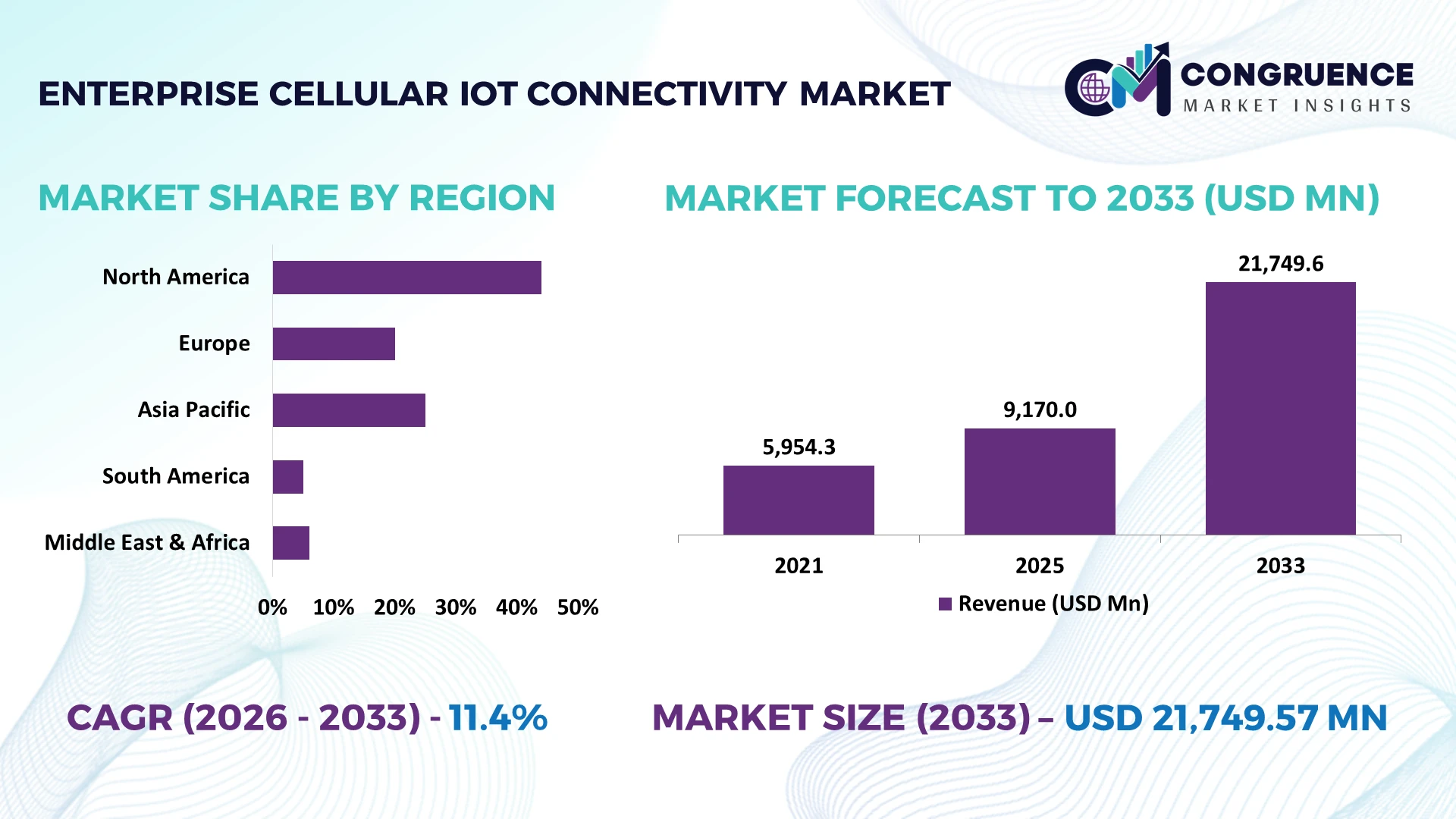
The Global Enterprise Cellular IoT Connectivity Market was valued at USD 9170 Million in 2025 and is anticipated to reach a value of USD 21749.57 Million by 2033 expanding at a CAGR of 11.4% between 2026 and 2033. Growth is driven by 5G RedCap commercialization, LTE-M and NB-IoT deployments, eSIM-based remote provisioning, and connected asset monitoring across industrial and logistics networks.
China dominates the global Enterprise Cellular IoT Connectivity Market through its extensive cellular infrastructure and industrial digitization programs. The country accounted for approximately 75% of global cellular IoT connections in 2024, supported by more than 2.4 billion connected terminals by mid-2024. China Mobile, China Telecom, and China Unicom are expanding 5G-enabled industrial connectivity across manufacturing, transportation, utilities, and smart cities. Compared with the United States, China's deployment scale benefits from coordinated infrastructure investment and extensive domestic equipment manufacturing under its industrial modernization strategy.
For connectivity providers, China's deployment concentration and expanding 5G industrial ecosystem reinforce the strategic importance of scalable eSIM orchestration, network interoperability, and specialized enterprise IoT connectivity platforms.
Key Highlights of the Global Enterprise Cellular IoT Connectivity Market
-
Market Size & Growth: USD 9,170 million in 2025, reaching USD 21,749.57 million by 2033 at 11.4% CAGR, driven by industrial 5G and eSIM adoption.
-
Top Growth Drivers: China's mobile IoT connections increased 8.7%, IoT access traffic rose 42.7%, and mobile internet traffic expanded 17.3% in 2025.
-
Short-Term Forecast: By 2028, eSIM orchestration deployments target 25% lower provisioning costs through remote activation and centralized subscription management.
-
Emerging Technologies: 5G RedCap, eSIM SGP.32, and AI-enabled connectivity management support 3 critical capabilities: efficient bandwidth allocation, remote provisioning, and predictive diagnostics.
-
Regional Leaders: Indicative 2033 allocations place Asia-Pacific at USD 9,787.31 million, North America at USD 5,437.39 million, and Europe at USD 4,349.91 million, reflecting industrial, logistics, and automotive adoption.
-
Consumer/End-User Trends: Broadband and critical IoT represented approximately 58% of global cellular IoT connections in 2025, strengthening demand for higher-throughput applications.
-
Pilot/Case Example: China's 2025 industrial modernization program supported over 23,000 5G industrial internet projects, demonstrating large-scale enterprise connectivity deployment.
-
Competitive Landscape: China Mobile leads China's cellular IoT ecosystem; Vodafone, Deutsche Telekom, AT&T, and Telefónica compete through international connectivity and managed services.
-
Regulatory & ESG Impact: By 2025, 80 operators had completed 3G shutdowns, accelerating migration toward more spectrum-efficient 4G and 5G networks.
-
Investment & Funding: Operators in 27 countries are investing in 5G RedCap, with 42 service providers pursuing technology deployment and ecosystem expansion.
-
Innovation & Future Outlook: Enhanced RedCap targets 10 Mbps peak data rates, supporting lower-complexity 5G IoT devices and broader commercial adoption from 2028.
The Enterprise Cellular IoT Connectivity Market is undergoing a technology transition as enterprises replace fragmented SIM contracts with unified connectivity management platforms. Manufacturing, fleet telematics, smart metering, and connected healthcare are accelerating demand for reliable cross-border device communication. Innovations in eSIM remote provisioning, 5G RedCap modules, and AI-based network diagnostics are improving deployment flexibility. Broadband and critical IoT accounted for approximately 58% of cellular connections in 2025, highlighting the importance of higher-capacity networks. Ongoing 2G and 3G shutdowns are also reshaping device procurement, establishing connectivity lifecycle management as a central strategic consideration.
What Is the Strategic Relevance and Future Pathways of the Enterprise Cellular IoT Connectivity Market?
Enterprise Cellular IoT Connectivity is becoming strategically essential as manufacturers, logistics operators, and utilities integrate connected assets into operational decision-making. China's cellular IoT infrastructure supports more than 2.5 billion connections, demonstrating the scale of industrial connectivity deployment. Network modernization is shifting investment from legacy 2G and 3G technologies toward LTE-M, NB-IoT, and 5G RedCap. This transition strengthens opportunities for operators offering managed connectivity, remote device provisioning, and integrated network monitoring across geographically distributed enterprise assets.
Modern eSIM provisioning reduces physical SIM replacement requirements, with enterprise deployment models targeting 25% lower activation costs compared with manual provisioning. China leads in connection volume and industrial implementation, while Germany emphasizes automotive telematics and industrial automation. During 2026–2028, enterprises are prioritizing centralized subscription management, network redundancy, and predictive connectivity analytics to improve device availability. The transition toward 5G RedCap also supports lower-complexity cellular modules for industrial monitoring and connected equipment.
A practical deployment involves logistics companies integrating eSIM-enabled tracking devices with cloud connectivity platforms to maintain network access across international transport routes. Operators are expanding roaming partnerships, developing multi-network connectivity agreements, and investing in automated device lifecycle management. Competitive advantage increasingly depends on reliable coverage, transparent connectivity costs, and seamless cross-border service continuity rather than connection volume alone.
Enterprise Cellular IoT Connectivity Market Dynamics
DRIVER:
Industrial 5G Deployment and Connected Asset Expansion
Industrial digitization is accelerating enterprise cellular IoT connectivity deployment across manufacturing, logistics, and utility infrastructure. China's mobile IoT connections increased approximately 8.7% during 2025, while IoT access traffic expanded 42.7%, reflecting greater device utilization and application intensity. Mobile internet traffic also increased 17.3%, reinforcing network capacity requirements. Government-supported industrial internet modernization is encouraging manufacturers to integrate cellular sensors, connected production equipment, and automated monitoring systems. China Mobile, China Telecom, and China Unicom are expanding industrial connectivity solutions through network upgrades and enterprise partnerships. The operational advantage extends beyond device connectivity: integrated monitoring enables manufacturers to identify equipment anomalies earlier, optimize maintenance scheduling, and reduce production interruptions across distributed industrial facilities.
RESTRAINT:
Legacy Network Dependence and Connectivity Fragmentation
Legacy network dependence and inconsistent coverage restrict enterprise IoT deployment economics. By 2025, approximately 80 mobile operators had completed 3G shutdowns, forcing enterprises to replace incompatible modules and redesign connectivity strategies. In the United States, major 3G networks have already been retired, while approximately 90% of the population has access to 5G coverage, leaving geographic gaps relevant to remote industrial operations. Enterprises operating across multiple countries also face fragmented roaming agreements, device certification requirements, and inconsistent network capabilities. These constraints increase hardware replacement expenditure and complicate large-scale deployment planning. Connectivity providers are responding through multi-operator agreements, LTE fallback capabilities, and localized network partnerships. Enterprises increasingly prioritize long-term module compatibility and contractual coverage guarantees over initial connectivity pricing.
OPPORTUNITY:
5G RedCap and Intelligent Connectivity Services
5G RedCap commercialization creates opportunities for enterprise applications requiring moderate bandwidth, lower device complexity, and extended operational lifecycles. RedCap technology supports reduced modem complexity compared with conventional 5G devices, while enhanced RedCap targets approximately 10 Mbps peak throughput. Industry deployment activity includes 42 operators pursuing RedCap development across 27 countries, demonstrating expanding ecosystem participation. In India, manufacturing modernization and smart infrastructure projects create opportunities for connected industrial equipment, remote diagnostics, and asset monitoring. Enterprises can target 20% lower device management costs through integrated eSIM provisioning and automated connectivity policies, subject to deployment conditions. Module manufacturers and telecommunications operators are expanding certification partnerships, connectivity orchestration platforms, and application-specific device portfolios to capture emerging industrial demand.
CHALLENGE:
Cybersecurity Governance Across Massive Device Fleets
Securing distributed device fleets presents a long-term operational challenge as cellular IoT deployments expand across critical infrastructure. Enterprise security teams must coordinate device authentication, firmware updates, network segmentation, and remote access policies across millions of endpoints. Approximately 75% of global cellular IoT connections were concentrated in China during 2024, highlighting the operational complexity of highly scaled deployments. In Germany, industrial operators integrating cellular gateways with production systems face additional security requirements under evolving European cybersecurity legislation. Enterprises targeting 99.9% connectivity availability must also manage certificate expiration, unauthorized device access, and inconsistent firmware maintenance. Operators and equipment manufacturers are investing in hardware-based identity protection, secure over-the-air updates, and automated threat detection. Sustainable competitiveness depends on maintaining security consistency throughout device lifecycles.
Enterprise Cellular IoT Connectivity Market Latest Trends
-
Satellite Connectivity Extends Remote Asset Coverage: Enterprises are integrating terrestrial cellular networks with satellite IoT services to maintain communications beyond conventional coverage areas. 3GPP Release 17 introduced standardized non-terrestrial network capabilities, while Release 18 expanded satellite integration. Telecommunications providers are developing hybrid connectivity platforms supporting maritime monitoring, agricultural equipment, and remote infrastructure, reducing communication interruptions and improving asset visibility.
-
Private Cellular Networks Reshape Factory Operations: Manufacturers are deploying dedicated 4G and 5G networks to support deterministic communications and operational data isolation. Germany allocated 100 MHz of spectrum between 3.7 and 3.8 GHz for local industrial networks. Enterprises are integrating cellular gateways with production monitoring platforms, while equipment vendors expand private network partnerships to improve operational control and reduce dependence on public connectivity infrastructure.
-
Embedded Connectivity Transforms Automotive Production: Automotive manufacturers are integrating cellular connectivity during vehicle assembly rather than through aftermarket installations. The European Union requires eCall functionality in new approved vehicle models, while 4G and 5G telematics support remote diagnostics and software updates. Automakers are partnering with connectivity aggregators to streamline international activation and reduce country-specific hardware configurations.
-
Connectivity Analytics Improves Fleet Economics: Enterprise connectivity platforms increasingly apply traffic classification and automated diagnostics to identify inactive subscriptions and abnormal data consumption. Operators are introducing centralized dashboards covering 4G, LTE-M, and NB-IoT connections. Fleet managers can target 15% lower subscription waste and 20% faster fault identification through modeled optimization programs, encouraging providers to expand analytics and automated policy enforcement.
Segmentation Analysis
By Type
4G LTE Dominates Enterprise Connectivity Infrastructure
4G LTE Connectivity represents the leading segment of the Enterprise Cellular IoT Connectivity Market, with an indicative 42% share in 2025. Its dominance reflects extensive network availability, mature module ecosystems, and reliable performance across industrial gateways, vehicle telematics, and connected enterprise equipment. LTE-M Connectivity supports applications requiring mobility, extended battery operation, and moderate data transmission, while NB-IoT Connectivity serves stationary devices transmitting smaller data packets. Utilities increasingly select NB-IoT for meter monitoring because its power efficiency supports long operational lifecycles. Meanwhile, 2G/3G Connectivity continues serving legacy installations, although network retirement programs are accelerating replacement decisions.
5G Connectivity represents the fastest-growing type, with an indicative 12% share in 2025, supported by industrial automation, connected machinery, and advanced enterprise applications. NB-IoT accounts for an estimated 20% of segment demand, reflecting its established role in utility monitoring. Telecommunications operators are expanding 5G enterprise coverage, while module suppliers develop multimode hardware supporting LTE fallback. Investment priorities increasingly emphasize network compatibility, device certification, and flexible connectivity contracts rather than maximum transmission speed alone.
- Ericsson's June 2025 Mobility Report projected approximately 4.5 billion cellular IoT connections by 2030, with broadband and critical IoT gaining importance as enterprise applications increasingly require higher data throughput and reliable network performance.
By Application
Smart Metering Anchors Large-Scale Cellular Deployments
Smart Metering leads the Enterprise Cellular IoT Connectivity Market, accounting for an indicative 30% share in 2025. Utilities deploy cellular-connected electricity, gas, and water meters to automate consumption reporting, improve billing accuracy, and identify network losses. Large installation volumes and predictable data transmission requirements support standardized connectivity contracts. Asset Tracking represents another established application, particularly across equipment leasing, container monitoring, and industrial inventory management. Smart Logistics integrates cellular tracking with warehouse and transportation systems to improve shipment visibility and delivery coordination. These applications increasingly rely on centralized device management and international connectivity agreements.
Industrial Automation represents the fastest-growing application, supported by factory modernization and connected production equipment. Indicative modeling assigns Industrial Automation approximately 24% of application demand, while Connected Healthcare accounts for 12%, reflecting specialized monitoring and medical device connectivity requirements. Manufacturers are expanding cellular gateway deployments and integrating network data with predictive maintenance platforms. Connectivity providers are developing industry-specific service packages, private network partnerships, and managed device provisioning solutions. Competitive differentiation increasingly depends on application reliability, integration capabilities, and measurable operational continuity.
- The European Commission's 2025 Digital Decade reporting identified continued expansion of connected infrastructure and digital public services, reinforcing demand for interoperable communications systems supporting utility monitoring, industrial automation, and enterprise data exchange.
By End-User
Manufacturing Leads Industrial Connectivity Adoption
Manufacturing represents the leading end-user segment of the Enterprise Cellular IoT Connectivity Market, with an indicative 29% share in 2025. Industrial enterprises deploy cellular connectivity across production equipment, monitoring systems, and distributed manufacturing facilities to improve asset visibility and operational coordination. Automotive and Transportation remains an established customer group, supported by connected vehicle platforms, fleet management, and embedded telematics. Energy and Utilities operators prioritize long-life connectivity for smart meters, remote substations, and distributed energy infrastructure. These industries favor predictable network performance and multiyear connectivity contracts to control device lifecycle expenditure.
Healthcare represents the fastest-growing end-user segment, supported by connected medical devices, remote patient monitoring, and mobile diagnostic equipment. Indicative modeling places Healthcare at approximately 13% of market demand, compared with 18% for Retail and Logistics. Healthcare providers increasingly require secure, continuously available connectivity, while retailers prioritize inventory monitoring and supply chain visibility. Operators are introducing specialized service-level agreements, embedded connectivity solutions, and sector-specific security controls. Competitive positioning increasingly depends on balancing network reliability, device management flexibility, and deployment costs across different enterprise operating environments.
- The Global Mobile Suppliers Association's 2025 private mobile network assessments documented continued enterprise deployment across manufacturing, transportation, utilities, and healthcare, demonstrating how dedicated cellular infrastructure is becoming integrated with operational technology and business-critical communications.
Region-Wise Market Insights
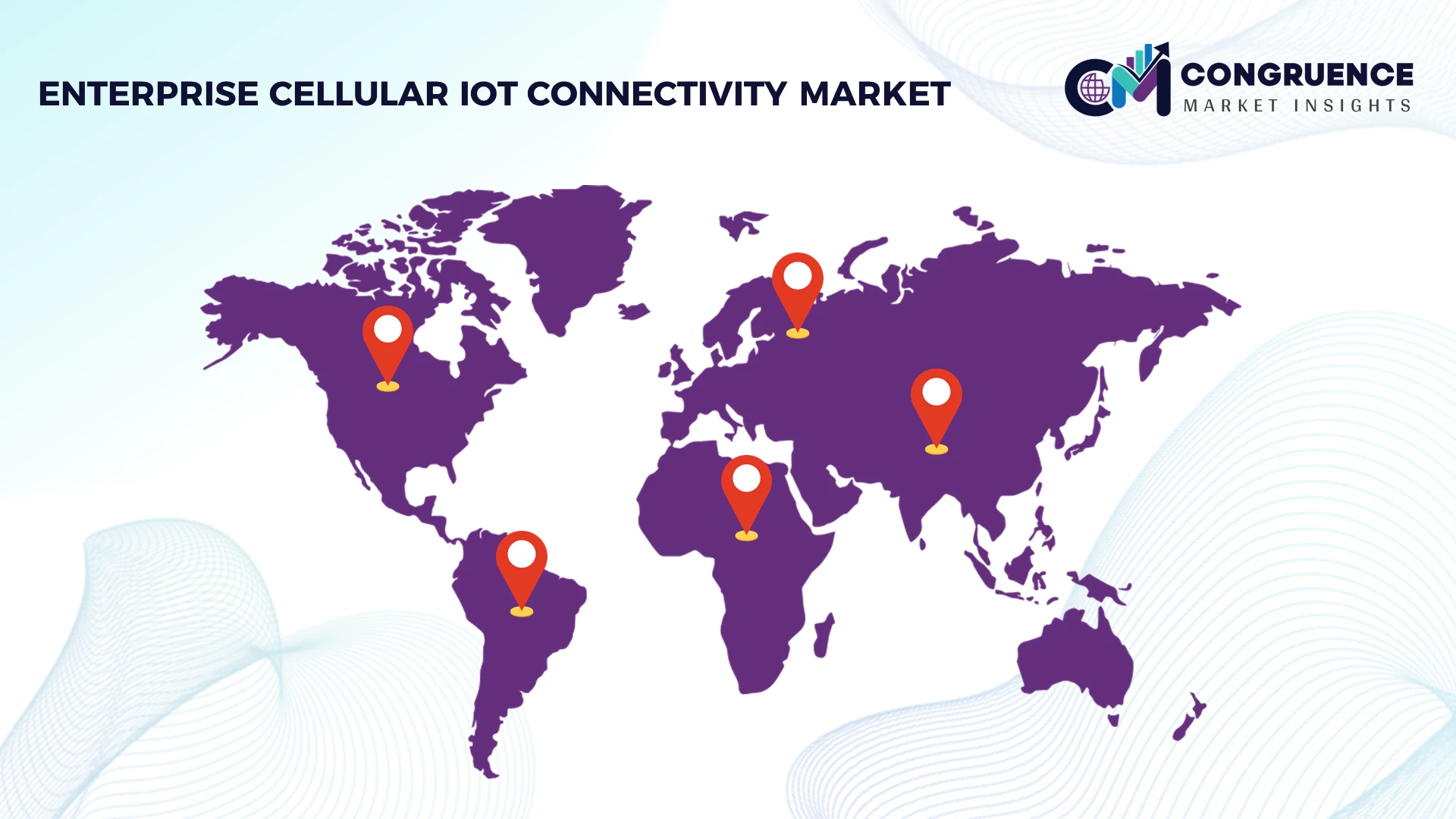
Asia-Pacific accounted for the largest market share at an estimated 45% in 2025 however, Asia-Pacific is expected to register the fastest growth, expanding at an indicative CAGR of 13.2% between 2026 and 2033.
North America Enterprise Cellular IoT Connectivity Market
Industrial Network Modernization and Enterprise Connectivity Integration
North America represents an estimated 25% of the global Enterprise Cellular IoT Connectivity Market, supported by extensive 4G LTE infrastructure, expanding 5G networks, and established enterprise connectivity platforms. The United States and Canada demonstrate concentrated adoption across automotive telematics, industrial automation, logistics, and energy infrastructure. AT&T, Verizon, and T-Mobile are strengthening enterprise IoT services through managed connectivity platforms, private cellular networks, and embedded device provisioning. The United States had approximately 90% population coverage through 5G networks by 2025, supporting advanced connected equipment deployment. Enterprises increasingly integrate cellular gateways with cloud analytics platforms to improve asset visibility and maintenance coordination. Cross-border logistics between the United States, Canada, and Mexico further strengthens demand for interoperable SIM management and international roaming agreements. Connectivity providers prioritize network reliability, centralized administration, and long-term device compatibility.
United States Market Outlook: The United States benefits from established telecommunications infrastructure, extensive industrial automation investment, and advanced connected vehicle ecosystems. The Federal Communications Commission has allocated 150 MHz of spectrum in the 3.5 GHz Citizens Broadband Radio Service band, supporting private cellular deployments. Manufacturing and logistics enterprises use this spectrum for localized network coverage, connected equipment monitoring, and operational data transmission. Enterprise connectivity providers are expanding private network integration and managed device services.
Europe Enterprise Cellular IoT Connectivity Market
Cross-Border Connectivity and Industrial Network Transformation
Europe accounts for an estimated 20% of the global Enterprise Cellular IoT Connectivity Market, driven by connected automotive manufacturing, industrial digitization, and cross-border logistics operations. Germany, the United Kingdom, France, and the Netherlands represent important enterprise deployment centers. Vodafone, Deutsche Telekom, and Telefónica are expanding IoT connectivity management, eSIM provisioning, and private cellular network services. The European Union's Digital Decade strategy targets 100% population coverage through 5G networks by 2030, strengthening infrastructure modernization priorities. Industrial enterprises increasingly adopt managed cellular connectivity to support production monitoring, fleet telematics, and energy infrastructure. Regulatory requirements covering data protection, cybersecurity, and device interoperability influence procurement decisions. Operators are developing standardized connectivity platforms and regional roaming partnerships, enabling enterprises to manage devices across multiple countries without maintaining separate national connectivity architectures.
Germany Market Outlook: Germany's automotive manufacturing and industrial engineering sectors support advanced cellular IoT deployment. The Federal Network Agency designated the 3.7–3.8 GHz frequency range for local industrial 5G networks, providing 100 MHz of dedicated spectrum. Automotive manufacturers, machinery producers, and industrial technology companies use localized connectivity infrastructure to support production monitoring, automated equipment coordination, and secure operational communications. Germany's Industry 4.0 ecosystem strengthens demand for integrated private network solutions.
Asia-Pacific Enterprise Cellular IoT Connectivity Market
Large-Scale Industrial Connectivity and Network Deployment Leadership
Asia-Pacific dominates the Enterprise Cellular IoT Connectivity Market with an estimated 45% share, supported by extensive device manufacturing, industrial automation, and telecommunications infrastructure investment. China represents the principal deployment center, while India, Japan, South Korea, and Australia contribute through smart infrastructure, automotive connectivity, and enterprise digitalization. China surpassed 2.4 billion cellular IoT connections during 2024, reflecting exceptional deployment scale across utilities, manufacturing, and connected infrastructure. Telecommunications operators are expanding NB-IoT, LTE-M, and 5G enterprise services to support diverse device performance requirements. Japan emphasizes connected automotive systems and industrial monitoring, while India is accelerating cellular connectivity adoption through infrastructure modernization and digital services expansion. Regional module manufacturers strengthen equipment availability and cost competitiveness. Connectivity providers increasingly combine domestic network capacity with international roaming arrangements to serve export-oriented industrial customers.
China Market Outlook: China leads cellular IoT deployment through coordinated telecommunications investment, domestic module manufacturing, and extensive industrial digitization. China Mobile, China Telecom, and China Unicom provide nationwide connectivity supporting smart meters, connected vehicles, and industrial monitoring systems. By the end of 2024, China had deployed approximately 4.25 million 5G base stations, establishing substantial infrastructure capacity. Government-supported industrial internet programs encourage manufacturers to integrate connected equipment with production analytics and automated operational management.
South America Enterprise Cellular IoT Connectivity Market
Connected Logistics and Utility Infrastructure Modernization
South America represents an estimated 6% of the global Enterprise Cellular IoT Connectivity Market, supported by expanding enterprise connectivity requirements across Brazil, Argentina, Chile, and Colombia. Logistics operators, energy utilities, agricultural enterprises, and automotive fleet managers increasingly deploy cellular tracking and monitoring devices. Brazil's extensive transportation network creates demand for remote asset visibility and cross-border connectivity management. Telefónica, América Móvil, and regional mobile operators are expanding managed IoT services through LTE coverage, enterprise SIM management, and cloud-based connectivity platforms. Brazil's 5G infrastructure expansion reached more than 800 municipalities by 2025, improving connectivity options for industrial and commercial applications. However, uneven rural coverage and legacy network dependence complicate large-scale deployments. Operators are strengthening roaming agreements, multimode device compatibility, and localized service partnerships to improve connectivity reliability across geographically dispersed operations.
Brazil Market Outlook: Brazil represents South America's largest enterprise cellular connectivity opportunity through its industrial base, agricultural exports, and extensive commercial transportation networks. The National Telecommunications Agency, Anatel, coordinates 5G spectrum deployment and network modernization. Agribusiness operators increasingly integrate cellular sensors with equipment monitoring platforms to improve machinery utilization and agricultural logistics. Telecommunications providers are developing enterprise connectivity solutions supporting remote asset tracking, smart utility monitoring, and industrial automation.
Middle East & Africa Enterprise Cellular IoT Connectivity Market
Smart Infrastructure Investment and Industrial Connectivity Expansion
The Middle East & Africa accounts for an estimated 4% of the global Enterprise Cellular IoT Connectivity Market, supported by telecommunications modernization and connected infrastructure development. Saudi Arabia, the United Arab Emirates, South Africa, and Qatar represent important enterprise deployment centers. Government smart city programs, energy infrastructure modernization, and logistics digitization strengthen demand for cellular asset monitoring and remote equipment management. Saudi Arabia's Vision 2030 initiatives encourage investment in industrial connectivity, while UAE telecommunications operators expand enterprise 5G services. South Africa's mining and utility sectors require reliable communications across geographically dispersed facilities. Regional operators are developing private cellular networks, managed IoT platforms, and international connectivity partnerships. Infrastructure gaps outside major urban centers remain a deployment constraint, encouraging hybrid connectivity architectures and application-specific service agreements that balance coverage requirements with operational costs.
Saudi Arabia Market Outlook: Saudi Arabia benefits from substantial telecommunications infrastructure investment and government-supported digital transformation programs. The Communications, Space and Technology Commission oversees spectrum management and network development, while Saudi Vision 2030 supports industrial modernization. Energy companies and logistics operators increasingly integrate cellular connectivity with remote monitoring systems and asset management platforms. STC and other telecommunications providers are expanding enterprise connectivity solutions, supporting industrial applications across energy infrastructure, transportation corridors, and emerging smart city developments.
Market Competition Landscape
The Enterprise Cellular IoT Connectivity Market features competition between telecommunications operators, global connectivity aggregators, and specialized IoT platform providers. China Mobile, Vodafone, Deutsche Telekom, AT&T, and Telefónica compete through network coverage, enterprise contracts, and managed connectivity capabilities. Their combined global market share is indicatively estimated at 40%, reflecting fragmented regional procurement and connectivity service models. China Mobile benefits from domestic deployment scale, while Vodafone and Telefónica emphasize international roaming partnerships. Specialized providers such as 1NCE and Wireless Logic differentiate through flexible subscription models and multicarrier integration. Enterprise deployment benchmarks target 25% lower provisioning costs through eSIM automation and 20% faster connectivity troubleshooting using centralized analytics. Operators are expanding private network partnerships, cloud integrations, and device lifecycle services. Network access agreements, regulatory compliance, and international coverage represent substantial entry barriers. Competitive success requires dependable cross-border connectivity, transparent pricing, and automated enterprise device management capabilities at scale across industrial markets.
Companies Profiled in the Enterprise Cellular IoT Connectivity Market Report
-
China Mobile Limited
-
Vodafone Group Plc
-
Deutsche Telekom AG
-
AT&T Inc.
-
Telefónica, S.A.
-
Verizon Communications Inc.
-
China Telecom Corporation Limited
-
China Unicom (Hong Kong) Limited
-
Orange S.A.
-
KDDI Corporation
-
1NCE GmbH
-
Wireless Logic Group
-
Aeris Communications, Inc.
-
Tata Communications Limited
Technology Insights for the Enterprise Cellular IoT Connectivity Market
Current enterprise cellular IoT infrastructure relies on 4G LTE, LTE-M, NB-IoT, and centralized connectivity management platforms. LTE-M supports mobile asset tracking, while NB-IoT enables low-power utility monitoring. Enterprises integrating eSIM provisioning with cloud dashboards can target 25% lower activation costs compared with manual SIM replacement, based on deployment economics. China operates billions of cellular IoT connections, demonstrating commercial maturity. Operators increasingly combine multicarrier access with automated diagnostics, improving device availability and reducing administrative workloads across geographically distributed fleets.
Emerging technologies include 5G RedCap, embedded SIM orchestration, and AI-assisted network optimization. RedCap reduces device complexity compared with conventional 5G modems, while eSIM SGP.32 enables standardized remote subscription management. Enterprise deployment models target 20% faster device activation and 15% lower connectivity administration costs through integrated provisioning workflows. Module manufacturers benefit from simplified hardware configurations, while global connectivity aggregators strengthen differentiation through roaming flexibility, predictive diagnostics, and centralized policy enforcement.
During 2026–2028, disruptive development will emphasize satellite-terrestrial integration, private cellular automation, and edge-native connectivity intelligence. Hybrid networks extend coverage beyond terrestrial infrastructure, supporting remote energy assets and maritime logistics. Enterprises should prioritize interoperable modules, secure firmware management, and measurable service availability. Competitive advantage will depend on consistent connectivity performance, scalable provisioning, and efficient device lifecycle governance across increasingly complex industrial networks.
Recent Developments in the Global Enterprise Cellular IoT Connectivity Market
-
February 2026: Deutsche Telekom demonstrated multi-orbit IoT roaming using commercial NB-IoT hardware across 3 connectivity environments: terrestrial networks, geostationary satellites, and low Earth orbit satellites. The innovation extends remote asset monitoring beyond conventional cellular coverage. Source: telekom.com
-
January 2026: 1NCE introduced 1NCE Insights, an AI-powered connectivity analytics solution, after adding 10 million endpoints during 2025. Managing over 40 million devices, the company strengthened enterprise fleet intelligence, operational benchmarking, and connected product management capabilities. Source: 1nce.com
-
May 2025: Vodafone reported 205 million IoT connections, representing 4.5% annual growth, while advancing its standalone IoT business strategy. The expansion strengthened enterprise connectivity scale, international service delivery, and managed network capabilities across industrial customer environments worldwide. Source: reports.investors.vodafone.com
-
June 2024: GSMA published SGP.32 version 1.2, advancing standardized remote SIM provisioning for constrained IoT devices. The specification establishes interoperable eSIM management architecture, reducing dependence on physical SIM replacement and supporting scalable enterprise connectivity deployment across international networks. Source: gsma.com
Scope of the Enterprise Cellular IoT Connectivity Market Report
The Enterprise Cellular IoT Connectivity Market Report evaluates five connectivity technologies: 2G/3G, 4G LTE, LTE-M, NB-IoT, and 5G. Application analysis covers Smart Metering, Asset Tracking, Industrial Automation, Connected Healthcare, and Smart Logistics. End-user assessment examines Manufacturing, Automotive and Transportation, Energy and Utilities, Healthcare, and Retail and Logistics. Geographic coverage includes North America, Europe, Asia-Pacific, South America, and the Middle East & Africa, assessing network infrastructure, enterprise adoption, regulatory developments, and connectivity deployment concentration.
The report examines eSIM provisioning, 5G RedCap, private cellular networks, satellite integration, and AI-enabled connectivity management. Competitive analysis profiles 14 major connectivity providers, evaluating network reach, technology differentiation, partnerships, and deployment economics. Strategic insights support investment allocation, enterprise procurement, geographic expansion, and connectivity infrastructure planning throughout 2026–2033.
Enterprise Cellular IoT Connectivity Market Report Summary
| Report Attribute/Metric | Report Details |
|---|
Market Revenue in 2025 | USD 9170 Million |
Market Revenue in 2033 | USD 21749.57 Million |
CAGR (2026 - 2033) | 11.4% |
Base Year | 2025 |
Forecast Period | 2026 - 2033 |
Historic Period | 2021 - 2025 |
Segments Covered | By TypeBy ApplicationBy End-UserAutomotive and Transportation
|
Key Report Deliverable | Revenue Forecast, Growth Trends, Market Dynamics, Segmental Overview, Regional and Country-wise Analysis, Competition Landscape |
Region Covered | North America, Europe, Asia-Pacific, South America, Middle East, Africa |
Key Players Analyzed | China Mobile Limited, Vodafone Group Plc, Deutsche Telekom AG, AT&T Inc., Telefónica, S.A., Verizon Communications Inc., China Telecom Corporation Limited, China Unicom (Hong Kong) Limited, Orange S.A., KDDI Corporation, 1NCE GmbH, Wireless Logic Group, Aeris Communications, Inc., Tata Communications Limited |
Customization & Pricing | Available on Request (10% Customization is Free) |





