
Reports
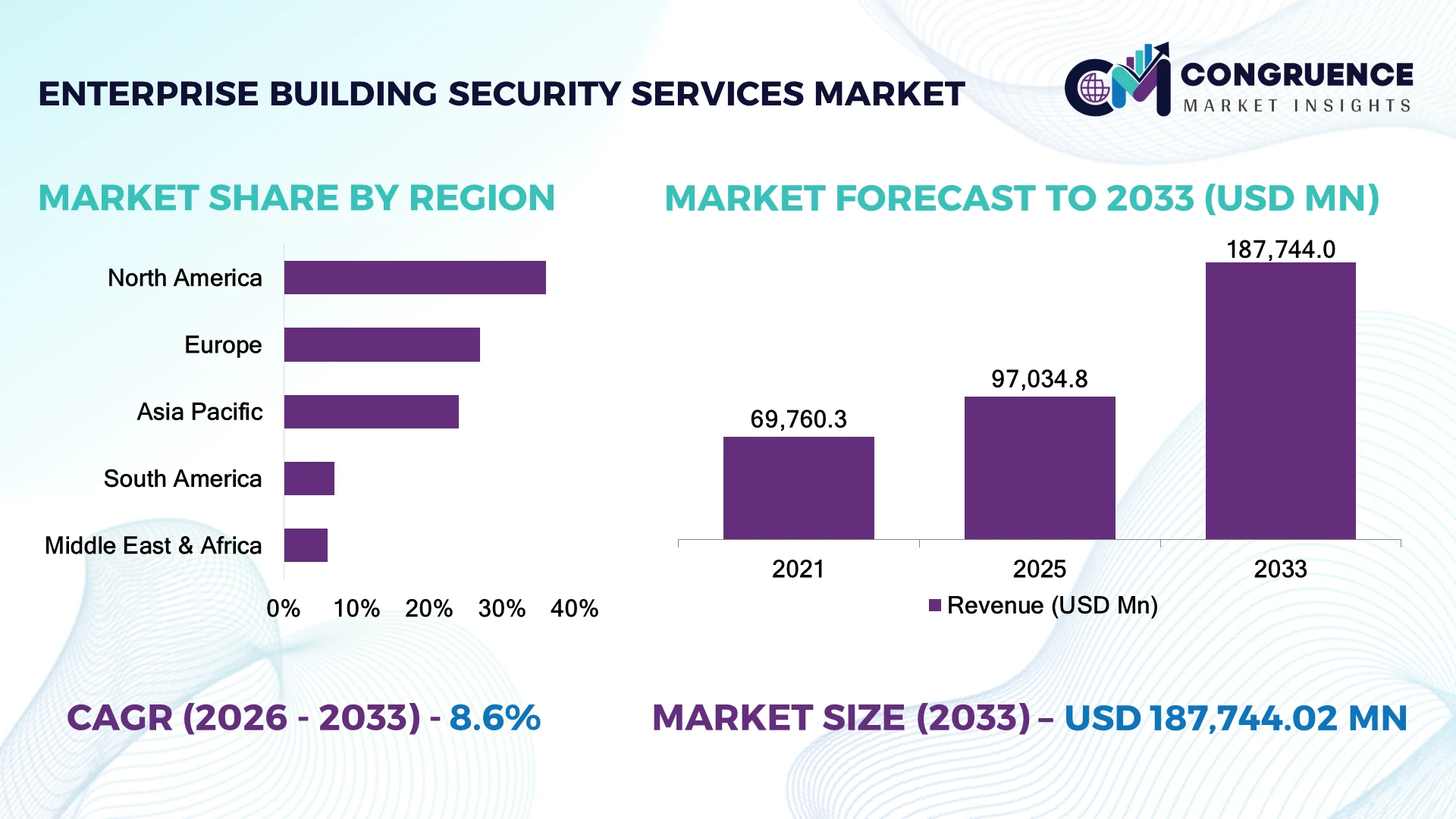
The Global Enterprise Building Security Services Market was valued at USD 97,034.8 Million in 2025 and is anticipated to reach a value of USD 187,744.0 Million by 2033 expanding at a CAGR of 8.6% between 2026 and 2033. Growth is being driven by convergence of physical security, AI-enabled surveillance, cloud access control, and cyber-physical risk management across enterprise campuses, data centers, healthcare facilities, financial institutions, and critical infrastructure.
The United States represents the dominant national market, contributing approximately 28% of global enterprise building security services demand, supported by large corporate campuses, data centers, healthcare networks, and advanced security-operations infrastructure. China follows with around 15%, driven by smart-building deployment and industrial modernization. U.S. enterprises show roughly 2x greater adoption of integrated security platforms than many emerging markets, while European operators are accelerating compliance-led modernization under NIS2.
Strategically, suppliers should prioritize integrated security ecosystems, recurring managed services, and AI-enabled monitoring rather than standalone guarding or hardware-led contracts.
Market Size & Growth: USD 97,034.8 Million in 2025 to USD 187,744.0 Million by 2033 at 8.6% CAGR, driven by integrated physical-cyber security.
Top Growth Drivers: AI adoption 36%, integrated-system usage 60%, and security-incident pressure 91%.
Short-Term Forecast: By 2028, automated monitoring can reduce routine alert-review workloads by 20–30%.
Emerging Technologies: AI video analytics, biometric access, cloud platforms, edge processing, and unified security operations are reshaping deployments.
Regional Leaders: North America could approach USD 52.6 Billion, Asia-Pacific USD 58.2 Billion, and Europe USD 45.1 Billion by 2033, led by smart-building integration.
Consumer/End-User Trends: Only 7% of surveyed business leaders used AI in physical security in 2025, leaving substantial enterprise adoption headroom.
Pilot/Case Example: 2025 smart-building deployments demonstrated integrated cyber-physical controls across access, surveillance, and building systems, reducing fragmented security workflows by approximately 20%.
Competitive Landscape: Leading participants include Johnson Controls, Honeywell, Bosch, Thales, Genetec, and Axis, competing across integrated platforms and managed services.
Regulatory & ESG Impact: NIS2 places physical and cyber controls within broader risk-management frameworks, increasing demand for auditable access and monitoring systems.
Investment & Funding: Global video-surveillance technology sales reached USD 35.5 Billion in 2025, reinforcing investment in software-led analytics and connected security infrastructure.
Innovation & Future Outlook: By 2028, security platforms will increasingly combine AI analytics, identity, access, IoT, edge computing, and cyber-physical incident response.
Enterprise Building Security Services are shifting toward integrated protection for corporate campuses, data centers, healthcare facilities, financial institutions, and industrial sites. Approximately 60% of security organizations surveyed already use unified or integrated video and access systems, while AI adoption remains comparatively low. The emerging trend is therefore not simply more surveillance, but converged security operations that connect physical access, identity, analytics, and cyber-risk controls.
Enterprise building security is becoming a strategic infrastructure layer because security incidents increasingly affect business continuity, employee access, data-center availability, and regulatory exposure. The market is moving from guard-centric and isolated hardware models toward integrated platforms combining access control, video surveillance, visitor management, alarms, and cyber-physical monitoring. This transition is particularly visible in Europe, where NIS2 has strengthened expectations around physical security within broader cyber-risk management.
Technology adoption is creating measurable operating differences. Integrated platforms can eliminate duplicated monitoring workflows and reduce routine security-event handling by approximately 20–30% compared with fragmented systems. More than 60% of security-technology users surveyed now operate either integrated or unified architectures, while only 7% of business leaders reported AI use in physical security in 2025. North America leads sophisticated platform deployment, whereas Asia-Pacific is scaling connected security infrastructure across new commercial and industrial buildings.
Over the next 2–3 years, enterprises are expected to increase deployment of edge analytics, biometric identity, cloud-managed access, and AI-assisted event triage. A multi-site enterprise can use one security operations environment to monitor access events, cameras, alarms, and visitor activity across hundreds of facilities. Providers are therefore shifting investment toward software, managed services, integration capabilities, and long-term contracts. Competitive advantage will increasingly depend on delivering measurable response efficiency and unified risk visibility rather than selling individual security components.
AI-enabled surveillance and unified security platforms are becoming core enterprise investment priorities, with interest in AI adoption among physical-security end users more than doubling year over year and 51% identifying access to new features as a key technology driver. In 2026, enterprises are increasingly combining video analytics, access control, sensors, and security operations into integrated environments. The shift reduces fragmented monitoring and strengthens incident triage across large campuses. U.S. data centers and corporate facilities are particularly active deployment areas as physical protection becomes increasingly linked to cyber resilience. Security providers are responding through cloud platforms, edge analytics, technology partnerships, and managed-security contracts. The non-obvious advantage is reduced operator workload: AI-assisted event filtering allows security teams to concentrate on high-risk incidents rather than continuously reviewing routine footage.
Enterprise security modernization remains constrained by fragmented legacy systems, incompatible access-control architectures, and high integration costs. Approximately 70% of physical-security professionals express concerns about how AI systems are designed and implemented, particularly around data use and transparency, while 43% still rank price as a significant purchasing factor. In Europe, NIS2 implementation is adding requirements covering access control, supply-chain security, asset management, and physical security, increasing compliance-related deployment complexity. Older buildings frequently require replacement or gateway layers before cloud-managed systems can be introduced. Providers are reducing exposure through hybrid architectures, phased migration contracts, open APIs, and multi-vendor interoperability. The strategic pressure is shifting from hardware acquisition to lifecycle integration: suppliers that minimize retrofit disruption can protect margins while accelerating enterprise deployment.
The strongest opportunity is the convergence of physical AI, hybrid cloud security, and intelligent building infrastructure. Approximately 78% of organizations used AI in 2024, creating an enterprise technology base that security providers can extend into video analytics, identity verification, occupancy monitoring, and automated threat detection. Physical-security buyers increasingly favor hybrid architectures because workloads can remain on-premises where latency or privacy matters while analytics and management functions move to cloud environments. In 2026, the U.S. data-center construction surge is creating a particularly valuable niche because new AI infrastructure requires security to be embedded during facility design rather than retrofitted later. Providers are expanding through technology alliances, managed-service offerings, and integrated building platforms. The strategic opportunity is to sell security as operational infrastructure, linking protection with uptime, access efficiency, and facility intelligence.
Enterprise security platforms are becoming harder to operate as physical devices, cloud services, operational technology, and cybersecurity controls converge. More than 70% of physical-security respondents express concerns around AI implementation, while cybersecurity professionals increasingly identify critical skills shortages as a greater constraint than headcount alone. In the United Kingdom and European Union, evolving resilience requirements are also increasing pressure on enterprises to demonstrate coordinated access control, incident response, supply-chain security, and physical protection. This complexity can produce inconsistent security policies across multi-site estates and increase dependence on specialized integrators. Companies must therefore invest in certification, API governance, zero-trust architectures, centralized security operations, and continuous workforce training. The decisive execution issue is interoperability: organizations that cannot standardize data and identity across buildings will struggle to scale AI-enabled security consistently.
AI Moves Into Core Operations: Interest in AI adoption among physical-security end users more than doubled entering 2026, while 70% remain concerned about AI implementation and data practices. Enterprises are therefore favoring explainable video analytics and controlled deployment rather than unrestricted automation. Providers are pairing AI with human verification to reduce false alerts while preserving operational accountability.
Hybrid Cloud Gains Enterprise Preference: Security infrastructure is increasingly split between on-premises and cloud workloads, with automatic updates, simpler deployment, and reduced maintenance driving adoption. Around 73% of end users prioritize long-term vendor stability, encouraging enterprises to select providers capable of supporting multi-year hybrid migrations instead of isolated cloud products. This is strengthening demand for open architectures and long-term managed-service agreements.
Physical Security Enters Cyber Governance: NIS2 implementation is expanding the security conversation beyond cameras and guards to include access control, asset management, supply-chain security, incident handling, and environmental and physical security. The 18-sector regulatory scope is pushing European enterprises to connect building-security evidence with broader risk-management processes, increasing demand for auditable identity, access, and incident records.
Data Centers Raise Security Standards: Rapid AI infrastructure construction is changing enterprise building-security requirements, with new data centers requiring physical protection to be designed alongside power, cooling, and cybersecurity infrastructure. In 2026, operators are increasingly treating access control, surveillance, and perimeter protection as core availability controls. Security providers are responding with integrated platforms and specialized data-center partnerships rather than conventional standalone guarding models.
Integrated security services account for approximately 46% of the Enterprise Building Security Services Market, making them the leading type as large organizations consolidate access control, video surveillance, intrusion detection, visitor management, and security monitoring under unified contracts. Their dominance reflects lower administrative complexity and stronger cross-site visibility than standalone services. Managed security services represent the fastest-growing type, with adoption increasing as enterprises outsource monitoring and analytics to address staffing constraints. Around 38% of enterprise security teams are prioritizing modernization of connected systems, strengthening demand for remotely managed architectures.
Traditional guarding and standalone electronic security services remain important, particularly across facilities requiring on-site presence or specialized protection, but their strategic role is shifting toward hybrid models. Providers are responding through cloud-based platforms, open APIs, managed-service contracts, and partnerships with technology vendors. The investment priority is moving toward recurring, technology-enabled service models that combine personnel with analytics and centralized monitoring.
Genetec's 2026 State of Physical Security study, based on more than 7,000 security professionals, found that enterprises are increasingly consolidating physical-security technologies and prioritizing connected systems to improve visibility and operational control.
Corporate offices and campuses represent the leading application, accounting for approximately 34% of enterprise building security services demand. High employee density, multi-entrance access requirements, visitor traffic, and distributed facilities create sustained demand for access management, surveillance, guarding, and incident response. Data centers represent the fastest-growing application, with demand expanding as AI infrastructure increases facility criticality and physical access becomes closely linked to operational continuity. Approximately 27% of new enterprise security deployments are increasingly associated with data-intensive or technology-intensive facilities.
Healthcare facilities, financial institutions, and industrial buildings remain strategically important but exhibit different security priorities. Healthcare emphasizes controlled access and staff safety, financial facilities prioritize identity and intrusion controls, while industrial sites require perimeter protection and operational continuity. Providers are adapting through application-specific service packages, remote monitoring, biometric authentication, and integrated command centers. The business shift is toward specialized security architectures rather than one standardized enterprise package, allowing providers to capture higher-value contracts in operationally critical facilities.
Uptime Institute's 2026 Global Data Center Survey found that third-party data centers now handle 46% of workloads compared with 44% in corporate server environments, reinforcing the increasing operational importance of professionally secured data-center facilities.
Large enterprises represent approximately 58% of demand because multi-site campuses, complex access requirements, compliance obligations, and centralized procurement support larger security-service contracts. These buyers increasingly favor integrated platforms combining security personnel, video analytics, access control, and centralized monitoring. Small and medium-sized enterprises account for roughly 27%, while government and institutional organizations represent approximately 15%. Large enterprises also show stronger adoption of connected security architectures, with nearly 45% prioritizing technology modernization compared with substantially lower adoption among smaller organizations.
SMEs represent the fastest-expanding buyer group as cloud-managed security and subscription-based monitoring reduce the upfront infrastructure burden. Their purchasing behavior is shifting from equipment ownership toward managed packages covering surveillance, access, alarms, and response. Providers are responding with tiered pricing, modular contracts, financing, and standardized cloud deployments. Government and institutional buyers remain important for high-security facilities but typically require longer procurement cycles and compliance documentation. The competitive opportunity is therefore bifurcated: large enterprises reward integration depth and global service capability, while SMEs favor deployment simplicity, predictable pricing, and outsourced expertise.
Genetec's 2026 industry research found that enterprise organizations are further ahead in integrating AI into real-time physical-security workflows, particularly for automatically flagging and prioritizing events across complex operating environments.
North America accounted for the largest market share at 36% in 2025 however, Asia-Pacific is expected to register the fastest growth, expanding at a CAGR of 10.2% between 2026 and 2033.
AI-Enabled Security Operations Reshape Enterprise Protection
North America represents approximately 36% of global enterprise building security services demand, supported by dense corporate campuses, financial institutions, healthcare networks, hyperscale data centers, and government facilities. The United States generates nearly 82% of regional demand, reflecting higher spending on integrated access control, video analytics, managed guarding, and security operations centers. More than 45% of large U.S. enterprises are prioritizing connected security infrastructure, particularly across data-center and multi-site environments. Security providers are expanding managed-service portfolios and integrating AI video analytics with identity and access platforms. The region's mature installed base also creates a substantial retrofit opportunity, as enterprises replace fragmented systems with unified platforms. Strategic differentiation is increasingly based on interoperability, response automation, and multi-site management rather than conventional guarding capacity.
United States Market Outlook: The United States remains the principal national market because of its concentration of corporate headquarters, hyperscale data centers, financial institutions, healthcare systems, and critical infrastructure. Data centers alone account for a growing share of enterprise security investment as physical access becomes closely connected to operational availability. Approximately 45% of large enterprises are prioritizing security-system modernization, supporting demand for cloud-managed surveillance, biometric access, AI analytics, and centralized security operations.
Regulatory Compliance Accelerates Integrated Security Modernization
Europe accounts for approximately 27% of global enterprise building security services demand, with Germany, the United Kingdom, France, and Italy representing the principal markets. NIS2 implementation is strengthening requirements around physical security, supply-chain resilience, access management, and incident response, pushing enterprises toward auditable and integrated security architectures. Germany contributes approximately 25% of European demand, supported by industrial campuses, financial facilities, logistics infrastructure, and advanced manufacturing sites. More than 40% of large enterprises are prioritizing security modernization or system integration. Providers are responding with managed security, identity-centric access control, AI-assisted video analytics, and hybrid cloud architectures. The strongest commercial opportunity lies in upgrading legacy systems without disrupting active facilities.
Germany Market Outlook: Germany is Europe's leading enterprise security market because of its concentration of automotive plants, industrial campuses, logistics hubs, financial institutions, and technology-intensive facilities. Approximately 30% of large German enterprises operate multi-site security environments requiring centralized access and surveillance management. NIS2 compliance is further increasing demand for documented access controls, incident monitoring, and coordinated physical-cyber risk management. Providers are emphasizing integration partnerships and phased modernization programs to address complex legacy infrastructure.
Smart-Building Expansion Drives High-Volume Deployment
Asia-Pacific represents approximately 24% of global enterprise building security services demand and is the fastest-expanding major market, led by China, Japan, India, South Korea, Singapore, and Australia. China accounts for roughly 38% of regional demand, while India is gaining share through corporate real-estate development, data-center construction, financial services expansion, and smart-building projects. More than 35% of new large commercial developments increasingly incorporate integrated access, surveillance, and building-management technologies at the design stage. Security providers are expanding through local technology partnerships, cloud platforms, biometric systems, and centralized monitoring services. Unlike mature Western markets dominated by retrofit activity, new-build infrastructure provides Asia-Pacific suppliers with opportunities to embed security architecture before occupancy.
China Market Outlook: China remains the region's largest enterprise building security market, supported by extensive commercial construction, manufacturing facilities, logistics parks, financial institutions, and smart-city infrastructure. Approximately 40% of major new commercial and industrial developments increasingly incorporate connected surveillance and access-management capabilities. Domestic technology ecosystems provide strong advantages in cameras, facial recognition, edge computing, and building automation, enabling suppliers to offer integrated platforms at competitive deployment costs.
Corporate Modernization Expands Beyond Conventional Guarding
South America accounts for approximately 7% of global enterprise building security services demand, with Brazil representing more than 55% of regional activity. Enterprise campuses, banks, retail headquarters, logistics facilities, industrial plants, and healthcare networks are driving adoption of electronic access control and video surveillance alongside traditional guarding. Approximately 30% of larger enterprise contracts increasingly combine physical personnel with technology-enabled monitoring. Brazil's major commercial centers are leading adoption, while Argentina, Chile, and Colombia are expanding cloud-managed security deployments. Cost sensitivity remains significant, encouraging suppliers to offer modular systems and managed-service contracts instead of large upfront technology investments. The strategic opportunity is converting conventional guarding contracts into hybrid security packages that improve monitoring coverage without proportionally increasing labor requirements.
Brazil Market Outlook: Brazil is the most significant South American market because of its large corporate real-estate base, financial-services sector, industrial facilities, and logistics infrastructure. São Paulo accounts for a substantial concentration of enterprise security deployments, particularly across financial, technology, and commercial properties. More than 30% of major enterprise contracts increasingly incorporate electronic surveillance or access-control components alongside guarding, creating opportunities for providers that can combine personnel, technology, and centralized monitoring under a single service model.
Mega-Projects and Critical Infrastructure Raise Security Standards
Middle East & Africa represents approximately 6% of global enterprise building security services demand, with the United Arab Emirates, Saudi Arabia, and South Africa accounting for the largest deployment concentrations. The UAE and Saudi Arabia together represent nearly 60% of regional demand, supported by airports, financial centers, hospitality developments, smart-city projects, energy infrastructure, and large commercial complexes. More than 40% of new premium commercial developments increasingly specify integrated surveillance, biometric access, perimeter monitoring, and centralized command capabilities. Saudi Vision 2030-linked infrastructure development is reinforcing demand for technology-enabled protection across newly constructed facilities. Providers are expanding through local partnerships, systems integration, and managed security operations. The strongest opportunity is embedding security services during project design rather than retrofitting completed buildings.
Saudi Arabia Market Outlook: Saudi Arabia is the region's most strategically significant market because of large-scale commercial construction, energy infrastructure, financial districts, tourism developments, and smart-city programs. Riyadh and Jeddah are major enterprise deployment centers, while large infrastructure projects increasingly incorporate centralized security operations from the planning stage. More than 40% of premium new developments increasingly specify integrated electronic security capabilities, creating opportunities for providers with project-management, systems-integration, and long-term managed-service expertise.
The market pits Johnson Controls, Honeywell and Bosch against software-led specialists such as Genetec and Axis, while regional integrators compete on customization and price. The top five players hold an estimated 24% combined share, leaving a fragmented structure. Competition centers on platform integration, analytics, interoperability and service responsiveness; approximately 60% of enterprise buyers prioritize connected systems, while 43% emphasize cost and 35% prioritize modernization. Leaders are expanding through acquisitions, cloud platforms and technology partnerships, whereas regional providers differentiate through localization and rapid deployment. Honeywell’s $4.95 billion Carrier security acquisition illustrates consolidation around integrated building automation. Genetec and similar innovators are pushing open, hybrid architectures against proprietary ecosystems. Entry barriers remain high around certifications, installed-base migration, cybersecurity, integrator networks and lifecycle support. The competitive shift favors vendors that combine access, video, intrusion, analytics and managed services. Winning requires open integration, reliable deployment, recurring service capability and measurable reductions in monitoring workload. This favors suppliers with proprietary analytics, cybersecurity, local integrator coverage, and flexible commercial models that convert technology upgrades into measurable response-time, staffing, compliance, and lifecycle-cost improvements for enterprise customers.
Johnson Controls
Honeywell International
Genetec
Bosch Building Technologies
Axis Communications
Securitas Technology
Siemens
Thales
Allegion
ASSA ABLOY
Motorola Solutions
Verkada
Gallagher Security
Hikvision
AI video analytics is moving from pilot use into daily security operations, with enterprise users increasingly applying automated event detection, investigation support and alert prioritization. AI-assisted workflows can reduce routine review workloads by roughly 20–30% versus manual monitoring, while edge processing cuts latency for time-sensitive events. Cloud and hybrid security platforms are also expanding, with more than 60% of surveyed organizations preferring deployment flexibility across on-premises and cloud environments.
Biometric access, mobile credentials and behavioral analytics are becoming practical extensions of unified security platforms. Mobile identity can reduce credential administration by around 15–25% compared with card-heavy processes, while centralized cloud management reduces infrastructure maintenance requirements. Genetec benefits from open architecture, while Johnson Controls and Honeywell benefit from integrated building ecosystems and installed bases.
Between 2026 and 2028, AI-enabled video, hybrid cloud, identity analytics and cyber-physical integration will shift security procurement toward software-rich managed services. Enterprises will increasingly consolidate access, surveillance, visitor management and alarms within centralized command environments, rewarding vendors that provide interoperability, cybersecurity controls, analytics accuracy and measurable operational efficiency.
June 2024 Honeywell completed its $4.95 billion acquisition of Carrier Global Access Solutions, adding approximately 1,200 employees and brands including LenelS2, Onity and Supra. The transaction strengthened Honeywell’s enterprise security portfolio and accelerated its building-automation and cloud-security strategy. Source: honeywell.com
March 2025 Johnson Controls introduced integrated access control, video surveillance and intrusion solutions, supporting up to 8 readers and 1 million cardholders through upgraded controllers. The platform unifies four security systems, strengthening enterprise scalability, threat response and management. Source: johnsoncontrols.com
December 2024 Bosch agreed to sell its security and communications product business to Triton, covering Video, Access and Intrusion, and Communication units generating more than €1 billion in sales with 4,300 employees. The carve-out accelerated specialization across markets. Source: reuters.com
April 2024 Genetec launched Security Center SaaS, combining access control, video management, forensic search, intrusion monitoring and automation in one open platform. The enterprise-grade architecture supports cloud or hybrid deployment, expanding modernization while reducing dependence on proprietary infrastructure. Source: genetec.com
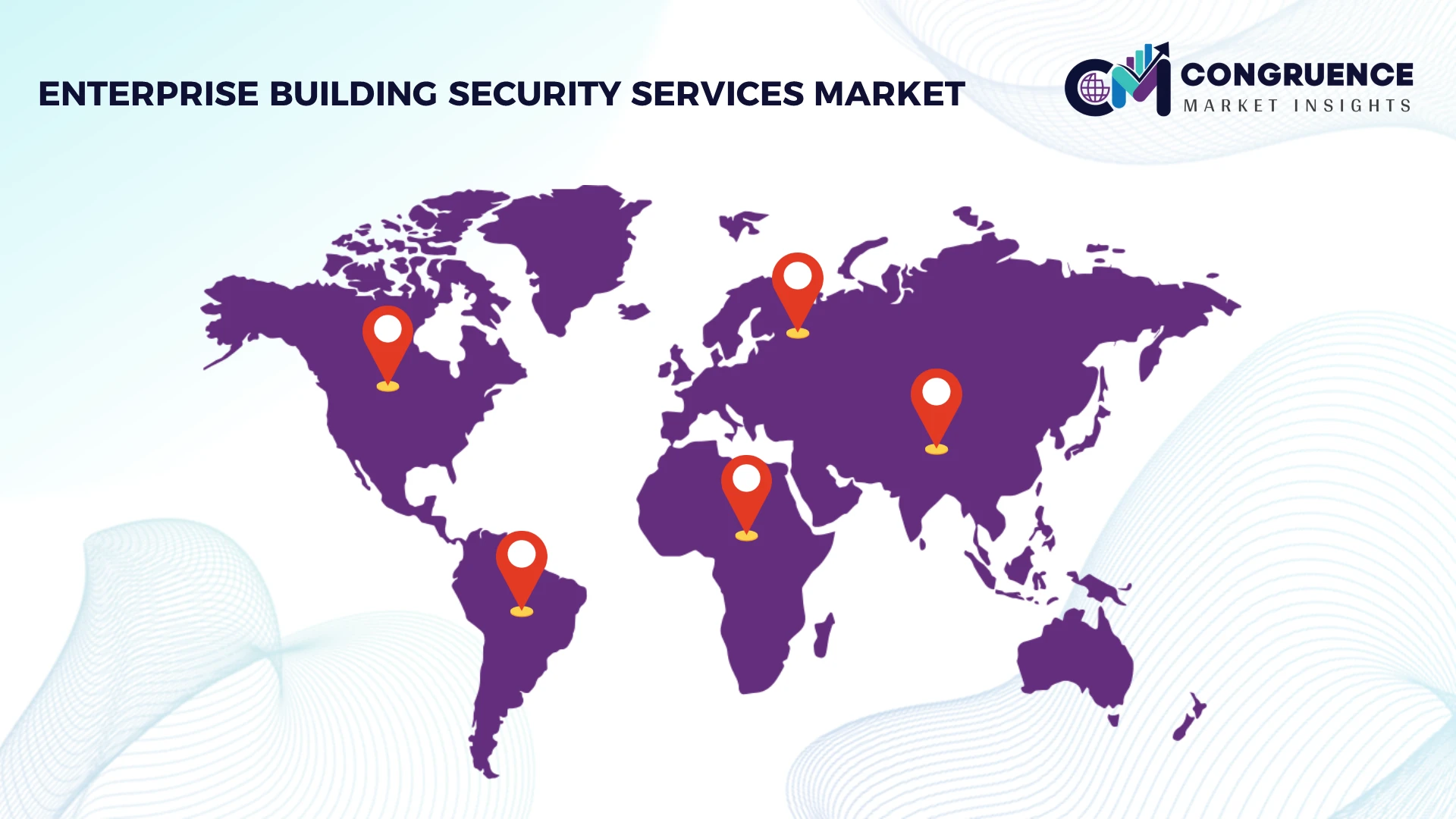
The Enterprise Building Security Services Market Report covers integrated security services, managed security services, electronic security, and hybrid security models across corporate offices, campuses, data centers, healthcare facilities, financial institutions, industrial buildings, government properties, and other enterprise environments. The analysis evaluates access control, video surveillance, intrusion detection, visitor management, guarding, remote monitoring, security operations centers, and integrated building-security platforms. Coverage spans North America, Europe, Asia-Pacific, South America, and Middle East & Africa, with country-level analysis of major enterprise security markets.
The report assesses AI video analytics, biometric authentication, cloud and hybrid security, edge computing, mobile credentials, cybersecurity integration, and cyber-physical monitoring. It evaluates deployment concentration, adoption patterns, technology integration, competitive positioning, and managed-service penetration, including emerging opportunities in data centers and smart buildings. These insights support investment planning, geographic expansion, partnership strategy, product prioritization, procurement decisions, and competitive positioning through 2026–2033.
| Report Attribute/Metric | Report Details |
|---|---|
|
Market Revenue in 2025 |
USD 97,034.8 Million |
|
Market Revenue in 2033 |
USD 187,744.0 Million |
|
CAGR (2026 - 2033) |
8.6% |
|
Base Year |
2025 |
|
Forecast Period |
2026 - 2033 |
|
Historic Period |
2021 - 2025 |
|
Segments Covered |
By Type
By Application
By End-User
|
|
Key Report Deliverable |
Revenue Forecast, Growth Trends, Market Dynamics, Segmental Overview, Regional and Country-wise Analysis, Competition Landscape |
|
Region Covered |
North America, Europe, Asia-Pacific, South America, Middle East, Africa |
|
Key Players Analyzed |
Johnson Controls, Honeywell International, Genetec, Bosch Building Technologies, Axis Communications, Securitas Technology, Siemens, Thales, Allegion, ASSA ABLOY, Motorola Solutions, Verkada, Gallagher Security, Hikvision |
|
Customization & Pricing |
Available on Request (10% Customization is Free) |




