
Reports
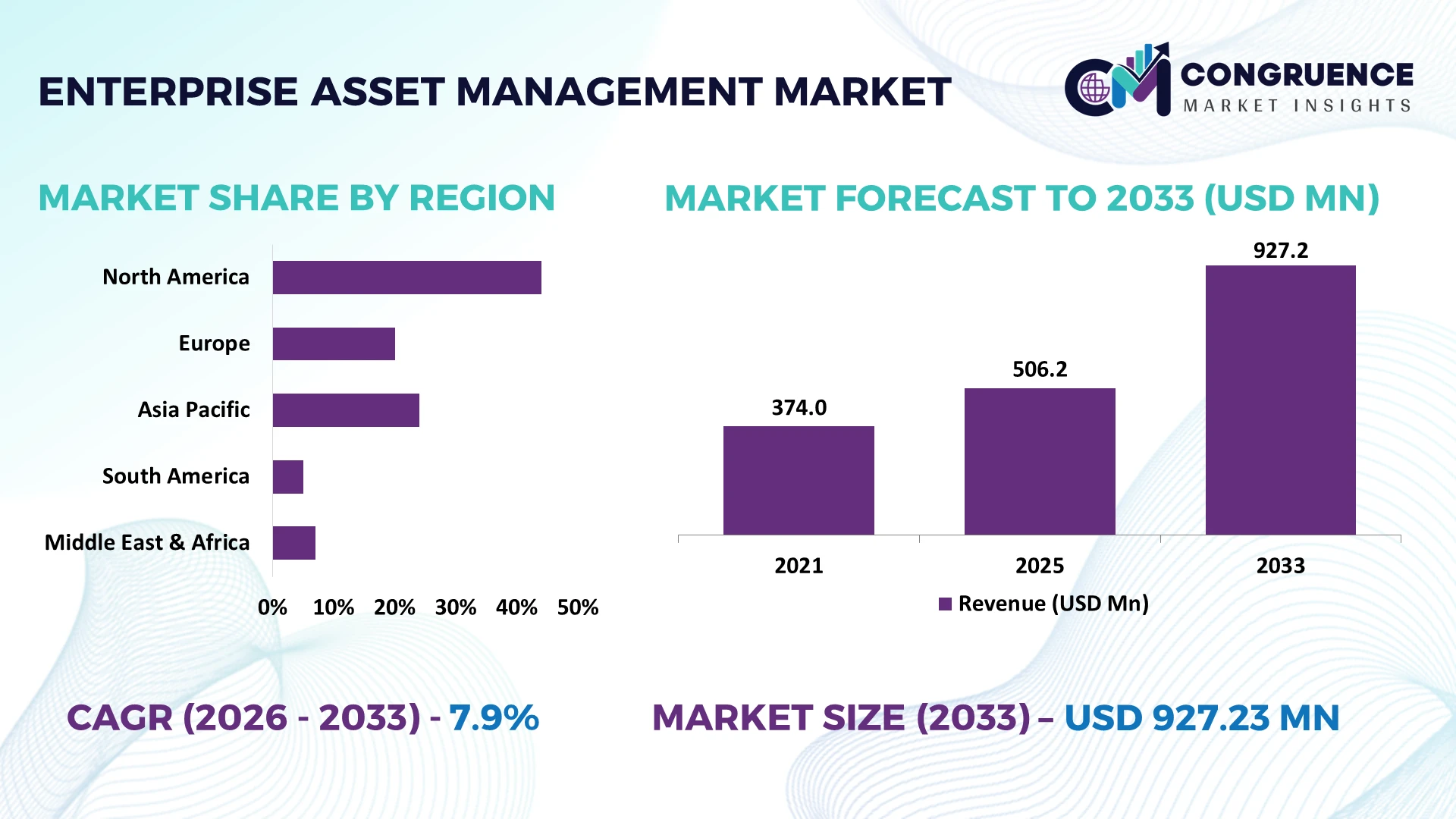
The Global Enterprise Asset Management Market was valued at USD 506.18 Million in 2025 and is anticipated to reach a value of USD 927.23 Million by 2033 expanding at a CAGR of 7.86% between 2026 and 2033. Growth is driven by predictive maintenance, aging industrial infrastructure, IoT-connected equipment, AI-based failure detection, mobile maintenance workflows, and enterprise migration from reactive servicing toward condition-based asset management.
The United States accounts for an estimated 32% of global Enterprise Asset Management deployment, supported by asset-intensive utilities, manufacturing, oil and gas, transportation, and government infrastructure. Manufacturers increasingly target 10–20% maintenance-cost reductions through predictive analytics and connected condition monitoring. Germany provides a comparison, with manufacturing contributing roughly 18% of national economic output and Industry 4.0 accelerating digital asset tracking. U.S.–China technology restrictions are also reinforcing equipment traceability, supplier-risk visibility, and lifecycle intelligence across industrial supply chains.
Strategically, enterprises integrating EAM with IoT, AI, ERP, and operational systems gain stronger uptime, maintenance productivity, compliance visibility, and capital-allocation control.
Market Size & Growth: USD 506.18 million in 2025 reaches USD 927.23 million by 2033 at 7.86%, supported by predictive maintenance and connected industrial assets.
Top Growth Drivers: Predictive maintenance cuts downtime 30–50%, IoT monitoring lowers maintenance costs 10–20%, and mobile workflows improve technician productivity 15–25%.
Short-Term Forecast: By 2028, AI-assisted maintenance planning can reduce unplanned equipment downtime by 20–30% across digitally mature asset-intensive operations.
Emerging Technologies: AI copilots, digital twins, IoT sensors, and computer vision increasingly automate 3 core workflows: inspection, diagnosis, and maintenance scheduling.
Regional Leaders: Applying projected regional positioning places North America near USD 306 million, Europe USD 250 million, and Asia-Pacific USD 278 million, driven respectively by cloud, compliance, and industrial digitization.
Consumer/End-User Trends: More than 60% of digitally advanced industrial organizations now prioritize predictive or condition-based maintenance over purely reactive servicing.
Pilot/Case Example: In 2025, AI-enabled predictive-maintenance programs demonstrated 20–30% lower unplanned downtime in data-rich industrial equipment environments.
Competitive Landscape: IBM holds an estimated 12% share, competing with SAP, Oracle, Hexagon, IFS, and specialized industrial asset-management providers.
Regulatory & ESG Impact: Predictive maintenance can extend equipment life by 20–40%, reducing premature replacement, material consumption, and associated industrial waste.
Investment & Funding: Global industrial digital-transformation investment exceeds USD 1 trillion annually, strengthening EAM integration with IoT, cloud, analytics, and automation programs.
Innovation & Future Outlook: AI agents, digital twins, and edge analytics are shifting EAM from scheduled maintenance toward continuous, risk-based asset decisions across 24/7 operations.
Enterprise Asset Management Market demand is concentrated across manufacturing, utilities, energy, transportation, mining, healthcare infrastructure, and public assets where downtime directly affects output and service continuity. Modern platforms integrate IoT sensors, AI diagnostics, mobile work orders, digital twins, GIS, and ERP data to create unified lifecycle intelligence. Predictive maintenance can reduce unplanned downtime by 20–30% in data-rich deployments, strengthening the business case for connected EAM. Aging infrastructure and tighter equipment traceability requirements are accelerating replacement of fragmented maintenance systems, while AI-assisted technician workflows are emerging as the next operational layer, establishing the foundation for strategic market transformation.
Enterprise Asset Management is becoming strategic infrastructure as manufacturers, utilities, transport operators, and energy companies shift capital decisions from scheduled maintenance toward asset-level risk intelligence. Aging infrastructure, skilled-technician shortages, and supply-chain restructuring are increasing the cost of equipment failure. Enterprises are consequently integrating EAM with ERP, IoT, GIS, procurement, and operational technology to connect maintenance decisions with inventory availability and production schedules.
Predictive maintenance provides a clear advantage over calendar-based servicing, reducing unplanned downtime by approximately 20–30% and maintenance expenditure by 10–20% in data-rich operations. The United States emphasizes cloud EAM and AI-enabled maintenance, Germany integrates asset management with Industry 4.0 production, while China deploys connected monitoring across large manufacturing networks. Through 2028, mobile-first work management, sensor integration, and AI-assisted diagnosis will increasingly become standard requirements for complex assets.
A manufacturer connecting vibration sensors to EAM can automatically generate work orders when equipment behavior exceeds thresholds, preventing production-line failures. Vendors are expanding AI capabilities, industry-specific cloud platforms, digital-twin integrations, and technology partnerships. Competitive positioning will increasingly depend on converting asset data into faster maintenance decisions, higher utilization, and disciplined lifecycle investment.
Industrial operators are accelerating EAM deployment as unplanned equipment failures directly affect throughput, labor utilization, and maintenance budgets. Predictive maintenance can reduce unplanned downtime by 20–30%, lower maintenance expenditure by 10–20%, and extend selected equipment life by 20–40%. Germany's Industry 4.0 manufacturing base is reinforcing connected condition monitoring, while aging U.S. utility and transportation infrastructure increases demand for lifecycle visibility. Enterprises are connecting vibration, temperature, pressure, and runtime sensors directly with EAM work-order engines. IBM, SAP, IFS, and other vendors are expanding AI diagnostics, mobile maintenance, and IoT integrations. The strategic advantage extends beyond failure prevention: accurate asset-health data allows companies to defer unnecessary capital replacement and redirect investment toward equipment with demonstrably higher operational risk.
EAM modernization remains constrained by fragmented ERP systems, proprietary industrial protocols, inconsistent asset records, and aging operational technology. Large industrial sites can operate equipment spanning 20–30 years, while asset-master-data inaccuracies can exceed 10% in poorly governed environments. Integration and data cleansing can represent 20–30% of complex modernization effort before predictive capabilities deliver meaningful results. U.S. utilities and manufacturers frequently operate mixed generations of PLCs, SCADA systems, and maintenance applications, increasing interface requirements. Enterprises are reducing exposure through phased migrations, standardized asset taxonomies, API integration, and hybrid-cloud architectures rather than full-system replacement. The non-obvious restraint is data quality rather than software capability: advanced AI provides limited operational value when equipment hierarchies, failure codes, maintenance histories, and spare-parts records remain inconsistent.
Generative AI, digital twins, edge analytics, and computer vision are expanding EAM beyond work-order administration into continuous operational decision support. AI-assisted troubleshooting can reduce diagnostic time by 20–40%, while automated work-order classification can cut administrative processing by 30–50%. India's expanding industrial digitization provides an attractive deployment environment as manufacturers modernize factories while building new capacity. Through 2028, technician copilots will increasingly combine maintenance histories, manuals, sensor alerts, and spare-parts availability to recommend corrective actions. Vendors are investing in generative AI, digital-twin partnerships, mobile interfaces, and industry-specific applications. A particularly valuable opportunity lies in workforce knowledge retention: converting experienced technicians' maintenance histories into searchable AI guidance protects operational expertise as skilled employees retire and reduces dependence on individual plant knowledge.
EAM increasingly connects enterprise IT with sensors, mobile devices, cloud applications, industrial controls, and third-party maintenance ecosystems, expanding the cybersecurity surface around critical assets. Manufacturing accounts for roughly 25% of reported industrial cyber incidents in several threat assessments, while connected plants can contain thousands of addressable devices. A single compromised integration can disrupt maintenance visibility across multiple facilities rather than one machine. U.S. critical-infrastructure operators also face tightening cybersecurity expectations around asset inventories and access controls. Companies must implement zero-trust authentication, segmented OT networks, encrypted device communication, continuous vulnerability management, and governed API access. The strategic challenge is maintaining connectivity without creating operational exposure: EAM platforms delivering deeper integration require equally mature identity, device, and data governance to sustain trusted deployment at enterprise scale.
Mobile Maintenance Moves Into Field: Industrial operators are replacing paper-based inspections and fixed terminals with mobile EAM workflows covering work orders, photographs, parts usage, and equipment histories. Mobile execution can reduce administrative maintenance time by 15–25% and accelerate work-order closure by 20–30%. U.S. utilities and manufacturers are equipping technicians with offline-capable applications, while vendors are expanding voice input, barcode scanning, and role-specific interfaces to improve field productivity.
Asset Data Governance Gains Priority: Companies are restructuring asset hierarchies before expanding automation because fragmented equipment records weaken analytics accuracy. Standardized master-data programs can eliminate 10–20% duplicate records and improve maintenance-planning accuracy by 15–25%. Supply-chain disruption has intensified attention on spare-parts traceability and critical-equipment dependencies. EAM providers are integrating data-quality engines, ERP connectors, and automated classification tools, turning information governance into an operational prerequisite rather than a back-office exercise.
Digital Twins Connect Lifecycle Decisions: Asset-intensive enterprises increasingly link engineering models, operating conditions, and maintenance histories through digital twins. Integrated models can reduce inspection requirements by 10–20% and shorten selected engineering decisions by 20–30%. Energy operators are applying twins to turbines, grids, and process equipment. EAM vendors are strengthening BIM, GIS, IoT, and engineering-platform integrations, allowing maintenance teams to evaluate degradation against actual operating conditions before committing labor or replacement capital.
Maintenance Planning Becomes Risk-Based: Organizations are replacing fixed servicing intervals with asset-criticality scoring that combines condition, failure consequence, parts availability, and production impact. Risk-based programs can eliminate 10–20% unnecessary preventive tasks while improving technician utilization by 15–25%. Regulatory scrutiny of infrastructure reliability reinforces this shift in utilities and transportation. Companies are embedding criticality matrices, automated prioritization, and reliability-centered maintenance workflows into EAM platforms, concentrating resources on assets carrying the highest operational consequence.
Cloud-Based Solutions lead with an estimated 36% share as enterprises prioritize centralized asset records, subscription deployment, remote accessibility, and faster multi-site standardization. Cloud architecture can reduce infrastructure administration by 20–30% compared with locally maintained environments while simplifying software upgrades across distributed facilities. On-Premise Solutions retain approximately 27%, particularly across critical infrastructure and highly controlled industrial environments where organizations require tighter data residency, customization, and operational-technology governance.
Hybrid Solutions are the fastest-growing type as manufacturers and utilities retain sensitive plant-level systems locally while moving analytics, collaboration, and enterprise reporting into cloud environments. Mobile Solutions strengthen technician execution through offline work orders, barcode scanning, inspections, and equipment histories, while Integrated Solutions connect EAM with ERP, GIS, IoT, procurement, and engineering systems. Vendors are investing in cloud-native architecture, configurable APIs, mobile applications, and industry-specific integration packages. Investment is consequently shifting from standalone maintenance software toward interoperable platforms capable of supporting centralized governance without disconnecting operational assets.
Asset Maintenance leads with an estimated 34% share because maintenance scheduling, failure history, labor allocation, and preventive servicing remain the operational foundation of EAM deployment. Work Order Management represents approximately 23%, supporting technician assignments, approvals, service documentation, and closure tracking. Asset Tracking connects equipment identity with location and lifecycle records, while Inventory Management aligns spare-parts availability with planned and corrective maintenance, reducing emergency procurement and production interruptions.
Condition Monitoring is the fastest-growing application as vibration, temperature, pressure, acoustic, and electrical sensors move maintenance decisions toward equipment health rather than fixed calendars. Data-rich monitoring programs can reduce unplanned downtime by 20–30% and maintenance expenditure by 10–20%. Vendors are integrating IoT gateways, anomaly detection, automated alerts, and condition-triggered work orders directly into EAM platforms. Companies are also linking inventory requirements with predicted failures, allowing parts to be positioned before interventions. The business priority is shifting from documenting maintenance activity toward identifying precisely when intervention produces the highest operational return.
Manufacturing leads with an estimated 32% share because factories manage dense portfolios of production machinery, robotics, utilities, material-handling systems, and safety-critical equipment. A single equipment failure can interrupt interconnected production lines, making maintenance scheduling and spare-parts coordination economically significant. Energy and Utilities represent approximately 25%, with operators managing geographically dispersed grids, generation equipment, pipelines, substations, and renewable assets requiring lifecycle visibility and regulatory documentation.
Energy and Utilities are the fastest-growing end-user segment as grid modernization, renewable integration, distributed energy resources, and aging infrastructure increase asset complexity. Predictive programs can reduce equipment downtime by 20–30%, while connected monitoring supports intervention before high-consequence failures. Transportation operators prioritize fleet and infrastructure availability; Healthcare organizations emphasize equipment uptime and compliance; Government agencies manage roads, buildings, water systems, and public infrastructure. Vendors are developing sector-specific workflows, GIS integration, regulatory templates, and cloud deployment models. Competitive positioning increasingly depends on solving industry-specific asset criticality rather than supplying standardized maintenance functionality.
North America accounted for the largest market share at 34% in 2025 however, Asia-Pacific is expected to register the fastest growth, expanding at a CAGR of 9.4% between 2026 and 2033.
Cloud Modernization Reshapes Asset Operations
North America represented approximately 34% of Enterprise Asset Management deployment in 2025, supported by large utility networks, manufacturing plants, transportation infrastructure, energy assets, and mature enterprise software adoption. U.S. operators are replacing fragmented computerized maintenance systems with cloud EAM platforms integrating IoT telemetry, mobile work execution, GIS, ERP, and predictive analytics. Predictive maintenance programs can reduce unplanned downtime by 20–30%, strengthening investment economics for asset-intensive enterprises. Grid modernization provides another deployment catalyst as utilities require stronger visibility across substations, transmission equipment, distributed energy resources, and field-service operations. Vendors are embedding AI assistants, condition monitoring, and automated work-order prioritization into enterprise suites. Canadian mining, energy, and transportation operators reinforce demand for remote asset monitoring where geographically distributed equipment makes conventional inspection expensive and operationally inefficient.
United States Market Outlook: The United States combines extensive industrial infrastructure with strong cloud, AI, IoT, and enterprise software ecosystems. Manufacturing contributes more than 10% of national economic output, while utilities manage millions of miles of electricity infrastructure. Federal infrastructure modernization is strengthening requirements for lifecycle planning, asset traceability, preventive maintenance, and data-driven capital allocation across transportation, energy, water, and public facilities.
Compliance Drives Lifecycle Asset Intelligence
Europe accounted for approximately 27% of Enterprise Asset Management deployment in 2025, led by Germany, the United Kingdom, France, Italy, and Nordic industrial economies. Manufacturers increasingly connect EAM with Industry 4.0 architectures, digital twins, energy-management systems, and condition-monitoring networks. Germany's manufacturing sector contributes roughly 18% of national economic output, creating substantial demand for production-asset reliability and lifecycle optimization. European operators also face stringent environmental, worker-safety, cybersecurity, and infrastructure-reporting requirements, making auditable maintenance histories strategically important. Energy transition investment is expanding asset portfolios across wind, solar, electricity grids, charging infrastructure, and storage systems. Vendors are responding with cloud platforms, carbon-related asset data, mobile inspections, and reliability-centered maintenance. The operational shift increasingly links maintenance planning with energy efficiency, regulatory compliance, and equipment replacement decisions rather than treating EAM solely as work-order software.
Germany Market Outlook: Germany's automotive, chemicals, machinery, electrical equipment, and process industries create concentrated demand for sophisticated asset-management platforms. Industry 4.0 adoption supports connected machinery and interoperable production data, while high industrial energy costs sharpen attention on equipment efficiency. Manufacturers increasingly integrate EAM with MES and ERP environments to coordinate maintenance windows with production schedules and minimize capacity disruption.
Industrial Digitization Accelerates Connected Maintenance
Asia-Pacific represented approximately 30% of Enterprise Asset Management deployment in 2025, with China, Japan, India, South Korea, and Australia combining manufacturing scale, infrastructure expansion, mining operations, and utility modernization. China accounts for nearly 30% of global manufacturing value added, creating a massive installed base of machinery requiring maintenance, tracking, and lifecycle management. India is simultaneously expanding manufacturing, transportation, renewable energy, and electricity infrastructure, increasing requirements for centralized asset visibility. Japanese manufacturers emphasize equipment reliability and automation, while Australian mining operators prioritize remote condition monitoring across geographically dispersed sites. Enterprises are deploying IoT sensors, mobile work management, cloud analytics, and digital twins to replace isolated maintenance databases. Vendors are expanding local cloud availability, systems-integration partnerships, and industry-specific applications to capture modernization programs across factories, grids, mines, and transportation networks.
China Market Outlook: China combines exceptional industrial scale with extensive automation, robotics, electricity infrastructure, and digitally connected manufacturing. More than 290,000 industrial robots were installed during 2022 alone, illustrating the expanding population of automation assets requiring lifecycle management. Domestic enterprises increasingly connect equipment monitoring with maintenance scheduling, spare-parts planning, and production systems to improve utilization across high-volume factories.
Industrial Assets Shift Toward Digital Maintenance
South America represented approximately 4% of Enterprise Asset Management deployment in 2025, with Brazil and Chile concentrating demand across mining, oil and gas, utilities, manufacturing, transportation, and public infrastructure. Brazil's extensive electricity system, industrial plants, ports, and petroleum operations create complex asset portfolios where unplanned failures carry significant production consequences. Chile's mining sector strengthens demand for condition monitoring because remote sites require dependable maintenance planning for crushers, conveyors, haulage equipment, and processing facilities. Cloud EAM reduces infrastructure requirements for distributed operations, while mobile applications allow field technicians to capture inspections without permanent connectivity. Adoption remains constrained by legacy systems, integration costs, inconsistent asset data, and shortages of specialized digital-maintenance expertise. Vendors are responding through localized implementation partnerships, modular deployments, mobile-first platforms, and industry-specific configurations designed to reduce transformation complexity.
Brazil Market Outlook: Brazil offers the region's broadest EAM opportunity through manufacturing, electricity, mining, petroleum, logistics, and infrastructure operations. Renewables generate more than 80% of the country's electricity, creating diverse hydroelectric, wind, solar, and transmission assets requiring coordinated lifecycle management. Large operators increasingly prioritize predictive maintenance, remote inspection, and centralized work management across geographically dispersed facilities.
Infrastructure Investment Modernizes Asset Governance
Middle East & Africa accounted for approximately 5% of Enterprise Asset Management deployment in 2025, with Saudi Arabia, the UAE, South Africa, and major energy-producing economies driving adoption. Gulf countries are investing in industrial diversification, utilities, airports, metros, renewable energy, manufacturing, and smart-city infrastructure, increasing the number and complexity of managed assets. Saudi Arabia's Vision 2030 projects are strengthening requirements for digital maintenance, lifecycle planning, and centralized infrastructure visibility. Oil and gas operators already manage asset-intensive environments where equipment availability, inspection compliance, and reliability directly affect production continuity. South African utilities, mines, and transport operators require stronger maintenance planning for aging infrastructure. Vendors are expanding cloud EAM, mobile inspections, digital twins, and IoT integration while partnering with local systems integrators to address implementation capability and data-sovereignty requirements.
Saudi Arabia Market Outlook: Saudi Arabia provides a concentrated deployment environment spanning petroleum, petrochemicals, utilities, mining, transportation, manufacturing, and large infrastructure projects. The Kingdom targets 50% of electricity generation capacity from renewable sources by 2030, expanding the mix of assets requiring monitoring and maintenance. EAM platforms increasingly support reliability engineering, contractor management, mobile inspections, and lifecycle governance across these investments.
IBM, SAP, Oracle, IFS, and Hexagon compete for asset-intensive enterprises, while specialized platforms challenge broad enterprise suites through faster deployment and industry-specific functionality. The top five providers hold an estimated 45% combined share, creating a moderately concentrated technology landscape. Competition centers on AI automation, integration depth, deployment flexibility, and lifecycle analytics. Predictive capabilities can reduce unplanned downtime 20–30%, mobile workflows improve technician productivity 15–25%, and automated work-order processing cuts administrative effort 20–40%. IBM and SAP leverage enterprise ecosystems; IFS emphasizes asset-intensive industries; Hexagon connects engineering and operational data; Oracle integrates maintenance with cloud ERP. Vendors are expanding through cloud migration, AI copilots, IoT partnerships, and vertical applications. Competition is shifting from maintenance recordkeeping toward autonomous asset intelligence. Integration complexity, installed enterprise systems, cybersecurity, and historical asset data create substantial switching barriers. Winning requires measurable reliability improvements, interoperable architecture, industry-specific workflows, scalable AI, and disciplined implementation execution globally.
IBM
SAP
Oracle
IFS
Hexagon
Infor
Microsoft
ServiceNow
AVEVA
Bentley Systems
Fiix
MaintainX
UpKeep
eMaint
Current EAM technology combines cloud platforms, IoT sensors, mobile work management, GIS, ERP integration, and machine-learning analytics. Condition monitoring can reduce unplanned downtime by 20–30%, while mobile workflows improve technician productivity by 15–25%. Compared with calendar-based maintenance, condition-based systems can lower maintenance expenditure by 10–20% by triggering intervention from actual equipment health. Manufacturers, utilities, and transport operators with asset histories gain immediate advantage.
Emerging architectures integrate digital twins, computer vision, edge analytics, generative AI, and automated reliability engineering. Digital twins can shorten inspection and engineering workflows by 20–30%, while AI-assisted diagnostics can reduce troubleshooting time by 20–40%. Adoption is moving beyond pilots as enterprise platforms embed copilots into work orders, asset histories, and failure analysis. Vendors combining EAM, asset performance management, and investment planning gain differentiation because customers connect maintenance decisions with capital priorities.
Between 2026 and 2028, agentic AI will increasingly create work orders, prioritize risk, recommend interventions, and coordinate spare parts with limited manual orchestration. Predictive models can improve asset availability by 10–20% when supported by reliable telemetry and maintenance histories. Edge processing will accelerate anomaly detection for remote assets. Companies investing now in governed AI, interoperable data, digital twins, and cybersecurity establish foundations for autonomous asset operations.
April 2024 Hexagon acquired Itus Digital, adding SaaS-based asset performance management and digital-twin capabilities to HxGN EAM. The acquired platform supports asset strategies from 25 assets to 1 million, strengthening predictive reliability and risk-based maintenance capabilities for industrial customers. Source: Hexagon.
June 2025 IBM released Maximo Application Suite 9.1 with Maximo Assistant, embedding generative AI into asset lifecycle workflows. The release builds on Maximo’s 40-year history and integrates facilities, investment planning, maintenance, and AI-assisted workforce productivity within one environment. Source: EnterpriseAI.
August 2025 IFS acquired 7bridges, adding AI-powered supply-chain simulation and logistics optimization to its Industrial AI portfolio. IFS operates across 80 countries, and the acquisition extends optimization capabilities into manufacturing and aerospace asset environments, strengthening integrated operational planning. Source: IFS.
June 2026 IBM introduced Maximo Application Suite 9.2, embedding asset-first AI across reliability, maintenance, field service, safety, and operations workflows. Asset Investment Planning 9.2 also supports large asset populations through background optimization, strengthening continuous planning and intervention execution. Source: IBM.
The Enterprise Asset Management Market Report evaluates On-Premise, Cloud-Based, Hybrid, Mobile, and Integrated Solutions across Asset Maintenance, Work Order Management, Asset Tracking, Inventory Management, and Condition Monitoring. End-user coverage includes Manufacturing, Energy and Utilities, Transportation, Healthcare, and Government. Cloud-Based Solutions represent approximately 36% of deployment, while Asset Maintenance accounts for nearly 34% of application demand, reflecting enterprise priorities around availability and lifecycle control.
Regional analysis covers North America, Europe, Asia-Pacific, South America, and Middle East & Africa, examining industrial digitization, infrastructure modernization, regulatory requirements, and deployment maturity. Technology coverage includes IoT condition monitoring, digital twins, generative and agentic AI, edge analytics, computer vision, mobile workflows, GIS, and predictive maintenance. The 2026–2033 outlook supports investment planning, geographic expansion, platform selection, partnership strategies, competitive positioning, and migration toward integrated asset-intelligence ecosystems.
| Report Attribute/Metric | Report Details |
|---|---|
Market Revenue in 2025 | USD 506.18 Million |
Market Revenue in 2033 | USD 927.23 Million |
CAGR (2026 - 2033) | 7.86% |
Base Year | 2025 |
Forecast Period | 2026 - 2033 |
Historic Period | 2021 - 2025 |
Segments Covered | By Type
By Application
By End-User
|
Key Report Deliverable | Revenue Forecast, Growth Trends, Market Dynamics, Segmental Overview, Regional and Country-wise Analysis, Competition Landscape |
Region Covered | North America, Europe, Asia-Pacific, South America, Middle East, Africa |
Key Players Analyzed | IBM, SAP, Oracle, IFS, Hexagon, Infor, Microsoft, ServiceNow, AVEVA, Bentley Systems, Fiix, MaintainX, UpKeep, eMaint |
Customization & Pricing | Available on Request (10% Customization is Free) |




