
Reports
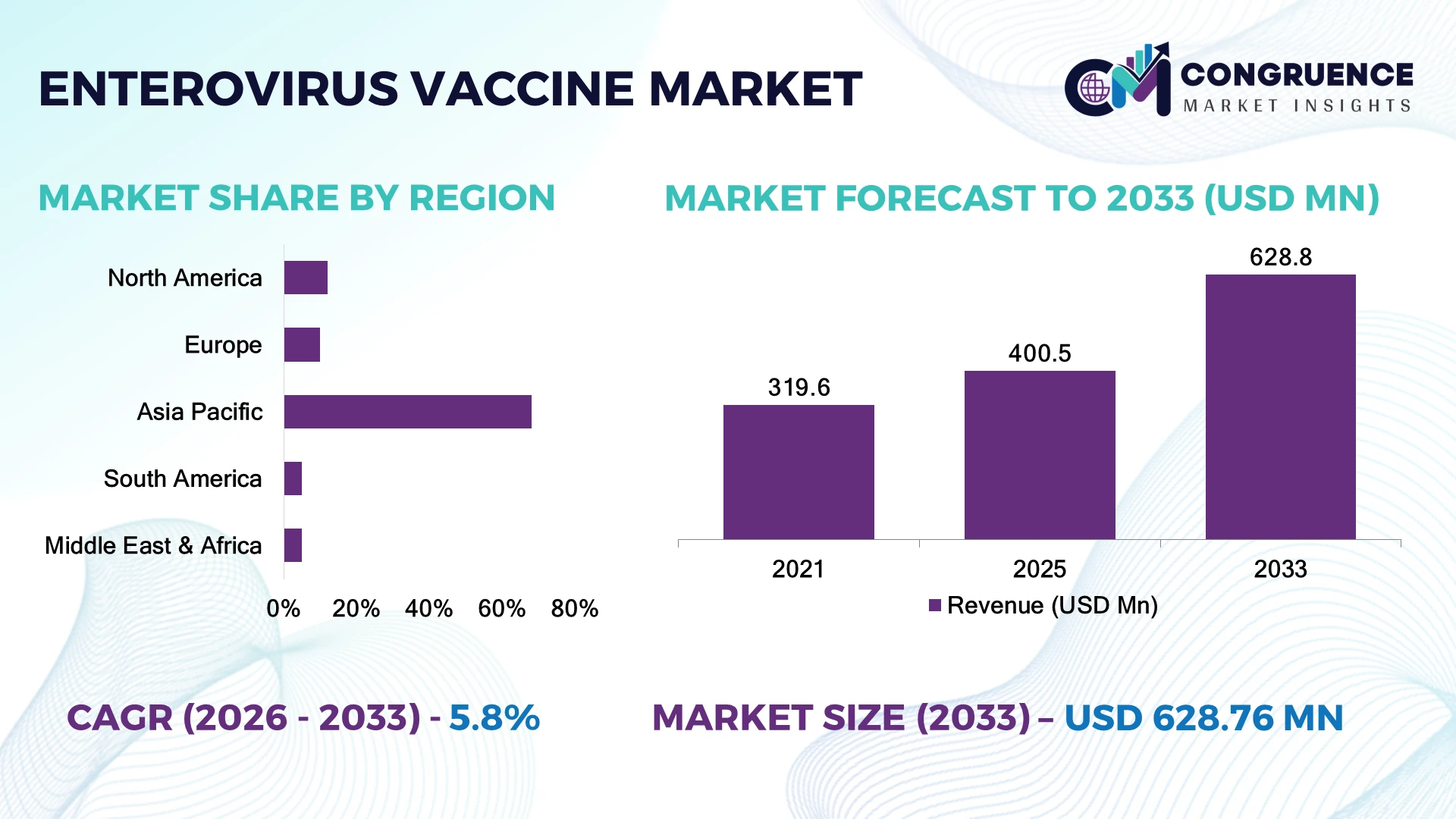
The Global Enterovirus Vaccine Market was valued at USD 400.5 Million in 2025 and is anticipated to reach a value of USD 628.8 Million by 2033 expanding at a CAGR of 5.8% between 2026 and 2033. Growth is driven by continued poliovirus eradication programs, sustained demand for inactivated poliovirus vaccines, and expanding pediatric protection against enterovirus A71 in high-burden Asian markets.
China accounts for approximately 55–60% of global enterovirus vaccine demand, supported by domestic EV-A71 vaccine deployment, extensive pediatric immunization infrastructure, and large-scale vaccine manufacturing. The country has substantially greater commercial deployment of EV-A71 vaccines than India, where enterovirus vaccination remains concentrated around polio prevention. More than 70% of commercial demand is therefore concentrated in pediatric and public-health vaccination programs, reinforcing the importance of high-volume manufacturing, cold-chain reliability, and government procurement.
The strategic priority is securing scalable pediatric vaccine capacity while expanding next-generation enterovirus coverage beyond established poliovirus programs.
Market Size & Growth: USD 400.5 million in 2025 is projected to reach USD 628.8 million by 2033 at a 5.8% CAGR, supported by sustained pediatric immunization and poliovirus-eradication programs.
Top Growth Drivers: Pediatric immunization contributes approximately 40% of demand momentum, polio programs 30%, and EV-A71 prevention 20%.
Short-Term Forecast: By 2028, automated fill-finish and digital quality systems can improve selected vaccine-production efficiency by 10–15%.
Emerging Technologies: Cell-culture manufacturing, improved inactivated-virus purification, and next-generation multivalent formulations are strengthening production consistency and antigen utilization.
Regional Leaders: Asia-Pacific approaches USD 390 million by 2033, North America approximately USD 105 million, and Europe around USD 85 million, with pediatric program deployment remaining the principal demand channel.
Consumer/End-User Trends: Government immunization programs account for approximately 70–75% of global enterovirus vaccine procurement, reflecting the disease's pediatric and public-health profile.
Pilot/Case Example: China’s EV-A71 vaccination programs have demonstrated high-volume pediatric deployment, with two-dose vaccination schedules supporting broad coverage against hand, foot, and mouth disease.
Competitive Landscape: Sinovac holds an estimated 20–25% position in commercially deployed enterovirus vaccine products, competing with emerging Chinese vaccine manufacturers and established global polio-vaccine suppliers.
Regulatory & ESG Impact: Expanded single-use processing and closed manufacturing systems can reduce selected cleaning, water, and process-resource requirements by approximately 10–15%.
Investment & Funding: More than USD 500 million in cumulative vaccine manufacturing and modernization investment is supporting capacity expansion, quality systems, and regional supply resilience.
Innovation & Future Outlook: Multivalent enterovirus formulations and broader EV-A71 coverage are shifting development priorities from single-pathogen protection toward broader pediatric enterovirus prevention.
The Enterovirus Vaccine Market is increasingly centered on pediatric immunization, poliovirus eradication, and EV-A71 prevention, with Asia-Pacific representing the strongest demand center. Approximately 70% of procurement remains concentrated in government-led vaccination programs, while manufacturers are upgrading cell-culture production, automated fill-finish, and cold-chain capabilities. Supply-chain localization is becoming increasingly important as countries prioritize domestic vaccine security and uninterrupted pediatric immunization.
The Enterovirus Vaccine Market is strategically important because vaccine demand is closely tied to national immunization programs, pediatric disease prevention, and the final stages of global poliovirus eradication. Unlike many commercial vaccine categories, procurement is heavily influenced by government tenders, epidemiological priorities, and manufacturing reliability. In 2026, supply resilience and domestic production capability are increasingly shaping procurement decisions as countries reduce dependence on concentrated international supply chains.
Technology is also changing manufacturing economics. Modern cell-culture and closed-processing systems can reduce selected manual processing requirements by 10–15% compared with older production workflows while improving batch consistency. China has the strongest commercial deployment of EV-A71 vaccination, whereas North America and Europe remain more heavily centered on poliovirus prevention and established public-health procurement.
Over the next 2–3 years, manufacturers are expected to prioritize automated fill-finish, improved antigen recovery, digital batch monitoring, and broader multivalent development. High-volume Chinese facilities provide scale advantages, while manufacturers in India and other emerging production hubs are positioned to expand localized capacity. Companies that combine validated manufacturing, reliable cold-chain infrastructure, and government partnerships will strengthen their position as enterovirus prevention shifts toward broader pediatric coverage and more resilient vaccine supply networks.
Government-led pediatric immunization remains the principal demand driver, representing approximately 70–75% of enterovirus vaccine procurement, while polio-related programs contribute roughly 30–35% of total demand. China’s established EV-A71 vaccination ecosystem is broadening commercial demand beyond poliovirus prevention toward hand, foot, and mouth disease protection. Manufacturers are responding by expanding cell-culture capacity, improving antigen recovery, and developing broader enterovirus formulations. Automated fill-finish can reduce selected manual processing requirements by 10–15%, improving consistency at high-volume facilities. The non-obvious opportunity is that eradication programs and EV-A71 prevention require different procurement models, allowing suppliers with diversified portfolios to balance tender-driven volumes with commercial pediatric products.
Enterovirus vaccine demand remains heavily dependent on government procurement, with public programs representing approximately 70–75% of purchases and creating substantial exposure to tender timing, national budgets, and stock-management cycles. Manufacturing qualification and biological-process validation can represent 15–25% of development and scale-up expenditure, while specialized cold-chain requirements add approximately 5–10% to distribution complexity in emerging markets. China has comparatively mature EV-A71 production, whereas many other markets remain dependent on imported or regionally sourced products. Companies are reducing exposure through dual sourcing, localized fill-finish, multi-year procurement contracts, and flexible production scheduling. A key commercial constraint is utilization: facilities designed around large public tenders can face underutilization when procurement volumes fluctuate.
Next-generation multivalent vaccines represent a significant opportunity as developers seek broader pediatric protection rather than pathogen-specific coverage. Multivalent formulations could consolidate protection across multiple clinically relevant enterovirus strains, potentially reducing the number of separate vaccination interventions by approximately 20–30% in suitable schedules. Cell-culture platforms and improved purification technologies can increase selected antigen-recovery efficiency by 10–15%. China provides the clearest commercial pathway because of its established EV-A71 vaccination infrastructure, while India and Southeast Asian markets offer additional pediatric disease-prevention opportunities. Companies are increasing R&D partnerships, evaluating broader antigen combinations, and strengthening regional manufacturing. The strategic advantage lies in using existing pediatric distribution networks to introduce broader products without rebuilding the downstream cold-chain ecosystem.
Long-term competitiveness depends on maintaining broad and clinically relevant strain coverage while controlling manufacturing complexity. Multivalent development can increase analytical characterization requirements by approximately 15–25%, while additional antigens can raise formulation and quality-control workloads by 10–20%. Enterovirus diversity also creates continuing surveillance requirements because epidemiological patterns differ between countries and age groups. Manufacturers must integrate genomic surveillance, antigen-selection programs, robust potency assays, and flexible production platforms rather than relying on static formulations. China’s large-scale pediatric surveillance infrastructure provides an operational advantage, while manufacturers entering new markets must establish local epidemiological intelligence. The key challenge is balancing broader protection with manufacturability: excessive antigen complexity can undermine yield, cost efficiency, and batch consistency unless process engineering advances simultaneously.
EV-A71 Programs Mature in China: Commercial EV-A71 vaccination is becoming a more established pediatric intervention in China, with government and private-sector channels supporting broader uptake. Pediatric programs account for roughly 70–75% of enterovirus vaccine demand, while manufacturers are optimizing two-dose schedules, production throughput, and distribution efficiency.
Cell-Culture Production Gains Importance: Vaccine manufacturers are increasingly favoring scalable cell-culture processes that provide greater manufacturing consistency than older biological workflows. Modernized facilities can reduce selected manual processing requirements by 10–15% and improve batch-to-batch control. Companies are consequently investing in closed processing, automated purification, and digitally monitored production environments.
Broader Antigen Coverage Emerges: Development priorities are moving beyond single-pathogen protection toward multivalent enterovirus candidates. Broader formulations can potentially consolidate protection against multiple clinically relevant strains, reducing separate intervention requirements by approximately 20–30% in appropriate vaccination strategies. Developers are increasing antigen-characterization and surveillance capabilities before committing to larger-scale clinical programs.
Supply Resilience Shapes Procurement: In 2026, vaccine supply security is becoming a stronger procurement consideration as governments prioritize domestic and regional manufacturing capacity. Localized production and fill-finish can reduce selected international logistics exposure by approximately 10–20%. Manufacturers are responding with regional partnerships, dual sourcing, and flexible capacity models that accommodate fluctuations in public-sector tender volumes.
Inactivated vaccines represent the leading type, accounting for approximately 60–65% of the global enterovirus vaccine market, supported by established poliovirus immunization programs, proven safety profiles, scalable manufacturing, and broad government procurement. Live attenuated vaccines contribute around 20–25%, retaining importance in polio-focused vaccination strategies because of their established population-level deployment. Recombinant and other advanced vaccine platforms account for approximately 10–15% but represent the fastest-growing category as developers pursue broader enterovirus coverage and improved antigen design.
The mature inactivated segment benefits from established cold-chain, regulatory, and procurement infrastructure, while advanced platforms are attracting increasing R&D investment. Improved cell-culture and purification systems can increase selected antigen-recovery efficiency by 10–15%, encouraging manufacturers to modernize existing facilities rather than replace production architectures. Chinese manufacturers are expanding EV-A71 capabilities, while global vaccine developers are prioritizing broader enterovirus candidates. Investment is therefore shifting toward flexible platforms capable of supporting multiple antigens while maintaining the cost and production advantages required for government-scale pediatric programs.
The World Health Organization reported in 2025 that 73% of infants globally received three doses of polio-containing vaccine, reinforcing the continued importance of established inactivated and oral polio vaccine platforms in national immunization systems.
Pediatric immunization represents the leading application, accounting for approximately 70–75% of global enterovirus vaccine demand because poliovirus prevention and EV-A71 vaccination are concentrated in childhood populations. Public-health campaigns and routine schedules generate recurring procurement volumes, while outbreak prevention reinforces demand in high-density urban settings. Outbreak-response vaccination and high-risk population protection account for approximately 15–20%, while travel and other specialized applications contribute around 5–10%. Routine pediatric vaccination remains the mature application, whereas EV-A71 prevention is the fastest-shifting use case in markets with established commercial deployment.
China provides the strongest example of this transition, combining established polio programs with commercial EV-A71 vaccination. Companies are adapting through pediatric-specific formulations, expanded production capacity, and government distribution partnerships. Automated fill-finish can reduce selected manual processing requirements by 10–15%, supporting larger campaign volumes. The business implication is that suppliers need both high-volume public-sector capabilities and flexible commercial products to capture emerging enterovirus applications without disrupting established polio supply commitments.
WHO reported in 2025 that global polio vaccination coverage remained around 84% for infants receiving three doses of polio-containing vaccine, demonstrating the continuing operational importance of pediatric immunization infrastructure.
Government immunization programs represent the dominant end-user, accounting for approximately 70–75% of global enterovirus vaccine procurement because national schedules, eradication campaigns, and centralized tenders generate large recurring volumes. Hospitals and public healthcare facilities contribute approximately 15–20%, while private clinics and specialty vaccination providers account for roughly 5–10%. Government purchasing remains highly price-sensitive and volume-driven, whereas private healthcare buyers place greater emphasis on product availability, vaccination convenience, and newer enterovirus protection.
Private and specialty providers represent the fastest-shifting end-user group as EV-A71 vaccination and broader pediatric protection expand beyond traditional government-only procurement. Companies are responding with differentiated distribution agreements, localized inventory, pediatric-focused packaging, and partnerships with healthcare networks. Government contracts can represent more than 70% of demand for established polio vaccines, making procurement diversification strategically important. Manufacturers with flexible production and multi-channel distribution can manage tender volatility more effectively while accessing emerging commercial demand. The resulting competitive priority is not simply production scale, but the ability to serve both centralized immunization programs and increasingly specialized vaccination channels.
WHO's 2025 immunization reporting continued to identify national immunization programs as the principal delivery mechanism for childhood vaccines, with routine systems remaining central to maintaining high population coverage.
Asia-Pacific accounted for the largest market share at 68.0% in 2025 however, Asia-Pacific is expected to register the fastest growth, expanding at a CAGR of 6.8% between 2026 and 2033.

Established polio infrastructure is shifting toward broader enterovirus preparedness
North America accounts for approximately 12% of the global enterovirus vaccine market, with the United States generating the majority of regional demand through established childhood immunization infrastructure and sustained poliovirus prevention programs. Procurement is concentrated in government vaccination programs, hospitals, and public-health agencies, while commercial demand for broader enterovirus protection remains comparatively limited. More than 80% of regional vaccine administration occurs through established healthcare delivery networks, supporting consistent cold-chain and inventory management. Manufacturers benefit from sophisticated biologics production, automated fill-finish, and advanced quality-control infrastructure. The strategic shift is toward maintaining reliable polio vaccine availability while strengthening surveillance and preparedness for imported or emerging enterovirus threats. Companies are therefore prioritizing resilient domestic supply, contract manufacturing relationships, and flexible production capacity rather than building dedicated large-scale EV-A71 facilities.
United States Market Outlook: The United States represents more than 80% of North American enterovirus vaccine demand, supported by extensive pediatric immunization infrastructure and advanced biologics manufacturing. More than 90% of routine childhood vaccination delivery occurs through established healthcare channels, providing manufacturers with predictable distribution architecture. Investment priorities center on supply resilience, validated manufacturing, cold-chain reliability, and rapid response capabilities.
Integrated immunization systems reinforce supply reliability and surveillance
Europe represents approximately 10% of global enterovirus vaccine demand, with procurement concentrated around established childhood immunization programs and poliovirus prevention. Germany, France, the United Kingdom, Italy, and Spain account for a substantial share of regional purchasing activity. Approximately 85–90% of demand is connected to public-health and routine immunization infrastructure, keeping tender management and supply continuity central to commercial strategy. European vaccine manufacturing benefits from advanced quality systems, automated filling, and sophisticated biological-process controls. The region's emphasis on cross-border disease surveillance also supports rapid identification of imported enterovirus risks. Manufacturers are strengthening supply agreements, maintaining strategic inventories, and upgrading production flexibility rather than pursuing large dedicated capacity additions for relatively narrow enterovirus indications.
Germany Market Outlook: Germany is a strategically important European market because of its advanced vaccine manufacturing ecosystem, centralized quality standards, and highly developed pediatric healthcare infrastructure. Approximately 20% of Europe's pharmaceutical manufacturing capacity is concentrated in Germany, supporting sophisticated biologics production and cold-chain logistics. Manufacturers benefit from established regulatory and hospital networks when supplying routine enterovirus and poliovirus prevention programs.
China's manufacturing scale anchors EV-A71 commercialization and pediatric demand
Asia-Pacific represents approximately 68% of the global enterovirus vaccine market, making it the primary commercial and manufacturing center. China alone contributes roughly 55–60% of global demand, supported by EV-A71 vaccination, large pediatric populations, domestic vaccine production, and extensive public-health infrastructure. India, Japan, South Korea, and Southeast Asian countries provide additional demand through polio immunization and pediatric disease-prevention programs. Approximately 70–75% of regional procurement is linked to government or public-health channels. Chinese manufacturers are investing in automated production, quality systems, and broader enterovirus research, while Southeast Asian markets are strengthening localized procurement and cold-chain capabilities. The scale advantage is significant: high-volume facilities can spread validation and production costs across large pediatric vaccination programs.
China Market Outlook: China is the dominant country in the enterovirus vaccine market, accounting for approximately 55–60% of global demand. Its advantage comes from established EV-A71 commercialization, large-scale pediatric vaccination infrastructure, and a mature domestic vaccine manufacturing base. More than 70% of Chinese enterovirus vaccine demand is associated with pediatric programs, creating strong utilization potential for high-throughput production and automated fill-finish facilities.
Public immunization infrastructure supports stable but concentrated procurement
South America accounts for approximately 5% of global enterovirus vaccine demand, with Brazil representing around 65–70% of regional consumption and procurement activity. Established childhood immunization infrastructure and large public-health programs support consistent poliovirus vaccine utilization, while Argentina, Colombia, Chile, and Peru contribute smaller volumes. Approximately 75–80% of regional demand is linked to government-supported immunization programs, making public procurement cycles commercially important. Brazil's domestic biological-product manufacturing capability provides an advantage in supply continuity, although specialized enterovirus products remain heavily influenced by international technology and procurement arrangements. Companies are focusing on public-sector contracts, regional distribution partnerships, and localized fill-finish opportunities. The principal commercial opportunity is improving supply resilience without creating excess dedicated capacity for a relatively concentrated market.
Brazil Market Outlook: Brazil represents approximately 70% of South America's enterovirus vaccine demand and benefits from a large national immunization system, established vaccine-production infrastructure, and extensive public-health distribution. Its domestic biological manufacturing capabilities support regional supply security. More than 75% of procurement is connected to public immunization programs, making government tenders, production reliability, and inventory planning central to supplier positioning.
Immunization modernization is strengthening regional vaccine security
Middle East & Africa accounts for approximately 5% of global enterovirus vaccine demand, with Saudi Arabia, the UAE, Egypt, South Africa, and Nigeria representing important procurement and healthcare centers. Approximately 80% of regional demand is concentrated in public-health and childhood immunization programs, keeping government purchasing and international supply agreements central to the market. Saudi Arabia and the UAE are expanding pharmaceutical localization and cold-chain infrastructure, while African markets continue strengthening routine immunization coverage and vaccine logistics. Manufacturers are responding through regional distribution partnerships, technology-transfer arrangements, and inventory localization. The strategic priority is not dedicated enterovirus capacity alone but integration with broader pediatric vaccine manufacturing and distribution platforms, improving asset utilization while strengthening supply continuity.
Saudi Arabia Market Outlook: Saudi Arabia represents a strategically significant Middle Eastern market because of its advanced healthcare infrastructure, pharmaceutical-localization agenda, and substantial public vaccination programs. Approximately 80% of vaccine procurement is institutionally driven, creating opportunities for suppliers with reliable tender execution and cold-chain capabilities. Manufacturers are increasingly positioning localized packaging, distribution, and technology partnerships as complements to imported vaccine supply.
Sinovac, Beijing Vigoo Biological, and the Chinese Academy of Medical Sciences compete directly in China’s EV71 vaccine market, while global polio suppliers such as Sanofi and Serum Institute compete for public-health procurement. The top five players hold an estimated 55–60% combined share. Competition centers on efficacy, manufacturing scale, regulatory reach, and supply reliability: established products exceed 90% efficacy in trials, while advanced candidates target broader strain coverage and 10–20% wider protection. Sinovac is expanding overseas access and advancing bivalent and quadrivalent candidates; regional producers leverage localized manufacturing and government relationships. The competitive shift is toward multivalent enterovirus portfolios, replacing single-strain protection with broader HFMD coverage. Entry barriers include clinical validation, strain-specific surveillance, GMP capacity, and public procurement qualification. Supply-chain resilience is becoming a stronger differentiator as governments prioritize domestic production. Winning requires proven efficacy, scalable manufacturing, regulatory credibility, pediatric distribution infrastructure, and a pipeline capable of broadening antigen coverage without sacrificing production economics.
Sinovac Biotech
Beijing Vigoo Biological
Chinese Academy of Medical Sciences
Wuhan Institute of Biological Products
Medigen Vaccine Biologics
Serum Institute of India
Sanofi
Bharat Biotech
Biological E.
Panacea Biotec
PT Bio Farma
Biological Products Institute of Liaoning
Chongqing Zhifei Biological Products
CanSino Biologics
Cell-culture Vero-cell manufacturing remains the backbone for enterovirus vaccines, with inactivated platforms dominating licensed EV71 products. Modern closed processing and automated purification can reduce manual intervention by 10–15% and improve batch consistency by 5–10%. Approximately 60–70% of established EV71 production relies on mature inactivated manufacturing architectures, making process modernization more practical than wholesale platform replacement.
Next-generation bivalent and quadrivalent formulations are the most important technology shift. Sinovac’s quadrivalent candidate targets EV71, CA16, CA10, and CA6, expanding beyond single-pathogen protection. Multivalent development can potentially broaden relevant HFMD coverage by 20–30% while consolidating production and administration workflows. AI-assisted antigen design and process analytics are emerging in vaccine R&D, with adoption still concentrated in development programs rather than commercial production.
Between 2026 and 2028, manufacturers with flexible cell-culture platforms, automated fill-finish, genomic surveillance, and digital quality systems will gain operational advantages. Closed, digitally monitored workflows can reduce quality-control workload by 10–15%. Sinovac benefits from commercial EV71 experience, while developers gain opportunities through localized manufacturing and partnerships. The competitive priority is shifting toward broader antigen coverage without sacrificing yield, potency, safety, or manufacturing scalability. Companies that combine validated clinical performance with adaptable production lines will be best positioned to commercialize broader enterovirus protection efficiently.
March 2026 Medigen received Vietnam marketing authorization for ENVACGEN, the country’s first approved EV-A71 vaccine. The product held over 97% market share in Taiwan, while a distribution partnership with Substipharm establishes Southeast Asian commercialization and expands regional pediatric access commercially. Source: medigenvac.com
March 2025 Sinovac’s Inlive EV71 vaccine received Malaysia GMP certification under NPRA, confirming compliance with PIC/S manufacturing standards. The certification strengthens regulatory credibility and creates a pathway for broader international commercialization, supporting regional expansion of an established pediatric enterovirus product. Source: sinovac.com
February 2026 WHO prequalified Biological E’s novel oral polio vaccine type 2, enabling UN procurement. The product uses 20-dose vials and requires 1.16 cm³ cold-chain volume per dose, strengthening scalable outbreak-response supply and expanding India’s role in global enterovirus prevention. Source: who.int
June 2026 Sinovac reported first epidemic-season data for its bivalent HFMD vaccine, with primary endpoint and monitoring data available from Phase III evaluation. The candidate showed favorable safety and efficacy results, strengthening the pipeline toward broader enterovirus protection and commercialization. Source: sec.gov
The Enterovirus Vaccine Market Report covers inactivated, live attenuated, recombinant, and emerging multivalent platforms, with application analysis spanning pediatric immunization, outbreak response, high-risk populations, travel, and specialized vaccination. End-user coverage includes government immunization programs, hospitals, public-health agencies, private clinics, and specialty vaccination providers. Regional assessment covers North America, Europe, Asia-Pacific, South America, and Middle East & Africa, with country-level evaluation of China, India, the United States, Brazil, and other strategic markets.
The study evaluates EV71, poliovirus, broader HFMD vaccine development, cell-culture manufacturing, automated fill-finish, antigen purification, genomic surveillance, and multivalent formulations. Quantitative analysis incorporates segment shares, public-sector procurement concentration, clinical-stage pipeline activity, manufacturing deployment, and company participation. The report supports capacity planning, technology investment, localization strategy, partnership development, competitive positioning, procurement planning, and portfolio expansion while identifying opportunities created by broader enterovirus coverage and evolving pediatric vaccination priorities through 2033.
| Report Attribute/Metric | Report Details |
|---|---|
|
Market Revenue in 2025 |
USD 400.5 Million |
|
Market Revenue in 2033 |
USD 628.8 Million |
|
CAGR (2026 - 2033) |
5.8% |
|
Base Year |
2025 |
|
Forecast Period |
2026 - 2033 |
|
Historic Period |
2021 - 2025 |
|
Segments Covered |
By Type
By Application
By End-User
|
|
Key Report Deliverable |
Revenue Forecast, Growth Trends, Market Dynamics, Segmental Overview, Regional and Country-wise Analysis, Competition Landscape |
|
Region Covered |
North America, Europe, Asia-Pacific, South America, Middle East, Africa |
|
Key Players Analyzed |
Sinovac Biotech, Beijing Vigoo Biological, Chinese Academy of Medical Sciences, Wuhan Institute of Biological Products, Medigen Vaccine Biologics, Serum Institute of India, Sanofi, Bharat Biotech, Biological E., Panacea Biotec, PT Bio Farma, Biological Products Institute of Liaoning, Chongqing Zhifei Biological Products, CanSino Biologics |
|
Customization & Pricing |
Available on Request (10% Customization is Free) |




