
Reports
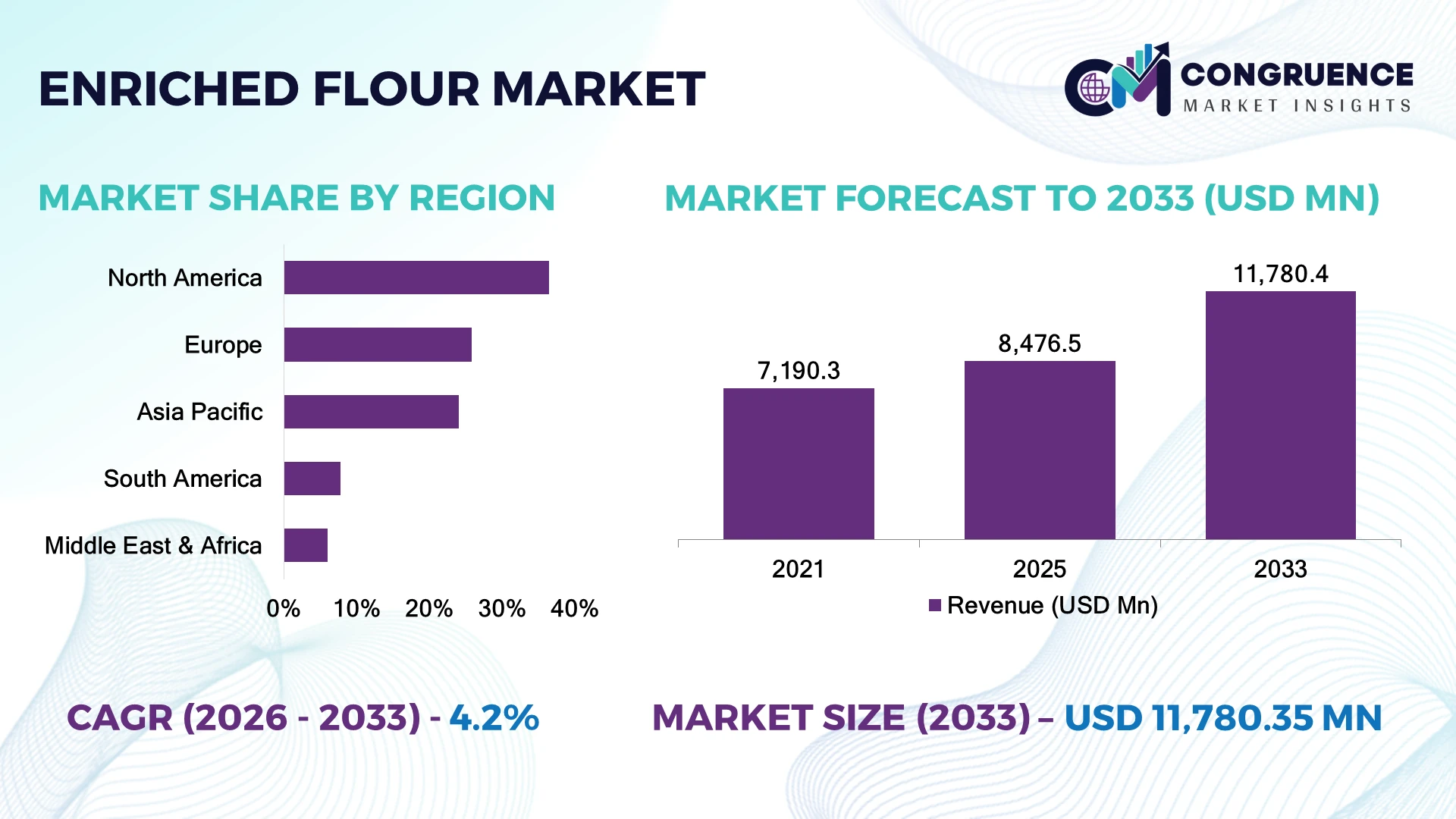
The Global Enriched Flour Market was valued at USD 8,476.5 Million in 2025 and is anticipated to reach a value of USD 11,780.4 Million by 2033 expanding at a CAGR of 4.2% between 2026 and 2033. Growth is driven by mandatory micronutrient fortification, rising industrial bakery production, and reformulation toward iron, folic acid, niacin, riboflavin, and thiamine-enriched staples.
The United States remains a dominant market, supported by highly industrialized milling and standardized enrichment practices, while India is accelerating adoption through large-scale wheat processing and public nutrition programs. More than 80 countries have wheat-flour fortification legislation, while global iron-fortified wheat or maize flour coverage averages about 43.5%, creating substantial room for capacity expansion and compliance-led demand.
Geopolitical grain-trade disruptions and shifting wheat procurement strategies in 2026 are increasing the value of localized milling and fortified ingredient supply chains.
Strategically, producers with reliable premix sourcing, automated dosing, and regulatory-grade quality control are best positioned to capture institutional and packaged-food demand.
Market Size & Growth: USD 8,476.5 million in 2025 to USD 11,780.4 million by 2033 at 4.2% CAGR, supported by fortification mandates and industrial bakery expansion.
Top Growth Drivers: Fortification adoption 43.5%; packaged bakery penetration 4–6%; industrial milling modernization 5–7%.
Short-Term Forecast: By 2028, automated nutrient dosing can reduce formulation variance by 15–20% while improving batch consistency by 8–12%.
Emerging Technologies: Inline micronutrient dosing, near-infrared quality monitoring, and automated blending are shifting mills toward tighter formulation control.
Regional Leaders: North America, Asia-Pacific, and Europe remain key demand centers, with adoption increasingly linked to fortified staple-food programs.
Consumer/End-User Trends: Institutional and packaged-food applications account for a growing share of fortified flour utilization, with specification-driven purchasing rising 8–10%.
Pilot/Case Example: 2025 mill-modernization programs demonstrated 10–15% lower formulation losses through automated premix handling and process monitoring.
Competitive Landscape: Large integrated millers and ingredient suppliers lead, while regional flour producers compete through 5–8% pricing advantages and localized distribution.
Regulatory & ESG Impact: More than 80 countries have wheat-flour fortification legislation, strengthening compliance-led production and reducing micronutrient delivery gaps.
Investment & Funding: Capital allocation is shifting toward automated milling, premix systems, quality laboratories, and regional storage, with efficiency projects targeting 10–15% lower operating losses.
Innovation & Future Outlook: Precision fortification, traceable sourcing, clean-label formulations, and digitally monitored milling will increasingly determine competitive differentiation through 2026–2028.
Enriched flour demand is concentrated in bread, bakery products, noodles, pasta, institutional foods, and household staples where standardized nutrient delivery can be integrated without major changes to established processing workflows. Approximately 43.5% of wheat or maize flour is estimated to be fortified with iron globally, leaving substantial whitespace for compliance-driven production expansion. In 2026, grain-trade volatility and tighter food-quality controls are encouraging millers to localize premix inventories, automate dosing, and strengthen batch traceability, making enrichment capability increasingly important for securing large institutional and food-manufacturing contracts.
Enriched flour is becoming strategically important because fortification is shifting from a product attribute into a production-control requirement. More than 80 countries have legislation covering wheat-flour fortification, making nutrient dosing, quality verification, and regulatory compliance increasingly important to mill competitiveness. For manufacturers, the commercial advantage now extends beyond flour output to consistent micronutrient delivery across high-volume batches.
Technology is reshaping this equation. Automated micro-ingredient dosing can improve formulation consistency by roughly 10–15% compared with manual addition, while inline monitoring reduces batch-release delays and formulation rework. The United States benefits from mature industrial milling and standardized enrichment systems, whereas India and other high-volume wheat-processing markets offer stronger capacity-expansion opportunities as fortified staple programs and packaged foods scale.
Between 2026 and 2028, mills are expected to prioritize automated dosing, digital quality records, premix inventory optimization, and flexible formulation systems. A practical deployment model combines centralized premix handling with automated feeder controls across multiple production lines, reducing operator dependency and improving specification compliance. Companies investing in these capabilities can defend margins, qualify for institutional contracts, and differentiate through traceable, specification-controlled enriched flour rather than competing solely on commodity pricing.
Mandatory wheat-flour fortification and higher packaged-food production are increasing demand for precision enrichment systems. More than 80 countries have wheat-flour fortification legislation, while global fortified wheat or maize flour coverage remains near 43.5%, leaving substantial compliance-driven expansion potential. Automated micronutrient dosing can improve formulation consistency by 10–15% and reduce premix losses by approximately 5–8% compared with manual handling. In the United States, mature industrial milling is accelerating investment in automated feeders, quality laboratories, and digital batch records. Companies are responding through mill modernization, premix-supplier partnerships, and integrated dosing controls. The non-obvious advantage is specification consistency: mills that minimize nutrient variance can qualify more reliably for institutional contracts and large food-manufacturing programs.
Volatile wheat procurement costs and imported premix dependency constrain margins for flour processors operating on narrow spreads. Wheat can represent 60–75% of flour production costs, while micronutrient premixes can add roughly 1–3% to processing expenses depending on formulation and dosage. Smaller mills in India, Nigeria, and other fragmented markets also face higher testing and compliance costs, limiting modernization budgets by an estimated 5–10%. Disruptions across Black Sea grain routes have increased procurement uncertainty and encouraged mills to hold larger inventories. Companies are mitigating exposure through multi-origin wheat contracts, localized premix sourcing, and longer-term supplier agreements. A key operational pressure is balancing low-cost procurement with uninterrupted nutrient availability without creating excessive working-capital requirements.
The largest opportunity lies in combining automated enrichment with expanding staple-food fortification programs in India, Indonesia, Nigeria, and other high-volume wheat-processing markets. With global flour fortification coverage near 43.5%, penetration gaps remain substantial, while automated dosing can reduce nutrient overuse by 5–10% and formulation rework by 8–12%. Next-generation inline sensors and digital batch controls are enabling mills to verify nutrient addition continuously rather than relying entirely on laboratory sampling. Companies are positioning through modular retrofit systems, local premix partnerships, and contract manufacturing arrangements that reduce upfront capital requirements. The strategic opportunity is particularly strong for mid-sized mills: standardized retrofit platforms can convert compliance requirements into a measurable productivity advantage without replacing entire milling lines.
Digital enrichment systems introduce execution complexity that extends beyond equipment installation. Approximately 15–20% of smaller milling facilities still rely heavily on manual dosing or fragmented quality checks, increasing operator dependency and batch variability. Integration between feeders, laboratory systems, enterprise software, and traceability platforms can add 10–15% to commissioning requirements when legacy equipment lacks standardized interfaces. In emerging milling hubs, shortages of automation technicians further slow deployment and maintenance response. Cybersecurity also becomes more relevant as production controls become network-connected. Companies must address these barriers through standardized machine interfaces, workforce training, remote diagnostics, and technology partnerships. The long-term competitive differentiator will be deployment reliability across multiple plants rather than simply installing advanced enrichment equipment.
Automated Dosing Gains Ground Automated premix feeders are increasingly replacing manual addition, improving dosing consistency by 10–15% and reducing ingredient losses by 5–8%. Mills are integrating feeder controls with batch-management systems to shorten quality-release cycles. Labor shortages and tighter formulation requirements are accelerating this transition, while equipment suppliers increasingly offer retrofit packages for older milling lines.
Traceability Becomes Operational Standard Digital batch records and ingredient traceability are expanding as food manufacturers demand stronger compliance visibility. Adoption of electronic production records is increasing operational transparency by approximately 10–15%, while automated lot tracking can reduce reconciliation time by 20%. U.S. and European processors are strengthening digital integration, making traceable enrichment data increasingly important for supplier qualification.
Localized Premix Supply Expands Supply-chain disruptions are encouraging mills to reduce dependence on single-origin micronutrient suppliers. Local or multi-source procurement strategies can lower replenishment exposure by 8–12% and improve inventory continuity. Companies are forming regional distribution partnerships and maintaining safety stocks, revealing a non-obvious shift toward treating premix availability as a production-critical input rather than a routine ingredient purchase.
Retrofit Technology Gains Priority Mid-sized mills are increasingly upgrading existing equipment instead of replacing complete production lines. Modular dosing and monitoring systems can deliver 8–12% higher process consistency with substantially lower installation complexity. Equipment providers are responding with standardized retrofit platforms, remote diagnostics, and scalable automation packages, allowing older facilities to meet tighter enrichment specifications without major structural reconstruction.
Wheat flour is estimated to account for approximately 78% of the global enriched flour market, reflecting its dominant use in bread, bakery products, pasta, noodles, and staple foods. Its established milling infrastructure, standardized enrichment protocols, and compatibility with high-volume processing give it a clear scalability advantage. Corn flour and rice flour represent smaller shares of roughly 12% and 6%, respectively, while other grain-based enriched flours remain niche. Wheat-based products continue to benefit from established fortification legislation and mature industrial supply chains, particularly in the United States, India, and Europe.
Rice flour is emerging as the fastest-growing type, supported by gluten-free formulations, specialty bakery applications, and diversification of staple-food processing. Companies are expanding specialty flour portfolios, investing in dedicated blending systems, and partnering with premix suppliers. The strategic shift is toward flexible milling platforms capable of handling multiple grain bases without compromising nutrient consistency.
In 2024, approximately 30.7% of industrially milled wheat flour in countries identified as good opportunities for fortification was fortified, indicating substantial whitespace for enrichment capacity and compliance-led investment.
Bread and bakery products are estimated to represent approximately 46% of enriched flour consumption, making them the leading application because high-volume commercial bakeries require consistent flour functionality, nutrient specifications, and predictable dough performance. Pasta and noodles follow at nearly 19%, while institutional foods, tortillas and flatbreads, and other processed-food applications collectively account for the remaining demand. Mature bakery applications prioritize formulation consistency and cost control, whereas specialty products increasingly emphasize gluten-free, micronutrient-enhanced, and functional formulations.
Pasta and noodles are the fastest-growing application segment, supported by automated processing, convenience-food expansion, and wider use of enriched formulations in standardized recipes. Adoption is estimated to be increasing 7–9% across industrial applications as manufacturers integrate automated flour dosing and quality-control systems. Companies are expanding application-specific formulations, integrating enrichment into centralized production systems, and developing tailored flour specifications. This makes nutrient consistency increasingly operationally critical for large-scale food manufacturers seeking repeatable texture, shelf stability, and regulatory compliance.
The Food Fortification Initiative reported in 2025 that 85 countries mandate wheat-flour fortification alone or alongside other grains, reinforcing the importance of enriched flour across staple-food and industrial applications.
Food manufacturers are estimated to account for approximately 41% of enriched flour demand, supported by large-scale production of bakery goods, pasta, noodles, prepared foods, and packaged staples. Their purchasing concentration reflects high throughput, strict formulation specifications, and dependence on uninterrupted flour supply. Commercial bakeries represent about 29%, while foodservice operators and household consumers account for approximately 17% and 13%, respectively. Established manufacturers prioritize standardized procurement and laboratory verification, whereas smaller bakeries increasingly seek ready-to-use enriched flour to reduce in-house formulation complexity.
Commercial bakeries are emerging as the fastest-growing end-user group, with adoption expanding around 7–9% as labor constraints and tighter quality requirements encourage outsourcing of enrichment. Companies are responding with customized flour grades, contract supply agreements, smaller packaging formats, and technical support for automated bakery lines. The competitive implication is clear: suppliers that combine reliable nutrient specifications with flexible delivery and application support can capture customers beyond commodity flour procurement. In India, institutional programs are also strengthening demand for already-milled fortified flour, creating opportunities for suppliers able to meet both quality-control and distribution requirements.
In 2025, Food Fortification Initiative work across Haryana, Maharashtra, and Rajasthan involved more than 70 government officials, millers, and development partners in workshops focused on quality-control procedures, monitoring systems, and consumer acceptance for fortified wheat flour.
North America accounted for the largest market share at 36.4% in 2025 however, Asia-Pacific is expected to register the fastest growth, expanding at a CAGR of 5.8% between 2026 and 2033.

Automated fortification and specification-driven milling strengthen production leadership
North America maintains the largest enriched flour position because of mature industrial milling, established enrichment standards, and high-volume bakery and packaged-food production. The United States represents the regional demand center, supported by standardized enrichment requirements for products labeled as enriched and sophisticated quality-control infrastructure. Approximately 80% of U.S. flour production is industrially processed through large-scale milling networks, supporting automated micronutrient dosing and batch verification. Millers are increasingly integrating inline quality monitoring, automated premix feeders, and digital traceability to reduce formulation variability by an estimated 10–15%. The region's competitive advantage increasingly comes from process precision rather than basic flour capacity, encouraging producers to invest in automation, laboratory infrastructure, and customized flour specifications for large bakery and food-manufacturing customers.
United States Market Outlook: The United States remains the principal North American market because of its extensive commercial milling base, mature bakery industry, and established enrichment standards. Enriched flour is deeply integrated into bread, pasta, cereal, and packaged-food manufacturing. More than 80% of U.S. households purchase packaged bread products, sustaining high-volume flour consumption and encouraging mills to prioritize consistent nutrient specifications, automated dosing, and efficient supply contracts.
Regulatory precision and cleaner processing reshape flour formulation
Europe remains a specification-intensive market where flour producers increasingly balance micronutrient compliance, ingredient transparency, and process efficiency. The United Kingdom is particularly significant because mandatory nutrient addition applies to common wheat flour, with folic-acid requirements scheduled for implementation from December 2026. This regulatory transition is encouraging millers and food manufacturers to strengthen premix handling, laboratory verification, and formulation traceability. Automated dosing can reduce nutrient variation by approximately 10–15%, supporting tighter compliance while limiting formulation losses. European producers are also increasing investment in energy-efficient milling and optimized logistics, with efficiency projects targeting 5–8% reductions in processing losses. The strategic shift is toward integrated compliance systems that connect ingredient sourcing, dosing, testing, and finished-product documentation.
United Kingdom Market Outlook: The United Kingdom offers a particularly strong regulatory-driven opportunity because common wheat flour already operates under mandatory enrichment requirements covering calcium, iron, niacin, and thiamin, with folic acid being added from December 2026. This transition is prompting millers to upgrade formulation controls and documentation. The country's established industrial bakery network and centralized retail supply chains support rapid implementation across high-volume flour applications.
India-led milling expansion is converting fortification into scalable production infrastructure
Asia-Pacific is the fastest-expanding market as India, China, Indonesia, and other high-volume grain-processing economies strengthen fortified staple programs and modernize milling capacity. India has approximately 1,500 roller flour mills and more than 376,000 local chakkis, creating a large modernization opportunity despite a highly fragmented structure. Fortification programs are increasingly shifting demand toward organized mills capable of consistent micronutrient dosing and quality verification. In 2025, fortified atta production supported through expanded mill partnerships reached more than 69,000 metric tonnes per month in India, representing an increase of over 120% from the previous year. Companies are responding through modular dosing systems, technical partnerships, and decentralized mill expansion.
India Market Outlook: India is the region's most strategically significant market because wheat flour is a major staple and fortification can be integrated into both organized and decentralized milling networks. Wheat consumption averages approximately 4 kg per person in urban India and 4.3 kg in rural areas, creating strong operational relevance for fortified atta. The organized segment represents only about 30% of the atta market, leaving substantial scope for automation, standardized premix handling, and branded fortified flour expansion.
Staple-food fortification and industrial bakery demand drive modernization
South America presents a structurally diverse enriched flour market, with Brazil representing the principal industrial hub because of its large wheat-processing, bakery, pasta, and food-manufacturing base. Fortification policies and established grain-processing infrastructure support consistent demand for enriched formulations, while fragmented milling capacity in several countries limits uniform technology adoption. Industrial producers are increasingly deploying automated dosing and centralized quality testing, with modernization programs targeting approximately 8–12% improvements in batch consistency. Brazil's large commercial bakery and pasta industries provide the strongest demand concentration, while smaller markets increasingly rely on regional millers and imported wheat. Companies are strengthening local procurement relationships, upgrading milling controls, and expanding fortified product portfolios to reduce exposure to wheat-import volatility.
Brazil Market Outlook: Brazil combines substantial wheat-processing capacity with a large packaged-food and bakery manufacturing base, making it the key South American market. The country relies significantly on imported wheat, increasing the importance of procurement diversification and inventory planning. Large mills are therefore prioritizing automated enrichment, quality laboratories, and longer-term supply agreements to maintain consistent flour specifications despite fluctuations in global wheat availability.
Fortification mandates are accelerating mill modernization and institutional procurement
Middle East and Africa demand is increasingly shaped by food-fortification policies, population growth, institutional feeding programs, and the expansion of commercial bakeries. Nigeria stands out because its 2025 bread regulations require wheat, maize, and composite flour used for bread production to contain specified micronutrients. This strengthens the business case for standardized premix dosing and laboratory verification across commercial mills. Large producers are moving toward automated enrichment systems that can improve formulation consistency by approximately 10–15%, while regional distributors are expanding premix availability. Infrastructure remains uneven, so companies are combining centralized technical support with localized mill deployment. The most important strategic shift is that fortification compliance is becoming a production-access requirement for institutional and commercial bakery channels rather than simply a nutritional product attribute.
Nigeria Market Outlook: Nigeria offers the strongest strategic opportunity because of its large population, extensive bread industry, and regulatory emphasis on fortified flour. The 2025 regulatory framework covers wheat, maize, composite flour, and selected alternative flours used for bread production, expanding the compliance perimeter. Flour producers are consequently investing in dosing equipment, quality-control procedures, and technical training while strengthening distributor networks to support consistent fortified flour availability across fragmented markets.
Global milling leaders such as Archer-Daniels-Midland, Cargill, Bunge, Ardent Mills, and General Mills compete with regional millers and specialty flour producers on scale, formulation, distribution, and fortification capability. The market remains moderately fragmented, with the top five players estimated to control about 24% of global value. Price competitiveness influences roughly 35% of purchasing decisions, while micronutrient consistency and product performance influence about 30%. Supply-chain reliability accounts for nearly 20%, particularly where wheat procurement remains exposed to geopolitical disruptions. Large players are expanding milling networks, strengthening direct food-manufacturer contracts, and integrating sourcing with processing, while specialty producers differentiate through clean-label, multigrain, and targeted-fortification formulations. The competitive shift is moving toward traceable micronutrient dosing, localized sourcing, and value-added flour portfolios rather than commodity pricing alone. Entry barriers center on milling infrastructure, quality-control systems, regulatory compliance, and reliable grain procurement. Winning requires scale economics combined with formulation precision, dependable supply, and differentiated nutrition positioning.
Archer-Daniels-Midland Company
Cargill, Incorporated
Bunge Global SA
Ardent Mills
General Mills, Inc.
Conagra Brands, Inc.
King Arthur Baking Company
Bob’s Red Mill
Bay State Milling Company
Grain Craft
Associated British Foods plc
The Scoular Company
MGP Ingredients, Inc.
ITC Limited
Automated micronutrient dosing is becoming the operational core of modern flour enrichment. Digital microdosers, inline weighing, and closed-loop quality monitoring improve premix consistency by approximately 10–15% versus manual dosing while reducing formulation losses by about 5–8%. Adoption is strongest among high-throughput mills integrating fortification directly into continuous production lines, giving large processors tighter nutrient compliance and lower batch variability.
AI-assisted process control and machine vision are extending automation beyond dosing into flour color, particle-size, moisture, and contamination monitoring. Integrated systems can improve inspection throughput by roughly 15–20% and reduce manual quality checks by around 10%. Producers with diversified flour portfolios benefit most because a common digital control layer enables faster product changeovers, tighter specifications, and more responsive production planning.
From 2026–2028, near-infrared spectroscopy, predictive maintenance, digital traceability, and automated premix replenishment will increasingly connect milling, enrichment, packaging, and quality systems. New sensor-enabled lines can deliver approximately 10% higher operating efficiency than legacy inspection workflows. Competitive advantage will shift toward vertically integrated millers and specialty producers that combine automation with localized sourcing, formulation agility, and real-time compliance data.
February 2025 Fortify Health supported fortified atta launches at six Indian mills, expanding commercial production across Madhya Pradesh, Maharashtra, Uttar Pradesh, and other states. The expansion strengthened decentralized fortification capacity and widened access to micronutrient-enriched wheat flour. Source: Fortify Health
February 2025 ACI Pure Flour launched ACI Pure Power Flour containing 10 essential vitamins and minerals, including iron, folic acid, calcium, and B vitamins. The formulation strengthened premium fortified-flour positioning and expanded micronutrient-focused product differentiation. Source: The Daily Star
October 2025 Millers for Nutrition, the Gujarat Roller Flour Millers Association, and Fortify Health launched seven fortified wheat-flour brands in Ahmedabad. The rollout strengthened private-sector fortification and expanded consumer access through established milling and retail channels. Source: FNB News
June 2026 Millers for Nutrition and industry stakeholders convened a national forum in India to develop a roadmap for scaling staple-food fortification. The initiative targeted wheat flour alongside rice and edible oil, strengthening coordinated industry adoption and policy alignment. Source: Millers for Nutrition
The Enriched Flour Market Report evaluates the industry across wheat, corn, rice, and other flour types, with analysis spanning bakery products, pasta, snacks, confectionery, and other major applications. Coverage also examines household, commercial, and industrial end-users, enabling comparison of purchasing behavior, formulation requirements, production scale, and channel dynamics. The study assesses major markets across North America, Europe, Asia-Pacific, South America, and the Middle East & Africa.
The report also evaluates vitamin, mineral, and multi-nutrient enrichment, automated dosing, digital quality control, traceability, and advanced milling technologies. Competitive analysis covers leading global and regional producers, with strategic assessment of capacity expansion, partnerships, product differentiation, sourcing, and fortification programs. Quantitative indicators covering segment shares, adoption patterns, deployment activity, and company participation support investment planning, geographic expansion, competitive positioning, and strategic decisions through 2033.
| Report Attribute/Metric | Report Details |
|---|---|
|
Market Revenue in 2025 |
USD 8,476.5 Million |
|
Market Revenue in 2033 |
USD 11,780.4 Million |
|
CAGR (2026 - 2033) |
4.2% |
|
Base Year |
2025 |
|
Forecast Period |
2026 - 2033 |
|
Historic Period |
2021 - 2025 |
|
Segments Covered |
By Type
By Application
By End-User
|
|
Key Report Deliverable |
Revenue Forecast, Growth Trends, Market Dynamics, Segmental Overview, Regional and Country-wise Analysis, Competition Landscape |
|
Region Covered |
North America, Europe, Asia-Pacific, South America, Middle East, Africa |
|
Key Players Analyzed |
Archer-Daniels-Midland Company, Cargill, Incorporated, Bunge Global SA, Ardent Mills, General Mills, Inc., Conagra Brands, Inc., King Arthur Baking Company, Bob’s Red Mill, Bay State Milling Company, Grain Craft, Associated British Foods plc, The Scoular Company, MGP Ingredients, Inc., ITC Limited |
|
Customization & Pricing |
Available on Request (10% Customization is Free) |




