
Reports
The Global Enhanced Flight Vision Systems Market was valued at USD 1725.69 Million in 2025 and is anticipated to reach a value of USD 3082.32 Million by 2033 expanding at a CAGR of 7.52% between 2026 and 2033. Growth is driven by multispectral infrared imaging, synthetic-vision fusion, head-up display integration, low-visibility landing capabilities, and increasing EFVS deployment across business jets, commercial aircraft, and special-mission aviation.
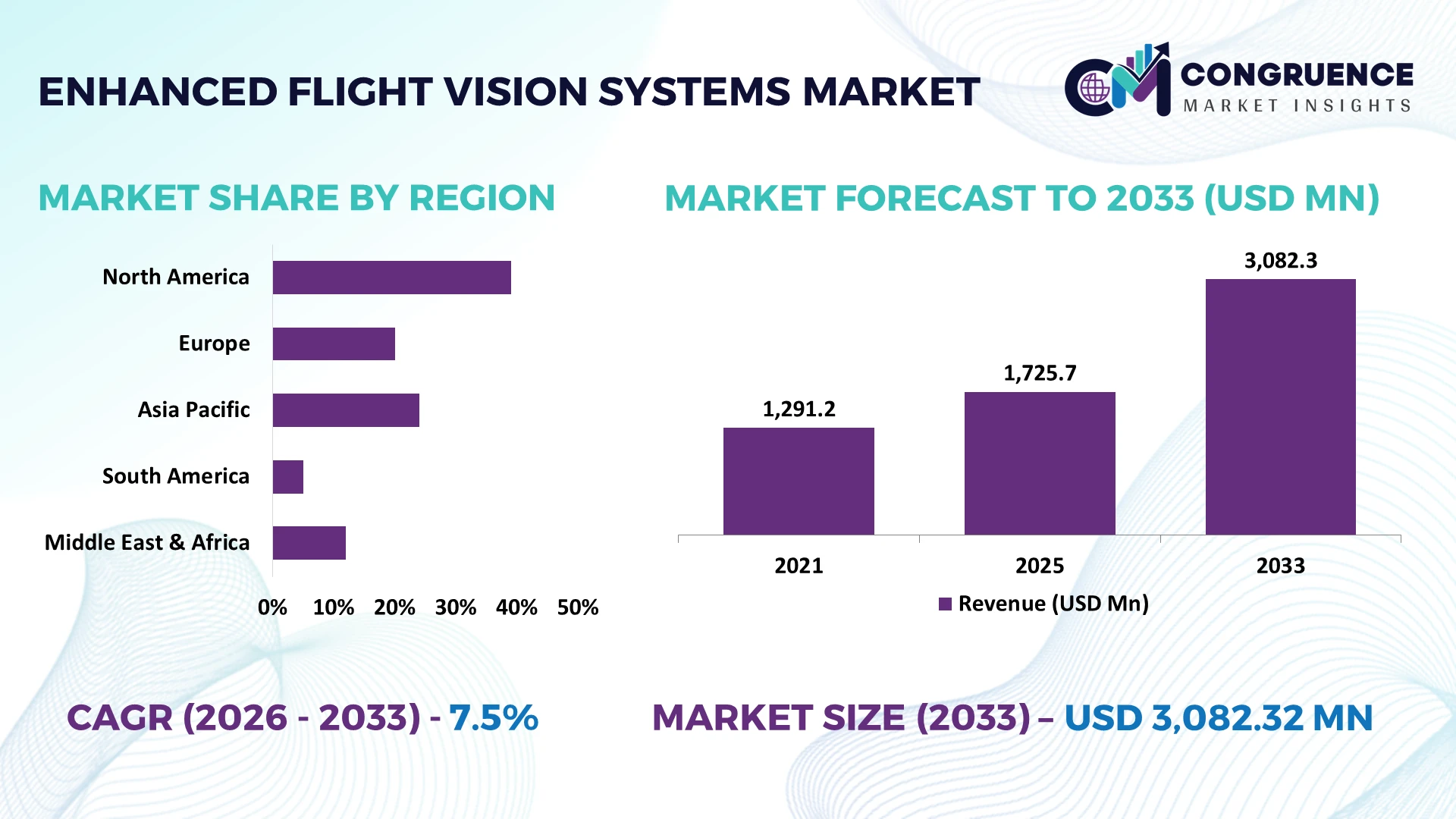
The United States dominates the Enhanced Flight Vision Systems Market, supported by more than 15,000 registered business aircraft, extensive avionics manufacturing capabilities, and early adoption of advanced cockpit technologies. North America accounts for approximately 43% of global demand, compared with nearly 27% for Europe. FAA regulations enabling qualified EFVS operations down to 100 feet reinforce U.S. technology adoption and retrofit activity. Global business-jet deliveries increased 11.8% to 854 aircraft in 2025, while geopolitical emphasis on all-weather defense, surveillance, emergency-response, and special-mission aviation is expanding requirements for sensor-fused flight vision systems.
Strategically, avionics suppliers combining certified multispectral sensors, synthetic vision, head-up guidance, and retrofit-ready architectures are positioned to gain competitive advantage as operators prioritize dispatch reliability and low-visibility airport accessibility.
Market Size & Growth: USD 1,725.69 million in 2025 is projected to reach USD 3,082.32 million by 2033 at 7.52% CAGR, supported by multispectral imaging, HUD integration, and low-visibility operational requirements.
Top Growth Drivers: 11.8% growth in business-jet deliveries, approximately 50% lower visibility thresholds with advanced EFVS configurations, and expanding special-mission aviation requirements are the three strongest adoption drivers.
Short-Term Forecast: By 2028, advanced EFVS installations will increasingly enable operations at visibility thresholds approximately 50% below conventional requirements, strengthening flight completion rates and reducing weather-driven operational disruption.
Emerging Technologies: Multispectral infrared cameras, AI-assisted image enhancement, synthetic-vision fusion, wearable HUDs, and 180-degree panoramic visualization are transforming EFVS from standalone imaging equipment into integrated cockpit situational-awareness platforms.
Regional Leaders: North America is projected near USD 1.33 billion by 2033, Europe around USD 832 million, and Asia-Pacific approximately USD 616 million, supported by business aviation, regulatory modernization, and fleet expansion respectively.
Consumer/End-User Trends: Approximately 97% of U.S. business aircraft operate outside Fortune 500 company fleets, creating substantial retrofit opportunities across charter operators, private aviation, emergency services, government agencies, and special-mission fleets.
Pilot/Case Example: In 2023, Boeing 737NG AerAware certification testing accumulated approximately 100 flight-test hours, supporting a system designed to reduce minimum required visibility by 50% through dual wearable head-up display technology.
Competitive Landscape: Gulfstream maintains a strong integrated-EFVS position, while Honeywell, Collins Aerospace, Universal Avionics, Elbit Systems, and Dassault-linked avionics platforms compete through certification breadth, sensor performance, retrofit flexibility, and cockpit integration.
Regulatory & ESG Impact: FAA EFVS regulations permit qualified operations to 100 feet above touchdown-zone elevation, with approved systems supporting touchdown and rollout, reducing weather-related diversions, go-arounds, unnecessary fuel consumption, and operational delays.
Investment & Funding: Collins Aerospace committed USD 26.5 million in 2026 toward advanced aviation radar production expansion, highlighting broader aerospace investment in sensing, imaging, processing, and next-generation situational-awareness technologies.
Innovation & Future Outlook: Fourth-generation multispectral cameras, combined vision systems, AI-supported imagery, dual-pilot HUD architectures, and wearable displays are shifting the global Enhanced Flight Vision Systems Market toward software-rich, sensor-fused avionics.
Enhanced Flight Vision Systems demand is strengthening across business aviation, commercial retrofits, defense transport, firefighting, and special-mission aircraft requiring reliable low-visibility operations. Multispectral sensors increasingly combine visible and infrared imagery with synthetic terrain and advanced HUDs, with selected systems reducing minimum visibility requirements by 50%. Regulatory operational credits and all-weather mission requirements are accelerating the strategic shift toward integrated vision architectures.
Enhanced Flight Vision Systems are becoming strategically important as airlines, business-jet operators, and special-mission fleets prioritize dispatch reliability and low-visibility airport access. Regulatory evolution is reinforcing this shift: qualified FAA operations can continue below conventional decision heights, including approved EFVS operations to 100 feet above touchdown-zone elevation. This converts enhanced vision from optional cockpit equipment into an operational-capability differentiator.
Multispectral EFVS combining infrared, visible-light sensing, synthetic terrain, and head-up guidance delivers a measurable advantage over legacy instrument-only approaches; advanced configurations support operations with approximately 50% lower minimum visibility requirements. The United States leads deployment through its large business-aviation base and certification ecosystem, while Europe emphasizes integrated avionics modernization and Asia-Pacific remains more concentrated in new-aircraft installations.
Through 2028, retrofit demand will strengthen alongside business-jet and special-mission fleet modernization. Boeing 737NG AerAware certification activity, including roughly 100 flight-test hours, demonstrates the pathway toward airline-scale applications. Suppliers are consequently investing in sensor fusion, wearable displays, certification partnerships, and platform-independent retrofit architectures. Competitive leadership will increasingly depend on converting superior visibility into certified operational access, fewer weather disruptions, and higher aircraft utilization.
Low-visibility operational access is the strongest structural driver for EFVS adoption because operators increasingly measure avionics value through mission completion rather than cockpit functionality alone. Advanced EFVS configurations can reduce minimum required visibility by approximately 50%, while FAA rules permit qualified operations to 100 feet above touchdown-zone elevation and approved systems through touchdown and rollout. Global business-jet deliveries increased 11.8% to 854 aircraft in 2025, expanding the installation base for advanced vision systems. In the United States, weather-sensitive charter, corporate, medical, and special-mission operations create particularly strong utilization economics. Manufacturers are responding by integrating multispectral cameras with HUDs, synthetic vision, and flight-guidance computers. The strategic advantage is higher dispatch reliability without requiring equivalent investment in airport-based landing infrastructure.
Certification complexity and aircraft-specific integration constrain rapid EFVS scaling, particularly across older fleets with heterogeneous avionics architectures. Approximately 97% of U.S. business aircraft operate outside Fortune 500 fleets, creating a fragmented customer base in which retrofit budgets and aircraft utilization vary substantially. Meanwhile, systems targeting approximately 50% lower visibility minima require more than sensor installation: HUD compatibility, flight-control interfaces, human-factors validation, supplemental certification, and pilot training increase program complexity. FAA operational credits also depend on approved configurations rather than hardware capability alone. This limits standardized deployment across multiple aircraft types and extends supplier payback periods. Avionics companies are reducing exposure through modular architectures, supplemental type certificates, reusable software components, and partnerships with aircraft OEMs and modification centers. Certification scalability, rather than sensor manufacturing capacity, remains the sharper commercial constraint.
The strongest opportunity lies in transforming EFVS from premium forward-looking infrared equipment into a software-rich combined vision platform deployable across broader aircraft classes. Advanced systems already demonstrate approximately 50% lower minimum visibility requirements, while the United States offers an addressable installed base exceeding 15,000 business aircraft. Global business-jet deliveries rose 11.8% in 2025, simultaneously creating factory-fit and future retrofit opportunities. The next technology cycle integrates multispectral infrared sensing, synthetic terrain, AI-assisted image enhancement, panoramic visualization, and wearable head-up displays. Boeing 737NG applications also establish a pathway beyond traditional business aviation into commercial retrofits. Suppliers are increasing R&D around sensor fusion and platform-independent interfaces while forming certification and OEM partnerships. A non-obvious opportunity is monetizing operational credits through avionics upgrades rather than selling imaging performance alone.
Long-term competitiveness depends on making fused vision information consistently usable across aircraft platforms, pilots, weather conditions, and certification regimes. Boeing 737NG AerAware certification accumulated roughly 100 flight-test hours, illustrating the validation burden required before operational deployment, while advanced configurations targeting 50% lower visibility minima demand precise alignment between sensors, displays, aircraft attitude data, and flight guidance. In the United States, more than 15,000 business aircraft span numerous cockpit generations, magnifying software-interface and human-factors complexity. Sensor latency, degraded visual environments, display clutter, pilot training, cybersecurity, and database integrity therefore become execution challenges rather than simple hardware constraints. Suppliers must invest in open avionics interfaces, simulation-based validation, secure software updates, standardized training, and OEM partnerships. Sustainable leadership requires repeatable certification and pilot trust across fleets, not merely superior infrared image quality.
Combined Vision Moves Into Cockpits: Operators are shifting from standalone infrared imagery toward combined enhanced and synthetic vision architectures that fuse real-time sensors with terrain databases. Advanced configurations support visibility thresholds around 50% below conventional requirements, while 2025 FAA guidance expanded operational-credit clarity. Avionics suppliers are integrating multispectral cameras, HUD symbology, and flight-guidance data into unified certification packages.
Wearable Displays Expand Retrofit Options: Head-mounted and wearable HUD technologies are reducing dependence on permanently installed cockpit displays, particularly for retrofit-sensitive fleets. Boeing 737NG AerAware testing accumulated about 100 flight-test hours, while dual wearable displays provide both pilots with aligned enhanced imagery. Suppliers are pursuing lighter hardware, standardized interfaces, and certification partnerships to shorten aircraft-modification cycles and improve fleet-level deployment economics.
Business Jet Modernization Accelerates: Global business-jet deliveries increased 11.8% to 854 aircraft in 2025, while Honeywell found 20% of surveyed operators had aircraft on firm order and 91% expected unchanged or higher flying activity in 2026. OEMs and avionics companies are responding by prioritizing factory-installed combined vision, retrofit packages, and integrated safety systems for increasingly utilized fleets.
Avionics Architectures Become Software-Led: Cockpit modernization is moving toward high-compute, domain-based architectures capable of supporting AI-enhanced imagery, cybersecurity, and faster processor upgrades. Honeywell and NXP expanded their 2025 partnership around next-generation avionics and large-area displays, while Honeywell’s aerospace orders rose 23% organically. The non-obvious shift is toward reusable computing infrastructure that lowers future sensor-integration complexity across multiple aircraft platforms.
Enhanced Vision Systems lead the type segmentation with an estimated 36% share, reflecting their established use of infrared and multispectral sensors for real-time external scene presentation in degraded visibility. Their mature certification base, compatibility with head-up displays, and retrofit availability sustain adoption across business and special-mission aircraft. Combined Vision Systems are the fastest-growing type as operators increasingly integrate enhanced imagery with synthetic terrain, navigation, and flight-guidance symbology. Combined architectures are estimated to represent about 24% of installations, while advanced configurations can support approximately 50% lower visibility minima than conventional visual operations.
Synthetic Vision Systems remain strategically important for terrain awareness and database-driven situational awareness, particularly where infrared sensing is unnecessary. Head-Up Display Systems remain essential interfaces for operational-credit applications, whereas Head-Mounted Systems are emerging as flexible alternatives for aircraft where conventional HUD installation is structurally difficult. Collins Aerospace, Honeywell, Universal Avionics, and Elbit Systems are consequently emphasizing sensor fusion, modular computing, wearable displays, and cross-platform certification. Investment priorities are moving from individual sensors toward integrated combined-vision architectures that create stronger operational value per installation.
Business Aviation leads application demand with an estimated 37% share, supported by frequent operations at secondary airports, schedule-sensitive missions, premium avionics adoption, and a strong installed base of EFVS-equipped Gulfstream and other large-cabin aircraft. Global business-jet shipments increased 11.8% to 854 units in 2025, expanding both factory-fit and future retrofit opportunities. Commercial Aviation is the fastest-growing application as wearable displays and platform-adaptable systems make enhanced vision more practical for larger airline fleets and narrow-body retrofit programs.
Military Aviation maintains strategically important demand for degraded-visual-environment missions, transport operations, and night capability, while Helicopter Operations benefit from enhanced terrain and obstacle identification during emergency, offshore, and low-altitude missions. General Aviation remains more cost-sensitive, favoring synthetic vision and lower-cost display integration over premium certified EFVS architectures. Suppliers are adapting through modular avionics, airline certification programs, lighter sensors, and cockpit-display partnerships. Demand is therefore shifting from premium business-jet safety equipment toward wider operational deployment where low-visibility access directly affects aircraft utilization and mission completion.
Business Jet Operators represent the largest end-user group with an estimated 35% share, reflecting high aircraft utilization, schedule sensitivity, operation into smaller airports, and willingness to invest in premium safety and low-visibility capability. Honeywell’s 2025 operator survey found 91% expected to fly more or approximately the same during 2026, while 20% had at least one aircraft on firm order. These utilization patterns strengthen demand for integrated EFVS, HUDs, and combined vision upgrades. Airlines are the fastest-growing buyer group as certified wearable displays and scalable retrofit architectures improve deployment economics across larger fleets.
Aircraft Manufacturers remain critical because factory integration reduces certification and installation complexity, while Defense Forces prioritize mission-capable multispectral systems rather than purely commercial operational credits. Flight Training Organizations represent a smaller but strategically important group as EFVS procedures become embedded in simulator and recurrent-training requirements. Suppliers are targeting buyers through OEM line-fit agreements, fleet-specific retrofit packages, certification support, training ecosystems, and software-upgrade pathways. Competitive positioning increasingly depends on supporting the complete operational lifecycle rather than selling standalone imaging hardware.
North America accounted for the largest market share at 43% in 2025 however, Asia-Pacific is expected to register the fastest growth, expanding at a CAGR of 9.4% between 2026 and 2033.

Certification Leadership Accelerates Advanced Cockpit Deployment
North America represents approximately 43% of global Enhanced Flight Vision Systems demand, anchored by the United States’ large business-aviation fleet, avionics engineering base, and mature supplemental type certification ecosystem. The region benefits from concentrated activity by Honeywell, Collins Aerospace, Gulfstream, Garmin, and specialized avionics integrators. U.S. FAA operational-credit frameworks permit qualified EFVS operations to 100 feet above touchdown-zone elevation and, for approved configurations, through touchdown and rollout. Global business-jet deliveries increased 11.8% to 854 aircraft in 2025, with U.S.-based operators representing a substantial addressable line-fit and retrofit base. Investment is increasingly directed toward multispectral sensing, combined vision, wearable displays, and software-defined avionics. Canadian operators add demand from northern, remote, medevac, and resource-sector missions where degraded visibility directly affects dispatch reliability.
United States Market Outlook: The United States maintains the strongest EFVS ecosystem through its business-jet concentration, FAA certification structure, aircraft OEM presence, and high-value avionics supply chain. More than 15,000 business aircraft provide a substantial installed base for cockpit modernization. Operational-credit certification gives U.S. suppliers a commercial advantage by converting improved sensor performance into measurable airport-access and mission-completion benefits.
Integrated Avionics Modernization Shapes Adoption
Europe holds approximately 27% of global Enhanced Flight Vision Systems demand, supported by business aviation, aerospace manufacturing, defense modernization, and dense cross-border flight activity. The European business-aviation fleet includes more than 4,100 based aircraft, creating a meaningful addressable platform for combined vision, synthetic vision, and head-up guidance. France, Germany, Switzerland, and the United Kingdom concentrate aircraft manufacturing, avionics engineering, premium business aviation, and modification capabilities. Europe is increasingly emphasizing integrated cockpit architectures rather than isolated sensor upgrades, with Thales, Saab, Leonardo, and aircraft OEMs advancing digital avionics and mission-system integration. High airport density and weather variability strengthen the operational case for enhanced situational awareness. However, certification harmonization and fleet diversity favor modular systems capable of integration across multiple aircraft types rather than highly customized single-platform solutions.
France Market Outlook: France provides a strategically important EFVS environment through Dassault Aviation, Thales, aerospace engineering clusters, military aviation programs, and Paris Le Bourget’s business-aviation activity. The Paris Le Bourget–Geneva route recorded more than 3,300 two-way business aviation flights in 2024, demonstrating the operational intensity supporting investments in dependable low-visibility cockpit technologies and advanced flight-guidance integration.
Fleet Expansion Opens New Deployment Scale
Asia-Pacific represents approximately 20% of Enhanced Flight Vision Systems demand, with China, Australia, Japan, Singapore, and India driving aircraft modernization, general aviation development, and airport infrastructure expansion. Unlike North America’s retrofit-heavy market, deployment increasingly follows new-aircraft procurement, digital cockpit upgrades, and expanding special-mission fleets. China had 3,140 registered general aviation aircraft and 513 registered general aviation airports by the end of 2025, while annual general aviation flying reached 1.219 million hours. These operating volumes create a larger foundation for synthetic vision, enhanced vision, and integrated display adoption. Japanese and Australian operators add demand from mountainous, remote, offshore, and emergency-service missions. Avionics suppliers are consequently prioritizing OEM partnerships, local certification support, modular cockpit integration, and regional maintenance capability to capture expanding fleets without creating excessive aircraft-specific engineering costs.
China Market Outlook: China offers substantial long-term deployment potential through aviation infrastructure expansion and low-altitude airspace modernization. Its 513 registered general aviation airports create a geographically distributed operating network, while 46 low-altitude flight-service stations covered 23 provincial-level areas by the end of 2025. This infrastructure favors integrated navigation, synthetic vision, terrain awareness, and eventually advanced EFVS adoption across specialized aviation missions.
Brazil Anchors Fleet Modernization Demand
South America represents approximately 6% of global Enhanced Flight Vision Systems demand, with Brazil providing the strongest industrial and operational foundation. Business aviation, agricultural aviation, offshore energy support, emergency services, and operations across geographically dispersed airports create practical demand for improved situational awareness. Brazil’s advantage extends beyond aircraft utilization because Embraer provides a domestic aircraft manufacturing and avionics-integration ecosystem capable of influencing factory-fit technology adoption. Embraer delivered 155 executive jets in 2025, including 72 Phenom 300-series aircraft, strengthening the installed base for increasingly sophisticated cockpit systems. Chile, Colombia, and Argentina provide additional opportunities in mountainous and remote operations, although fleet age and modernization budgets constrain deployment speed. Suppliers are emphasizing scalable retrofit packages, OEM integration, training support, and maintenance partnerships rather than relying solely on premium factory installations.
Brazil Market Outlook: Brazil combines aircraft manufacturing, executive aviation, defense programs, and extensive operations across remote terrain. Embraer surpassed 2,000 cumulative business-jet deliveries in 2025, while more than 900 Phenom 300-series aircraft are now operating across 70 countries. This manufacturing scale gives Brazil an unusually strong pathway for introducing advanced vision functionality through OEM cockpit architectures and subsequent fleet upgrades.
Aviation Megaprojects Reinforce Cockpit Modernization
Middle East & Africa accounts for approximately 4% of global Enhanced Flight Vision Systems demand, but aviation infrastructure investment and premium fleet modernization create concentrated high-value opportunities. The UAE and Saudi Arabia are building airport capacity around international connectivity, executive aviation, defense, and long-range fleet operations. Dubai’s planned Al Maktoum International expansion is designed around substantially greater future passenger and aircraft capacity, strengthening demand for advanced avionics across operators using the hub. Gulf carriers and business-jet fleets generally adopt high-specification cockpit technologies earlier than cost-sensitive African operators. Across Africa, medevac, mining, humanitarian, surveillance, and remote-airfield operations provide a different EFVS use case centered on mission completion. Suppliers are pursuing OEM relationships, defense partnerships, regional MRO capability, and integrated cockpit packages rather than broad commodity-style distribution.
United Arab Emirates Market Outlook: The UAE is the region’s strongest technology and infrastructure hub, led by Dubai and Abu Dhabi aviation ecosystems. Al Maktoum International’s planned expansion targets eventual capacity of approximately 260 million passengers annually and five parallel runways. This infrastructure scale, combined with premium business aviation and defense activity, supports advanced HUD, synthetic vision, and multispectral cockpit adoption.
Honeywell, Collins Aerospace, Elbit Systems, Thales, and Garmin form the core technology-led competitive group, while Gulfstream, Dassault Aviation, Saab, and Leonardo influence adoption through aircraft and mission-system integration. The top five suppliers are estimated to control approximately 68% of EFVS-related system demand, reflecting certification barriers and concentrated avionics expertise. Competition centers on sensor fusion, certification coverage, retrofit flexibility, and display integration rather than price alone. Advanced combined-vision configurations can lower minimum visibility requirements by roughly 50%, while business-jet deliveries increased 11.8% in 2025, intensifying line-fit competition. Honeywell and Collins emphasize integrated avionics architectures; Elbit advances wearable displays and multispectral systems; Garmin targets scalable cockpit integration; Thales leverages commercial and defense avionics. Partnerships with OEMs, certification specialists, and modification centers increasingly determine deployment speed. The competitive shift favors software-defined combined vision over standalone infrared sensors. Certification cost, human-factors validation, and platform integration remain formidable entry barriers. Winning requires certified operational capability, reusable architectures, OEM access, and dependable lifecycle support.
Honeywell International
Collins Aerospace
Elbit Systems
Thales
Garmin
Gulfstream Aerospace
Dassault Aviation
Saab
Leonardo
L3Harris Technologies
BAE Systems
Astronics Corporation
Avidyne Corporation
Current EFVS technology centers on multispectral electro-optical sensors combining visible, short-wave infrared, and long-wave infrared imagery with head-up guidance. Collins EVS-3600 delivers 33% operational credit in CAT II/III weather, while certified AerAware provides a 50% visual advantage over unaided vision. Adoption is strongest on premium business aircraft, special-mission platforms, and certified Boeing 737NG retrofits, converting improved visibility into fewer diversions and higher dispatch reliability.
Emerging combined vision systems fuse real-time enhanced imagery with synthetic terrain, obstacle databases, flight guidance, and increasingly wearable displays. Compared with legacy natural-vision operations, certified EFVS can cut applicable visibility minima by 50%, materially widening usable approach windows. FalconEye integrates six sensors across four lenses, while SkyLens provides 360-degree synthetic-vision symbology. Aircraft OEMs and retrofit specialists benefit by differentiating platforms without requiring equivalent airport infrastructure upgrades.
Disruptive development is shifting toward AI-assisted image processing, augmented-reality overlays, object detection, and software-defined vision architectures. FAA research through 2029 is examining dual HUDs and advanced displays, reinforcing the integration pathway. During 2026–2028, wider certification of combined and wearable systems should move EFVS beyond premium jets into airline, firefighting, helicopter, and special-mission fleets. Suppliers acting now secure certification experience, OEM integration positions, and recurring software-upgrade advantages across global fleet programs.
October 2024 Universal Avionics secured FAA STC approval for ClearVision EFVS on King Air B200/300 aircraft with Global Aviation Tech. SkyLens combines EVS and synthetic 3D terrain, expanding wearable-HUD deployment for firefighting, medical, special-operations, and VIP missions globally. Source: universalavionics.com
September 2025 Dassault Aviation’s Falcon 6X received EASA approval for FalconEye EFVS operations down to a 100-foot decision height. The certification strengthens all-weather business-jet capability, converting combined synthetic and enhanced vision into measurable airport-access and dispatch advantages operationally. Source: ainonline.com
September 2025 FAA issued AC 20-167B, updating airworthiness guidance for EVS, EFVS, and combined vision installations across Parts 23, 25, 27, and 29 aircraft. The revision broadens certification pathways for novel vision functions and scalable multi-platform deployment worldwide. Source: faa.gov
March 2026 Dassault Aviation rolled out the Falcon 10X before more than 400 customers, partners, and aviation leaders, making dual FalconEye Enhanced Vision Systems standard. The configuration embeds combined vision into a flagship business jet, strengthening factory-fit adoption. Source: dassault-aviation.com
The Enhanced Flight Vision Systems Market Report evaluates technology deployment, competitive positioning, and adoption pathways from 2026 to 2033. Coverage includes Enhanced Vision Systems, Synthetic Vision Systems, Combined Vision Systems, Head-Up Display Systems, and Head-Mounted Systems across commercial aviation, business aviation, general aviation, military aviation, and helicopter operations. Business aviation currently represents approximately 37% of application demand, while Enhanced Vision Systems account for an estimated 36% of type-level deployment.
The report assesses airlines, aircraft manufacturers, defense forces, business jet operators, and flight training organizations across North America, Europe, Asia-Pacific, South America, and Middle East & Africa. Analysis incorporates multispectral infrared sensing, synthetic terrain, wearable displays, AI-assisted imaging, sensor fusion, and operational-credit certification. With advanced systems delivering up to 50% visibility advantage, the scope supports investment prioritization, geographic expansion, technology partnerships, competitive benchmarking, retrofit planning, and identification of emerging commercial and special-mission deployment opportunities.
| Report Attribute/Metric | Report Details |
|---|---|
Market Revenue in 2025 | USD 1725.69 Million |
Market Revenue in 2033 | USD 3082.32 Million |
CAGR (2026 - 2033) | 7.52% |
Base Year | 2025 |
Forecast Period | 2026 - 2033 |
Historic Period | 2021 - 2025 |
Segments Covered | By Type
By Application
By End-User
|
Key Report Deliverable | Revenue Forecast, Growth Trends, Market Dynamics, Segmental Overview, Regional and Country-wise Analysis, Competition Landscape |
Region Covered | North America, Europe, Asia-Pacific, South America, Middle East, Africa |
Key Players Analyzed | Honeywell International, Collins Aerospace, Elbit Systems, Thales, Garmin, Gulfstream Aerospace, Dassault Aviation, Saab, Leonardo, L3Harris Technologies, BAE Systems, Astronics Corporation, Avidyne Corporation |
Customization & Pricing | Available on Request (10% Customization is Free) |




