
Reports
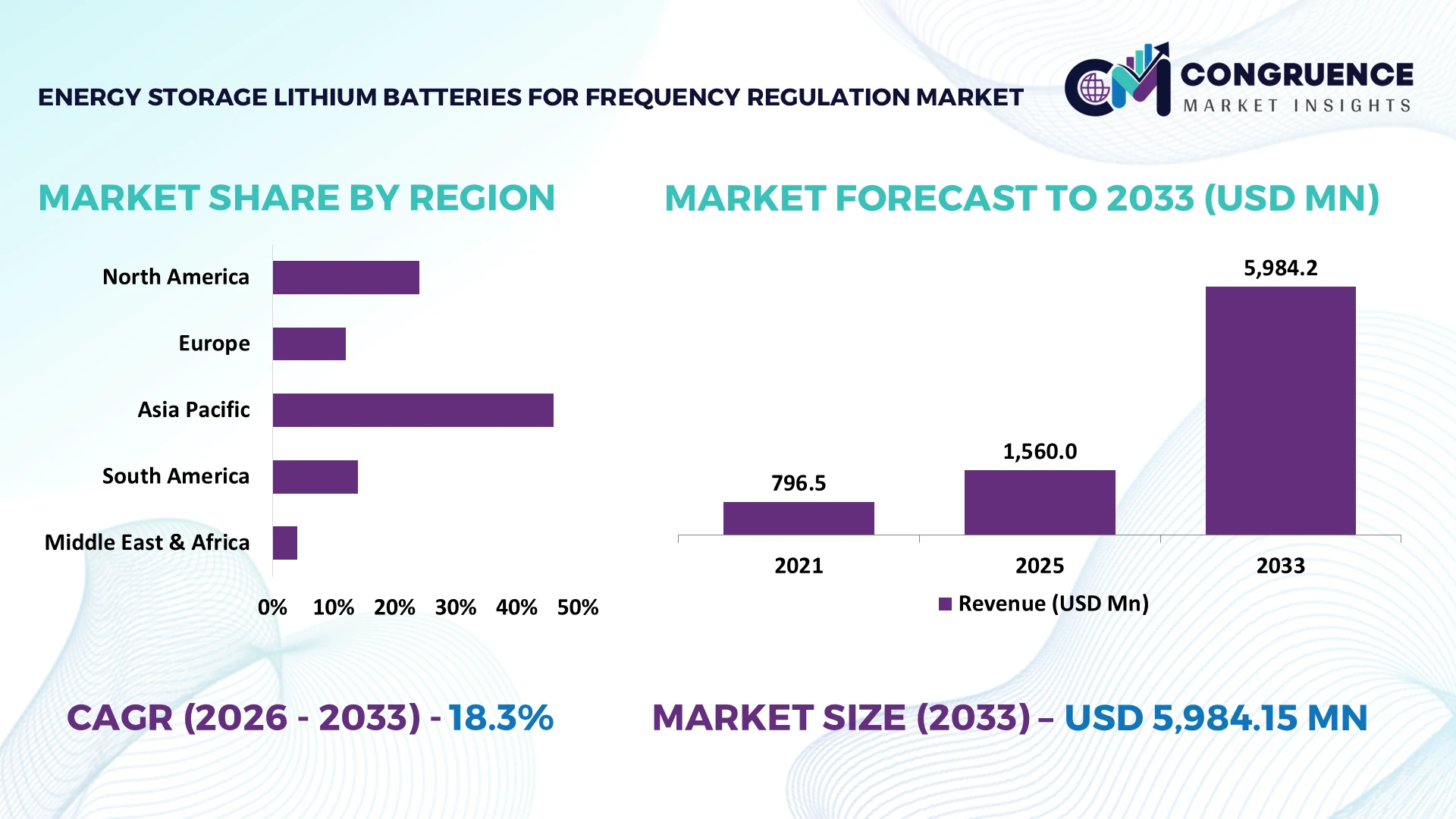
The Global Energy Storage Lithium Batteries for Frequency Regulation Market was valued at USD 1,560.0 Million in 2025 and is anticipated to reach a value of USD 5,984.2 Million by 2033 expanding at a CAGR of 18.3% between 2026 and 2033. Growth is anchored in grid operators replacing slow thermal frequency response with lithium battery systems capable of sub-second dispatch, exemplified by China’s 2025 ancillary services rule that formally admits storage as a market entity across 15 provincial frequency regulation markets.
China dominates with approximately 54% of global storage capacity additions in 2025, backed by state-backed VGF auctions in Andhra Pradesh, India, discovering tariffs of ₹1.48 lakh/MW/month for 2 GWh of frequency-capable BESS. The United States follows with 16% share but faces a 90% processing dependency on China for LFP cathode and graphite anode material, creating a strategic divergence: China scales deployment while the US attempts supply-chain localization.
The strategic implication is clear—battery frequency regulation leadership now hinges on simultaneous control of cell manufacturing capacity and ancillary service market access, not standalone project development.
Market Size & Growth: Valued at USD 1,560.0 Million in 2025, projected to reach USD 5,984.2 Million by 2033 at 18.3% CAGR, driven by ancillary service market liberalization that compensates fast-ramping storage for frequency response.
Top Growth Drivers: 54% of global storage capacity additions originated in China in 2025; 15 Chinese provinces now operate frequency regulation markets; LFP chemistry commands over 90% share of stationary storage deployments .
Short-Term Forecast: By 2027, four-hour battery storage costs decline 27% year-on-year to USD 78/MWh, accelerating frequency regulation project economics .
Emerging Technologies: Sodium-ion batteries enter frequency regulation with CATL’s 60 GWh supply agreement to Beijing HyperStrong; virtual machine mode enables batteries to provide synthetic inertia equivalent to 3,000 MWs .
Regional Leaders: China leads with 54% of 2025 global capacity additions; United States holds 16% share with data-center-driven frequency regulation demand; India emerges with 2 GWh BESS auction at ₹1.48 lakh/MW/month .
Consumer/End-User Trends: 95% minimum annual availability requirements now standard in Indian BESS contracts, forcing integrators to guarantee frequency response uptime .
Pilot/Case Example: Hornsdale Power Reserve (Australia, 2024) reduced South Australia regulation FCAS prices by 75% while delivering response times under 100 milliseconds .
Competitive Landscape: CATL leads with 9.5% revenue share in grid-scale storage; BYD surpassed Tesla in 2025 BESS shipments with 13% share versus Tesla’s 10% .
Regulatory & ESG Impact: China’s 2025 ancillary services rules require “who benefits, who pays” cost allocation, expanding storage revenue certainty across 15 provincial markets .
Investment & Funding: Energy storage VC investment rose 30% to USD 4.8 billion in 2025, with downstream frequency-capable project developers capturing the largest share .
Innovation & Future Outlook: Virtual inertia and grid-forming inverter modes shift batteries from passive frequency support to active grid-stabilization assets, redefining procurement specifications.
The Energy Storage Lithium Batteries for Frequency Regulation Market is shifting from pilot-scale frequency response toward contracted ancillary service revenue, with over 90% of stationary systems relying on LFP chemistry and 15 Chinese provinces formalizing storage compensation . Product innovation centers on grid-forming inverters and virtual machine mode, enabling batteries to substitute synchronous inertia rather than merely inject fast frequency response. A parallel trend is sodium-ion commercialization, with CATL committing 60 GWh to stationary applications. China’s 2025 ancillary service rules, which mandate cost pass-through to beneficiaries, establish a replicable regulatory template for emerging markets. This regulatory and technology convergence sets the stage for strategic positioning discussions.
Frequency regulation batteries have moved from technical curiosity to grid-critical infrastructure, and the competitive stakes now extend beyond cell chemistry into market design and supply-chain control. China’s 2025 ancillary service rules created a national framework where storage competes directly with thermal generators for frequency response payments across 15 provincial markets, transforming a pilot-stage revenue stream into a bankable cash flow. Simultaneously, the United States pursues tariff-driven localization, yet 90% of LFP cathode processing remains in China, creating a cost-versus-security tension that shapes procurement decisions .
Technology comparisons favor lithium batteries decisively over legacy frequency response assets. The Hornsdale Power Reserve reduced South Australia’s regulation FCAS costs by 75% while delivering response times under 100 milliseconds, compared to the multi-second ramp rates of conventional synchronous generators . Grid-forming inverter modes now allow batteries to provide synthetic inertia up to 3,000 MWs, directly substituting the mechanical inertia that retiring coal plants once supplied . Regionally, China’s 54% share of 2025 capacity additions reflects centralized procurement scale, while the United States’ 16% share is driven by data-center load growth and state-level storage mandates .
Operationally, APTRANSCO’s 2025 auction for 1,000 MW/2,000 MWh of BESS in Andhra Pradesh established a ₹1.48 lakh/MW/month benchmark and required 95% annual availability, signaling that Indian utilities now treat frequency-capable storage as firm capacity rather than experimental supplementation . Developers are responding by structuring build-own-operate models with VGF support and securing LFP cell supply agreements that hedge against cathode material volatility. The strategic conclusion: competitive advantage in frequency regulation storage belongs to firms that combine low-cost LFP cell access, proven grid-forming inverter performance, and early positioning in newly liberalized ancillary service markets—not simply to those with the largest project pipelines.
China’s 2025 Basic Rules for the Power Auxiliary Services Market formally recognized storage enterprises as eligible market participants, expanding frequency regulation compensation to 15 provincial markets and mandating “beneficiary pays” cost allocation. This regulatory shift converts frequency response from an unrewarded grid obligation into a contracted revenue line, directly improving project bankability. BYD capitalized on this policy clarity to ship over 60 GWh of BESS in 2025, capturing 13% global market share and overtaking Tesla, with its 14.5 MWh浩瀚 system deployed in Saudi Arabia’s 12.5 GWh project. The operational insight: market design—not cell cost alone—determines whether frequency regulation assets achieve utilization rates sufficient to justify premium inverter and control-system specifications.
Over 90% of LFP cathode processing capacity and approximately 90% of battery anode active material production remain concentrated in China, creating tariff exposure and supply lead-time risk for non-Chinese frequency regulation projects. US developers face a 105–115% anti-dumping duty on synthetic graphite, yet duty-inclusive prices remain at USD 5–7/lb because domestic capacity is commercially immature. The direct business impact is margin compression for Western integrators who cannot pass cathode cost increases into fixed-price ancillary service contracts. Companies are responding through LFP supply agreements with diversified cell vendors and, in limited cases, seed-stage investments in non-Chinese cathode processing, though commercial-scale alternatives remain years from qualification.
Virtual machine mode demonstrated at Hornsdale Power Reserve enables lithium batteries to supply up to 3,000 MWs of synthetic inertia, directly addressing the frequency stability gap created by coal retirements in South Australia and comparable markets. This capability commands premium ancillary service payments beyond basic frequency response, as grid operators in Britain, Australia, and parts of the US Midwest increasingly procure inertia as a distinct service. CATL’s TENER platform and Tesla’s Megapack 3 now ship with grid-forming firmware as standard, positioning integrators to bid into inertia markets without hardware retrofits . The non-obvious opportunity lies in markets where synchronous condenser retrofits are being evaluated—grid-forming batteries can provide equivalent inertia at lower capital cost and faster deployment timelines.
As frequency regulation fleets scale, utilities in India and the United States report integration complexity between BESS inverters, SCADA systems, and legacy frequency measurement infrastructure, with 95% availability requirements leaving minimal tolerance for communication latency or firmware incompatibility. A related constraint is the shortage of power-systems engineers trained in grid-forming inverter tuning; Australia’s AEMO has noted that virtual machine mode commissioning requires specialized expertise not widely available outside original equipment manufacturers. Companies must invest in interoperability testing protocols and operator training programs before committing to multi-vendor procurement strategies, or risk availability penalties that erode frequency regulation revenue.
Hybrid Lithium-Sodium Configurations Enter Commercial Service China’s first large-scale lithium-sodium hybrid storage station, the 200 MW/400 MWh Baochi facility in Yunnan, entered operation in May 2025 with 98% green electricity input and a grid-forming sodium battery system delivering three times the power and six times the response speed of prior sodium units. The configuration allows operators to switch between slow-charge/slow-discharge and fast-charge/fast-discharge modes, improving frequency regulation flexibility while reducing lithium import dependence—China sources 70% of lithium battery materials from overseas. CSG is positioning the model for deployment across high-renewable provinces including Tibet, Xinjiang, and Gansu, where coal retirements are accelerating.
Grid-Forming Inverters Become Procurement Default Grid-forming inverter capability is shifting from pilot specification to baseline requirement as utilities confront inertia shortfalls from coal closures. The Baochi station’s sodium system provides real-time voltage and frequency adjustment, enabling renewable clusters to participate in market transactions rather than merely stabilize locally . In Japan, CATL’s TENER Flex units are being deployed across multiple Kanto sites under a 1 GWh supply agreement, with AI.net targeting 500 MW of storage development by March 2028 . The operational impact: inverters that once represented 8–12% of system cost now determine whether a project qualifies for premium frequency response contracts.
Safety Compliance Reshapes System Architecture Thermal incidents at large-scale installations have pushed fire mitigation and degradation-limit verification into procurement scoring, with developers required to demonstrate cycling performance under realistic frequency regulation duty cycles rather than nominal power ratings. South Korea and Japan now impose stricter certification and interconnection standards, lengthening deployment timelines for non-compliant vendors by 4–6 months. Companies are responding by integrating AI-enabled monitoring for predictive maintenance, as demonstrated by Samsung SDI’s 2025 grid-service modules, reducing unplanned downtime that would trigger availability penalties.
Revenue Stacking Rewrites Dispatch Logic Frequency regulation assets are being dispatched to capture stacked revenue from regulation, arbitrage, and capacity payments, with optimization platforms prioritizing multi-market participation over single-service cycling. This shift is visible in Japan’s FIP-subsidized projects, where CATL and AI.net are structuring self-trading capabilities to capture price spreads alongside frequency response payments. The non-obvious insight: batteries optimized solely for frequency regulation now underperform financially against assets that reserve 15–20% of capacity for energy arbitrage, forcing developers to re-specify duration and state-of-charge windows at the design stage.
Lithium iron phosphate (LFP) chemistry accounts for approximately 90% of new utility-scale frequency regulation deployments, sustained by 3,000 to over 6,000 cycle durability and stable partial-charge performance under high-frequency cycling duty. LFP’s dominance is structural rather than temporary: manufacturing capacity concentrated in China has driven cell costs low enough that frequency regulation projects recover chemistry premiums within 18–24 months of operation.
The fastest-growing sub-segment is hybrid lithium-sodium configurations, which entered commercial service in Yunnan in 2025 with a 200 MW/400 MWh facility integrating grid-forming sodium batteries alongside LFP racks. Sodium’s threefold power advantage and sixfold response-speed improvement over earlier sodium units position it for high-cycling frequency regulation where lithium supply volatility poses procurement risk. Companies are responding by locking LFP cell supply through multi-year agreements while funding sodium qualification pilots, with CATL and CSG both advancing hybrid architectures rather than replacing LFP outright.
Frequency regulation commands an estimated 81.7% share of grid-scale stationary battery storage applications, reflecting the near-instantaneous response advantage that lithium systems hold over thermal and hydro balancing resources in high-renewable grids. Demand concentration is highest in markets where renewable penetration exceeds 50%, such as South Australia and China’s Yunnan province, where frequency volatility forces system operators to procure fast-response capacity as a reliability necessity rather than an economic optimization.
The fastest-growing application variant is hybrid frequency regulation combined with multi-hour energy shifting, with 2-hour and 4-hour systems increasingly specified to capture both regulation payments and evening peak arbitrage. Peak shaving and renewable integration applications remain secondary, though they are converging with frequency regulation as developers stack services on single assets. Companies are adapting by configuring DC-coupled architectures that preserve frequency response speed while extending discharge duration, and by integrating forecasting and automated controls to manage state-of-charge across stacked service obligations .
Utilities and independent system operators account for the dominant share of frequency regulation battery procurement, driven by the operational necessity of maintaining frequency stability as synchronous generation retires and renewable penetration rises. This buyer group prioritizes verified response time, availability guarantees exceeding 95%, and cybersecurity compliance over cell-level cost optimization, creating a procurement profile distinct from commercial and industrial storage buyers.
The fastest-growing end-user segment is independent power producers, who are entering frequency regulation markets in Japan and India through build-own-operate models supported by VGF auctions and FIP subsidies. In Japan, AI.net's 1 GWh CATL supply agreement and 500 MW development target by 2028 exemplify IPP positioning, with self-trading capabilities planned to capture ancillary service revenue directly . Commercial and industrial end-users remain marginal for frequency regulation specifically, though virtual power plant aggregation of behind-the-meter batteries is gaining traction in dense urban markets like Japan and South Korea as a cost-effective alternative to utility-scale installations .
Asia-Pacific accounted for the largest market share at 46% in 2025 however, North America is expected to register the fastest growth, expanding at a CAGR of 19.8% between 2026 and 2033.
North America commands 24% of global frequency regulation lithium battery demand, anchored by PJM and ERCOT ancillary service frameworks that compensate sub-second response assets. Deployment concentrates in Texas and the Mid-Atlantic, where coal retirements have created acute frequency response shortfalls. The region’s supply position remains structurally exposed: over 90% of LFP cathode processing and anode material originates in China, and US anti-dumping duties on synthetic graphite have not catalyzed commercial-scale domestic substitution. A measurable operational development is the 2025 Samsung SDI–NextEra agreement supplying grid-forming battery modules for 1.2 GWh of frequency-capable projects in Texas, signaling Korean suppliers capturing share as tariff-exposed Chinese cells face procurement friction.
United States Market Outlook: The United States anchors North American demand through PJM’s Regulation D market and ERCOT’s fast frequency response procurement, with grid operators prioritizing resources capable of sub-second dispatch. Data-center load growth in Virginia and Texas has intensified local frequency volatility, prompting utilities to contract storage with 95% availability guarantees. Domestic LFP manufacturing remains nascent, with announced plants unlikely to reach commercial output before 2028, sustaining import dependency through the forecast horizon.
Europe represents 12% of global frequency regulation battery demand, concentrated in Great Britain’s Dynamic Containment market and Nordic primary frequency reserves. The region’s distinctive technical requirement is fast-switching power conversion capable of 2–3 times rated power for seconds, favoring high-C-rate LFP systems over energy-optimized configurations. Europe installed 36 GWh of new battery storage in 2025, with utility-scale surpassing residential as the largest annual segment for the first time. The EU’s Critical Raw Materials Act targets 40% domestic lithium processing by 2030, yet Chinese suppliers CATL, BYD, and Gotion still hold 60–70% of European frequency regulation cell volume.
United Kingdom Market Outlook: The UK’s Dynamic Containment and Dynamic Moderation markets have created Europe’s most liquid frequency regulation revenue streams, attracting over 1 GW of operational grid-scale batteries. National Grid ESO’s procurement framework rewards response times under 200 milliseconds, driving adoption of grid-forming inverter firmware across new projects. The UK added approximately 4 GWh of large-scale capacity in 2025, rebounding after a 2024 decline caused by reduced grid-scale revenues, with front-of-the-meter storage reaching 18.5 GW/34.4 GWh across Europe by year-end.
Asia-Pacific commands 46% of global frequency regulation lithium battery demand, underpinned by China’s dominance in cell manufacturing and grid-scale deployment. China alone installed over 63 GW of new battery capacity in 2025, with utility-scale systems accounting for 55 GW, and Chinese manufacturers CATL and BYD anchoring global LFP supply chains. Australia recorded one of the strongest surges globally, adding 9.8 GWh—a 216% jump—supported by AEMO’s fast frequency response market rules. India is the fastest-growing major market, with severe grid frequency deviations driving demand for fast-response batteries, supported by national storage policy and VGF auctions. The region’s integrated supply chain and aggressive renewable buildouts create a structural cost advantage that Western markets cannot replicate near-term.
China Market Outlook: China anchors Asia-Pacific demand through its 15 provincial frequency regulation markets and state-backed renewable integration mandates. The country hosts more than 70% of global lithium-ion cell manufacturing capacity, with CATL’s 121 GWh BESS-dedicated output and BYD’s 60 GWh shipments reinforcing supply-chain control. China’s December 2025 alone added 65 GWh of grid-scale capacity, exceeding the US annual total by more than 15 GWh. Grid-forming inverter adoption is accelerating across provincial markets, positioning Chinese developers to capture premium ancillary service payments as market rules mature.
South America represents 14% of global frequency regulation battery demand, with deployment concentrated in Chile where renewable curtailment and mining sector load growth create localized frequency stability needs. The region holds approximately half of global lithium reserves, yet domestic cell manufacturing remains absent, leaving developers dependent on imported Chinese and Korean systems. A measurable deployment milestone is the BESS del Desierto project, a 200 MW/800 MWh standalone facility in northern Chile featuring Sungrow PowerTitan liquid cooling systems, supplying over 280 GWh of clean energy annually and addressing grid capacity limitations that cause renewable curtailment. High capital costs and limited ancillary service market frameworks constrain scale, though Chile’s renewable capacity exceeding 14 GW has created operational urgency for fast-response storage in the northern Atacama grid.
Chile Market Outlook: Chile leads South American frequency regulation storage deployment, driven by renewable curtailment and frequency deviations in the northern mining grid. ACCIONA Energía is constructing a 1 GWh BESS at its Malgarida photovoltaic complex in the Atacama Desert, delivering 200 MW for up to five hours and scheduled for commissioning in early 2027. Chile’s lithium resource endowment provides long-term cost advantages, but domestic processing capacity remains undeveloped, leaving project economics exposed to imported cell pricing.
Middle East & Africa represents 4% of global frequency regulation battery demand, with deployment dominated by Saudi Arabia’s giga-scale storage tenders and South Africa’s grid stabilization needs. Saudi Electricity Company awarded Hithium a contract for two BESS projects in Tabuk and Hail provinces totaling 4 GWh, one of the largest Middle East deployments, with systems engineered for extreme climate conditions and providing frequency regulation alongside load shifting and black-start capability. The region’s distinctive dynamic is that frequency regulation value is embedded within larger renewable integration and grid modernization projects, with developers configuring systems to capture ancillary service payments where regulatory frameworks permit.
Saudi Arabia Market Outlook: Saudi Arabia’s giga-scale storage procurement, anchored by the 4 GWh Hithium-supplied Tabuk and Hail projects, embeds frequency regulation capability within sovereign renewable integration mandates rather than standalone ancillary service markets. The kingdom’s grid is characterized by large centralized generation and rapidly growing solar capacity, creating frequency stability challenges that battery systems address alongside energy shifting. Vision 2030 industrial localization targets are beginning to attract battery assembly investment, though cell manufacturing remains import-dependent, leaving project costs tied to Asian supply chains.
Competition in frequency regulation lithium batteries pits vertically integrated Chinese manufacturers against Western system integrators and Korean cell suppliers. CATL leads BESS cell shipments at 20% share, while BYD commands 13% of system integration, overtaking Tesla. The top five players—CATL, BYD, Hithium, EVE, and LG Energy Solution—hold approximately 73% combined share. Competition hinges on LFP cell cost control (stationary storage packs at $70/kWh, 45% below 2024) and grid-forming inverter capability, with Chinese firms leveraging 13% domestic price declines versus 44–56% premiums in North America and Europe. Players compete through vertical integration: BYD’s self-supplied blade LFP cells and 14.5 MWh 浩瀚 system, CATL’s 121 GWh BESS-dedicated output, and Tesla’s Megapack grid-forming deployment in Australia . The competitive shift is toward supply-chain control and ancillary market access, not standalone cell performance. Entry barriers are severe: LFP cathode processing concentration in China and 95% availability guarantees in Indian tenders favor incumbents with locked cell supply and proven inverter firmware. Winning requires simultaneous control of low-cost LFP access, grid-forming technology validation, and early positioning in liberalizing frequency regulation markets.
CATL
BYD
Hithium
EVE Energy
LG Energy Solution
Samsung SDI
Tesla
Fluence
Sungrow
Risen Energy
Gotion High-tech
Trina Storage
HyperStrong
Narada Power
LFP chemistry dominates current frequency regulation deployments at approximately 89% share, driven by cycle durability exceeding 6,000 cycles and stationary storage pack prices falling 45% to $70/kWh in 2025 . Grid-forming inverters operating in virtual machine mode represent the critical emerging technology, demonstrated at the 185 MW/370 MWh Koorangie facility in Victoria, where Tesla Megapacks provide 125 MW of system strength services under a 20-year AEMO agreement . This capability replaces synchronous inertia once supplied by coal plants, enabling batteries to bid into premium system strength markets beyond basic frequency response.
Sodium-ion chemistry is the disruptive contender, with China’s 200 MW/400 MWh Baochi hybrid facility entering operation in 2025 and demonstrating three times the power and six times the response speed of earlier sodium units. Adoption remains at pilot-scale, representing under 2% of stationary deployments, but addresses China’s 70% lithium import dependence. The new-versus-old comparison is stark: grid-forming LFP systems deliver sub-100 millisecond response and synthetic inertia, versus multi-second ramp rates from thermal generators, commanding premium ancillary payments.
Competitively, Chinese manufacturers with integrated cell-to-system capability—CATL, BYD—benefit most from LFP cost leadership, while Tesla and Fluence capture value through grid-forming firmware and market integration expertise. Through 2026–2028, grid-forming capability becomes procurement default, and firms without validated inverter technology face exclusion from AEMO and National Grid tender shortlists.
July 2025 – Edify Energy The 185 MW/370 MWh Koorangie BESS with 100 Tesla Megapacks in virtual machine mode became fully operational, securing a 20-year AEMO agreement for 125 MW system strength services. Business impact: validates grid-forming storage as coal-inertia substitute. Source: pv-magazine-australia.com
December 2025 – BloombergNEF Stationary storage pack prices fell 45% to $70/kWh in 2025, the sharpest decline across all battery segments, driven by LFP overcapacity and Chinese manufacturing scale. Business impact: frequency regulation project economics improve as cell costs compress. Source: about.bnef.com
May 2026 – BYD overtook Tesla as the largest BESS integrator with 60 GWh shipped and 13% market share in 2025, propelled by its 14.5 MWh 浩瀚 system deployed in Saudi Arabia’s 12.5 GWh project. Business impact: vertical integration proves decisive in system-level competition. Source: cnenergynews.cn
June 2026 – Energy-Storage.News CATL retained BESS cell leadership with 121 GWh delivered and 20% market share, though its share declined from 29% in 2024 as competitors scaled. Business impact: market expansion outpaces single-supplier dominance, intensifying price competition. Source: energy-storage.news
This report delivers a comprehensive assessment of the global frequency regulation lithium battery market, segmented by type (LFP, sodium-ion hybrid, and emerging chemistries), application (frequency regulation, energy shifting, and stacked ancillary services), and end-user (utilities, independent power producers, and commercial aggregators). Regional coverage spans North America, Europe, Asia-Pacific, South America, and Middle East & Africa, with country-level granularity for the United States, United Kingdom, Australia, China, India, Japan, Chile, and Saudi Arabia.
Quantitative indicators include LFP’s 89% type share, 1C systems commanding 69% of application demand, and the top five manufacturers holding 73% combined share. The report supports investment planning through deployment pipeline analysis, competitive positioning via grid-forming technology benchmarking, and expansion strategy through identification of liberalizing ancillary service markets in India, Japan, and Australia. Coverage extends to emerging sodium-ion commercialization and hybrid lithium-sodium configurations entering commercial service in China, providing forward-looking intelligence for 2026–2033 capital allocation and partnership decisions.
| Report Attribute / Metric | Details |
|---|---|
| Market Revenue (2025) | USD 1,560.0 Million |
| Market Revenue (2033) | USD 5,984.2 Million |
| CAGR (2026–2033) | 18.3% |
| Base Year | 2025 |
| Forecast Period | 2026–2033 |
| Historic Period | 2021–2025 |
| Segments Covered |
By Type
By Application
By End-User
|
| Key Deliverables | Revenue Forecast; Market Trends; Growth Drivers & Restraints; Technology Insights; Segmentation Analysis; Regional Insights; Competitive Landscape; Regulatory & ESG Overview; Recent Developments |
| Regions Covered | North America; Europe; Asia-Pacific; South America; Middle East & Africa |
| Companies Profiled | CATL; BYD; Hithium; EVE Energy; LG Energy Solution; Samsung SDI; Tesla; Fluence; Sungrow; Risen Energy; Gotion High-tech; Trina Storage; HyperStrong; Narada Power |
| Customization & Pricing | Available on Request (10% Customization Free) |




