
Reports
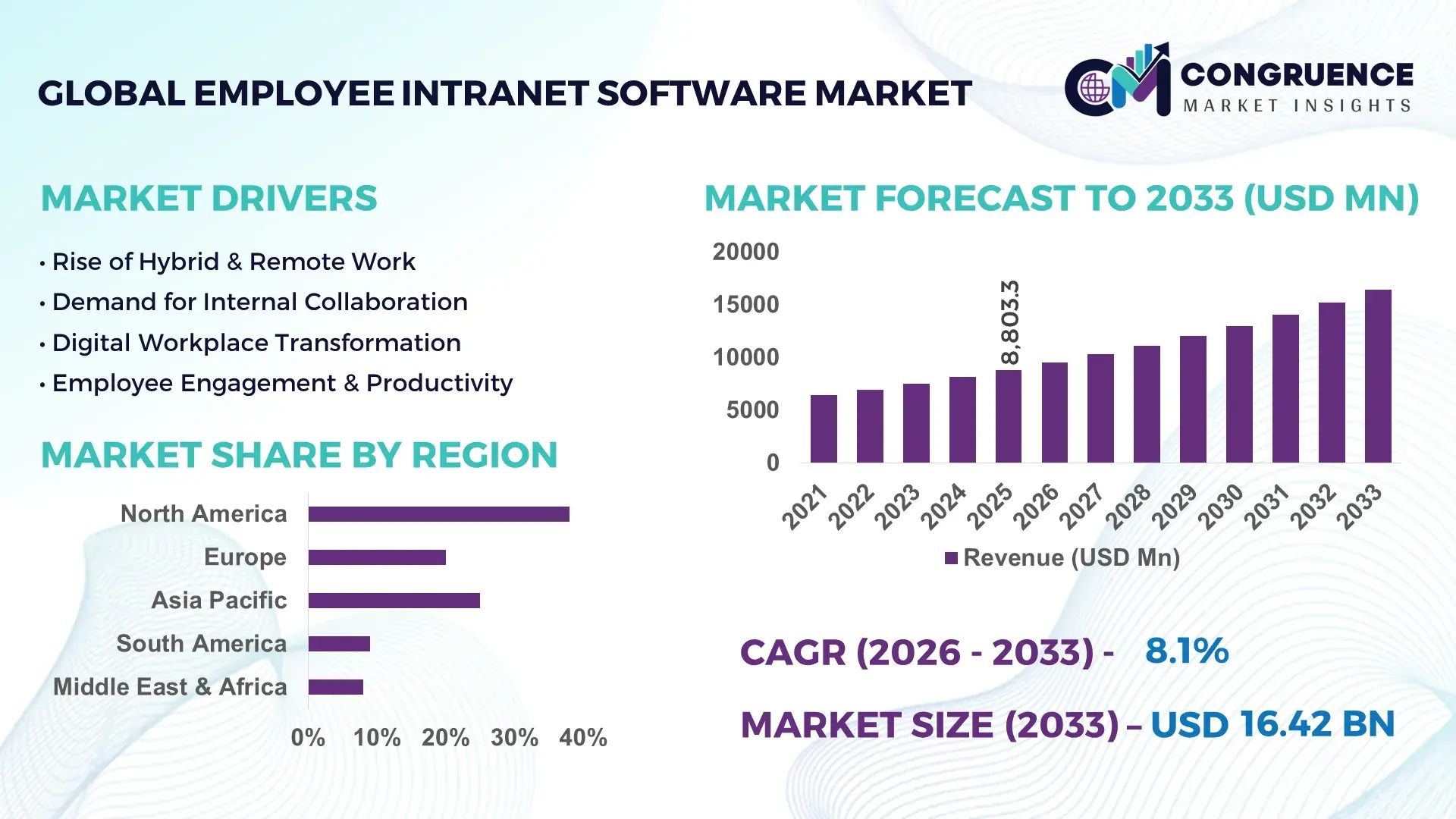
The Global Employee Intranet Software Market was valued at USD 8803.34 Million in 2025 and is anticipated to reach a value of USD 16415.46 Million by 2033 expanding at a CAGR of 8.1% between 2026 and 2033, driven by the increasing need for streamlined internal communications and digital collaboration solutions.
The United States plays a pivotal role in the Employee Intranet Software market, with production capacity exceeding 2,500 enterprise-grade platforms annually. In 2025, investments in R&D for AI-enabled collaboration tools reached approximately USD 1.2 Billion, facilitating seamless integration with cloud-based workflows. Key applications span corporate HR management, knowledge sharing, and internal social networking. Technological advancements include predictive analytics for employee engagement and adaptive user interfaces. Adoption among Fortune 500 companies averages 78%, with mid-sized enterprises rapidly increasing deployment, reflecting robust acceptance across both public and private sectors.
Market Size & Growth: Valued at USD 8803.34 Million in 2025, expected to reach USD 16415.46 Million by 2033 at a CAGR of 8.1%, fueled by digital workplace transformation.
Top Growth Drivers: Increased digital adoption (67%), enhanced operational efficiency (52%), rising cloud deployment (48%).
Short-Term Forecast: By 2028, organizations can expect internal communication efficiency to improve by 35% and collaboration cost reductions of up to 22%.
Emerging Technologies: AI-driven analytics, cloud-native intranet platforms, intelligent chatbots.
Regional Leaders: North America USD 6150 Million, Europe USD 4380 Million, Asia-Pacific USD 3950 Million by 2033; high enterprise adoption in tech and finance sectors noted.
Consumer/End-User Trends: Corporates prioritize knowledge management and remote team integration, with adoption rates highest in IT and professional services.
Pilot or Case Example: A 2026 U.S. enterprise pilot demonstrated 40% reduction in email traffic and 30% improvement in project turnaround.
Competitive Landscape: Market leader Microsoft (approx. 27%), followed by Slack, IBM, Salesforce, and Atlassian.
Regulatory & ESG Impact: Compliance with data privacy regulations and ESG-driven digital workplace policies encourages adoption.
Investment & Funding Patterns: Over USD 900 Million invested in innovative intranet solutions in 2025, focusing on cloud integration and AI features.
Innovation & Future Outlook: Advanced personalization, cross-platform integration, and AI-powered knowledge recommendations expected to redefine intranet software utility.
The Employee Intranet Software market continues to evolve with corporate sectors such as IT services, finance, healthcare, and manufacturing driving demand through enhanced collaboration and operational efficiency. Recent technological innovations, including AI-assisted document management, advanced search algorithms, and real-time workflow automation, are improving productivity and employee engagement. Regulatory compliance and environmental considerations are shaping adoption patterns, while regional growth is notable in North America, Europe, and Asia-Pacific, reflecting targeted investments and digital transformation initiatives. Emerging trends such as AI-driven analytics, mobile-first intranet platforms, and hybrid workplace enablement indicate strong forward-looking potential for businesses aiming to optimize internal communications and knowledge management strategies.
The Employee Intranet Software Market holds strategic relevance as organizations increasingly prioritize digital collaboration, operational efficiency, and secure internal communications. Advanced AI-driven intranet platforms deliver up to 35% improvement in workflow automation compared to traditional static intranet systems. North America dominates in volume, while Europe leads in adoption with over 72% of enterprises implementing advanced intranet solutions. By 2028, predictive analytics and AI-powered knowledge management are expected to improve employee productivity by 28% and reduce internal communication bottlenecks by 22%. Firms are committing to ESG improvements such as a 20% reduction in paper-based workflows and a 15% increase in recycled digital resources by 2027. In 2026, a U.S.-based multinational achieved a 40% reduction in project turnaround time through AI-assisted document management and collaborative workflow integration. Regional investments are shaping future pathways, with Asia-Pacific seeing increasing uptake in cloud-based intranet solutions due to remote workforce expansion and regulatory compliance initiatives. Forward-looking strategies emphasize scalability, seamless cloud integration, and AI-driven personalization, positioning the Employee Intranet Software Market as a pillar of resilience, compliance, and sustainable growth in an increasingly digital corporate landscape.
The rising demand for digital collaboration is a key driver of the Employee Intranet Software market. Organizations are prioritizing tools that allow seamless communication across geographically dispersed teams. AI-enabled intranet platforms enable real-time collaboration, reduce email overload, and facilitate knowledge sharing across departments. For example, enterprises implementing advanced intranet solutions report up to 30% faster project completion and 25% improvement in internal communication efficiency. Moreover, the integration of mobile-accessible intranet solutions has increased adoption among remote and hybrid workforce segments, with over 65% of mid-sized firms deploying mobile-friendly platforms in 2025. These trends highlight the critical role of digital collaboration in driving enterprise efficiency and engagement, directly influencing market growth.
Integration complexities present a significant restraint to the Employee Intranet Software market. Enterprises often operate with multiple legacy systems, creating challenges in seamlessly connecting new intranet platforms with existing ERP, CRM, or HR management tools. These integration hurdles can lead to delayed deployment and increased IT overhead, with some organizations reporting up to a 20% rise in implementation time and associated costs. Additionally, ensuring data security and compliance during integration with cloud-based or hybrid environments adds further challenges, especially in highly regulated industries like finance and healthcare. Compatibility issues across devices and operating systems also limit uniform adoption. Consequently, while demand remains high, these technical and operational constraints continue to moderate the market’s growth pace.
AI-driven personalization presents a major opportunity in the Employee Intranet Software market. By leveraging machine learning algorithms, intranet platforms can tailor content, workflows, and notifications to individual employee roles and preferences, enhancing engagement and productivity. In pilot programs conducted in 2025, organizations implementing AI personalization observed a 32% increase in knowledge-sharing activities and a 28% improvement in task completion speed. Additionally, the integration of AI chatbots for real-time support reduces helpdesk workload by 20–25%. Expanding these capabilities into mobile platforms and multilingual environments opens untapped markets in emerging economies, providing scalable solutions for diverse workforce structures. The focus on predictive insights and intelligent recommendations positions AI-enhanced intranets as a transformative opportunity for enterprises seeking operational excellence.
Rising implementation costs and compliance complexities pose significant challenges to the Employee Intranet Software market. Advanced intranet platforms require substantial upfront investment in software licenses, cloud infrastructure, and IT resources, with some enterprises reporting implementation costs exceeding USD 250,000 for mid-sized deployments. Compliance with data privacy regulations such as GDPR in Europe or HIPAA in the U.S. adds layers of technical and legal requirements, increasing project timelines by up to 15–20%. Smaller organizations often lack the resources or expertise to navigate these challenges, slowing adoption. Furthermore, continuous updates, cybersecurity measures, and integration with evolving enterprise systems increase operational expenditures. These financial and regulatory pressures necessitate strategic planning, making cost and compliance management critical for sustaining market expansion.
Growing Adoption of AI-Driven Personalization: Companies are increasingly deploying AI-powered intranet features that tailor content and workflows to individual employee roles. In 2025, over 62% of large enterprises reported measurable improvements in knowledge-sharing efficiency, while task completion speed increased by 28% due to personalized dashboards and automated notifications. North American firms lead adoption, with nearly 70% integrating AI-driven recommendations into internal communications.
Shift Toward Mobile-First Intranet Solutions: Mobile accessibility has become a top priority, with 58% of organizations enabling employees to access intranet platforms via smartphones and tablets. This trend has reduced internal email volume by 35% and improved remote collaboration response times by 22%. Asia-Pacific shows the highest growth, with mid-sized enterprises deploying mobile intranet apps across multilingual environments to support hybrid workforces.
Integration with Enterprise Collaboration Tools: Integration with cloud-based ERP, HRM, and project management systems is transforming intranet functionality. Approximately 47% of firms report improved cross-department collaboration and reduced workflow redundancies by 25% after connecting intranet systems with enterprise tools. Europe dominates in integrated deployments, while North America demonstrates faster adoption rates in large multinational corporations.
Focus on Security and Regulatory Compliance: Intranet platforms are increasingly enhanced with advanced cybersecurity and compliance features. By 2025, 61% of enterprises reported reduced internal security incidents, and audit preparedness improved by 30% through encrypted communications and automated compliance monitoring. Firms are also implementing ESG-aligned digital initiatives, achieving a 15% reduction in paper-based processes and a 12% increase in secure digital documentation.
The Employee Intranet Software market is distinctly segmented by type, application, and end-user, reflecting varied enterprise needs and technological preferences. Type-based segmentation encompasses on-premise, cloud-based, and hybrid platforms, each offering differing levels of customization, accessibility, and integration capabilities. Applications primarily focus on internal communications, knowledge management, workflow automation, and employee engagement initiatives, addressing productivity and compliance priorities across sectors. End-users range from large corporations to mid-sized enterprises and public sector organizations, with adoption influenced by workforce size, operational complexity, and digital transformation readiness. Regional adoption patterns show North America leading in cloud-based deployment and Europe excelling in integrated workflow solutions. Increasing demand for personalized, mobile-accessible intranet platforms and AI-enhanced features is shaping segmentation dynamics, enabling enterprises to select solutions aligned with strategic goals while enhancing collaboration and knowledge-sharing efficiency.
Cloud-based intranet platforms are the leading type, accounting for 48% of adoption due to their scalability, low infrastructure overhead, and seamless remote accessibility. On-premise solutions follow with a 30% adoption share, favored by enterprises requiring full control over data security and compliance. Hybrid platforms currently hold 22% of adoption but are the fastest-growing segment, driven by organizations balancing legacy system integration with cloud flexibility, expected to see a 12% annual adoption increase through 2033. Niche types, such as AI-enabled modular intranets, represent the remaining 10%, catering to enterprises seeking advanced analytics and personalization.
Internal communication remains the leading application, representing 44% of platform usage, as companies prioritize centralized messaging and collaborative tools. Knowledge management is the fastest-growing application, expected to see a 14% annual adoption increase, driven by AI-powered search and content recommendation tools that improve employee engagement and workflow efficiency. Workflow automation and employee engagement tools together account for 30% of the application landscape, supporting productivity gains and organizational transparency.
Large enterprises dominate as end-users, accounting for 52% of market adoption due to complex communication needs and workforce size. Mid-sized enterprises represent the fastest-growing end-user segment, with AI-driven, cloud-accessible intranet adoption rising at an estimated 13% annual rate, fueled by hybrid work trends and digital transformation initiatives. Public sector organizations, SMEs, and educational institutions together account for 35% of usage, leveraging intranet platforms for employee collaboration, compliance, and workflow management.
North America accounted for the largest market share at 38% in 2025; however, Asia-Pacific is expected to register the fastest growth, expanding at a CAGR of 9% between 2026 and 2033.
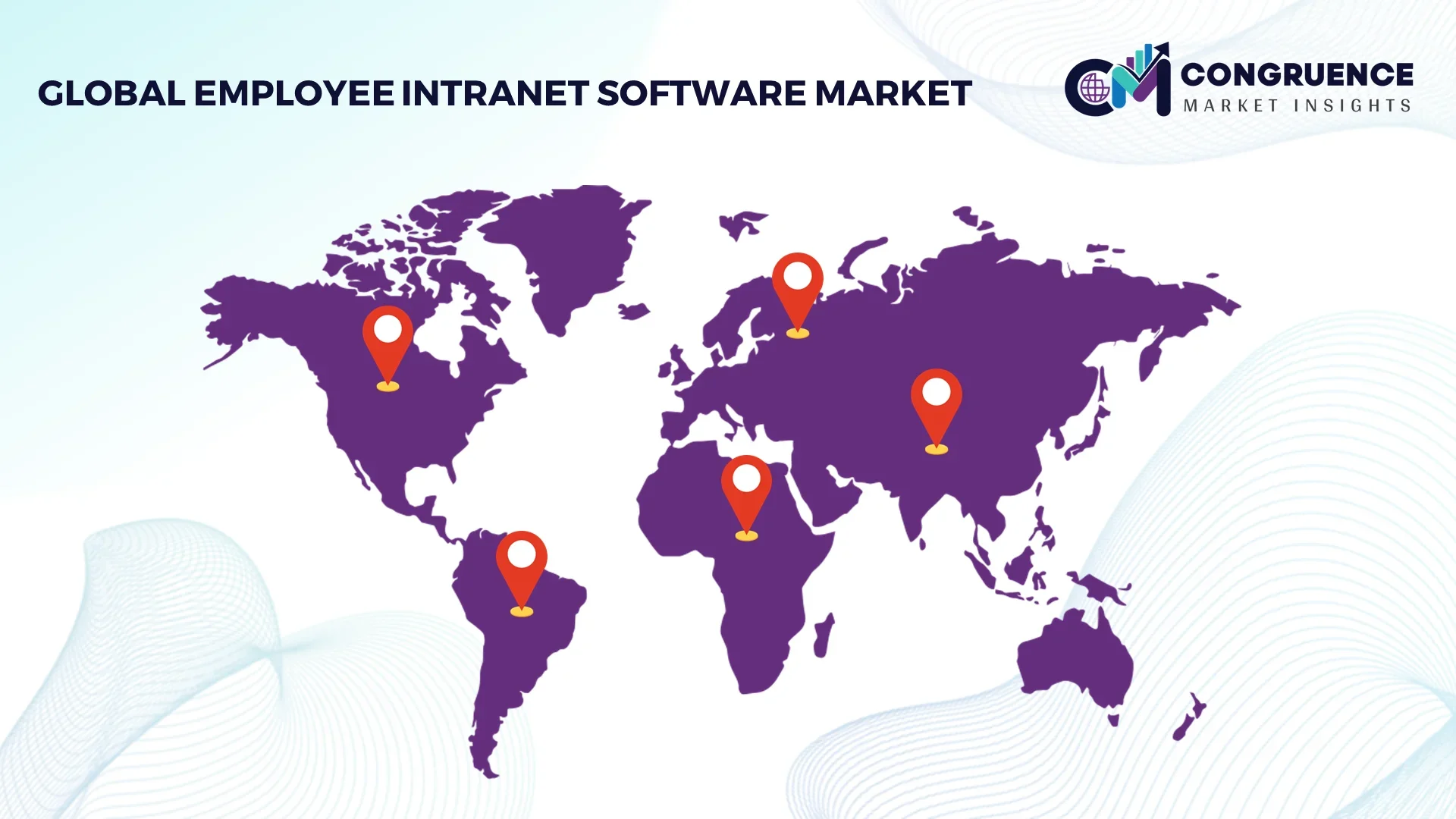
In 2025, North America had over 2,800 enterprise deployments of advanced Employee Intranet Software, while Europe and Asia-Pacific recorded 1,950 and 1,670 deployments, respectively. North America saw adoption rates of 72% among large enterprises, compared to 55% in Europe and 48% in Asia-Pacific. Cloud-based intranet platforms accounted for 48% of deployments in North America, with hybrid solutions rising to 22% adoption. Asia-Pacific growth is fueled by over 1,200 mobile-accessible intranet deployments and increasing AI-based knowledge management adoption in countries like China, India, and Japan. Employee engagement platforms integrated with workflow automation tools reduced internal email traffic by 35% across top-performing firms, highlighting regional adoption patterns and technological maturity across markets.
How are enterprises leveraging digital workplace transformation to drive intranet adoption?
North America holds 38% of the global Employee Intranet Software market, driven by strong adoption in healthcare, finance, and IT industries. Regulatory support such as HIPAA compliance and federal digital workplace initiatives has accelerated deployment of secure, cloud-based intranet solutions. Technological trends include AI-powered knowledge management, mobile-first access, and seamless integration with ERP and HRM systems. Local players, such as Microsoft and Slack, continue to enhance AI-driven collaboration features, improving employee productivity by over 30% in pilot implementations. Enterprise adoption varies, with healthcare and finance sectors showing higher uptake due to stringent compliance requirements, while technology firms focus on innovation-driven collaboration efficiency.
How is regulatory compliance shaping enterprise intranet deployments?
Europe accounts for 27% of the Employee Intranet Software market, with Germany, the UK, and France leading in volume. Stringent GDPR compliance and sustainability initiatives drive demand for secure and transparent internal communication platforms. Emerging technologies, including AI chatbots and predictive analytics, are increasingly adopted to improve workflow efficiency. Local players, such as SAP, are deploying integrated intranet systems that enhance cross-department knowledge sharing, achieving up to 25% faster project turnaround. Regulatory pressure results in a preference for explainable intranet software, particularly among financial institutions and public sector organizations, shaping enterprise adoption behavior.
What factors are driving rapid digital collaboration adoption across emerging economies?
Asia-Pacific holds 20% of global Employee Intranet Software deployments, with China, India, and Japan as top consumers. Growth is supported by expanding digital infrastructure, cloud integration, and mobile-first adoption. Regional tech hubs focus on AI-based knowledge management and workflow automation platforms. Local players, such as Zoho and Freshworks, have implemented intranet systems enabling 35% faster internal communication in mid-sized firms. Consumer behavior varies with strong adoption in IT, e-commerce, and manufacturing sectors, emphasizing mobile accessibility, AI-enhanced personalization, and multilingual support to cater to a diverse workforce.
How are regional enterprises optimizing internal communication through tailored intranet solutions?
South America holds 8% of the Employee Intranet Software market, with Brazil and Argentina as leading countries. Growth is influenced by expanding corporate infrastructure and increasing digital literacy. Government incentives for IT modernization and trade policies supporting cloud-based deployment enhance market uptake. Local players, such as Totvs, have deployed intranet platforms that improved cross-team collaboration efficiency by 28% in Brazilian enterprises. Regional adoption is strongest in media, service, and finance sectors, with language localization and bilingual platforms driving higher engagement among employees.
How are enterprises leveraging technology modernization to streamline workforce communication?
The Middle East & Africa region accounts for 7% of the Employee Intranet Software market, led by UAE and South Africa. Demand is driven by oil & gas, construction, and financial services industries. Technological modernization, including cloud-based platforms, AI-driven content recommendations, and mobile accessibility, enhances workflow efficiency and employee engagement. Local players, such as Saber Technologies, have implemented intranet systems improving project management efficiency by 30%. Regional adoption reflects workforce-driven priorities, with multinational corporations emphasizing secure communication, compliance with local regulations, and integration with global IT systems.
United States – 38% market share: High enterprise adoption in healthcare, finance, and IT industries, combined with robust digital infrastructure.
Germany – 12% market share: Strong end-user demand supported by regulatory compliance requirements and advanced technological integration in enterprises.
The Employee Intranet Software market is moderately fragmented, with over 120 active competitors globally. The top five companies—Microsoft, Slack, IBM, Salesforce, and Atlassian—together account for approximately 57% of the market, reflecting significant concentration among leading vendors while leaving room for niche and emerging players. Competitive strategies focus on product innovation, strategic partnerships, cloud platform integration, and AI-driven feature enhancements. For example, Microsoft recently launched AI-powered collaborative dashboards, Slack expanded interoperability with third-party ERP and HRM systems, and Atlassian introduced automated workflow management features to enhance enterprise productivity. Mergers and acquisitions are also shaping market dynamics, with IBM acquiring AI-focused intranet startups to strengthen its digital workplace offerings. Emerging players focus on mobile-first platforms, predictive analytics, and hybrid deployment models, catering to mid-sized enterprises and region-specific needs. Innovation trends include AI-enabled knowledge management, personalized employee engagement, voice and chat-based search integration, and enhanced cybersecurity features. Market positioning is increasingly determined by technological sophistication, scalability, regulatory compliance, and customer support infrastructure, providing measurable competitive differentiation across regions.
The Employee Intranet Software market is undergoing significant transformation driven by advanced technologies that enhance internal communications, knowledge management, and workflow automation. Cloud-based deployment remains the backbone of modern intranet solutions, with over 48% of enterprises adopting cloud platforms for scalability, remote accessibility, and seamless integration with enterprise systems such as ERP, CRM, and HRM. AI-driven personalization is emerging as a critical technology, enabling tailored dashboards, automated notifications, and predictive content recommendations, resulting in measurable improvements of 28–35% in employee task completion and knowledge-sharing efficiency.
Mobile-first and hybrid intranet solutions are increasingly deployed, with approximately 58% of organizations enabling mobile access for remote and hybrid workforces. Voice-activated search, intelligent chatbots, and machine learning algorithms are driving engagement by reducing internal email traffic by up to 35% and accelerating document retrieval by 30%. Organizations are also integrating workflow automation, allowing 25% faster project approvals and real-time task tracking, which streamlines collaboration across departments.
Emerging technologies such as natural language processing, semantic search engines, and AI-based analytics are further enhancing intranet functionality, enabling enterprises to monitor engagement, measure employee productivity, and optimize content delivery. Regional adoption patterns show North America leading in AI-enabled solutions, while Asia-Pacific emphasizes mobile accessibility and multilingual support. Cybersecurity advancements, including end-to-end encryption and automated compliance monitoring, are shaping secure intranet deployment, ensuring data protection while supporting ESG-aligned digital initiatives. Overall, technology innovation is positioning Employee Intranet Software as a strategic pillar for organizational efficiency and digital transformation.
• In January 2025, Salesforce expanded its integration of AI agents and CRM data directly within Slack via its Agentforce platform, enabling contextual conversational workflows across Sales, IT, HR Service, and analytics tasks within Slack’s intranet-like environment. This embedment allows enterprise employees to complete support actions and access dashboards without switching applications. (Salesforce)
• In October 2025, Slack revealed a substantial upgrade to Slackbot, transforming it into a more capable AI assistant designed to deliver natural language workflow support, create custom project plans, summarize work activity, and streamline information retrieval across enterprise collaboration spaces by the end of the year. (The Verge)
• In October 2025, Salesforce rebranded Slack as an “agentic OS” under its Agentforce 360 strategy, a platform shift positioning Slack as a core interface for organizational AI, enhanced enterprise search, and automated task resolution for internal workflows across departments. (IT Pro)
• In October 2025, Salesforce implemented deeper AI capabilities into Slack through Real-Time Search (RTS) API and a Model Context Protocol (MCP) server to improve context-aware AI agent functionality, significantly boosting enterprise productivity by accelerating team insights and analytic responsiveness. (TechRadar)
The scope of the Employee Intranet Software Market Report encompasses a comprehensive analysis of technological, functional, and operational dimensions shaping intranet solutions across global enterprises. This report examines segmentation by deployment type, from on-premise systems used by highly regulated sectors to cloud-native platforms prioritized for scalability in distributed workforces. Across applications, the analysis includes internal communications, knowledge management, employee engagement tools, workflow automation, and compliance functions. Geographically, the report covers regional adoption trends, including maturity indicators in North America, regulatory-driven enhancements in Europe, and rapid mobile-centric uptake in Asia-Pacific, while also assessing emerging needs in South America and Middle East & Africa markets. The technologies covered reflect current and evolving capabilities — including AI-driven personalization, enterprise-grade search, mobile-first UX design, integration frameworks with ERP/HRM/CRM systems, and advanced security protocols for encrypted internal content exchange. The report’s industry focus spans key end-users such as healthcare, finance, IT services, manufacturing, and public sector organizations, each demonstrating specific intranet utilization patterns tied to operational scale, hybrid work enablement, and digital workplace strategies. Niche segments such as modular intranet components, employee experience platforms integrated with collaboration suites, and frontier tech applications (e.g., conversational agents and predictive analytics) are also evaluated. The outcome is a strategic resource for decision-makers seeking actionable insights into competitive positioning, technological investment priorities, and practical adoption benchmarks for intranet platforms.
| Report Attribute/Metric | Report Details |
|---|---|
|
Market Revenue in 2025 |
USD V2025 Million |
|
Market Revenue in 2033 |
USD V2033 Million |
|
CAGR (2026 - 2033) |
8.1% |
|
Base Year |
2025 |
|
Forecast Period |
2026 - 2033 |
|
Historic Period |
2021 - 2025 |
|
Segments Covered |
By Types
By Application
By End-User
|
|
Key Report Deliverable |
Revenue Forecast, Growth Trends, Market Dynamics, Segmental Overview, Regional and Country-wise Analysis, Competition Landscape |
|
Region Covered |
North America, Europe, Asia-Pacific, South America, Middle East, Africa |
|
Key Players Analyzed |
Microsoft, Slack, IBM, Salesforce, Atlassian, Zoho, Freshworks, SAP, HCL Technologies, Oracle |
|
Customization & Pricing |
Available on Request (10% Customization is Free) |




