
Reports
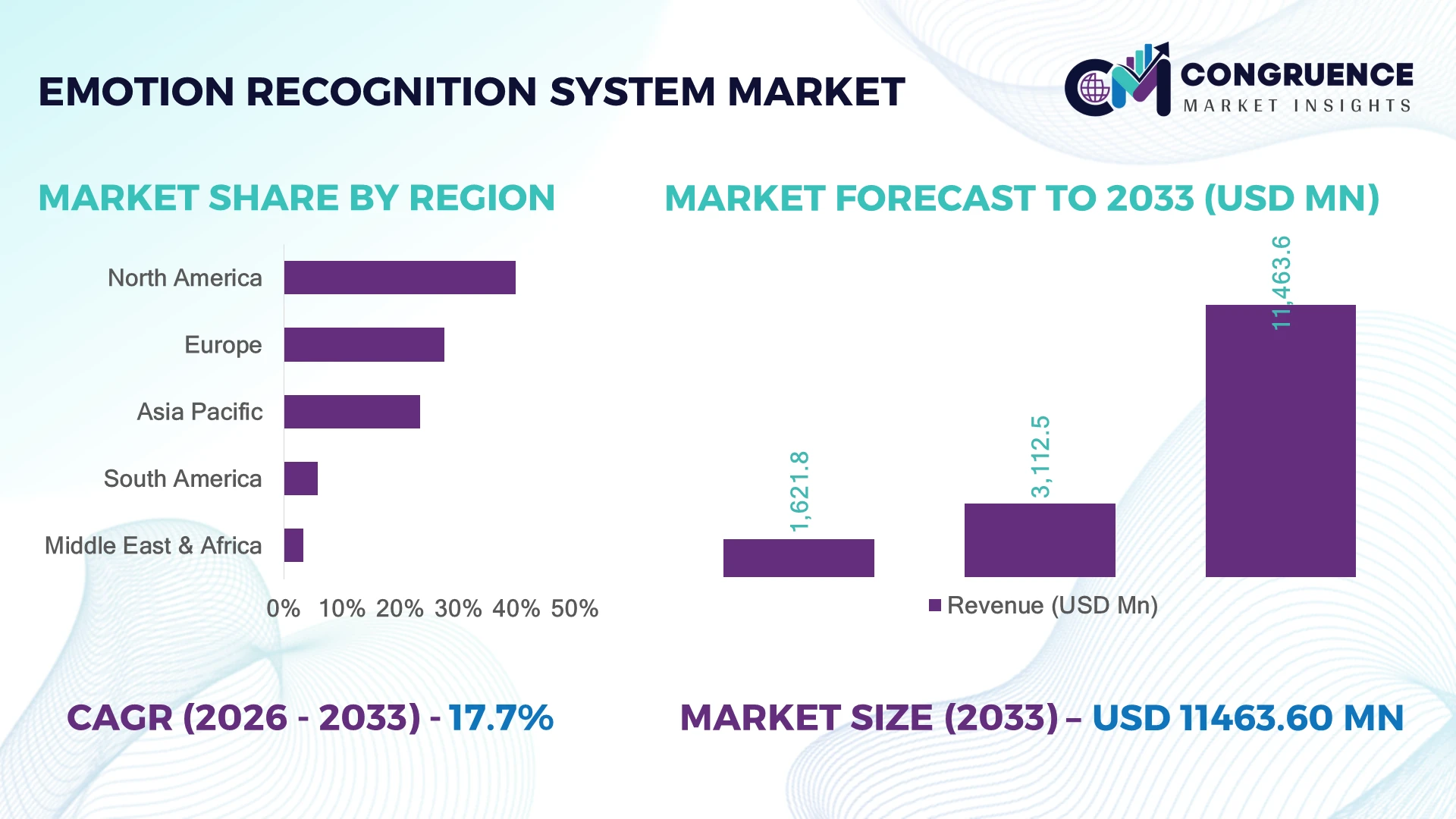
The Global Emotion Recognition System Market was valued at USD 3,112.5 Million in 2025 and is anticipated to reach a value of USD 11,463.6 Million by 2033 expanding at a CAGR of 17.7% between 2026 and 2033. Growth is primarily driven by rapid enterprise adoption of multimodal artificial intelligence, increasing deployment of emotion-aware customer experience platforms, and expanding integration of affective computing into healthcare, automotive, and digital workforce analytics.
The United States dominates the Emotion Recognition System Market, representing approximately 37% of global enterprise deployments and AI-based affective computing investments in 2025. More than 69% of Fortune 500 technology and customer service organizations have piloted or implemented emotion analytics across contact centers, healthcare, and retail operations. Compared with Japan, where emotion AI adoption in robotics exceeds 31%, the U.S. leads in cloud-based multimodal analytics and enterprise software integration. Ongoing geopolitical competition in artificial intelligence development has accelerated investment in secure, explainable emotion recognition technologies across defense, healthcare, and digital public services.
The market increasingly favors organizations capable of combining ethical AI governance with scalable multimodal emotion analytics to achieve sustainable competitive differentiation.
Market Size & Growth: USD 3,112.5 Million (2025) to USD 11,463.6 Million (2033) at 17.7% CAGR, fueled by enterprise AI adoption and multimodal analytics.
Top Growth Drivers: AI-enabled customer analytics (64%), healthcare digitization (51%), automotive HMI adoption (39%).
Short-Term Forecast: By 2028, emotion-aware automation is projected to improve customer engagement accuracy by 29%.
Emerging Technologies: Multimodal AI, edge computing, generative AI integration, and explainable emotion analytics.
Regional Leaders: North America (~USD 4.6 Billion), Europe (~USD 2.8 Billion), Asia-Pacific (~USD 2.7 Billion) by 2033 with expanding enterprise deployments.
Consumer Trends: Nearly 58% of digital service providers now evaluate emotion-aware interfaces for personalized engagement.
Pilot Example: A 2025 enterprise deployment reduced customer response time by 24% using AI-driven sentiment recognition.
Competitive Landscape: Microsoft leads with approximately 18% market presence, followed by Smart Eye, Affectiva, Noldus, and Realeyes.
Regulatory & ESG: AI governance initiatives increased explainable AI implementation by nearly 33% across regulated industries.
Investment Activity: More than USD 4.5 billion committed globally since 2024 toward emotion AI, multimodal analytics, and enterprise partnerships.
Innovation Outlook: Emotion-aware copilots, privacy-preserving AI, and multimodal perception engines are reshaping intelligent human-machine interaction.
The Emotion Recognition System Market continues expanding across healthcare, automotive, education, financial services, retail, and workplace analytics as enterprises seek deeper behavioral intelligence. Nearly 47% of newly deployed AI customer engagement platforms now integrate emotion analysis capabilities, while evolving AI governance frameworks encourage investment in transparent and privacy-centric solutions, naturally leading into the strategic evolution of the market.
The Emotion Recognition System Market has evolved into a strategic component of enterprise artificial intelligence as organizations increasingly compete through personalized digital experiences, workforce intelligence, and human-centric automation. Emotion-aware AI is transforming decision-making across customer engagement, healthcare diagnostics, automotive safety, and education by enabling systems to interpret facial expressions, voice patterns, physiological signals, and behavioral cues in real time. Accelerating digital transformation and stronger AI governance frameworks are encouraging enterprises to invest in trustworthy emotion analytics platforms capable of supporting both operational efficiency and regulatory compliance.
Modern multimodal emotion recognition systems deliver approximately 36% higher recognition accuracy than traditional facial-expression-only solutions while reducing false emotional classifications by nearly 27% through integrated voice, text, and behavioral analytics. North America continues leading large-scale enterprise deployments, whereas Asia-Pacific demonstrates faster implementation across smart retail, robotics, and intelligent transportation applications. By 2028, edge-based emotion AI processing is expected to reduce inference latency by approximately 32%, enabling real-time decision support across connected devices and autonomous systems.
Technology providers continue expanding partnerships with cloud providers, healthcare organizations, automotive manufacturers, and AI platform developers to accelerate commercialization of multimodal emotion intelligence. Several enterprises are embedding emotion recognition into customer support platforms and digital assistants to optimize engagement quality while strengthening privacy controls through on-device AI processing. As human-centered artificial intelligence becomes increasingly important across industries, the Emotion Recognition System Market is positioned as a critical enabler of competitive differentiation, intelligent automation, and long-term digital transformation.
The Emotion Recognition System Market is experiencing significant structural transformation as enterprises increasingly integrate affective artificial intelligence into customer engagement, healthcare diagnostics, automotive safety, education technology, and workforce analytics. The market is transitioning from standalone facial expression analysis toward multimodal emotion recognition platforms that combine facial imaging, speech analysis, physiological monitoring, gesture recognition, and contextual behavioral analytics. Growing enterprise investment in generative AI, conversational interfaces, and intelligent human-machine interaction is accelerating adoption across commercial and public-sector applications. Simultaneously, evolving AI governance frameworks and data privacy regulations are encouraging vendors to develop explainable, privacy-preserving emotion recognition models. Competition is increasingly centered on recognition accuracy, multimodal integration, edge AI deployment, and interoperability with existing enterprise software ecosystems, positioning emotion recognition as a core capability within next-generation intelligent automation strategies.
Enterprise demand for intelligent customer engagement and human-centric automation remains the strongest driver for the Emotion Recognition System Market. More than 65% of large organizations expanding conversational AI platforms now evaluate emotion recognition capabilities, while multimodal AI improves emotional inference accuracy by approximately 34% compared with single-input recognition models. In the United States, digital healthcare providers and financial institutions continue integrating emotion analytics into virtual consultations and customer service platforms following broader enterprise AI modernization initiatives. This structural shift enables organizations to personalize interactions, improve service quality, and reduce customer attrition. Technology vendors are responding through strategic acquisitions, cloud partnerships, and expanded investment in multimodal AI engines, creating scalable enterprise solutions that integrate seamlessly with CRM, contact center, and workforce management platforms. The strategic advantage increasingly lies in embedding emotion intelligence directly into core business workflows rather than offering it as a standalone application.
Regulatory requirements surrounding biometric data, facial recognition, and personal privacy remain a significant structural restraint for the Emotion Recognition System Market. Approximately 58% of enterprise buyers identify compliance with privacy legislation as a primary barrier to deployment, while nearly 43% require on-premise or sovereign-cloud implementations for sensitive applications. In the European Union, expanding AI governance requirements have increased validation, documentation, and transparency obligations for emotion-aware systems, extending deployment timelines for regulated industries. These compliance challenges directly affect scalability, implementation costs, and international product standardization. Companies are mitigating operational risks by investing in privacy-preserving machine learning, localized data processing, federated learning architectures, and explainable AI models that reduce dependence on centralized biometric databases while maintaining regulatory alignment across multiple jurisdictions.
The next phase of growth lies in edge-based emotion recognition and industry-specific AI platforms designed for healthcare, automotive, education, industrial safety, and smart retail environments. Nearly 61% of newly developed emotion AI solutions now support edge processing, reducing response latency by approximately 31% while strengthening data privacy through on-device inference. Japan continues expanding emotion-aware robotics for elderly care, while South Korea is accelerating intelligent vehicle cockpit development using driver emotion monitoring systems. Companies are strengthening competitive positioning through dedicated R&D programs, semiconductor partnerships, and ecosystem collaborations supporting multimodal AI deployment across embedded devices. An emerging strategic opportunity involves combining emotion recognition with digital twins and predictive behavioral analytics, enabling enterprises to optimize customer engagement, workforce wellbeing, and operational decision-making using real-time emotional intelligence rather than traditional behavioral metrics alone.
Scaling emotion recognition systems across enterprise environments remains a major execution challenge due to integration complexity, multimodal data synchronization, and real-time processing requirements. Nearly 57% of enterprise AI projects encounter interoperability issues when integrating emotion analytics with CRM, ERP, and contact center platforms, while inference latency can increase by over 26% during high-volume deployments. In Germany, industrial AI deployments increasingly require edge processing to maintain operational continuity where cloud latency affects decision-making. Workforce shortages in affective AI engineering and multimodal model optimization further slow implementation consistency. Companies are addressing these challenges through investment in standardized APIs, edge computing infrastructure, model compression techniques, and strategic partnerships with cloud and semiconductor providers. A key competitive differentiator is no longer recognition accuracy alone, but the ability to deploy scalable, low-latency emotion intelligence consistently across geographically distributed enterprise operations.
AI-Driven Multimodal Expansion Emotion recognition platforms are rapidly shifting from facial analysis to multimodal AI combining voice, facial expressions, physiological signals, and behavioral analytics. Nearly 63% of newly launched enterprise solutions now integrate three or more recognition modalities, improving contextual accuracy by approximately 35%. Organizations are standardizing unified AI architectures to reduce fragmented workflows, while technology providers expand partnerships with cloud AI vendors to accelerate enterprise-scale deployment following widespread generative AI adoption.
Edge Intelligence Deployment Edge-based emotion recognition implementations increased by approximately 41% during the past year as enterprises prioritize low-latency inference and localized data processing. On-device AI reduces response time by nearly 30% while lowering cloud processing requirements by 24%. Automotive manufacturers and healthcare providers increasingly deploy embedded emotion analytics to support real-time decision-making, prompting semiconductor companies to optimize AI accelerators specifically for edge emotion recognition workloads.
Ethical AI Standardization Enterprise procurement increasingly favors explainable and transparent emotion AI solutions as evolving AI governance frameworks reshape deployment priorities. Nearly 54% of regulated organizations now require explainability features before system implementation, while bias evaluation processes have expanded by approximately 28% across enterprise AI validation programs. Vendors are strengthening governance capabilities through model auditing, fairness monitoring, and automated compliance documentation, transforming responsible AI into a measurable competitive advantage rather than a regulatory obligation.
Industry-Specific Platform Growth Vertical-specific emotion recognition platforms continue replacing generic AI solutions, with healthcare, automotive, education, and financial services accounting for nearly 61% of new enterprise deployments. Customized emotion models improve application-specific accuracy by approximately 22% while reducing implementation time by 18% through pre-trained industry datasets. Companies are responding by developing sector-focused AI ecosystems, expanding technology alliances, and integrating emotion intelligence directly into operational software instead of deploying standalone analytical applications.
The Emotion Recognition System Market is segmented by type, application, and end-user, reflecting the growing adoption of affective artificial intelligence across enterprise software, healthcare, automotive, consumer electronics, and public-sector applications. Vendors are increasingly shifting toward multimodal emotion recognition platforms capable of combining facial, speech, physiological, and behavioral intelligence within a unified analytics framework. Enterprise buyers now prioritize recognition accuracy, deployment flexibility, data privacy, and interoperability over standalone algorithm performance. Approximately 64% of newly deployed emotion recognition solutions integrate more than one sensing modality, while AI-enabled edge processing and cloud-native architectures continue improving scalability across industries. As organizations embed emotional intelligence into digital workflows, segmentation is increasingly influenced by operational use cases, AI maturity, and sector-specific compliance requirements rather than hardware capability alone.
The Emotion Recognition System Market is segmented into Facial Recognition, Speech & Voice Recognition, Gesture & Posture Recognition, Physiological Signal Recognition, and Multimodal Emotion Recognition.
Facial Recognition remains the largest segment, accounting for approximately 39% of market adoption owing to its mature algorithm ecosystem, broad camera infrastructure, cost-effective deployment, and seamless integration into customer analytics, surveillance, retail, and healthcare applications. Continuous improvements in deep learning models and high-resolution imaging have further strengthened its commercial adoption across enterprise environments.
Multimodal Emotion Recognition represents the fastest-growing segment and is projected to expand at approximately 20.8% CAGR through 2033. Organizations increasingly combine facial expressions, vocal tone, physiological responses, and behavioral analytics to improve contextual understanding and reduce false emotional interpretation. Speech & Voice Recognition, Gesture & Posture Recognition, and Physiological Signal Recognition collectively contribute approximately 61% of the market, with growing deployment across healthcare diagnostics, intelligent vehicles, human-robot interaction, and workplace analytics. Technology providers continue investing in multimodal AI engines, edge inference platforms, and strategic partnerships to strengthen model robustness while supporting industry-specific deployments.
According to the 2025 Stanford AI Index, enterprise investment in multimodal AI systems accelerated significantly as organizations increasingly prioritized combined visual, audio, and behavioral intelligence over single-modality AI deployments.
The Emotion Recognition System Market is segmented into Healthcare, Retail & E-commerce, Automotive, Media & Entertainment, BFSI, Education, Security & Surveillance, and Others.
Retail & E-commerce remains the leading application, representing approximately 29% of total market demand. Businesses increasingly deploy emotion recognition to optimize customer engagement, personalize product recommendations, evaluate consumer reactions, and improve digital marketing performance. AI-powered customer interaction platforms have enhanced customer satisfaction metrics by nearly 24% while enabling retailers to better understand purchasing behavior through real-time emotional analytics.
Healthcare is emerging as the fastest-growing application segment, projected to expand at approximately 21.5% CAGR through 2033. Emotion AI is increasingly adopted for mental health assessment, neurological disorder monitoring, telemedicine consultations, and patient engagement. Automotive, Media & Entertainment, BFSI, Education, Security & Surveillance, and other sectors collectively account for nearly 71% of market demand as intelligent human-machine interaction becomes operationally critical. Companies continue expanding deployment through AI automation, cloud integration, and strategic healthcare and automotive collaborations that improve workflow efficiency while strengthening service personalization.
According to a 2026 enterprise AI adoption survey conducted by IDC, more than 62% of organizations evaluating next-generation customer engagement platforms identified emotion analytics as a priority capability for enhancing personalized digital interactions.
The Emotion Recognition System Market serves Healthcare Providers, Retail & E-commerce Enterprises, Automotive Manufacturers, Government & Defense Organizations, Media & Entertainment Companies, Educational Institutions, and Other Commercial Enterprises.
Retail & E-commerce Enterprises represent the largest end-user segment, accounting for approximately 31% of overall demand due to extensive deployment across customer experience management, marketing optimization, loyalty programs, and digital commerce platforms. These organizations possess the infrastructure, customer interaction volume, and AI investment capacity necessary to commercialize emotion analytics at enterprise scale. Nearly 66% of large retailers implementing advanced customer analytics now evaluate emotion-aware AI capabilities as part of broader personalization strategies.
Healthcare Providers constitute the fastest-growing end-user segment and are expected to expand at approximately 22.1% CAGR through 2033. Hospitals, behavioral health centers, and telehealth providers increasingly utilize emotion recognition to support clinical decision-making, patient monitoring, and cognitive health assessment. Automotive Manufacturers, Government & Defense Organizations, Media & Entertainment Companies, Educational Institutions, and other commercial users collectively contribute approximately 69% of market demand. Vendors continue strengthening competitive positioning through industry-specific AI models, strategic partnerships, customized deployment frameworks, and subscription-based pricing models that simplify enterprise adoption while expanding long-term customer retention.
Findings published in the 2025 Deloitte Global AI Survey indicated that more than 60% of digitally mature enterprises plan to increase investment in human-centric AI technologies, including emotion recognition, to improve operational intelligence, customer engagement, and workforce productivity.
North America accounted for the largest market share at 39.8% in 2025 however, Asia-Pacific is expected to register the fastest growth, expanding at a CAGR of 19.8% between 2026 and 2033.
North America continues to lead the Emotion Recognition System Market through early commercialization of affective AI, mature cloud infrastructure, and strong enterprise investment in intelligent customer engagement platforms. Europe follows with approximately 27.6% of global demand, supported by responsible AI initiatives and industrial digitalization, while Asia-Pacific represents the fastest-expanding regional market due to rapid AI deployment across healthcare, smart retail, automotive, and consumer electronics. South America and the Middle East & Africa are steadily increasing adoption through digital transformation initiatives and smart city investments. Nearly 67% of enterprise emotion recognition deployments are concentrated across North America and Europe, whereas Asia-Pacific accounts for over 44% of newly announced commercial AI implementation projects, highlighting a gradual shift in future market expansion.
Strategic Enterprise AI Integration Drives Commercial Leadership
North America contributes approximately 39.8% of the global Emotion Recognition System Market, supported by extensive enterprise AI deployment across healthcare, retail, financial services, automotive, and digital customer experience platforms. More than 71% of large AI software vendors operating in the region have integrated emotion analytics into conversational AI, intelligent virtual assistants, or customer interaction platforms. Cloud-native AI infrastructure, advanced GPU availability, and strong venture capital investment continue accelerating commercialization. Organizations increasingly combine emotion recognition with customer analytics, workforce intelligence, and cybersecurity monitoring to strengthen operational decision-making. Enterprise partnerships between AI software providers, cloud companies, and healthcare organizations continue expanding multimodal emotion recognition deployment across commercial environments.
United States Market Outlook: The United States dominates the regional market through advanced AI research, hyperscale cloud infrastructure, and enterprise software leadership. Nearly 69% of Fortune 500 organizations deploying advanced customer experience platforms have evaluated or implemented emotion analytics capabilities. Technology companies continue expanding investments in multimodal AI, responsible AI governance, and edge intelligence, strengthening the country's leadership across healthcare diagnostics, automotive driver monitoring, digital assistants, and enterprise customer engagement solutions.
Responsible AI Governance Accelerates Commercial Deployment
Europe accounts for approximately 27.6% of the global Emotion Recognition System Market, supported by strong digital infrastructure, AI regulatory frameworks, and increasing enterprise investment in trustworthy artificial intelligence. Germany, the United Kingdom, France, and the Netherlands collectively contribute more than 68% of regional commercial deployments. Organizations increasingly prioritize explainable AI, privacy-preserving analytics, and secure multimodal emotion recognition platforms for healthcare, automotive, banking, and industrial automation. More than 48% of newly implemented enterprise AI projects now incorporate governance and transparency mechanisms as part of procurement requirements. Technology developers continue strengthening collaborations with research institutes and industrial partners to improve deployment quality while maintaining regulatory compliance.
Germany Market Outlook: Germany represents the region's most influential market through its leadership in automotive electronics, industrial AI, and intelligent manufacturing. Approximately 44% of domestic emotion recognition deployments are associated with automotive driver monitoring, industrial human-machine interaction, and healthcare innovation. Continued investment in Industry 4.0, AI safety validation, and embedded intelligence strengthens Germany's position as a leading adopter of enterprise emotion recognition technologies.
Large-Scale AI Deployment Creates Exceptional Commercial Momentum
Asia-Pacific has emerged as the fastest-growing Emotion Recognition System Market, representing approximately 23.4% of global deployments in 2025. China, Japan, South Korea, India, and Singapore account for nearly 79% of regional AI commercialization initiatives involving emotion recognition. Smart retail, robotics, intelligent transportation, healthcare diagnostics, and education technology remain major deployment areas. More than 58% of newly developed AI-powered customer engagement solutions across the region now integrate emotion analytics as part of broader multimodal intelligence platforms. Governments and private enterprises continue expanding AI infrastructure, semiconductor investment, and digital innovation ecosystems that accelerate commercialization of next-generation affective computing technologies.
China Market Outlook: China leads the Asia-Pacific market through substantial AI infrastructure investment, extensive smart city initiatives, and rapid commercialization of computer vision technologies. Nearly 63% of domestic AI platform providers now support multimodal emotion recognition capabilities across intelligent surveillance, retail analytics, education technology, and customer service automation. Strong AI ecosystem development and continued investment in domestic semiconductor capability position China among the world's largest commercial markets for emotion-aware artificial intelligence.
Digital Service Modernization Expands Enterprise Adoption
South America represents approximately 5.8% of the global Emotion Recognition System Market, with Brazil and Argentina leading enterprise AI implementation across financial services, retail, healthcare, and public administration. Growing cloud adoption, digital banking expansion, and customer experience modernization continue strengthening demand for emotion-aware analytics platforms. Nearly 41% of regional financial institutions have expanded AI investment programs supporting conversational banking and customer engagement automation. Infrastructure limitations remain across selected markets; however, strategic cloud partnerships and digital transformation initiatives continue improving deployment scalability and enterprise accessibility for advanced AI solutions.
Brazil Market Outlook: Brazil accounts for the largest share of regional deployments through its expanding digital economy, financial technology ecosystem, and large retail sector. More than 57% of enterprise AI investments within the country now prioritize customer experience optimization, conversational AI, and behavioral analytics. Continued expansion of hyperscale cloud infrastructure and enterprise digital transformation programs supports broader adoption of emotion recognition technologies across commercial industries.
National AI Strategies Strengthen Intelligent Technology Adoption
The Middle East & Africa contribute approximately 3.4% of the global Emotion Recognition System Market while demonstrating increasing investment in artificial intelligence, digital government, healthcare modernization, and smart infrastructure. Countries including the United Arab Emirates, Saudi Arabia, Israel, and South Africa continue expanding AI deployment across public services, transportation, education, and enterprise operations. Nearly 46% of regional smart city programs now evaluate AI-powered analytics capable of improving citizen engagement and operational efficiency. Public-private collaborations continue strengthening cloud infrastructure, AI research, and digital innovation ecosystems supporting broader commercialization of affective computing technologies.
United Arab Emirates Market Outlook: The United Arab Emirates has become the regional leader through comprehensive AI strategies, advanced digital government initiatives, and strong investment in intelligent infrastructure. Approximately 61% of government-led digital transformation projects incorporate advanced AI technologies supporting citizen services, mobility, and healthcare innovation. Strategic partnerships with global technology providers and continued expansion of AI research facilities position the UAE as a key commercialization hub for emotion recognition systems across the Middle East.
The Emotion Recognition System Market is led by Microsoft, Smart Eye, Realeyes, Noldus Information Technology, and Cognitec Systems, competing against specialized AI startups and regional computer vision developers. Global technology leaders leverage integrated AI ecosystems and cloud platforms, while niche innovators differentiate through multimodal algorithms, healthcare applications, and automotive driver monitoring solutions. The top five players collectively account for approximately 52% of market activity, reflecting moderate consolidation with continuous technology disruption. Competition centers on recognition accuracy, multimodal AI performance, deployment speed, and privacy-preserving architectures rather than pricing alone. Multimodal platforms improve emotion detection accuracy by nearly 35%, while edge AI deployment reduces inference latency by approximately 30%, creating measurable competitive advantages. Companies are strengthening positions through strategic acquisitions, cloud partnerships, embedded AI integration, and industry-specific product development. Rising AI governance requirements and proprietary training datasets create significant entry barriers. Sustainable market leadership increasingly depends on delivering trusted, scalable, and regulation-ready emotion intelligence integrated seamlessly into enterprise workflows.
Noldus Information Technology
Cognitec Systems GmbH
iMotions A/S
Kairos AR Inc.
Hume AI
Cogito Corporation
NEC Corporation
Emotibot Technologies
Elliptic Labs
Eyeris Technologies
Emotion recognition technology is rapidly evolving from single-modality facial analysis toward multimodal AI combining facial expressions, speech, text, physiological signals, and behavioral analytics. Nearly 64% of newly deployed enterprise platforms now integrate multiple data inputs, improving recognition accuracy by approximately 36% compared with conventional facial-only systems. Edge AI deployment continues expanding, with almost 42% of new implementations processing emotional inference locally to reduce latency and strengthen privacy. This transition enables faster decision-making across healthcare, automotive, customer engagement, and intelligent workplace applications while reducing cloud processing costs.
Transformer-based multimodal foundation models are replacing rule-based recognition engines by improving contextual understanding and lowering false classifications by approximately 28%. Organizations integrating explainable AI and privacy-preserving machine learning report up to 24% faster enterprise approval cycles in regulated industries. Automotive manufacturers, healthcare providers, and financial institutions benefit most because these technologies combine high recognition accuracy with transparent decision-making, enabling safer deployment in compliance-sensitive environments. Continuous integration with digital assistants, contact center software, and intelligent cameras is expanding operational use cases beyond traditional analytics.
Between 2026 and 2028, on-device multimodal inference, federated learning, synthetic emotion datasets, and AI accelerators will redefine commercial deployment. Compared with legacy cloud-dependent architectures, edge-native emotion AI is expected to improve response efficiency by nearly 33% while reducing bandwidth requirements by approximately 27%. Companies investing now in multimodal AI, edge infrastructure, and explainable models will establish stronger competitive positions as emotion intelligence becomes a core capability across enterprise software, autonomous systems, and human-machine interaction platforms.
September 2024 – Hume AI launched Empathic Voice Interface (EVI 2), enabling real-time speech emotion understanding with support for expressive voice interactions. The platform improves emotional responsiveness through multimodal voice analysis, strengthening enterprise deployment across customer engagement and digital health applications. Source: WIRED
March 2025 – Microsoft introduced Dragon Copilot, integrating ambient voice intelligence and conversational AI into healthcare workflows. The platform automates clinical documentation and multilingual note generation, with 93% of clinicians reporting reduced burnout from ambient AI technologies, accelerating adoption of emotion-aware healthcare interactions. Source: The Verge
January 2024 – Eyeris partnered with OMNIVISION and Leopard Imaging to deliver a production-ready in-cabin sensing reference design combining emotion recognition, occupant monitoring, and 3D perception. The platform supports multiple safety and comfort functions within a single embedded AI architecture, strengthening automotive deployment readiness. Source: Eyeris News
July 2024 – Smart Eye advanced deployment of its AI-powered Driver Monitoring System following the enforcement of new EU General Safety Regulation requirements for new vehicle type approvals. The company expanded commercialization of emotion-aware in-cabin monitoring, supporting wider automotive OEM adoption across European vehicle programs. Source: Smart Eye
The report provides a comprehensive assessment of the Emotion Recognition System Market across five major regions and more than 20 key countries, covering deployment trends, competitive positioning, technology evolution, and enterprise adoption between 2026 and 2033. It evaluates the market by type (facial, speech, gesture, physiological, and multimodal recognition), application (healthcare, retail, automotive, BFSI, education, security, media, and others), and end-user segments, while examining deployment intensity, operational priorities, and emerging demand patterns. Nearly 64% of new enterprise implementations now involve multimodal AI, reflecting the market's transition toward integrated affective intelligence.
The study further analyzes advances in multimodal AI, edge computing, explainable AI, computer vision, speech analytics, and privacy-preserving machine learning alongside regional regulatory developments and commercialization strategies. It benchmarks leading technology providers, identifies high-opportunity investment areas, and evaluates enterprise adoption, partnership activity, and innovation priorities. The report supports product development, expansion planning, competitive benchmarking, technology selection, and long-term strategic decision-making by providing actionable intelligence on evolving customer requirements, deployment models, and emerging industry opportunities.
| Report Attribute/Metric | Report Details |
|---|---|
|
Market Revenue in 2025 |
USD 3,112.5 Million |
|
Market Revenue in 2033 |
USD 11,463.6 Million |
|
CAGR (2026 - 2033) |
17.7% |
|
Base Year |
2025 |
|
Forecast Period |
2026 - 2033 |
|
Historic Period |
2021 - 2025 |
|
Segments Covered |
By Type
By Application
By End-User
|
|
Key Report Deliverable |
Revenue Forecast, Growth Trends, Market Dynamics, Segmental Overview, Regional and Country-wise Analysis, Competition Landscape |
|
Region Covered |
North America, Europe, Asia-Pacific, South America, Middle East, Africa |
|
Key Players Analyzed |
Microsoft, Smart Eye AB, Realeyes, Noldus Information Technology, Cognitec Systems GmbH, iMotions A/S, Kairos AR Inc., Hume AI, Cogito Corporation, NEC Corporation, Emotibot Technologies, Elliptic Labs, Eyeris Technologies |
|
Customization & Pricing |
Available on Request (10% Customization is Free) |




