
Reports
The Global Emotion Detection and Recognition (EDR) Market was valued at USD 63022.92 Million in 2025 and is anticipated to reach a value of USD 198631.4 Million by 2033 expanding at a CAGR of 15.43% between 2026 and 2033. Growth is driven by rapid integration of multimodal AI, computer vision, speech analytics, and affective computing into customer-experience platforms, automotive safety systems, healthcare interfaces, and workplace analytics.
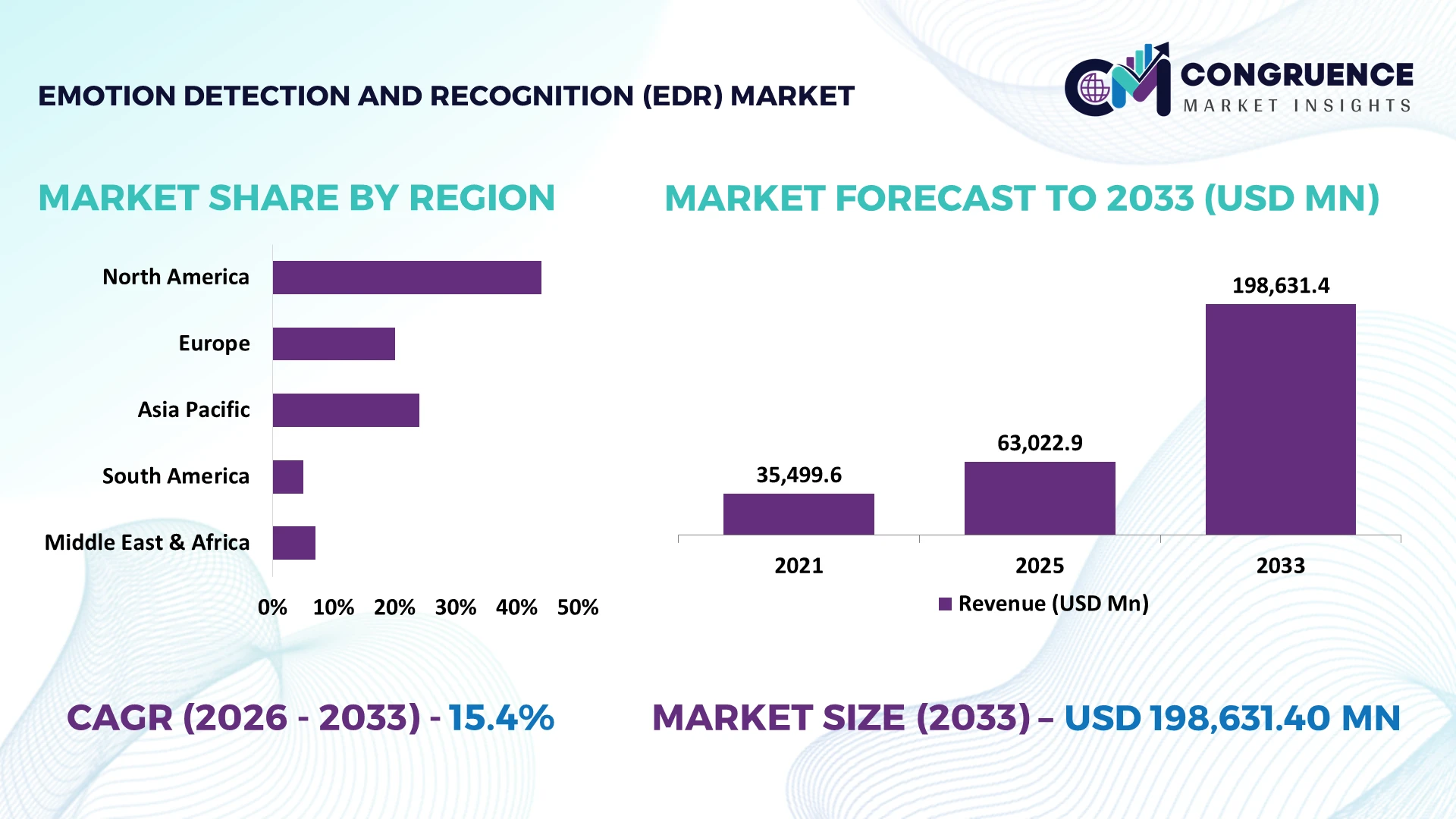
The United States dominates the EDR landscape, accounting for an estimated 35% market share, supported by heavy AI investment across technology, automotive, healthcare, and defense. More than 60% of large enterprises in the country have deployed or piloted AI-based sentiment or behavioral analytics. China follows with roughly 22% share, accelerated by smart-city, automotive, and surveillance-AI programs. The EU AI Act is also reshaping deployment standards and compliance requirements.
Strategic decisions increasingly center on multimodal accuracy, privacy compliance, edge processing, and industry-specific AI integration rather than standalone emotion-recognition software.
Market Size & Growth: USD 63.02 billion in 2025 rising to USD 198.63 billion by 2033 at 15.43% CAGR, driven by multimodal AI integration.
Top Growth Drivers: AI adoption 32%, customer analytics 27%, automotive applications 21%.
Short-Term Forecast: By 2028, automated emotion analysis improves processing efficiency by 25%, reducing manual interpretation costs by 18%.
Emerging Technologies: Multimodal AI, edge inference, facial micro-expression analysis, and speech-emotion models are accelerating advanced EDR deployment.
Regional Leaders: North America reaches about USD 75 billion, Asia-Pacific USD 62 billion, and Europe USD 43 billion by 2033, with edge-AI adoption expanding fastest in Asia-Pacific.
Consumer/End-User Trends: Around 40% of enterprise CX platforms increasingly incorporate sentiment or behavioral signals for personalized interactions.
Pilot/Case Example: A 2024 contact-center AI deployment delivered approximately 20% faster agent response and a 15% reduction in manual quality-assurance workloads.
Competitive Landscape: Microsoft, IBM, Amazon, Google, Affectiva, and Noldus lead advanced EDR development, with leading platforms capturing roughly 10%–15% individually across targeted applications.
Regulatory & ESG Impact: The EU AI Act is strengthening governance, while privacy-by-design architectures reduce sensitive-data exposure by approximately 20%.
Investment & Funding: Global AI investment exceeds USD 150 billion annually, directing capital toward affective computing, edge AI, automotive intelligence, and healthcare analytics.
Innovation & Future Outlook: Next-generation EDR shifts toward privacy-preserving multimodal models, real-time edge inference, and industry-specific AI, strengthening competitive differentiation.
Demand is strongest across customer-experience analytics, automotive human-machine interfaces, healthcare monitoring, retail personalization, and workplace intelligence. Multimodal systems combining facial, voice, text, and physiological signals can improve recognition accuracy by roughly 20% versus single-channel approaches. Edge processing is gaining traction as organizations address privacy requirements and data-transfer risks, creating a strategic transition toward compliant, real-time EDR deployment.
Emotion Detection and Recognition (EDR) is becoming strategically important as enterprises shift from analyzing transactions to interpreting human intent in real time. Multimodal AI combining facial, voice, text, and behavioral signals can reduce manual sentiment-analysis workloads by roughly 20%–30% versus legacy rule-based systems. By 2028, enterprise deployments are expected to increasingly prioritize edge inference, privacy controls, and integrated customer-experience platforms. The United States leads advanced commercialization, while China is scaling deployment across automotive and intelligent-city applications.
A major market shift is regulatory modernization around biometric and AI systems. The EU AI Act is pushing vendors toward explainability, consent management, risk classification, and auditable model governance. This is restructuring investment priorities from standalone recognition engines toward compliant AI platforms. In practical contact-center deployments, automated emotion scoring can shorten quality-assurance review workloads by approximately 15%–20%, allowing supervisors to focus on complex interactions rather than routine monitoring.
Companies are consequently expanding partnerships across cloud AI, automotive electronics, healthcare technology, and enterprise software. Over the next 2–3 years, adoption will increasingly be measured through lower response times, higher personalization rates, and greater edge-processing penetration rather than model novelty alone. Competitive advantage will belong to providers that combine recognition accuracy with privacy, interoperability, and scalable operational deployment.
The strongest growth driver is enterprise adoption of multimodal AI across customer service, automotive interfaces, healthcare, and retail analytics. Platforms combining speech, facial, and textual signals can improve contextual interpretation by approximately 20%–25%, while automation reduces manual review workloads by 15%–20%. In the United States, contact centers and automotive technology firms are prioritizing real-time behavioral intelligence as digital customer interactions expand. Companies are responding through cloud partnerships, edge-AI investments, and integration with CRM and analytics platforms. A non-obvious advantage is cross-channel signal fusion: organizations can identify emotional shifts earlier than single-channel sentiment tools, improving escalation decisions and reducing costly service failures.
Privacy regulation remains a structural restraint because facial, voice, and behavioral signals require stricter governance than conventional analytics. Compliance requirements can increase deployment and data-management costs by roughly 10%–15%, while model validation and consent controls add approximately 15%–20% to implementation workloads in sensitive applications. European deployments face particularly stringent requirements under evolving AI governance frameworks. Companies are responding through on-device processing, data minimization, anonymization, and localized storage. The operational constraint is not simply regulatory approval; inconsistent rules across countries can force vendors to maintain multiple architectures, limiting scalability. Standardized privacy-by-design frameworks therefore represent a direct competitive advantage for multinational EDR providers.
The largest emerging opportunity lies in privacy-preserving edge EDR for automotive, healthcare, retail, and industrial environments. Edge inference can reduce cloud data transfers by approximately 30%–40% and lower response latency by 20%–35%, strengthening real-time applications. Japan and South Korea are particularly attractive for automotive human-machine interfaces, while India offers expanding opportunities across digitally enabled customer-service operations. Companies are increasing R&D spending on lightweight multimodal models, partnering with semiconductor vendors, and embedding EDR into broader AI platforms. A distinctive opportunity is emotion-aware automation in physical environments, where localized inference enables rapid responses without continuously transmitting sensitive biometric data to centralized infrastructure.
Long-term deployment is constrained by interoperability, cultural variation, cybersecurity exposure, and inconsistent emotion-model performance. Integrating EDR with legacy CRM, contact-center, vehicle, and healthcare systems can extend implementation timelines by 20%–30%, while multilingual environments can reduce model consistency by approximately 10%–15% without localized training data. Companies operating across the United States, India, and Japan must therefore address different languages, behavioral norms, infrastructure standards, and governance expectations. Vendors are investing in domain-specific datasets, API standardization, cybersecurity controls, and continuous model validation. The key operational challenge is sustaining reliable inference after deployment; inaccurate emotional classification can undermine trust faster than limited functionality.
Multimodal Models Reshape Workflows: Enterprises are combining facial, voice, text, and behavioral signals, with multimodal architectures improving contextual interpretation by 20%–25% versus single-channel tools. Adoption is shifting from isolated sentiment dashboards toward integrated CRM and analytics workflows. Companies are partnering with cloud-AI providers and expanding model training to improve cross-channel accuracy.
Edge Processing Gains Ground: Privacy-sensitive deployments increasingly move inference closer to devices, cutting data-transfer requirements by 30%–40% and response latency by 20%–35%. European AI governance requirements are accelerating this transition, particularly for biometric applications. Vendors are restructuring architectures around on-device inference, anonymization, and localized storage to improve compliance and operating efficiency.
Contact Centers Automate Emotion Signals: In 2025, AI use across contact centers reached 78% in DMG Consulting’s enterprise survey, while 52% of agents surveyed by Dialpad reported using AI call summaries. EDR is increasingly embedded into quality monitoring and escalation workflows, reducing manual review. Providers are integrating emotion analytics directly into agent-assistance platforms rather than selling standalone tools.
Automotive HMI Becomes Adaptive: Speech recognition is now used at least occasionally by 80% of respondents in S&P Global Mobility’s 2025 HMI survey, strengthening demand for emotion-aware interfaces. Automakers are shifting from touch-centric controls toward voice and contextual interaction, while suppliers develop sensor-fusion systems. The non-obvious shift is toward detecting driver cognitive state as an operational safety signal, not merely a personalization feature.
Facial Recognition remains the leading type, estimated at approximately 31% share, supported by mature computer-vision infrastructure, broad camera availability, and straightforward integration into retail, security, and customer analytics. Voice Recognition follows at around 24%, benefiting from conversational AI deployment, while Text Analysis accounts for nearly 20% through established sentiment-analysis workflows. Gesture Recognition remains more specialized at roughly 10%, particularly across interactive environments.
Multimodal Recognition is the fastest-growing type, with adoption expanding approximately 25%–30% faster than mature single-channel deployments as enterprises seek higher contextual accuracy. Its ability to combine facial, voice, and text signals reduces dependence on any single input and strengthens resilience in noisy environments. Companies are shifting R&D budgets toward fusion models, lightweight transformers, and API-based integrations. The investment implication is clear: mature facial systems retain scale advantages, but multimodal platforms increasingly capture premium enterprise deployments.
Customer Experience leads the application landscape with an estimated 34% share, reflecting high-volume contact-center, digital-service, and personalization workflows. Market Research follows at roughly 22%, while Security & Surveillance represents about 19%. Human-Computer Interaction holds approximately 14%, supported by conversational interfaces and adaptive digital environments. Healthcare Monitoring remains smaller but strategically important because deployment requires stronger validation, privacy safeguards, and clinical workflow integration.
Healthcare Monitoring is the fastest-growing application, expanding adoption as hospitals modernize digital infrastructure and integrate AI into patient-facing and operational systems. In the United States, 71% of hospitals reported predictive AI integrated into EHR workflows in 2024, creating infrastructure that supports future emotion-aware monitoring. Companies are responding with healthcare-specific models, clinical partnerships, and privacy controls. The key shift is from experimental emotion detection toward workflow-embedded analytics where emotional signals complement existing patient data rather than operate independently.
Retail & E-Commerce represents the leading end-user group, estimated at approximately 29% share, driven by high interaction volumes, personalization requirements, and established digital analytics infrastructure. Banking & Finance follows near 23%, supported by customer-service intelligence and fraud-related behavioral analysis. Media & Entertainment accounts for about 18%, while Automotive reaches approximately 17%, increasingly integrating emotion-aware interfaces into connected vehicles.
Automotive is the fastest-growing end-user segment, with adoption advancing roughly 25%–30% as manufacturers move toward software-defined vehicles and adaptive human-machine interfaces. Healthcare remains highly strategic despite a smaller current base, with deployment constrained by validation and governance requirements. Companies are targeting automotive through semiconductor partnerships, embedded AI platforms, and customized HMI solutions, while retailers prioritize cloud-based pricing models and rapid integration. Competitive positioning is shifting toward ecosystem ownership, where EDR becomes an embedded capability rather than a standalone purchase.
North America accounted for the largest market share at 35% in 2025 however, Asia-Pacific is expected to register the fastest growth, expanding at a CAGR of 18.2% between 2026 and 2033.
Enterprise AI Integration Accelerates Emotion Intelligence
North America commands approximately 35% of global EDR activity, supported by dense cloud infrastructure, advanced AI laboratories, automotive technology clusters, and large enterprise software ecosystems. The United States concentrates deployment across customer-experience platforms, connected vehicles, healthcare analytics, and workplace intelligence. More than 60% of large enterprises are estimated to have piloted AI-driven sentiment or behavioral analytics, creating a strong integration base for multimodal EDR. Technology vendors are increasingly embedding emotion analytics into CRM, contact-center, and conversational-AI platforms rather than marketing standalone solutions. Investment is shifting toward edge inference and privacy-preserving architectures as organizations address biometric governance and latency requirements.
United States Market Outlook: The United States remains the principal commercialization hub, supported by major cloud-AI infrastructure, automotive innovation, and enterprise software spending. Its extensive deployment of generative AI and conversational platforms creates an immediate integration pathway for emotion-aware analytics. More than 60% of large enterprises using or piloting behavioral AI strengthens the country's ecosystem advantage.
Regulation Drives Privacy-Centric EDR Modernization
Europe represents roughly 24% of global EDR activity, with adoption concentrated in Germany, the United Kingdom, France, and technology-intensive enterprise markets. Regulatory modernization is reshaping product architecture as companies prioritize consent management, explainability, anonymization, and auditable AI governance. The EU AI Act is accelerating movement toward privacy-by-design deployment, particularly where facial and behavioral signals intersect with sensitive applications. European enterprises are increasingly favoring edge processing, which can reduce data-transfer requirements by approximately 30%–40%. Automotive manufacturers and industrial technology suppliers are integrating emotion-aware interfaces into broader human-machine systems. Vendors are responding through compliance-focused partnerships, localized data infrastructure, and domain-specific model validation.
Germany Market Outlook: Germany holds strong strategic importance through its automotive manufacturing base, industrial automation capabilities, and engineering-led AI adoption. Emotion-aware human-machine interfaces are gaining relevance in connected vehicles and advanced cockpit systems. Automotive software investment and extensive manufacturing digitization provide a strong commercialization channel for EDR suppliers targeting embedded, privacy-conscious applications.
High-Volume Digital Deployment Strengthens Scale Advantage
Asia-Pacific is positioned as the fastest-expanding EDR market, accounting for approximately 27% of global activity. China, Japan, South Korea, and India are driving deployment through automotive electronics, smart-city infrastructure, digital commerce, telecommunications, and consumer technology. China combines large-scale AI infrastructure with extensive computer-vision deployment, while Japan and South Korea emphasize automotive HMI and robotics. India is strengthening demand through expanding digital-service ecosystems and enterprise automation. EDR deployments increasingly use edge AI to manage latency and data-transfer constraints. Companies are expanding local engineering teams, forming semiconductor and cloud partnerships, and adapting models to multilingual environments. The region's non-obvious advantage is its ability to commercialize EDR across both premium and mass-market digital platforms.
China Market Outlook: China remains the region's largest deployment center, supported by domestic AI infrastructure, automotive electronics manufacturing, smart-city programs, and extensive computer-vision capabilities. Government-backed digital transformation continues to reinforce enterprise AI adoption, while local technology developers increasingly combine facial, speech, and behavioral signals. This ecosystem supports rapid scaling and localized model development.
Digital Service Modernization Expands Practical Adoption
South America contributes approximately 8% of global EDR activity, with Brazil representing the principal commercial hub. Adoption is concentrated in customer-experience analytics, financial services, retail, telecommunications, and security applications where large digital interaction volumes justify automation. Brazil's expanding cloud infrastructure and digital-payment ecosystem provide favorable conditions for AI-enabled behavioral analytics. Deployment remains more concentrated in major urban enterprise centers because advanced AI infrastructure and specialized technical talent are unevenly distributed. Companies are responding through cloud-based EDR platforms, regional system-integrator partnerships, and localized language models. Operational efficiency remains a central purchasing criterion, with automated sentiment workflows reducing manual interaction-review requirements by roughly 15%–20%. Expansion strategies increasingly target scalable software deployment rather than capital-intensive infrastructure.
Brazil Market Outlook: Brazil offers the strongest commercial base through its large consumer economy, sophisticated financial-services infrastructure, expanding cloud adoption, and high-volume digital customer interactions. Banks, retailers, and telecommunications companies provide substantial use cases for emotion-aware customer analytics. Local partnerships with technology integrators are helping vendors address Portuguese-language model performance and enterprise implementation requirements.
Smart Infrastructure Investment Accelerates AI Deployment
Middle East & Africa accounts for approximately 6% of global EDR activity, with deployment concentrated in the United Arab Emirates, Saudi Arabia, Israel, and major metropolitan technology hubs. Smart-city programs, digital government, aviation, hospitality, retail, and security modernization are creating demand for real-time behavioral intelligence. Gulf economies are investing heavily in AI infrastructure, cloud capacity, and connected public environments, enabling EDR integration into broader digital platforms. The UAE and Saudi Arabia are prioritizing AI-enabled service delivery and automated interaction systems, while cybersecurity and data sovereignty remain important procurement criteria. Companies are entering through government partnerships, cloud deployments, and localized system integration. Edge processing is increasingly attractive because it reduces sensitive-data movement while supporting low-latency applications.
United Arab Emirates Market Outlook: The UAE provides a strong commercialization environment through advanced smart-city infrastructure, digital government programs, premium hospitality, aviation, and AI-focused investment. Abu Dhabi and Dubai are expanding intelligent infrastructure and enterprise automation, creating concentrated demand for real-time analytics. The country's advanced cloud ecosystem supports rapid pilot-to-production conversion for EDR applications.
The EDR market pits global technology leaders such as Microsoft, Google, IBM, and Amazon against specialist innovators including Affectiva and Noldus. The top five players collectively control an estimated 30%–35% of commercially addressable activity, leaving substantial space for specialized vendors. Competition centers on recognition accuracy, integration speed, privacy engineering, customization, and deployment economics. Multimodal systems can improve contextual interpretation by 20%–25%, while edge architectures reduce data-transfer requirements by 30%–40%, creating clear differentiation. Global leaders are embedding EDR into cloud, CRM, automotive, and conversational-AI ecosystems; specialists compete through domain-specific models and rapid customization. Partnerships with semiconductor, automotive, healthcare, and enterprise-software providers are intensifying. The competitive shift is moving from standalone emotion-recognition engines toward integrated AI platforms. High-quality training data, privacy compliance, model validation, and enterprise integration remain major entry barriers. Winning requires superior multimodal performance, scalable infrastructure, trusted governance, and ecosystem-level integration rather than low pricing alone.
Microsoft Corporation
Google LLC
IBM Corporation
Amazon Web Services, Inc.
Affectiva
Noldus Information Technology
Realeyes Data Services Ltd.
Kairos AR, Inc.
Emotiva
Nuance Communications
audEERING GmbH
Hume AI
iMotions A/S
MorphCast
Multimodal AI is becoming the core EDR architecture, combining facial, voice, text, and behavioral signals to improve contextual performance by 20%–25% versus single-channel recognition. Transformer-based speech models, computer vision, and natural-language processing are increasingly integrated into customer-experience and automotive platforms. Enterprise deployment is moving toward embedded APIs and SDKs, with approximately 40% of advanced EDR implementations incorporating multiple signal types.
Edge AI is the most important emerging technology because on-device inference reduces data-transfer requirements by 30%–40% and improves response speed by roughly 20%. Privacy-first processing is gaining traction as European AI governance tightens requirements for sensitive biometric applications. Realeyes already supports on-device processing and 100% explicit camera opt-in, while iMotions expanded Affectiva Emotion SDK availability to Android in May 2026, extending emotion inference to mobile, automotive, and embedded environments.
Disruptive development through 2026–2028 will center on multimodal foundation models, emotion-aware conversational AI, and adaptive human-machine interfaces. Advanced models can reduce manual interaction-review workloads by 15%–20%, giving cloud-AI leaders and specialized platforms stronger operational leverage. Companies combining edge inference with multimodal intelligence will gain advantages in privacy, latency, customization, and deployment economics, making technology architecture a decisive competitive factor now.
January 2024 – FORVIA and Smart Eye demonstrated production-ready in-vehicle Emotion AI at CES, combining cameras with emotion recognition for adaptive cabin experiences and content recommendations. The system also built on a design win for upcoming vehicle models, strengthening automotive commercialization and human-machine interaction. Source: forvia.com
October 2024 – Affectiva and Kantar renewed their partnership for three years, expanding facial coding and emotional insights across advertising and media research. Affectiva stated its technology was used by 90% of the world’s largest advertisers, strengthening scaled Emotion AI deployment and testing volumes. Source: affectiva.com
May 2025 – Maharashtra University of Health Sciences partnered with Nihilent to explore Emoscape for clinical emotion-AI applications. The platform detects 9 core emotions through 3D upper-body movement analysis, creating a healthcare deployment pathway across an institution overseeing 600+ medical and allied-health organizations. Source: nihilent.com
May 2026 – iMotions launched the Affectiva Emotion SDK for Android, extending on-device facial-expression and emotion recognition to Android devices, including automotive and VR/AR platforms. The deployment expands privacy-first processing while reducing infrastructure dependence and broadening commercial integration opportunities. Source: imotions.com
The Emotion Detection and Recognition (EDR) Market Report covers Facial Recognition, Voice Recognition, Text Analysis, Gesture Recognition, and Multimodal Recognition across Customer Experience, Market Research, Healthcare Monitoring, Security & Surveillance, and Human-Computer Interaction. End-user analysis spans Retail & E-Commerce, Healthcare, Automotive, Media & Entertainment, and Banking & Finance, enabling comparison of deployment intensity and technology priorities.
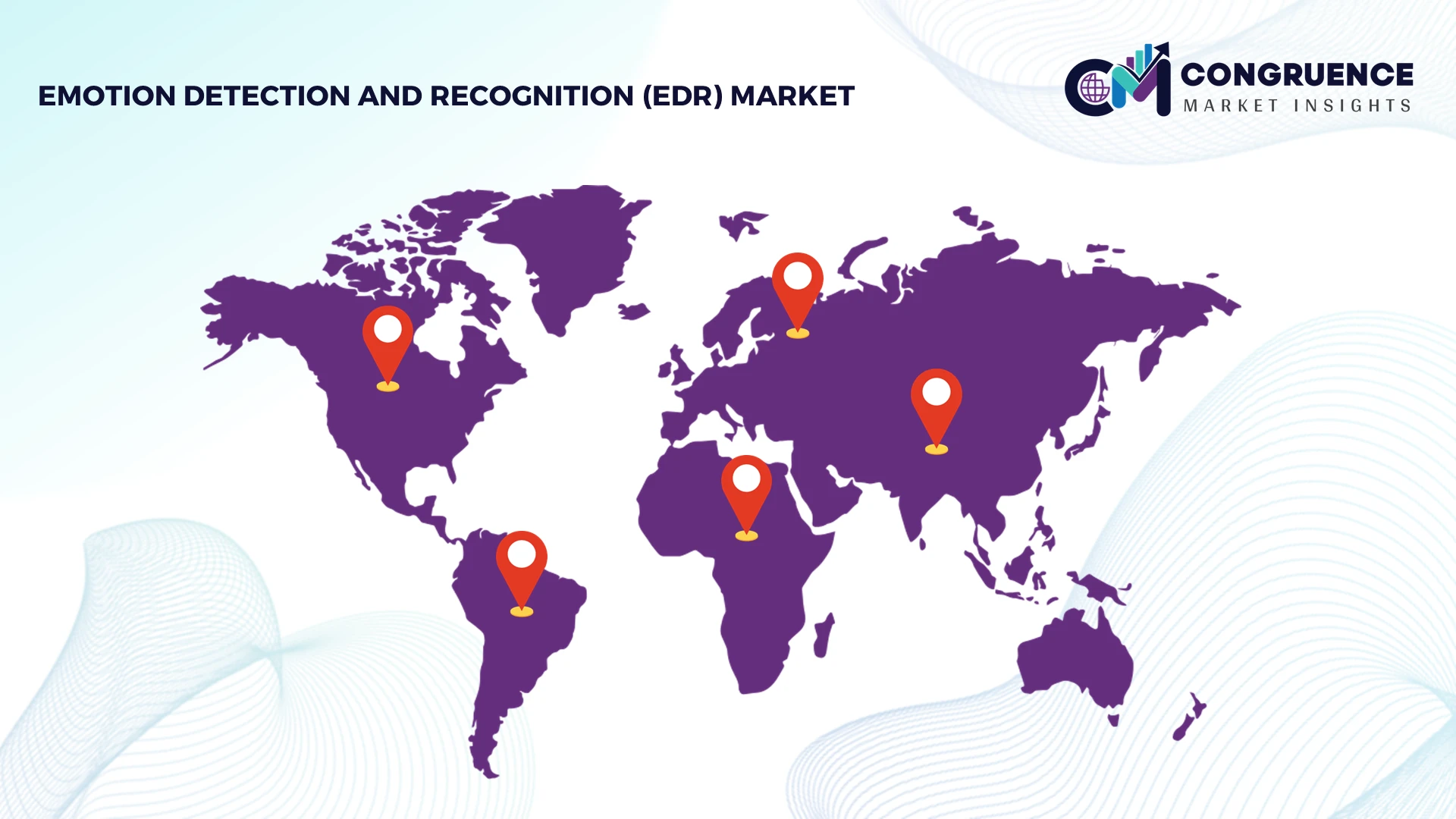
Geographic coverage includes North America, Europe, Asia-Pacific, South America, and Middle East & Africa, with country-level assessment of adoption, infrastructure, regulatory conditions, and investment activity. The report evaluates multimodal AI, edge inference, conversational intelligence, computer vision, speech analytics, and privacy-preserving architectures. With multimodal deployment improving contextual performance by approximately 20%–25% and edge processing reducing data transfers by 30%–40%, the analysis supports investment planning, expansion priorities, vendor positioning, partnership strategy, and technology roadmaps through 2026–2033.
| Report Attribute/Metric | Report Details |
|---|---|
Market Revenue in 2025 | USD 63022.92 Million |
Market Revenue in 2033 | USD 198631.4 Million |
CAGR (2026 - 2033) | 15.43% |
Base Year | 2025 |
Forecast Period | 2026 - 2033 |
Historic Period | 2021 - 2025 |
Segments Covered | By Type
By Application
By End-User
|
Key Report Deliverable | Revenue Forecast, Growth Trends, Market Dynamics, Segmental Overview, Regional and Country-wise Analysis, Competition Landscape |
Region Covered | North America, Europe, Asia-Pacific, South America, Middle East, Africa |
Key Players Analyzed | Microsoft Corporation, Google LLC, IBM Corporation, Amazon Web Services, Inc., Affectiva, Noldus Information Technology, Realeyes Data Services Ltd., Kairos AR, Inc., Emotiva, Nuance Communications, audEERING GmbH, Hume AI, iMotions A/S, MorphCast |
Customization & Pricing | Available on Request (10% Customization is Free) |




