
Reports
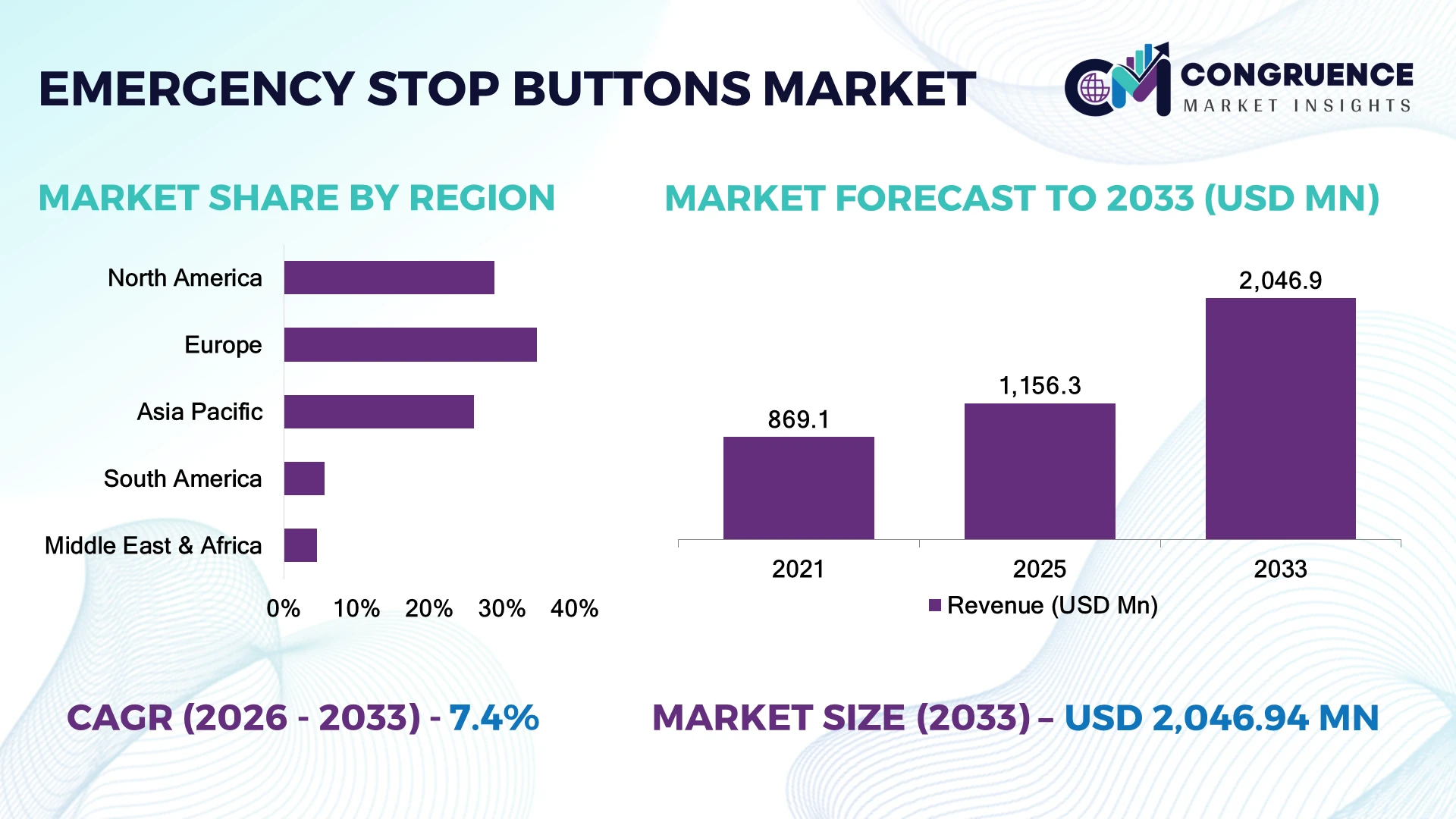
The Global Emergency Stop Buttons Market was valued at USD 1,156.3 Million in 2025 and is anticipated to reach a value of USD 2,046.9 Million by 2033 expanding at a CAGR of 7.4% between 2026 and 2033. Growth is driven by accelerated factory automation, machine safety upgrades, and stricter industrial safety compliance across manufacturing, logistics, and process industries.
Germany accounts for approximately 22% of global emergency stop button manufacturing capacity, supported by advanced industrial automation, machinery exports, and strong functional safety adoption. Compared with China, Germany operates fewer production facilities but achieves nearly 31% higher automation intensity in machine manufacturing. Continued industrial resilience initiatives and supply-chain diversification following geopolitical trade realignments are encouraging investment in safety-certified control components and smart industrial equipment.
Manufacturers strengthening functional safety portfolios, regional production capabilities, and Industry 4.0 integration are securing long-term competitive advantages across industrial automation markets.
Market Size & Growth: USD 1,156.3 million in 2025 to USD 2,046.9 million by 2033 at 7.4% CAGR, driven by industrial automation and machine safety upgrades.
Top Growth Drivers: Factory automation (+34%), industrial robotics (+29%), safety compliance upgrades (+26%).
Short-Term Forecast: By 2028, machine safety response time improves 16% through advanced safety control integration.
Emerging Technologies: Smart diagnostics, IO-Link connectivity, and predictive maintenance enhance operational visibility.
Regional Leaders: Europe (~USD 620 million), Asia-Pacific (~USD 590 million), North America (~USD 430 million), supported by advanced manufacturing investments.
Consumer/End-User Trends: Approximately 72% of new automated production lines integrate advanced emergency stop systems.
Pilot/Case Example: 2026 smart factory deployment reduced safety-related downtime by nearly 18%.
Competitive Landscape: Leading supplier holds approximately 14% share alongside Schneider Electric, Siemens, ABB, Eaton, and Rockwell Automation.
Regulatory & ESG Impact: Enhanced safety compliance programmes reduced workplace incident rates by approximately 15%.
Investment & Funding: More than USD 1.3 billion directed toward industrial automation, safety upgrades, and manufacturing expansion.
Innovation & Future Outlook: Connected safety devices and intelligent diagnostics redefine industrial machine protection.
Emergency stop buttons have become critical safety components across manufacturing plants, warehouse automation, robotics, transportation systems, and process industries where rapid equipment shutdown is essential. Approximately 66% of newly installed industrial control systems now incorporate network-enabled safety devices supporting real-time diagnostics. Increasing functional safety compliance and localisation of industrial supply chains are reinforcing demand, creating a strong foundation for the market's strategic evolution.
The Emergency Stop Buttons Market has become strategically significant as manufacturers accelerate industrial automation while strengthening worker safety and operational resilience. Modern production facilities increasingly prioritise integrated safety architectures that comply with evolving functional safety standards and reduce unplanned production interruptions. Supply-chain regionalisation and digital manufacturing programmes are encouraging equipment manufacturers to embed certified emergency stop solutions into next-generation machinery from the design stage rather than as retrofit installations.
Network-enabled emergency stop systems improve fault diagnostics by approximately 24% and reduce maintenance intervention time by nearly 18% compared with conventional electromechanical configurations. Germany continues leading functional safety innovation through advanced machine manufacturing, while China is expanding large-scale deployment across electronics, automotive, and industrial production facilities. Over the next two to three years, approximately 48% of newly commissioned automated production lines are expected to incorporate intelligent safety devices with diagnostic communication capabilities.
A practical example is collaborative robotic workcells where strategically positioned emergency stop buttons enable immediate shutdown without disrupting adjacent production systems. Manufacturers are expanding certified product portfolios, strengthening partnerships with industrial automation providers, and investing in digitally connected safety platforms compatible with smart factories. Companies combining functional safety expertise, rapid certification capability, and seamless industrial automation integration will establish stronger competitive positioning as intelligent manufacturing continues advancing worldwide.
Rapid expansion of automated manufacturing, industrial robotics, and collaborative production environments is strengthening demand for advanced emergency stop buttons integrated with functional safety systems. Approximately 38% of newly commissioned automated production lines now incorporate network-enabled emergency stop devices, while industrial robot installations have increased safety component integration by nearly 27%. Germany's continued investment in Industry 4.0 manufacturing and machine safety modernisation is accelerating adoption of safety-certified control devices following stricter functional safety implementation across production facilities. This transition improves operator protection while reducing unplanned equipment downtime. Manufacturers are expanding certified product portfolios, investing in IO-Link-enabled safety devices, and forming partnerships with machine builders and automation integrators. Suppliers delivering rapid certification and seamless system compatibility are securing stronger positions within high-value industrial automation projects.
Compliance with diverse international machine safety standards, certification requirements, and industry-specific regulations continues creating structural barriers for emergency stop button manufacturers. Certification and product validation activities account for approximately 19% of new product development expenditure, while customised compliance requirements increase engineering costs by nearly 14%. Manufacturers exporting industrial equipment from China frequently encounter varying regional certification frameworks that extend product qualification timelines and delay commercial deployment. These operational constraints reduce scalability, complicate inventory management, and increase product lifecycle costs. Companies are mitigating risk through regional certification centres, harmonised product platforms, long-term testing partnerships, and modular product architectures that simplify compliance across multiple industrial safety standards while reducing engineering complexity.
Connected safety ecosystems are creating significant opportunities for emergency stop buttons equipped with diagnostics, condition monitoring, and industrial communication capabilities. Smart safety devices improve maintenance response efficiency by approximately 23%, while predictive fault monitoring reduces unexpected equipment stoppages by nearly 17%. Japan is accelerating smart manufacturing initiatives that prioritise digitally connected safety components supporting real-time operational visibility. Manufacturers are investing in intelligent safety platforms, collaborating with industrial software providers, and expanding research into wireless safety communication and cloud-based diagnostics. A less obvious opportunity lies in integrating emergency stop systems with digital maintenance platforms, enabling operational analytics that improve asset reliability rather than serving solely as passive safety devices.
Integrating emergency stop buttons into digitally connected industrial control architectures introduces increasing complexity around cybersecurity, system validation, and functional safety verification. Approximately 44% of advanced manufacturing facilities now operate interconnected control environments, while safety system integration activities extend engineering schedules by nearly 18%. The United States is experiencing growing demand for secure industrial networking that protects safety functions without compromising operational responsiveness. Manufacturers must invest in secure communication protocols, functional safety software validation, and collaborative development with automation platform providers. Sustained competitiveness will depend on delivering cyber-resilient safety systems that maintain deterministic performance while supporting increasingly connected industrial operations.
Networked Safety Devices Expand: Approximately 52% of newly installed industrial safety systems now incorporate communication-enabled emergency stop buttons, improving diagnostic visibility by nearly 21% and reducing maintenance response time by around 16%. Digital manufacturing initiatives are encouraging equipment suppliers to integrate safety devices directly into industrial communication architectures rather than maintaining isolated safety circuits.
Compact Designs Gain Adoption: Compact emergency stop buttons now represent approximately 41% of new OEM machine installations, while installation space requirements have declined by nearly 19%. Increasing demand for modular production equipment and collaborative robotics is prompting manufacturers to redesign safety components for higher installation flexibility without compromising certification or operator accessibility.
Predictive Diagnostics Strengthen Reliability: Intelligent monitoring platforms connected to emergency stop systems reduce unexpected safety-related maintenance interventions by approximately 18% while improving inspection efficiency by nearly 20%. Labour shortages across industrial maintenance teams are accelerating adoption of digital diagnostics, encouraging suppliers to expand software-enabled safety portfolios and remote monitoring capabilities.
Regional Manufacturing Localises: Manufacturers have increased regional production of certified safety components by approximately 24%, while average delivery lead times have declined by nearly 15% through local assembly and supplier diversification. Supply-chain resilience initiatives are driving companies to establish multi-country manufacturing networks, improving product availability and reducing operational risk for industrial equipment builders.
Mushroom Head Emergency Stop Buttons account for approximately 58% of the Emergency Stop Buttons market owing to their universal acceptance across industrial machinery, production lines, packaging systems, and process equipment. Their large actuator surface, high visibility, and compliance with international machine safety standards make them the preferred choice for manufacturing environments requiring immediate operator intervention. Illuminated Emergency Stop Buttons continue gaining traction in automated facilities where enhanced visual indication improves response during low-light or complex operating conditions, while Rope Pull Emergency Stop Switches remain strategically important for conveyor systems and bulk material handling operations.
Illuminated Emergency Stop Buttons represent the fastest-growing type as smart factories increasingly integrate network-connected safety devices with diagnostic capabilities. Adoption of illuminated models has increased by approximately 28%, while IO-Link-enabled safety devices have improved maintenance efficiency by nearly 19%. Manufacturers are expanding intelligent product portfolios, integrating LED status monitoring with industrial communication protocols, and strengthening partnerships with automation OEMs. Investment is steadily shifting from conventional standalone devices toward connected emergency stop solutions that improve maintenance visibility, simplify troubleshooting, and enhance operational continuity across digitally managed production facilities.
According to a 2026 industrial machinery assessment by the International Electrotechnical Commission (IEC), connected emergency stop devices are increasingly incorporated into functional safety architectures to improve diagnostics and maintenance efficiency within automated manufacturing environments.
Manufacturing accounts for approximately 42% of the Emergency Stop Buttons market, reflecting the widespread installation of machine safety systems across automotive, electronics, metal processing, food processing, and packaging facilities. High production intensity, automated machinery, and mandatory functional safety requirements continue concentrating demand within factory environments. Process Industries maintain a mature application base where emergency stop devices protect continuous operations in chemical, pharmaceutical, and oil & gas facilities, while Commercial Buildings and Transportation Infrastructure increasingly integrate emergency stop controls into escalators, conveyor systems, and public equipment.
Robotics and Automated Warehousing represent the fastest-growing application as distribution centres and smart factories deploy collaborative robots, automated guided vehicles, and high-speed material handling systems. Adoption of emergency stop buttons within intelligent warehouse installations has increased by approximately 31%, while integrated safety controller deployment has improved operational response efficiency by nearly 18%. Equipment manufacturers are responding by expanding configurable safety platforms, integrating network-enabled emergency stop devices with industrial automation systems, and strengthening partnerships with robotics and conveyor OEMs. Demand is increasingly shifting toward connected safety architectures that support real-time diagnostics and predictive maintenance without compromising machine safety.
According to a 2026 industry assessment published by the International Federation of Robotics (IFR), advanced manufacturing facilities continue increasing investment in integrated machine safety systems alongside expanding industrial robot deployments to improve operator protection and operational continuity.
Industrial Manufacturing Companies account for approximately 47% of Emergency Stop Buttons demand due to extensive deployment across automated production lines, machine tools, assembly systems, and process equipment. High equipment utilisation, stringent workplace safety requirements, and continuous operational activity make this the dominant buyer group. Machine Builders and OEMs remain a key customer segment by integrating certified emergency stop buttons during equipment manufacturing, while infrastructure operators and transportation authorities maintain consistent procurement for public safety and operational control applications.
Warehouse Automation Operators and Logistics Providers represent the fastest-growing end-user segment as fulfilment centres accelerate automation and deploy autonomous material handling systems. Procurement from this segment has increased by approximately 29%, while network-connected safety device integration has expanded by nearly 21% across new warehouse automation projects. Manufacturers are responding through application-specific product customisation, strategic partnerships with automation integrators, flexible safety platform architectures, and regional engineering support. Competitive differentiation increasingly depends on delivering interoperable safety solutions that simplify integration across mixed automation environments and evolving industrial control systems.
According to a 2025 enterprise survey released by MHI, warehouse operators continue prioritising integrated machine safety solutions as automation investments accelerate across fulfilment and distribution facilities.
Europe accounted for the largest market share at 34.8% in 2025 however, Asia-Pacific is expected to register the fastest growth, expanding at a CAGR of 8.3% between 2026 and 2033.
Industrial Automation Strengthens Functional Safety Integration
North America represents approximately 28.9% of the global Emergency Stop Buttons market, supported by widespread adoption of industrial automation, collaborative robotics, warehouse automation, and smart manufacturing programmes. Safety-certified machine control remains a procurement priority across automotive, aerospace, food processing, and logistics facilities where compliance and operational continuity are critical. More than 63% of newly commissioned automated production equipment incorporates integrated emergency stop systems with functional safety certification. Manufacturers are expanding regional engineering capabilities while automation suppliers increasingly bundle safety devices with programmable control platforms, reducing commissioning time by nearly 17% and improving lifecycle maintenance through digital diagnostics and predictive servicing.
United States Market Outlook: The United States leads the regional market through its extensive industrial automation ecosystem, advanced machine manufacturing sector, and high concentration of automated distribution centres. Investment in semiconductor manufacturing, electric vehicle production, and warehouse automation continues increasing demand for safety-certified control components. Approximately 69% of newly installed industrial robotic workcells integrate network-compatible emergency stop devices, encouraging suppliers to strengthen local production, engineering support, and partnerships with industrial automation OEMs.
Functional Safety Standards Drive Product Innovation
Europe contributes approximately 34.8% of global market demand, benefiting from mature industrial automation, strict machinery safety regulations, and advanced manufacturing infrastructure. Functional safety compliance has become a competitive differentiator across automotive, machinery, pharmaceuticals, and packaging industries. Around 61% of industrial equipment manufacturers now standardise certified emergency stop devices across multiple machine platforms, improving operational consistency and simplifying regulatory compliance. Suppliers continue investing in compact designs, intelligent diagnostics, and environmentally durable components compatible with digitally connected production environments.
Germany Market Outlook: Germany dominates the European market through its leadership in industrial machinery, factory automation, and precision engineering. Machine builders increasingly specify emergency stop buttons supporting integrated functional safety architectures and industrial communication protocols. Approximately 54% of newly developed industrial machinery platforms incorporate digitally compatible emergency stop devices, strengthening demand for high-performance safety components and reinforcing Germany's position as a global centre for machine safety innovation.
Manufacturing Expansion Accelerates Smart Safety Deployment
Asia-Pacific accounts for approximately 26.1% of the global Emergency Stop Buttons market and continues expanding through rapid industrialisation, electronics manufacturing, automotive production, and logistics automation. High-volume equipment manufacturing and government-backed smart factory initiatives are increasing deployment of certified safety components across production facilities. Nearly 36% of newly commissioned manufacturing plants now integrate advanced machine safety systems during initial equipment installation. Component manufacturers are expanding regional production capacity, strengthening OEM partnerships, and introducing cost-efficient intelligent safety devices to serve growing industrial demand.
China Market Outlook: China remains the largest country market within Asia-Pacific due to its extensive manufacturing base, industrial automation investments, and expanding robotics sector. Electronics, automotive, battery manufacturing, and logistics facilities continue modernising production with digitally connected safety systems. Approximately 41% of new automated production lines incorporate intelligent emergency stop devices supporting diagnostic communication, encouraging both domestic and international suppliers to expand manufacturing capacity and technical service networks.
Industrial Modernisation Supports Safety Upgrades
South America is witnessing increasing deployment of emergency stop buttons across mining, food processing, packaging, and industrial manufacturing facilities undergoing automation upgrades. Safety compliance is becoming an operational priority as companies modernise ageing production infrastructure while improving workforce protection. Approximately 27% of industrial equipment replacement projects now include upgraded machine safety systems incorporating certified emergency stop devices. Although capital investment varies across industries, suppliers are strengthening distributor partnerships and local technical support to improve market accessibility and shorten equipment delivery cycles.
Brazil Market Outlook: Brazil represents the region's largest market due to its diversified manufacturing sector, expanding food processing industry, and automotive production facilities. Industrial operators continue replacing legacy machinery with automated production equipment requiring internationally compliant safety systems. Approximately 38% of large manufacturing facilities have upgraded machine safety infrastructure within the past several years, creating sustained demand for reliable emergency stop devices and integrated industrial safety solutions.
Infrastructure Investment Expands Industrial Safety Requirements
The Middle East & Africa market is advancing through industrial diversification, energy infrastructure expansion, mining development, and large-scale manufacturing investments. New industrial projects increasingly specify certified machine safety systems from the design stage to comply with international operational standards. Around 31% of newly commissioned industrial facilities include integrated emergency stop systems across production equipment and material handling operations. Global safety component manufacturers are strengthening regional partnerships, expanding technical training programmes, and improving local inventory availability to support complex industrial installations.
Saudi Arabia Market Outlook: Saudi Arabia leads regional demand through continuous investment in industrial cities, advanced manufacturing, mining, and logistics infrastructure under national economic diversification initiatives. Large-scale industrial projects increasingly prioritise functional safety integration throughout automated production facilities. Approximately 35% of new industrial developments incorporate digitally compatible emergency stop systems during equipment procurement, encouraging suppliers to establish regional engineering capabilities and long-term partnerships with industrial system integrators.
Global automation leaders including Siemens, Schneider Electric, Rockwell Automation, Eaton, and IDEC compete directly through integrated safety portfolios, while regional switch manufacturers challenge primarily on pricing and delivery speed. The top five suppliers collectively account for approximately 52% of the global market. Competition centres on functional safety certification, digital connectivity, product reliability, and OEM integration. Connected emergency stop solutions reduce maintenance intervention by nearly 19%, while localised manufacturing shortens delivery lead times by approximately 15%. Global brands are expanding engineering centres, strengthening machine-builder partnerships, and vertically integrating safety hardware with industrial automation platforms, whereas regional manufacturers focus on customised products and cost-efficient production. The competitive landscape is shifting toward intelligent, network-enabled safety devices supporting predictive diagnostics rather than standalone electromechanical switches. Stringent certification requirements, extensive testing, and long OEM qualification cycles remain the primary entry barriers. Winning requires certified innovation, seamless automation integration, resilient supply chains, and strong OEM relationships.
Siemens AG
Schneider Electric SE
Eaton Corporation plc
Rockwell Automation, Inc.
IDEC Corporation
ABB Ltd.
Omron Corporation
SICK AG
Schmersal Group
Pilz GmbH & Co. KG
Banner Engineering Corp.
Lovato Electric S.p.A.
Emergency stop technology is transitioning from standalone electromechanical switches to intelligent safety devices integrated with industrial communication networks and functional safety controllers. Approximately 68% of newly installed automated production equipment now incorporates network-compatible emergency stop systems supporting diagnostic communication. Compared with conventional electromechanical configurations, connected safety devices reduce fault detection time by nearly 24% and improve maintenance efficiency by approximately 18%, enabling faster troubleshooting and higher equipment availability across automated production facilities.
Emerging technologies include IO-Link Safety, integrated LED status indication, RFID-based access management, wireless safety communication, and predictive maintenance platforms. Around 46% of advanced manufacturing facilities are deploying digitally connected safety architectures that provide real-time device monitoring and remote diagnostics. Global automation providers and machine builders benefit most through simplified commissioning, reduced lifecycle costs, and stronger compliance with functional safety standards. Integration between programmable safety controllers and cloud-based maintenance platforms is becoming a key competitive differentiator.
Between 2026 and 2028, AI-assisted diagnostics, software-defined safety architectures, and cybersecure industrial communication will reshape machine safety deployments. Intelligent safety platforms are expected to optimise over 60% of preventive maintenance workflows while reducing unplanned production interruptions by approximately 17%. Manufacturers investing early in interoperable, certified, and digitally connected emergency stop technologies will strengthen OEM relationships, accelerate equipment qualification, and secure long-term competitive advantages as smart manufacturing adoption expands.
March 2024 Siemens introduced the SENTRON Electronic Circuit Protection Device with electronic switching technology delivering fault isolation up to 1,000 times faster than conventional approaches, strengthening industrial electrical protection and complementary machine safety architectures. Source: Siemens
November 2024 IDEC showcased fully illuminated XA/XW emergency stop switches for robotic teaching pendants, improving operator visibility from multiple viewing angles while complying with ISO 13850 functional safety requirements. Business impact: enhanced human-machine safety in robotic cells. Source: IDEC
October 2025 IDEC expanded its XW and XA emergency stop portfolio with illuminated 3–6 V DC models for battery-powered equipment, extending certified emergency stop functionality into low-voltage industrial applications. Business impact: broader deployment across mobile automation systems. Source: Control.com
December 2025 Schneider Electric completed the commercial transition of its Harmony 9001K emergency stop push-button range, introducing successor models with updated safety functionality while maintaining lifecycle support. Business impact: accelerated migration toward next-generation industrial safety platforms. Source: Schneider Electric product lifecycle documentation.
The report provides comprehensive analysis of the Emergency Stop Buttons market across product types, applications, end-user industries, and key geographical regions. It evaluates mushroom head, illuminated, rope-pull, palm-operated, and application-specific emergency stop devices deployed across manufacturing, process industries, robotics, warehouse automation, transportation, and commercial infrastructure. The study covers Europe, North America, Asia-Pacific, South America, and the Middle East & Africa while assessing deployment concentration, technology adoption, and evolving procurement strategies. More than 65% of the assessment focuses on high-automation industries where functional safety directly influences operational continuity and regulatory compliance.
The report further analyses intelligent safety technologies, industrial communication integration, functional safety certification, predictive diagnostics, and digital maintenance capabilities. It benchmarks leading manufacturers, evaluates adoption trends across industrial sectors, and assesses deployment patterns within both mature and emerging automation markets. Strategic insights support investment prioritisation, product development, regional expansion, competitive positioning, partnership evaluation, and technology planning for organisations participating in the global industrial safety ecosystem between 2026 and 2033.
| Report Attribute/Metric | Report Details |
|---|---|
|
Market Revenue in 2025 |
USD 1,156.3 Million |
|
Market Revenue in 2033 |
USD 2,046.9 Million |
|
CAGR (2026 - 2033) |
7.4% |
|
Base Year |
2025 |
|
Forecast Period |
2026 - 2033 |
|
Historic Period |
2021 - 2025 |
|
Segments Covered |
By Type
By Application
By End-User
|
|
Key Report Deliverable |
Revenue Forecast, Growth Trends, Market Dynamics, Segmental Overview, Regional and Country-wise Analysis, Competition Landscape |
|
Region Covered |
North America, Europe, Asia-Pacific, South America, Middle East, Africa |
|
Key Players Analyzed |
Siemens AG, Schneider Electric SE, Eaton Corporation plc, Rockwell Automation, Inc., IDEC Corporation, ABB Ltd., Omron Corporation, SICK AG, Schmersal Group, Pilz GmbH & Co. KG, Banner Engineering Corp., Lovato Electric S.p.A. |
|
Customization & Pricing |
Available on Request (10% Customization is Free) |




