
Reports
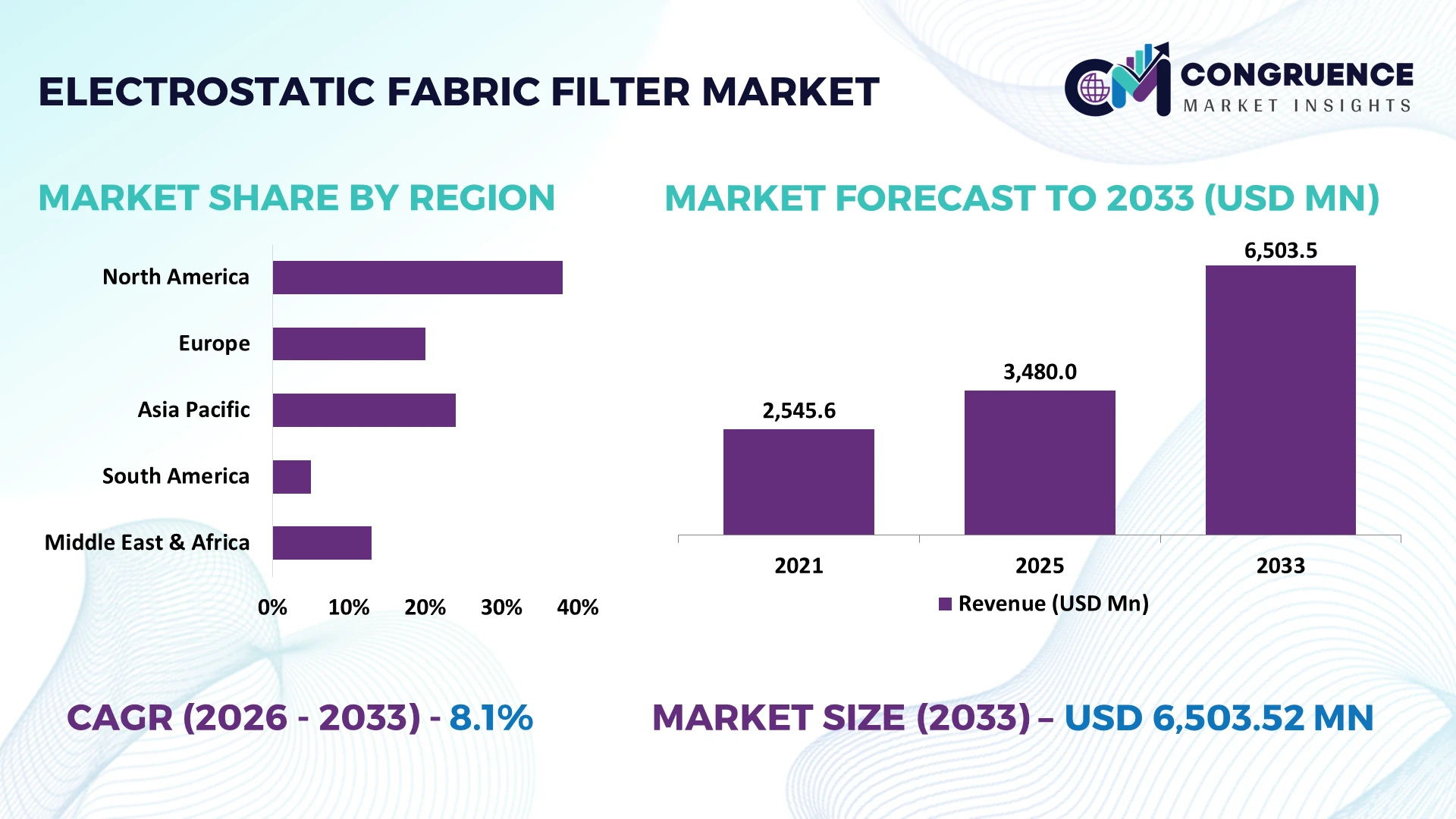
The Global Electrostatic Fabric Filter Market was valued at USD 3480 Million in 2025 and is anticipated to reach a value of USD 6503.52 Million by 2033 expanding at a CAGR of 8.13% between 2026 and 2033. Growth is driven by coal-plant particulate retrofits, cement and steel emission upgrades, tighter PM limits, and replacement of standalone electrostatic precipitators with high-efficiency hybrid electrostatic-fabric filtration.
China represents an estimated 35% of global demand, supported by more than 1,200 GW of coal-fired capacity and the world's largest cement and steel production bases. Ultra-low-emission retrofits have pushed particulate control toward below 10 mg/Nm³ at major power and industrial installations, supporting hybrid filter deployment with above 99.9% collection efficiency. India, by comparison, operates over 220 GW of coal capacity and is accelerating particulate-control upgrades. China's industrial decarbonization agenda and continuing geopolitical emphasis on domestic energy security sustain retrofit activity.
Strategically, suppliers should prioritize high-temperature filter media, ESP-to-hybrid conversions, intelligent controls, and localized aftermarket capability across coal, cement, steel, and waste-processing clusters.
Market Size & Growth: USD 3,480 million in 2025 reaches USD 6,503.52 million by 2033 at 8.13% CAGR, driven by industrial particulate-control retrofits.
Top Growth Drivers: Collection efficiency above 99.9%, particulate reduction above 95%, and filtration-energy savings approaching 20% strengthen hybrid-system economics.
Short-Term Forecast: By 2028, intelligent pressure-drop optimization can lower filtration energy consumption approximately 10–15% across digitally controlled installations.
Emerging Technologies: AI diagnostics, electrostatically enhanced filter media, pulse-jet automation, and IoT monitoring are targeting above 99.9% fine-particle capture.
Regional Leaders: Asia-Pacific approaches USD 3.1 billion, Europe USD 1.3 billion, and North America USD 1.2 billion by 2033 as industrial retrofits expand.
Consumer/End-User Trends: Cement, power, and steel operators increasingly specify systems capable of maintaining particulate emissions below 10 mg/Nm³ under variable loads.
Pilot/Case Example: Hybrid ESP-fabric installations have demonstrated above 99.9% particulate collection while achieving outlet concentrations below 5 mg/Nm³ in optimized operating conditions.
Competitive Landscape: ANDRITZ holds an estimated 15% position, competing with Babcock & Wilcox, FLSmidth, Thermax, and Mitsubishi Power through retrofit engineering and filtration performance.
Regulatory & ESG Impact: China's ultra-low-emission programs target particulate concentrations near 10 mg/Nm³, accelerating replacement and hybridization of aging industrial collection systems.
Investment & Funding: More than USD 100 billion in global industrial decarbonization investment increasingly includes air-pollution controls alongside efficiency, electrification, and process-modernization projects.
Innovation & Future Outlook: Next-generation conductive media, AI cleaning controls, and hybrid collectors target 10–20% lower energy use while maintaining above 99.9% particulate capture.
The Electrostatic Fabric Filter Market is increasingly shaped by coal-fired power retrofits, cement kilns, steel furnaces, waste incinerators, and other dust-intensive industrial processes requiring consistent fine-particle control. Hybrid systems combine electrostatic pre-charging with fabric filtration, enabling collection efficiencies above 99.9% while reducing dust loading on filter bags. Conductive media, automated pulse cleaning, pressure-drop sensors, and predictive controls are improving bag life and energy management. China's ultra-low-emission requirements and tighter industrial particulate limits in India are accelerating modernization of aging collection assets, shifting procurement toward integrated systems that combine compliance performance with lifecycle operating efficiency.
Electrostatic fabric filters are becoming strategically important as power, cement, steel, and waste-processing operators must achieve tighter particulate limits without sacrificing plant throughput. China's ultra-low-emission framework has established particulate targets near 10 mg/Nm³ for major combustion assets, shifting investment from standalone collectors toward integrated electrostatic-fabric systems. India is following through thermal-power and industrial emission upgrades, creating a retrofit-led equipment cycle across large installed plants.
Hybrid electrostatic-fabric filtration combines particle pre-charging with barrier capture, delivering above 99.9% collection efficiency versus roughly 99% for conventional systems under demanding fine-particle conditions. Lower dust loading can also extend cleaning intervals and reduce pressure-drop penalties. China leads deployment scale through its 1,200+ GW coal fleet and industrial base, while Europe emphasizes energy efficiency and tighter industrial-emissions compliance. Through 2026–2028, digital controls should reduce filtration energy consumption by approximately 10–15%.
A practical coal-boiler retrofit can convert an existing ESP casing into a hybrid collector, preserving infrastructure while achieving sub-10 mg/Nm³ particulate performance. Suppliers are investing in conductive media, pulse-cleaning controls, retrofit engineering, and localized service capability. Competitive advantage will increasingly depend on combining compliance certainty with lower lifecycle energy and bag-replacement costs.
Industrial particulate regulation is forcing operators to upgrade collectors that cannot consistently maintain low outlet concentrations under changing fuel and process loads. Hybrid electrostatic-fabric systems deliver above 99.9% collection efficiency and can achieve particulate concentrations below 10 mg/Nm³, while optimized installations approach 5 mg/Nm³. China's ultra-low-emission program has already established a demanding benchmark across coal-fired generation, and India is tightening thermal-power and industrial pollution controls. Electrostatic pre-charging reduces particulate loading on downstream fabric media, allowing plants to pursue compliance without sacrificing filtration stability. This creates retrofit demand across existing ESP infrastructure rather than only greenfield facilities. ANDRITZ, Thermax, FLSmidth, and other suppliers are strengthening conversion engineering, advanced media, pulse-cleaning systems, and digital controls. Retrofit compatibility therefore becomes a decisive procurement advantage.
Electrostatic fabric filter conversions require substantial structural, electrical, ducting, media, and control modifications, particularly where aging ESP casings were not designed for fabric-filter modules. Pressure-drop requirements can increase auxiliary fan consumption by approximately 5–10% if airflow and cleaning cycles are poorly optimized, while filter bags can represent 15–25% of lifecycle maintenance expenditure in dust-intensive applications. Indian cement and thermal-power plants also face uneven retrofit windows because major modifications must align with scheduled outages, constraining installation speed. High-temperature media and corrosion-resistant components add procurement exposure where specialized fibers remain internationally sourced. Suppliers are reducing these constraints through modular conversion designs, localized bag production, optimized pulse cleaning, and long-term maintenance contracts. The strongest commercial proposition is therefore not lowest equipment cost, but predictable compliance with controlled pressure drop and replacement frequency.
AI-enabled pressure-drop control, predictive bag monitoring, conductive filter media, and adaptive pulse cleaning are creating a higher-value technology layer around conventional particulate capture. Digitally optimized cleaning can reduce compressed-air and fan energy consumption by approximately 10–15%, while predictive maintenance can extend effective bag life by 15–20% under controlled operating conditions. China's enormous installed ESP base creates retrofit potential, while India's 220+ GW coal fleet provides a second large modernization pool alongside cement and steel plants. Future systems will increasingly combine particulate sensors, differential-pressure analytics, and automated cleaning algorithms to balance emissions performance against energy use. Manufacturers are investing in smart controllers, sensor integration, advanced fibers, and remote service platforms. The non-obvious opportunity lies in monetizing filtration data through lifecycle service contracts rather than relying primarily on collector hardware sales.
Maintaining stable filtration performance across fluctuating dust resistivity, moisture, temperature, particle loading, and gas chemistry remains the critical execution challenge. Hybrid systems depend on effective coordination between electrostatic charging and fabric capture; process excursions can increase pressure drop by 10–20% and accelerate bag degradation if cleaning algorithms respond poorly. Cement kilns introduce abrasive dust, while coal boilers encounter ash characteristics that vary with fuel sourcing, making standardized operating parameters ineffective across installations. India's increasing use of diverse domestic and imported coal grades intensifies this variability. Digital control also raises requirements for reliable sensors, trained technicians, and integration with distributed-control systems. Suppliers must invest in application-specific media selection, real-time diagnostics, operator training, and adaptive cleaning software. Long-term competitiveness depends on maintaining sub-10 mg/Nm³ performance without excessive energy consumption or premature bag replacement.
Pulse Cleaning Becomes Demand Responsive: Plants are replacing fixed-timer cleaning with differential-pressure-controlled pulse sequences that react to actual dust loading. Optimized systems are targeting 10–15% lower compressed-air consumption while maintaining collection efficiency above 99.9% and outlet particulate concentrations below 10 mg/Nm³. Chinese power and cement operators are integrating pressure sensors with plant controls, allowing suppliers to package automated valves, diagnostics, and filtration media around measurable operating-cost reductions.
High-Temperature Media Adoption Accelerates: Cement kilns, steel furnaces, and waste incinerators increasingly require filter media capable of sustained operation above 200°C. PTFE, PPS, fiberglass, and composite constructions are replacing conventional polyester where temperature excursions shorten bag life. Advanced media can extend replacement intervals by approximately 15–25% in suitable service. Manufacturers are expanding application-specific coatings and membrane treatments as operators prioritize predictable replacement cycles over lowest initial bag cost.
ESP Conversions Preserve Existing Infrastructure: Brownfield operators increasingly retain usable ESP casings, ductwork, and foundations while installing fabric-filter modules, reducing demolition and reconstruction requirements. Conversion strategies can reuse more than 50% of major structural infrastructure while delivering above 99.9% particulate collection. India's aging coal and industrial fleet makes this approach operationally attractive. Engineering suppliers are standardizing modular internals and phased installation packages to fit upgrades within scheduled plant outages.
Lifecycle Service Models Gain Ground: Procurement is moving beyond collector delivery toward bag diagnostics, performance guarantees, spare inventories, and scheduled replacement programs. Plants targeting availability above 95% increasingly treat filtration consumables as reliability assets rather than commodity purchases. Suppliers are localizing bag inventories and technical support near Chinese and Indian industrial clusters, reducing replacement lead times while strengthening recurring aftermarket relationships.
Pulse-jet filters represent the leading type with an estimated 36% market share, supported by compact construction, online cleaning, high filtration velocity, and compatibility with continuously operating industrial processes. Their ability to clean individual bag rows without shutting down the collector gives power, cement, and steel operators stronger availability economics. Standard fabric filters account for approximately 24% and remain important where moderate temperatures and predictable dust characteristics favor lower system complexity. Reverse-air filters retain relevance across large legacy installations, although their lower air-to-cloth ratios increase equipment footprint.
High-temperature filters are the fastest-growing type as cement kilns, steel processing, and waste incineration expose media to increasingly severe thermal and chemical conditions. Specialized configurations can operate above 200°C, supporting longer service under conditions unsuitable for polyester media. High-voltage filters add electrostatic pre-charging to improve fine-particle capture. Manufacturers are therefore prioritizing PTFE membranes, PPS and fiberglass media, intelligent pulse controls, and hybrid high-voltage architectures, shifting investment toward performance-specific filtration rather than standardized bags.
Flue gas treatment leads application demand with approximately 38% share because particulate removal is integral to emission-control trains across combustion and process industries. Electrostatic fabric filters complement desulfurization, NOx control, and sorbent-injection systems by capturing fine ash and reaction products before stack discharge. Coal-fired power represents approximately 26% of deployment, supported by large installed generating fleets in China and India where increasingly stringent particulate limits require modernization of aging collectors. Cement production remains a mature application across kiln, clinker-cooler, and grinding operations.
Waste incineration is the fastest-growing application as municipal waste treatment expands and regulators tighten control of fine particulates and sorbent residues. Steel processing requires durable filtration around sintering, furnaces, and material handling, where abrasive dust challenges media longevity. Suppliers are responding with corrosion-resistant cages, high-temperature membranes, intelligent pulse cleaning, and integrated electrostatic pre-charging. Investment is increasingly concentrated on application-specific gas chemistry and temperature requirements rather than uniform filtration specifications.
Power generation represents the largest end-user group at approximately 34% share, reflecting extensive particulate-control infrastructure across coal-fired generating assets, particularly in China and India. Continuous boiler operation requires collectors capable of maintaining stable pressure drop and high removal efficiency despite changing ash composition and load profiles. Cement manufacturers account for approximately 25% of demand, with filtration distributed across raw mills, kilns, clinker coolers, and grinding lines. Steel producers prioritize abrasion resistance and high-temperature performance around sintering and furnace operations.
Waste management companies represent the fastest-growing buyer group as incineration capacity expands and operators require reliable capture of fine ash and air-pollution-control residues. Chemical industries remain strategically important where corrosive gases require specialized media and coatings. Suppliers are targeting these end users through sector-specific bag materials, retrofit packages, performance contracts, digital monitoring, and localized replacement inventories. Competitive positioning increasingly depends on demonstrating filtration stability under each industry's specific temperature, chemistry, and dust-loading profile.
Asia-Pacific accounted for the largest market share at 47% in 2025 however, Asia-Pacific is expected to register the fastest growth, expanding at a CAGR of 9.4% between 2026 and 2033.

Industrial Retrofits Shift Toward Lifecycle Efficiency
North America represents approximately 21% of global electrostatic fabric filter demand, with the United States concentrating deployment across power generation, cement, steel, chemicals, and waste-processing facilities. Industrial operators increasingly retrofit existing particulate-control systems rather than construct entirely new collectors, preserving casings, ductwork, and foundations while upgrading filtration performance. U.S. coal generation still exceeded 600 TWh in 2025, sustaining a sizeable installed base of boilers requiring particulate-control maintenance despite long-term generation restructuring. Cement production of roughly 90 million tonnes annually provides another filtration-intensive application across kilns, clinker coolers, and grinding systems. EPA particulate standards reinforce demand for reliable fine-dust capture, while aging equipment increases aftermarket requirements. Suppliers are emphasizing pulse-jet optimization, PTFE-coated media, pressure-drop monitoring, and modular conversions that minimize plant shutdown duration and reduce lifecycle maintenance exposure.
United States Market Outlook: The United States combines mature emission-control infrastructure with substantial cement, steel, chemical, and waste-processing capacity. More than 70 municipal solid-waste combustion facilities create specialized demand for high-temperature filtration and sorbent-residue capture. Operators increasingly prioritize digitally monitored collectors, locally available replacement media, and retrofit engineering capable of improving emissions performance without extensive reconstruction.
Industrial Emissions Rules Accelerate Modernization
Europe accounts for approximately 19% of global demand, with Germany, Italy, Poland, France, and the United Kingdom maintaining significant cement, steel, waste-to-energy, and industrial combustion infrastructure. Industrial Emissions Directive requirements increasingly link particulate-control investment with broader plant modernization, encouraging operators to combine high-efficiency filtration with energy optimization and continuous emissions monitoring. Europe's waste-to-energy infrastructure includes more than 500 operating plants, creating an important installed base for high-temperature fabric media and fine-particle capture. Germany's industrial clusters remain particularly relevant for filtration engineering, while Poland retains significant coal-based generation requiring pollution-control maintenance. European suppliers increasingly compete through PTFE membranes, corrosion-resistant media, optimized pulse cleaning, and lifecycle service agreements. Energy costs create a distinctive procurement constraint: pressure-drop management is becoming nearly as important as collection efficiency because auxiliary fan demand directly affects operating economics.
Germany Market Outlook: Germany combines large chemical, cement, metals, and waste-treatment industries with demanding environmental compliance. More than 90 waste-to-energy facilities create recurring requirements for high-temperature filtration, replacement bags, cages, and monitoring systems. Suppliers with energy-efficient cleaning controls and application-specific media gain an advantage where plants must reconcile stringent particulate performance with electricity-intensive induced-draft fan operation.
Industrial Scale Drives Hybrid Filtration Deployment
Asia-Pacific commands approximately 47% of global demand, supported by China's enormous coal-power, cement, steel, and waste-treatment infrastructure and India's accelerating industrial emission-control upgrades. China operates more than 1,200 GW of coal-fired generating capacity and produces over half of global crude steel, creating unmatched particulate-control equipment density. Ultra-low-emission retrofits have pushed many installations toward particulate concentrations of 10 mg/Nm³ or lower, encouraging hybrid ESP-fabric configurations and advanced baghouses. India adds a large modernization pipeline through more than 220 GW of coal capacity, expanding cement production, steel investment, and tightening pollution-control enforcement. Regional manufacturers benefit from localized filter-media, cage, and equipment supply chains, while international suppliers differentiate through engineering performance. Investment is shifting toward intelligent pulse cleaning, high-temperature materials, modular ESP conversions, and locally supported aftermarket services.
China Market Outlook: China remains the market's most important country through unparalleled equipment scale and stringent industrial particulate-control programs. Crude steel output remains near 1 billion tonnes annually, while cement production exceeds 1.8 billion tonnes. This industrial concentration creates continuous demand for filter replacement, collector optimization, high-temperature media, and digitally controlled cleaning across existing installations.
Cement and Metals Anchor Retrofit Demand
South America represents approximately 6% of global demand, led by Brazil's cement, steel, mining, pulp and paper, and industrial-processing base. Brazil produces roughly 65 million tonnes of cement annually, creating extensive dust-control requirements across raw-material preparation, kilns, clinker cooling, and finish grinding. Steelmaking and mineral processing add abrasive particulate streams requiring durable filter media and robust cleaning architectures. Unlike China, where ultra-low-emission retrofits operate at massive scale, South American procurement is more selective and strongly influenced by project economics, imported-component costs, and service availability. Currency volatility also increases the value of localized consumables and refurbishment capability. Equipment suppliers are consequently expanding distributor relationships, replacement-bag inventories, technical support, and modular retrofit offerings. Operationally, reducing imported-media dependency can matter more than marginal collector-efficiency gains when replacement lead times threaten production continuity.
Brazil Market Outlook: Brazil combines the region's largest industrial economy with approximately 30 million tonnes of annual crude steel production and substantial cement capacity. São Paulo, Minas Gerais, and Espírito Santo concentrate filtration-intensive operations. Local availability of filter bags, cages, controls, and field technicians provides a meaningful advantage where industrial operators seek predictable maintenance schedules and reduced import exposure.
Industrial Diversification Expands Filtration Requirements
Middle East & Africa accounts for approximately 7% of global demand, with Saudi Arabia, the UAE, South Africa, Egypt, and Turkey-linked trade corridors supporting cement, metals, power, waste-processing, and petrochemical applications. Saudi Arabia's industrial diversification is expanding cement and metals capacity alongside large infrastructure programs, increasing requirements for high-temperature particulate collection. The country produces more than 50 million tonnes of cement annually, providing a concentrated filtration installed base. UAE waste-to-energy development adds another technically demanding application where fine particulate and sorbent residues require reliable fabric capture. South Africa retains coal-intensive electricity and heavy-industry assets requiring collector maintenance despite infrastructure constraints. Suppliers are establishing regional service partnerships, stocking critical filter media, and offering modular upgrades because imported replacement components can extend maintenance cycles. Local technical capability therefore becomes a decisive differentiator alongside filtration performance.
Saudi Arabia Market Outlook: Saudi Arabia offers the strongest industrial investment platform through cement, mining, metals, petrochemicals, and infrastructure expansion under Vision 2030. Planned industrial diversification increases dust-control intensity beyond conventional power applications. Suppliers are positioning with high-temperature media, localized technical support, pulse-jet systems, and aftermarket inventories suited to continuous-duty cement and emerging metals-processing facilities.
ANDRITZ, FLSmidth, Thermax, Babcock & Wilcox, and Mitsubishi Heavy Industries compete through engineered particulate-control systems, while specialist filtration suppliers challenge them through media customization and aftermarket responsiveness. The top five suppliers hold approximately 42% combined share, leaving substantial scope for regional engineering firms. Competition centers on collection efficiency above 99.9%, pressure-drop optimization delivering 10–15% energy savings, and advanced media extending bag life by roughly 20%. ANDRITZ and Babcock & Wilcox leverage large retrofit engineering capabilities; FLSmidth concentrates on cement process integration, while Thermax competes aggressively across Asian industrial installations. Suppliers are expanding local service, intelligent controls, high-temperature media, and modular ESP-to-fabric conversions. The competitive shift favors lifecycle performance over equipment pricing as plants prioritize energy consumption and replacement intervals. Engineering qualification, emissions guarantees, installed-base access, and specialized media expertise create strong entry barriers. Winning requires measurable particulate control, low pressure drop, retrofit flexibility, rapid service, and dependable consumables supply.
ANDRITZ AG
FLSmidth
Thermax Limited
Babcock & Wilcox Enterprises, Inc.
Mitsubishi Heavy Industries, Ltd.
Sumitomo Heavy Industries, Ltd.
Dürr Group
Hamon
Longking Environmental Protection
Fujian Longking Co., Ltd.
Zhejiang Feida Environmental Science & Technology
Nederman Holding AB
Donaldson Company, Inc.
GEA Group AG
Current electrostatic fabric filter technology combines electrostatic particle charging with downstream fabric capture, pulse-jet cleaning, high-frequency power and differential-pressure controls. Hybrid configurations preserve existing ESP infrastructure while fabric stages capture residual fine particulate, enabling collection efficiencies above 99.9%. Advanced controllers modulate energization and cleaning cycles, cutting auxiliary energy requirements by approximately 10–15% and reducing unnecessary compressed-air consumption in industrial service.
Emerging systems integrate PTFE membranes, fiberglass and PPS media, IoT sensors, predictive diagnostics, and automated airflow balancing. Compared with legacy standalone ESPs, hybrid filters can improve fine-particle capture from roughly 99% to above 99.9%, when dust resistivity fluctuates. More than 2,000 fabric-filter installations and 4 million operating filter bags demonstrate commercial maturity globally. Cement, power, steel, and waste-to-energy operators benefit from longer bag life, stable pressure drop, and tighter emissions compliance.
Disruptive development through 2026–2028 will center on AI-directed pulse cleaning, digital twins, conductive filter media, and multi-pollutant integration with sorbent injection and desulfurization. Predictive controls should reduce maintenance interventions by 10–20% as sensor coverage expands across retrofit fleets. Suppliers controlling filter-media manufacturing, collector engineering, automation, and aftermarket diagnostics gain competitive advantage. Investment now matters because stricter particulate limits reward systems delivering verified emissions performance alongside lower lifecycle energy consumption.
November 2025 – Thermax-designed gas-cleaning equipment at Aether Alloys’ ferroalloy unit was documented operating two 9-MVA furnaces, with the baghouse system designed for 25 mg/Nm³ particulate discharge versus the applicable 150 mg/Nm³ standard, strengthening high-efficiency industrial filtration deployment. Source: NGT
February 2025 – ANDRITZ acquired LDX Solutions, adding Dustex fabric-filter and wet-ESP technologies plus an installed base exceeding 2,000 systems. The transaction expanded ANDRITZ’s North American particulate-control service footprint and strengthened its ability to deliver integrated industrial emissions solutions. Source: MarketScreener
August 2025 – Donaldson reported Industrial Filtration Solutions sales growth of 10.5%, driven partly by stronger dust-collection equipment demand in Europe and the United States. The increase demonstrated accelerating customer investment in industrial filtration equipment and aftermarket-supported particulate control. Source: Donaldson
February 2025 – Nederman inaugurated its Helsingborg Innovation Center, consolidating filtration R&D, testing capacity, and specialist expertise. The group’s Extraction & Filtration Technology division reported 982 average employees in 2025, reinforcing structured development capability for advanced industrial air-filtration systems. Source: Nederman
The report evaluates Standard Fabric Filters, High-Temperature Filters, High-Voltage Filters, Pulse-Jet Filters, and Reverse-Air Filters across Flue Gas Treatment, Cement Production, Steel Processing, Coal-Fired Power, and Waste Incineration. End-user coverage includes Power Generation, Cement Manufacturers, Steel Producers, Chemical Industries, and Waste Management Companies. Pulse-jet systems represent approximately 36% of type demand, while flue-gas treatment accounts for about 38% of application deployment.
Regional analysis covers North America, Europe, Asia-Pacific, South America, and Middle East & Africa, with Asia-Pacific representing approximately 47% of 2025 demand. Technology coverage includes hybrid ESP-fabric architectures, high-temperature media, PTFE membranes, intelligent pulse cleaning, IoT monitoring, and predictive diagnostics. The 2026–2033 assessment supports investment prioritization, retrofit planning, manufacturing localization, aftermarket expansion, competitive benchmarking, and positioning across increasingly stringent industrial particulate-control environments.
| Report Attribute/Metric | Report Details |
|---|---|
Market Revenue in 2025 | USD 3480 Million |
Market Revenue in 2033 | USD 6503.52 Million |
CAGR (2026 - 2033) | 8.13% |
Base Year | 2025 |
Forecast Period | 2026 - 2033 |
Historic Period | 2021 - 2025 |
Segments Covered | By Type
By Application
By End-User
|
Key Report Deliverable | Revenue Forecast, Growth Trends, Market Dynamics, Segmental Overview, Regional and Country-wise Analysis, Competition Landscape |
Region Covered | North America, Europe, Asia-Pacific, South America, Middle East, Africa |
Key Players Analyzed | ANDRITZ AG, FLSmidth, Thermax Limited, Babcock & Wilcox Enterprises, Inc., Mitsubishi Heavy Industries, Ltd., Sumitomo Heavy Industries, Ltd., Dürr Group, Hamon, Longking Environmental Protection, Fujian Longking Co., Ltd., Zhejiang Feida Environmental Science & Technology, Nederman Holding AB, Donaldson Company, Inc., GEA Group AG |
Customization & Pricing | Available on Request (10% Customization is Free) |




