
Reports
The Global Electroplating Market was valued at USD 4210 Million in 2025 and is anticipated to reach a value of USD 7174.28 Million by 2033 expanding at a CAGR of 6.89% between 2026 and 2033. Growth is supported by rising precision surface finishing requirements across electric vehicles, semiconductor manufacturing, aerospace components, and corrosion-resistant industrial equipment.
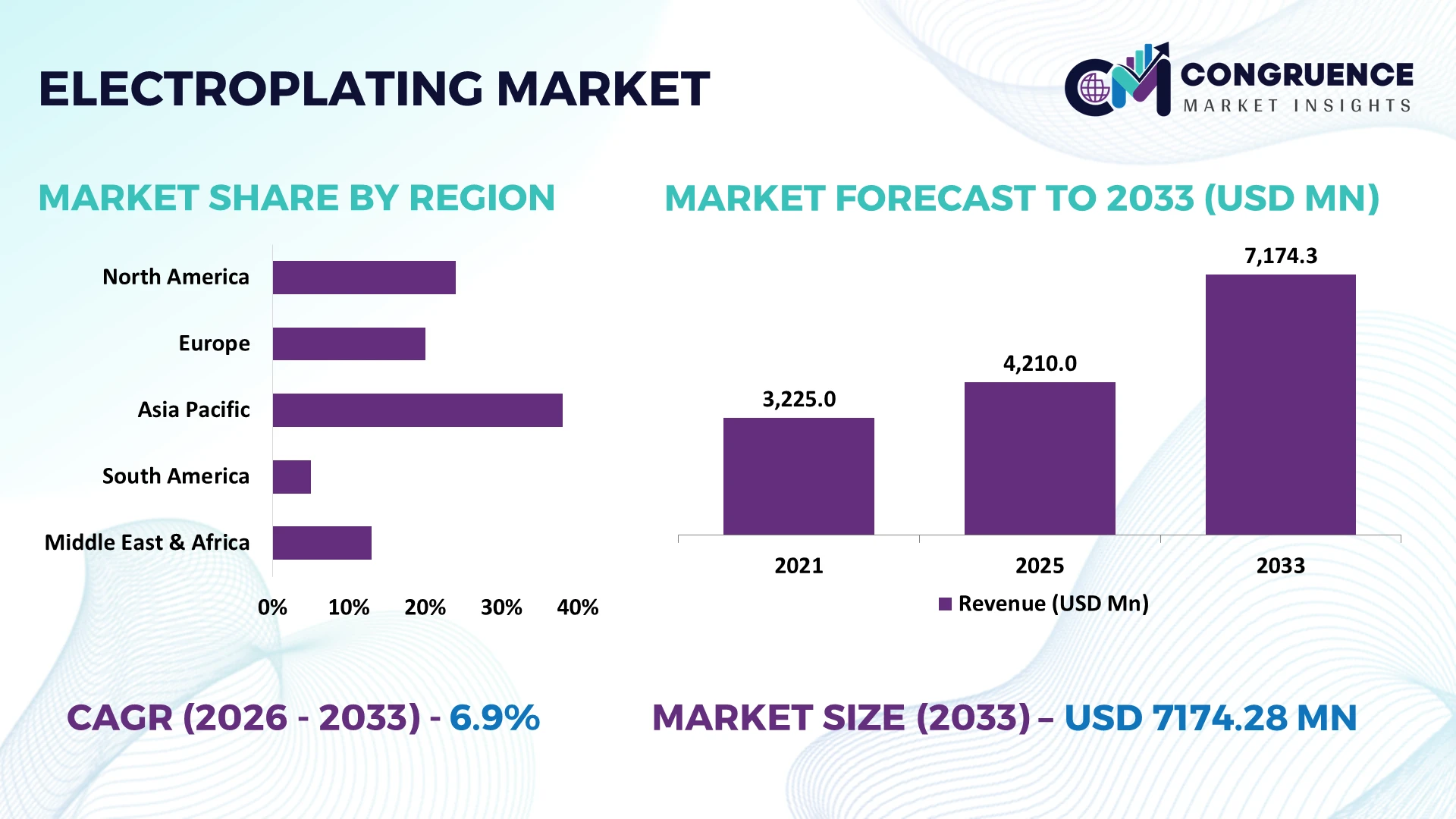
China remains the dominant electroplating hub, accounting for approximately 38% of global production capacity, supported by extensive electronics, automotive, and metal-processing industries alongside continued industrial modernization. India is expanding faster through manufacturing investments, while Germany maintains leadership in high-precision engineering applications. More than 62% of advanced plating facilities are integrating automated process controls to improve coating consistency amid evolving global supply-chain diversification following geopolitical trade realignments in Asia.
Businesses prioritizing automated, sustainable electroplating capabilities and diversified regional manufacturing footprints are positioned to strengthen long-term competitive resilience.
Market Size & Growth: USD 4210 Million in 2025 reaching USD 7174.28 Million by 2033 at 6.89% CAGR, driven by advanced automotive electrification and precision electronics manufacturing.
Top Growth Drivers: EV component demand +24%, semiconductor production +18%, industrial corrosion-protection applications +15% globally.
Short-Term Forecast: By 2028, automated plating systems reduce chemical consumption by nearly 20% while improving production efficiency by approximately 16%.
Emerging Technologies: AI-driven process monitoring, robotic automation, and pulse electroplating improve coating quality while reducing defect rates by over 18%.
Regional Leaders: Asia-Pacific exceeds USD 3300 Million, Europe approaches USD 1700 Million, North America surpasses USD 1400 Million through advanced manufacturing adoption.
Consumer/End-User Trends: Nearly 58% of electronics manufacturers prioritize high-performance plated components for durability, conductivity, and miniaturized device production.
Pilot/Case Example: A 2026 smart electroplating implementation improved coating uniformity by 22% while reducing wastewater generation by 17%.
Competitive Landscape: Leading manufacturers collectively hold approximately 34% market share, supported by Atotech, MacDermid Enthone, JCU Corporation, Uyemura, and Coventya.
Regulatory & ESG Impact: Sustainable plating technologies lower hazardous chemical discharge by nearly 25%, aligning with stricter environmental compliance across industrial regions.
Investment & Funding: More than USD 2 billion supports automation upgrades, strategic partnerships, and regional capacity expansion amid global manufacturing relocation.
Innovation & Future Outlook: High-speed selective plating, digital process optimization, and recyclable electrolyte systems accelerate next-generation industrial surface engineering.
Electroplating continues evolving toward precision manufacturing requirements across electric mobility, aerospace, consumer electronics, and medical devices, where superior corrosion resistance and conductivity remain essential. Automated chemistry management and digital quality inspection have improved production consistency by nearly 18%, while tighter environmental compliance and regional supply-chain diversification are accelerating investments in cleaner, high-efficiency plating technologies, setting the foundation for the strategic market assessment that follows.
Electroplating has become strategically important as manufacturers prioritize durable, high-performance surface finishing to support electric mobility, advanced electronics, aerospace, and medical devices. Supply-chain restructuring is encouraging localized finishing capabilities, while stricter environmental regulations are accelerating investment in cleaner plating chemistries and automated process control. This shift is transforming electroplating from a cost-focused operation into a competitive manufacturing capability that directly influences product quality, compliance, and production reliability.
Modern pulse electroplating systems deliver approximately 18% higher coating uniformity while reducing chemical consumption by nearly 15% compared with conventional direct-current plating lines. China continues to lead through large-scale manufacturing capacity, whereas Germany emphasizes precision plating for high-value engineering applications with greater automation intensity. During the next two to three years, automated monitoring systems are expected to be installed in more than 45% of newly upgraded industrial plating facilities, improving operational consistency and reducing process variability.
A growing number of automotive suppliers are deploying closed-loop plating systems that recycle process chemicals and improve metal recovery, lowering operating waste while supporting environmental compliance. Companies are expanding partnerships with automation providers, specialty chemical suppliers, and equipment manufacturers to modernize production lines. Organizations combining digital process intelligence with sustainable plating technologies will strengthen operational resilience, secure premium manufacturing contracts, and reinforce long-term competitive positioning.
Rapid electrification and advanced manufacturing are increasing demand for precision electroplating across automotive, semiconductor, aerospace, and medical production. More than 52% of electric vehicle connectors require specialized plated coatings to ensure conductivity and corrosion resistance, while automated plating lines improve throughput by approximately 20%. India's manufacturing expansion and China's continued investment in electronics production are strengthening demand for advanced finishing technologies. In response, leading companies are expanding automated facilities, introducing intelligent process monitoring, and forming technology partnerships to improve coating quality. The strategic advantage increasingly depends on delivering consistent micron-level surface performance while reducing operational waste and production variability.
Electroplating operations face mounting pressure from tightening environmental regulations governing wastewater treatment, hazardous chemicals, and emissions. Compliance costs have increased by nearly 18% for several industrial facilities adopting upgraded treatment systems, while fluctuations in nickel and chromium prices continue affecting production economics. Japan and several European manufacturing hubs are accelerating stricter environmental standards, creating additional operational complexity for smaller suppliers. Companies are reducing exposure through localized sourcing, long-term raw material agreements, and chromium-free plating technologies. Businesses capable of stabilizing material supply while maintaining environmental compliance achieve stronger production continuity and improved customer confidence.
Digital manufacturing is creating significant opportunities through AI-enabled quality inspection, predictive maintenance, and automated chemical management. Intelligent process control can reduce plating defects by approximately 22% while lowering energy consumption by nearly 14%. South Korea is expanding smart manufacturing initiatives that encourage industrial automation and precision production across electronics supply chains. Companies are increasing investment in robotic plating cells, recyclable electrolyte technologies, and collaborative research programs to improve efficiency and sustainability. An emerging competitive advantage lies in offering digitally traceable, environmentally optimized plating services that satisfy both performance requirements and evolving procurement standards.
Expanding high-performance electroplating operations requires specialized technical expertise, integrated automation, and consistent quality management across multiple production sites. More than 30% of manufacturers report shortages of experienced electrochemical process engineers, while commissioning advanced automated plating lines can extend implementation timelines by nearly 25%. Germany and the United States are investing in workforce development alongside industrial modernization to address technical capability gaps. Companies must strengthen digital training, standardize production analytics, and integrate real-time monitoring platforms through strategic technology partnerships. Sustained competitiveness will depend on combining skilled talent, scalable automation, and standardized operational excellence across global manufacturing networks.
Smart Process Control Expansion AI-enabled bath monitoring and automated dosing systems are becoming standard across high-volume plating facilities, reducing coating defects by nearly 20% and chemical consumption by around 15%. Labor shortages and stricter quality requirements are accelerating deployment, prompting manufacturers in Germany and Japan to expand digital process control partnerships and integrate predictive maintenance into plating operations.
Localized Supply Chain Strategies Manufacturers are restructuring procurement networks to reduce dependence on imported specialty chemicals and critical metals. More than 35% of large electroplating companies have diversified supplier bases, while localized sourcing has shortened material lead times by approximately 18%. India is attracting new finishing investments as companies establish regional production clusters to improve supply resilience and operational continuity.
Sustainable Chemistry Adoption Industrial facilities are replacing legacy chromium-based processes with lower-emission plating technologies and closed-loop wastewater systems. Advanced recovery solutions improve metal reuse by nearly 30% while reducing hazardous discharge by approximately 22%. Compliance-driven modernization is encouraging equipment upgrades, strategic technology alliances, and environmentally optimized production lines without compromising coating performance or throughput.
Precision Coating for Electronics Miniaturized electronic components require increasingly uniform conductive coatings, driving adoption of pulse electroplating and robotic handling systems. Automated inspection improves dimensional consistency by about 18%, while production cycle times decline by nearly 12%. Semiconductor manufacturers and specialty plating companies are expanding precision finishing capacity to support advanced packaging, high-frequency connectors, and next-generation electronic assemblies.
Nickel Plating leads the electroplating market with an estimated 36% share because of its superior corrosion resistance, wear protection, and compatibility with automotive, industrial, and electronics applications. Its scalability and balanced cost-performance profile continue to support widespread deployment across high-volume manufacturing. Zinc Plating remains essential for cost-sensitive corrosion protection, while Chromium Plating retains importance in premium decorative and heavy-duty industrial applications. Copper Plating continues serving as a critical intermediate conductive layer across electronics manufacturing.
Gold Plating represents the fastest-growing segment as demand increases for high-reliability connectors, semiconductor packaging, and aerospace electronics requiring exceptional conductivity and oxidation resistance. Adoption has increased by approximately 16% in advanced electronic assemblies, while automated plating technologies improve coating consistency by nearly 19%. Companies are expanding specialty plating capabilities, investing in selective plating technologies, and strengthening partnerships with electronics manufacturers to capture premium application opportunities. Investment priorities increasingly favor precision plating processes capable of supporting miniaturized, high-performance electronic components.
Automotive Components account for approximately 34% of electroplating demand due to extensive use in powertrain systems, braking components, connectors, and corrosion-resistant structural parts. Electrification and stricter durability requirements continue strengthening demand for precision coatings across conventional and electric vehicle production. Electronics is the fastest-growing application, supported by semiconductor packaging, printed circuit boards, and high-density connectors. Aerospace Components maintain strong value through stringent performance specifications, while Industrial Equipment and Jewelry remain strategically relevant through specialized finishing requirements.
Electronics applications are expanding as miniaturized devices require higher coating precision and conductivity, with automated plating adoption increasing by roughly 21% across advanced manufacturing facilities. Production efficiency has improved by approximately 17% through robotic handling and intelligent process control. Companies are expanding electronics-focused production lines, integrating digital quality systems, and developing customized plating chemistries to support increasingly complex component designs. Competitive differentiation is shifting toward precision capability rather than production volume alone.
Automotive remains the dominant end-user, representing approximately 38% of overall electroplating demand due to extensive deployment across structural components, battery systems, connectors, and corrosion-resistant assemblies. High production volumes, stringent durability standards, and expanding electric vehicle manufacturing continue concentrating procurement within this sector. Electronics is the fastest-growing end-user, driven by increasing semiconductor complexity, compact device architectures, and demand for highly conductive plated surfaces. Aerospace, Manufacturing, and Jewelry continue supporting diversified demand through specialized functional and decorative applications.
Electronics manufacturers have increased investment in automated plating systems by nearly 20%, while precision quality requirements have reduced acceptable coating variation by approximately 15%. Companies are responding through customized process development, long-term technology collaborations, and dedicated production cells designed for advanced electronic components. Manufacturing customers increasingly prioritize integrated quality monitoring, while aerospace buyers focus on certified high-reliability coatings. Competitive positioning is increasingly determined by technical capability, process consistency, and application-specific engineering expertise.
Asia-Pacific accounted for the largest market share at 47% in 2025 however, Middle East & Africa is expected to register the fastest growth, expanding at a CAGR of 8.12% between 2026 and 2033.
Advanced Manufacturing Modernization Strengthens Competitive Capacity
North America represents approximately 23% of the global electroplating market, supported by high-value automotive, aerospace, medical device, and semiconductor manufacturing. The region is accelerating digital production through automated plating lines, intelligent bath monitoring, and precision quality inspection. More than 48% of newly upgraded industrial facilities are integrating automated process controls to improve coating consistency and regulatory compliance. Reshoring initiatives across the United States and Mexico are increasing investment in domestic surface-finishing capacity, reducing dependence on overseas processing. Companies are prioritizing sustainable plating chemistries, closed-loop wastewater treatment, and collaborative technology partnerships to strengthen production resilience while meeting demanding industrial performance standards.
United States Market Outlook: The United States remains the regional leader through its extensive aerospace, defense, semiconductor, and electric vehicle manufacturing ecosystem. More than 55% of North American precision electroplating capacity is concentrated in the country, supported by advanced automation and strong industrial infrastructure. Manufacturers continue investing in smart finishing technologies, localized supply chains, and environmentally compliant production systems to improve operational efficiency and secure long-term contracts across high-value industrial sectors.
Sustainability Standards Accelerate Process Modernization
Europe contributes nearly 21% of global electroplating activity through its advanced automotive, industrial machinery, aerospace, and precision engineering industries. Environmental compliance is driving rapid modernization as manufacturers replace conventional chemical processes with lower-emission technologies and resource-efficient production systems. Automated wastewater treatment and metal recovery technologies have improved material utilization by approximately 20% across upgraded facilities. Industrial clusters continue expanding digital quality management and robotic finishing systems to strengthen productivity while complying with increasingly stringent environmental regulations. Companies are investing in cleaner plating technologies that balance operational performance with sustainability objectives.
Germany Market Outlook: Germany maintains the strongest electroplating ecosystem in Europe through its globally competitive automotive, industrial equipment, and engineering industries. Approximately 35% of the region's advanced precision plating installations are located in Germany, supported by highly automated production facilities and continuous industrial innovation. Companies are strengthening partnerships with equipment manufacturers and specialty chemical suppliers to enhance coating precision, production reliability, and sustainable manufacturing performance.
Manufacturing Scale Drives Global Leadership
Asia-Pacific accounts for approximately 47% of the global electroplating market due to its unmatched concentration of electronics manufacturing, automotive production, industrial machinery, and metal processing facilities. China, Japan, South Korea, and India continue expanding automated plating capacity to support semiconductor packaging, electric vehicles, and precision engineering. Industrial automation has increased production efficiency by nearly 18% across leading facilities, while new manufacturing investments continue strengthening export competitiveness. Companies are scaling intelligent production systems, expanding localized supply chains, and integrating advanced quality monitoring to meet rising demand for high-performance coated components.
China Market Outlook: China dominates regional electroplating through its extensive electronics manufacturing, automotive production, and industrial export infrastructure. Nearly 38% of global electroplating production capacity is concentrated in China, supported by integrated supply chains and continuous manufacturing expansion. Enterprises continue investing in automated finishing lines, digital inspection technologies, and environmentally optimized processing systems to strengthen productivity while supporting high-volume global manufacturing requirements.
Industrial Diversification Supports Emerging Demand
South America represents approximately 5% of the global electroplating market, supported primarily by automotive manufacturing, mining equipment, industrial machinery, and consumer goods production. Brazil and neighboring manufacturing hubs are expanding localized finishing capabilities to reduce dependence on imported components and improve supply-chain flexibility. Industrial modernization projects have increased automated plating deployment by approximately 14% within selected manufacturing clusters. Infrastructure limitations and specialized workforce availability remain operational constraints, yet companies continue investing in production upgrades, strategic partnerships, and environmentally compliant technologies to strengthen long-term manufacturing competitiveness.
Brazil Market Outlook: Brazil remains the largest electroplating market in South America because of its diversified automotive, industrial equipment, and consumer manufacturing base. The country accounts for more than 45% of regional industrial production activity related to advanced surface finishing. Manufacturers are expanding localized processing capabilities, improving automation, and strengthening supplier networks to support domestic production while reducing logistics costs and operational delays.
Industrial Investment Expands Surface Engineering Capacity
The Middle East & Africa market is gaining momentum through industrial diversification, infrastructure modernization, and expanding manufacturing investment. Regional governments are encouraging domestic production across automotive components, industrial equipment, and metal fabrication to strengthen local value chains. More than 16% of recently commissioned industrial facilities include advanced surface-finishing capabilities integrated into production operations. Companies are adopting automated plating technologies and environmentally efficient processing systems while establishing partnerships that support technical capability development and industrial localization. Investment-led modernization is steadily improving production quality and operational competitiveness across emerging manufacturing centers.
Saudi Arabia Market Outlook: Saudi Arabia is becoming the region's most strategically significant electroplating market through large-scale industrial diversification and manufacturing expansion initiatives. Industrial development zones continue attracting investments in metal processing and component manufacturing, while automated finishing technologies are increasingly integrated into new facilities. More than 20% of recently established advanced manufacturing projects include modern surface-treatment capabilities, strengthening domestic production capacity and supporting long-term industrial transformation.
The competitive landscape is shaped by Atotech, MacDermid Enthone, JCU Corporation, Uyemura, and Coventya competing against regional plating specialists and contract surface-finishing providers. Global technology leaders focus on premium automotive, semiconductor, and aerospace applications, while regional companies compete through lower production costs, shorter delivery cycles, and localized customer support. The top five participants collectively control approximately 34% of the market. Competition increasingly centers on process automation, coating precision, and environmental compliance, with automated production improving throughput by nearly 20% and advanced chemistry reducing defect rates by approximately 18%. Companies are strengthening positions through capacity expansion, specialty chemical partnerships, selective acquisitions, and vertical integration across plating equipment and process technologies. The competitive shift favors intelligent manufacturing platforms, sustainable surface-treatment solutions, and integrated quality monitoring over traditional volume-based production. High compliance costs, technical expertise requirements, and qualification standards create significant entry barriers. Winning requires scalable automation, precision engineering, resilient material sourcing, application-specific innovation, and consistently superior production reliability across demanding industrial sectors.
Atotech
MacDermid Enthone
JCU Corporation
Uyemura & Co., Ltd.
Coventya
Grauer & Weil (India) Ltd.
Sharretts Plating Company
Pioneer Metal Finishing
Roy Metal Finishing
Kuntz Electroplating Inc.
Peninsula Metal Finishing Inc.
Allied Finishing Inc.
Birmingham Plating Company
Precision Plating Company
Current electroplating technology is rapidly shifting toward digitally controlled, automated production environments that improve process stability and coating precision. AI-enabled bath chemistry management, robotic handling systems, and inline optical inspection are becoming standard in advanced manufacturing facilities. Automated monitoring reduces coating defects by approximately 20% while lowering chemical consumption by nearly 15%. Nearly 46% of newly modernized plating lines now incorporate real-time process analytics, enabling faster corrective actions and improving production consistency for automotive, semiconductor, and aerospace manufacturers.
Emerging technologies are replacing conventional manual operations with pulse electroplating, selective plating, and closed-loop electrolyte recovery systems. Compared with legacy direct-current plating, pulse electroplating delivers approximately 18% better coating uniformity while reducing energy consumption by around 12%. Companies producing high-value electronic connectors and precision medical components gain the greatest competitive advantage through these technologies because they achieve tighter tolerance control, lower rework rates, and higher production reliability. Integration with manufacturing execution systems further strengthens operational visibility across production workflows.
Between 2026 and 2028, digital twins, predictive maintenance, and AI-assisted quality optimization will reshape industrial electroplating operations. Automated decision-support platforms are expected to expand across more than 55% of advanced facilities, improving equipment utilization and reducing unplanned downtime. Manufacturers investing early in intelligent automation, sustainable plating chemistry, and integrated production analytics will strengthen supply-chain resilience, accelerate customer qualification, and secure long-term competitiveness in increasingly demanding industrial applications.
January 2024 MacDermid Enthone Industrial Solutions acquired All-Star Chemical Company's surface finishing and cleaning chemical solutions business, strengthening its North American portfolio serving automotive and EV manufacturers. The acquisition expanded specialty chemical capabilities and accelerated customer support integration across existing operations.
February 2024 MacDermid Enthone Industrial Solutions inaugurated its new Nagoya laboratory in Japan, enhancing local application development and technical support for automotive customers. The facility delivers dedicated regional testing capabilities, improving product qualification speed and customer collaboration. Source: https://en.prnasia.com
July 2025 MKS' Atotech announced participation in the CII India Surface Coating Show 2025, showcasing advanced surface treatment technologies for battery and industrial applications. The initiative targeted three major industrial segments, strengthening customer engagement and supporting expansion across India's manufacturing ecosystem. Source: https://www.atotech.com
June 2026 MacDermid Enthone's Jandira facility in Brazil received the Element Solutions Safe Site Award 2025, recognizing operational excellence and workplace safety performance. The achievement reinforced manufacturing reliability, strengthened customer confidence, and supported higher-quality industrial surface-finishing operations. Source: https://www.abts.org.br
This report provides a comprehensive assessment of the global electroplating industry, covering strategic developments, technology evolution, competitive dynamics, and operational trends between 2026 and 2033. The analysis evaluates five major product types, five application segments, five end-user industries, and key regional markets across North America, Europe, Asia-Pacific, South America, and the Middle East & Africa. It also examines automation adoption, sustainable plating technologies, digital quality control, and advanced surface engineering practices influencing industrial competitiveness.
The report profiles leading industry participants representing more than one-third of global market activity while assessing deployment patterns, manufacturing expansion, supply-chain transformation, and investment priorities. It delivers actionable insights for capacity planning, regional expansion, technology selection, partnership strategies, and competitive positioning. Additional coverage includes emerging precision plating applications, environmentally compliant processing technologies, semiconductor manufacturing requirements, electric vehicle component finishing, and intelligent production systems that are reshaping long-term industrial demand and operational performance.
| Report Attribute/Metric | Report Details |
|---|---|
Market Revenue in 2025 | USD 4210 Million |
Market Revenue in 2033 | USD 7174.28 Million |
CAGR (2026 - 2033) | 6.89% |
Base Year | 2025 |
Forecast Period | 2026 - 2033 |
Historic Period | 2021 - 2025 |
Segments Covered | By Type
By Application
By End-User
|
Key Report Deliverable | Revenue Forecast, Growth Trends, Market Dynamics, Segmental Overview, Regional and Country-wise Analysis, Competition Landscape |
Region Covered | North America, Europe, Asia-Pacific, South America, Middle East, Africa |
Key Players Analyzed | Atotech, MacDermid Enthone, JCU Corporation, Uyemura & Co., Ltd., Coventya, Grauer & Weil (India) Ltd., Sharretts Plating Company, Pioneer Metal Finishing, Roy Metal Finishing, Kuntz Electroplating Inc., Peninsula Metal Finishing Inc., Allied Finishing Inc., Birmingham Plating Company, Precision Plating Company |
Customization & Pricing | Available on Request (10% Customization is Free) |




