
Reports
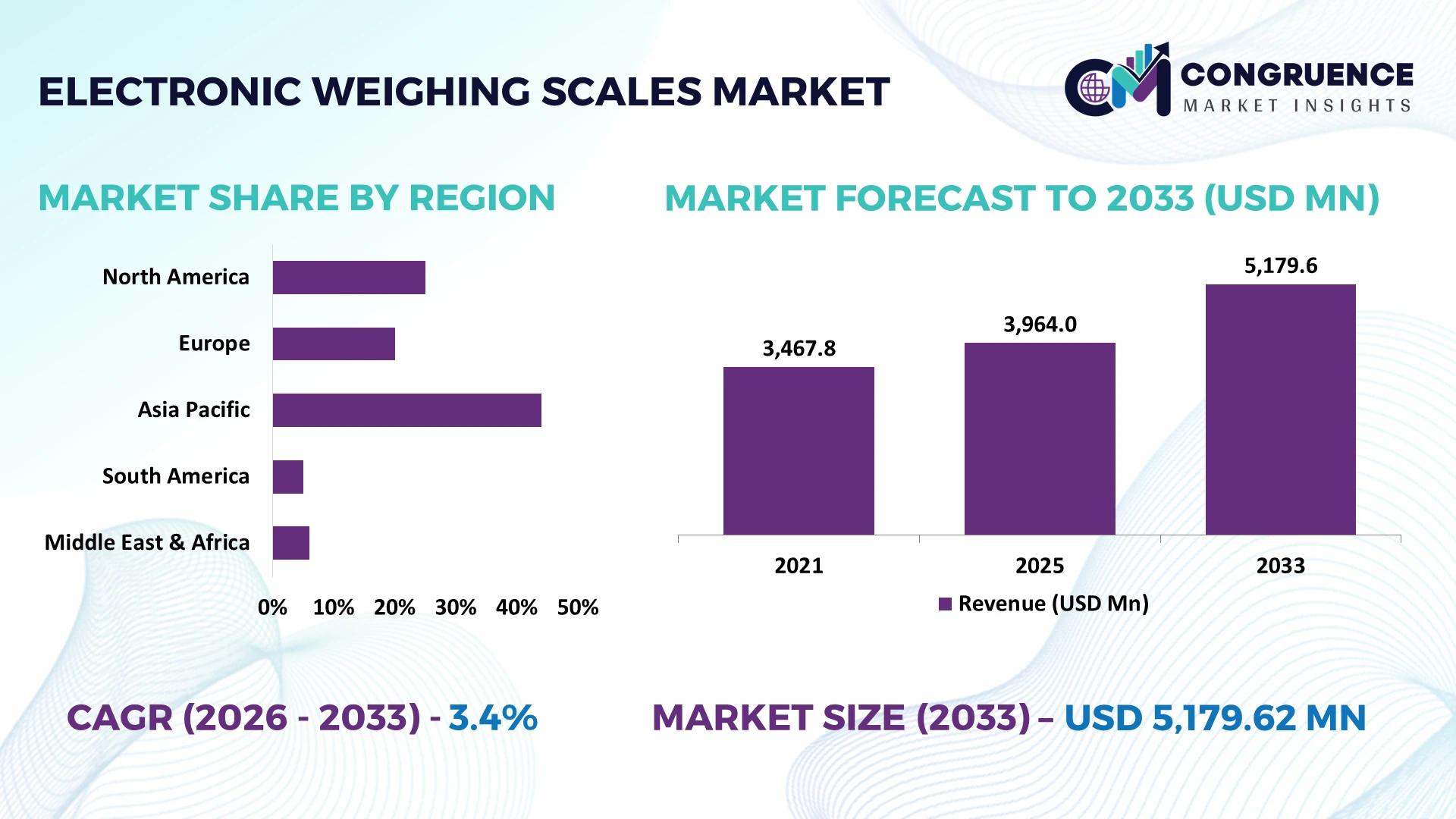
The Global Electronic Weighing Scales Market was valued at USD 3964 Million in 2025 and is anticipated to reach a value of USD 5179.62 Million by 2033 expanding at a CAGR of 3.4% between 2026 and 2033. Growth is driven by automated weighing integration in logistics, pharmaceutical manufacturing, food processing, and retail, alongside stricter accuracy and traceability requirements.
China holds a dominant position with an estimated 30%+ share of global electronic weighing-scale manufacturing capacity, supported by extensive electronics supply chains and industrial-scale production. More than 60% of new industrial weighing deployments increasingly integrate digital displays, data connectivity, or automated calibration. India trails China in manufacturing scale but is expanding adoption across pharmaceuticals, food processing, warehousing, and organized retail, while geopolitical supply-chain diversification following US-China trade restrictions is accelerating regional sourcing.
Strategic implication: Manufacturers should prioritize connected, calibrated, and automation-ready scales while expanding localized production and service networks in Asia.
Market Size & Growth: USD 3.964 billion in 2025 rising to USD 5.180 billion by 2033 at a 3.4% CAGR, driven by automation and connected weighing systems.
Top Growth Drivers: Industrial automation contributes 25%, logistics digitization 20%, and pharmaceutical manufacturing 15% to key adoption momentum.
Short-Term Forecast: By 2028, automated calibration and digital diagnostics are positioned to reduce maintenance costs by 8% and improve weighing efficiency by 12%.
Emerging Technologies: AI-enabled calibration, IoT connectivity, and advanced load-cell materials are reshaping high-precision weighing, with connected systems reaching roughly 35% adoption in new industrial deployments.
Regional Leaders: Asia Pacific approaches USD 2.1 billion, North America about USD 1.3 billion, and Europe nearly USD 1.2 billion by 2033, supported by automation, traceability, and smart-factory adoption.
Consumer/End-User Trends: More than 40% of organized retail and logistics operators increasingly prioritize digital data capture, remote monitoring, and automated weight records.
Pilot/Case Example: A 2024 automated warehouse weighing deployment delivered approximately 15% faster processing and reduced manual recording errors by 20%.
Competitive Landscape: China-based manufacturers lead production scale at approximately 30% share, with Mettler Toledo, A&D Company, Sartorius, OHAUS, and Shimadzu maintaining strong industrial and laboratory positions.
Regulatory & ESG Impact: Accuracy, calibration, and traceability requirements are increasing compliance spending by approximately 5–8%, while digital records reduce paper-based operational processes.
Investment & Funding: More than USD 500 million is being directed across manufacturing expansion, automation partnerships, sensor development, and connected-equipment platforms, strengthening regional supply chains.
Innovation & Future Outlook: Next-generation scales increasingly combine AI diagnostics, wireless connectivity, predictive maintenance, and modular sensors, shifting competition toward software-enabled weighing ecosystems.
The Electronic Weighing Scales Market is gaining traction across logistics, pharmaceuticals, food processing, laboratories, healthcare, and precision manufacturing, where measurement accuracy directly influences inventory control and production quality. Connected scales are increasingly replacing standalone equipment, with approximately 35% of new industrial deployments incorporating digital connectivity or automated data capture. Recent product innovation centers on wireless monitoring, automatic calibration, compact load cells, touchscreen interfaces, and cloud-compatible data systems. Supply-chain diversification linked to US-China trade restrictions is also encouraging localized assembly and component sourcing. These shifts strengthen the market’s transition toward connected, traceable, and automation-ready weighing infrastructure, creating clear strategic opportunities across industrial applications.
Electronic weighing scales are becoming strategically important as manufacturers, logistics operators, laboratories, and retailers shift from standalone measurement toward automated, traceable data capture. Connected weighing systems can reduce manual recording time by approximately 15–25% and improve process consistency by 10–15%, strengthening inventory accuracy and production control. Supply-chain restructuring is also encouraging manufacturers to localize components and diversify sourcing beyond China.
Technology differentiation is widening. Modern digital scales with automated calibration, wireless connectivity, and electronic data logging can deliver approximately 10–20% faster weighing workflows than manually recorded legacy systems. China retains significant manufacturing scale, while Japan and Germany emphasize high-precision instrumentation and automation, and India is accelerating deployment across pharmaceuticals, food processing, warehousing, and organized retail. Over the next 2–3 years, connected industrial deployments are positioned to expand as digital traceability becomes embedded in operational workflows.
A practical deployment is automated warehouse weighing, where integrated scales can process weights directly into inventory systems and reduce manual-entry errors by roughly 20%. Companies are therefore increasing investment in smart load cells, software integration, calibration services, and regional partnerships. Competitive positioning will increasingly depend on measurement accuracy combined with connectivity, interoperability, service responsiveness, and lifecycle efficiency.
Industrial automation is strengthening demand for electronic weighing equipment as manufacturers integrate measurement directly into production and inventory workflows. Automated weighing can reduce manual handling time by approximately 15–25%, while digital data capture can lower recording errors by around 20%. Pharmaceutical plants, food processors, and warehouses are prioritizing networked scales that connect with ERP, MES, and warehouse-management platforms. India is expanding automated manufacturing and logistics infrastructure, while China continues to benefit from dense electronics and sensor supply chains. Manufacturers are responding through connected load-cell development, software partnerships, and localized service networks. The non-obvious advantage is data continuity: integrating weight measurements into operational software converts a basic weighing device into a real-time process-control asset.
Electronic weighing equipment remains exposed to fluctuations in sensors, semiconductors, displays, and precision electronic components, with imported inputs representing a substantial portion of production costs for manufacturers dependent on overseas supply chains. Component-price movements of 5–10% can materially pressure equipment margins in highly competitive product categories. China-based supply networks provide manufacturing scale but expose global buyers to geopolitical trade restrictions and logistics disruptions. Companies are responding through multi-supplier contracts, localized assembly, alternative component qualification, and longer procurement agreements. The key operational constraint is not equipment availability alone but maintaining consistent sensor and electronics specifications across suppliers, because even small component variations can increase calibration requirements and quality-control costs.
Connected weighing creates opportunities beyond hardware sales by combining scales with analytics, remote monitoring, automated calibration, and service contracts. Wireless and network-enabled systems can improve measurement workflow efficiency by approximately 10–20%, while predictive maintenance can reduce avoidable equipment downtime by around 10%. India offers expanding demand across pharmaceutical manufacturing, organized retail, cold-chain logistics, and food processing, where traceable measurement supports quality control. AI-assisted diagnostics and cloud-connected weighing platforms are creating opportunities for recurring software and maintenance revenue. Manufacturers are positioning through R&D partnerships, IoT integration, and modular product architectures. A distinctive opportunity lies in retrofit solutions that connect existing scales to digital systems without requiring complete equipment replacement.
Connected electronic weighing systems introduce execution challenges that extend beyond measurement accuracy, particularly when equipment must integrate with ERP, MES, warehouse, laboratory, and cloud platforms. Integration-related configuration can account for approximately 10–15% of deployment effort, while cybersecurity controls become increasingly important as industrial devices exchange operational data across networks. Germany and Japan are emphasizing highly automated production environments, whereas Indian facilities often operate mixed fleets of legacy and connected equipment, increasing interoperability requirements. Companies must invest in standardized communication protocols, secure firmware, technician training, and system validation. The critical strategic challenge is maintaining measurement reliability while expanding connectivity, because a digitally advanced scale delivers limited operational value when inconsistent interfaces prevent dependable data exchange.
Connected Weighing Deployment Accelerates: Industrial buyers are shifting toward networked scales, with connected equipment representing an estimated 30–35% of new deployments and reducing manual weight-recording time by 15–20%. Manufacturers are integrating Ethernet, wireless connectivity, and ERP interfaces, while multi-site enterprises standardize platforms to improve data consistency and inventory visibility.
Calibration Becomes Digitally Managed: Automated calibration and remote diagnostics are gaining adoption, reducing routine verification time by approximately 10–15% and improving measurement consistency by 5–8%. The shift is particularly relevant in pharmaceutical and food facilities facing tighter traceability requirements. Suppliers are embedding diagnostic software and remote-service capabilities rather than relying solely on field technicians.
Supply Chains Favor Local Assembly: Electronics and sensor procurement is being diversified as geopolitical trade restrictions and logistics disruptions encourage regional sourcing. Companies are targeting 10–20% higher local content in selected product lines and maintaining dual suppliers for critical load cells and controllers. India is attracting localized assembly, while Chinese manufacturers continue leveraging established component ecosystems and production scale.
Traceability Shapes Commercial Scales: Regulatory modernization is increasing demand for transaction-ready digital scales, with compliance-focused deployments estimated to rise 8–12% across organized retail and packaged-goods operations. Updated commercial-weighing requirements are encouraging manufacturers to strengthen verification, software controls, and documentation. Suppliers are increasingly embedding compliance-oriented features directly into connected weighing platforms.
Platform Scales represent the leading type, accounting for an estimated 27% market share, supported by broad capacity ranges, rugged construction, and compatibility with warehouse and manufacturing workflows. Bench Scales follow at approximately 21%, serving compact production and laboratory-adjacent operations. Crane Scales hold roughly 10%, while Counting Scales capture about 12% through inventory and component-management applications. Precision Scales and Analytical Balances remain smaller but command higher-value applications where tighter measurement control is essential.
Counting Scales are among the fastest-expanding categories, with adoption increasing approximately 8–10% as warehouses automate inventory verification and reduce manual counting. Retail Scales remain important for transaction-based weighing, while specialized industrial users increasingly combine Platform and Crane Scales with digital interfaces. Manufacturers are shifting investment toward modular platforms, integrated displays, wireless communication, and application-specific software, making connectivity a stronger differentiator than basic capacity.
Industrial Weighing leads the application landscape at approximately 29% share because factories require high-capacity, repeatable measurement for raw materials, production batches, inventory, and quality control. Logistics Weighing follows at nearly 18%, while Commercial Weighing accounts for around 16% through transaction-based applications. Laboratory Weighing and Medical Weighing prioritize precision and controlled environments, whereas Food Weighing and Retail Weighing increasingly emphasize traceability, throughput, and standardized data capture.
Logistics Weighing is among the fastest-growing applications, with automated and integrated deployments expanding approximately 9–11% as warehouses connect scales with inventory and shipping systems. Industrial users are investing in rugged platforms and automation, while retailers emphasize price-computing functionality and digital records. Food processors are adding hygienic designs and faster cleaning workflows. Companies are increasingly selecting application-specific systems instead of universal equipment, improving throughput while reducing integration and validation requirements.
Manufacturing represents the leading end-user group at approximately 31% share, reflecting intensive use of weighing systems across material receiving, batching, production control, and finished-goods verification. Logistics follows at roughly 18%, while Food & Beverage contributes about 16% through ingredient measurement, packaging, and quality-control processes. Pharmaceuticals and Healthcare require tighter precision and traceability, whereas Retail and Agriculture remain more price-sensitive and application-specific.
Logistics is emerging as the fastest-growing end-user category, with connected weighing adoption increasing approximately 10–12% as distribution centers automate receiving, picking, packing, and dispatch. Manufacturers are prioritizing integrated scales and MES connectivity, while pharmaceutical companies emphasize validated data capture and calibration control. Food & Beverage operators increasingly favor hygienic and washdown-compatible equipment. Suppliers are responding with modular configurations, vertical-specific software, service contracts, and partnerships that align weighing hardware with broader operational ecosystems.
Asia-Pacific accounted for the largest market share at 39% in 2025 however, South America is expected to register the fastest growth, expanding at a CAGR of 4.2% between 2026 and 2033.

Automation and traceability reshape industrial weighing
North America represents approximately 25% of global electronic weighing-scale demand, supported by advanced manufacturing, pharmaceuticals, food processing, logistics, and organized retail. The United States concentrates most regional deployment, particularly across automated warehouses and high-throughput production facilities. More than 35% of newly installed industrial weighing systems increasingly incorporate connectivity or automated data capture, strengthening integration with warehouse-management and manufacturing software. Pharmaceutical and food-processing operators are prioritizing calibrated, traceable equipment as quality-control requirements become more data intensive. Manufacturers are responding through software-enabled platforms, regional service expansion, and partnerships with automation integrators. Canada contributes through mining, agriculture, food processing, and logistics applications, while Mexico is strengthening industrial weighing demand through manufacturing expansion. The strategic shift is toward connected measurement infrastructure rather than standalone equipment.
United States Market Outlook: The United States remains the region's principal deployment center, supported by large pharmaceutical, logistics, food-processing, and manufacturing facilities. Automated warehouse investments are increasing demand for high-capacity platform scales, dimension-weigh systems, and network-connected equipment. More than 40% of advanced logistics installations increasingly emphasize direct digital data capture, strengthening the business case for integrated weighing solutions.
Precision manufacturing drives connected measurement
Europe accounts for approximately 22% of global electronic weighing-scale demand, with Germany, France, Italy, and the United Kingdom forming major industrial and laboratory deployment centers. Germany maintains strong demand from automotive, chemicals, pharmaceuticals, food processing, and precision engineering, while Switzerland and the United Kingdom reinforce laboratory and analytical applications. Approximately 30–35% of newer industrial installations increasingly incorporate digital interfaces, automated calibration, or centralized data capture. European manufacturers are also responding to energy-efficiency and waste-reduction priorities by developing longer-life equipment, modular electronics, and lower-maintenance designs. Companies are strengthening partnerships with automation providers and expanding localized service capabilities. The strategic opportunity centers on combining precision metrology with digital compliance, enabling manufacturers to address both productivity and traceability requirements.
Germany Market Outlook: Germany remains the most strategically significant European market because of its dense manufacturing base and advanced automation infrastructure. Automotive, chemicals, pharmaceuticals, and machinery producers generate recurring demand for precision and industrial weighing. More than 35% of sophisticated production environments increasingly integrate measurement equipment into automated workflows, supporting demand for connected scales and calibration services.
Manufacturing scale strengthens connected deployment
Asia-Pacific accounts for approximately 39% of global electronic weighing-scale demand and maintains the strongest manufacturing concentration. China anchors production through extensive electronics, sensor, load-cell, and component ecosystems, while Japan and South Korea emphasize precision instrumentation and automated manufacturing. India is expanding deployment across pharmaceuticals, food processing, organized retail, and logistics. China represents an estimated 30%+ share of global electronic weighing-scale manufacturing capacity, giving regional suppliers advantages in component availability and production scalability. More than 35% of new industrial deployments increasingly incorporate digital connectivity or automated data capture. Manufacturers are diversifying assembly footprints as geopolitical trade restrictions encourage supply-chain localization. The strategic shift favors suppliers capable of combining Asian production economics with localized engineering, calibration, and after-sales support.
China Market Outlook: China remains the central manufacturing hub, supported by deep electronics supply chains and high-volume industrial production. Its estimated 30%+ share of global manufacturing capacity provides scale advantages in load cells, displays, controllers, and related components. Domestic demand from logistics, manufacturing, food processing, and retail also supports rapid product iteration and shorter commercialization cycles.
Industrial modernization expands precision weighing
South America represents approximately 7% of global electronic weighing-scale demand, with Brazil accounting for the largest share through agriculture, food processing, mining, logistics, and manufacturing. Industrial weighing remains concentrated around production facilities, distribution centers, ports, and agricultural supply chains. Brazil's expanding logistics infrastructure and modernization of food-processing operations are increasing demand for platform, truck, counting, and automated weighing systems. Connected deployment remains below North American and European levels, with roughly 20–25% of newer industrial systems incorporating advanced digital connectivity. Argentina and Chile contribute through agriculture, mining, and export-oriented processing. Companies are responding with localized distributors, service partnerships, ruggedized products, and modular systems designed for variable infrastructure conditions. The principal strategic requirement is balancing advanced functionality with acquisition and maintenance costs.
Brazil Market Outlook: Brazil is the region's largest operational market, supported by extensive agricultural production, food-processing facilities, mining operations, and logistics networks. Approximately one-fifth of newer industrial weighing deployments increasingly incorporate digital data capabilities, creating opportunities for suppliers offering rugged equipment, remote diagnostics, and localized calibration services.
Infrastructure modernization accelerates industrial adoption
The Middle East & Africa accounts for approximately 7% of global electronic weighing-scale demand, with deployment concentrated in Saudi Arabia, the United Arab Emirates, South Africa, and major logistics corridors. Saudi Arabia and the UAE are expanding warehousing, food-processing, manufacturing, ports, and industrial infrastructure, creating demand for automated platform and logistics scales. Approximately 20–25% of new industrial deployments increasingly incorporate digital interfaces or automated data capture. South Africa maintains stronger demand across mining, agriculture, food processing, and transportation. Companies are responding through distributor partnerships, regional service centers, and equipment packages designed for harsh operating environments. Infrastructure modernization and large logistics projects are shifting demand toward higher-capacity, connected systems, although technician availability and localization remain important deployment considerations.
Saudi Arabia Market Outlook: Saudi Arabia stands out because industrial diversification, logistics infrastructure, food-security initiatives, and large-scale warehouse development are expanding demand for commercial and industrial weighing equipment. Automated logistics facilities increasingly require integrated weight capture, while manufacturers are establishing local partnerships to improve installation, calibration, maintenance, and response times.
Mettler Toledo, Sartorius, A&D Company, Shimadzu, and OHAUS compete with regional manufacturers such as CAS and Adam Equipment across industrial, laboratory, retail, and logistics. The top five players collectively account for an estimated 25–30% of the market, leaving space for specialized and cost-focused suppliers. Competition centers on precision, connectivity, calibration, customization, and total ownership cost. Connected models can command 10–15% higher pricing, while automated data capture can reduce manual processing by 15–20%. Leading OEMs are expanding through regional service networks, software partnerships, and application-specific product lines; Asian suppliers compete through manufacturing scale and shorter lead times. The competitive shift is moving from hardware pricing toward integrated measurement ecosystems, particularly in pharmaceuticals, logistics, and advanced manufacturing. Entry barriers remain highest in certified precision equipment, where calibration capability, validation expertise, and service infrastructure influence purchasing decisions. Winning requires measurement, digital integration, responsive service, and competitive lifecycle economics rather than low acquisition cost alone.
Mettler Toledo International Inc.
Sartorius AG
A&D Company Limited
Shimadzu Corporation
OHAUS Corporation
CAS Corporation
Adam Equipment
Avery Weigh-Tronix
Rice Lake Weighing Systems
Minebea Intec
Kern & Sohn GmbH
Essae-Teraoka Pvt. Ltd.
Cardinal Scale Manufacturing Company
Doran Scales
Modern electronic scales increasingly combine digital load cells, automatic calibration, wireless connectivity, and touchscreen controls, replacing manually recorded weighing workflows. Digital load-cell systems can improve measurement consistency by 1–2% and reduce setup effort by 5–8%. Connected deployment is estimated at 30–35% of new industrial installations, improving traceability and inventory synchronization.
Emerging platforms integrate IoT gateways, ERP/MES interfaces, cloud data capture, and software-guided calibration. Compared with legacy standalone scales, automated data transfer can improve workflow efficiency by 15–20% and reduce transcription errors by approximately 10–15%. This shift enables centralized calibration records, faster audit preparation, remote service triage, and standardized weighing data across multi-site operations and plants. Sartorius and METTLER TOLEDO benefit in premium industrial and laboratory segments by combining precision hardware with software, diagnostics, and compliance capabilities.
Disruptive development is moving toward intelligent load cells, predictive diagnostics, edge analytics, and machine-learning-assisted anomaly detection. By 2026–2028, connected systems are positioned to reach roughly 40–45% of new industrial deployments, while automated diagnostics can reduce avoidable maintenance intervention by 10–15%. Companies acting now can secure integration partnerships, standardize data architecture, and differentiate through lifecycle cost, uptime, and validated measurement performance rather than hardware price alone.
September 2024 A&D introduced the AD-4963 checkweigher, supporting type-approved trade verification and installation plus inspection in as little as 2 weeks. The launch strengthens compliance-ready weighing deployment for regulated Japanese commercial applications and shortens commissioning cycles for customers. Source: aandd.jp
February 2024 Sartorius launched the Cubis II Ultra-High Resolution Semi-Micro balance, delivering stabilization in under 2 seconds and minimum sample weights from 4.1 mg. The upgrade improves laboratory throughput and precision, supporting pharmaceutical and research workflows requiring faster, cleaner measurements. Source: sartorius.com
September 2025 METTLER TOLEDO launched POWERCELL GDD digital load cells for vehicle weighing, adding digital signal processing, diagnostics, and simplified installation. The architecture strengthens accuracy and maintenance visibility for truck and rail scales, improving operational reliability in heavy-capacity weighing environments. Source: weighingnews.com
November 2025 Shimadzu released eight AP W-AD ex and AP W ex analytical balance models, reducing minimum weight from 20 mg to 13 mg. The improvement expands pharmaceutical and API testing capability, strengthening repeatability and reducing sample requirements in quality-control workflows. Source: shimadzu.com
The Electronic Weighing Scales Market report covers seven types: Bench Scales, Platform Scales, Counting Scales, Precision Scales, Analytical Balances, Crane Scales, and Retail Scales. Application analysis spans Industrial, Commercial, Laboratory, Retail, Food, Logistics, and Medical Weighing, while end-user coverage includes Manufacturing, Retail, Food & Beverage, Pharmaceuticals, Logistics, Healthcare, and Agriculture. The study evaluates adoption patterns and shifts toward automated data capture.
Regional coverage includes North America, Europe, Asia-Pacific, South America, and Middle East & Africa, with country-level analysis emphasizing China, the United States, Germany, India, Brazil, and Saudi Arabia. Technology assessment covers digital load cells, IoT connectivity, automated calibration, wireless interfaces, diagnostics, and software integration. The report supports investment planning, product positioning, expansion priorities, partnerships, and competitive benchmarking by identifying deployment intensity, technology adoption, and demand shifts shaping 2026–2033 market direction.
| Report Attribute/Metric | Report Details |
|---|---|
Market Revenue in 2025 | USD 3964 Million |
Market Revenue in 2033 | USD 5179.62 Million |
CAGR (2026 - 2033) | 3.4% |
Base Year | 2025 |
Forecast Period | 2026 - 2033 |
Historic Period | 2021 - 2025 |
Segments Covered | By Type
By Application
By End-User
|
Key Report Deliverable | Revenue Forecast, Growth Trends, Market Dynamics, Segmental Overview, Regional and Country-wise Analysis, Competition Landscape |
Region Covered | North America, Europe, Asia-Pacific, South America, Middle East, Africa |
Key Players Analyzed | Mettler Toledo International Inc., Sartorius AG, A&D Company Limited, Shimadzu Corporation, OHAUS Corporation, CAS Corporation, Adam Equipment, Avery Weigh-Tronix, Rice Lake Weighing Systems, Minebea Intec, Kern & Sohn GmbH, Essae-Teraoka Pvt. Ltd., Cardinal Scale Manufacturing Company, Doran Scales |
Customization & Pricing | Available on Request (10% Customization is Free) |




