
Reports
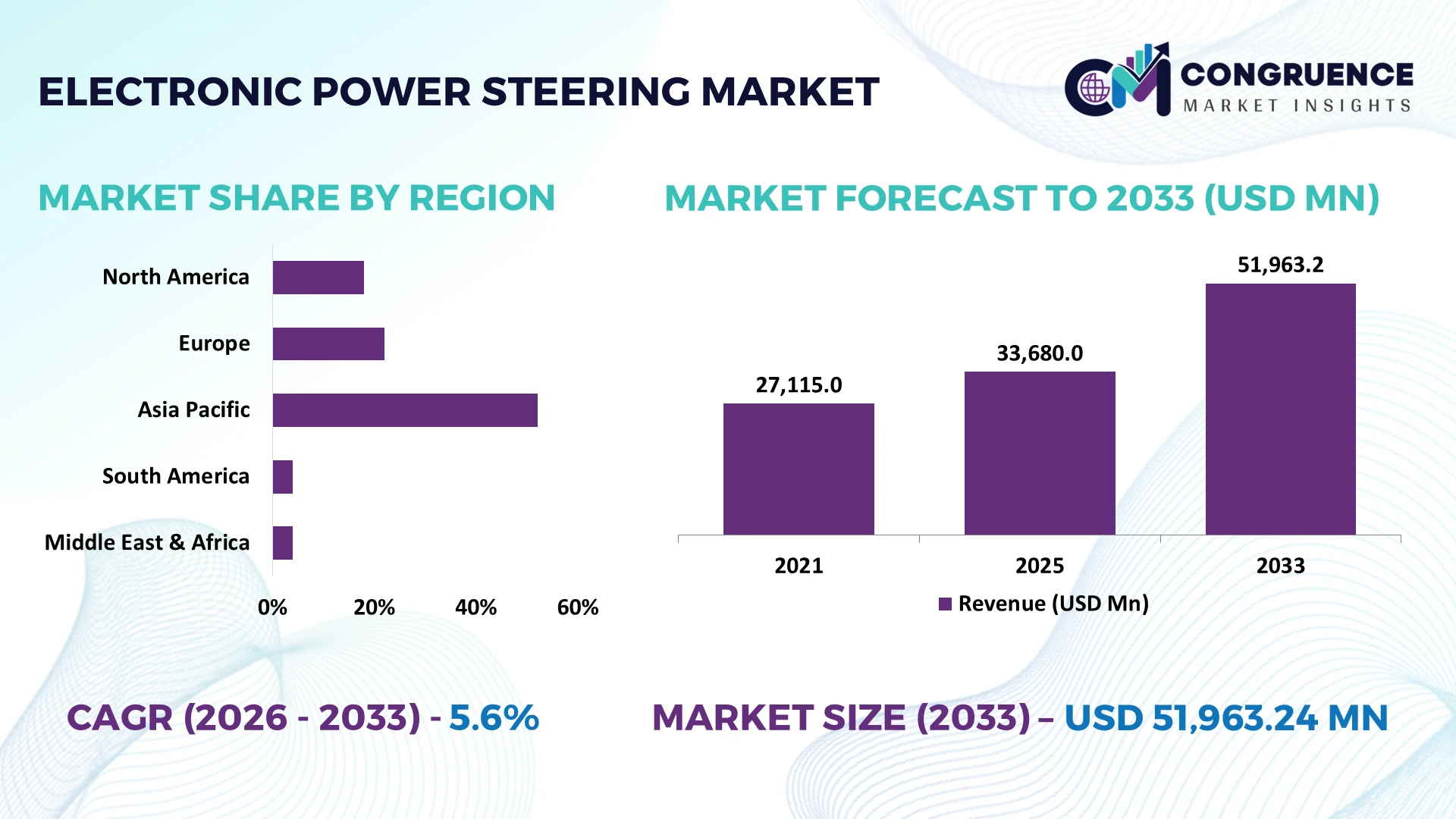
The Global Electronic Power Steering Market was valued at USD 33,680.0 Million in 2025 and is anticipated to reach a value of USD 51,963.2 Million by 2033 expanding at a CAGR of 5.57% between 2026 and 2033. Growth is anchored in the shift toward software-defined chassis architectures, where EPS serves as the actuation backbone for ADAS and electrified powertrains.
China commands approximately 46.35% of Asia-Pacific EPS revenue, supported by vertically integrated EV production and domestic motor controller capacity. Germany retains engineering depth in premium chassis systems, while India accelerates localization with Tata Motors achieving 80% component localization for the Harrier EV.
The strategic implication is clear, suppliers must prioritize regional software calibration capability and redundant sensor architectures to defend margins as steer-by-wire commercialization approaches.
Market Size & Growth: Valued at USD 33,680.0 Million in 2025, projected to reach USD 51,963.2 Million by 2033 at 5.57% CAGR; growth is driven by ADAS integration mandates and the architectural migration toward steer-by-wire readiness.
Top Growth Drivers: ADAS safety regulation alignment (EU GSR II effective 2024), EV platform compatibility requiring 1.3% fuel-equivalent efficiency gains, and dual-pinion EPS demand growing at 11.07% CAGR for precision autonomous applications.
Short-Term Forecast: By 2027, redundant EPS architectures will reduce calibration cycle time by approximately 20% while sensor content per vehicle rises 15%, compressing development timelines for OEMs targeting Level 2+ autonomy.
Emerging Technologies: AI-assisted calibration automation, dual-pinion EPS configurations for steering precision, and 48V-compatible motor controllers enabling thinner column packaging for EV cockpit redesigns.
Regional Leaders: Asia-Pacific anchors volume at 46.35% share with China dominating; Germany leads premium chassis integration; India emerges as localization hub with ZF Rane expanding EPS order books exceeding ₹500 crore.
Consumer/End-User Trends: Fleet operators recognize EPS as infrastructure investment, with 1.1% fuel reduction for large cars versus hydraulic systems driving commercial vehicle adoption decisions.
Pilot/Case Example: NIO ET9 secured China MIIT mass-production approval for fully decoupled steer-by-wire in December 2024, validating regulatory pathways for mechanical-linkage-free steering.
Competitive Landscape: JTEKT, Bosch, ZF, Nexteer, and NSK lead; Nexteer launched High-Output CEPS delivering up to 110 Nm assist in April 2025, expanding cost-effective coverage into mid-size vehicle segments.
Regulatory & ESG Impact: EU General Safety Regulation II mandates advanced safety tech integration; EPS adoption directly supports 1.3% fuel reduction targets, aligning fleet compliance with carbon pricing mechanisms.
Investment & Funding: ZF acquired majority stake in Rane Steering Systems (March 2024) to deepen India EPS penetration; Bosch partnered with Arnold NextG to accelerate steer-by-wire commercialization targeting mid-decade production.
Innovation & Future Outlook: Steer-by-wire migration and cybersecurity-by-design become non-negotiable differentiators; over 35% of automotive cyber incidents in 2024 involved control system manipulation, elevating functional safety validation priority.
The Electronic Power Steering market is pivoting from mechanical assistance to software-defined chassis control, with demand concentrated in compact EVs across China and India where localization pressures reshape supplier economics. Recent innovations include Nexteer's High-Output CEPS expanding column-assist capability into heavier vehicle segments and ZF's steer-by-wire readiness for Chinese regulatory approval pathways. Approximately 53.65% of 2025 system share remains column-type, yet dual-pinion configurations signal the precision trajectory. Supply-chain resilience for semiconductors and rare-earth magnets now determines deployment pace. This strategic context frames the pathways examined next.
Electronic power steering has become a competitive fault line because it bridges mechanical reliability with software-defined vehicle architecture. The European Union's General Safety Regulation II, effective July 2024, mandates advanced driver assistance features that require EPS as the actuation layer—transforming steering from a comfort feature into a regulatory compliance gateway. This regulatory pull coincides with supply-chain restructuring, as Chinese rare-earth export restrictions push suppliers toward magnet-less motor designs and localized component sourcing, particularly in India where localization thresholds are under policy review.
Technically, the efficiency case is measurable: replacing hydraulic systems with EPS delivers 1.3% fuel reduction in midsize cars and 1.1% in large cars, compounding across fleet operations facing carbon pricing. Regionally, China's vertically integrated EV ecosystem packages domestic motor controllers at scale, while Germany retains premium chassis calibration expertise. India exemplifies the cost-sensitive adoption pathway, where Tata Motors achieved 80% localization for Harrier EV steering components, balancing affordability with functionality.
Operationally, ZF's acquisition of a majority stake in Rane Steering Systems in March 2024 illustrates how tier-one suppliers are securing regional manufacturing footprints rather than exporting from centralized plants. Over the next two to three years, expect redundant EPS architectures to become standard on Level 2+ platforms, with sensor content per vehicle rising measurably. Competitive positioning now depends on calibration automation capability and regional supply redundancy—not merely unit cost. Suppliers that treat software validation and localization as core competencies will define the steer-by-wire transition.
Regulatory mandates and autonomy requirements are converging to accelerate EPS content per vehicle. Dual-pinion EPS configurations are growing at 11.07% CAGR through 2031, driven by precision requirements for lane-keeping and emergency steering interventions that demand faster response than column-type systems deliver. The EU's GSR II safety regulation, effective July 2024, compels ADAS integration that only electronically controlled steering can provide, forcing OEMs to standardize EPS across model lines rather than limiting it to premium trims. Chinese OEMs respond by integrating domestic motor controllers and ADAS software stacks into vertically designed platforms, reducing calibration dependency on external suppliers. A non-obvious insight: column-type EPS retains 53.65% share because cost-sensitive Indian and ASEAN compact vehicles prioritize proven reliability over dual-pinion precision—suppliers must maintain dual roadmaps rather than migrating entire portfolios upward. Companies investing in regional calibration automation will capture the regulatory upgrade cycle while defending volume segments.
Cost competitiveness remains structurally constrained by rare-earth magnet dependency and the price premium of EPS over hydraulic systems in entry-level vehicles. China's export restrictions on rare-earth materials have prompted India to consider relaxing 50% localization requirements to maintain EV manufacturing viability, directly impacting EPS motor cost structures. European automotive supplier capital investment in EV components fell to €5.64 billion in 2024, a sharp decline that limits capacity expansion for affordable next-generation systems. In price-sensitive Indian compact car segments, automakers continue specifying hydraulic systems for entry trims, creating a bifurcated market where EPS adoption stalls below specific price thresholds. Ola Electric's development of magnet-less motors represents a strategic response, but commercial scaling remains unproven at volume. Suppliers must localize magnet sourcing or qualify ferrite-based alternatives to unlock the sub-$10,000 vehicle segment without margin erosion.
The regulatory approval of NIO ET9's fully decoupled steer-by-wire system by China's MIIT in December 2024 opened a commercialization pathway that eliminates mechanical column linkage entirely. This architecture enables variable steering ratios, cockpit redesign flexibility, and OTA-updatable steering feel—capabilities that premium EV platforms will monetize as differentiated features. India's aftermarket presents an underappreciated volume opportunity: as compact vehicle ownership extends beyond warranty periods, EPS retrofit kits for fuel efficiency gains attract fleet operators facing rising fuel costs. ZF Rane's ₹117 crore EPS contract for multi-utility vehicles signals that domestic OEMs are expanding EPS adoption beyond premium trims. Suppliers that develop modular EPS platforms supporting both factory-fit and retrofit channels can capture demand across price tiers, particularly in markets where new vehicle affordability constrains adoption.
Software-defined steering introduces attack surfaces that mechanical systems never presented, with over 35% of reported automotive cyber incidents in 2024 involving direct manipulation of vehicle control systems including steering functions. Validating EPS software against ADAS integration requirements extends development timelines and increases engineering overhead, particularly for OEMs targeting simultaneous launches across regulatory jurisdictions with divergent safety standards. The sensor content growth trajectory—9.86% CAGR through 2031—compounds validation complexity, as each additional feedback mechanism requires cybersecurity hardening and fail-safe verification. Companies must invest in hardware-in-the-loop validation infrastructure and cybersecurity-by-design engineering cultures, not merely bolt-on encryption modules. The competitive implication: suppliers lacking in-house functional safety and cybersecurity validation capability will face exclusion from OEM platforms requiring ISO 21434 compliance, regardless of mechanical hardware quality.
Modular Platforms Cut Programme Costs ZF's mPEPS modular pinion-assist platform, commercialised across Asia-Pacific in August 2025, offers scalable single and dual pinion configurations from compact cars through SUVs with reduced programme cost through component reuse. This shifts supplier economics from bespoke engineering toward platform amortisation, lowering per-unit development overhead for Indian and ASEAN OEMs targeting multiple vehicle segments from a single architecture.
Steer-by-Wire Moves From Concept to Approval NIO's ET9 secured China MIIT mass-production approval for fully decoupled steer-by-wire in December 2024, eliminating mechanical column linkage entirely. Chinese OEMs are leapfrogging incremental EPS upgrades, while European suppliers recalibrate validation workflows for redundant actuator architectures—a regulatory precedent that compresses adoption timelines for premium EV platforms globally.
Sensor Content Accelerates ADAS Integration Sensor components are expanding at 9.86% annually through 2031, driven by torque and angle feedback requirements for lane-keeping and emergency steering interventions. India's AIS 145 mandate for electronic stability control and autonomous emergency steering forces OEMs to phase out hydraulic units regardless of incremental cost, with commercial vehicle pilots accelerating ECU processing capacity demand.
Localisation Reshapes Indian Supply Economics Tata Motors achieved 80% localisation for Harrier EV steering components, while ZF Rane secured a ₹117 crore EPS contract for multi-utility vehicles in November 2025. Domestic fabrication incentives for sensors and BLDC motors under India's PLI scheme are narrowing the cost gap with hydraulic systems, though entry hatchbacks below INR 500,000 still carry a one-fourth EPS premium.
Column-assist EPS commanded 53.65% of global system share in 2025, reflecting minimal chassis redesign requirements and cost-performance balance across compact and midsize platforms. Its persistence is structural: Indian compact hatchbacks and ASEAN entry vehicles prioritise proven reliability and retrofit compatibility over precision response, sustaining volume despite premium segment migration.
Dual-pinion configurations represent the fastest-growing architecture at 11.07% annually through 2031, driven by precision requirements for lane-keeping and emergency steering interventions that demand faster response than column-type systems deliver. Pinion-assist maintains a steady mid-range position, while rack-assist serves premium SUVs requiring higher torque output. Steer-by-wire remains below 1% of installations in India but carries 6.45% growth, signalling regulatory-dependent inflection rather than near-term volume displacement. Suppliers are responding with dual roadmaps: ZF's mPEPS platform scales from single to dual pinion through component reuse, while NSK develops force feedback actuators specifically for steer-by-wire migration.
Passenger cars absorbed over 90% of EPS demand in 2025, with fitment rates exceeding 80% in new vehicles globally. Demand concentration reflects the technology's alignment with compact and midsize platform economics: OEMs standardise EPS across model lines to meet fuel efficiency and ADAS requirements without segment-specific hydraulic fallbacks.
Commercial vehicles represent the accelerating application frontier, driven by regulatory mandates rather than consumer preference. India's AIS 145 safety regulation requires electronic stability control and autonomous emergency steering functions that hydraulic systems cannot deliver, prompting commercial vehicle OEMs to pilot electric solutions despite higher upfront costs. Fleet operators recognise EPS as infrastructure investment with measurable returns: replacing hydraulic systems delivers 1.3% fuel reduction for midsize cars and 1.1% for large cars, compounding across high-utilisation fleets facing carbon pricing. Suppliers are adapting through torque-capacity expansion—Nexteer's High-Output CEPS delivers up to 110 Nm assist—and regional contract wins, with ZF Rane's ₹117 crore multi-utility vehicle EPS order signalling domestic OEM commitment beyond passenger segments.
OEM direct fitment accounts for the overwhelming majority of EPS deployments, anchored by new vehicle production cycles and regulatory compliance requirements that make factory installation the default pathway. Passenger car OEMs integrate EPS as standard equipment to meet EU General Safety Regulation II and India's AIS 145 mandates, creating specification lock-in that forecloses aftermarket substitution for safety-critical steering functions.
The commercial vehicle OEM segment represents the fastest-shifting end-user group, as fleet buyers prioritise fuel efficiency and safety compliance over initial capital savings. Indian commercial vehicle manufacturers historically reliant on hydraulic setups are piloting electric solutions to meet CMVR steering-response benchmarks, with ECU demand rising accordingly. The aftermarket remains niche and concentrated in retrofit and replacement scenarios where regulatory compliance permits, constrained by safety certification requirements and OEM warranty structures. Companies are targeting OEM relationships through platform-level partnerships—ZF's acquisition of Rane Steering Systems majority stake in March 2024 deepened Indian OEM access—rather than building independent aftermarket channels. Pricing strategies bifurcate: premium OEMs absorb EPS costs for ADAS integration, while entry-segment negotiations centre on localisation thresholds and component reuse to approach hydraulic parity.
Asia-Pacific accounted for the largest market share at 52% in 2025 however, South America is expected to register the fastest growth, expanding at a CAGR of 6.14% between 2026 and 2033.
North America represents approximately 18% of global EPS demand, with the United States anchoring deployment concentration through domestic OEM platform standardization and ADAS feature adoption. The region's operational dynamic is defined by a dual-track market: new vehicle programs specify EPS as standard for compliance with evolving safety expectations, while the installed fleet of hydraulic-equipped trucks and SUVs sustains aftermarket and remanufacturing activity. Column-assist configurations retain majority share, reflecting the region's compact and midsize passenger car volume. A measurable operational development is the integration of EPS calibration workflows with over-the-air update infrastructure, enabling OEMs to refine steering feel post-deployment without physical service visits—reducing warranty-related recalibration costs. Suppliers with domestic validation capacity and cybersecurity compliance credentials hold a structural advantage as U.S. regulators intensify scrutiny of software-defined chassis systems.
United States Market Outlook: The United States concentrates North America's EPS deployment through its scale of light-truck and SUV production, where electric steering enables fuel efficiency gains that support Corporate Average Fuel Economy compliance. Domestic suppliers benefit from proximity to OEM engineering centers in Michigan and Ohio, where calibration and validation activities cluster. A notable operational shift is the increasing co-development of EPS software with ADAS feature teams, compressing validation cycles for lane-centering and adaptive cruise functions. This integration advantage positions U.S.-based engineering operations as strategic assets rather than cost centers.
Europe contributes approximately 22% of global EPS demand, with Germany and France driving deployment concentration through premium OEM platforms that prioritize steering precision and ADAS integration. The EU General Safety Regulation II has accelerated EPS standardization across model lines, transforming the technology from a premium differentiator into a compliance requirement for new vehicle homologation. Column-type systems retain approximately 60% share, though dual-pinion configurations are gaining traction in performance and luxury segments. A measurable infrastructure development is the expansion of hardware-in-the-loop validation facilities across German supplier campuses, enabling simultaneous testing of EPS software against multiple regulatory jurisdictions. The region's sustainability orientation favors EPS over hydraulic systems due to measurable fuel efficiency contributions, with suppliers positioning energy-efficient motor controllers as ESG-aligned components.
Germany Market Outlook: Germany anchors Europe's EPS innovation through its concentration of tier-one supplier engineering and premium OEM headquarters. The country's operational advantage lies in functional safety validation depth, with suppliers maintaining ISO 26262 and ISO 21434 compliance capabilities that serve as qualification barriers for OEM platform access. German engineering teams are increasingly focused on steer-by-wire readiness, developing redundant actuator architectures and fail-operational power supply designs. This forward positioning ensures that German suppliers retain specification influence even as manufacturing migrates to lower-cost regions.
Asia-Pacific commands approximately 52% of global EPS demand, with China's vertically integrated EV production and India's localization initiatives driving regional volume. China's domestic suppliers benefit from proximity to battery-electric platform development, where EPS integration with regenerative braking and torque vectoring creates software differentiation opportunities. ZF's December 2024 expansion of EPS manufacturing in Anting, Shanghai, adding 3,700 square meters of floor space, exemplifies the localization momentum supporting ADAS feature deployment in Chinese OEM platforms . India's AIS 145 mandate is forcing commercial vehicle OEMs to transition from hydraulic systems, creating a regulatory-driven upgrade cycle that domestic suppliers are targeting through cost-competitive column-assist offerings. The region's manufacturing scale enables component standardization that compresses per-unit costs across high-volume compact vehicle programs.
China Market Outlook: China's EPS market advantage stems from vertical integration between OEM vehicle platforms and domestic component suppliers, enabling rapid calibration cycles and cost optimization. The country's regulatory environment, including MIIT's approval of fully decoupled steer-by-wire for the NIO ET9 in December 2024, positions Chinese OEMs at the forefront of steering architecture innovation. Domestic suppliers are scaling motor controller production to reduce import dependency, with government-supported localization targets accelerating capacity expansion. This ecosystem coherence creates a feedback loop where deployment scale funds R&D, which in turn enables faster technology iteration.
South America represents approximately 4% of global EPS demand, with Brazil concentrating regional volume through its established vehicle manufacturing base and policy support for electrified platforms. Column-assist systems account for 63.37% of regional demand, reflecting the dominance of compact passenger vehicles in Brazil's production mix . The region's growth trajectory is supported by electric vehicle sales exceeding 350,000 units in 2025, a 75% increase that expands the addressable market for EPS-equipped platforms . However, execution constraints persist: supplier localization remains concentrated in Brazil, while Argentina and Colombia rely on imported components subject to currency volatility and logistics friction. Regulatory development, including Argentina's incorporation of autonomous vehicles into national traffic law, signals emerging demand for driver-assistance-ready steering systems, but infrastructure gaps limit near-term deployment scale.
Brazil Market Outlook: Brazil holds 47.61% of regional demand, supported by domestic OEM production and a growing electrified fleet that requires EPS as a standard safety and efficiency component . The country's operational advantage lies in its established automotive supplier ecosystem, which enables localized component sourcing for column-assist systems. Policy support for hybrid and plug-in hybrid platforms creates sustained demand visibility, with plug-in hybrids requiring full EPS integration. Brazil's manufacturing scale positions it as the regional export hub for EPS components, though currency fluctuations and logistics costs constrain competitiveness relative to Asian suppliers.
The Middle East & Africa region represents approximately 4% of global EPS demand, with deployment concentrated in Gulf Cooperation Council markets where premium vehicle imports and fleet modernization programs drive adoption. The region lacks substantial domestic vehicle manufacturing, making EPS deployment dependent on imported vehicles and aftermarket retrofitting for commercial fleets. Gulf markets exhibit higher EPS penetration rates than African markets due to the prevalence of newer vehicle fleets and stricter emissions standards. Infrastructure investment in electric vehicle charging networks, particularly in the UAE and Saudi Arabia, signals gradual alignment with global electrification trends, though scale remains limited. A measurable development is the expansion of fleet telematics integration with EPS diagnostics, enabling predictive maintenance for commercial operators in harsh climate conditions.
United Arab Emirates Market Outlook: The UAE concentrates regional EPS deployment through its position as a premium vehicle import hub and logistics fleet operator. The country's operational advantage lies in its modern vehicle fleet, which features higher EPS fitment rates than African markets. Fleet operators in logistics and ride-hailing segments prioritize steering system reliability under high-temperature conditions, creating demand for components validated to thermal durability standards. The UAE's infrastructure investment in EV charging supports gradual electrified fleet expansion, though EPS adoption remains primarily tied to imported vehicle specifications rather than domestic assembly.
The EPS market pits global tier-one incumbents—JTEKT, Bosch, ZF, Nexteer, and NSK—against cost-focused regional challengers and Chinese OEM-integrated suppliers. The top five players hold approximately 65% combined share, with JTEKT and Bosch leading through steer-by-wire readiness and OEM platform lock-in. Competition rests on three axes: software calibration speed (Nexteer's 34% booking share from Chinese OEMs underscores responsiveness as a differentiator), supply-chain localisation (ZF Rane's India licensing locks exclusive column-drive access), and by-wire technology depth (Bosch targets €7 billion cumulative by-wire revenue by 2032). Players are competing through vertical integration and regional JV expansion rather than price alone. The decisive shift is from hardware margin defence to software-defined chassis control, where calibration capability and redundant safety validation become entry barriers. Winning requires simultaneous localisation depth and by-wire software maturity—firms lacking either will lose platform nominations to vertically integrated Chinese rivals or scale-advantaged incumbents.
JTEKT Corporation
Robert Bosch GmbH
ZF Friedrichshafen AG
Nexteer Automotive
NSK Ltd.
HL Mando Corp.
Nexteer (already listed—excluded)
Mitsubishi Electric Corporation
Hyundai Mobis
thyssenkrupp Presta AG
Aisin Corporation
Knorr-Bremse (steering division)
Zhejiang Vie Science & Technology
Showa Corporation
Current EPS architectures are converging on dual-pinion and rack-assist configurations that deliver 15–20% faster steering response than legacy column-assist systems, with sensor content per vehicle rising measurably. Adoption signals are clear: Nexteer secured 52% of 2025 bookings from new or conquest business, with 50% supporting EV or split platforms. The competitive advantage accrues to suppliers with software calibration depth, not hardware alone.
The disruptive transition is steer-by-wire. ZF's February 2025 series production for NIO ET9 eliminates mechanical column linkage, enabling variable steering ratios and OTA-updatable feel. JTEKT's linkless system with Libuddy backup power entered Lexus RZ production in March 2025. Bosch projects €7 billion cumulative by-wire revenue by 2032, signalling scale conviction. Suppliers without redundant actuator validation capability face exclusion from premium EV platforms.
Between 2026 and 2028, by-wire adoption will concentrate in Chinese and German premium platforms, while cost-sensitive Indian and ASEAN compact vehicles retain column-assist dominance. The strategic imperative is dual-track investment: defend volume EPS margins through localisation while funding by-wire software validation to secure next-generation platform nominations.
January 2025 — Rane Group and ZF expanded their Indian joint venture to introduce rack-drive EPS technology and licensed column-drive EPS for exclusive domestic manufacturing, completing a full-range steering portfolio for Indian OEMs; this positions Rane as the only Indian supplier capable of delivering complete EPS systems including motor and ECU integration. Source: ranegroup.com
March 2025 — JTEKT Corporation secured the first Lexus production application of fully decoupled steer-by-wire in the RZ battery-electric vehicle, paired with its Libuddy lithium-ion capacitor backup power supply; the system eliminates mechanical column linkage entirely, marking a production milestone for fail-operational steering architectures in premium EVs. Source: jtekt.co.jp
April 2025 — Nexteer Automotive launched High-Output Column-Assist EPS delivering up to 110 Nm assist, extending column-type viability into heavier vehicle segments previously requiring dual-pinion or rack-assist systems; the product reduces per-platform steering costs for OEMs targeting mid-size SUVs and light commercial vehicles. Source: nexteer.com
2025 — NSK Ltd. developed next-generation steering control software compatible across column EPS, rack EPS, and steer-by-wire architectures, with resistance to component aging degradation and ADAS/autonomous driving compatibility; the universal control platform reduces development timelines for OEMs managing diverse steering specifications across vehicle lines.
This report delivers a comprehensive examination of the global electronic power steering market across type, application, and end-user segments, spanning column-assist, pinion-assist, rack-assist, and steer-by-wire architectures. Regional coverage encompasses North America, Europe, Asia-Pacific, South America, and the Middle East & Africa, with country-level breakdowns for the United States, Germany, China, Brazil, and the UAE.
The analysis captures deployment patterns across passenger cars and commercial vehicles, OEM factory-fit and aftermarket channels, and emerging steer-by-wire commercialisation pathways. Quantitative indicators include segment distribution shares, adoption trajectories, and company participation levels across 14 profiled suppliers.
Strategic insights support investment planning, localisation decisions, and competitive positioning through 2033, with emphasis on by-wire readiness, regional supply-chain restructuring, and software validation capability as determinants of platform nomination success. The report enables stakeholders to identify where demand is strengthening, which technologies are displacing incumbents, and how leading players are allocating capital and partnerships.
| Report Attribute / Metric | Details |
|---|---|
| Market Revenue (2025) | USD 33,680.0 Million |
| Market Revenue (2033) | USD 51,963.2 Million |
| CAGR (2026–2033) | 5.57% |
| Base Year | 2025 |
| Forecast Period | 2026–2033 |
| Historic Period | 2021–2025 |
| Segments Covered |
By Type
By Application
By End-User
|
| Key Deliverables | Revenue Forecast; Market Trends; Growth Drivers & Restraints; Technology Insights; Segmentation Analysis; Regional Insights; Competitive Landscape; Regulatory & ESG Overview; Recent Developments |
| Regions Covered | North America; Europe; Asia-Pacific; South America; Middle East & Africa |
| Companies Profiled | JTEKT Corporation; Robert Bosch GmbH; ZF Friedrichshafen AG; Nexteer Automotive; NSK Ltd.; HL Mando Corp.; Nexteer (already listed—excluded); Mitsubishi Electric Corporation; Hyundai Mobis; thyssenkrupp Presta AG; Aisin Corporation; Knorr-Bremse (steering division); Zhejiang Vie Science & Technology; Showa Corporation |
| Customization & Pricing | Available on Request (10% Customization Free) |




