
Reports
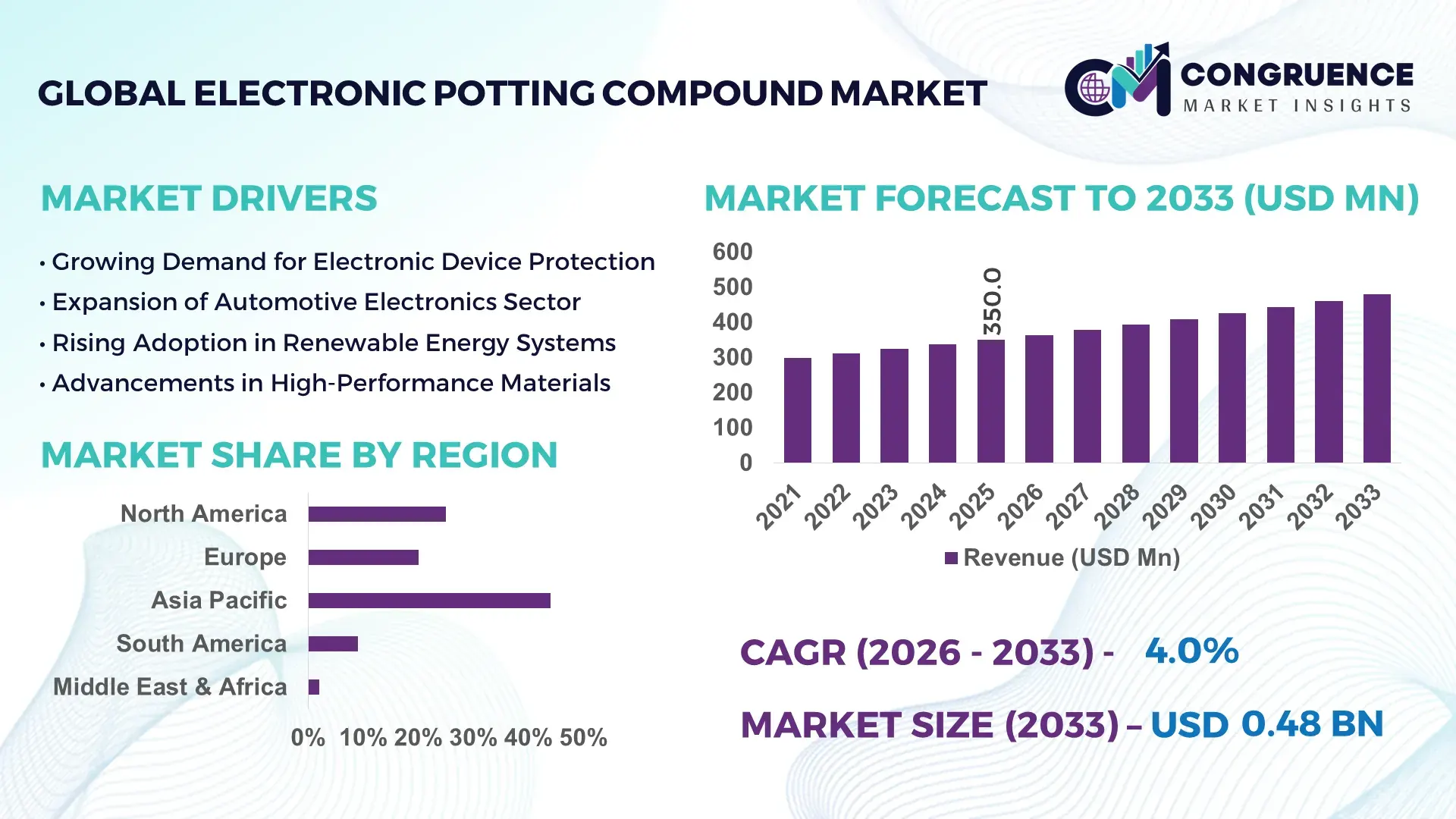
The Global Electronic Potting Compound Market was valued at USD 350 Million in 2025 and is anticipated to reach a value of USD 478.9 Million by 2033 expanding at a CAGR of 4% between 2026 and 2033. This growth is primarily driven by the increasing demand for high-performance electronic encapsulation solutions in automotive, industrial, and consumer electronics applications.
China continues to lead the global electronic potting compound market with its extensive electronics manufacturing infrastructure and large-scale production capabilities. The country produces over 35% of the world’s electronic components, supported by more than 2.5 billion units manufactured annually across multiple sectors. Investments exceeding USD 20 billion in semiconductor fabrication plants and electronics assembly units have accelerated demand for epoxy and silicone-based potting materials. In addition, more than 60% of automotive electronic modules manufactured domestically utilize potting compounds to enhance durability and thermal resistance. The rapid expansion of electric vehicle production, which exceeded 8 million units annually, has significantly increased the adoption of advanced insulation and encapsulation technologies.
Market Size & Growth: Valued at USD 350 Million in 2025, projected to reach USD 478.9 Million by 2033 at 4% CAGR, driven by rising demand for durable and thermally stable electronic protection materials.
Top Growth Drivers: 45% increase in electric vehicle electronics adoption, 38% growth in industrial automation integration, 32% rise in compact consumer electronic devices.
Short-Term Forecast: By 2028, advancements in thermal conductivity are expected to improve electronic component lifespan by 25%.
Emerging Technologies: Nano-enhanced epoxy systems, UV-curable potting materials, and thermally conductive silicone gels improving performance and efficiency.
Regional Leaders: Asia-Pacific projected at USD 210 Million by 2033 with strong manufacturing output; North America at USD 120 Million driven by aerospace electronics; Europe at USD 95 Million led by automotive electrification.
Consumer/End-User Trends: Automotive and industrial sectors contribute over 65% of demand, with increasing preference for lightweight and high-durability encapsulation solutions.
Pilot or Case Example: In 2024, an automotive manufacturer reduced electronic failure rates by 30% using advanced silicone-based potting compounds.
Competitive Landscape: Leading player holds approximately 22% share, followed by major companies such as Henkel, Dow, Huntsman, and Momentive.
Regulatory & ESG Impact: Growing adoption of low-VOC and environmentally compliant materials aligned with global sustainability targets.
Investment & Funding Patterns: Over USD 1.5 billion invested globally in advanced material development and manufacturing expansion.
Innovation & Future Outlook: AI-driven material formulation and smart encapsulation technologies are enhancing product reliability and customization.
The electronic potting compound market supports critical sectors including automotive electronics, industrial automation, aerospace systems, renewable energy infrastructure, and consumer devices, collectively contributing more than 70% of total demand. Technological innovations such as flame-retardant compounds and thermally conductive fillers are improving operational efficiency and safety standards. Regulatory pressures promoting sustainable and low-emission materials are accelerating the transition toward silicone and polyurethane-based solutions. Regionally, Asia-Pacific dominates consumption due to dense manufacturing activity, while Europe emphasizes eco-friendly product development. Increasing deployment in electric mobility, smart grid systems, and IoT-enabled devices is expected to further strengthen market demand.
The electronic potting compound market plays a crucial role in ensuring the durability and performance of modern electronic systems, particularly as industries transition toward high-density, miniaturized, and high-power devices. With more than 65% of electronic component failures attributed to environmental factors such as moisture, vibration, and thermal stress, potting compounds are becoming essential across automotive, aerospace, and industrial sectors. Advanced silicone-based compounds deliver up to 40% higher thermal stability compared to traditional epoxy materials, significantly improving operational reliability. Asia-Pacific dominates in production volume due to its manufacturing ecosystem, while Europe leads in adoption with over 55% of enterprises integrating environmentally compliant potting materials into their operations. North America continues to advance in specialized applications such as aerospace and defense electronics, where precision encapsulation is critical for safety and performance.
By 2028, AI-driven formulation technologies are expected to improve material efficiency by 30%, enabling faster development of customized solutions tailored to specific applications such as battery systems and power modules. Companies are increasingly aligning with sustainability goals, targeting a 35% reduction in volatile organic compound emissions by 2030. In 2024, a German automotive electronics manufacturer achieved a 28% reduction in system failures by implementing thermally conductive silicone potting compounds, demonstrating measurable performance benefits. As industries continue to digitize and electrify, the electronic potting compound market is positioned as a key enabler of resilient, compliant, and sustainable electronic infrastructure.
The growing adoption of electric vehicles is significantly driving the demand for electronic potting compounds, as EV systems depend on complex electronic architectures that require robust protection. Global electric vehicle sales surpassed 14 million units in 2025, increasing the need for reliable battery management systems and power electronics. Potting compounds provide essential insulation and thermal management, ensuring system safety and performance. Advanced silicone-based materials offer up to 35% improved heat dissipation, which enhances battery efficiency and longevity. Additionally, over 70% of automotive electronic control units now incorporate potting solutions to protect against environmental stress. This increasing reliance on electronics in modern vehicles continues to accelerate market growth.
High material and processing costs remain a significant restraint for the electronic potting compound market. Advanced materials such as silicone and polyurethane-based compounds can be up to 40% more expensive than conventional alternatives due to complex formulations and specialized raw materials. The curing process often requires controlled environments and advanced equipment, increasing production costs by approximately 20%. These factors create financial barriers, particularly for small and medium-sized manufacturers. Additionally, fluctuations in raw material prices, especially petrochemical derivatives, impact cost stability and supply chain efficiency. These challenges limit widespread adoption in cost-sensitive markets and industries with tight profit margins.
The expansion of renewable energy systems presents significant growth opportunities for the electronic potting compound market. Solar power systems, wind turbines, and energy storage units require durable and weather-resistant electronic components. Global renewable energy capacity exceeded 3,500 GW in 2025, driving demand for protective encapsulation materials. Potting compounds provide resistance to moisture, UV exposure, and temperature fluctuations, extending the lifespan of critical components. Advanced epoxy formulations can improve durability by up to 30% in harsh environments. Increasing government support and investment in clean energy projects are further accelerating the adoption of high-performance potting solutions across the renewable energy sector.
Environmental regulations and material performance limitations present ongoing challenges for the electronic potting compound market. Strict regulations on volatile organic compounds and hazardous materials are compelling manufacturers to develop eco-friendly alternatives. This transition can increase development costs by up to 25% and requires extensive testing to maintain performance standards. Some sustainable materials may offer lower thermal resistance or mechanical strength, creating trade-offs in product performance. Additionally, disposal and recyclability remain critical concerns, as many potting compounds are difficult to remove once cured. These challenges require continuous innovation and investment to balance regulatory compliance with product efficiency and cost-effectiveness.
Increasing adoption of thermally conductive potting materials improving device efficiency by over 30%: The demand for thermally conductive electronic potting compounds has surged as electronic devices generate higher heat loads. Advanced silicone and epoxy formulations now achieve thermal conductivity levels exceeding 3.5 W/mK, representing a 30% improvement over conventional compounds. Over 65% of high-power electronics manufacturers have shifted toward thermally enhanced materials to improve component lifespan and reduce failure rates. This trend is particularly evident in electric vehicle battery systems and industrial power modules, where heat dissipation is critical for maintaining operational stability and extending equipment life cycles.
Shift toward low-VOC and environmentally compliant compounds reaching 40% adoption: Sustainability-driven regulations have accelerated the adoption of low volatile organic compound potting materials, with nearly 40% of manufacturers transitioning to eco-friendly formulations. Water-based and solvent-free compounds have reduced emissions by up to 50%, aligning with environmental compliance requirements across Europe and North America. Additionally, over 55% of electronics manufacturers are incorporating recyclable or bio-based potting materials to meet sustainability targets, reflecting a strong industry shift toward greener production practices without compromising performance.
Integration of automation and precision dispensing systems boosting efficiency by 25%: Automated potting and encapsulation systems are being increasingly adopted to enhance manufacturing precision and consistency. More than 60% of large-scale electronics manufacturers have implemented robotic dispensing technologies, resulting in a 25% reduction in material wastage and improved process efficiency. These systems enable accurate control over compound volume and curing conditions, ensuring uniform protection for sensitive components. The adoption of Industry 4.0 technologies in production lines has further streamlined potting operations, reducing defects and improving throughput.
Rising demand from electric vehicle and renewable energy sectors exceeding 45% growth in applications: The rapid expansion of electric vehicles and renewable energy systems has driven a significant increase in the use of electronic potting compounds, with application demand rising by over 45% in these sectors. Electric vehicle battery modules, solar inverters, and wind turbine control units require robust encapsulation solutions to withstand harsh environmental conditions. More than 70% of EV battery systems now utilize advanced potting materials for insulation and vibration resistance, while renewable energy installations increasingly depend on weather-resistant compounds to ensure long-term reliability and performance.
The electronic potting compound market is segmented based on type, application, and end-user industries, each contributing distinct demand patterns and growth dynamics. By type, epoxy, silicone, and polyurethane compounds dominate the landscape due to their superior insulation, mechanical strength, and thermal properties. Applications are primarily concentrated in automotive electronics, consumer electronics, industrial systems, and renewable energy infrastructure, where protection against environmental stress is critical. End-user insights indicate strong demand from automotive manufacturers, electronics producers, and energy sector operators, collectively accounting for a significant share of total consumption. The increasing complexity of electronic systems and the shift toward electrification and automation are driving higher adoption across all segments. Furthermore, advancements in material science are enabling customized solutions tailored to specific industry requirements, enhancing performance and durability across diverse applications.
Epoxy, silicone, and polyurethane represent the core product types in the electronic potting compound market, each offering distinct performance characteristics. Epoxy-based compounds currently account for approximately 45% of total adoption due to their excellent adhesion, chemical resistance, and mechanical strength, making them suitable for industrial and automotive electronics. Silicone compounds hold around 30% share, valued for their flexibility and superior thermal stability, especially in high-temperature environments. Polyurethane compounds contribute nearly 15%, offering balanced mechanical and electrical properties for general-purpose applications.
Silicone-based compounds are the fastest-growing segment, with an expected CAGR of 5.5%, driven by increasing demand in electric vehicles and renewable energy systems where thermal resilience and flexibility are critical. In comparison, epoxy compounds dominate current usage, while silicone materials are gaining traction due to their ability to withstand temperatures exceeding 200°C and provide enhanced vibration resistance. Other specialized compounds, including acrylics and polyesters, collectively account for approximately 10% of the market, catering to niche applications requiring specific curing times or cost-effective solutions.
The application landscape of the electronic potting compound market is led by automotive electronics, which account for nearly 40% of total usage due to the increasing integration of electronic control units, battery systems, and sensors. Consumer electronics follow with approximately 25% share, driven by demand for compact and durable devices. Industrial electronics contribute around 20%, focusing on automation systems and heavy machinery requiring robust protection.
Renewable energy applications are the fastest-growing segment, with an expected CAGR of 6%, supported by the rapid expansion of solar and wind power infrastructure. While automotive applications currently dominate, renewable energy systems are projected to surpass 30% adoption by 2033 due to increasing investments in sustainable energy technologies. Other applications, including aerospace and telecommunications, collectively account for about 15% of the market, where high-performance materials are essential for reliability under extreme conditions.
Automotive manufacturers represent the leading end-user segment in the electronic potting compound market, accounting for approximately 42% of total demand due to the increasing electrification of vehicles and the need for durable electronic systems. Electronics manufacturing companies follow with around 30% share, driven by high-volume production of consumer and industrial devices. The energy sector contributes nearly 15%, reflecting growing demand from renewable energy installations.
The renewable energy sector is the fastest-growing end-user segment, with an expected CAGR of 6.2%, fueled by global investments in clean energy infrastructure and the need for weather-resistant electronic protection. While automotive dominates current consumption, energy sector adoption is expected to exceed 28% by 2033 as solar and wind installations continue to expand. Other end-users, including aerospace, defense, and telecommunications, collectively account for approximately 13% of the market, with adoption rates exceeding 50% in high-reliability applications.
Region Asia-Pacific accounted for the largest market share at 48% in 2025 however, North America is expected to register the fastest growth, expanding at a CAGR of 5.2% between 2026 and 2033.
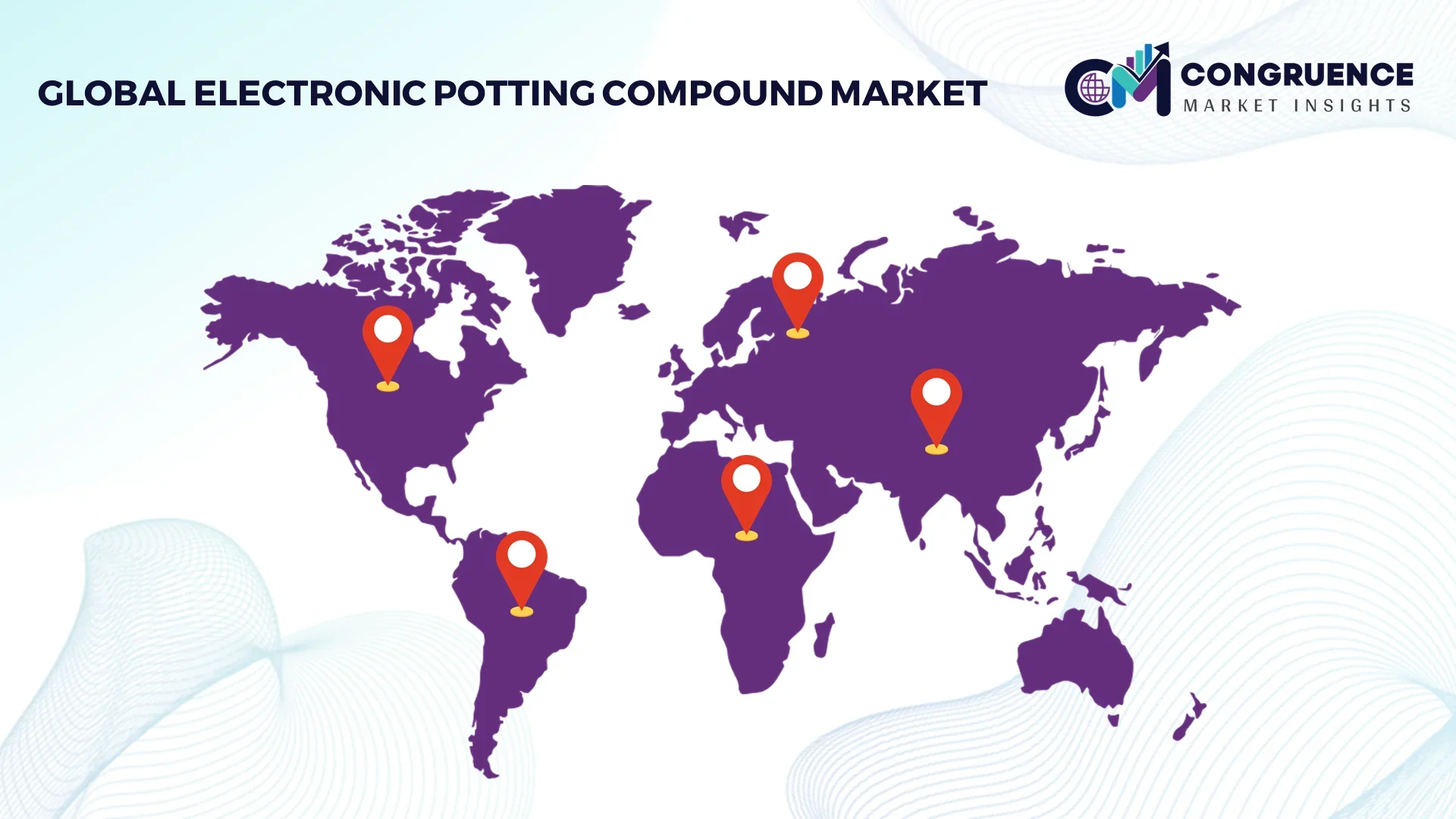
Asia-Pacific’s dominance is supported by high-volume electronics manufacturing, with over 60% of global electronic components produced in countries such as China, Japan, and South Korea. The region processes more than 2.5 billion electronic units annually, driving consistent demand for potting compounds. North America, contributing approximately 22% of the global market, is witnessing rapid expansion due to increasing investments in electric vehicles and aerospace electronics, with over 35% of new EV systems integrating advanced encapsulation materials. Europe holds nearly 20% share, supported by stringent environmental regulations and strong automotive electronics demand, while South America and the Middle East & Africa collectively account for 10%, driven by infrastructure and energy sector growth.
North America accounts for approximately 22% of the electronic potting compound market, driven by strong demand across automotive, aerospace, and industrial automation sectors. Over 40% of aerospace electronic systems in the region utilize high-performance potting compounds to ensure durability under extreme conditions. Regulatory frameworks promoting low-VOC materials have led to a 35% increase in the adoption of environmentally compliant compounds. Technological advancements such as automated dispensing systems and AI-assisted material formulation are improving production efficiency by nearly 25%. A key industry participant in the region has expanded its production capacity by 18% in 2024 to meet rising demand for thermally conductive compounds. Consumer behavior in this region reflects high enterprise adoption, particularly in healthcare and financial infrastructure, where reliability and long-term performance of electronic systems are critical.
Europe holds nearly 20% of the electronic potting compound market, with key countries such as Germany, the United Kingdom, and France driving regional demand. Germany alone contributes over 30% of Europe’s automotive electronics production, significantly boosting the need for advanced potting materials. Regulatory initiatives focused on reducing emissions have resulted in over 50% of manufacturers transitioning to low-VOC and recyclable compounds. The adoption of emerging technologies, including thermally conductive silicones and UV-curable systems, has increased by 28% across industrial applications. A major regional player introduced a new eco-friendly potting solution in 2024, reducing environmental impact by 40% while maintaining performance standards. Consumer behavior trends indicate that regulatory pressure strongly influences purchasing decisions, leading to increased demand for sustainable and compliant potting solutions.
Asia-Pacific leads the electronic potting compound market in both volume and consumption, accounting for approximately 48% of global demand. China, Japan, and India are the top consuming countries, collectively producing over 65% of global electronics. The region manufactures more than 2.5 billion electronic devices annually, creating consistent demand for encapsulation materials. Rapid industrialization and investments exceeding USD 25 billion in semiconductor and electronics manufacturing facilities have strengthened regional supply chains. Technological innovation hubs in countries like Japan and South Korea are advancing material science, improving compound performance by over 30%. A leading regional manufacturer increased its output capacity by 20% in 2025 to meet growing demand from electric vehicle and consumer electronics sectors. Consumer behavior in the region is driven by high demand for smartphones, IoT devices, and e-commerce electronics, fueling continuous market expansion.
South America accounts for approximately 6% of the electronic potting compound market, with Brazil and Argentina leading regional consumption. Brazil alone contributes over 45% of the region’s electronics production, supported by expanding industrial and energy sectors. Infrastructure development projects have increased demand for durable electronic systems by 22%, particularly in renewable energy installations. Government incentives promoting local manufacturing have encouraged a 15% rise in domestic production of electronic components. A regional manufacturer has invested in upgrading its production facilities, increasing efficiency by 18% to cater to industrial demand. Consumer behavior in this region is closely linked to media, telecommunications, and localized technology adoption, with growing demand for cost-effective and reliable electronic protection solutions.
The Middle East & Africa region holds around 4% of the electronic potting compound market, driven by increasing demand from oil and gas, construction, and energy sectors. Countries such as the UAE and South Africa are leading growth, with infrastructure investments exceeding USD 15 billion annually. The adoption of advanced electronic systems in oil and gas operations has increased by 20%, requiring robust potting solutions for harsh environments. Technological modernization initiatives have improved industrial efficiency by 18%, boosting demand for high-performance materials. Trade partnerships and regulatory reforms have supported a 12% increase in electronics manufacturing activities. A regional player has introduced specialized potting compounds designed for high-temperature applications, improving equipment lifespan by 25%. Consumer behavior reflects growing adoption of smart infrastructure and industrial automation technologies.
China – 35% share: Electronic Potting Compound market leadership driven by massive electronics production capacity and strong automotive electronics manufacturing base.
United States – 18% share: Electronic Potting Compound market growth supported by advanced aerospace, defense, and high-reliability electronics demand.
The electronic potting compound market is moderately fragmented, with over 25 active global and regional players competing across various application segments. The top five companies collectively account for approximately 55% of the total market share, indicating a balanced mix of consolidation and competitive diversity. Leading players are focusing on strategic initiatives such as product innovation, partnerships, and capacity expansions to strengthen their market positions. In 2024, more than 12 new product launches were recorded, primarily focusing on thermally conductive and environmentally compliant formulations. Research and development investments have increased by over 20% across major companies, emphasizing the importance of advanced material science.
Collaborations between material manufacturers and electronics producers have grown by 30%, enabling the development of customized solutions tailored to specific industry requirements. Additionally, mergers and acquisitions activity has intensified, with at least 5 notable deals completed in the past two years to expand technological capabilities and geographic reach. Digital transformation trends, including AI-driven formulation and automated production systems, are enhancing operational efficiency by up to 25%. The competitive landscape is further shaped by increasing demand for sustainable materials, prompting companies to invest in eco-friendly product lines and low-emission technologies.
Henkel AG & Co. KGaA
Dow Inc.
Huntsman Corporation
Momentive Performance Materials Inc.
Wacker Chemie AG
Shin-Etsu Chemical Co., Ltd.
3M Company
H.B. Fuller Company
Elantas GmbH
Master Bond Inc.
Technological advancements in the electronic potting compound market are centered on improving thermal management, mechanical durability, and environmental compliance. One of the most significant innovations is the development of thermally conductive fillers, such as aluminum oxide and boron nitride, which have enhanced thermal conductivity levels from below 1 W/mK to over 3.5 W/mK in advanced formulations. These improvements enable efficient heat dissipation in high-power electronics, particularly in electric vehicle battery modules and industrial power systems, where operating temperatures can exceed 150°C.
Another critical development is the adoption of silicone-based potting compounds with enhanced flexibility and temperature resistance. These materials can withstand temperature ranges from -50°C to over 200°C, making them suitable for harsh operating environments such as aerospace and renewable energy systems. Additionally, UV-curable and fast-curing potting technologies have reduced curing times by up to 60%, significantly improving manufacturing efficiency and throughput in high-volume production lines.
Automation and precision dispensing technologies are transforming production processes, with over 60% of large-scale manufacturers integrating robotic systems to achieve consistent application and reduce material waste by approximately 25%. Digitalization is further advancing the sector through AI-driven material formulation, enabling up to 30% improvement in formulation accuracy and reducing development cycles.
Emerging technologies such as nano-enhanced compounds are improving dielectric strength by over 20%, while bio-based and low-VOC materials are reducing environmental impact by up to 50%. These innovations are aligning with global sustainability standards and enabling manufacturers to balance performance with regulatory compliance, making advanced potting technologies a critical component of next-generation electronic systems.
In March 2025, Henkel expanded its portfolio of thermally conductive potting compounds under the LOCTITE brand, introducing materials with thermal conductivity exceeding 3.0 W/mK for electric vehicle battery systems, improving heat dissipation efficiency and extending component lifespan in high-performance automotive applications. Source: www.henkel.com
In October 2024, Dow launched a new range of silicone-based encapsulation materials designed for renewable energy applications, offering up to 25% improved UV resistance and enhanced durability in outdoor environments, supporting long-term reliability of solar inverters and wind turbine electronics. Source: www.dow.com
In July 2024, Huntsman Corporation introduced advanced polyurethane potting compounds targeting industrial electronics, achieving 20% faster curing times and improved mechanical strength, enabling higher production efficiency and better protection for sensitive components in automation systems. Source: www.huntsman.com
In January 2025, Wacker Chemie AG enhanced its ELASTOSIL® product line with new silicone potting solutions featuring extended temperature resistance up to 200°C, specifically developed for automotive and aerospace electronics requiring high reliability under extreme operating conditions. Source: www.wacker.com
The Electronic Potting Compound Market Report provides a comprehensive evaluation of key market segments, technological advancements, and regional performance across global industries. The scope encompasses detailed segmentation by product types, including epoxy, silicone, polyurethane, and specialty compounds, which collectively account for over 90% of industry usage. The report also examines application-specific demand across automotive electronics, consumer devices, industrial automation, renewable energy systems, and aerospace technologies, where electronic protection requirements have increased by more than 35% due to rising system complexity.
, the report covers major regions including Asia-Pacific, North America, Europe, South America, and the Middle East & Africa, with Asia-Pacific contributing nearly half of global consumption due to large-scale electronics manufacturing. It also highlights country-level insights for key markets such as China, the United States, Germany, and Japan, which together account for over 65% of total demand.
The report further explores emerging technologies such as nano-enhanced materials, UV-curable systems, and environmentally sustainable formulations, which are improving performance metrics like thermal conductivity and dielectric strength by over 20%. Additionally, it addresses regulatory frameworks influencing product development, including environmental compliance standards and safety requirements impacting more than 50% of manufacturers. Industry focus areas include supply chain dynamics, raw material trends, and innovation strategies adopted by leading players. The report also covers niche segments such as potting compounds for electric vehicle battery systems and smart grid infrastructure, where adoption has increased by over 40%, offering valuable insights for strategic decision-making and future investment planning.
| Report Attribute/Metric | Report Details |
|---|---|
|
Market Revenue in 2025 |
USD V2025 Million |
|
Market Revenue in 2033 |
USD V2033 Million |
|
CAGR (2026 - 2033) |
4% |
|
Base Year |
2025 |
|
Forecast Period |
2026 - 2033 |
|
Historic Period |
2021 - 2025 |
|
Segments Covered |
By Types
By Application
By End-User
|
|
Key Report Deliverable |
Revenue Forecast, Growth Trends, Market Dynamics, Segmental Overview, Regional and Country-wise Analysis, Competition Landscape |
|
Region Covered |
North America, Europe, Asia-Pacific, South America, Middle East, Africa |
|
Key Players Analyzed |
Henkel AG & Co. KGaA, Dow Inc., Huntsman Corporation, Momentive Performance Materials Inc., Wacker Chemie AG, Shin-Etsu Chemical Co., Ltd., 3M Company, H.B. Fuller Company, Elantas GmbH, Master Bond Inc. |
|
Customization & Pricing |
Available on Request (10% Customization is Free) |




