
Reports
The Global Electronic Potting and Encapsulating Market was valued at USD 2355.05 Million in 2025 and is anticipated to reach a value of USD 4796.91 Million by 2033 expanding at a CAGR of 9.3% between 2026 and 2033. EV power electronics, high-density automotive control modules, industrial automation hardware, and thermally demanding charging systems are accelerating adoption of advanced silicone, epoxy, and polyurethane encapsulation materials.
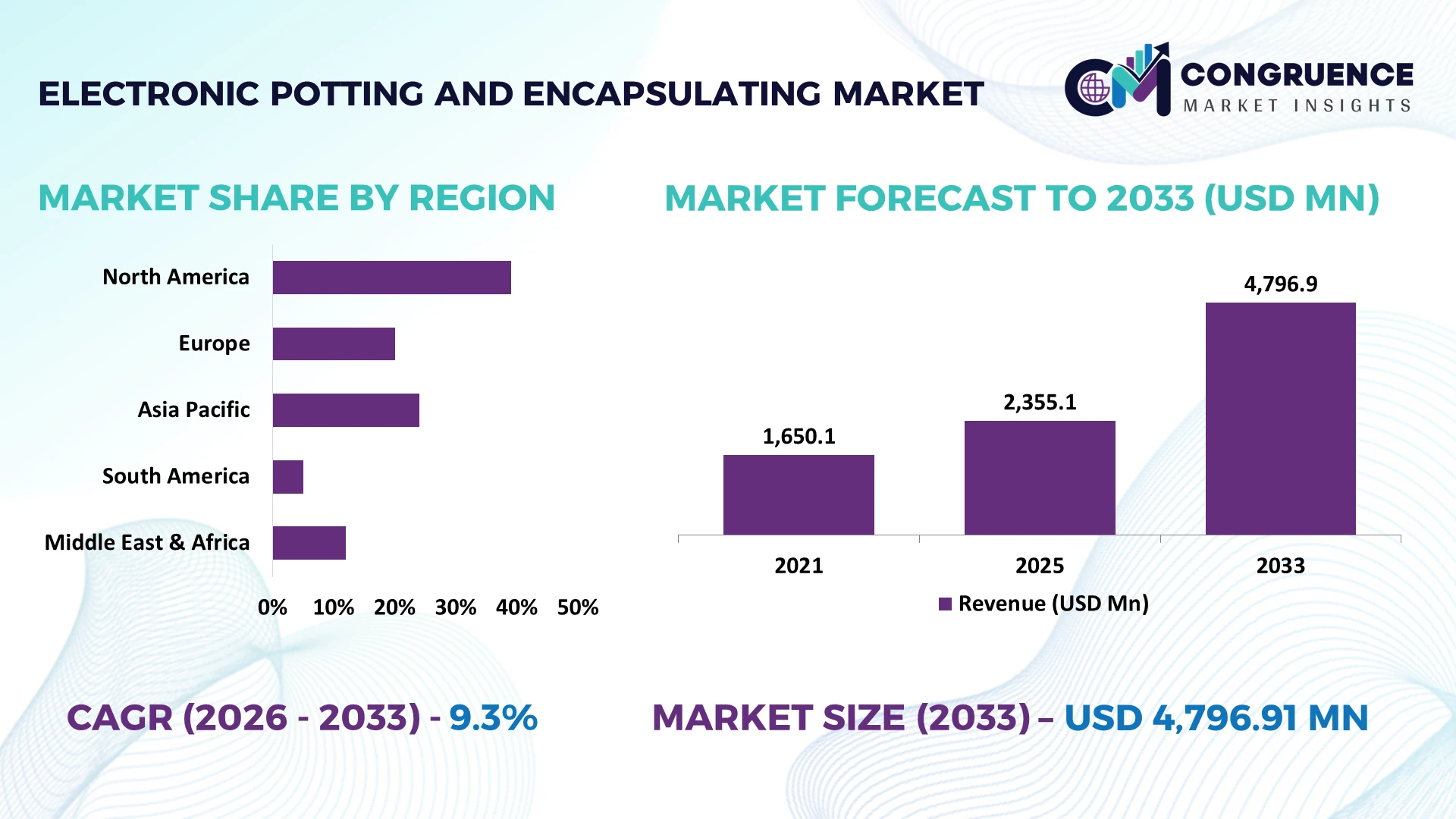
China anchors the dominant Asia-Pacific electronic potting and encapsulating ecosystem, with the region representing approximately 36–40% of global demand and China accounting for a substantial share of regional consumption. Its position is reinforced by EVs, battery-management systems, consumer electronics, power conversion, and industrial controls. China targets approximately 28 million EV charging facilities by 2027, creating significant requirements for thermally conductive encapsulants. India and Southeast Asia remain smaller but are gaining manufacturing capacity as global electronics supply chains diversify beyond established Chinese production clusters.
Strategically, suppliers should prioritize China-linked EV electronics programs while establishing localized formulation, dispensing, qualification, and technical-support capabilities across India and Southeast Asia.
Market Size & Growth: USD 2,355.05 million in 2025 advances to USD 4,796.91 million by 2033 at 9.3% CAGR, supported by EV power electronics, charging hardware, and high-density electronic modules.
Top Growth Drivers: Automotive electronics represent approximately 24–28% of demand, Asia-Pacific captures roughly 36–40%, and electronic modules account for around 30–34%, concentrating material consumption in high-reliability applications.
Short-Term Forecast: By 2027, China targets approximately 28 million EV charging facilities and more than 300 million kW of public charging capacity, enlarging the addressable requirement for thermal potting materials.
Emerging Technologies: Thermally conductive silicones, low-viscosity formulations, automated dispensing, and fast-curing systems are reshaping production, particularly across integrated inverters, onboard chargers, DC-DC converters, battery systems, and e-motors.
Regional Leaders: Asia-Pacific represents approximately USD 895 million of the 2025 baseline, versus around USD 500 million for North America and USD 470 million for Europe, reflecting electronics manufacturing, electrification, and industrial automation intensity.
End-User Trends: Consumer electronics represent approximately 32% of application demand in industry estimates, while automotive electronics approach 29%, demonstrating strong material consumption across compact, vibration-sensitive, moisture-exposed, and thermally stressed assemblies.
Pilot/Case Example: In 2025, Henkel expanded its thermal-management portfolio with 2 silicone potting solutions targeting EV power-conversion components, reinforcing industry movement toward faster processing, improved thermal transfer, and automated high-volume dispensing.
Competitive Landscape: In specialized EV-charger potting applications, Henkel holds approximately 11.7% share, followed by Dow at about 6.5% and 3M near 4.4%, alongside Wacker Chemie and ELANTAS.
Regulatory & ESG Impact: Epoxy represents approximately 44% of material demand in selected industry assessments, increasing development emphasis on low-emission, halogen-free, durable formulations meeting automotive safety, electronics reliability, and restricted-substance requirements.
Investment & Funding: China’s planned expansion toward 28 million charging facilities by 2027 creates a major infrastructure-linked investment channel, directing supplier capacity and formulation investments toward EV-grade thermal-management and electrical-insulation materials.
Innovation & Future Outlook: Silicone represents approximately 36% of material demand in selected assessments, while next-generation competition is shifting toward low-modulus, thermally conductive compounds compatible with precision dispensing, miniaturized electronics, and integrated power modules.
The Electronic Potting and Encapsulating Market is increasingly aligned with EV battery electronics, onboard chargers, inverters, industrial control systems, telecommunications hardware, and miniaturized consumer devices where thermal cycling, moisture, vibration, and electrical isolation directly determine component reliability. Automotive electronics represent approximately 24–28% of industry demand, intensifying development of thermally conductive silicones, fast-curing compounds, low-viscosity encapsulants, and precision automated dispensing. China’s accelerated EV charging infrastructure rollout adds a major operational catalyst, while electronics manufacturing diversification toward India and Southeast Asia is expanding regional qualification requirements and setting the stage for strategic market positioning.
Electronic potting and encapsulating materials are becoming strategically important as EV power electronics, battery-management systems, industrial controls, renewable-energy converters, and compact consumer devices operate at higher power densities. China’s planned expansion toward approximately 28 million EV charging facilities by 2027 illustrates the infrastructure shift supporting thermal-management materials. Electronics supply-chain restructuring toward India, Vietnam, and Mexico is simultaneously pushing suppliers to localize formulation, qualification, and dispensing support closer to assembly operations.
Technology competition increasingly centers on thermally conductive silicones and low-viscosity encapsulants. Automated precision dispensing can reduce material waste by roughly 15–25% versus manually controlled legacy processes while improving repeatability in densely packaged modules. China leads deployment scale through EV and electronics manufacturing, whereas Germany and the United States emphasize high-specification automotive, aerospace, industrial, and power-electronics applications requiring stringent thermal-cycle and dielectric performance.
Through 2028, faster-curing formulations, automated mixing-dispensing systems, and higher thermal-conductivity materials will gain importance as electronics manufacturers shorten takt times and increase component density. A practical example is automated potting of onboard chargers and DC-DC converters, where controlled dispensing improves void management and production consistency. Suppliers are consequently expanding application laboratories, localized production, and OEM qualification partnerships. Competitive advantage will increasingly depend on combining material performance with process engineering and application-level technical support.
Automotive electrification is the strongest structural driver because inverters, onboard chargers, battery-management systems, sensors, and high-voltage control units require simultaneous thermal dissipation, dielectric insulation, and vibration resistance. Automotive electronics represent approximately 24–28% of potting demand, while electric vehicles can contain 2–3 times more power-electronic content than conventional vehicles. China accounted for more than 70% of global electric-car production in 2024, concentrating substantial encapsulation requirements around its automotive clusters. Higher switching frequencies and compact module designs are also increasing thermal loads by approximately 15–30% in selected power-electronics architectures. Material suppliers are responding with low-modulus silicones, thermally conductive epoxies, automated dispensing systems, and OEM qualification programs. The strategic differentiator is shifting from supplying resin alone toward engineering complete thermal-protection processes.
Advanced thermally conductive formulations carry substantial cost premiums because ceramic fillers, specialty silicones, curing agents, and flame-retardant additives require controlled sourcing and processing. High-performance thermal potting materials can cost 20–40% more than conventional general-purpose compounds, while raw-material movements can alter formulation costs by approximately 10–20% during tight supply periods. China dominates several upstream mineral-processing chains used by electronics materials, exposing manufacturers in Japan, Germany, and the United States to sourcing concentration and geopolitical trade controls. Excessive filler loading also raises viscosity, potentially increasing dispensing cycle times by 15–25% without optimized equipment. Suppliers are mitigating exposure through dual sourcing, localized compounding, longer procurement contracts, and alternative filler chemistries. Operationally, controlling total applied material per module is becoming as important as negotiating resin prices.
Wide-bandgap semiconductors, 800-volt EV architectures, renewable-energy inverters, data-center power systems, and fast chargers create an attractive opportunity for materials engineered around higher operating temperatures and power densities. Silicon-carbide devices can reduce switching losses by approximately 50% compared with conventional silicon technologies in suitable power-conversion applications, but their higher performance increases thermal-interface requirements elsewhere in the assembly. China’s charging network is targeted to reach roughly 28 million facilities by 2027, while India continues expanding domestic electronics and EV manufacturing incentives. Suppliers developing low-viscosity compounds with thermal conductivity above 2 W/mK can address demanding power modules without sacrificing dispensing performance. R&D investment is therefore moving toward silicone hybrids, recyclable or reworkable chemistries, and automated application ecosystems. The non-obvious opportunity lies in engineering materials specifically for faster production cycles rather than competing solely on thermal specifications.
Scaling potting from laboratory qualification to millions of electronic modules remains difficult because mixing accuracy, air entrapment, cure profiles, adhesion, component geometry, and thermal expansion directly influence field reliability. Even void levels above approximately 2–5% can create localized thermal resistance in sensitive assemblies, while dispensing deviations of 5–10% can increase material consumption or leave critical components insufficiently protected. Automotive production in Germany, China, and the United States further demands consistent performance across temperature cycling, vibration, moisture, and high-voltage environments. Faster curing compounds solve takt-time constraints but narrow processing windows, increasing automation and workforce requirements. Manufacturers must invest in vacuum dispensing, inline metering, vision inspection, process simulation, and application engineering partnerships. Long-term competitiveness therefore depends on controlling the complete dispensing-and-curing process, not simply improving encapsulant chemistry.
Automated Dispensing Moves Into Production: Electronics manufacturers are replacing operator-controlled potting with meter-mix, vacuum, and robotic dispensing as miniaturized assemblies demand tighter material control. Automated workflows are targeting dispensing variation below 5%, while optimized low-viscosity compounds can shorten filling cycles by 15–30%. Chinese and South Korean electronics plants are integrating inline vision inspection and programmable dosing to control void formation. Suppliers are responding by pairing formulations with dispensing equipment and process engineering, shifting competition from standalone resin performance toward validated production solutions.
Fast-Cure Processing Gains Priority: UV and accelerated thermal curing are moving deeper into high-throughput electronics manufacturing, with UV curing representing about 55% of curing-technique demand in 2025. Cycle times can fall below 30 seconds for suitable UV-curable formulations compared with substantially longer conventional cure schedules. Smartphone, sensor, and compact module manufacturers increasingly specify rapid-curing acrylic systems to reduce work-in-process inventory. Compound suppliers are expanding dual-cure and shadow-area chemistries that combine production speed with complete encapsulation.
Supply Chains Become More Localized: Electronics assembly diversification is changing procurement patterns for encapsulation materials. Vietnam’s potting-compound imports reportedly increased about 41% in 2025, while Asia-Pacific represented approximately 43% of global potting demand. Manufacturing migration from concentrated Chinese supply chains toward Vietnam and India is pushing formulators to establish local distributors, application laboratories, and technical qualification capabilities, reducing lead times and protecting customers from cross-border logistics disruption.
Reliability Testing Becomes More Integrated: Qualification is shifting from basic dielectric testing toward combined thermal cycling, vibration, moisture, and high-voltage validation. Automotive formulations increasingly target performance across roughly -40°C to 125°C and as many as 2,000 thermal cycles. EV and industrial-electronics manufacturers are therefore involving material suppliers earlier in module design. Suppliers are responding with application-specific simulation, accelerated aging, and joint OEM validation, reducing late-stage material substitutions and costly production requalification.
Epoxy Resins remain the leading type, accounting for approximately 34% of 2025 potting-compound demand. Their position reflects strong adhesion, dielectric insulation, chemical resistance, dimensional stability, and compatibility with established high-volume processing. Polyurethane occupies an important middle position where flexibility and impact resistance outweigh maximum rigidity. Polyester remains relevant for cost-sensitive electrical protection, while Acrylics support rapid and UV-curable workflows where production speed and optical properties are important.
Silicone is the fastest-growing strategic type as EV power modules, high-temperature electronics, renewable-energy converters, and sensitive assemblies require low modulus and broader temperature tolerance. Silicone holds roughly 28% in selected 2025 assessments versus approximately 20% for polyurethane, demonstrating the shift toward thermally demanding applications. Silicone formulations can command a 25–40% premium over comparable epoxy systems, making application selectivity essential. Manufacturers are consequently investing in thermally conductive silicones, hybrid chemistries, low-viscosity grades, and faster curing systems rather than expanding commodity portfolios indiscriminately.
PCB Protection represents the largest application, estimated at approximately 30–35% of electronic potting and encapsulating demand, because printed circuit assemblies require moisture barriers, electrical insulation, vibration resistance, and mechanical stabilization across consumer, industrial, automotive, and telecom hardware. Component Protection forms another mature volume base, particularly for power supplies and control modules. Transformer Protection and Cable Sealing remain established applications where dielectric strength and environmental sealing determine operating life.
Sensor Encapsulation is emerging as the fastest-growing application as vehicles, factories, medical equipment, and connected infrastructure deploy greater numbers of compact sensing devices. Sensor-intensive systems can contain dozens to hundreds of sensing points, increasing demand for low-stress compounds that protect delicate electronics without compromising signal performance. LED Encapsulation is also shifting toward optically stable silicones and Acrylics as higher-output packages increase thermal exposure. Manufacturers are expanding automated micro-dispensing, low-viscosity formulations, and application-specific cure profiles, directing investment toward precision protection rather than simply increasing compound volume.
Electronics is the leading end-user, representing approximately 38–45% of potting-compound demand in major 2025 assessments. High-density PCBs, power supplies, semiconductor assemblies, consumer devices, telecom equipment, and edge hardware create recurring requirements for moisture, thermal, and mechanical protection. Industrial Equipment remains a substantial established buyer through drives, controllers, power supplies, robotics, and instrumentation, while Telecom demand centers on 5G radios, outdoor electronics, and network power systems. Aerospace and Medical Devices represent smaller but qualification-intensive segments requiring highly controlled formulations and traceability.
Automotive is the fastest-expanding strategic buyer group as electrification increases electronic content per vehicle. Nearly 22 million electric cars were produced globally in 2025, more than 25% above 2024, with China manufacturing roughly 75% of the total. That scale is intensifying requirements for encapsulated sensors, battery-management electronics, inverters, chargers, and control modules. Suppliers are targeting OEMs through thermally conductive formulations, customized qualification programs, local technical centers, and partnerships with dispensing-equipment specialists.
Asia-Pacific accounted for the largest market share at approximately 51% in 2025 however, Asia-Pacific is expected to register the fastest growth, expanding at a CAGR of approximately 10.4% between 2026 and 2033.
High-Reliability Electronics Reshape Material Qualification
North America accounted for approximately 22% of electronic potting and encapsulating demand in 2025, supported by aerospace electronics, EV power systems, medical devices, industrial automation, defense electronics, and data-center infrastructure. The United States concentrates demand for high-reliability silicone and epoxy systems capable of handling thermal cycling, vibration, moisture, and elevated operating voltages. EV charging is particularly important as 800-V architectures and high-power DC systems push suppliers toward higher thermal conductivity and partial-discharge resistance. Domestic semiconductor and electronics manufacturing investment is also strengthening requirements for localized formulation and qualification support. Henkel, Dow, 3M, Parker Hannifin, and H.B. Fuller are responding through application laboratories, OEM collaboration, automated-dispensing compatibility, and specialized thermal-management portfolios. Procurement increasingly rewards suppliers capable of combining material availability with engineering validation and shorter qualification cycles.
United States Market Outlook: The United States leads North American adoption through its concentration of aerospace, semiconductor, automotive, medical-device, and industrial-electronics engineering. Federal semiconductor programs have committed USD 52.7 billion toward domestic semiconductor manufacturing, R&D, and workforce development, expanding the downstream ecosystem for protected electronic assemblies. Suppliers with domestic application engineering and qualification capacity hold an operational advantage when customers require rapid formulation adjustments and traceable material performance.
Electrification and Compliance Drive Material Upgrades
Europe represented approximately 21% of electronic potting and encapsulating demand in 2025, with Germany, France, the United Kingdom, and Italy anchoring consumption. Automotive electrification, industrial drives, renewable-energy converters, charging systems, and factory automation are shifting specifications toward flame-retardant, thermally conductive, low-modulus compounds. Germany’s automotive engineering base creates particularly demanding qualification cycles for battery electronics, onboard chargers, sensors, and high-voltage control modules. European sustainability requirements are simultaneously increasing scrutiny of material composition, durability, repairability, and lifecycle performance. Suppliers such as Wacker Chemie, Henkel, ELANTAS, and Huntsman are therefore emphasizing application-specific silicone, polyurethane, and epoxy systems alongside local technical support. A significant operational shift is occurring from catalog-grade materials toward jointly qualified formulations integrated with automated meter-mix and dispensing processes.
Germany Market Outlook: Germany remains Europe’s strategic center for high-specification potting applications because automotive OEMs, Tier-1 suppliers, industrial automation companies, and power-electronics manufacturers operate dense engineering networks. Battery-electric vehicles represented roughly 17% of German new-car registrations in 2025, reinforcing requirements for thermal management and dielectric protection. Domestic chemical expertise further supports rapid co-development between formulators, equipment suppliers, and electronics manufacturers.
Manufacturing Scale Accelerates Material Deployment
Asia-Pacific held approximately 51% of electronic potting and encapsulating demand in 2025, reflecting the concentration of semiconductor packaging, consumer electronics, EV manufacturing, batteries, telecommunications equipment, and industrial electronics across China, Japan, South Korea, Taiwan, and India. China provides unmatched application scale, while Japan and South Korea concentrate high-performance semiconductor, automotive, and precision-electronics requirements. The region also commands approximately 84% of the specialized EV-charger electronic potting segment, demonstrating how charging-equipment manufacturing amplifies material consumption. India and Vietnam are strengthening electronics assembly as global OEMs diversify production footprints, encouraging compound suppliers to establish local distribution, technical laboratories, and qualification capabilities. Competitive advantage increasingly depends on matching rapid electronics product cycles with automated dispensing, localized inventory, and application-specific formulations rather than relying on long-distance material supply.
China Market Outlook: China is the region’s decisive volume center, manufacturing approximately 16 million electric cars in 2025, or nearly three-quarters of global output. Its dense battery, inverter, charger, PCB, and consumer-electronics supply chains shorten qualification-to-production timelines for encapsulation materials. Suppliers are consequently prioritizing Chinese application laboratories, localized manufacturing, and partnerships with power-electronics OEMs to secure design-stage specifications.
Electronics Localization Broadens Industrial Demand
South America represented approximately 4% of global electronic potting and encapsulating demand in 2025, with Brazil providing the strongest industrial base. Demand centers on automotive electronics, renewable-energy equipment, telecommunications infrastructure, appliances, industrial controls, and electrical equipment requiring protection against humidity and thermal cycling. Brazil’s large vehicle-production ecosystem supports localized consumption of epoxy and polyurethane systems, while solar and distributed-energy installations create additional requirements for protected inverters, controllers, and power modules. Regional electronics manufacturing remains less integrated than in China or the United States, increasing dependence on imported specialty silicones and advanced additives. Suppliers are addressing this constraint through distributor partnerships, localized inventories, technical service, and selective compounding capacity. Shorter replenishment cycles are becoming a stronger procurement differentiator because imported material lead times directly affect production scheduling.
Brazil Market Outlook: Brazil combines the region’s largest manufacturing base with substantial automotive, telecom, renewable-energy, and industrial-equipment activity. The country produced approximately 2.5 million vehicles in 2024, sustaining a sizable electronics protection requirement across sensors, control modules, lighting, and power systems. Local warehousing and formulation support provide suppliers with a practical advantage over import-only competitors facing currency and logistics volatility.
Infrastructure Modernization Expands Electronics Protection
Middle East & Africa represented approximately 2% of global electronic potting and encapsulating demand in 2025, but procurement is becoming more technically demanding as Saudi Arabia and the UAE invest in renewable energy, EV charging, telecommunications, data centers, automation, and smart infrastructure. Harsh operating conditions make temperature resistance, moisture protection, dielectric stability, and UV durability particularly important for outdoor power and communications electronics. Saudi industrial localization programs are encouraging electronics and electrical-equipment assembly, while UAE data-center and digital-infrastructure expansion strengthens requirements for reliable power-control hardware. South Africa contributes through automotive assembly, mining electronics, telecom infrastructure, and renewable-energy systems. Suppliers are building distribution partnerships and technical support networks rather than large-scale local production, reflecting fragmented demand and limited regional specialty-chemical manufacturing.
Saudi Arabia Market Outlook: Saudi Arabia provides the strongest transformation-led opportunity as Vision 2030 directs capital toward industrial localization, digital infrastructure, renewable energy, and electric mobility. The Kingdom targets 50% of electricity generation from renewable sources by 2030, expanding the installed base of inverters, converters, control electronics, and monitoring equipment requiring reliable encapsulation under high-temperature operating conditions.
Henkel, Dow, Wacker Chemie, ELANTAS, and Momentive compete at the performance-led end of the Electronic Potting and Encapsulating Market, while 3M, H.B. Fuller, Huntsman, Dymax, and specialist formulators challenge through application customization and processing speed. The top five suppliers account for approximately 20–25% of specialized electronic potting demand, confirming a fragmented structure with substantial room for regional specialists. Competition increasingly centers on thermal conductivity, dielectric performance, cure speed, and automated dispensing compatibility; advanced formulations can improve processing throughput by 15–30%, while precision dispensing reduces material waste by roughly 10–20%. Leading suppliers are expanding application laboratories, co-developing compounds with EV and electronics OEMs, and localizing technical support near manufacturing hubs. The competitive shift favors integrated material-plus-process solutions over commodity resin supply. Lengthy automotive and electronics qualification cycles remain the principal entry barrier. Winning requires validated reliability, localized supply, formulation flexibility, and engineering support that accelerates customer qualification and scalable production.
Henkel AG & Co. KGaA
Dow Inc.
Wacker Chemie AG
3M Company
Huntsman Corporation
H.B. Fuller Company
Shin-Etsu Chemical Co., Ltd.
Parker Hannifin Corporation
ELANTAS
Dymax Corporation
Elkem ASA
Sika AG
CHT Group
MG Chemicals
Current potting technology is shifting toward thermally conductive silicones, low-viscosity polyurethanes, and automated meter-mix dispensing. Precision dosing can reduce material waste by 10–20%, while vacuum-assisted encapsulation improves void control in densely populated PCBs and power modules. High-conductivity silicone compounds reaching 4 W/mK can cut heat rise by about 50°C versus 0.1 W/mK insulating materials, improving reliability while supporting smaller, higher-power assemblies.
Emerging systems combine thermal management, dielectric insulation, flame resistance, and mechanical damping in one formulation. WACKER’s SEMICOSIL 9649 TC withstands thermal shocks from -40°C to 150°C, while Henkel’s polyurethane STYCAST US 8000 provides 24 kV/mm dielectric strength and insulation resistance above 10⁸ ohms after 500 hours at 85°C/85% humidity. Compared with legacy low-conductivity potting, advanced thermal compounds reduce stabilization time from nearly two hours to about 15 minutes. EV and industrial-electronics manufacturers gain through denser packaging and lower thermal stress.
Disruptive development centers on electrically insulating EMI-shielding composites, self-healing silicone gels, dual-cure chemistries, and digitally controlled dispensing. Dow’s EG-4175 gel tolerates 180°C for high-voltage IGBT modules. Between 2026 and 2028, integration will intensify globally across EV inverters, renewable-power converters, and industrial controls. Suppliers combining advanced chemistry with dispensing compatibility, validation, and application engineering will now secure stronger design-in positions.
January 2026 – Henkel launched LOCTITE STYCAST US 8000 A/B polyurethane potting compound, delivering ionic content below 20 ppm, 24 kV/mm dielectric strength, and 140°C UL RTI, strengthening long-term insulation reliability for industrial power electronics operating under severe heat and humidity.
September 2025 – Dow launched DOWSIL EG-4175 Silicone Gel for Generation 7 IGBT modules, providing thermal resistance up to 180°C alongside self-healing properties and primerless adhesion, supporting higher-voltage power electronics used across electric vehicles, photovoltaic inverters, and wind-energy equipment globally.
June 2025 – WACKER presented SEMICOSIL 9649 TC for electric and hybrid vehicle power electronics, delivering approximately 4 W/mK thermal conductivity and resistance to temperature fluctuations from -40°C to 150°C, enabling reliable heat transfer between electronic components and active or passive cooling systems.
September 2024 – Beijing University of Chemical Technology researchers published an electrically insulating EMI-shielding silicone compound enabling direct potting between assembled components, combining high resistivity, electromagnetic shielding, and thermal conductivity while addressing signal interference, heat accumulation, and short-circuit risks in densely integrated electronics.
The Electronic Potting and Encapsulating Market Report evaluates Epoxy Resins, Polyurethane, Silicone, Acrylics, and Polyester across PCB Protection, Component Protection, Sensor Encapsulation, LED Encapsulation, Cable Sealing, and Transformer Protection. End-user coverage includes Automotive, Electronics, Telecom, Aerospace, Medical Devices, and Industrial Equipment, capturing established electrical protection requirements alongside high-voltage, thermal-management, miniaturization, and reliability-intensive applications.
Regional analysis covers North America, Europe, Asia-Pacific, South America, and Middle East & Africa, incorporating country-level manufacturing, infrastructure, technology adoption, and supply-chain dynamics. Technology coverage includes thermally conductive compounds reaching approximately 4 W/mK, automated dispensing, rapid-curing chemistries, advanced silicone gels, and multifunctional encapsulation. Competitive assessment evaluates major suppliers through product innovation, localization, partnerships, qualification support, and application engineering, supporting investment planning, capacity expansion, market entry, technology selection, competitive positioning, and strategic direction between 2026 and 2033.
| Report Attribute/Metric | Report Details |
|---|---|
Market Revenue in 2025 | USD 2355.05 Million |
Market Revenue in 2033 | USD 4796.91 Million |
CAGR (2026 - 2033) | 9.3% |
Base Year | 2025 |
Forecast Period | 2026 - 2033 |
Historic Period | 2021 - 2025 |
Segments Covered | By Type
By Application
By End-User
|
Key Report Deliverable | Revenue Forecast, Growth Trends, Market Dynamics, Segmental Overview, Regional and Country-wise Analysis, Competition Landscape |
Region Covered | North America, Europe, Asia-Pacific, South America, Middle East, Africa |
Key Players Analyzed | Henkel AG & Co. KGaA, Dow Inc., Wacker Chemie AG, 3M Company, Huntsman Corporation, H.B. Fuller Company, Shin-Etsu Chemical Co., Ltd., Parker Hannifin Corporation, ELANTAS, Dymax Corporation, Elkem ASA, Sika AG, CHT Group, MG Chemicals |
Customization & Pricing | Available on Request (10% Customization is Free) |




