
Reports
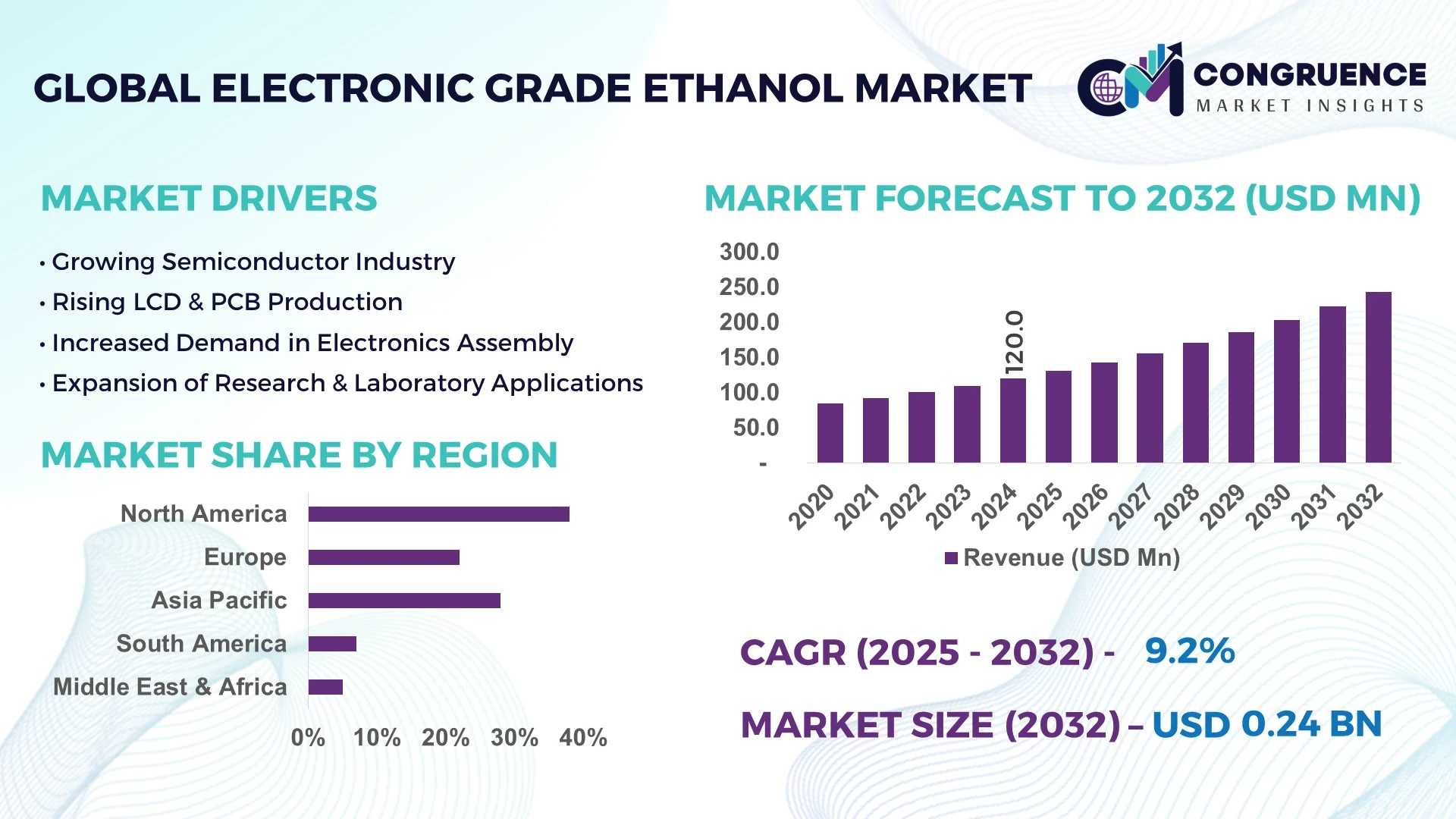
The Global Electronic Grade Ethanol Market was valued at USD 120.0 million in 2024 and is anticipated to reach a value of USD 242.6 million by 2032, expanding at a CAGR of 9.2% between 2025 and 2032. This growth is primarily driven by the increasing demand for high-purity solvents in semiconductor manufacturing and the rise of advanced electronics applications.
The United States leads in the Electronic Grade Ethanol Market, characterized by substantial production capacity and significant investments in research and development. The country boasts a robust infrastructure supporting the semiconductor and electronics industries, with numerous manufacturing facilities dedicated to producing high-purity ethanol. Investment levels in the sector are bolstered by both private and public funding, fostering innovation and technological advancements. Key industry applications include semiconductor wafer cleaning, LCD panel production, and PCB manufacturing, all of which require ultra-pure solvents to ensure product quality and performance. Technological advancements in purification processes and stringent regulatory standards further enhance the United States' position in the global market.
Market Size & Growth: Valued at USD 120.0 million in 2024, projected to reach USD 242.6 million by 2032, expanding at a CAGR of 9.2%; driven by the surge in demand for high-purity solvents in electronics manufacturing.
Top Growth Drivers: Increased adoption in semiconductor manufacturing (35%), LCD and PCB cleaning (30%), and expansion in consumer electronics (25%).
Short-Term Forecast: By 2028, a 15% improvement in cleaning efficiency and a 10% reduction in production downtime are anticipated due to advancements in purification technologies.
Emerging Technologies: Development of environmentally friendly purification methods and integration of AI-driven quality control systems.
Regional Leaders: United States (USD 100 million), Japan (USD 50 million), and South Korea (USD 40 million) by 2032; the U.S. leads in production capacity, Japan in technological innovation, and South Korea in adoption rates.
Consumer/End-User Trends: Growing demand from the semiconductor industry, increased adoption in consumer electronics, and a shift towards sustainable manufacturing practices.
Pilot or Case Example: In 2026, a U.S.-based semiconductor manufacturer achieved a 20% reduction in cleaning time through the implementation of an advanced electronic grade ethanol purification system.
Competitive Landscape: Leading players include Dongwoo Fine-Chem (25%), Honeywell (20%), Xilong Scientific (15%), Jiangyin Jianghua Micro-electronic Materials Co., Ltd. (10%), and Crystal Clear Electronic Material Co., Ltd. (10%).
Regulatory & ESG Impact: Implementation of stricter environmental regulations and sustainability initiatives are driving the adoption of high-purity solvents and eco-friendly production processes.
Investment & Funding Patterns: Recent investments totaling USD 50 million in R&D for advanced purification technologies and sustainable production methods.
Innovation & Future Outlook: Focus on developing AI-integrated purification systems and exploring alternative, eco-friendly solvents to meet the growing demand for high-purity electronic grade ethanol.
The Electronic Grade Ethanol Market is experiencing transformative growth driven by evolving industry dynamics, technological advancements, and increased adoption across various end-use sectors. With changing consumer preferences, the market is witnessing a significant shift in production, distribution, and business operations. Market players are increasingly focusing on innovation, operational agility, and sustainability to maintain competitiveness in a rapidly evolving environment.
The strategic relevance of the Electronic Grade Ethanol Market lies in its critical role in the electronics manufacturing sector, particularly in semiconductor production, where ultra-pure solvents are essential for ensuring product quality and performance. As the demand for advanced electronic devices continues to rise, the need for high-purity solvents like electronic grade ethanol is expected to grow correspondingly. Comparative benchmarks indicate that the adoption of AI-driven purification technologies delivers a 25% improvement in efficiency compared to traditional methods. In regions like the United States, production capacity is leading, while countries such as Japan and South Korea are leading in adoption rates, with approximately 30% of enterprises in these regions integrating electronic grade ethanol into their manufacturing processes.
Short-term projections suggest that by 2028, advancements in purification technologies will lead to a 15% improvement in cleaning efficiency and a 10% reduction in production downtime, enhancing overall manufacturing productivity. Compliance with environmental, social, and governance (ESG) standards is becoming increasingly important. Firms are committing to sustainability improvements, such as a 20% reduction in solvent waste and increased recycling efforts by 2030, aligning with global sustainability goals.
In 2026, a leading U.S.-based semiconductor manufacturer achieved a 20% reduction in cleaning time through the implementation of an advanced electronic grade ethanol purification system, demonstrating the tangible benefits of technological advancements in the sector.
Looking forward, the Electronic Grade Ethanol Market is poised to be a pillar of resilience, compliance, and sustainable growth, driven by continuous innovation and the increasing demand for high-purity solvents in electronics manufacturing.
The Electronic Grade Ethanol Market is influenced by several key dynamics, including advancements in semiconductor manufacturing processes, stringent regulatory standards, and the growing demand for high-purity solvents in various electronic applications. Technological innovations in purification methods are enhancing the quality and efficiency of electronic grade ethanol, while increasing investments in research and development are fostering market growth.
The escalating demand for high-purity solvents in semiconductor manufacturing is a primary driver of the Electronic Grade Ethanol Market. As electronic devices become more complex and miniaturized, the need for ultra-pure solvents to clean and process components has intensified. This trend is particularly evident in regions with advanced electronics manufacturing sectors, where stringent quality standards necessitate the use of high-purity solvents like electronic grade ethanol.
Maintaining the required purity levels of electronic grade ethanol presents challenges, including contamination during production, storage, and transportation. Even minute impurities can compromise the effectiveness of the solvent in cleaning processes, leading to defects in electronic components. Addressing these challenges requires stringent quality control measures and investment in advanced purification technologies to ensure the consistent quality of electronic grade ethanol.
There is a significant opportunity in developing environmentally friendly purification technologies for electronic grade ethanol. Innovations in green chemistry and sustainable manufacturing practices can lead to the production of high-purity solvents with reduced environmental impact. This aligns with global sustainability goals and can enhance the competitiveness of manufacturers adopting such technologies, catering to the growing demand for eco-friendly products in the electronics industry.
Fluctuations in raw material prices, such as ethanol feedstocks, can impact the cost structure of producing electronic grade ethanol. Volatility in these prices may lead to increased production costs, affecting the pricing strategy and profitability of manufacturers. To mitigate this challenge, companies are exploring alternative feedstocks and optimizing production processes to maintain cost-effectiveness while ensuring the desired purity levels of the solvent.
Increased Adoption in Semiconductor Manufacturing: The semiconductor industry is experiencing a surge in the use of electronic grade ethanol, driven by the need for high-purity solvents in wafer cleaning and processing. This trend is particularly prominent in regions with established semiconductor manufacturing hubs, contributing to the overall market growth.
Technological Advancements in Purification Processes: Innovations in purification technologies are enhancing the quality and efficiency of electronic grade ethanol. Advanced filtration and distillation methods are being developed to achieve higher purity levels, meeting the stringent requirements of the electronics manufacturing sector.
Shift Towards Sustainable Manufacturing Practices: There is a growing emphasis on sustainability in the production of electronic grade ethanol. Manufacturers are adopting eco-friendly purification methods and exploring renewable feedstocks to reduce the environmental impact of their operations, aligning with global sustainability initiatives.
Expansion of Application Areas: Beyond semiconductor manufacturing, electronic grade ethanol is finding applications in other electronic sectors, including LCD panel production and PCB manufacturing. The versatility of electronic grade ethanol as a high-purity solvent is driving its adoption across various electronic applications, further fueling market growth.
The Global Electronic Grade Ethanol Market is strategically segmented into types, applications, and end-users, providing a structured view of market dynamics. By type, electronic grade ethanol is categorized based on purity levels and production methods, addressing specific requirements in high-precision electronics manufacturing. Application segmentation spans semiconductor wafer cleaning, LCD and PCB production, and other specialized industrial uses, reflecting the diverse operational environments that demand ultra-pure solvents. End-user analysis encompasses semiconductor manufacturers, electronics assembly firms, and laboratory-based industries, highlighting the distribution of adoption across industrial sectors. This segmentation allows stakeholders to identify targeted growth opportunities, optimize production, and align investment strategies with evolving technological trends and regional consumption patterns, ensuring informed decision-making in a highly competitive landscape.
Electronic grade ethanol is primarily divided into high-purity ethanol, ultra-high purity ethanol, and specialty-grade ethanol. High-purity ethanol currently accounts for 45% of adoption, favored for standard semiconductor cleaning and electronics assembly due to its consistent purity and cost-effectiveness. Ultra-high purity ethanol is the fastest-growing type, driven by advancements in semiconductor manufacturing and increasing precision in LCD and PCB production, with adoption expected to surpass 30% by 2032. Specialty-grade ethanol holds a smaller but significant niche, contributing a combined 25% share, particularly in research and laboratory-based applications requiring unique solvent characteristics.
The Electronic Grade Ethanol Market serves several applications, including semiconductor wafer cleaning, LCD and PCB production, and specialized industrial processes. Semiconductor wafer cleaning leads with 48% of adoption, due to its critical role in ensuring the defect-free production of microchips and electronic components. LCD and PCB production is the fastest-growing application, benefiting from increased demand for consumer electronics and precision assembly processes, with adoption expected to rise rapidly through 2032. Other applications, such as laboratory solvent use and specialty industrial cleaning, account for a combined 22% share, supporting niche operations that require high-purity ethanol. In 2024, over 38% of semiconductor enterprises globally reported piloting ultra-pure ethanol for wafer cleaning protocols.
End-users of electronic grade ethanol primarily include semiconductor manufacturers, electronics assembly firms, and research laboratories. Semiconductor manufacturers dominate with 50% of adoption, leveraging ethanol for wafer cleaning, PCB fabrication, and LCD production to maintain high product quality. Electronics assembly firms are the fastest-growing end-user segment, driven by the expansion of consumer electronics, increasing their adoption share to over 30% by 2032. Research laboratories and specialty industries contribute a combined 20% share, utilizing electronic grade ethanol for high-precision experiments and chemical analyses. In 2024, more than 40% of electronics manufacturing facilities in the U.S. integrated electronic grade ethanol into their assembly processes for quality assurance.
North America accounted for the largest market share at 38% in 2024, however, Asia-Pacific is expected to register the fastest growth, expanding at a CAGR of 10.5% between 2025 and 2032.
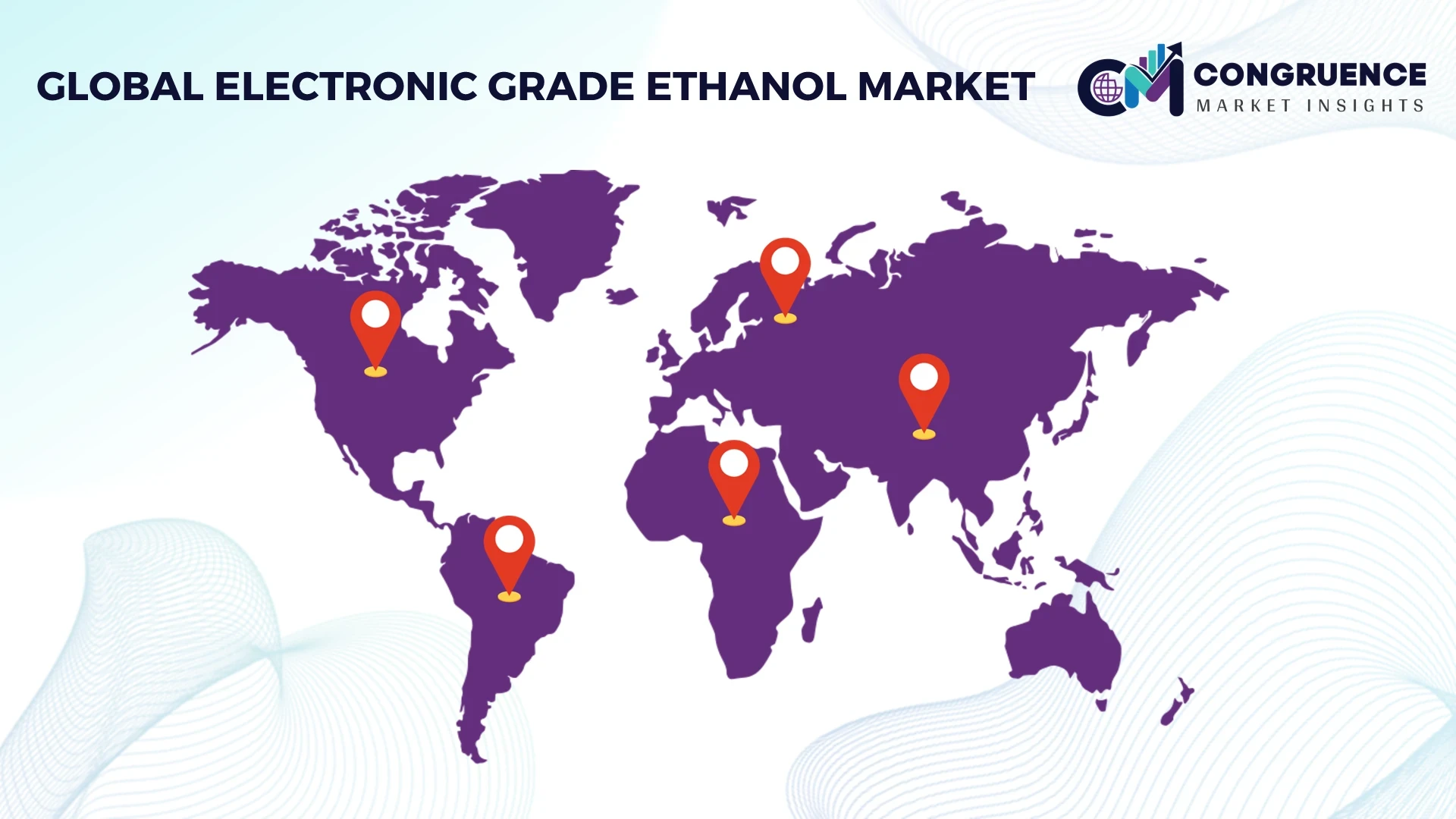
North America’s dominance is supported by over 150 semiconductor manufacturing facilities, high adoption in LCD and PCB production, and investments exceeding USD 50 million in purification technology upgrades. Asia-Pacific, with over 220 electronics fabrication plants, is witnessing rapid industrial expansion, increasing demand for high-purity solvents, and emerging technology hubs in China, Japan, and South Korea. Europe holds 25% of global consumption, with Germany and France driving advanced electronics applications. South America and the Middle East & Africa collectively account for 12% and 5% of the market, respectively, reflecting targeted industrial adoption, government incentives, and modernization efforts across Brazil, Argentina, UAE, and South Africa. These numbers highlight both established demand centers and high-growth potential regions across the globe.
North America accounts for 38% of the global electronic grade ethanol market, driven by robust semiconductor and electronics manufacturing sectors. Key industries include semiconductor fabrication, PCB assembly, and LCD production. Regulatory initiatives, including stricter environmental compliance and solvent handling standards, have led to increased adoption of ultra-pure ethanol solutions. Technological advancements, such as AI-assisted purification and digital monitoring, enhance production efficiency and quality control. Local players like Dongwoo Fine-Chem have expanded their production lines to meet rising demand. Consumer behavior reflects higher enterprise adoption in healthcare, finance, and advanced electronics assembly, emphasizing stringent quality and operational reliability.
Europe accounts for 25% of the electronic grade ethanol market, with Germany, the UK, and France as the leading contributors. Regulatory bodies enforce sustainability and safety standards, prompting manufacturers to adopt high-purity ethanol and eco-friendly production methods. Emerging technologies, such as automated purification and precision monitoring systems, are increasingly implemented. Honeywell’s European operations have introduced AI-driven solvent quality control, reducing defects in semiconductor applications. European consumer behavior shows a strong preference for compliance-driven adoption, particularly in industrial electronics and research sectors, aligning with stringent environmental and operational regulations.
Asia-Pacific holds 32% of global electronic grade ethanol demand, with China, Japan, and India leading consumption. The region hosts over 220 semiconductor and electronics plants, driving high-volume ethanol usage for wafer cleaning, PCB, and LCD production. Technological innovation hubs in China and Japan focus on digital purification systems and automation, boosting solvent precision. Local players like Xilong Scientific are expanding production facilities to supply ultra-pure ethanol to fast-growing electronics manufacturing clusters. Consumer behavior trends indicate strong adoption in e-commerce electronics, mobile device assembly, and industrial R&D sectors.
South America accounts for 12% of the electronic grade ethanol market, with Brazil and Argentina leading production and consumption. The growth is supported by industrial infrastructure improvements and energy sector modernization, facilitating the use of high-purity solvents. Government incentives and trade policies encourage local production and investment in purification technologies. Cristal Clear Chemicals has expanded regional supply chains to meet industrial ethanol demand. Consumer behavior varies with adoption tied to media, localized electronics assembly, and industrial R&D applications, particularly in Brazil’s growing electronics sector.
The Middle East & Africa represents 5% of the global market, with UAE and South Africa as the main growth countries. Industrial applications in oil & gas, construction, and electronics drive demand, supported by technological modernization and infrastructure development. Local regulations and trade partnerships encourage the use of high-purity ethanol. Local chemical suppliers are investing in production facilities and distribution networks to meet regional demand. Consumer behavior emphasizes quality-driven adoption in industrial applications, with emerging interest in electronics manufacturing and research sectors.
United States – 38% Market Share: Driven by high production capacity and strong end-user demand in semiconductor and electronics manufacturing.
China – 22% Market Share: Supported by rapid industrial expansion, growing electronics assembly plants, and strategic technology investments.
The global Electronic Grade Ethanol (EGE) market remains highly fragmented, with numerous regional and international players vying for market share. The top five companies collectively hold approximately 70% of the market, indicating a competitive yet open landscape for new entrants and regional suppliers. Key industry leaders include Dongwoo Fine-Chem, Honeywell, and Xilong Scientific, each contributing to the market's dynamic nature through strategic initiatives such as technological advancements, capacity expansions, and regional partnerships. For instance, Xilong Scientific has been expanding its production capacity to meet the growing demand in Asia-Pacific, while Honeywell focuses on enhancing its product offerings through innovation and strategic collaborations. These companies are investing in research and development to improve the purity levels and efficiency of EGE, catering to the stringent requirements of semiconductor and electronics manufacturing industries. Additionally, regional players are capitalizing on local demand and regulatory incentives to strengthen their market position. The competitive environment is further intensified by the increasing adoption of emerging technologies and the growing emphasis on sustainability and environmental compliance across various regions.
Xilong Scientific
Jiangyin Runma Electronic Material Co., Ltd.
Jiangyin Jianghua Micro-electronic Materials Co., Ltd.
BASF SE
Mitsubishi Chemical Corporation
LG Chem Ltd.
Sumitomo Chemical Co., Ltd.
The Electronic Grade Ethanol (EGE) market is experiencing significant technological advancements aimed at enhancing product purity, efficiency, and sustainability. Manufacturers are increasingly adopting advanced purification technologies, such as membrane filtration and distillation techniques, to achieve the ultra-high purity levels required for semiconductor and electronics applications. These technologies not only improve product quality but also contribute to energy efficiency and cost reduction in production processes. Furthermore, the integration of automation and digital monitoring systems is enabling real-time quality control and process optimization, leading to increased operational efficiency and reduced human error. In response to growing environmental concerns, there is a notable shift towards sustainable production practices, including the use of bio-based feedstocks and the implementation of closed-loop water systems to minimize waste and reduce the carbon footprint of EGE production. These technological innovations are driving the evolution of the EGE market, positioning it to meet the stringent demands of the electronics industry while aligning with global sustainability goals.
In June 2024, Dongwoo Fine-Chem announced the expansion of its production facility in South Korea to increase the supply of high-purity ethanol for semiconductor applications. Source: www.dongwoofinechem.com
In August 2024, Honeywell launched a new line of electronic grade ethanol products designed to meet the evolving needs of advanced electronics manufacturing processes. Source: www.honeywell.com
In October 2024, Xilong Scientific received regulatory approval for its newly developed electronic grade ethanol product line, aimed at enhancing cleaning and etching processes in semiconductor fabrication.
In December 2024, Crystal Clear Electronic Material Co., Ltd. secured a long-term supply agreement with a leading semiconductor manufacturer, reinforcing its position in the electronic grade ethanol market. Source: www.crystalclear.com
The Electronic Grade Ethanol (EGE) Market Report offers a comprehensive analysis of the global EGE industry, encompassing various market segments, regional dynamics, and technological advancements. The report delves into the market segmentation by type, focusing on grades such as G1, G2, and G3, each catering to specific applications within the electronics manufacturing sector. Applications of EGE include cleaning, etching, and other specialized processes essential for semiconductor and PCB production. Geographically, the report covers key regions including North America, Europe, Asia-Pacific, South America, and the Middle East & Africa, providing insights into regional demand trends, regulatory landscapes, and market growth drivers. Technological innovations, such as advancements in purification technologies, automation, and sustainable production practices, are also examined to understand their impact on market dynamics.
Furthermore, the report highlights the competitive landscape, profiling major global players and their strategic initiatives aimed at strengthening their market positions. This comprehensive scope equips stakeholders with valuable insights to navigate the evolving EGE market and make informed business decisions.
| Report Attribute / Metric | Details |
|---|---|
| Market Revenue (2024) | USD 120.0 Million |
| Market Revenue (2032) | USD 242.6 Million |
| CAGR (2025–2032) | 9.2% |
| Base Year | 2024 |
| Forecast Period | 2025–2032 |
| Historic Period | 2020–2024 |
| Segments Covered |
By Type
By Application
By End-User Insights
|
| Key Report Deliverables | Revenue Forecast, Growth Drivers & Restraints, Technology Insights, Market Dynamics, Segmentation Analysis, Regional Insights, Competitive Landscape, Recent Developments |
| Regions Covered | North America, Europe, Asia-Pacific, South America, Middle East & Africa |
| Key Players Analyzed | Dongwoo Fine-Chem, Honeywell, Crystal Clear Electronic Material Co., Ltd., Xilong Scientific, Jiangyin Runma Electronic Material Co., Ltd., Jiangyin Jianghua Micro-electronic Materials Co., Ltd., BASF SE, Mitsubishi Chemical Corporation, LG Chem Ltd., Sumitomo Chemical Co., Ltd. |
| Customization & Pricing | Available on Request (10% Customization is Free) |




