
Reports
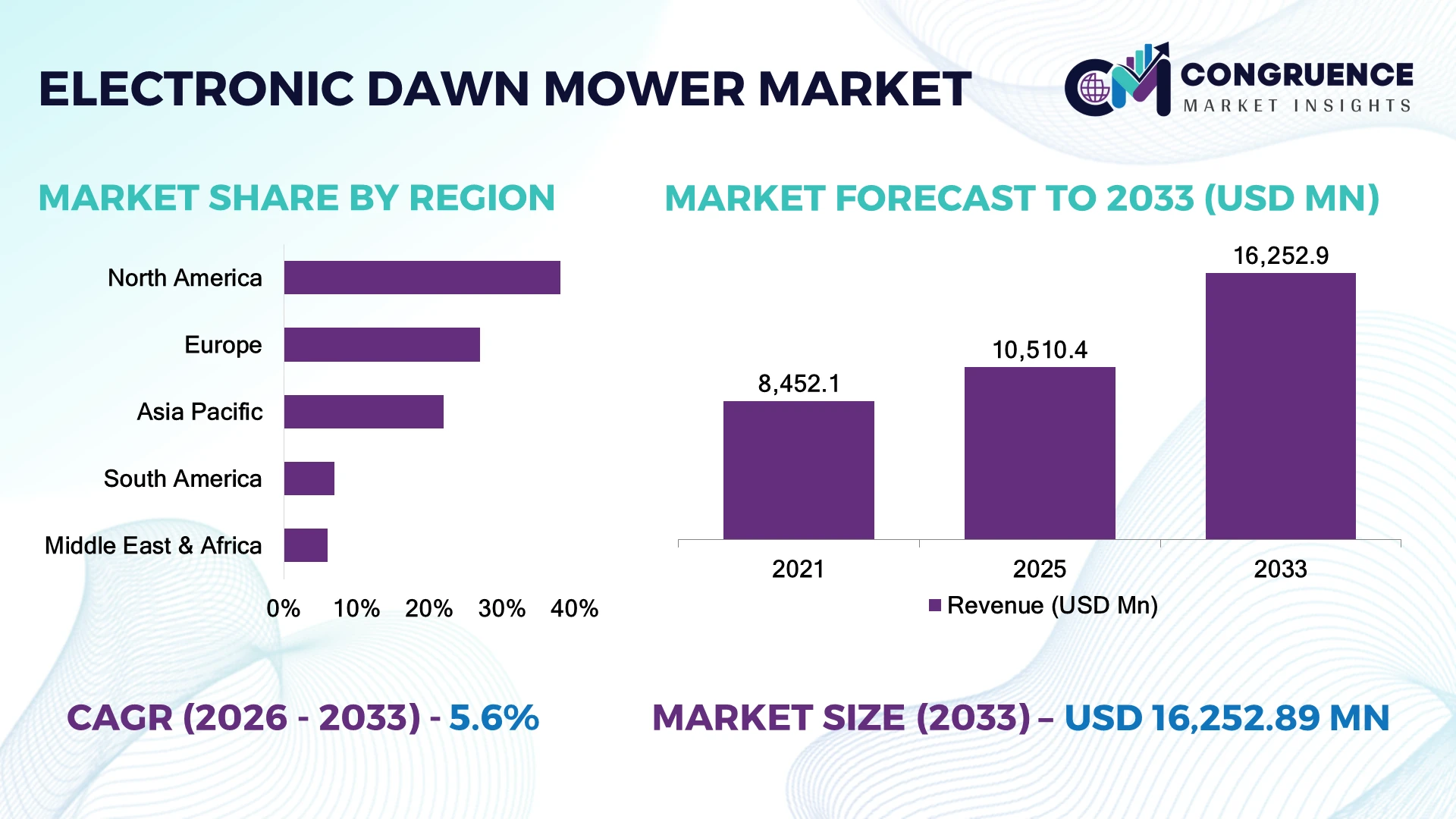
The Global Electronic Dawn Mower Market was valued at USD 10,510.4 Million in 2025 and is anticipated to reach a value of USD 16,252.9 Million by 2033 expanding at a CAGR of 5.6% between 2026 and 2033. Growth is driven by lithium-ion battery improvements, cordless equipment adoption, robotic mowing, and the replacement of gasoline-powered lawn-care equipment.
The United States remains a strategically important market, supported by residential lawn ownership, professional landscaping, and established outdoor power equipment distribution. California's zero-emission standards for most newly manufactured small off-road engines from model year 2024 strengthen the transition toward electric equipment. European markets emphasize robotic mowing, noise management, and automated garden maintenance, while Asian manufacturers benefit from established battery and motor supply chains. These differences make product pricing, battery availability, runtime, and after-sales service decisive factors in regional expansion.
Manufacturers should prioritize dependable battery performance, scalable product platforms, and service coverage to convert gasoline-mower users and capture professional landscaping demand.
Market Size & Growth: The market is valued at USD 10,510.4 million in 2025 and is projected to reach USD 16,252.9 million by 2033, supported by electrification and automated lawn maintenance.
Top Growth Drivers: Battery-powered equipment, robotic navigation, and reduced engine maintenance are reshaping demand across residential and commercial lawn-care applications.
Short-Term Forecast: By 2028, product differentiation will increasingly depend on longer usable runtime, faster charging, and battery compatibility across outdoor power tools.
Emerging Technologies: Brushless motors, lithium-ion battery systems, GPS-assisted navigation, and obstacle detection are improving electric mower capability and automation.
Regional Leaders: North America benefits from residential and commercial lawn-care demand, Europe leads in robotic mowing adoption, and Asia-Pacific offers manufacturing and component-supply advantages.
Consumer/End-User Trends: Residential buyers prioritize affordability and ease of use, while professional landscapers evaluate cutting capacity, runtime, charging logistics, and equipment uptime.
Pilot/Case Example: Robotic mower deployments on defined lawns allow operators to measure labor requirements, coverage consistency, charging interruptions, and maintenance needs before wider installation.
Competitive Landscape: Husqvarna, Deere & Company, The Toro Company, STIHL, Honda, EGO Power+, and Greenworks compete through battery performance, automation, distribution, and product breadth.
Regulatory & ESG Impact: California's small-engine rules accelerate the transition toward zero-emission outdoor equipment, encouraging manufacturers to expand compliant electric mower portfolios.
Investment & Funding: Battery platforms, robotic navigation, motor efficiency, and dealer service infrastructure are key investment areas for manufacturers seeking stronger product differentiation.
Innovation & Future Outlook: Competition is shifting from basic cutting performance toward connected automation, interchangeable batteries, dependable service, and lower lifecycle operating costs.
The electronic lawn mower market covers battery-powered walk-behind mowers, riding mowers, robotic systems, and other electric mowing equipment used in residential gardens, commercial landscaping, and managed outdoor spaces. Demand is increasingly shaped by battery performance, automated navigation, and the cost of maintaining gasoline-powered equipment. California's small-engine emissions standards add a regulatory incentive for electric alternatives, while robotic mowing is changing maintenance practices for suitable properties. Manufacturers must balance product affordability, runtime, cutting quality, and support availability to strengthen adoption across distinct customer groups.
The electronic lawn mower market is becoming strategically important as battery technology, automation, and emissions requirements reshape outdoor power equipment portfolios. Manufacturers compete on operating convenience and lifecycle value rather than cutting performance alone. California's standards for most newly manufactured small off-road engines from model year 2024 reinforce the commercial relevance of zero-emission alternatives. This transition also creates pressure to maintain affordable products for price-sensitive households and durable equipment for professional operators.
Battery-powered mowers eliminate direct exhaust emissions during operation and avoid engine-oil changes, but their economics depend on battery life, replacement costs, charging time, and workload. Robotic mowers add automation through programmable schedules and navigation, making them suitable for properties with repeatable layouts. North American buyers value residential convenience and professional productivity, while European demand is supported by established robotic mowing applications. Asian manufacturers contribute through battery, motor, and component supply capabilities.
During 2026–2028, suppliers should prioritize efficient brushless motors, battery interchangeability, improved charging workflows, and more reliable navigation. Commercial landscaping companies can begin with properties that allow predictable charging and measure labor hours, coverage, downtime, and maintenance before expanding electric fleets. Manufacturers that combine validated performance with accessible service, replacement batteries, and application-specific designs will be better positioned to secure repeat purchases and protect margins.
Battery-powered equipment is gaining strategic relevance as improvements in lithium-ion cells, brushless motors, and battery management systems strengthen the performance of electric lawn mowers. Buyers benefit from simpler routine maintenance, reduced operating noise, and the elimination of direct exhaust emissions during mowing. California's small-engine emissions standards for most newly manufactured small off-road engines from model year 2024 provide a regulatory incentive for electric alternatives. Manufacturers are responding with expanded cordless portfolios, higher-capacity battery options, and shared platforms across outdoor power tools. The key commercial advantage is platform reuse: compatible batteries and chargers can encourage repeat purchases while lowering the learning and ownership burden for customers already using cordless equipment.
Higher initial prices remain a barrier when electric mowers require separate batteries, chargers, or spare packs. Professional operators must also consider charging time, replacement cycles, and the availability of power at depots or job sites. Gasoline models remain relevant for customers who prioritize long operating shifts, rapid refueling, or lower upfront expenditure. Battery performance also varies with grass height, moisture, terrain, cutting speed, and temperature, making advertised runtime an imperfect basis for fleet planning. Manufacturers are responding through entry-level models, bundled battery kits, platform compatibility, and clearer workload guidance. The decisive restraint is total ownership cost: electric models must deliver measurable operational value rather than relying exclusively on environmental positioning.
Robotic lawn mowers create opportunities in residential gardens, corporate campuses, hotels, sports facilities, and other properties with recurring mowing requirements. GPS-assisted positioning, programmable schedules, boundary management, and obstacle detection can reduce routine manual intervention when site conditions are suitable. The strongest opportunity lies in repeatable landscapes where service providers can standardize installation and maintenance across multiple properties. Manufacturers are developing wire-free navigation and connected controls, while landscaping companies can introduce subscription-based installation, monitoring, and maintenance services. Before scaling, operators should measure coverage, labor hours, interruptions, and service visits in pilot deployments. This evidence-based approach helps suppliers target properties where automation produces practical benefits rather than overextending into unsuitable terrain.
Electric and robotic mowers must maintain consistent cutting quality across uneven ground, wet grass, slopes, dense vegetation, and changing weather. Battery runtime and cutting performance vary with workload, while robotic systems require reliable navigation and effective obstacle management. Professional fleets also need coordinated charging, replacement batteries, spare parts, and timely repairs to avoid disrupting scheduled work. Manufacturers must validate products under realistic operating conditions and provide accurate guidance on terrain limits, coverage, and maintenance. Partnerships with dealers and landscaping service providers can strengthen installation quality and repair access. Long-term competitiveness will depend on consistent field performance and dependable support, not specifications alone, especially as customers expand electric equipment across larger properties and more demanding commercial workloads.
Battery Platforms Reshape Product Selection — Manufacturers are extending shared battery systems across lawn mowers, trimmers, blowers, and other outdoor tools. This approach reduces the need for separate charging ecosystems and encourages customers to remain within one product family. Buyers increasingly compare runtime, battery replacement cost, compatibility, and cutting performance alongside the mower's purchase price. Suppliers are expanding product ranges and bundling batteries or chargers to strengthen platform loyalty and improve repeat-purchase opportunities.
Robotic Navigation Advances Beyond Boundary Wires — Robotic mower development is shifting toward satellite positioning, virtual boundaries, obstacle detection, and app-based scheduling. Wire-free systems simplify installation where site layout and signal conditions support reliable navigation. Husqvarna and other suppliers are expanding automated mower portfolios for residential and demanding landscape applications. The business impact is reduced installation complexity and more flexible lawn management, although terrain, tree cover, connectivity, and servicing requirements remain important deployment considerations.
Emission Rules Influence Equipment Portfolios — California's standards for most newly manufactured small off-road engines from model year 2024 strengthen the market relevance of zero-emission lawn-care equipment. The rules apply to new equipment and do not require owners to replace existing machines. Manufacturers are expanding electric product offerings and assessing compliance by product category and market. The resulting competitive pressure extends beyond motor design to battery supply, pricing, charging convenience, and dealer readiness.
Commercial Users Prioritize Fleet Productivity — Landscaping companies are evaluating electric mowers through runtime, cutting consistency, charging schedules, service access, and total operating cost. Battery-powered riding and walk-behind models are expanding the available choices for professional use, while robotic equipment suits properties with predictable mowing requirements. Suppliers are improving battery capacity, mower durability, and service support. The non-obvious shift is that charging logistics and spare-pack availability can determine fleet productivity as strongly as nominal motor power.
Walk-behind electric lawn mowers, including push and self-propelled models, represent the leading type, accounting for an estimated 54% of the electric lawn mower market in 2025. Their dominance reflects affordability, maneuverability, broad retail availability, and suitability for residential gardens and small commercial properties. Corded electric models retain relevance for compact lawns where uninterrupted access to power is available, while battery-powered variants offer greater mobility and compatibility with cordless tool ecosystems. Ride-on mowers serve larger properties and professional landscaping operations, where cutting width and productivity outweigh acquisition cost. Manufacturers are strengthening walk-behind portfolios through improved batteries, brushless motors, and ergonomic designs.
Robotic and autonomous mowers represent the fastest-emerging product category as buyers seek scheduled mowing, reduced manual intervention, and improved maintenance consistency. Adoption is supported by advances in navigation, obstacle detection, and wire-free installation. Robotic models remain less suitable for complex terrain and highly variable grass conditions, while ride-on electric platforms face battery-capacity and charging constraints during extended shifts. Manufacturers are increasing investment in intelligent navigation and higher-voltage systems, with premium products targeting larger lawns and commercial users. An estimated 15–20% improvement in usable runtime or task efficiency would strengthen commercial value, although outcomes depend on operating conditions and product configuration.
Residential lawn maintenance is the leading application, representing an estimated 60–65% of electric lawn mower demand. Homeowners and residential communities favor compact walk-behind equipment because it supports routine mowing without fuel handling or engine-oil changes. Battery-powered models are particularly attractive where noise, storage space, and ease of starting influence purchase decisions. Commercial landscaping is the fastest-emerging application area for higher-capacity electric and automated equipment, driven by labor constraints, recurring maintenance contracts, and growing interest in operational efficiency. Suppliers are responding with durable cutting systems, interchangeable batteries, and service arrangements tailored to professional workloads.
Sports turf maintenance and public green-space management remain strategically relevant but have different operating requirements. Sports facilities demand consistent cutting quality and careful scheduling, whereas municipal buyers prioritize equipment durability, service availability, and operating budgets. Robotic systems are most appropriate for predictable sites where terrain and access conditions support reliable navigation. Commercial adoption is increasingly evaluated through labor hours, charging downtime, coverage consistency, and maintenance costs rather than emissions benefits alone. Manufacturers are developing application-specific models and partnering with landscaping contractors to validate performance. For investors, commercial deployment offers opportunities in fleet electrification and recurring service models, while residential demand continues to provide volume and broad distribution potential.
Residential homeowners and managed residential communities constitute the leading end-user group, accounting for an estimated 65–70% of electric lawn mower demand. Their purchasing decisions are shaped by lawn size, upfront price, battery compatibility, ease of storage, and access to replacement parts. Walk-behind models dominate routine household use, while robotic mowers appeal to buyers seeking scheduled, low-intervention maintenance. Professional landscaping contractors represent an important and increasingly technology-focused customer group because equipment utilization is higher and labor productivity directly affects contract profitability. Manufacturers are responding with commercial-grade batteries, self-propelled models, larger cutting decks, and maintenance support designed for repeated daily use.
Commercial property managers, hospitality operators, sports facilities, and government agencies have more specialized purchasing requirements. These buyers evaluate equipment reliability, noise, service coverage, and the ability to maintain large or frequently used landscapes. Municipal and institutional adoption is particularly relevant where procurement policies emphasize emissions reduction and predictable operating costs. Compared with residential buyers, professional users are more likely to assess fleet-wide charging requirements, spare-battery availability, and service turnaround before switching technologies. Manufacturers are developing fleet packages, dealer partnerships, and financing options to reduce acquisition barriers. Future competitive positioning will depend on matching product configuration to operating intensity, while commercial users offer opportunities for multi-unit procurement and recurring maintenance relationships.
North America accounted for the largest market share at approximately 38% in 2025 however, Asia-Pacific is expected to register the fastest growth, expanding at an estimated CAGR of 7.1% between 2026 and 2033.

Battery-Powered Replacement and Professional Fleet Electrification Strengthen Demand
North America leads the electronic lawn mower market through established residential lawn ownership, extensive landscaping services, and broad retail distribution. The region is estimated to account for approximately 38% of global demand in 2025, with the United States representing the largest national market. Battery-powered walk-behind mowers benefit from convenient operation and expanding cordless tool ecosystems, while riding mowers address larger residential and commercial properties. California's emissions requirements for most newly manufactured small off-road engines from model year 2024 reinforce the transition toward electric equipment. Manufacturers are competing through battery compatibility, runtime, dealer coverage, and professional-grade cutting performance. The strongest commercial opportunity lies in converting gasoline-dependent users without disrupting operating schedules.
United States Market Outlook: The United States combines a large residential lawn-care base with a mature landscaping services industry and established outdoor power equipment retailers. California's regulatory direction is encouraging manufacturers to expand zero-emission product portfolios, while professional contractors increasingly assess charging logistics and fleet productivity. Suppliers that provide interchangeable batteries, accessible replacement parts, and reliable dealer servicing are better positioned to convert customers beyond early adopters. Premium demand remains linked to cutting performance, battery life, and total ownership cost.
Robotic Mowing and Environmental Compliance Reshape Product Demand
Europe represents an established market for electric and robotic lawn mowers, supported by residential garden maintenance, landscaping services, and demand for quieter equipment. The region is estimated to contribute approximately 27% of global market demand in 2025. Robotic mowers are particularly relevant for properties with predictable layouts, while cordless walk-behind models appeal to households seeking lower routine maintenance. European noise requirements and broader environmental policies influence equipment design, although affordability, garden complexity, and battery replacement costs continue to affect adoption. Manufacturers are expanding wire-free navigation, obstacle detection, and connected controls to simplify installation and improve usability. Dealer installation and maintenance capabilities remain important competitive differentiators.
Germany Market Outlook: Germany offers a strong base of garden-equipment consumers, established machinery suppliers, and technically demanding buyers. Demand is shaped by product durability, noise performance, repairability, and access to replacement parts. Robotic mowing creates opportunities for manufacturers that can deliver reliable navigation across varied garden layouts and changing weather conditions. Suppliers can strengthen positioning through dealer-led installation, software updates, and service agreements. Product reliability and clear ownership economics will remain central to wider adoption among households and professional landscaping operators.
Manufacturing Scale and Smart Garden Equipment Accelerate Market Development
Asia-Pacific is estimated to represent approximately 22% of global electronic lawn mower demand in 2025 and is positioned for the fastest expansion as battery supply chains, electric motor manufacturing, and automated garden equipment develop. China contributes manufacturing capacity across batteries, motors, electronics, and finished equipment, enabling suppliers to compete across price segments. Japan offers an established market for precision garden machinery and robotic mowing, while Australia supports demand through residential lawns and professional landscaping. Adoption remains uneven because property sizes, purchasing power, and garden-maintenance practices differ considerably. Manufacturers are expanding regional distribution and adapting products to local price points, terrain, and service requirements.
China Market Outlook: China is strategically important as both a production base and a growing market for intelligent outdoor equipment. Its established electronics and battery supply chains support component sourcing, product development, and manufacturing at different price points. Domestic and export-oriented manufacturers can use these capabilities to improve cost competitiveness and introduce connected features more quickly. The opportunity extends beyond finished mowers to motors, battery-management systems, navigation modules, and contract manufacturing. Suppliers must still address product certification, export-market requirements, and dependable after-sales support.
Residential Landscaping and Commercial Grounds Create Selective Electrification Opportunities
South America remains a developing market for electronic lawn mowers, with demand concentrated in Brazil, Argentina, Chile, and selected urban landscaping centres. The region is estimated to account for approximately 7% of global demand in 2025. Residential gardens, hospitality properties, private estates, and commercial grounds provide potential applications, but gasoline equipment remains competitive where large properties and extended operating hours require rapid refueling. Electric adoption depends on product affordability, battery availability, repair infrastructure, and access to suitable charging facilities. Importers and distributors are important in market development, while suppliers can improve adoption through localized servicing, replacement batteries, and product configurations suited to tropical grass and demanding outdoor conditions.
Brazil Market Outlook: Brazil is the region's principal opportunity because of its large domestic market, extensive landscaping needs, and established agricultural machinery and equipment distribution channels. Residential properties, hotels, commercial facilities, and institutional grounds create distinct demand for walk-behind and riding equipment. Electric models can gain traction in noise-sensitive environments and smaller managed landscapes, although battery replacement costs and service coverage remain important purchase considerations. Suppliers should build distributor relationships, maintain replacement-part availability, and offer durable models suited to local vegetation and operating conditions.
Landscaping Investment and Urban Greening Support Targeted Electric Adoption
The Middle East and Africa market is estimated to represent approximately 6% of global electronic lawn mower demand in 2025, with opportunities concentrated in the Gulf states, South Africa, and selected urban development projects. Hotels, residential compounds, sports facilities, parks, and managed commercial landscapes generate demand for reliable grounds-maintenance equipment. Large landscaping projects create opportunities for riding and robotic mowers, but heat exposure, dust, water availability, battery thermal management, and after-sales support influence equipment selection. Suppliers are positioning through professional distributors and project-based procurement. Electric equipment is most compelling where noise control, predictable maintenance schedules, and reduced on-site exhaust are operational priorities.
Saudi Arabia Market Outlook: Saudi Arabia offers opportunities through large-scale urban development, hospitality investment, public landscaping, and green-space projects associated with national transformation priorities. Managed landscapes and premium developments require dependable equipment, maintenance planning, and access to replacement components. High ambient temperatures make battery thermal protection and validated operating limits important selection criteria. Suppliers can compete through professional-grade equipment, distributor partnerships, and service arrangements for project operators. Adoption will depend on matching mower specifications to local climate, landscape design, water-management practices, and the operational requirements of each site.
Husqvarna and Deere & Company compete in premium robotic, riding, and professional mowing, while Honda is extending its established gasoline mower presence into battery-powered models. The Toro Company targets residential and commercial users; EGO Power+ and Greenworks challenge incumbents through cordless performance and value. The market remains fragmented across product categories and geographies; comparable audited global shares are unavailable, so the top five players' combined share cannot be stated reliably. Competition centres on price, runtime, cutting quality, navigation, battery compatibility, and dealer support. A 20–30% runtime advantage can strengthen premium positioning, while a 10–15% reduction in maintenance needs can improve fleet economics; these are directional comparisons, not universal measured outcomes. Husqvarna is scaling wire-free robotics and AI vision, Honda is expanding battery models, and STIGA is developing autonomous professional equipment. Competition is shifting from cutting hardware toward intelligent, service-supported platforms. Entry barriers include distribution, reliability testing, battery investment, and repair coverage. Winning requires dependable performance, accessible service, and competitive lifecycle cost.
Battery-powered mowers increasingly use lithium-ion packs, brushless motors, and electronic load control to balance cutting power with runtime. Compared with conventional brushed-motor designs, brushless systems can improve motor efficiency by approximately 5–10%, depending on operating conditions. Shared battery platforms also let customers reuse packs across compatible outdoor tools, reducing duplicate charging equipment. Adoption is strongest in residential cordless products, while commercial electrification depends on runtime, spare-battery logistics, and charging access.
Robotic mowers are progressing from boundary-wire navigation toward satellite positioning, virtual boundaries, camera-based obstacle recognition, and AI-assisted route planning. Husqvarna reported that systematic mowing can increase cutting-area capacity by 50% on compatible NERA models. Wire-free systems can reduce installation complexity, although tree cover, terrain, and signal quality affect performance. Connected controls also enable scheduling and status monitoring, giving service providers better visibility into interruptions and maintenance needs.
During 2026–2028, autonomous commercial mowers, smarter battery management, and sensor-based navigation will shape premium competition. STIGA's APX Pro, announced in March 2026, combines GPS-RTK, LiDAR, and other navigation technologies for areas up to 27,000 square metres. Husqvarna, STIGA, and specialist robotics developers benefit from this shift, while established engine-led brands face pressure to accelerate electrification. Buyers should pilot new systems against cutting quality, coverage, labour hours, safety, and service requirements before scaling deployments.
The report assesses electric lawn mowers across battery-powered walk-behind and riding mowers, robotic mowers, and other electric systems. Applications include residential lawn care, commercial landscaping, sports turf, public parks, and institutional grounds. End-user analysis distinguishes homeowners, landscaping contractors, property operators, and public-sector buyers. Regional coverage spans North America, Europe, Asia-Pacific, South America, and the Middle East and Africa, examining regulation, distribution, manufacturing, and service infrastructure.
Technology coverage includes lithium-ion batteries, brushless motors, battery management, wire-free navigation, AI vision, GPS-RTK, LiDAR, and connected fleet tools. The report compares established cordless equipment with autonomous platforms, including deployment suitability, charging logistics, maintenance, and lifecycle cost. It supports investment screening, regional expansion, supplier benchmarking, product positioning, and partnership decisions through 2033. Particular attention is given to robotic mowing and commercial electrification, where productivity, service coverage, and field reliability determine scalable adoption.
| Report Attribute/Metric | Report Details |
|---|---|
|
Market Revenue in 2025 |
USD 10,510.4 Million |
|
Market Revenue in 2033 |
USD 16,252.9 Million |
|
CAGR (2026 - 2033) |
5.6% |
|
Base Year |
2025 |
|
Forecast Period |
2026 - 2033 |
|
Historic Period |
2021 - 2025 |
|
Segments Covered |
By Type
By Application
By End-User
|
|
Key Report Deliverable |
Revenue Forecast, Growth Trends, Market Dynamics, Segmental Overview, Regional and Country-wise Analysis, Competition Landscape |
|
Region Covered |
North America, Europe, Asia-Pacific, South America, Middle East, Africa |
|
Key Players Analyzed |
Husqvarna Group, Deere & Company, The Toro Company, Honda Motor Co., Ltd., STIGA Group, Stanley Black & Decker, Techtronic Industries (TTI), Chervon, Greenworks, EGO Power+, Makita Corporation, Robert Bosch GmbH, Yamabiko Corporation, Generac Holdings |
|
Customization & Pricing |
Available on Request (10% Customization is Free) |




