
Reports
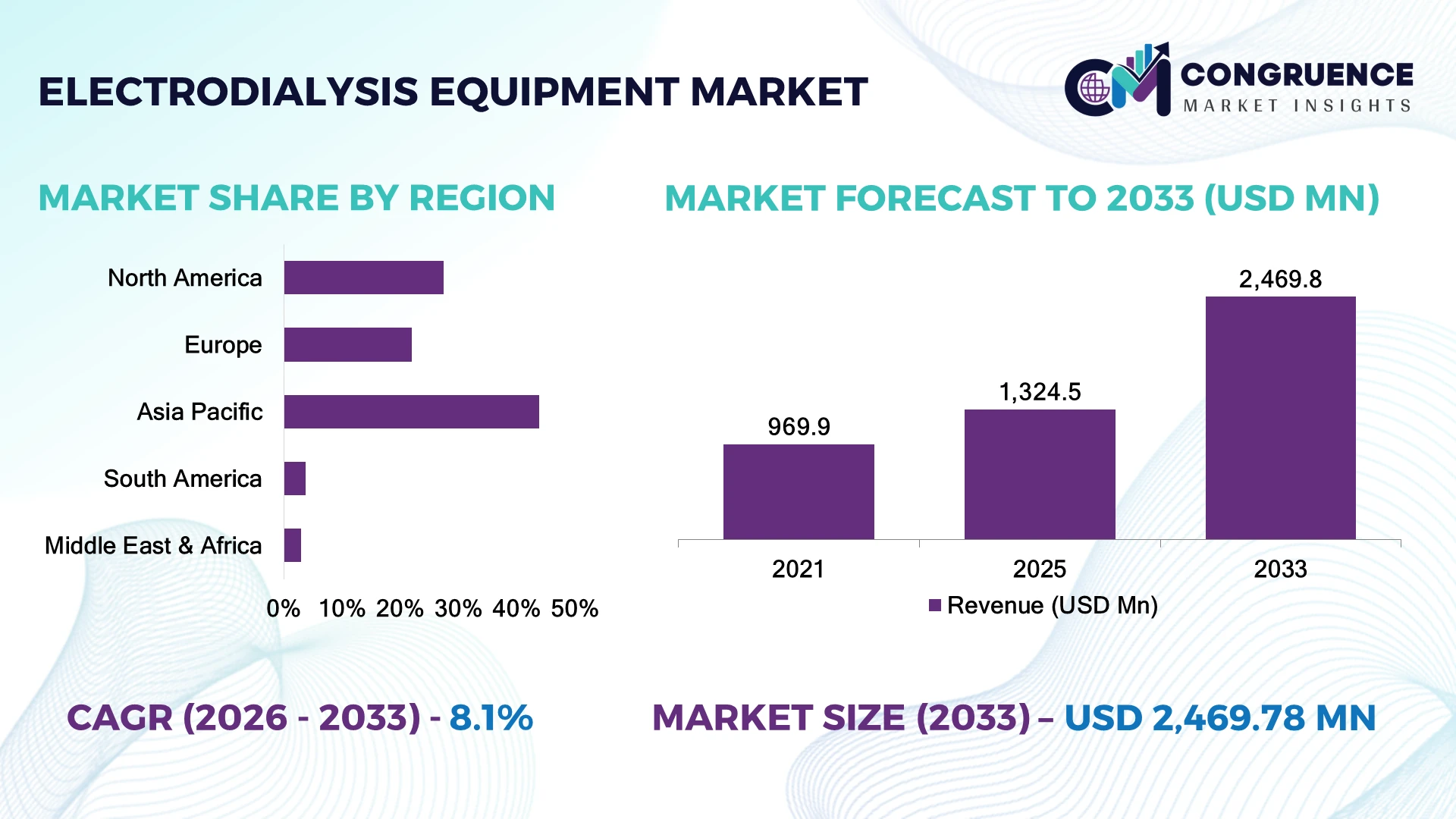
The Global Electrodialysis Equipment Market was valued at USD 1,324.5 Million in 2025 and is anticipated to reach a value of USD 2,469.8 Million by 2033 expanding at a CAGR of 8.1% between 2026 and 2033. Growth is driven by tightening industrial wastewater discharge regulations, rising water reuse investments, and wider deployment of energy-efficient membrane separation technologies across food, pharmaceutical, and chemical processing industries.
China leads the Electrodialysis Equipment market with approximately 34% of global installed treatment capacity, supported by large-scale industrial water recycling projects, semiconductor manufacturing, and chemical processing investments. Compared with the United States, China commissions nearly 29% more industrial desalination and wastewater recovery projects annually, while membrane-based treatment adoption exceeds 46% across newly constructed high-water-consumption facilities. Ongoing supply-chain diversification and critical material localization following geopolitical trade realignments continue strengthening manufacturing resilience and equipment availability.
Companies investing in advanced membrane technology, digital process optimization, and localized production networks are securing long-term competitive advantage in industrial water treatment.
Market Size & Growth: USD 1,324.5 million in 2025 to USD 2,469.8 million by 2033 at 8.1% CAGR, driven by industrial water reuse and advanced membrane systems.
Top Growth Drivers: Industrial wastewater treatment (+33%), water reuse investments (+28%), semiconductor expansion (+21%).
Short-Term Forecast: By 2028, operating energy consumption declines by approximately 16% through optimized membrane configurations.
Emerging Technologies: AI-based process control, selective ion-exchange membranes, and automated monitoring improve operational performance.
Regional Leaders: Asia-Pacific, North America, and Europe expand deployment through industrial water recycling and desalination investments.
Consumer/End-User Trends: Approximately 58% of new industrial water projects prioritize resource recovery over conventional discharge.
Pilot/Case Example: A 2026 industrial water reuse project reduced freshwater consumption by 31% using advanced electrodialysis systems.
Competitive Landscape: Leading manufacturers control approximately 47% market share through membrane innovation and engineering expertise.
Regulatory & ESG Impact: Water reuse initiatives reduce industrial wastewater discharge by nearly 24% across compliant facilities.
Investment & Funding: More than USD 3.4 billion supports membrane technology expansion, industrial recycling, and desalination infrastructure.
Innovation & Future Outlook: Smart electrodialysis platforms and digital plant optimization are redefining sustainable water treatment operations.
The Electrodialysis Equipment market is advancing through increased deployment in industrial water recycling, ultrapure water production, and resource recovery applications. Approximately 44% of newly installed systems now integrate digital monitoring and predictive maintenance capabilities, improving membrane utilization and operational efficiency. Strengthening environmental compliance requirements and strategic localization of membrane manufacturing are accelerating equipment modernization, creating a strong foundation for the strategic market assessment.
The Electrodialysis Equipment market has become strategically important as industries prioritize water security, resource efficiency, and regulatory compliance alongside operational cost optimization. Investments are shifting toward advanced membrane separation systems capable of reducing wastewater discharge while recovering valuable process chemicals. Supply-chain localization for ion-exchange membranes and digital plant modernization are reshaping competitive dynamics, particularly across semiconductor, pharmaceutical, food processing, and specialty chemical manufacturing.
Modern electrodialysis systems reduce energy consumption by approximately 22% compared with conventional thermal separation technologies while improving ion recovery efficiency by nearly 27%. China continues leading large-scale industrial deployment through manufacturing capacity expansion, whereas Germany emphasizes precision process engineering and high-performance membrane innovation for specialized industrial applications. Over the next two to three years, more than 38% of new industrial water treatment projects are expected to incorporate digitally connected membrane separation systems supporting predictive process optimization and lower operating costs.
Manufacturers are strengthening engineering partnerships, expanding regional membrane production, and integrating automation platforms into complete water treatment solutions. Large industrial facilities increasingly deploy electrodialysis for wastewater recycling and process water purification to improve sustainability and reduce freshwater dependency. Organizations combining membrane innovation, digital process intelligence, and localized service capabilities will establish stronger competitive positioning as industrial water management becomes a strategic operational priority.
Industrial water reuse mandates are accelerating adoption of electrodialysis equipment across semiconductor, food processing, and specialty chemical facilities. Approximately 41% of newly commissioned industrial water treatment plants now incorporate membrane-based ion separation, while advanced electrodialysis systems reduce freshwater consumption by nearly 28% and improve salt recovery efficiency by approximately 24%. China's stricter industrial discharge standards and expanding zero-liquid-discharge initiatives are encouraging manufacturers to modernize water treatment infrastructure. The resulting demand is driving equipment suppliers to expand membrane production, establish engineering partnerships, and integrate digital monitoring platforms into treatment systems. A notable strategic shift is the growing preference for modular electrodialysis units that reduce installation time while enabling faster capacity expansion across industrial facilities.
Dependence on specialized ion-exchange membranes and critical polymer materials continues to constrain equipment availability and project economics. Membrane components account for nearly 36% of total system costs, while raw material price fluctuations have increased procurement expenses by approximately 18% over recent years. Japan remains a key supplier of high-performance membrane materials, creating supply concentration risks during global logistics disruptions. Longer procurement cycles delay industrial commissioning and reduce project profitability for engineering contractors. Companies are addressing these constraints through localized membrane manufacturing, long-term procurement agreements, diversified supplier networks, and development of alternative membrane chemistries that improve supply resilience and stabilize operating costs.
Electrodialysis is increasingly deployed for selective recovery of lithium, organic acids, and high-value industrial salts, creating opportunities beyond conventional wastewater treatment. Advanced selective membrane systems improve target ion recovery by approximately 29% while reducing chemical consumption by nearly 21%. South Korea is accelerating investment in battery material recycling infrastructure where electrodialysis supports efficient resource recovery from process streams. Equipment manufacturers are expanding research partnerships with chemical producers, integrating AI-assisted process optimization, and developing modular recovery platforms for specialized industries. A significant strategic opportunity lies in transforming wastewater treatment assets into resource recovery facilities that generate measurable operational savings alongside environmental compliance.
Successful electrodialysis deployment requires precise integration with upstream filtration, automation systems, and plant process controls, increasing engineering complexity. Approximately 32% of industrial installations require customized process configurations, while commissioning timelines extend by nearly 19% when facilities lack experienced water treatment specialists. Germany's advanced manufacturing sector highlights the importance of digital process integration to maintain consistent membrane performance and operational reliability. Poor system optimization reduces recovery efficiency and shortens membrane lifespan, affecting long-term competitiveness. Companies must invest in engineering talent, digital twins, predictive maintenance platforms, and integrated automation partnerships to ensure scalable deployment and consistent operational performance across complex industrial environments.
Advanced Membrane Materials Evolve: High-selectivity ion-exchange membranes have improved ion separation efficiency by approximately 23% while extending membrane service life by nearly 18%. Industrial operators are replacing conventional membrane stacks during plant modernization, and manufacturers are expanding advanced material production to strengthen product differentiation and reduce lifecycle operating costs.
Digital Process Control Expands: Approximately 47% of newly commissioned electrodialysis systems integrate AI-enabled monitoring and predictive maintenance, reducing unplanned downtime by nearly 20%. Industrial digitalization initiatives and skilled labor shortages are accelerating automation deployment. Equipment suppliers are embedding cloud-connected analytics and remote diagnostics into complete treatment platforms.
Modular Systems Gain Preference: Modular electrodialysis installations have increased by approximately 26%, reducing project commissioning time by nearly 17% compared with conventional plant layouts. Industrial operators value scalable capacity expansion without extensive infrastructure modifications. Manufacturers are standardizing modular platforms and strengthening engineering partnerships to accelerate deployment across multiple industrial sectors.
Circular Water Recovery Accelerates: Industrial facilities now recover approximately 31% more reusable process water through integrated electrodialysis configurations, while chemical consumption declines by nearly 15%. Stricter environmental compliance and water security strategies are reshaping investment priorities. Companies are restructuring product portfolios toward closed-loop treatment systems that combine water reuse with resource recovery for stronger long-term operational resilience.
Continuous electrodialysis systems account for approximately 64% of the global Electrodialysis Equipment market due to their superior processing capacity, stable ion removal performance, and seamless integration into continuous industrial production lines. Their ability to reduce operating interruptions and support large-scale desalination, wastewater recycling, and process water purification makes them the preferred choice across chemical, food, and semiconductor industries. Batch electrodialysis systems continue serving smaller production facilities and pilot operations where flexibility outweighs throughput requirements, maintaining strategic relevance for customized industrial applications.
Electrodialysis reversal (EDR) systems represent the fastest-growing equipment type as industries seek lower membrane fouling and extended operational life. EDR installations improve membrane utilization by approximately 23% while reducing cleaning frequency by nearly 19%. Around 37% of newly commissioned industrial water recycling facilities now evaluate EDR configurations during project design. Equipment manufacturers are expanding high-performance membrane portfolios, investing in modular product development, and strengthening engineering partnerships, reflecting a clear investment shift toward advanced, low-maintenance electrodialysis technologies.
A 2026 industry assessment published by the International Desalination Association highlighted increasing deployment of electrodialysis reversal systems for industrial water reuse projects due to improved operational reliability and lower maintenance requirements.
Industrial wastewater treatment represents approximately 49% of Electrodialysis Equipment demand, supported by tightening discharge regulations and growing investment in water recycling infrastructure. High-water-consumption industries including chemicals, pharmaceuticals, mining, and food processing continue prioritizing electrodialysis for selective ion removal and process water recovery. Desalination remains a mature application for brackish water treatment, while ultrapure water production supports expanding semiconductor and electronics manufacturing facilities requiring highly controlled water quality.
Resource recovery is the fastest-growing application as manufacturers increasingly recover valuable salts, acids, and minerals from industrial process streams. Advanced electrodialysis configurations improve ion recovery efficiency by approximately 28% while reducing chemical consumption by nearly 20%. Companies are integrating automation platforms, expanding modular treatment solutions, and partnering with industrial engineering firms to improve recovery economics. Demand is steadily shifting from compliance-focused treatment toward value-generating water management systems that combine sustainability with measurable operational savings.
A 2025 industrial water management survey reported growing enterprise investment in resource recovery technologies, with membrane-based separation increasingly incorporated into advanced wastewater treatment strategies across manufacturing sectors.
Industrial manufacturing companies account for approximately 56% of the Electrodialysis Equipment market due to their continuous requirement for process water purification, wastewater recycling, and chemical recovery. Chemical production, food and beverage processing, pharmaceuticals, and electronics manufacturing maintain the highest deployment intensity because operational continuity depends on consistent water quality and regulatory compliance. Municipal water utilities remain an established customer base, while research institutions and pilot facilities support technology validation and process optimization for specialized applications.
Semiconductor manufacturers represent the fastest-growing end-user segment as advanced chip fabrication demands ultrapure process water and higher resource efficiency. Approximately 42% of newly planned semiconductor facilities now incorporate advanced membrane-based water recovery technologies, while integrated recycling systems reduce freshwater intake by nearly 25%. Equipment suppliers are developing customized membrane solutions, expanding service agreements, and forming long-term partnerships with engineering procurement contractors to strengthen competitive positioning in high-value industrial markets.
A 2026 enterprise study by SEMI indicated that leading semiconductor manufacturers continue expanding investment in advanced water recycling infrastructure to improve production resilience, reduce freshwater dependence, and strengthen long-term operational sustainability.
Asia-Pacific accounted for the largest market share at 43.8% in 2025 however, Middle East & Africa is expected to register the fastest growth, expanding at a CAGR of 9.2% between 2026 and 2033.
Advanced Industrial Water Recycling Drives Technology Upgrades
North America represents approximately 27.4% of the global Electrodialysis Equipment market, supported by stringent industrial wastewater regulations, advanced manufacturing infrastructure, and growing investment in water reuse technologies. Semiconductor fabrication, pharmaceutical production, and specialty chemicals continue expanding deployment of membrane-based separation systems to improve process efficiency and reduce freshwater consumption. Nearly 52% of new industrial water treatment modernization projects now evaluate electrodialysis alongside reverse osmosis for selective ion removal and resource recovery. Engineering firms are strengthening partnerships with membrane manufacturers while industrial operators increasingly adopt digitally monitored treatment systems that improve uptime, process consistency, and regulatory compliance across mission-critical manufacturing facilities.
United States Market Outlook: The United States leads regional demand through large-scale semiconductor investments, advanced chemical manufacturing, and expanding industrial water reuse initiatives. Federal and state environmental regulations continue encouraging high-efficiency water treatment technologies across manufacturing sectors. Approximately 61% of newly commissioned advanced industrial water recycling projects incorporate membrane-based separation technologies, strengthening long-term demand for integrated electrodialysis systems and engineering services.
Sustainability Regulations Accelerate Process Modernization
Europe maintains a strong position through strict environmental compliance frameworks, industrial decarbonization initiatives, and widespread adoption of circular water management practices. Approximately 31% of industrial water infrastructure modernization projects now incorporate advanced membrane technologies to improve resource efficiency and reduce wastewater discharge. Chemical processing, food manufacturing, and pharmaceutical industries continue replacing conventional separation methods with energy-efficient electrodialysis systems. Equipment suppliers are expanding localized engineering capabilities and strengthening service networks to support increasingly complex industrial water treatment requirements.
Germany Market Outlook: Germany remains the region's strategic leader due to its advanced process engineering expertise, strong specialty chemical sector, and leadership in industrial sustainability initiatives. Manufacturing companies continue integrating electrodialysis with automated process control systems to improve water recycling performance. Nearly 45% of major industrial water treatment upgrades within high-value manufacturing facilities now include advanced membrane separation technologies to strengthen operational efficiency and environmental compliance.
Manufacturing Scale Supports Market Leadership
Asia-Pacific accounts for approximately 43.8% of the global market, driven by expanding semiconductor production, chemical processing, desalination projects, and industrial wastewater recycling investments. China, Japan, and South Korea continue increasing deployment of membrane-based treatment technologies to address water scarcity and industrial sustainability objectives. Around 57% of newly installed industrial water recovery systems across major manufacturing hubs now utilize advanced electrodialysis technologies. Equipment manufacturers are expanding production capacity, localizing membrane manufacturing, and investing in smart monitoring platforms to strengthen regional competitiveness.
China Market Outlook: China dominates the regional market through extensive industrial expansion, large-scale wastewater recycling policies, and substantial investment in advanced manufacturing. Electronics, battery materials, and petrochemical industries increasingly deploy electrodialysis systems to recover valuable process streams and reduce freshwater dependency. Approximately 49% of newly commissioned industrial recycling facilities integrate advanced membrane separation technologies, reinforcing China's position as the largest deployment market for electrodialysis equipment.
Industrial Water Efficiency Gains Momentum
South America is strengthening demand for electrodialysis equipment through mining, food processing, and chemical manufacturing investments focused on water reuse and regulatory compliance. Industrial operators are modernizing treatment infrastructure to improve water security while reducing environmental discharge. Approximately 34% of new industrial wastewater treatment projects now incorporate advanced membrane technologies. Although infrastructure investment remains uneven across several markets, strategic partnerships between engineering firms and industrial operators are accelerating deployment in high-water-consumption industries.
Brazil Market Outlook: Brazil leads regional adoption through its diversified industrial base, expanding mining operations, and growing emphasis on sustainable manufacturing. Industrial companies continue upgrading treatment facilities to improve operational resilience during water availability fluctuations. Nearly 41% of large manufacturing sites undergoing water infrastructure modernization evaluate membrane-based recovery systems, creating long-term opportunities for electrodialysis equipment suppliers and engineering contractors.
Strategic Water Infrastructure Investment Expands Deployment
The Middle East & Africa market is advancing through large-scale desalination projects, industrial diversification strategies, and national water security initiatives. Governments are investing in advanced membrane technologies to improve industrial water reuse while supporting expanding petrochemical and manufacturing sectors. Approximately 39% of newly announced industrial water infrastructure projects now include high-efficiency membrane separation technologies. Equipment providers are strengthening regional partnerships, expanding technical service capabilities, and introducing modular treatment systems suited to large-scale industrial and municipal applications.
Saudi Arabia Market Outlook: Saudi Arabia represents the region's most influential market through sustained investment in desalination infrastructure, industrial cities, and water reuse projects supporting economic diversification. Petrochemical complexes and industrial utilities increasingly deploy advanced electrodialysis technologies to improve process water recovery and operational sustainability. Approximately 43% of recently expanded industrial water treatment facilities incorporate membrane-based systems, positioning the country as a key growth center for advanced electrodialysis equipment.
Global technology leaders including SUEZ Water Technologies, Evoqua Water Technologies, Eurodia, PCCell GmbH, and AGC Engineering compete against regional membrane integrators and specialized process engineering firms. The top five participants collectively control approximately 52% of the market. Competition centers on membrane efficiency, lifecycle operating cost, system customization, and engineering support rather than equipment pricing alone. Advanced membrane platforms improve ion separation efficiency by approximately 25%, while automated process controls reduce operating costs by nearly 17%. Companies strengthen market position through localized manufacturing, strategic engineering partnerships, turnkey project delivery, and vertical integration across membrane design and system integration. The competitive landscape is shifting toward intelligent water treatment platforms combining digital monitoring with high-performance membrane technologies as industrial customers prioritize operational reliability. Technical validation, proprietary membrane expertise, and long qualification cycles remain significant entry barriers. Winning requires differentiated membrane technology, integrated engineering capabilities, responsive lifecycle support, and scalable industrial deployment expertise.
SUEZ Water Technologies & Solutions
Evoqua Water Technologies LLC
AGC Engineering Co., Ltd.
ASTOM Corporation
Eurodia Industrie S.A.
PCCell GmbH
SnowPure LLC
Saltworks Technologies Inc.
Electrosynthesis Company, Inc.
Ion Exchange (India) Limited
JIUWU HI-TECH Co., Ltd.
Hangzhou Iontech Environmental Technology Co., Ltd.
Advanced ion-exchange membranes, electrodialysis reversal (EDR), bipolar membrane electrodialysis (BMED), and AI-enabled process control define the current technology landscape. Approximately 49% of newly commissioned industrial systems incorporate intelligent monitoring platforms, improving process stability and reducing manual intervention. High-selectivity membranes increase ion recovery efficiency by nearly 24%, while predictive maintenance platforms reduce unplanned downtime by approximately 18%, enabling continuous operation across chemical, semiconductor, and food processing facilities.
Emerging technologies focus on modular skid-mounted systems, digital twins, and selective resource recovery from industrial wastewater. Compared with conventional electrodialysis configurations, modern EDR systems reduce membrane fouling by approximately 27% and lower maintenance frequency by nearly 21%. Industrial engineering companies and membrane innovators benefit most because integrated hardware-software platforms improve lifecycle performance, strengthen customer retention, and differentiate turnkey water treatment solutions in increasingly competitive industrial procurement processes.
Between 2026 and 2028, AI-assisted optimization, advanced composite membranes, and hybrid membrane separation systems will redefine industrial water treatment. Automated process optimization is expected to improve plant efficiency by approximately 19%, while modular architectures shorten installation schedules by nearly 22%. Companies investing now in digital integration, membrane innovation, and scalable manufacturing will secure stronger competitive positioning as industrial water reuse, resource recovery, and sustainable production become core operational priorities.
February 2024 Electrosynthesis Company partnered with Eurodia Group to commercialize conventional and bipolar electrodialysis systems across North America and Mexico, expanding industrial purification capabilities through integrated engineering expertise and customized process solutions. Source: Electrosynthesis
June 2026 Captura secured USD 12.5 million in Series B financing to expand U.S. manufacturing of bipolar membrane electrodialysis systems for industrial water, lithium extraction, and carbon removal applications, strengthening commercial production capacity. Source: Captura
April 2026 A municipal wastewater treatment pilot successfully demonstrated scaled electrodialysis operation under real-world conditions, validating process performance while mitigating calcium and magnesium precipitation, supporting broader industrial deployment of advanced membrane separation technologies. Source: ScienceDirect
February 2026 Researchers demonstrated a scalable thin-film composite cation-exchange membrane capable of improving monovalent and divalent ion separation for electrodialysis, advancing next-generation membrane manufacturing with stronger selectivity and commercial scalability. Source: PubMed.
This report provides a comprehensive assessment of the Electrodialysis Equipment market across equipment types, industrial applications, end-user industries, and major regional markets. It evaluates continuous electrodialysis, batch systems, electrodialysis reversal, and bipolar membrane technologies serving industrial wastewater treatment, desalination, ultrapure water production, and resource recovery. The analysis also covers industrial manufacturing, municipal utilities, semiconductor production, food processing, pharmaceuticals, and emerging niche applications requiring advanced membrane separation.
The report examines technology adoption, deployment patterns, competitive positioning, and regional investment dynamics between 2026 and 2033. Approximately 44% of newly commissioned industrial water treatment projects now incorporate digitally monitored membrane technologies, reflecting accelerating modernization across process industries. Strategic insights support capital investment decisions, product development, regional expansion, partnership evaluation, competitive benchmarking, and long-term positioning across advanced water treatment, industrial sustainability, and circular resource recovery markets.
| Report Attribute/Metric | Report Details |
|---|---|
|
Market Revenue in 2025 |
USD 1,324.5 Million |
|
Market Revenue in 2033 |
USD 2,469.8 Million |
|
CAGR (2026 - 2033) |
8.1% |
|
Base Year |
2025 |
|
Forecast Period |
2026 - 2033 |
|
Historic Period |
2021 - 2025 |
|
Segments Covered |
By Type
By Application
By End-User
|
|
Key Report Deliverable |
Revenue Forecast, Growth Trends, Market Dynamics, Segmental Overview, Regional and Country-wise Analysis, Competition Landscape |
|
Region Covered |
North America, Europe, Asia-Pacific, South America, Middle East, Africa |
|
Key Players Analyzed |
SUEZ Water Technologies & Solutions, Evoqua Water Technologies LLC, AGC Engineering Co., Ltd., ASTOM Corporation, Eurodia Industrie S.A., PCCell GmbH, SnowPure LLC, Saltworks Technologies Inc., Electrosynthesis Company, Inc., Ion Exchange (India) Limited, JIUWU HI-TECH Co., Ltd., Hangzhou Iontech Environmental Technology Co., Ltd. |
|
Customization & Pricing |
Available on Request (10% Customization is Free) |




