
Reports
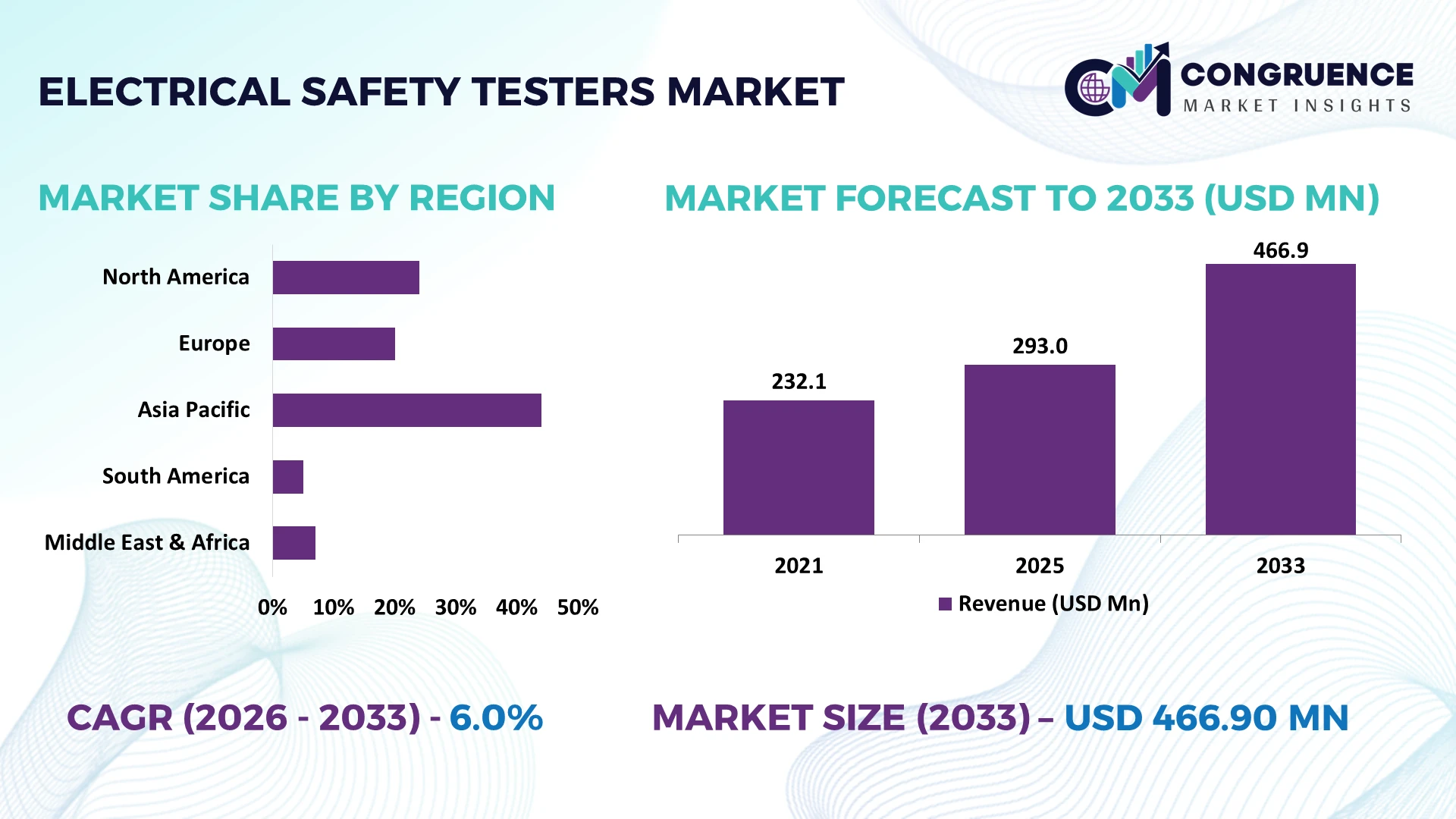
The Global Electrical Safety Testers Market was valued at USD 293 Million in 2025 and is anticipated to reach a value of USD 466.9 Million by 2033 expanding at a CAGR of 6% between 2026 and 2033. Growth is being accelerated by stricter electrical compliance standards, expanding EV and electronics manufacturing, and higher investment in automated production quality assurance across industrial facilities.
China commands approximately 31% of global manufacturing capacity for electrical safety testers, supported by large-scale electronics, automotive, and industrial equipment production, while Germany accounts for nearly 18% of advanced industrial testing deployments through Industry 4.0 integration. Following supply-chain diversification after Red Sea shipping disruptions, manufacturers increased regional production flexibility, with automated testing adoption improving production-line inspection efficiency by around 27% across leading facilities during 2026.
Manufacturers prioritizing automation-ready, digitally connected electrical safety testers in Asia-Pacific and Europe are positioned to strengthen compliance performance, shorten validation cycles, and improve competitive positioning in high-value industrial supply chains.
Market Size & Growth: USD 293 Million in 2025 is projected to reach USD 466.9 Million by 2033 at a 6% CAGR, supported by automated electrical compliance testing across electronics and EV manufacturing.
Top Growth Drivers: Automated testing adoption (+24%), EV production expansion (+19%), and stricter workplace electrical compliance (+17%) continue accelerating market demand.
Short-Term Forecast: By 2028, automated testing workflows reduce inspection time by approximately 28% while improving production efficiency by nearly 22%.
Emerging Technologies: AI-assisted diagnostics, cloud-connected reporting, and automated multi-function testers improve testing accuracy by about 30% and reduce manual intervention.
Regional Leaders: Asia-Pacific exceeds USD 185 Million through manufacturing expansion, North America approaches USD 118 Million with digital compliance adoption, and Europe surpasses USD 103 Million through industrial modernization.
Consumer/End-User Trends: More than 61% of industrial manufacturers are integrating connected electrical safety testing into predictive maintenance and digital quality programs.
Pilot/Case Example: In 2026, an automated electronics production deployment reduced final inspection defects by 21% while increasing testing throughput by 26%.
Competitive Landscape: The leading supplier holds approximately 16% market share, with competition driven by several established global testing equipment manufacturers focused on automation and precision.
Regulatory & ESG Impact: Digital compliance documentation reduces paper-based reporting by around 40% while supporting faster audit readiness under evolving international safety requirements.
Investment & Funding: More than USD 420 Million in manufacturing expansion, automation partnerships, and product development strengthens regional production amid ongoing supply-chain diversification.
Innovation & Future Outlook: Next-generation IoT-enabled testers, predictive analytics, and integrated software platforms accelerate enterprise-wide electrical safety management and support high-growth industrial digitalization.
Electrical Safety Testers Market demand continues expanding across electronics manufacturing, automotive production, renewable energy installations, and industrial maintenance where automated compliance verification improves operational reliability. AI-enabled diagnostics and cloud-based reporting platforms now support approximately 35% faster documentation workflows, while manufacturers increasingly regionalize production to strengthen supply-chain resilience under evolving regulatory requirements. These developments establish a strong foundation for the following strategic market assessment.
Electrical safety testers have become strategically important as manufacturers prioritize compliance, digital quality assurance, and resilient production networks. Growing investment in electronics, electric vehicles, medical devices, and industrial automation is reshaping procurement priorities, while supply-chain restructuring encourages localized testing capabilities to reduce production delays. Regulatory modernization and factory digitalization are shifting electrical safety testing from a periodic inspection function to an integrated production-stage quality process, strengthening operational competitiveness and reducing product certification timelines.
Modern automated electrical safety testers complete multi-parameter inspections approximately 32% faster than conventional standalone systems while reducing manual reporting effort by nearly 38% through integrated software and cloud-enabled documentation. China continues expanding large-scale manufacturing deployments, whereas Germany emphasizes high-precision automated validation for advanced industrial equipment and export-oriented production. Over the next two to three years, connected testing platforms are expected to exceed 55% deployment among newly commissioned automated manufacturing lines, supported by increasing adoption of predictive maintenance and digital compliance management.
A leading electronics manufacturer deploying network-connected electrical safety testers across multiple assembly facilities reduced inspection bottlenecks while improving traceability and audit readiness. In response, suppliers are expanding software capabilities, forming automation partnerships, and strengthening localized service networks to support multinational customers. Companies combining intelligent testing, regulatory compliance expertise, and digital integration will secure stronger competitive positioning through higher operational efficiency, faster certification workflows, and long-term manufacturing resilience.
Industrial automation and stricter electrical safety verification requirements continue accelerating demand for advanced electrical safety testers across production environments. Nearly 63% of large electronics manufacturers are integrating automated testing into quality control workflows, while digital inspection systems improve testing throughput by approximately 28% and reduce manual verification errors by about 24%. India's expanding electronics manufacturing initiatives and increasing domestic production of electrical equipment are encouraging broader investment in automated compliance infrastructure. As product complexity increases, manufacturers are responding through expanded production capacity, collaborative automation partnerships, and software-enabled testing platforms. A notable strategic shift is the integration of testing data into enterprise quality management systems, allowing faster corrective actions, improved traceability, and stronger operational consistency across distributed manufacturing facilities.
High-performance electrical safety testers depend on specialized measurement electronics, precision components, and certified calibration systems, creating operational constraints when supply availability fluctuates. Lead times for selected electronic components remain approximately 18% longer than pre-disruption levels, while integration expenses increase project implementation costs by nearly 15% for complex manufacturing environments. Japan and several European manufacturers continue facing procurement challenges for specialized testing modules supporting high-accuracy industrial applications. These structural limitations delay production expansion, reduce deployment flexibility, and pressure operating margins. Companies are responding by localizing component sourcing, securing long-term supplier agreements, standardizing hardware architectures, and redesigning products around interchangeable modules that improve procurement flexibility and reduce dependency on single-source suppliers.
The rapid adoption of intelligent manufacturing creates significant opportunities for connected electrical safety testing platforms capable of supporting predictive quality management. AI-assisted diagnostics improve fault identification accuracy by approximately 29%, while cloud-enabled reporting reduces compliance documentation time by nearly 34%. South Korea's advanced electronics manufacturing ecosystem is increasingly adopting smart factory architectures that integrate testing equipment directly with production execution systems. Equipment manufacturers are investing in embedded analytics, remote diagnostics, and open communication protocols while expanding partnerships with industrial automation providers. A less obvious opportunity lies in subscription-based software services for compliance management, enabling recurring revenue streams alongside hardware sales while strengthening long-term customer retention and operational visibility.
Expanding intelligent electrical safety testing across multi-site manufacturing operations introduces significant execution complexity beyond hardware deployment. Approximately 41% of industrial facilities continue operating mixed-generation equipment, while cybersecurity investment associated with connected testing infrastructure has increased by nearly 22% as factories digitize critical operations. Germany's advanced manufacturing sector illustrates the challenge of integrating legacy production assets with modern industrial communication standards without disrupting productivity. Inconsistent data formats, workforce capability gaps, and evolving cybersecurity requirements complicate enterprise-wide deployment. Companies must strengthen software interoperability, invest in workforce training, expand secure industrial networking, and collaborate with automation partners to maintain reliable testing performance while ensuring scalable digital compliance across increasingly connected manufacturing environments.
Connected Testing Ecosystems Expand Electrical safety testers are increasingly deployed as connected assets within smart factories, with nearly 58% of newly installed industrial systems supporting Ethernet or cloud-enabled data exchange. Digital workflow integration shortens compliance reporting by approximately 33% while improving equipment traceability by around 27%. Japanese manufacturers are linking testing platforms with manufacturing execution systems to reduce manual intervention, prompting suppliers to strengthen software partnerships and develop centralized lifecycle management capabilities.
Automation Reshapes Inspection Workflows Automated multi-station electrical safety testing has reduced production inspection time by nearly 30% and improved first-pass testing consistency by approximately 24% across high-volume electronics facilities. Labor shortages and expanding production capacity are accelerating automated deployment, particularly in South Korea. Equipment vendors are redesigning platforms with robotic interfaces, modular fixtures, and adaptive testing software that supports rapid product changeovers without disrupting manufacturing throughput.
Compliance Software Gains Priority Regulatory updates and expanding audit requirements are driving digital compliance management, with more than 54% of industrial manufacturers replacing paper-based documentation with automated reporting platforms. Electronic certification workflows reduce administrative effort by about 35% while improving audit readiness. Companies are responding by integrating encrypted reporting, remote calibration management, and standardized compliance databases into electrical safety testers to strengthen operational transparency across geographically distributed manufacturing sites.
Localized Manufacturing Strategies Accelerate Continued supply-chain restructuring has encouraged manufacturers to diversify production footprints, reducing single-country sourcing exposure by nearly 22%. India and Vietnam are attracting additional electronics manufacturing investments, increasing demand for localized testing infrastructure and faster equipment commissioning. Suppliers are expanding regional calibration centers, strengthening distributor partnerships, and introducing configurable testing platforms that support localized certification requirements while shortening customer implementation timelines.
Automatic electrical safety testers represent the leading segment with an estimated 39% market share, driven by their ability to deliver high-throughput inspection, repeatable testing accuracy, and seamless integration with automated production lines. Their adoption is strongest across electronics, automotive, and industrial equipment manufacturing where continuous testing minimizes production interruptions. Portable testers remain indispensable for field servicing and maintenance due to operational flexibility, while benchtop systems continue serving laboratories and precision validation environments requiring controlled testing conditions.
Multi-Function electrical safety testers are emerging as the fastest-growing segment as manufacturers increasingly prefer consolidated platforms capable of performing multiple electrical verification procedures within a single workflow. Deployment of integrated multi-function systems has improved technician productivity by approximately 29% while reducing equipment footprint by nearly 20%. Manufacturers are expanding modular product portfolios, investing in software-enabled diagnostics, and strengthening automation partnerships to address rising enterprise demand. Investment priorities increasingly favor scalable testing platforms that combine operational flexibility with digital connectivity, reflecting a shift from single-purpose equipment toward intelligent inspection ecosystems.
Production Testing accounts for approximately 41% of total demand, reflecting its critical role in verifying electrical safety before products leave manufacturing facilities. High-volume electronics and automotive production depend on continuous testing to reduce defect rates, improve traceability, and maintain regulatory compliance. Compliance Testing is the fastest-growing application as manufacturers respond to evolving international certification requirements and increasingly digital audit processes. Automated compliance documentation reduces reporting time by nearly 34%, strengthening operational efficiency across multi-site manufacturing environments.
Quality Inspection continues supporting precision validation during manufacturing, while Equipment Maintenance is gaining importance through predictive maintenance strategies that reduce unexpected downtime. Nearly 57% of large manufacturing facilities now integrate electrical safety testing with broader quality management systems, improving corrective action speed and equipment reliability. Suppliers are expanding software integration, deploying automated inspection workflows, and introducing configurable testing platforms tailored to diverse production environments. The market increasingly favors applications that combine regulatory assurance with operational intelligence, making integrated production testing a strategic competitive advantage.
Manufacturing remains the largest end-user segment with an estimated 38% market share, supported by extensive deployment across automotive, industrial machinery, consumer appliances, and electrical equipment production. Large-scale factories require continuous electrical safety verification to maintain product quality and certification readiness. Electronics represents the fastest-growing end-user segment as semiconductor devices, communication equipment, and consumer electronics become more complex, increasing demand for precision testing and automated inspection. Testing automation has improved production efficiency by approximately 26% while reducing manual verification requirements by around 23%.
Healthcare continues investing in advanced electrical safety testing for medical equipment reliability, while Energy & Utilities require testing platforms for power infrastructure maintenance and asset reliability. Aerospace & Defense prioritizes high-precision validation to satisfy stringent operational standards. Equipment suppliers are responding through customized product configurations, industry-specific software, strategic partnerships, and localized service capabilities that address sector-specific compliance requirements. Future demand is increasingly concentrated among industries requiring digital quality assurance, operational resilience, and scalable automated testing across distributed production environments.
Asia-Pacific accounted for the largest market share at 42% in 2025 however, North America is expected to register the fastest growth, expanding at a CAGR of 6.8% between 2026 and 2033.
Digital Compliance and Smart Factory Integration Accelerate Deployment
North America represents a highly advanced market for electrical safety testers, supported by extensive adoption across electronics, aerospace, medical devices, and industrial manufacturing. The region contributes approximately 28% of global demand through continuous investment in automated quality assurance and connected production systems. More than 62% of large manufacturing facilities have integrated digital inspection workflows into production operations, improving audit readiness and reducing manual testing cycles. Increased reshoring of electronics manufacturing and modernization of industrial facilities continue driving equipment upgrades. Equipment suppliers are strengthening calibration networks, expanding software capabilities, and forming automation partnerships to deliver integrated compliance solutions that reduce operational complexity while supporting enterprise-wide quality management.
United States Market Outlook: The United States leads the regional market through its strong electronics, aerospace, defense, and medical device manufacturing ecosystem. More than 65% of advanced production facilities utilize automated electrical safety verification within digital quality programs. Continued investment in semiconductor manufacturing, industrial automation, and smart factory deployment is encouraging adoption of intelligent testing platforms. Manufacturers are prioritizing integrated software, predictive diagnostics, and localized service capabilities to strengthen production efficiency and regulatory compliance.
Industrial Modernization Strengthens Compliance Infrastructure
Europe maintains a strong position through advanced industrial engineering, strict electrical safety standards, and widespread digital manufacturing adoption. The region accounts for approximately 24% of global market activity, with demand concentrated across industrial equipment, automotive production, and precision manufacturing. Around 57% of newly upgraded manufacturing facilities now integrate connected electrical testing systems into production quality management. Sustainability-focused factory modernization and digital compliance initiatives continue accelerating equipment replacement cycles. Companies are expanding automation partnerships and investing in software-enabled testing platforms that improve traceability while supporting evolving regulatory requirements across cross-border manufacturing operations.
Germany Market Outlook: Germany remains the strategic center of Europe's electrical safety testers market because of its advanced industrial automation capabilities and globally competitive machinery sector. More than 60% of large manufacturing plants have implemented Industry 4.0-enabled quality inspection systems incorporating automated electrical safety verification. Domestic equipment suppliers continue investing in precision testing technologies, intelligent software integration, and collaborative automation solutions that improve production consistency and export competitiveness.
Manufacturing Scale Drives Market Leadership
Asia-Pacific dominates the global electrical safety testers market through its unmatched manufacturing capacity, expanding electronics production, and continuous investment in industrial automation. The region accounts for approximately 42% of global demand, supported by large-scale production of consumer electronics, automotive components, and electrical equipment. Automated testing deployment across major manufacturing facilities has increased by nearly 31% during recent factory modernization initiatives. Government-backed manufacturing expansion, export-oriented production, and growing semiconductor investments continue strengthening equipment demand. Suppliers are expanding regional manufacturing, localization strategies, and technical support capabilities to shorten delivery timelines and improve customer responsiveness.
China Market Outlook: China remains the largest individual market because of its extensive electronics manufacturing base, industrial equipment production, and integrated supply chain ecosystem. The country represents nearly one-third of worldwide production capacity for electrical testing equipment and related manufacturing infrastructure. Continuous investment in smart factories, EV production, and advanced industrial automation encourages rapid deployment of network-connected testing systems. Domestic manufacturers are expanding product portfolios while strengthening export competitiveness through intelligent testing technologies.
Industrial Expansion Supports Targeted Adoption
South America continues expanding demand through industrial modernization, mining operations, energy infrastructure, and growing manufacturing investments. The region contributes approximately 5% of global market activity, with Brazil representing the largest deployment center. Nearly 26% of industrial equipment upgrades now include automated electrical safety verification to improve operational reliability and regulatory compliance. Infrastructure investment and localized manufacturing initiatives are supporting gradual market expansion despite logistics and procurement challenges. Equipment suppliers are strengthening regional distribution partnerships, expanding calibration services, and introducing application-specific testing platforms tailored for industrial users.
Brazil Market Outlook: Brazil leads regional adoption through its diversified industrial economy, electrical equipment manufacturing, automotive production, and expanding utility infrastructure. Modernization of industrial plants has increased demand for automated compliance verification, while large manufacturing enterprises continue integrating digital quality systems into production workflows. Companies are investing in technician training, regional service capabilities, and localized maintenance support to improve operational uptime and strengthen long-term customer engagement.
Infrastructure Investment Accelerates Industrial Testing
The Middle East & Africa market is strengthening through industrial diversification, energy infrastructure expansion, and large-scale construction projects requiring reliable electrical safety verification. The region contributes approximately 4% of global demand while increasing deployment across utilities, manufacturing, and oil and gas operations. More than 29% of recently commissioned industrial facilities have incorporated advanced electrical testing systems into operational safety programs. Government-backed industrial modernization initiatives and expanding industrial zones continue encouraging investment in digital compliance technologies. Suppliers are increasing regional partnerships, technical training, and after-sales support to improve implementation efficiency and equipment reliability.
Saudi Arabia Market Outlook: Saudi Arabia represents the region's strongest market through ongoing industrial diversification, energy infrastructure expansion, and advanced manufacturing initiatives. Large industrial projects increasingly specify automated electrical safety testing as part of integrated operational safety frameworks. Growing investment in smart industrial zones, electrical infrastructure, and digital manufacturing supports higher deployment of intelligent testing systems. Equipment providers are expanding local partnerships, calibration capabilities, and technical service networks to strengthen long-term market presence.
Competition is led by GW Instek, Seaward Electronic, Associated Research, Chroma ATE, and OMICRON, while regional manufacturers compete aggressively on cost and localized service. The top five participants collectively control approximately 48% of market activity, with competition centered on automation capability, software integration, calibration accuracy, and delivery speed rather than price alone. Premium suppliers improve testing throughput by nearly 25% through intelligent automation, while modular product designs reduce customer integration costs by approximately 18%. Regional manufacturers challenge global leaders through faster customization and localized technical support. Companies increasingly expand through automation partnerships, digital compliance software, regional calibration centers, and selective vertical integration to strengthen supply resilience. Intelligent connected testing platforms are reshaping purchasing decisions faster than traditional hardware upgrades, accelerating technology-based differentiation. High certification requirements, precision engineering expertise, and software interoperability remain significant entry barriers. Sustainable competitive advantage depends on integrated digital ecosystems, dependable service infrastructure, and continuous product innovation.
Associated Research
Chroma ATE Inc.
GW Instek
Seaward Electronic Ltd.
OMICRON electronics GmbH
Ikonix USA
Vitrek Corporation
HIOKI E.E. Corporation
Megger Group
Kikusui Electronics Corporation
Fluke Corporation
Sefelec
GMC Instruments
EXTECH Instruments
Electrical safety testers are rapidly evolving from standalone inspection devices into intelligent, network-connected quality assurance platforms. Automated hipot, insulation resistance, leakage current, and ground bond testing integrated with Manufacturing Execution Systems improves testing efficiency by approximately 28% while reducing manual documentation effort by nearly 35%. Around 59% of newly deployed industrial testing stations now support Ethernet or cloud connectivity, enabling centralized compliance management and predictive calibration scheduling. These capabilities strengthen production consistency, accelerate certification workflows, and reduce quality-related downtime across electronics, medical device, and industrial manufacturing operations.
Emerging technologies including AI-assisted fault classification, digital twin validation, and IoT-enabled remote diagnostics are reshaping operational performance. AI-based analytics improve defect identification accuracy by approximately 24%, while predictive calibration lowers unexpected equipment downtime by nearly 18%. Compared with conventional standalone testers, intelligent multi-function platforms complete integrated electrical verification approximately 31% faster, allowing manufacturers to increase throughput without expanding testing infrastructure. Companies with advanced software ecosystems gain a competitive advantage by delivering faster implementation, seamless enterprise integration, and lifecycle-based service offerings.
Between 2026 and 2028, edge computing, cybersecurity-enabled testing architectures, and interoperable industrial communication protocols will become strategic differentiators. More than 64% of newly commissioned automated production lines are expected to prioritize digitally integrated electrical safety verification. Equipment manufacturers investing in modular hardware, cloud-based compliance platforms, and AI-enabled diagnostics will strengthen customer retention, while slower adopters risk longer deployment cycles, reduced operational visibility, and weaker positioning within increasingly automated global manufacturing supply chains.
September 2025 Seaward Electronic launched PATGuard Cloud, introducing a fully cloud-based platform for portable appliance testing data management that improves multi-site accessibility and supports 100% browser-based deployment, strengthening digital compliance workflows for enterprise users. Source: seaward.com
July 2025 GW Instek unveiled an expanded smart measurement portfolio featuring new digital multimeters and data acquisition systems capable of reducing industrial testing time by up to 50%, improving manufacturing efficiency for semiconductor, EV, and AI server production. Source: gwinstek.com
April 2026 Seaward Electronic expanded its PV:1525 Series with integrated IV curve tracing for 1500 V DC photovoltaic systems, combining electrical commissioning and performance analysis in one platform, improving field testing efficiency through a unified workflow. Source: seaward.com
April 2026 NSF expanded its food equipment certification portfolio to include electrical safety testing, enabling manufacturers to consolidate compliance processes under a single certification framework and streamline pre-market product qualification activities.
The report provides comprehensive analysis across portable, benchtop, automatic, and multi-function electrical safety testers, covering production testing, quality inspection, equipment maintenance, and compliance testing applications. It evaluates demand across manufacturing, electronics, healthcare, energy & utilities, and aerospace & defense while assessing adoption trends across North America, Europe, Asia-Pacific, South America, and the Middle East & Africa. More than 60% of industrial deployments are increasingly linked with automated quality management and digital compliance platforms, reflecting the market's transition toward intelligent testing ecosystems.
The assessment examines competitive positioning, technology evolution, deployment strategies, regional manufacturing capabilities, and enterprise investment priorities between 2026 and 2033. It highlights automation adoption, software integration, predictive diagnostics, and connected testing platforms while evaluating operational efficiency, product differentiation, and emerging niche opportunities. The report enables stakeholders to strengthen expansion planning, benchmark competitive performance, identify high-potential application segments, and align long-term investment strategies with evolving industrial compliance, digital manufacturing, and electrical safety verification requirements.
| Report Attribute/Metric | Report Details |
|---|---|
Market Revenue in 2025 | USD 293 Million |
Market Revenue in 2033 | USD 466.9 Million |
CAGR (2026 - 2033) | 6% |
Base Year | 2025 |
Forecast Period | 2026 - 2033 |
Historic Period | 2021 - 2025 |
Segments Covered | By Type
By Application
By End-User
|
Key Report Deliverable | Revenue Forecast, Growth Trends, Market Dynamics, Segmental Overview, Regional and Country-wise Analysis, Competition Landscape |
Region Covered | North America, Europe, Asia-Pacific, South America, Middle East, Africa |
Key Players Analyzed | Associated Research, Chroma ATE Inc., GW Instek, Seaward Electronic Ltd., OMICRON electronics GmbH, Ikonix USA, Vitrek Corporation, HIOKI E.E. Corporation, Megger Group, Kikusui Electronics Corporation, Fluke Corporation, Sefelec, GMC Instruments, EXTECH Instruments |
Customization & Pricing | Available on Request (10% Customization is Free) |




