
Reports
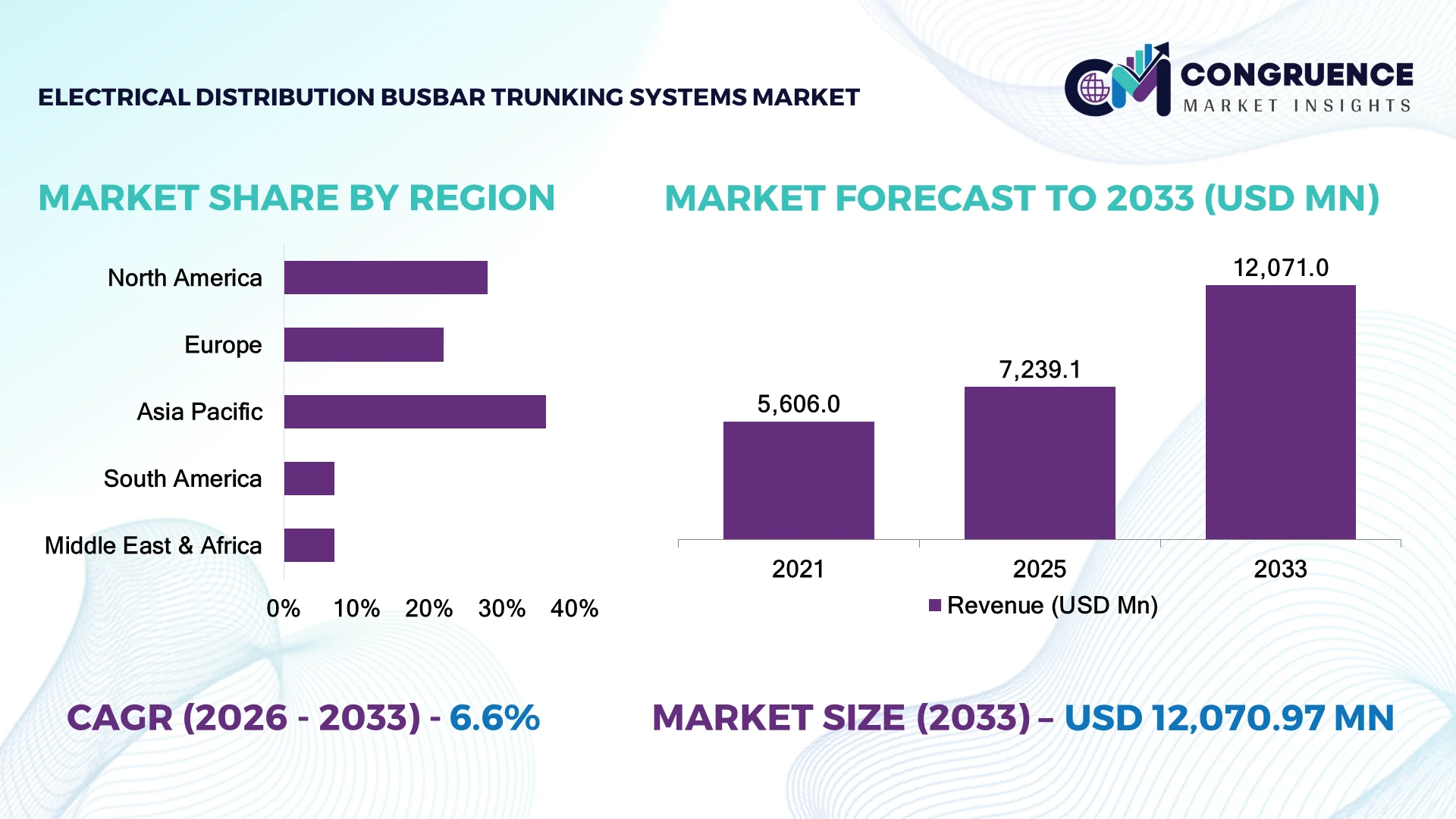
The Global Electrical Distribution Busbar Trunking Systems Market was valued at USD 7,239.1 Million in 2025 and is anticipated to reach a value of USD 12,071.0 Million by 2033 expanding at a CAGR of 6.6% between 2026 and 2033. Growth is driven by high-density data centers, industrial electrification, commercial building modernization, and the need for modular power distribution that simplifies capacity expansion and reduces dependence on fixed cable networks.
China holds a strategically important position through its extensive manufacturing base, large commercial construction pipeline, and expanding digital infrastructure; national electricity demand is projected to grow by an average of 4.9% annually through 2030. The United States remains a critical market as AI infrastructure raises power requirements and data-center operators prioritize scalable overhead distribution. Geopolitical tensions and supply-chain diversification are also encouraging manufacturers to strengthen regional production and sourcing.
For suppliers, the priority is to align manufacturing capacity, conductor sourcing, and product development with data-center and industrial investment hotspots rather than rely exclusively on conventional building demand.
Market Size & Growth: The market is valued at USD 7,239.1 million in 2025 and is projected to reach USD 12,071.0 million by 2033, supported by modular power distribution and infrastructure modernization.
Top Growth Drivers: Data-center expansion, industrial electrification, and commercial construction are central demand drivers as global electricity demand is forecast to grow by an average of 3.6% annually from 2026 to 2030.
Short-Term Forecast: By 2028, buyers will increasingly prioritize modular extensions, rapid tap-off changes, and monitoring-ready systems to reduce disruption during facility upgrades.
Emerging Technologies: Intelligent metering, high-density plug-in busways, and prefabricated distribution assemblies are improving visibility, installation consistency, and flexibility.
Regional Leaders: Asia-Pacific benefits from China's industrial scale and India's infrastructure investment; North America is supported by data-center expansion, while Europe emphasizes energy efficiency and building modernization.
Consumer/End-User Trends: Data-center operators increasingly value overhead busway for scalable rack connections, accessible tap-off points, and reduced floor-space pressure as AI workloads intensify.
Pilot/Case Example: In 2025, Vertiv expanded its PowerBar Track portfolio with a double-stack configuration designed for high-density data centers, with product configurations rated up to 2,000 A under UL 857 and up to 2,500 A under IEC 61439-6.
Competitive Landscape: Schneider Electric, Siemens, ABB, Eaton, and Vertiv compete through busway portfolios, integrated power infrastructure, engineering support, and regional distribution networks; a reliable market-wide leader share is not consistently disclosed.
Regulatory & ESG Impact: Energy-efficiency priorities and electrical safety requirements strengthen demand for systems with lower installation waste, accessible maintenance, and improved power monitoring.
Investment & Funding: Global data-center investment has accelerated, with investment in data centers rising 67% over two years; this strengthens demand for high-capacity distribution equipment and scalable power architectures.
Innovation & Future Outlook: Higher rack power, digital monitoring, and modular construction are shifting competition toward integrated, configurable systems backed by dependable delivery and lifecycle support.
Electrical distribution busbar trunking systems are gaining relevance across data centers, manufacturing plants, transport infrastructure, and large commercial buildings where compact, adaptable power distribution is essential. Modular tap-off designs and monitoring-enabled assemblies help operators manage changing loads, while supply-chain uncertainty is increasing the value of dependable regional manufacturing and standardized components. These shifts are making system flexibility and deployment speed important differentiators in purchasing decisions.
Electrical distribution busbar trunking systems are becoming a strategic infrastructure choice because power demand is changing faster than many conventional building layouts can accommodate. Data centers, electrified factories, and large commercial facilities need distribution networks that can expand without extensive cable rerouting. With global electricity demand projected to rise by an average of 3.6% annually from 2026 to 2030, reliable internal power distribution is becoming a planning priority rather than a late-stage electrical specification.
Compared with fixed cable installations, modular busway systems allow plug-in tap-off points to be repositioned or added along compatible runs, reducing the scope of rewiring and supporting staged capacity upgrades. The precise savings depend on site design, current rating, installation conditions, and maintenance practices; the clearest advantage is adaptability when equipment layouts change. North American investment is being shaped by high-density data centers, while China and India combine industrial electrification with major infrastructure expansion.
Over the next two to three years, buyers are expected to place greater emphasis on pre-engineered assemblies, real-time metering, standardized interfaces, and high-current configurations. For example, an expanding data center can use overhead busway to add rack connections without rebuilding the entire distribution route. Manufacturers are responding with configurable portfolios, engineering partnerships, and closer alignment with switchgear and data-center infrastructure providers. Competitive advantage will depend on verified safety performance, fast deployment, reliable supply, and the ability to accommodate future load changes.
Rising electrical loads in data centers, advanced manufacturing, and large commercial facilities are strengthening demand for modular busbar trunking systems. Global electricity demand is forecast to increase by an average of 3.6% annually between 2026 and 2030, while China's demand is projected to grow by 4.9% annually over the same period. Data-center electricity consumption is also projected to approach 950 TWh by 2030, increasing the need for scalable distribution near IT equipment. This shift favors overhead busway, factory-assembled sections, and accessible tap-off units over layouts that require extensive cable rerouting. Manufacturers are expanding high-current product ranges and developing monitoring-ready designs. The strategic advantage lies in supporting phased capacity additions without redesigning the complete electrical backbone.
Busbar trunking manufacturers remain exposed to copper and aluminum price movements, insulation-material availability, and the cost of precision fabrication. Because conductor selection, current rating, enclosure design, and fire-safety requirements vary by project, products are not always interchangeable without engineering review. Even a modest 5% increase in key input costs can compress margins when contracts lock in selling prices before procurement is completed. International trade friction and changing logistics routes add uncertainty to delivery schedules, particularly for projects with imported components. Manufacturers are responding through dual sourcing, regional supplier qualification, commodity-adjustment clauses, and improved demand planning. The commercial priority is to protect project-level margins without compromising conductor quality, thermal performance, or compliance.
Existing buildings offer an important opportunity as operators upgrade power distribution to support electrified equipment, denser IT loads, and changing tenant requirements. Monitoring-enabled busway can provide circuit-level visibility, while modular tap-off points help facilities accommodate new loads without replacing complete distribution routes. Data-center electricity demand is projected to reach approximately 950 TWh by 2030, reinforcing the need for power architectures that can scale alongside compute capacity. Manufacturers can differentiate through integrated metering, standardized plug-in interfaces, compact layouts, and engineering services for retrofit projects. India and Southeast Asian markets also present opportunities where industrial and digital infrastructure are expanding. The strongest positioning combines product sales with commissioning, lifecycle support, and repeatable designs for multi-site customers.
Scaling busbar trunking across complex facilities requires coordination among electrical designers, switchgear suppliers, contractors, and operations teams. Misalignment in fault ratings, protection coordination, joint installation, thermal conditions, or interface specifications can create commissioning delays and reduce system reliability. As AI facilities increase rack power and operators demand rapid deployment, the margin for late-stage redesign narrows. Grid infrastructure constraints are also material: more than 2,500 GW of generation, storage, and large-load projects worldwide have been reported as waiting in grid connection queues, highlighting the wider difficulty of matching electrical infrastructure to new demand. Manufacturers must strengthen application engineering, installer training, digital configuration tools, and commissioning protocols. Standardized interfaces and verified system-level testing are essential to repeatable deployment.
Higher-Density Data Center Busways. AI infrastructure is pushing power distribution toward higher-current, space-efficient configurations. New product designs include double-stack layouts and ratings reaching 2,000 A under UL 857 and 2,500 A under IEC 61439-6. Operators are adopting overhead systems to preserve floor space and simplify rack-level expansion, while suppliers are increasing engineering focus on thermal management, tap-off flexibility, and future load changes.
Real-Time Power Visibility Expands. Monitoring-enabled busway is moving circuit-level measurement closer to the load. Digital metering helps facilities track utilization, identify imbalances, and plan maintenance before adding equipment. As electricity demand rises and operators seek greater control over operating costs, manufacturers are integrating sensors, metering, and remote visibility into distribution portfolios. The competitive distinction is shifting from conductor capacity alone to actionable operational data.
Prefabrication Reshapes Installation Workflows. Factory-assembled sections, pretested joints, and plug-in tap-off units reduce the amount of field wiring and help standardize installation quality. This approach is particularly relevant to data centers and industrial facilities operating under compressed construction schedules. Suppliers are coordinating earlier with contractors and design teams, using repeatable assemblies to reduce rework exposure and improve consistency across multi-site projects.
Regional Supply Resilience Gains Priority. Geopolitical tensions and logistics uncertainty are encouraging manufacturers to review sourcing and production footprints. Copper and aluminum procurement, enclosure fabrication, and accessory availability can influence project delivery as much as final assembly. Companies are qualifying alternative suppliers, strengthening regional distribution, and standardizing components where technically feasible. The less obvious shift is that supply reliability and engineering support increasingly influence purchasing alongside price and rated capacity.
Compact or sandwich-type busbar trunking systems are estimated to represent approximately 45% of the type segment, supported by space-efficient construction, strong mechanical protection, and suitability for high-capacity distribution in commercial buildings, industrial plants, and data centers. Their enclosed design supports installation in congested electrical routes and simplifies integration into modern building infrastructure. Air-insulated systems remain relevant for installations where accessibility, design flexibility, and project-specific configurations influence procurement. Feeder busbar systems serve primary power-transfer requirements, while plug-in configurations support distributed loads and allow compatible equipment connections to be repositioned as facility layouts change. Lighting busbar systems retain a focused role in retail, warehouses, and production areas where flexible luminaire placement is important.
Plug-in and monitoring-ready configurations are expected to record comparatively strong adoption as operators prioritize modularity, load visibility, and faster equipment changes. Demand for configurable systems is particularly relevant as data-center electricity consumption is projected to reach approximately 950 TWh by 2030. Manufacturers are strengthening high-current portfolios, expanding prefabricated assemblies, and integrating metering options. Investment priorities are shifting toward products that combine electrical capacity with adaptable installation and lifecycle support.
Data centers are estimated to account for approximately 28% of application demand, reflecting the need for reliable, space-efficient power delivery across server rooms, equipment rows, and expanding AI infrastructure. Busbar trunking supports overhead distribution, modular tap-off connections, and staged capacity additions without requiring extensive cable rerouting. Industrial facilities remain another major application, using busway systems to distribute power across production lines, machinery, and plant expansions. Commercial buildings also contribute through electrical modernization in offices, shopping complexes, and mixed-use developments. Hospitals, transport infrastructure, warehouses, and other specialized facilities use busbar trunking where continuity, layout flexibility, and maintenance access are important. Application priorities differ: industrial projects emphasize operating reliability, while commercial projects place greater weight on space utilization and installation coordination.
Data centers are expected to remain among the fastest-expanding applications as AI workloads increase power density and operators accelerate capacity deployment. The IEA projects electricity consumption from data centers to approach 950 TWh by 2030, while the American Institute of Architects' July 2026 construction forecast projects U.S. data-center construction spending to grow 33% in 2026. Suppliers are responding with higher-current busways, prefabricated assemblies, and integrated monitoring. This shifts commercial focus toward early engagement with electrical consultants and data-center engineering teams, where product selection can influence installation schedules and future expansion costs.
Commercial and industrial facility operators are estimated to represent approximately 38% of end-user demand collectively, reflecting their broad installed base across factories, offices, retail properties, logistics facilities, and institutional buildings. Industrial buyers prioritize dependable power delivery, equipment uptime, and expansion without extensive disruption to production. Commercial property owners focus more on space efficiency, maintainability, and the ability to accommodate tenant changes. Data-center operators form a distinct, strategically important buyer group because rising rack power and rapid capacity additions increase requirements for high-current distribution and modular connections. Contractors, electrical consultants, and engineering, procurement, and construction firms also influence product selection through design specifications, installation planning, and compliance requirements.
Data-center operators are expected to be among the fastest-growing end-user groups as AI infrastructure investment accelerates. The IEA projects data-center electricity consumption to increase from around 415 TWh in 2024 to approximately 945 TWh by 2030. By comparison, conventional industrial and commercial buyers often prioritize lifecycle reliability and phased modernization over rapid capacity scaling. Manufacturers are adapting through dedicated data-center product configurations, engineering partnerships, commissioning support, and monitoring-ready solutions. For industrial customers, modular retrofit packages and predictable maintenance remain important differentiators. Competitive positioning will increasingly depend on matching product design, delivery schedules, and technical support to each buyer's operating model.
Asia-Pacific accounted for the largest market share at approximately 36% in 2025 however, Asia-Pacific is expected to register the fastest growth, expanding at an estimated CAGR of 8.1% between 2026 and 2033.
AI Infrastructure and High-Capacity Power Distribution Reshape Regional Demand
North America represents a major market for electrical distribution busbar trunking systems, supported by data-center construction, industrial modernization, healthcare infrastructure, and commercial building upgrades. The United States is the principal demand center as hyperscale operators and colocation providers expand electrical capacity for AI workloads. Overhead busway systems are gaining importance because they enable modular rack connections, improve access to distribution points, and support staged facility expansion. The American Institute of Architects' July 2026 forecast projected U.S. data-center construction spending to increase by 33% in 2026 and 24.7% in 2027, highlighting the strength of this infrastructure investment cycle. Canada contributes through commercial development, industrial facilities, and digital infrastructure, while Mexico offers manufacturing-related demand. Suppliers are prioritizing high-current configurations, prefabrication, and regional technical support to address project schedules and electrical equipment constraints.
United States Market Outlook: The United States leads regional demand through hyperscale data centers, cloud infrastructure, semiconductor facilities, and advanced manufacturing. Data-center projects require scalable power distribution, high-current busways, and modular tap-off arrangements that can accommodate evolving equipment layouts. The 2026 construction outlook points to sustained investment, although grid availability, permitting, and equipment lead times can affect project execution. Manufacturers with established engineering teams, dependable delivery networks, and compatibility across switchgear and monitoring systems are well positioned to serve large infrastructure projects.
Energy Efficiency and Industrial Modernization Guide System Selection
Europe's electrical distribution busbar trunking systems market is shaped by industrial automation, building renovation, data-center development, and requirements for safe, efficient electrical infrastructure. Germany, France, the United Kingdom, and Italy represent important demand centers, with manufacturing plants and commercial facilities supporting replacement and expansion projects. European buyers place considerable emphasis on product safety, lifecycle performance, installation quality, and alignment with applicable electrical standards. The expansion of digital infrastructure is adding demand for modular, high-capacity distribution, while factory modernization supports busway installations around production equipment and automated material-handling systems. Compared with new-build projects, retrofit installations often require more detailed route planning and coordination with existing switchgear. Suppliers are responding with compact designs, prefabricated sections, and engineering services that help reduce site complexity and improve installation consistency.
Germany Market Outlook: Germany is a strategically important market because of its advanced manufacturing base, industrial automation activity, and substantial stock of commercial and industrial buildings requiring electrical upgrades. Automotive production, machinery manufacturing, logistics facilities, and data-center projects support demand for reliable distribution systems. Buyers increasingly value modularity where production layouts change or additional machinery is introduced. Suppliers can strengthen their position through local engineering support, standardized components, and solutions compatible with industrial power-management requirements.
Manufacturing Scale and Digital Infrastructure Accelerate Deployment
Asia-Pacific is the largest regional market, supported by China's manufacturing scale, India's infrastructure investment, and expanding data-center capacity in Japan, South Korea, Singapore, and Australia. Industrial plants, commercial complexes, transport facilities, and digital infrastructure create varied demand for feeder, plug-in, and high-current busbar systems. China benefits from a broad electrical equipment supply chain and large industrial construction base, while India offers opportunities from factory expansion, urban development, and increasing digital infrastructure requirements. Singapore and Japan emphasize reliability and space-efficient distribution for data centers and dense commercial facilities. Regional manufacturers are expanding product portfolios and local distribution capabilities to serve project-specific electrical requirements. Differences in standards, installation practices, and procurement models mean that suppliers need localized engineering and certification strategies rather than relying on a uniform regional product offering.
China Market Outlook: China remains a strategically significant market through its extensive electrical equipment manufacturing ecosystem, industrial facilities, commercial construction, and expanding computing infrastructure. Domestic production capabilities support the supply of conductors, enclosures, and associated electrical components, helping manufacturers serve large projects and respond to changing specifications. Demand spans factory power distribution, logistics facilities, and high-density digital infrastructure. Competition is intense, making product reliability, manufacturing efficiency, pricing discipline, and compliance with project requirements central to maintaining market position.
Industrial Upgrades and Commercial Infrastructure Support Selective Expansion
South America's electrical distribution busbar trunking systems market is supported by industrial facilities, commercial construction, mining operations, logistics infrastructure, and investments in electrical modernization. Brazil represents the principal regional opportunity because of its comparatively large industrial base, urban commercial infrastructure, and manufacturing activity. Chile and Peru offer demand linked to mining and mineral processing, where reliable power distribution is important for equipment uptime and plant expansion. Compared with mature North American and European markets, adoption can be more project-specific, reflecting capital availability, local engineering capacity, and the installed base of conventional cable distribution. Currency volatility and dependence on imported components can influence project costs and delivery schedules. Suppliers are best positioned through local electrical contractors, distributor partnerships, technical training, and product configurations suited to industrial operating conditions.
Brazil Market Outlook: Brazil offers the strongest broad-based opportunity in South America because of its manufacturing, mining, food processing, commercial property, and infrastructure sectors. Industrial operators require reliable power distribution for production lines and facility upgrades, while large commercial buildings create demand for compact electrical systems. Project economics remain sensitive to financing conditions, imported component costs, and installation expertise. Manufacturers that develop local contractor relationships, provide responsive engineering support, and maintain dependable component availability can improve competitiveness across both new installations and retrofit projects.
Large Infrastructure Programs and Digital Investment Expand Power Requirements
The Middle East and Africa market is shaped by commercial megaprojects, airports, healthcare facilities, industrial development, energy infrastructure, and expanding data-center capacity. Saudi Arabia and the United Arab Emirates are important demand centers, supported by urban development, digital transformation, and investments in large commercial and mixed-use facilities. Data-center projects require scalable power distribution, while industrial and infrastructure applications prioritize reliability under demanding operating conditions. South Africa contributes through mining, manufacturing, commercial buildings, and infrastructure modernization, although investment conditions vary across the region. Project delivery can be affected by imported equipment lead times, local certification requirements, and the availability of experienced electrical contractors. Suppliers are strengthening regional distributor networks, engineering partnerships, and project-specific support to address complex installations and improve equipment availability.
Saudi Arabia Market Outlook: Saudi Arabia is a strategically important market because of large-scale urban development, industrial diversification, commercial construction, and investment in digital infrastructure. New facilities require coordinated electrical distribution systems that can accommodate high loads, phased commissioning, and future expansion. Data centers and large commercial developments are creating opportunities for modular busway and high-current distribution products. Suppliers that establish strong local partnerships, align products with project specifications, and provide commissioning and after-sales support are better positioned to compete for complex infrastructure contracts.
Schneider Electric, Siemens, ABB, Eaton, and Legrand compete globally through certified busway portfolios, engineering support, and integrated electrical distribution. Vertiv challenges these incumbents in data centers with prefabricated power infrastructure, while regional manufacturers compete aggressively on price, lead time, and customization. Industry estimates place the top five players’ combined share at approximately 30%, indicating meaningful room for specialist suppliers; this figure varies with market definition and should be treated as an estimate.
Competition increasingly depends on project execution as much as equipment price. Buyers weigh lifecycle reliability, installation speed, modular expansion, and compatibility with monitoring platforms. Compact, plug-in and high-capacity systems help differentiate premium offers, while procurement and conductor-cost management influence price-led bids. Schneider Electric’s data-center busway portfolio and Vertiv’s integrated infrastructure target fast deployment; established electrical OEMs leverage broad portfolios, while regional specialists target retrofit projects and local specifications. Manufacturers are expanding capacity and integrating busway with digital monitoring, cooling and prefabricated infrastructure. IEC qualification and project validation create entry barriers, especially for mission-critical facilities. Copper and aluminium price volatility remains a margin pressure point. Winning requires verified performance, dependable delivery, application-specific engineering, and service coverage—not simply the lowest quotation.
Compact sandwich busways, plug-in tap-off units and higher-current designs are increasingly important where floor space, load density and future reconfiguration matter. Compared with conventional cable distribution, prefabricated busway can simplify routing and reduce installation work; actual savings depend on project design, distance, labour rates and site conditions. Rittal reported an independent study showing RiLineX assembly time reductions of up to 75% against conventional systems, demonstrating the potential advantage of modular connection technology. This result applies to the tested switchgear assembly, not every trunking installation.
Digital monitoring is another differentiator. Sensors and connected power-management platforms can help operators identify abnormal temperatures, load imbalance and capacity constraints earlier, supporting predictive maintenance and better asset utilization. No reliable market-wide adoption percentage is publicly established for digitally monitored busbar trunking, so deployment is best described as selective and growing, particularly in data centers and critical industrial facilities. Integrated monitoring benefits suppliers that combine hardware, software and service expertise rather than sell components alone.
For 2026–2028, higher-density AI infrastructure is likely to accelerate demand for modular overhead busway, prefabricated power assemblies and designs coordinated with liquid cooling. Vertiv’s integrated overhead infrastructure and newer high-capacity busway configurations illustrate this direction, while liquid-cooled busbar development targets thermal constraints at rack level. Molex reported up to 20% greater cooling efficiency for its multi-channel design versus a single-channel design. Adoption will depend on validated thermal performance, safety certification, interoperability and lifecycle economics. Suppliers should prioritize tested modularity, digital visibility and rapid deployment now to compete for increasingly time-sensitive projects.
This report examines the electrical distribution busbar trunking systems market across product types, including compact sandwich, air-insulated and plug-in systems; applications spanning data centers, industrial facilities, commercial buildings, infrastructure and transportation; and end-users such as manufacturers, building operators, utilities and data-center developers. Geographic coverage includes North America, Europe, Asia-Pacific, South America, and the Middle East and Africa, with country-level analysis of major demand centres and industrial investment patterns.
The analysis assesses copper and aluminium conductors, insulation and enclosure designs, high-capacity distribution, modular tap-off connections, digital monitoring, prefabricated power infrastructure and emerging cooling-integrated solutions. It evaluates global OEMs alongside regional manufacturers, considering product differentiation, supply reliability, installation requirements, certification and customization. Segment distribution, deployment patterns and competitive positioning help readers identify opportunities in established applications and niche requirements, including high-density computing and retrofit projects. The findings support investment screening, geographic expansion, product prioritization, supplier assessment and strategic planning for market developments between 2026 and 2033.
| Report Attribute/Metric | Report Details |
|---|---|
|
Market Revenue in 2025 |
USD 7,239.1 Million |
|
Market Revenue in 2033 |
USD 12,071.0 Million |
|
CAGR (2026 - 2033) |
6.6% |
|
Base Year |
2025 |
|
Forecast Period |
2026 - 2033 |
|
Historic Period |
2021 - 2025 |
|
Segments Covered |
By Type
By Application
By End-User
|
|
Key Report Deliverable |
Revenue Forecast, Growth Trends, Market Dynamics, Segmental Overview, Regional and Country-wise Analysis, Competition Landscape |
|
Region Covered |
North America, Europe, Asia-Pacific, South America, Middle East, Africa |
|
Key Players Analyzed |
Schneider Electric, Siemens AG, ABB Ltd., Eaton Corporation, Legrand SA, Vertiv Holdings, Larsen & Toubro Limited, C&S Electric Limited, Rittal GmbH & Co. KG, Powell Industries, LS Cable & System, Furukawa Electric Co., EAE Elektrik, Megabarre Group |
|
Customization & Pricing |
Available on Request (10% Customization is Free) |