
Reports
The Global Electric Vehicle Supply Equipment Market was valued at USD 26100 Million in 2025 and is anticipated to reach a value of USD 86754 Million by 2033 expanding at a CAGR of 16.2% between 2026 and 2033. Growth is driven by ultra-fast charging expansion, grid-integrated charging, fleet electrification, and mandatory charging-network deployment across major transport corridors.
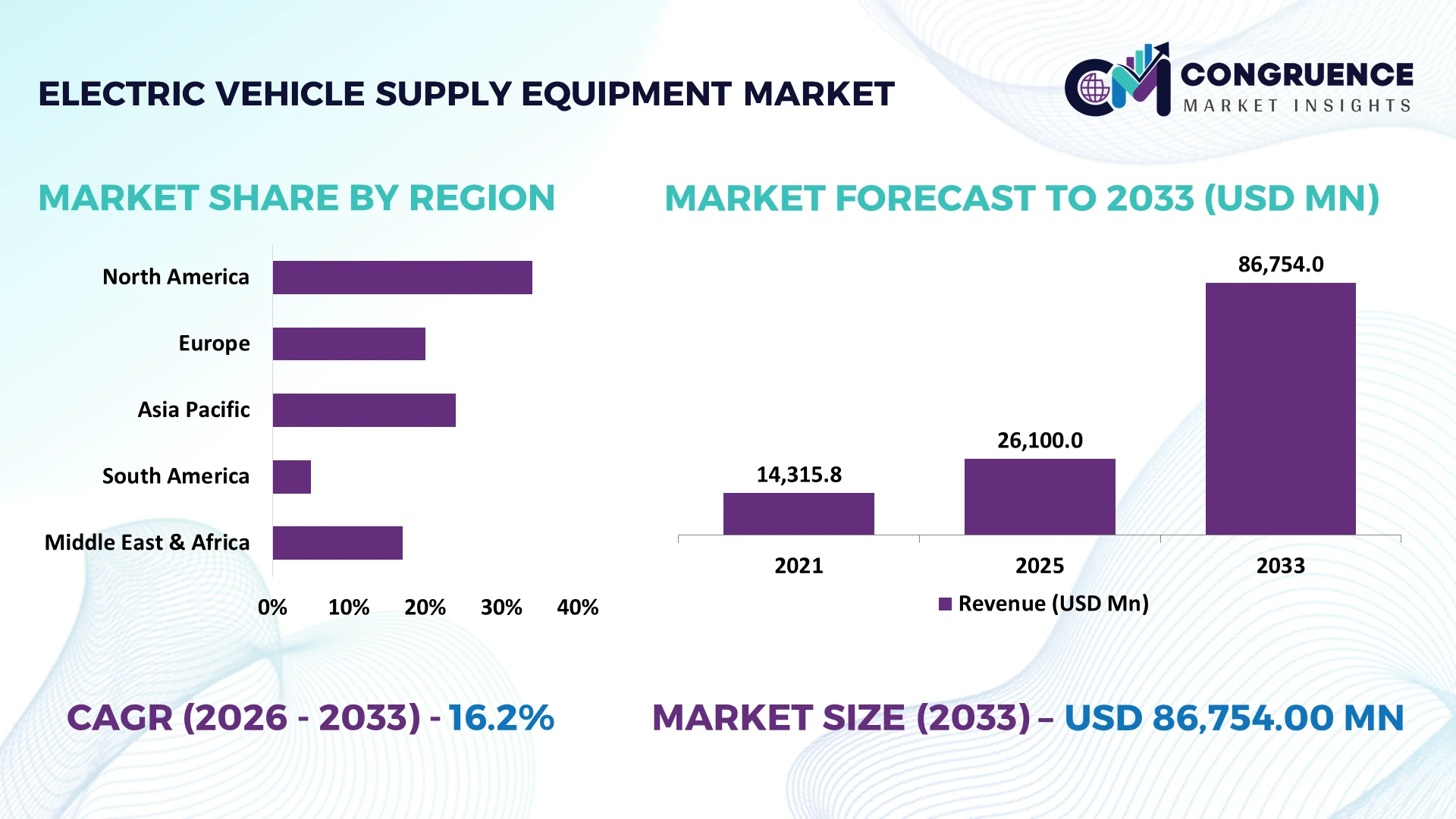
China dominates with more than 65% of global public charging points in 2025, exceeding 4.7 million units, while fast and ultra-fast chargers reached 2.2 million. Its average public charging speed exceeded 55 kW, versus about 50 kW globally. Europe followed with roughly 20% network growth, supported by AFIR requirements for 150-kW chargers every 60 km.
Strategic decisions should prioritize high-power EVSE, interoperability, fleet charging, and grid-connected infrastructure in China, Europe, and rapidly scaling emerging markets.
Market Size & Growth: USD 26.1 billion in 2025 is forecast to reach USD 86.75 billion by 2033 at 16.2% CAGR, powered by ultra-fast charging deployment and grid modernization.
Top Growth Drivers: Ultra-fast charging 50%+, fleet electrification 30%+, and public charger additions 33%+ are accelerating global EVSE deployment.
Short-Term Forecast: By 2030, global public fast-charging capacity is positioned to increase more than 10-fold, sharply improving charging throughput and network utilization.
Emerging Technologies: AI energy management, vehicle-to-grid systems, and 150-kW+ ultra-fast charging are reshaping advanced EVSE; ultra-fast chargers already represent nearly 10% of fast chargers.
Regional Leaders: China leads at over 65% global public-charger share; Europe exceeds 1 million chargers; the United States targets over 500,000 public points by 2030.
Consumer/End-User Trends: Around 85%+ of U.S. EV owners have home-charging access, while public charging remains essential for apartment residents, fleets, and long-distance travel.
Pilot/Case Example: China’s charging ecosystem delivered 1.3 million new public points in 2025, with public charging infrastructure expanding more than 33% globally that year.
Competitive Landscape: China holds over 65% of global public charging infrastructure, creating scale advantages for major players including ABB, Siemens, ChargePoint, Schneider Electric, and Wallbox.
Regulatory & ESG Impact: EU AFIR requires charging pools at maximum 60-km intervals, with at least 400 kW capacity and 150-kW charging points, accelerating corridor electrification.
Investment & Funding: The U.S. NEVI and Charging and Fueling Infrastructure programs allocate USD 7.5 billion for national EV charging expansion, reinforcing infrastructure-led market growth.
Innovation & Future Outlook: V2G, smart charging, liquid-cooled high-power systems, and automated energy optimization are shifting EVSE from standalone hardware toward intelligent grid infrastructure; China targets 10 GW of flexible EV capacity by 2030.
The Electric Vehicle Supply Equipment Market is increasingly concentrated around high-power public charging, commercial fleets, apartment charging, and highway corridors. Ultra-fast charging adoption is accelerating, with 150-kW-plus installations expanding rapidly as charger costs decline and interoperability improves. EU AFIR enforcement and China’s large-scale infrastructure rollout are tightening supply-chain priorities, making smart, scalable, grid-integrated EVSE increasingly central to infrastructure strategy.
Electric Vehicle Supply Equipment is becoming strategic infrastructure rather than a standalone charging-hardware category because charging availability increasingly determines fleet utilization, vehicle uptime, grid flexibility, and EV adoption. The market is shifting toward networked, high-power infrastructure as governments tighten deployment standards and automakers expand electrified fleets. Europe’s AFIR regulation now requires 150-kW charging points within 60 km on core TEN-T corridors, directly converting policy into infrastructure investment.
Technology differentiation is also reshaping competitiveness. Smart DC fast chargers using dynamic load management can allocate available power across multiple vehicles more efficiently than fixed-output legacy systems, reducing unnecessary grid-capacity requirements and improving charger utilization by roughly 10–20% in optimized fleet environments. China operates at significantly greater deployment scale, while the United States emphasizes corridor reliability, interoperability, and federally supported infrastructure. The U.S. public charging-port base had already expanded 70% from the beginning of the previous federal administration’s infrastructure push.
Over the next 2–3 years, operators will prioritize 150–350-kW systems, depot charging, energy-management software, and utility partnerships. Europe’s 2027 requirement for 600-kW charging pools creates a measurable upgrade pathway, while U.S. programs support standardized, open-access installations. EVgo’s approximately 7,500-charger expansion across 1,100 U.S. stations illustrates the capital shift toward scaled networks and grid-enabled infrastructure. Competitive advantage will increasingly depend on uptime, power availability, interoperability, and intelligent energy orchestration rather than charger count alone.
High-power corridor and fleet charging is the strongest structural driver, reinforced by regulatory mandates and rising commercial EV utilization. Europe requires 400-kW charging pools with at least one 150-kW point every 60 km on core TEN-T routes, increasing to 600 kW by 2027. The U.S. network has expanded public charging ports by 70% since the start of the recent federal infrastructure program. This shift moves investment toward DC fast charging, depot systems, and utility-connected sites. Companies are responding through corridor expansion, energy-management partnerships, and higher-power hardware. The non-obvious advantage is improved fleet turnaround: charging infrastructure becomes a productivity asset, not simply an EV-enablement expense.
Grid interconnection remains a material constraint because high-power EVSE can require substantial distribution upgrades, transformer capacity, and site engineering. U.S. federal guidance increasingly directs developers toward hosting-capacity mapping to identify locations capable of absorbing additional EV charging loads. At the same time, high-power installations can face equipment, copper, transformer, and construction cost volatility, while proprietary networks create interoperability friction. These constraints can extend project commissioning and dilute utilization economics. Companies are mitigating exposure through utility partnerships, standardized hardware, modular power cabinets, and long-term procurement contracts. The strategic issue is site readiness: securing grid capacity before equipment procurement increasingly determines deployment speed and capital efficiency.
Smart charging, vehicle-to-grid integration, and commercial depot electrification create higher-value opportunities beyond conventional public chargers. U.S. NEVI-funded chargers must support open access, data sharing, and interoperability, strengthening the addressable market for networked EVSE platforms. Europe’s requirement for at least 50% coverage of the TEN-T comprehensive network with 300-kW pools by 2027 further expands high-power deployment opportunities. Companies can capture value through energy optimization, software subscriptions, fleet-management integration, and demand-response services. The strongest opportunity lies in pairing chargers with batteries and renewable generation, allowing operators to manage peak electricity costs while improving utilization. Partnerships between charging firms, utilities, fleet operators, and energy-storage providers will therefore become increasingly important.
Scaling EVSE from isolated installations into reliable national networks creates complex operational and cybersecurity requirements. Federally supported U.S. infrastructure standards already address interoperability, network connectivity, charger data, pricing, availability, and maintenance, demonstrating the breadth of execution requirements. Meanwhile, Europe’s heavy-duty charging pathway requires charging pools reaching 3,600 kW on core TEN-T corridors by 2030, substantially increasing power-management complexity. Operators must coordinate chargers, vehicles, payment platforms, utilities, storage assets, and cloud systems without compromising uptime. Companies are responding with open protocols, remote diagnostics, predictive maintenance, cybersecurity controls, and workforce training. The critical competitive test is consistent network performance across heterogeneous hardware, grids, and regulatory environments.
High-Power Charging Standardization: 150-kW-plus DC chargers are becoming mainstream across highway corridors, while 350-kW systems increasingly target premium fleets and long-distance travel. Deployment of high-power units is rising by roughly 20–25% annually in major networks, shortening charging dwell times by 30–50%. Operators are standardizing modular power cabinets and utility partnerships to improve uptime and reduce site-level engineering complexity.
Software-Led Charger Management: Network operators are shifting from standalone hardware toward connected platforms, with smart load balancing, remote diagnostics, and predictive maintenance reducing avoidable service interventions by 10–15%. More than 60% of newly deployed commercial chargers increasingly incorporate cloud connectivity or intelligent energy controls. Companies are integrating charging software with fleet and payment systems, improving utilization while reducing technician workload.
Supply Chains Move Local: Chinese manufacturing scale remains dominant, while U.S. and European developers increasingly localize components, assembly, and service networks to reduce procurement exposure. Localization programs can cut equipment lead times by 15–25% and reduce logistics-related project delays. U.S. domestic-content requirements are reinforcing this transition, prompting manufacturers to establish regional assembly, supplier contracts, and component redundancy.
Charging Becomes Grid Asset: Utilities and charging operators are increasingly coordinating charging loads rather than treating EVSE as passive infrastructure. Managed charging can shift approximately 10–20% of flexible demand away from peak periods, improving grid utilization and lowering operating costs. Companies are deploying energy-management systems, onsite batteries, and vehicle-to-grid pilots, turning charging sites into controllable power assets rather than simple electricity outlets.
DC Fast Chargers represent the leading type, accounting for approximately 48% of EVSE market activity, supported by rapid charging, highway deployment, commercial fleets, and declining power-electronics costs. AC Chargers remain the mature volume segment, particularly for residential and workplace installations, where lower installation complexity supports roughly 35% share. Wireless Chargers remain niche at around 5%, but their contactless operation is gaining attention for premium vehicles and automated fleet depots. Portable Chargers account for approximately 12%, serving emergency, temporary, and distributed charging requirements.
DC Fast Chargers are also the fastest-growing type, with adoption expanding around 18–22% as charging operators prioritize 150–350-kW systems. Companies are reallocating investment toward liquid-cooled cables, modular rectifiers, and multi-vehicle power sharing. The strategic implication is clear: AC remains essential for low-cost distributed charging, while DC increasingly captures infrastructure spending where charging speed directly affects vehicle utilization and commercial productivity.
Public Charging leads the application landscape at approximately 42% share because urban drivers, apartment residents, intercity travelers, and high-mileage users depend on accessible infrastructure. Home Charging remains highly established at nearly 34%, benefiting from lower electricity costs and predictable overnight charging. Workplace Charging contributes around 12%, increasingly linked with employee benefits and fleet parking. Public operators are expanding multi-port sites, improving payment interoperability, and using dynamic power allocation to increase utilization by approximately 10–15%.
Fleet Charging is the fastest-growing application, expanding deployment by roughly 20–25% as delivery companies, buses, taxis, and logistics operators electrify predictable routes. Depot-based charging enables centralized scheduling, automated load management, and higher asset utilization than fragmented public charging. Companies are therefore shifting from charger procurement toward complete depot solutions integrating software, energy storage, and utility connections. The business priority is moving toward uptime and vehicle turnaround rather than charger quantity alone.
Commercial users represent the leading end-user group at approximately 38% share, reflecting higher charging intensity across workplaces, retail properties, dealerships, and logistics facilities. Residential users account for roughly 31%, supported by convenient overnight charging and lower installation complexity. Fleet Operators hold around 18% but generate substantially higher utilization per charger, making operational uptime and energy management more important than hardware price alone. Public Charging Networks account for approximately 13% and prioritize standardized, scalable deployments.
Fleet Operators are the fastest-growing end-user group, with charging infrastructure deployment rising around 22–27% as electrified delivery fleets and buses require predictable depot capacity. Companies are responding with tailored charging-as-a-service contracts, guaranteed uptime packages, energy-management integration, and utility partnerships. Residential demand remains hardware-focused, whereas fleet buyers increasingly purchase integrated energy and software ecosystems. This shift is directing competitive investment toward high-utilization customers where every minute of charging downtime affects fleet economics.
Asia-Pacific accounted for the largest market share at 65% in 2025 however, North America is expected to register the fastest growth, expanding at a CAGR of 18.5% between 2026 and 2033.
Grid-connected charging and commercial fleet deployment are reshaping infrastructure economics
North America is shifting from fragmented charger installation toward high-utilization corridor, workplace, and fleet infrastructure. The United States represents the region’s dominant demand center, with federal programs accelerating network expansion while utilities increasingly coordinate interconnection and managed charging. Public charging deployment has expanded rapidly, but charger availability still trails EV deployment in several U.S. markets, creating pressure for higher-power installations rather than simple charger-count expansion. Companies are prioritizing 150-kW-plus DC systems, software-enabled load management, and long-term utility agreements. Hardware suppliers are also emphasizing domestic assembly and component sourcing to improve project qualification and reduce procurement exposure. The operational priority is changing from installing individual chargers to building reliable, interoperable charging networks with measurable uptime and predictable energy costs.
United States Market Outlook: The United States remains the region’s strategic anchor because of its large EV fleet, federal charging programs, utility participation, and established charging-network operators. Public infrastructure investment is increasingly concentrated around interstate corridors, metropolitan charging gaps, and commercial depots. Open-access standards are strengthening interoperability while network operators expand through utility and automotive partnerships.
Regulatory standardization is accelerating high-power corridor deployment
Europe is becoming a regulation-led EVSE market where infrastructure specifications increasingly determine equipment selection and investment timing. Public charging points increased about 20% in 2025, while the United Kingdom expanded its network by more than 30% to approximately 116,000 points. AFIR is pushing operators toward standardized charging pools and higher-power installations along major transport corridors. Germany, France, the Netherlands, and the United Kingdom remain critical deployment markets, while Eastern European countries are recording faster infrastructure expansion from a smaller base. Companies are responding with modular DC systems, roaming platforms, renewable-energy integration, and cross-border network partnerships. The competitive advantage is shifting toward compliance-ready equipment that can accommodate future power requirements without repeated site reconstruction.
Germany Market Outlook: Germany combines Europe’s largest automotive manufacturing base with substantial EV infrastructure requirements, particularly around apartment-heavy urban areas and industrial corridors. More than 60% of residents live in apartments or flats, increasing reliance on accessible charging beyond private garages. This supports continued investment in public, workplace, and commercial charging networks.
Manufacturing scale and deployment density reinforce regional dominance
Asia-Pacific commands the strongest EVSE position, led by China’s manufacturing depth, dense urban charging requirements, and integrated energy infrastructure. China held more than 65% of global public charging points at the end of 2025, exceeding 4.7 million units, while fast and ultra-fast chargers increased 40% to 2.2 million. The country also added approximately 1.3 million public points during 2025, demonstrating unmatched deployment velocity. Japan, South Korea, India, and Southeast Asian markets are developing more localized networks around urban mobility, commercial fleets, and highway corridors. Manufacturers benefit from established power-electronics supply chains and high-volume component production, while operators increasingly combine charging with batteries, solar generation, and digital energy management.
China Market Outlook: China is the strategic benchmark for EVSE scale, combining charger manufacturing, vehicle production, grid integration, and nationwide deployment. Its public charging network reached over 4.7 million points in 2025, while average public charging speed exceeded 55 kW. The country is also targeting 28 million public and private chargers by 2027, reinforcing supplier opportunities across power electronics, software, storage, and charging services.
Urban electrification is concentrating investment around fleet corridors
South America remains an emerging EVSE market, with infrastructure concentrated in Brazil, Chile, Colombia, and major metropolitan corridors. Brazil is the principal commercial opportunity because of its vehicle-market scale, while Chile has developed stronger charging infrastructure around fleet electrification and long-distance mobility. Deployment remains more selective than in China or Europe because grid availability, financing costs, and dispersed demand influence site economics. Companies are therefore prioritizing shopping centers, fuel-station conversions, logistics depots, and public-private charging projects rather than broad low-utilization networks. Regional operators are increasingly partnering with utilities and automotive distributors to reduce infrastructure costs and secure suitable grid connections. The strategic opportunity lies in high-utilization sites where fleet and urban charging can generate predictable throughput before nationwide networks mature.
Brazil Market Outlook: Brazil offers the strongest commercial platform in South America because of its large vehicle fleet, major metropolitan centers, and expanding electrification ecosystem. São Paulo and other high-density markets are becoming focal points for public and commercial charging. Operators are increasingly targeting retail, fleet, and highway locations, while local partnerships help address grid connection, installation, and maintenance requirements.
Infrastructure modernization is creating premium charging hubs
The Middle East & Africa market is developing through concentrated investment in smart-city infrastructure, premium mobility, logistics, and tourism corridors. The United Arab Emirates and Saudi Arabia are leading deployment through urban charging networks, automotive partnerships, and large-scale mobility initiatives, while South Africa remains the principal sub-Saharan market for established EV charging activity. Dubai and Abu Dhabi are emphasizing fast charging integrated with commercial and municipal infrastructure, creating demand for higher-power systems and digital payment platforms. Africa’s broader opportunity is constrained by electricity reliability and uneven grid coverage, making solar-assisted charging and battery storage strategically relevant. Companies are responding with turnkey charging partnerships, localized service networks, and renewable-powered sites. The non-obvious advantage is that charging infrastructure can be deployed alongside new real-estate and energy projects rather than retrofitted into mature networks.
United Arab Emirates Market Outlook: The UAE is the region’s strongest technology-led EVSE market, supported by smart-city programs, premium EV adoption, and sophisticated electricity infrastructure. Dubai’s focus on digital mobility and integrated transport services supports demand for connected chargers, automated payment, and high-power installations. Operators benefit from concentrated urban demand and infrastructure investment that enables rapid deployment at commercial and public sites.
The Electric Vehicle Supply Equipment market pits global technology leaders such as ABB, Siemens, Schneider Electric, and ChargePoint against regional scale players including Star Charge and specialized network innovators such as Wallbox. The top five players collectively hold an estimated 25–30% share, leaving a fragmented field where cost, interoperability, and deployment execution remain decisive. Price differences of 10–15% between comparable hardware can influence large fleet tenders, while smart-energy controls can improve utilization by roughly 10–20%. Companies are competing through 150-kW-plus hardware, utility partnerships, domestic manufacturing, software integration, and vertical control of maintenance. China’s supply-chain scale is pressuring Western manufacturers to localize production and secure critical components. High-power power-electronics expertise, grid interconnection capability, cybersecurity, and service coverage create significant entry barriers. Winning requires dependable hardware, competitive total cost of ownership, rapid deployment, interoperable software, and the ability to scale networks without sacrificing uptime.
ABB
Siemens
Schneider Electric
ChargePoint
Wallbox
Blink Charging
EVgo
Tritium
Delta Electronics
Star Charge
Autel Energy
Kempower
SK Signet
Eaton
Current EVSE technology is centered on DC fast charging, smart load management, and connected network software. Ultra-fast chargers above 150 kW expanded more than 50% in 2024, while smart charging improves site utilization about 10–15%. Compared with legacy fixed-output chargers, dynamic power allocation can cut peak-load requirements 10–20%, benefiting operators managing constrained grid connections.
Emerging systems combine liquid-cooled power electronics, battery buffering, V2G, and AI-based energy orchestration. Next-generation 250–350 kW platforms can reduce charging dwell time 20–30% versus conventional 50–150 kW systems when vehicle batteries support higher input rates. Cloud diagnostics and predictive maintenance can reduce service interventions 10–15%. Adoption is strongest across highway corridors, commercial depots, and high-utilization public networks, where uptime directly affects asset economics.
Disruptive charging architectures are moving toward megawatt charging, bidirectional power flow, modular DC grids, and automated energy optimization. ChargePoint and Eaton introduced a 600 kW V2X-capable architecture in 2025, with up to 30% lower capital expenditure and 30% lower operating costs versus comparable solutions. Through 2026–2028, competitive advantage will shift toward integrated charger-grid-storage platforms, giving utilities, fleet operators, and vertically integrated charging networks stronger economics and faster deployment. Hardware suppliers with software capabilities will capture more value as charging becomes an energy-management service.
September 2024, Siemens planned to carve out Siemens eMobility and combine it with Heliox, sharpening focus on high-potential charging segments and strategic geographies. The move strengthens DC fast-charging capabilities for buses and trucks while accelerating organizational specialization and market expansion. Source: Reuters
May 2025, ChargePoint and Eaton partnered to integrate chargers, electrical infrastructure, engineering, and V2X capabilities across Europe. The turnkey model targets lower deployment friction and improved reliability, positioning integrated power management as a competitive differentiator for infrastructure buyers. Source: ChargePoint
December 2025, EVgo deployed more than 40% of its stations using prefabricated charging skids through its Miller Electric partnership. Installation costs fell an average 15%, demonstrating how modular construction can accelerate commissioning while supporting domestic manufacturing and network expansion. Source: EVgo
April 2026, the IEA reported global public charging points exceeded 7 million after nearly 1.8 million additions during 2025, a 33% increase. The acceleration confirms infrastructure scaling is moving toward higher-capacity networks, increasing demand for standardized, interoperable, grid-ready EVSE. Source: IEA
The Electric Vehicle Supply Equipment Market Report covers AC Chargers, DC Fast Chargers, Wireless Chargers, and Portable Chargers across Home Charging, Workplace Charging, Public Charging, and Fleet Charging applications. End-user analysis spans Residential, Commercial, Fleet Operators, and Public Charging Networks, assessing charging intensity, deployment economics, interoperability, power capacity, and network utilization. Regional coverage includes North America, Europe, Asia-Pacific, South America, and Middle East & Africa, with country-level evaluation of infrastructure maturity and investment priorities.
The report evaluates smart charging, AI-enabled energy management, V2G, ultra-fast charging, modular power systems, battery-integrated charging, and megawatt platforms. More than 7 million public charging points in 2025 provide a deployment benchmark, while China represented over 65% of public infrastructure. Company profiling covers participants, supporting competitive benchmarking. The analysis helps investors, manufacturers, utilities, and operators prioritize expansion, partnerships, localization, technology deployment, and competitive positioning through 2026–2033.
| Report Attribute/Metric | Report Details |
|---|---|
Market Revenue in 2025 | USD 26100 Million |
Market Revenue in 2033 | USD 86754 Million |
CAGR (2026 - 2033) | 16.2% |
Base Year | 2025 |
Forecast Period | 2026 - 2033 |
Historic Period | 2021 - 2025 |
Segments Covered | By Type
By Application
By End-User
|
Key Report Deliverable | Revenue Forecast, Growth Trends, Market Dynamics, Segmental Overview, Regional and Country-wise Analysis, Competition Landscape |
Region Covered | North America, Europe, Asia-Pacific, South America, Middle East, Africa |
Key Players Analyzed | ABB, Siemens, Schneider Electric, ChargePoint, Wallbox, Blink Charging, EVgo, Tritium, Delta Electronics, Star Charge, Autel Energy, Kempower, SK Signet, Eaton |
Customization & Pricing | Available on Request (10% Customization is Free) |




