
Reports
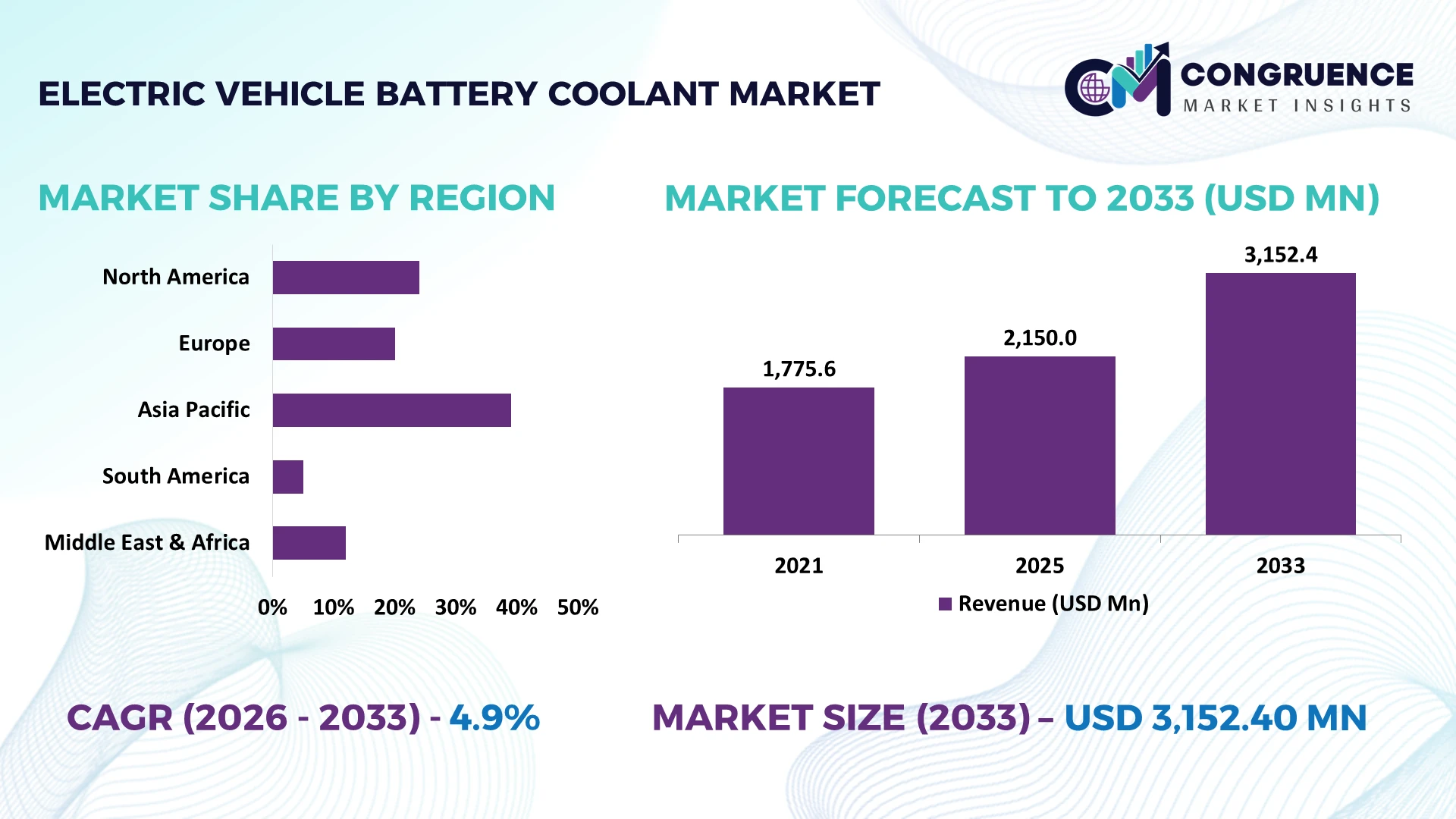
The Global Electric Vehicle Battery Coolant Market was valued at USD 2150 Million in 2025 and is anticipated to reach a value of USD 3152.4 Million by 2033 expanding at a CAGR of 4.9% between 2026 and 2033. Growth is driven by 800 V fast-charging architectures, higher battery power density, stricter thermal-safety requirements, and OEM migration toward low-conductivity and dielectric cooling fluids.
China anchors global electric vehicle battery coolant demand, producing 70% of electric cars and more than 80% of battery cells in 2025. Electric vehicles exceeded 50% of Chinese new-car sales, while domestic battery manufacturers controlled nearly 75% of global battery deployment. Shanghai-based production of low-electrical-conductivity coolants also strengthens China's integration of battery, chemical, automotive, and thermal-management supply chains. China's EV penetration exceeds the United States by more than 40 percentage points, while EU trade measures on Chinese EVs and U.S. localization policies are accelerating regional battery and coolant sourcing outside China.
Strategically, coolant suppliers combining low conductivity, corrosion protection, fast-charging thermal stability, and localized OEM qualification will capture the highest-value positions as battery cooling becomes a safety-critical EV subsystem.
Market Size & Growth: USD 2.15 billion in 2025 advances to USD 3.15 billion by 2033 at 4.9%, supported by high-voltage battery thermal management.
Top Growth Drivers: Global EV sales increased above 20%, BEVs represented 65% of electric-car sales, and China produced over 80% of battery cells.
Short-Term Forecast: By 2028, advanced low-conductivity fluids will increasingly support 800 V platforms, targeting more stable electrical resistance and lower thermal-degradation risk.
Emerging Technologies: Low-conductivity glycol coolants, dielectric immersion fluids, and direct-cell cooling are shifting thermal management toward tighter temperature control and higher charging power.
Regional Leaders: By 2033, Asia-Pacific approaches USD 1.55 billion, Europe USD 720 million, and North America USD 600 million as local battery production expands.
Consumer/End-User Trends: Electric vehicles represented about 25% of global car sales in 2025, increasing coolant demand across battery packs, charging circuits, and power electronics.
Pilot/Case Example: In 2025, BASF commercialized China-compliant low-conductivity coolant meeting GB 29743.2-2025, strengthening protection against fluid decomposition and hydrogen generation.
Competitive Landscape: BASF holds an estimated 11% position, competing with Castrol, Shell, TotalEnergies, Valvoline, and specialized thermal-fluid formulators on conductivity control and OEM approvals.
Regulatory & ESG Impact: China's GB 29743.2-2025 became effective October 2025, establishing dedicated low-conductivity requirements for electrified vehicles with independent battery cooling circuits.
Investment & Funding: Approximately USD 41 billion of battery-cell manufacturing investments were announced globally in 2025, with China contributing about USD 31.5 billion.
Innovation & Future Outlook: China's 70% EV-production share and 800 V platform expansion are shifting supplier R&D toward immersion-ready fluids, material compatibility, lifetime stability, and localized formulations.
The Electric Vehicle Battery Coolant Market is increasingly concentrated around battery-electric cars, fast-charging systems, high-voltage packs, commercial EVs, and performance-focused thermal architectures. With electric cars representing roughly 25% of global vehicle sales, low-conductivity coolants and dielectric immersion fluids are gaining strategic relevance. China's new coolant standard and localized battery supply chains now set the stage for deeper technology and competitive analysis.
Battery coolant is becoming a strategic EV performance material as charging power, pack density, and thermal-safety requirements intensify. Electric cars represented roughly 25% of global car sales in 2025, while China supplied more than 80% of battery cells. China’s GB 29743.2-2025 standard formalized low-conductivity coolant requirements, shifting competition toward validated electrical insulation, corrosion protection, and material compatibility.
Conventional water-glycol indirect cooling offers roughly 0.4–0.6 W/m·K thermal conductivity, but direct dielectric immersion removes intermediate cold plates and thermal-interface layers, reducing cell-to-fluid thermal resistance by more than 20% in optimized systems. China leads deployment scale, Europe emphasizes safety and lifecycle performance, while U.S. investment targets fast-charging and localized battery production. These differences are driving region-specific coolant qualification rather than universal formulations.
Through 2026–2028, 800 V architectures and charging above 250 kW will increase demand for low-conductivity and dielectric fluids. BASF’s China-compliant low-conductivity coolant demonstrates practical adaptation to new standards. Suppliers are expanding localized formulation, testing, and OEM partnerships. Competitive advantage will depend on controlling conductivity throughout coolant life, not simply initial thermal performance, making fluid durability a critical battery-system design parameter.
Fast-charging deployment is increasing battery coolant performance requirements as EV platforms move toward 400–800 V electrical architectures. Electric cars represented approximately 25% of global car sales in 2025, China exceeded 50% electric-car penetration, and battery-electric models accounted for roughly 65% of worldwide electric-car sales. Charging at 250–350 kW concentrates substantial heat generation into short operating windows, requiring tighter cell-temperature uniformity and higher coolant-flow control. China’s October 2025 implementation of GB 29743.2 formalized requirements for low-conductivity cooling fluids in electrified vehicles. Coolant manufacturers are responding with dedicated EV formulations, improved inhibitor packages, and OEM-specific validation. The strategic shift is clear: charging speed increasingly depends on thermal-system capability, making coolant chemistry an enabling component of vehicle charging performance rather than routine maintenance fluid.
EV-specific coolants require tighter electrical conductivity, corrosion, elastomer compatibility, and long-duration stability specifications than conventional automotive antifreeze. China produces more than 80% of global battery cells and approximately 70% of electric cars, concentrating qualification activity around Asian battery and vehicle platforms. Meanwhile, lithium iron phosphate represented nearly 50% of the global EV battery market in 2025, while nickel-based chemistries retained different thermal characteristics, complicating universal coolant formulation. Regulatory divergence adds cost: China now applies dedicated low-conductivity coolant specifications while other major markets rely on different OEM protocols. Suppliers are mitigating fragmentation through regional laboratories, standardized base-fluid platforms, localized additive packages, and longer OEM contracts. The hidden commercial restraint is validation duplication—chemically similar fluids can require separate testing across battery chemistries, pack materials, cooling architectures, and vehicle manufacturers.
Direct immersion cooling creates a higher-value pathway because dielectric fluids contact cells directly, eliminating conventional cold plates and reducing thermal interfaces. Optimized immersion systems can lower cell-to-fluid thermal resistance by more than 20%, while advanced designs target battery temperature variation below 5°C during demanding operation. This becomes strategically relevant as 800 V platforms and charging rates above 250 kW expand across Chinese and European premium EVs. Dielectric fluids also create opportunities in electric commercial vehicles, high-performance cars, stationary battery systems, and battery testing equipment. Fluid companies are investing in low-viscosity dielectric chemistry, material-compatibility testing, and partnerships with battery-pack and thermal-system developers. The non-obvious opportunity is lifecycle services: suppliers that combine fluids with condition monitoring, filtration, testing, and replacement protocols can capture recurring value beyond initial vehicle filling.
Maintaining coolant properties throughout an EV’s operating life is more difficult than achieving specification at initial fill. Battery systems typically target operating temperatures around 20–40°C, while fast charging, sub-zero starts, and high ambient temperatures repeatedly stress inhibitors, polymers, seals, and electrical characteristics. Even low-conductivity fluids can accumulate ionic contamination through material leaching and degradation, undermining electrical resistance and corrosion protection. Battery warranties commonly extend to 8 years or roughly 160,000 kilometers, forcing coolant performance to align with long-duration pack reliability. China’s dedicated low-conductivity standard further raises validation expectations for suppliers serving high-volume EV programs. Companies must invest in accelerated aging, conductivity monitoring, multi-material corrosion testing, and predictive fluid diagnostics. The decisive execution challenge is proving stable coolant chemistry across years of thermal cycling without imposing frequent service intervals that weaken EV ownership economics.
Low-Conductivity Fluids Become Standard: China’s GB 29743.2-2025 took effect in October 2025, formalizing dedicated requirements for electric-vehicle coolant as domestic EV sales exceeded 50% of new cars. Suppliers are reformulating glycol systems around conductivity stability, corrosion inhibition, and hydrogen suppression, while expanding domestic testing. The operational shift increases qualification work but creates stronger differentiation for fluids engineered specifically around high-voltage battery circuits.
Immersion Cooling Moves Toward Deployment: Direct dielectric cooling is progressing from laboratory evaluation toward vehicle-level demonstration. Shell’s 34 kWh immersion-cooled pack reached 10–80% charge in under 10 minutes and delivered up to five times more range addition per charging minute than typical BEVs. Fluid developers are partnering with battery engineers to eliminate cold plates, simplify coolant routing, and enable higher current without proportionally increasing thermal stress.
Single-Fluid Architectures Simplify Systems: Thermal engineers are testing one dielectric fluid across batteries, motors, and power electronics instead of maintaining separate glycol and oil circuits. Shell demonstrated compatibility with existing drivetrain hardware while maintaining 99.5%-pure base-fluid chemistry. Consolidating reservoirs, pumps, and dedicated circuits reduces packaging complexity, assembly steps, and supply-chain interfaces, prompting fluid suppliers to collaborate earlier with vehicle-platform designers.
Storage Systems Expand Coolant Adjacencies: Global battery-storage additions reached 108 GW in 2025, increasing 40% year-on-year, while LFP represented about 90% of deployments. Thermal-fluid companies are adapting EV-derived cooling chemistry for stationary packs, where longer discharge durations increase sustained heat-management requirements. This creates a non-obvious diversification route beyond automotive cycles and encourages partnerships with containerized storage and thermal-system integrators.
Glycol-Based coolants account for approximately 46% of the Electric Vehicle Battery Coolant Market, supported by mature ethylene-glycol and propylene-glycol supply chains, strong freeze protection, corrosion-inhibitor compatibility, and established indirect cold-plate architectures. Water-Based formulations represent around 25%, benefiting from high specific heat capacity but requiring rigorous electrical isolation. Silicone-Based products hold approximately 10%, serving applications requiring chemical stability and broader operating-temperature capability.
Fluorinated fluids, representing approximately 13%, are the fastest-growing type because their dielectric characteristics support direct immersion and high-voltage battery architectures. Bio-Based formulations remain near 6% but attract development investment where lower lifecycle impact can be achieved without sacrificing thermal stability. Suppliers are reallocating R&D from conventional additive optimization toward low-conductivity glycol chemistry and dielectric fluids. Glycol remains economically attractive for established platforms, whereas fluorinated and silicone technologies capture higher-value programs requiring direct cell contact, reduced electrical risk, and tighter thermal control.
Battery Thermal Management accounts for approximately 36% of application demand because pack temperature directly influences charging performance, degradation, safety, and usable power. Battery Pack Cooling contributes approximately 27%, reflecting widespread use of liquid cold plates and distributed coolant channels. Thermal Runaway Control represents around 11%, while Energy Storage Systems account for approximately 8% as stationary battery deployment increasingly requires sustained temperature regulation.
Fast-Charging Systems, holding approximately 18%, are the fastest-growing application as 800 V architectures and charging above 250 kW compress heat generation into shorter intervals. Shell’s immersion-cooled 34 kWh battery demonstrated 10–80% charging in under 10 minutes, showing how fluid technology can remove charging-rate constraints created by heat. Suppliers are therefore developing lower-viscosity dielectric fluids, optimized glycol packages, and direct-cell cooling systems. Investment is shifting toward coolants that support both normal cycling and extreme charging events, making transient heat rejection a stronger purchasing criterion than basic freeze protection.
Electric Vehicle Manufacturers represent approximately 41% of end-user demand because OEMs specify factory-fill chemistry, coolant lifecycle, conductivity limits, material compatibility, and servicing requirements across complete battery platforms. Battery Manufacturers account for about 24%, increasingly participating earlier in thermal-system design as cell energy density and charging rates rise. Automotive Suppliers contribute approximately 17%, particularly through integrated pumps, cold plates, valves, and thermal modules. Charging Equipment Manufacturers represent roughly 7% where liquid-cooled charging systems create adjacent thermal-fluid requirements.
Energy Storage Companies, at approximately 11%, are the fastest-growing buyer group as stationary battery installations expand rapidly. Global battery-storage additions increased 40% in 2025 to 108 GW, broadening demand for fluids capable of continuous multi-hour thermal regulation. Coolant suppliers are responding with platform-specific formulations, joint validation programs, bulk supply contracts, condition-monitoring services, and localized blending. Future purchasing power therefore shifts toward buyers integrating coolant selection directly with battery safety, maintenance intervals, and thermal-control software.
Asia-Pacific accounted for the largest market share at 49% in 2025 however, Asia-Pacific is expected to register the fastest growth, expanding at a CAGR of 6.2% between 2026 and 2033.
Battery Localization Reshapes Coolant Qualification
North America accounts for approximately 20% of global Electric Vehicle Battery Coolant Market demand, concentrated in U.S. battery and EV manufacturing corridors across Michigan, Georgia, Tennessee, Kentucky, Nevada, and Texas. Electric cars represented roughly 10% of U.S. light-vehicle sales in 2025, while domestic cell manufacturing capacity continued expanding through joint ventures between automakers and battery producers. Localized pack production is moving coolant qualification closer to cell, cold-plate, and thermal-system engineering, increasing demand for low-conductivity glycol formulations validated against aluminum, polymers, elastomers, and electronic components. Higher-power DC charging also raises transient battery heat loads, strengthening requirements for thermal stability and corrosion control. Coolant suppliers are responding with local laboratories, OEM-specific formulations, extended-life additive packages, and partnerships across battery thermal-management ecosystems rather than treating EV coolant as conventional antifreeze.
United States Market Outlook: The United States provides the region's strongest addressable base through large-scale battery plants and expanding high-voltage EV platforms. More than 1.5 million plug-in vehicles were sold during 2024, while federally supported charging deployment is increasing high-power charging availability. Coolant suppliers positioned near battery plants gain faster validation cycles, lower logistics exposure, and closer access to pack engineers specifying conductivity and material-compatibility requirements.
Regulation Pushes Lifetime Thermal Performance
Europe represents approximately 23% of global battery coolant demand, with Germany, France, the United Kingdom, Sweden, Hungary, and Poland forming major EV production and battery-system clusters. Battery-electric vehicles represented about 17% of EU new-car registrations in 2025, increasing factory-fill and service demand for dedicated battery coolants. Stricter fleet-emission requirements are accelerating electric-platform deployment, while Europe's developing battery manufacturing base is strengthening local validation of thermal fluids. German premium vehicles increasingly use 800 V architectures, raising requirements for electrical conductivity control, thermal stability, and compatibility with aluminum cooling plates. BASF, Shell, Castrol, TotalEnergies, and specialized formulators compete through OEM approvals, extended fluid life, and localized technical support. Battery recycling requirements add another consideration: coolant chemistry must increasingly align with safe pack servicing, disassembly, material recovery, and circular battery operations.
Germany Market Outlook: Germany combines premium EV engineering with established chemical, automotive, and thermal-management industries. Battery-electric vehicles represented approximately 19% of German passenger-car registrations in 2025, reinforcing demand for specialized thermal fluids. Porsche, Audi, BMW, and Mercedes-Benz deployments create a strong qualification environment for coolants supporting high-voltage batteries, rapid charging, cold-weather operation, and increasingly integrated vehicle thermal systems.
Battery Scale Creates Formulation Leadership
Asia-Pacific commands approximately 49% of global Electric Vehicle Battery Coolant Market demand, anchored by China's unmatched battery and electric-vehicle manufacturing scale. China produced more than 80% of global battery cells and approximately 70% of electric cars in 2025, creating dense demand around Guangdong, Shanghai, Jiangsu, Zhejiang, Anhui, and other manufacturing hubs. China's GB 29743.2-2025 standard, effective from October 2025, establishes dedicated technical requirements for low-conductivity coolants used in electrified vehicles, accelerating formulation specialization and testing. Japan and South Korea contribute advanced battery materials, automotive engineering, and high-value thermal-management expertise, while India is expanding localized cell and EV production. Suppliers are establishing regional blending, conductivity testing, corrosion laboratories, and OEM qualification programs. The region's strategic advantage increasingly extends from manufacturing volume into coolant specifications, chemistry development, and direct integration with battery-platform engineering.
China Market Outlook: China provides the industry's deepest coolant commercialization environment because electric vehicles exceeded 50% of domestic new-car sales in 2025. Its combination of CATL, BYD, major vehicle manufacturers, chemical suppliers, and thermal-system producers enables rapid formulation-to-platform validation. Dedicated low-conductivity regulation further advantages suppliers with domestic laboratories, standardized testing capabilities, and formulations optimized for locally manufactured cells and cooling hardware.
Electrified Imports Create Service-Led Demand
South America contributes approximately 3% of global Electric Vehicle Battery Coolant Market demand, with Brazil accounting for the largest operational base. Brazil's electrified light-vehicle registrations exceeded 170,000 units in 2024, supported by accelerating battery-electric and plug-in hybrid adoption. Chinese vehicle brands are increasing local market penetration and manufacturing commitments, creating new requirements for OEM-approved battery coolants rather than conventional engine antifreeze. Brazil's established automotive chemicals, distribution, and service networks provide infrastructure for localized blending and aftermarket supply, but limited domestic battery-cell production restricts deeper upstream integration. Suppliers are therefore emphasizing imported concentrate, local finishing, dealer distribution, and vehicle-specific coolant compatibility. As EV parc expands, replacement demand becomes strategically important because workshops must prevent cross-contamination between conventional cooling fluids and electrically sensitive battery circuits.
Brazil Market Outlook: Brazil offers the strongest regional pathway through BYD and GWM manufacturing investments, established vehicle assembly, and rapidly expanding electrified-model availability. Plug-in vehicles already represent a meaningful share of electrified registrations. Suppliers combining locally packaged coolant with OEM compatibility databases and technician education gain an advantage because servicing increasingly requires chemistry matched to battery cold plates, seals, hoses, and electrical-conductivity specifications.
Extreme Heat Elevates Thermal Reliability
Middle East & Africa represents approximately 5% of global battery coolant demand, with the UAE, Saudi Arabia, Morocco, Israel, and South Africa providing the most relevant deployment and manufacturing ecosystems. Gulf ambient temperatures frequently exceed 40°C, placing sustained loads on battery cooling loops and increasing the importance of oxidation stability, corrosion inhibition, and fluid longevity. Saudi Arabia is developing EV manufacturing through Lucid and Ceer, while Morocco's established automotive export industry provides a potential localization platform for EV thermal components and fluids. Lucid's Jeddah operation has initial capacity of 5,000 vehicles annually, establishing direct demand for battery-system consumables. Coolant companies targeting these markets are prioritizing high-temperature validation, localized distribution, OEM approvals, and long-life formulations. Operational reliability under extreme heat provides a stronger differentiation point than basic freeze protection.
Saudi Arabia Market Outlook: Saudi Arabia combines new EV manufacturing capacity with unusually demanding thermal operating conditions. Lucid's Jeddah facility is designed to progress from 5,000 vehicles annually toward substantially larger production, while Ceer is developing a domestic EV ecosystem. This creates opportunities for locally qualified coolant suppliers offering high-temperature stability, low conductivity, corrosion protection, and technical support aligned with battery-pack production and servicing.
BASF, Shell, Castrol, TotalEnergies and Valvoline compete for OEM-approved battery coolant programs, while specialized dielectric-fluid developers challenge glycol incumbents in direct immersion cooling. The top five suppliers hold approximately 43% of organized demand, reflecting established automotive approvals and chemical manufacturing scale. BASF commands about 11%, while other leaders individually hold approximately 6–10%. Competition centers on conductivity stability, corrosion protection, material compatibility, fluid life and localized supply; advanced formulations target conductivity below 100 µS/cm, while extended-life products reduce replacement frequency by approximately 20–30%. Leaders are expanding regional blending, partnering with battery-system developers and developing dielectric fluids for direct-cell cooling. Competition is shifting from modified antifreeze toward EV-specific thermal chemistry and validated lifecycle performance. OEM qualification, multi-material testing and long validation cycles remain decisive barriers. Winning requires locally manufactured, regulation-compliant fluids that preserve electrical properties, thermal performance and component protection throughout battery service life while supporting high-voltage charging architectures at scale.
BASF SE
Shell plc
Castrol
TotalEnergies SE
Valvoline Global Operations
Exxon Mobil Corporation
Chevron Corporation
FUCHS SE
PETRONAS Lubricants International
Arteco
Prestone Products Corporation
Recochem Inc.
LIQUI MOLY GmbH
Motul S.A.
Current EV battery coolant technology is dominated by water-glycol indirect cooling, low-conductivity inhibitors, aluminum-compatible corrosion packages, and electronically controlled cold-plate loops. Dedicated low-electrical-conductivity fluids reduce leakage-current risk while maintaining thermal transfer, with optimized formulations targeting conductivity below 100 µS/cm. Compared with conventional multifunction antifreeze, EV-specific coolant can reduce electrical decomposition risk materially while extending battery-system protection across high-voltage duty cycles.
Emerging technology centers on dielectric immersion cooling, direct-cell contact, low-viscosity synthetic fluids, and integrated battery thermal management. Shell demonstrated a 34 kWh immersion-cooled pack charging from 10% to 80% in under 10 minutes, while direct cooling removes intermediate cold plates and increases active heat-transfer area. XING Mobility’s cell-to-chassis immersion architecture reports more than 35% higher energy density, creating packaging, charging, and safety advantages for performance EV platforms.
Disruptive development is shifting toward single-fluid thermal circuits, predictive coolant monitoring, and formulations engineered for 800 V systems. Integration can reduce pumps, hoses, interfaces, and pack mass while improving serviceability. From 2026–2028, OEMs will prioritize lifetime conductivity stability, material compatibility, and immersion-ready chemistries. Suppliers with validated fluids, battery-system partnerships, and localized testing gain the strongest competitive advantage because coolant qualification increasingly influences charging speed, safety, platform durability and long-term ownership economics globally directly.
March 2025 — CATL was listed among drafting organizations for China’s GB 29743.2-2025 electric-vehicle coolant standard, published March 28 and effective October 1. The regulation formalized low-conductivity coolant requirements for independent battery cooling circuits, raising qualification requirements nationwide.
September 2025 — BASF launched GLYSANTIN ELECTRIFIED low-electrical-conductivity coolants in China, compliant with GB 29743.2-2025 effective October 1. Production at Shanghai’s Pudong site strengthens localized EV battery safety, reducing fluid decomposition and hydrogen-generation risks for high-voltage battery circuits.
September 2025 — Shell and RML Group demonstrated a 34 kWh immersion-cooled battery using EV-Plus Thermal Fluid, charging from 10% to 80% in under 10 minutes. The result validates dielectric cooling for faster charging without compromising battery safety.
February 2025 — TotalEnergies integrated Cell-Shield immersion cooling into a Renault Mégane E-Tech prototype, demonstrating battery cooling in a mass-market EV platform. The project removed conventional cooling-system constraints while targeting faster charging, reduced weight, improved safety and scalability.
The Electric Vehicle Battery Coolant Market Report covers coolant technologies, battery thermal-management applications, vehicle-platform requirements, and OEM/Tier-1 demand across North America, Europe, Asia-Pacific, South America, and Middle East & Africa. Asia-Pacific represents about 49% of current demand, reflecting China’s battery-cell and EV manufacturing concentration. Technology coverage includes low-conductivity glycol fluids, dielectric immersion coolants, corrosion inhibitors, cold-plate systems, direct-cell cooling, and integrated thermal circuits.
The report evaluates deployment patterns across passenger EVs, commercial electric vehicles, high-voltage fast-charging platforms, battery manufacturers, automotive OEMs, thermal-system suppliers, and specialized fluid formulators. Electric cars represented roughly 25% of global car sales in 2025, strengthening coolant qualification requirements across new platforms. The 2026–2033 assessment supports investment planning, localization decisions, partnership strategy, product development, regulatory readiness, competitive positioning, and identification of emerging opportunities in immersion cooling, 800 V architectures, long-life fluids, and battery-service ecosystems.
| Report Attribute/Metric | Report Details |
|---|---|
Market Revenue in 2025 | USD 2150 Million |
Market Revenue in 2033 | USD 3152.4 Million |
CAGR (2026 - 2033) | 4.9% |
Base Year | 2025 |
Forecast Period | 2026 - 2033 |
Historic Period | 2021 - 2025 |
Segments Covered | By Type
By Application
By End-User
|
Key Report Deliverable | Revenue Forecast, Growth Trends, Market Dynamics, Segmental Overview, Regional and Country-wise Analysis, Competition Landscape |
Region Covered | North America, Europe, Asia-Pacific, South America, Middle East, Africa |
Key Players Analyzed | BASF SE, Shell plc, Castrol, TotalEnergies SE, Valvoline Global Operations, Exxon Mobil Corporation, Chevron Corporation, FUCHS SE, PETRONAS Lubricants International, Arteco, Prestone Products Corporation, Recochem Inc., LIQUI MOLY GmbH, Motul S.A. |
Customization & Pricing | Available on Request (10% Customization is Free) |




