Global Electric Spin Scrubber Market Report Overview
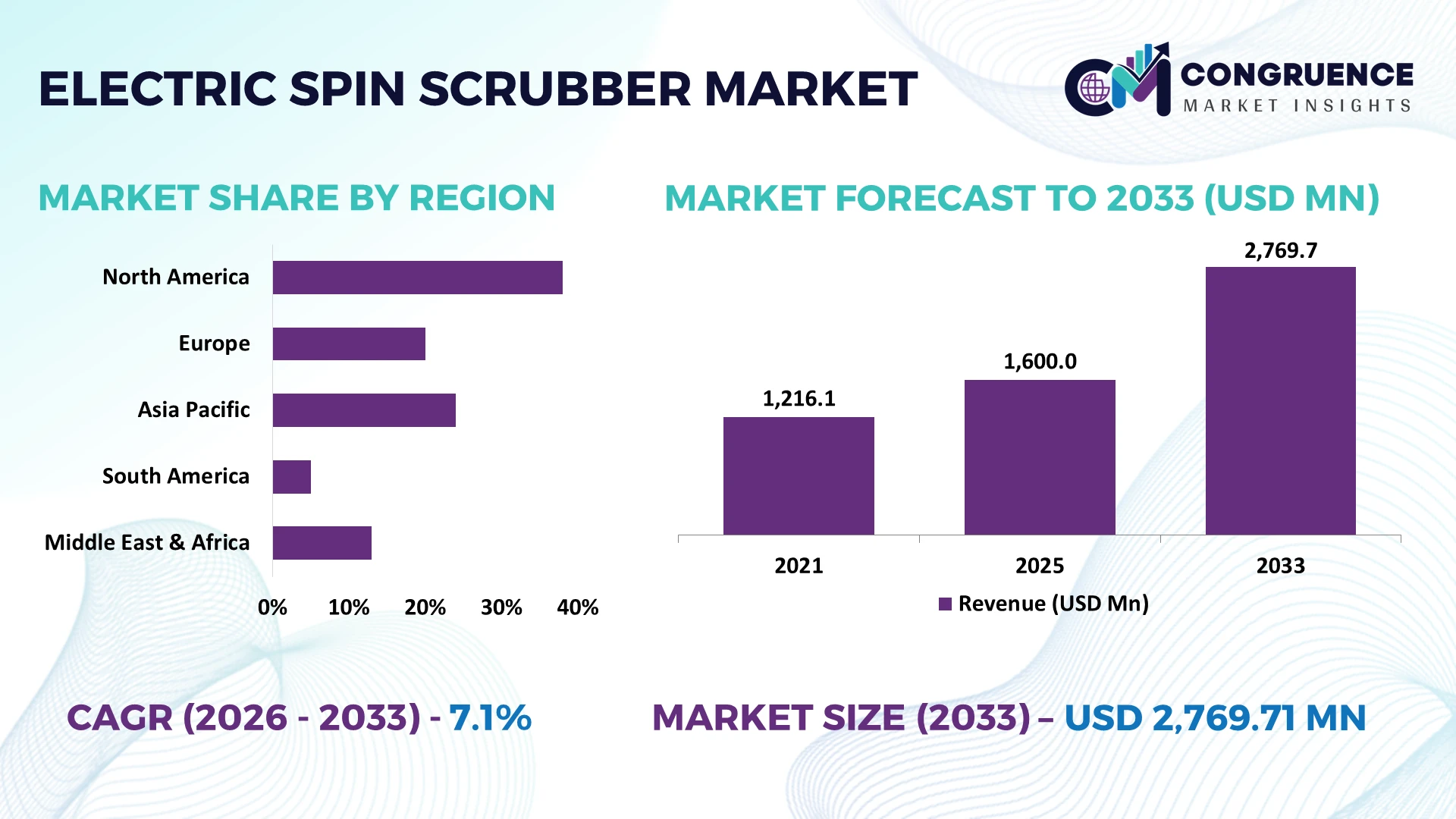
The Global Electric Spin Scrubber Market was valued at USD 1600 Million in 2025 and is anticipated to reach a value of USD 2769.71 Million by 2033 expanding at a CAGR of 7.1% between 2026 and 2033. Growth is driven by cordless motor technology, rechargeable lithium-ion batteries, interchangeable cleaning heads, and high-torque designs that reduce manual scrubbing across bathrooms, kitchens, floors, and commercial sanitation environments.
The United States maintains the strongest country-level position, accounting for approximately 28.5% of the 2025 market in an independent country-level estimate. Its leadership reflects established home-improvement retail, high household appliance expenditure, and strong e-commerce penetration. The market benefits from established brands and premium cordless cleaning products. China, with an estimated USD 126.68 million market, strengthens its position through manufacturing scale and affordable product exports, while India records USD 41.18 million. This contrast highlights the United States' consumption advantage and Asia's manufacturing and expansion potential.
For manufacturers, prioritizing premium product differentiation in North America and cost-efficient manufacturing partnerships in Asia offers a stronger competitive positioning strategy.
Key Highlights of the Global Electric Spin Scrubber Market
-
Market Size & Growth: USD 1,600 million (2025) to USD 2,769.71 million (2033), at 7.1% CAGR, driven by cordless cleaning innovation.
-
Top Growth Drivers: 6.7% estimated purchase conversion, 3.3% quarterly search growth, and 47% top-five brand click concentration in the US online market.
-
Short-Term Forecast: By 2028, manufacturers targeting 20% faster cleaning cycles through optimized motor speeds and interchangeable brush systems gain product differentiation.
-
Emerging Technologies: Dual-speed motors, lithium-ion batteries, IPX7 waterproofing, and LCD battery displays strengthen product functionality.
-
Regional Leaders: North America USD 991.6 million, Europe USD 725.7 million, and Asia-Pacific USD 728.4 million by 2033, supported by premium appliance adoption, cordless cleaning upgrades, and expanding online retail respectively.
-
Consumer Trends: Residential buyers increasingly prioritize extendable handles, multiple brush attachments, and rechargeable operation over conventional manual brushes.
-
Pilot/Case Example: 2026 product configurations featuring 8 interchangeable brush heads and up to 90 minutes of operating time demonstrate the industry's shift toward multipurpose cleaning equipment.
-
Competitive Landscape: Competition includes BLACK+DECKER, RYOBI, Bosch, Dremel, Rubbermaid, HOTO, Leebein, and LABIGO; fragmented competition makes product reliability and distribution critical.
-
Regulatory & ESG Impact: EU Battery Regulation 2023/1542 strengthens battery sustainability, recycling, labelling, and supply-chain compliance; global battery demand is projected to increase 14-fold by 2030.
-
Investment & Funding: Manufacturers are prioritizing cordless product development, waterproof motor engineering, accessory expansion, and manufacturing partnerships; no independently verified aggregate investment figure is available.
-
Innovation & Future Outlook: Next-generation products increasingly combine adjustable torque, ergonomic extension systems, replaceable batteries, and durable brush materials, shifting competition toward long-term usability rather than low pricing.
The Electric Spin Scrubber Market is experiencing a shift toward multifunctional cordless cleaning equipment, particularly across bathroom sanitation, kitchen surfaces, floor maintenance, and commercial housekeeping. Approximately 47% of top-five brand clicks in the US online marketplace indicate meaningful brand concentration alongside opportunities for differentiated products. Recent innovations include adjustable-speed motors, waterproof charging architectures, LCD battery indicators, and interchangeable brush attachments. Meanwhile, EU battery sustainability requirements are increasing the importance of traceable components and responsible battery disposal. Manufacturers are consequently prioritizing product durability, accessory compatibility, and distribution efficiency as central competitive advantages.
What Is the Strategic Relevance and Future Pathways of the Electric Spin Scrubber Market?
The Electric Spin Scrubber Market is becoming strategically important as household cleaning shifts from manual tools toward rechargeable, motorized equipment that reduces physical effort and cleaning time. Competition increasingly depends on motor durability, battery performance, waterproof construction, and interchangeable brush systems rather than product pricing alone. Lithium-ion battery integration and direct-to-consumer distribution are reshaping product development and retail strategies, while manufacturers are strengthening supplier relationships to manage component costs and product availability.
Compared with conventional manual scrubbing, powered rotary brushes deliver continuous mechanical cleaning action and reduce repetitive physical effort. Product configurations offering 200–400 RPM, adjustable operating speeds, and 60–90 minutes of battery runtime illustrate the functional advantage of motorized equipment. US manufacturers prioritize premium ergonomics and product differentiation, whereas Chinese producers benefit from manufacturing scale, component sourcing, and competitive pricing.
A representative deployment is the adoption of 300–400 RPM scrubbers with 60–90-minute operating capacity and 8 interchangeable brush heads for bathrooms, tiled floors, and hard-to-reach surfaces. Through 2027–2028, manufacturers are expected to prioritize longer battery life, replaceable components, stronger waterproofing, and localized after-sales networks. Competitive advantage will increasingly depend on lifecycle reliability and accessory availability rather than headline motor speed alone.
Electric Spin Scrubber Market Dynamics
DRIVER:
Cordless Cleaning and Multifunctional Product Adoption
The transition toward convenient, motor-assisted household cleaning is strengthening product demand. A 2025 US housewares industry survey found that 70% of consumers planned to purchase cleaning tools, with replacement accounting for 50% of purchase motivation. Dual-speed motors operating at 300–400 RPM, rechargeable batteries, and interchangeable brush heads address repetitive bathroom, grout, and floor-cleaning tasks. China's established small-appliance manufacturing ecosystem supports competitive product development, while US brands emphasize ergonomics and premium functionality. Manufacturers are responding through modular brush systems, improved battery capacity, and online distribution partnerships. The key advantage lies in converting a low-involvement cleaning accessory into a differentiated rechargeable appliance.
RESTRAINT:
Price Sensitivity and Product Commoditization
Price sensitivity limits premium positioning because consumers continue to perceive cleaning tools as functional, frequently replaceable household accessories. A 2025 US housewares survey found that 40% of consumers were unwilling to pay more for cleaning tools despite product innovation, while only 26% accepted a 1–9% price premium. This restricts manufacturers' ability to recover investments in advanced motors, lithium-ion batteries, and waterproof assemblies through higher selling prices. Low-cost Chinese suppliers intensify competition in entry-level categories. Companies are mitigating margin pressure through component standardization, localized assembly, multi-head product bundles, and differentiated warranty packages. The critical commercial priority is demonstrating measurable durability rather than competing exclusively on initial purchase price.
OPPORTUNITY:
Modular Product Platforms and Emerging Household Markets
Significant opportunities exist in converting traditional cleaning routines into multipurpose powered-cleaning applications. A 2025 US consumer survey found that 81.7% of respondents regularly used cloths and disinfectants, while 80% used brooms weekly, demonstrating the established penetration of conventional cleaning methods. Manufacturers can target this installed consumer base with interchangeable brush heads, adjustable extension handles, and surface-specific cleaning attachments. In India, expanding organized retail and online appliance distribution create opportunities for affordable cordless models. Product development featuring 6–9 attachments, replaceable brush assemblies, and improved battery capacity supports broader household applications. Companies investing in modular designs and regional distribution partnerships can increase accessory sales and strengthen repeat-purchase opportunities.
CHALLENGE:
Product Reliability and Battery Lifecycle Management
Maintaining consistent performance across repeated wet-cleaning applications remains a significant execution challenge. Water ingress, motor overheating, battery degradation, and brush-head wear directly affect product reliability and warranty costs. Manufacturers must balance waterproofing, battery capacity, torque, and overall device weight without compromising ergonomic performance. The European Union's Battery Regulation introduces additional product-design obligations, with Article 11 battery removability and replaceability requirements applying from 18 February 2027 and provisions requiring spare-battery availability for at least five years after the final model unit enters the market. Companies must strengthen sealing validation, battery lifecycle testing, component traceability, and after-sales infrastructure. Long-term competitiveness depends on engineering products for sustained operation, repairability, and consistent quality across manufacturing batches.
Electric Spin Scrubber Market Latest Trends
-
Waterproofing and Motor Reliability: Manufacturers are strengthening IP-rated enclosures, sealed charging ports, and moisture-resistant motor assemblies to reduce failures during prolonged wet cleaning. IPX7-rated designs support immersion resistance up to 1 metre for 30 minutes, while 60–90-minute battery runtimes improve cleaning continuity. Companies are prioritizing seal testing, thermal protection, and longer warranty coverage to reduce replacement frequency and after-sales costs.
-
E-Commerce Product Differentiation: Online retail is changing how electric spin scrubbers compete, with product demonstrations, attachment comparisons, and customer reviews influencing purchasing decisions. Multi-head configurations offering 6–9 attachments and adjustable extension handles improve product visibility across household cleaning categories. Manufacturers are investing in direct-to-consumer channels, demonstration-led marketing, and bundled accessories to improve conversion and reduce dependence on price-based competition.
-
Battery Compliance and Repairability: European battery regulation is pushing manufacturers to reconsider sealed battery architectures and product lifecycle design. From 18 February 2027, EU requirements under Article 11 of Regulation (EU) 2023/1542 strengthen battery removability and replaceability obligations for covered products. Companies are redesigning battery compartments, fasteners, and service procedures to improve repairability. This transition increases initial engineering requirements but creates opportunities for longer product lifecycles, replacement-part sales, and reduced whole-device disposal.
-
Hygiene-Focused Precision Cleaning: Consumers are placing greater emphasis on bathroom sanitation, grout maintenance, and difficult-to-reach surfaces. The American Cleaning Institute's 2025 survey found that 56% prioritize toilet and shower cleaning, while 19% specifically prioritize hard-to-reach areas. Manufacturers are responding with angled brush heads, narrow grout attachments, and controlled-speed rotary systems. This specialization shifts competition toward application-specific performance, enabling differentiated product bundles instead of undifferentiated multipurpose scrubbers.
Segmentation Analysis
By Type
Cordless Models Lead as Telescopic Designs Gain Traction
Cordless Spin Scrubbers represent the leading product category, with an indicative 55% share of global unit demand, supported by portability, rechargeable operation, and freedom from power-cord restrictions. Their suitability for bathrooms, kitchens, and floor maintenance strengthens household adoption. Telescopic Scrubbers are the fastest-expanding configuration as adjustable handles improve access to ceilings, shower walls, and difficult-to-reach surfaces. Their growing relevance reflects demand for ergonomic cleaning rather than simply higher motor speeds. Manufacturers are prioritizing longer battery runtime, adjustable torque, and lightweight extension mechanisms to strengthen differentiation.
Corded Spin Scrubbers retain relevance in continuous-use environments where charging interruptions are undesirable. Handheld Scrubbers serve localized cleaning requirements, while Multi-Head Scrubbers attract buyers seeking multiple surface-cleaning functions within one device. An estimated 60–65% of product-development priorities are concentrated around cordless convenience and ergonomic versatility. Companies are increasingly allocating engineering resources toward modular accessories and battery optimization, while maintaining affordable corded and handheld alternatives.
- Industry-backed insight: The International Housewares Association's 2025 consumer research found that 70% of surveyed consumers planned to purchase cleaning tools, while 50% identified replacement as a purchase motivation, supporting the importance of differentiated product upgrades.
By Application
Bathroom Cleaning Leads as Specialized Surface Care Expands
Bathroom Cleaning holds the leading application position, with an indicative 34% share, driven by frequent toilet, shower, bathtub, and washbasin maintenance. Persistent moisture, soap deposits, and surface buildup create recurring cleaning requirements suited to powered rotary brushes. Tile and Grout Cleaning represents the fastest-growing application, supported by specialized narrow-brush attachments and demand for improved access to embedded dirt. Approximately 55% of product configurations increasingly emphasize specialized brush attachments and adjustable cleaning heads, strengthening application-specific differentiation.
Kitchen Cleaning remains an established use case for removing grease and residue, while Floor Cleaning benefits from extension handles and broader brush coverage. Window Cleaning serves a narrower market because glass requires controlled contact and suitable attachments. Vehicle Cleaning is expanding through demand for interior detailing, wheel maintenance, and localized surface cleaning. Manufacturers are increasingly developing application-specific attachment bundles rather than relying exclusively on standard brush configurations, improving product relevance across residential cleaning requirements.
- Industry-backed insight: The American Cleaning Institute's 2025 survey found that 56% of US consumers prioritize toilet and shower cleaning, while 19% prioritize hard-to-reach areas, reinforcing demand for specialized bathroom and grout-cleaning attachments.
By End-User
Household Consumers Dominate as Professional Adoption Broadens
Household Consumers account for an indicative 72% of global demand, supported by recurring bathroom, kitchen, and floor-cleaning requirements and growing preference for convenient cordless appliances. Cleaning Service Providers represent the fastest-growing end-user category as professional operators prioritize ergonomic equipment, faster localized cleaning, and reduced repetitive manual effort. Their purchasing decisions increasingly emphasize battery runtime, motor durability, attachment replacement, and maintenance costs. An estimated 60% of household purchases favor multifunctional configurations, while professional buyers place greater importance on operating consistency and product durability. Manufacturers are developing differentiated pricing, extended warranties, and replacement-accessory packages to address these contrasting requirements.
Hotels and Resorts require specialized cleaning equipment for bathrooms and guest facilities, while Commercial Buildings prioritize routine surface maintenance. Healthcare Facilities demand controlled cleaning procedures and compatible sanitation practices, whereas Automotive Service Centers use scrubbers for vehicle interiors and localized detailing. Companies are strengthening institutional distribution partnerships and developing application-specific configurations. The strategic shift is toward professional-grade product variants, where repeat purchasing, accessory replacement, and service relationships create opportunities beyond individual household sales.
Industry-backed insight: The American Cleaning Institute's 2025 survey found that 68% of US respondents consider cleaning and hygiene very important for public health, reinforcing the importance of consistent cleaning practices across residential and institutional environments.
- Market-share figures identified as indicative analyst estimates are directional segmentation assumptions, not independently verified published market measurements. Consumer survey statistics represent broader cleaning-tool behavior, not electric spin scrubber-specific penetration.
Region-Wise Market Insights
North America accounted for the largest market share at approximately 38% in 2025; however, Europe is expected to register the fastest growth, expanding at an estimated CAGR of 10.4% between 2026 and 2033.
North America Electric Spin Scrubber Market
Premium Cordless Appliances and Established Retail Distribution Strengthen Market Leadership
North America represents approximately 38% of global demand, supported by established household appliance distribution, home-improvement retailers, and strong online product availability. The United States drives regional consumption through premium cordless cleaning equipment, multifunctional brush attachments, and rechargeable household appliances. Retailers such as Home Depot and Walmart provide established distribution channels for brands including RYOBI and BLACK+DECKER. Product configurations featuring 60–90-minute battery runtimes and telescopic handles strengthen adoption across residential and professional cleaning applications. Canadian demand complements US consumption through household appliance replacement and home-maintenance spending. Manufacturers are prioritizing direct-to-consumer distribution, product demonstrations, and extended accessory portfolios. Competition increasingly depends on product reliability, ergonomic design, and retail visibility rather than entry-level pricing alone.
United States Market Outlook: The United States leads North American consumption through established home-improvement retail networks, strong household appliance purchasing activity, and premium cleaning-equipment adoption. RYOBI's cordless power-tool ecosystem provides opportunities for cross-category product positioning, while BLACK+DECKER strengthens mainstream household distribution. Manufacturers are focusing on battery compatibility, interchangeable attachments, and warranty-backed product differentiation to strengthen customer retention.
Europe Electric Spin Scrubber Market
Battery Sustainability and Product Lifecycle Requirements Reshape Competition
Europe represents approximately 27% of global demand, with Germany, the United Kingdom, France, and Italy supporting household appliance adoption. The European Union's Battery Regulation (EU) 2023/1542 is influencing battery design, material traceability, removability, and recycling requirements. From February 2027, applicable battery-removability provisions increase the importance of serviceable product architectures. This regulatory transition creates additional engineering requirements for manufacturers selling rechargeable cleaning equipment. Germany's established appliance engineering capabilities and European specialty retailers strengthen premium product positioning. Manufacturers are increasingly prioritizing replaceable battery systems, durable motor assemblies, and repair-oriented product designs. The region's competitive advantage increasingly comes from compliance readiness and product lifecycle differentiation rather than manufacturing scale.
Germany Market Outlook: Germany benefits from established household appliance manufacturing, engineering expertise, and strong retail distribution infrastructure. Companies such as Kärcher and Leifheit provide established positions in cleaning equipment and household maintenance products. The country's emphasis on product quality and European battery compliance encourages manufacturers to strengthen waterproofing, component durability, and repairability. German distribution networks also provide access to neighboring European markets.
Asia-Pacific Electric Spin Scrubber Market
China's Manufacturing Scale Accelerates Cost-Competitive Product Expansion
Asia-Pacific represents approximately 22% of global demand, with China serving as the principal manufacturing and export hub for electric spin scrubbers. Its established electronics supply chain supports the procurement of lithium-ion batteries, compact motors, plastic housings, and charging components. Chinese manufacturers benefit from integrated sourcing and contract manufacturing capabilities, enabling rapid production adjustments across different price categories. China also supports private-label production for international e-commerce brands. India, Japan, and South Korea contribute through expanding household appliance distribution and demand for convenient cleaning equipment. Manufacturers are increasingly investing in product customization, export partnerships, and quality-control systems. The region's strategic advantage lies in combining manufacturing efficiency with the ability to supply multiple international price segments.
China Market Outlook: China dominates the regional manufacturing ecosystem through its extensive small-appliance supply chain, electronics component availability, and established export infrastructure. Manufacturers can source motors, rechargeable battery packs, injection-moulded housings, and brush assemblies within integrated industrial networks. This reduces procurement complexity and supports shorter product-development cycles. Companies are strengthening quality assurance and international distribution partnerships to compete beyond low-cost manufacturing.
South America Electric Spin Scrubber Market
Modern Retail Expansion Creates Opportunities for Affordable Cordless Cleaning
South America accounts for approximately 6% of global demand, with Brazil representing the principal consumption market. Household appliance distribution, expanding e-commerce channels, and increasing availability of imported cleaning equipment support market development. Price sensitivity remains an important purchasing consideration, encouraging demand for entry-level cordless scrubbers and practical multifunctional configurations. Import dependence on Asian-manufactured motors, batteries, and assembled products exposes distributors to freight costs, currency fluctuations, and customs-related delays. Brazil's large consumer market provides opportunities for retailers and appliance distributors to introduce localized product portfolios. Manufacturers are responding through regional distribution agreements, affordable product configurations, and localized customer support. Competitive positioning depends on balancing import costs, retail affordability, and after-sales reliability.
Brazil Market Outlook: Brazil offers the strongest national demand opportunity in South America through its large household appliance market and established retail infrastructure. Online marketplaces and major appliance distributors provide access to imported cordless cleaning products. Manufacturers targeting Brazil are prioritizing competitive pricing, Portuguese-language product support, locally accessible replacement accessories, and distributor partnerships to reduce purchasing barriers and strengthen market penetration.
Middle East & Africa Electric Spin Scrubber Market
Hospitality Investment and Commercial Facility Expansion Support Adoption
The Middle East and Africa account for approximately 7% of global demand, with the United Arab Emirates, Saudi Arabia, and South Africa representing important commercial markets. Hospitality infrastructure, hotel construction, residential property development, and professional facility management support demand for powered cleaning equipment. Saudi Arabia's Vision 2030 development programme is accelerating hospitality and tourism infrastructure investment, creating additional cleaning-equipment procurement requirements. Hotels and commercial cleaning operators prioritize ergonomic equipment, waterproof construction, and interchangeable brush attachments for bathroom and surface maintenance. However, import dependence, distributor coverage, and replacement-part availability influence purchasing decisions. Manufacturers are strengthening regional distributor relationships and targeting hospitality procurement channels with durable, application-specific product configurations.
Saudi Arabia Market Outlook: Saudi Arabia benefits from expanding hospitality infrastructure, tourism development, and large-scale commercial property investment under Vision 2030. Hotel operators and facility-management companies require reliable cleaning equipment for guest bathrooms, tiled surfaces, and common facilities. Manufacturers can strengthen market access through partnerships with hospitality suppliers and professional cleaning distributors. Durable battery systems, accessible replacement accessories, and institutional product warranties provide important differentiation opportunities.
Market Competition Landscape
The competitive landscape combines established power-tool and cleaning-equipment brands with specialist cordless scrubber manufacturers. RYOBI and BLACK+DECKER compete through established retail networks, battery platforms, and recognizable household appliance portfolios, while Kärcher and Rubbermaid leverage cleaning-equipment expertise and institutional distribution. HOTO, Homitt, and ALLDIO compete through compact designs, interchangeable attachments, and cost-efficient manufacturing. The top-five players' combined market share is not independently verifiable through public disclosures; therefore, assigning a precise percentage would create false market concentration. Competition increasingly separates premium branded products from price-led private-label offerings. Product differentiation centers on battery runtime, motor durability, waterproofing, and attachment compatibility. Companies are expanding e-commerce distribution, strengthening OEM relationships, and improving accessory availability. Chinese manufacturing scale intensifies pricing pressure, while European battery requirements increase compliance-related design considerations. Entry barriers remain moderate in assembly but higher in brand development, quality assurance, and distribution. Winning requires reliable engineering, competitive sourcing, and strong after-sales support.
Companies Profiled in the Electric Spin Scrubber Market Report
-
RYOBI
-
BLACK+DECKER
-
Kärcher
-
Rubbermaid
-
HOTO
-
Leifheit
-
Homitt
-
ALLDIO
-
EVERTOP
-
FYUFY
-
Oh My Clean
-
YOUKADA
-
ELLESYE
-
ADPOW
Technology Insights for the Electric Spin Scrubber Market
Electric spin scrubber technology is advancing through higher-torque motors, dual-speed controls, and precision-engineered rotary brush assemblies. Earlier 300 RPM configurations are being complemented by models reaching 400 RPM, representing a 33.3% increase in maximum rotational speed. This improves available mechanical cleaning intensity, although rotational speed alone does not establish equivalent cleaning-time savings. RYOBI and HOTO are strengthening product differentiation through adjustable motor settings, ergonomic handles, and application-specific attachments.
Battery integration represents another important technology shift. Rechargeable lithium-ion systems, USB-C charging, and improved battery management support cordless operation, with advanced HOTO configurations offering up to 110 minutes of runtime. IPX7 waterproofing, digital battery displays, and replaceable brush assemblies improve operational versatility. Magnetic quick-change mechanisms and adjustable extension systems also reduce attachment replacement complexity.
Between 2026 and 2028, competitive differentiation will increasingly center on battery longevity, motor durability, lightweight materials, and modular product architecture. Professional-grade cordless platforms will benefit manufacturers with established battery ecosystems, while specialist brands gain opportunities through ergonomic innovation. Companies investing in waterproof electronics, replaceable components, and precision motor controls will strengthen product reliability and lifecycle competitiveness.
Recent Developments in the Global Electric Spin Scrubber Market
-
January 2024: HOTO introduced its Electric Spin Scrubber with 2.5 N·m torque, dual speeds of 220 and 300 RPM, and six interchangeable heads, strengthening its position in multifunctional cordless cleaning. The specifications demonstrate performance differentiation without published comparative cleaning-time trials. Source: hototools.com
-
March 2025: Makita expanded its 40VMax XGT cleaning range with the PS001G cordless scrubber-polisher, featuring IPX4 splash protection and a handle adjustable by 354 mm, extending professional surface-care applications. This move broadens cordless cleaning into more professional facility maintenance settings. Source: fmj.co.uk
-
April 2025: RYOBI introduced its USB Lithium Telescoping Power Scrubber, featuring interchangeable brushes, rechargeable battery operation, and an extendable handle reaching 47 inches. The launch strengthens its cordless cleaning portfolio and expands compatibility across its portable battery ecosystem. Source: youtube.com
-
October 2025: HOTO launched Flexi with five-position head adjustment, 4 N·m torque, eight interchangeable brushes, and remote pole controls, targeting hard-to-reach cleaning while differentiating through ergonomic flexibility. The design expands cleaning access while supporting premium product differentiation. Source: ifdesign.com
Scope of the Electric Spin Scrubber Market Report
The Electric Spin Scrubber Market Report examines five product categories: Cordless Spin Scrubbers, Corded Spin Scrubbers, Handheld Scrubbers, Telescopic Scrubbers, and Multi-Head Scrubbers. Application coverage includes bathroom, kitchen, floor, window, tile and grout, and vehicle cleaning. End-user analysis covers household consumers, cleaning service providers, hotels and resorts, commercial buildings, healthcare facilities, and automotive service centers.
Geographical coverage spans North America, Europe, Asia-Pacific, South America, and the Middle East and Africa, with country-level assessments of manufacturing capabilities, distribution networks, and consumption patterns. The report evaluates lithium-ion battery integration, motor performance, waterproofing, interchangeable brush systems, and ergonomic innovations. Competitive analysis examines established brands, specialist manufacturers, product differentiation, and distribution strategies. These insights support investment planning, market-entry assessment, product development, regional expansion, and competitive positioning throughout 2026–2033.
Electric Spin Scrubber Market Report Summary
| Report Attribute/Metric | Report Details |
|---|
Market Revenue in 2025 | USD 1600 Million |
Market Revenue in 2033 | USD 2769.71 Million |
CAGR (2026 - 2033) | 7.1% |
Base Year | 2025 |
Forecast Period | 2026 - 2033 |
Historic Period | 2021 - 2025 |
Segments Covered | By TypeBy ApplicationBy End-UserCleaning Service Providers Automotive Service Centers
|
Key Report Deliverable | Revenue Forecast, Growth Trends, Market Dynamics, Segmental Overview, Regional and Country-wise Analysis, Competition Landscape |
Region Covered | North America, Europe, Asia-Pacific, South America, Middle East, Africa |
Key Players Analyzed | RYOBI, BLACK+DECKER, Kärcher, Rubbermaid, HOTO, Leifheit, Homitt, ALLDIO, EVERTOP, FYUFY, Oh My Clean, YOUKADA, ELLESYE, ADPOW |
Customization & Pricing | Available on Request (10% Customization is Free) |





