
Reports
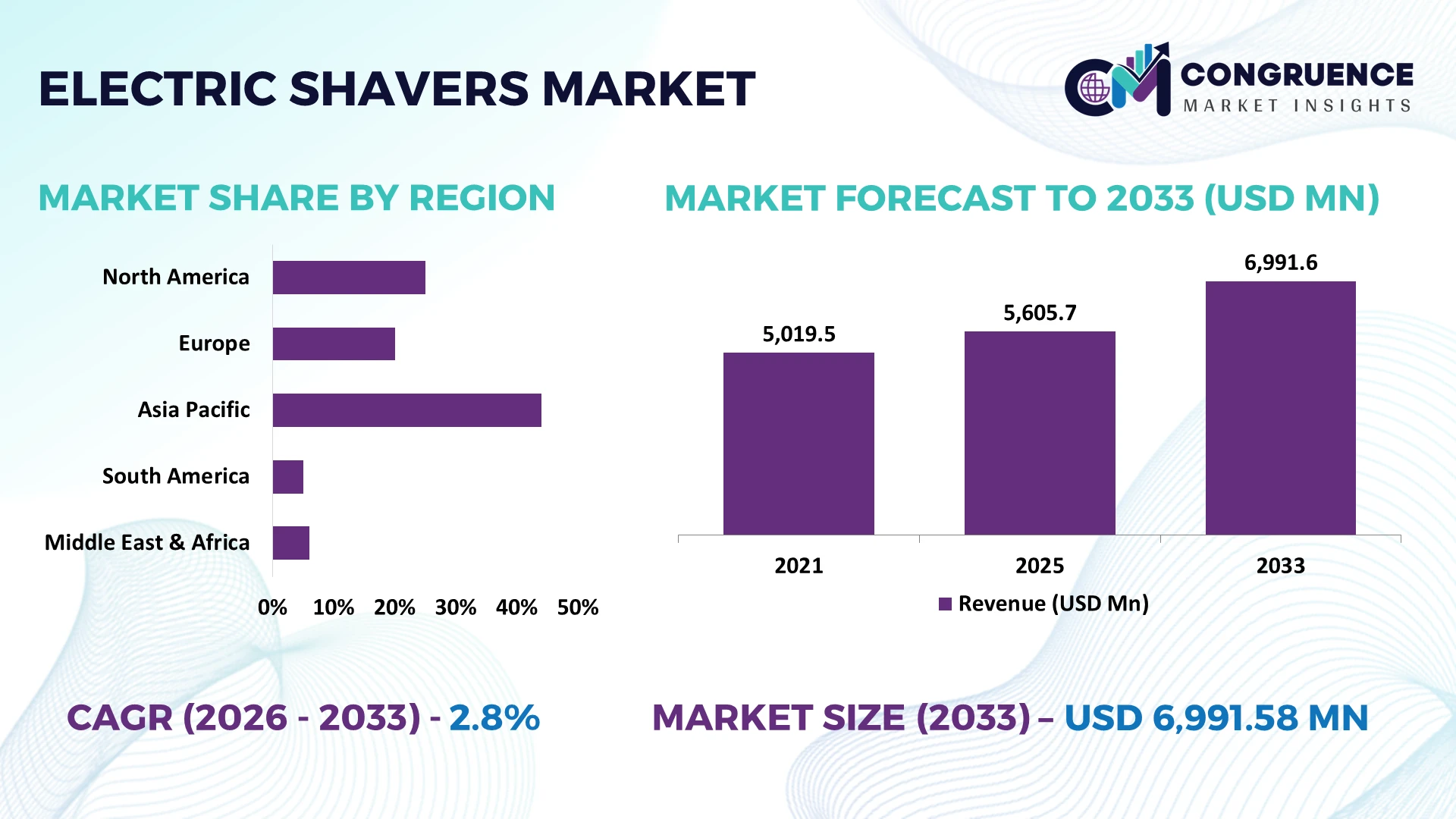
The Global Electric Shavers Market was valued at USD 5605.71 Million in 2025 and is anticipated to reach a value of USD 6991.58 Million by 2033 expanding at a CAGR of 2.8% between 2026 and 2033. Growth is driven by rechargeable lithium-ion grooming devices, wet-and-dry shaving systems, precision blade engineering, and replacement demand for cordless personal care appliances.
China represents a dominant electric shaver manufacturing hub, supported by extensive electronics assembly capacity, precision motor production, and established personal care appliance supply chains. The country accounts for more than 30% of global manufacturing value added, providing an industrial advantage for electric grooming device production. Guangdong and Zhejiang concentrate appliance assembly, component sourcing, and export-oriented manufacturing. Compared with Germany, where Braun emphasizes premium foil-shaving engineering, China offers greater manufacturing scale and cost flexibility. Lithium-ion batteries, waterproof enclosures, and automated blade production strengthen product differentiation across domestic and international brands.
Strategic implication: Manufacturers combining efficient Asian production networks with premium shaving performance, durable batteries, and dependable replacement-part ecosystems will strengthen their competitive positioning.
Market Size & Growth: USD 5,605.71 million in 2025, reaching USD 6,991.58 million by 2033 at 2.8% CAGR, supported by rechargeable precision grooming.
Top Growth Drivers: China's electric shaver retail sales increased 11.8% in 2025; portable models gained 11.1 percentage points of share, while premium devices advanced skin comfort.
Short-Term Forecast: By 2028, beard-density sensors operating at 300–500 readings per second will reinforce automatic power adjustment in premium product ranges.
Emerging Technologies: AI shaving guidance, 360° flexible heads, and UV cleaning systems differentiate advanced models; selected sanitizing accessories claim 99.9% bacterial reduction.
Regional Leaders: Asia-Pacific emphasizes portable devices, Europe premium foil engineering, and North America connected grooming; verified regional USD forecasts are unavailable.
Consumer/End-User Trends: Portable shavers reached 36.5% of China's electric shaver retail market in 2025, up from 25.4% in 2024.
Pilot/Case Example: Philips' 2025 i9000 Prestige Ultra introduced redesigned shaving heads delivering 20% greater precision under company-defined testing.
Competitive Landscape: Philips and Braun compete in premium shaving alongside Panasonic, Xiaomi, and Flyco; independently verified global brand shares remain unavailable.
Regulatory & ESG Impact: EU battery rules introduce removable and replaceable portable-battery requirements from 2027, subject to applicable exemptions, reshaping device engineering.
Investment & Funding: Philips' 2025 launch introduced 3 i9000 variants, emphasizing connected personalization and durability; shaver-specific investment totals remain undisclosed.
Innovation & Future Outlook: Braun's 300-readings-per-second sensing and Philips' 500-readings-per-second technology intensify competition around adaptive motor control and skin protection.
The Electric Shavers Market is shifting toward portable grooming devices, intelligent beard-density detection, and premium wet-and-dry shaving systems. Philips reports that 41% of surveyed high-end shaver consumers are willing to spend more for comfort, reinforcing demand for skin-sensitive technologies. Its i9000 Prestige Ultra incorporates AI-powered shaving guidance, redesigned rotary heads, and hydrophilic coatings that deliver 50% smoother gliding under company testing. Braun emphasizes precision foil engineering and automated cleaning. European battery sustainability requirements are also increasing attention to repairability and product longevity. Manufacturers must balance shaving performance, battery durability, and replacement-part availability to strengthen competitive positioning.
The Electric Shavers Market is becoming strategically important as manufacturers shift competition from motor performance toward intelligent grooming, skin comfort, and connected product ecosystems. Premiumization is reshaping investment priorities, particularly in sensor-controlled shaving heads, waterproof electronics, and rechargeable battery systems. China's portable electric shaver segment reached 36.5% of domestic retail sales in 2025, reflecting changing consumer preferences. Meanwhile, European battery regulations are encouraging manufacturers to reassess repairability, component accessibility, and product lifecycle management across cordless personal care appliances.
Technology differentiation increasingly determines product positioning. Philips' redesigned premium shaving heads deliver a claimed 20% precision improvement over earlier designs, while Braun's beard-density sensors perform 300 readings per second to regulate shaving power. China emphasizes manufacturing scale and portable product affordability, whereas Germany and Japan concentrate on advanced foil engineering, cutting accuracy, and premium device reliability. Between 2026 and 2028, intelligent power management and longer replacement intervals will influence purchasing decisions.
Philips' i9000 Prestige Ultra demonstrates commercial deployment of adaptive shaving technology through integrated sensors, flexible heads, and personalized guidance. Manufacturers are strengthening semiconductor integration, blade engineering, and aftermarket accessory distribution. Competitive leadership increasingly depends on combining measurable grooming performance with dependable batteries, replacement components, and differentiated user experiences.
Consumer preference for comfortable, precise, and portable grooming is accelerating electric shaver product innovation. China's portable electric shaver retail share increased from 25.4% in 2024 to 36.5% in 2025, demonstrating an 11.1 percentage-point shift toward compact devices. Philips reports that 41% of surveyed premium shaver consumers are willing to spend more for improved comfort. Advanced shaving heads delivering a claimed 20% precision improvement strengthen premium product differentiation. Manufacturers are responding through intelligent motor controls, flexible cutting assemblies, and specialized skin-protection coatings. Philips and Braun are expanding sensor-assisted shaving platforms, while Chinese manufacturers emphasize compact rechargeable models. The strategic advantage lies in converting measurable comfort improvements into premium purchasing decisions and replacement demand.
Electric shaver manufacturing remains dependent on precision blades, miniature motors, rechargeable batteries, and electronic control components. China accounts for more than 30% of global manufacturing value added, highlighting its industrial scale but also the concentration of appliance component sourcing. Lithium-ion batteries commonly operate within approximately 80–90% charging efficiency, making battery selection important for portable device performance. Premium cutting assemblies require tight manufacturing tolerances, while waterproof enclosures increase production complexity and quality-control requirements. Supply-chain disruptions affecting semiconductor components or battery materials create procurement and inventory pressure. Manufacturers are diversifying component suppliers, qualifying alternative motor assemblies, and strengthening regional distribution inventories. Standardized electronics and modular cutting systems help control manufacturing costs without sacrificing shaving consistency or product reliability.
Sensor-assisted grooming creates opportunities for manufacturers to differentiate premium electric shavers through adaptive cutting performance and personalized user feedback. Braun's AutoSense technology evaluates beard density approximately 300 times per second, while selected Philips systems perform up to 500 measurements per second to adjust shaving power. Philips also reports 50% smoother gliding for its advanced hydrophilic coating under specified testing conditions. These technologies strengthen opportunities for skin-sensitive grooming and premium product upgrades. Japan's precision blade manufacturing capabilities support further development of specialized cutting systems. Manufacturers are investing in embedded sensors, intelligent control algorithms, and connected grooming applications. The emerging commercial opportunity extends beyond device replacement toward compatible cutting heads, cleaning accessories, and personalized maintenance recommendations.
Integrating adaptive electronics, waterproof construction, and rechargeable batteries creates long-term engineering challenges for electric shaver manufacturers. Premium systems performing 300–500 beard-density measurements per second require dependable sensor calibration and motor response throughout repeated shaving cycles. Lithium-ion battery performance gradually declines with charging cycles, while cutting-head wear affects shaving consistency and skin comfort. European battery regulations introduce additional design considerations for portable appliances from 2027, subject to applicable exemptions. Manufacturers must balance compact enclosure dimensions with component accessibility, water resistance, and electrical safety. Philips, Braun, and Panasonic face increasing pressure to maintain software reliability alongside mechanical durability. Investment in modular assemblies, accelerated lifecycle testing, and standardized replacement components will determine whether intelligent shaving features deliver sustainable product differentiation.
Compact Shaver Formats Gain Retail Space: China's portable electric shaver share increased from 25.4% in 2024 to 36.5% in 2025, an 11.1 percentage-point gain. Retailers are allocating more shelf space to pocket-sized grooming appliances suited to travel and everyday portability. Xiaomi and Flyco are responding with compact charging systems, lightweight housings, and expanded online distribution, improving inventory turnover across smaller appliance categories.
Automated Cleaning Becomes Premium Differentiator: Cleaning stations increasingly combine lubrication, drying, and sanitization within one maintenance cycle. Selected ultraviolet sanitizing systems claim up to 99.9% bacterial reduction under specified testing conditions. Braun and Philips integrate cleaning accessories into premium product ecosystems, while replaceable cartridges create recurring consumable requirements. Manufacturers are refining docking mechanisms and cleaning fluid delivery to improve maintenance convenience and preserve cutting-head performance.
Blade Manufacturing Prioritizes Precision Engineering: Japanese manufacturers are emphasizing ultra-thin foil structures, precision-ground cutting elements, and high-speed linear motors. Panasonic's premium shaving systems incorporate motors operating at approximately 14,000 cycles per minute, supporting consistent cutting under varying beard densities. Automated blade inspection and specialized metal processing improve manufacturing repeatability. Companies are strengthening precision component production to differentiate premium devices through shaving consistency rather than additional electronic features.
Battery Repairability Reshapes Product Architecture: European battery regulations introduce portable-battery removability requirements from 2027, subject to applicable exemptions. Manufacturers are reassessing sealed housings, battery attachment methods, and service procedures without compromising waterproof performance. Lithium-ion cells commonly retain approximately 80% of initial capacity after a specified number of charging cycles, depending on chemistry and operating conditions. Modular engineering strengthens serviceability while requiring revised enclosure validation and assembly processes.
Foil Shavers represented an estimated 34.6% of global electric shaver demand in 2025, supported by established consumer familiarity, close-cutting performance, and strong adoption among daily facial shaving users. Their oscillating cutting elements and protective foil screens provide controlled contact with facial contours, making them attractive for consistent grooming routines. Braun and Panasonic emphasize precision blade engineering, flexible shaving heads, and motor efficiency to defend premium positioning. Panasonic's selected high-performance systems operate at approximately 14,000 cycles per minute, illustrating the importance of cutting speed in product differentiation. Rotary Shavers remain significant through flexible multidirectional heads, particularly within Philips' established grooming portfolio.
Wet and Dry Shavers represent the fastest-growing type as waterproof construction and flexible grooming routines influence replacement purchases. Cordless Shavers benefit from rechargeable battery integration and compact travel-oriented designs, while Trimmers and Grooming Shavers address controlled hair-length maintenance and styling requirements. China's portable shaver retail share reached 36.5% in 2025, highlighting consumer interest in convenience-oriented formats. Manufacturers are expanding waterproof product ranges, improving charging interfaces, and refining interchangeable cutting assemblies. Investment increasingly targets multifunctional performance and compact mechanical design rather than shaving power alone.
Facial Shaving accounted for an estimated 48.2% of global electric shaver applications in 2025, supported by recurring beard maintenance, established shaving routines, and widespread availability of dedicated facial grooming devices. Foil and rotary technologies remain central to this application, with manufacturers differentiating products through cutting accuracy, contour adaptation, and skin-contact performance. Braun's premium systems incorporate beard-density sensing at approximately 300 readings per second, supporting adaptive motor control during facial shaving. Beard and Mustache Styling represents an established adjacent application, where precision attachments and adjustable cutting lengths support detailed grooming. Manufacturers are refining cutting assemblies and accessory compatibility to improve product versatility.
Sensitive-Skin Shaving represents the fastest-growing application as consumers prioritize friction reduction, controlled pressure, and improved shaving comfort. Philips reports 50% smoother gliding for selected hydrophilic coating technology under specified testing conditions. Head Shaving requires flexible cutting surfaces and ergonomic handling, while Body Grooming emphasizes skin protection and specialized trimming attachments. Manufacturers are expanding dermatologically oriented product positioning, integrating pressure guidance, and developing application-specific cutting heads. Competitive advantage increasingly depends on matching shaving technology to individual skin and hair characteristics.
Individual Consumers represented an estimated 88.5% of global electric shaver demand in 2025, reflecting widespread household ownership, personal grooming routines, and direct retail purchasing. Replacement cycles are influenced by battery durability, cutting-head wear, and product performance rather than institutional procurement schedules. China's portable electric shaver retail share increased by 11.1 percentage points between 2024 and 2025, demonstrating changing household purchasing preferences. Manufacturers are strengthening direct-to-consumer distribution, product comparison tools, and replacement-head availability. Professional Barbershops represent a smaller but technically demanding customer group, prioritizing durable motors, hygienic maintenance, and reliable cutting performance during repeated daily use.
Hotels and Hospitality Providers represent the fastest-growing end-user category from a comparatively limited base, supported by premium guest amenities and differentiated grooming services. Hair and Beauty Salons increasingly incorporate specialized shaving and finishing devices into broader personal care offerings. Professional equipment requires consistent performance, washable cutting components, and straightforward maintenance procedures. Manufacturers are developing compact travel products, commercial-grade accessories, and institutional distribution partnerships. Competitive strategies increasingly separate convenience-focused household products from durable professional grooming systems, allowing suppliers to target distinct purchasing requirements and service expectations.
Asia-Pacific accounted for the largest market share at an estimated 39.5% in 2025 however, Asia-Pacific is expected to register the fastest growth, expanding at a CAGR of 3.8% between 2026 and 2033.

Premium Grooming and Omnichannel Retail Expansion
North America represented an estimated 26.5% of global electric shaver demand in 2025, supported by established personal grooming expenditure, extensive retail distribution, and premium product replacement cycles. The United States dominates regional consumption, with Canada contributing through organized appliance retail and online grooming channels. Philips, Braun, Panasonic, and Wahl compete through precision cutting systems, ergonomic design, and differentiated grooming accessories. Electric shavers incorporating wet-and-dry functionality, flexible shaving heads, and rechargeable lithium-ion batteries remain central to premium product positioning. Walmart, Target, Amazon, and specialist grooming retailers provide multiple purchasing channels, enabling manufacturers to reach distinct consumer segments. Companies are strengthening direct-to-consumer operations, expanding replacement-head availability, and introducing bundled grooming accessories. The competitive shift favors brands combining shaving comfort, reliable battery performance, and convenient aftermarket maintenance across established retail networks.
United States Market Outlook: The United States benefits from extensive personal care appliance distribution, established professional grooming businesses, and strong consumer access to premium shaving technology. Wahl maintains domestic manufacturing capabilities for selected grooming equipment, while Philips and Braun compete through established retail partnerships. The country has more than 340 million residents, supporting a substantial consumer base for facial shaving, beard styling, and replacement grooming accessories. Manufacturers emphasize product warranties, replacement components, and differentiated performance claims to strengthen repeat purchasing.
Precision Engineering and Battery Compliance Transformation
Europe accounted for an estimated 29.0% of global electric shaver demand in 2025, supported by established premium grooming brands, sophisticated retail networks, and advanced appliance engineering capabilities. Germany and the Netherlands represent important innovation centers through Braun and Philips, respectively. Manufacturers emphasize precision foil systems, adaptive motor controls, skin-contact materials, and automated cleaning accessories. European Union battery regulations introduce additional product design requirements from 2027, including portable-battery removability provisions subject to applicable exemptions. This regulatory transition increases the importance of serviceable components, validated waterproof enclosures, and product lifecycle engineering. Braun's premium shaving platforms incorporate beard-density sensing at approximately 300 readings per second, demonstrating continued investment in electronic cutting control. Manufacturers are strengthening technical development, replacement-part distribution, and compliant product architecture to maintain premium positioning.
Germany Market Outlook: Germany remains strategically important through Braun's engineering expertise, premium shaving product development, and established consumer appliance distribution. Precision manufacturing supports advanced foil geometry, high-frequency cutting mechanisms, and durable shaving assemblies. German consumers benefit from extensive electronics retail infrastructure and established aftermarket servicing channels. Manufacturers are refining cleaning stations, battery management, and ergonomic cutting systems to differentiate premium products while meeting evolving European appliance requirements.
Manufacturing Scale and Portable Grooming Adoption
Asia-Pacific leads global electric shaver demand with an estimated 39.5% market share in 2025, supported by concentrated electronics manufacturing, established personal care appliance supply chains, and expanding organized retail distribution. China dominates regional manufacturing, while Japan contributes advanced cutting technologies and precision motor engineering. India represents an important consumer market for affordable rechargeable grooming devices, particularly through e-commerce and electronics retailers. China's portable electric shaver retail share increased from 25.4% in 2024 to 36.5% in 2025, highlighting changing product preferences. Xiaomi, Flyco, Panasonic, and Philips compete across differentiated price and performance categories. Manufacturers are expanding compact device portfolios, improving battery integration, and strengthening automated component production. Regional competitiveness increasingly depends on manufacturing efficiency, localized product design, and reliable distribution across diverse consumer purchasing environments.
China Market Outlook: China benefits from extensive appliance manufacturing clusters in Guangdong and Zhejiang, supporting miniature motors, rechargeable batteries, electronic controls, and precision cutting components. Domestic manufacturers including Flyco and Xiaomi compete through product accessibility, compact designs, and online distribution. China's manufacturing sector accounts for more than 30% of global manufacturing value added, providing substantial industrial infrastructure for appliance production. Local suppliers increasingly emphasize automated assembly, waterproof product engineering, and competitive component sourcing.
Affordable Rechargeable Grooming and Retail Modernization
South America represented an estimated 3.2% of global electric shaver demand in 2025, with Brazil accounting for the largest regional consumption concentration. Consumer purchasing emphasizes practical shaving performance, accessible pricing, and dependable rechargeable battery systems. Brazil's established electronics retail networks support distribution of Philips, Panasonic, and other international grooming brands, while e-commerce expands access beyond major metropolitan centers. Import duties, exchange-rate movements, and distribution costs influence retail pricing and product availability. Manufacturers are emphasizing entry-level cordless devices, multifunctional grooming attachments, and compact charging systems to address price-sensitive consumers. Local distribution partnerships help improve inventory availability and warranty support. Competitive positioning increasingly depends on balancing appliance durability, replacement-part accessibility, and affordable product configurations across diverse purchasing segments.
Brazil Market Outlook: Brazil provides the region's most substantial consumer market, supported by a population exceeding 200 million and established personal care retail infrastructure. São Paulo concentrates electronics distribution, appliance import operations, and organized retail activity. Philips and other international manufacturers compete through rechargeable shaving systems and multifunctional grooming devices. Import taxation and currency fluctuations influence product positioning, encouraging distributors to emphasize dependable entry-level models, warranty services, and efficient inventory management.
Premium Retail Expansion and Grooming Accessibility
The Middle East & Africa represented an estimated 1.8% of global electric shaver demand in 2025, supported by organized electronics retail, expanding online marketplaces, and professional grooming services. Saudi Arabia and the United Arab Emirates represent important premium consumer markets, while South Africa contributes through established appliance retail networks. Manufacturers target demand for rechargeable foil and rotary shavers, precision beard trimmers, and wet-and-dry grooming systems. International brands compete through electronics retailers, online platforms, and authorized distributors. Product differentiation emphasizes charging convenience, durable cutting assemblies, and suitability for frequent grooming routines. Manufacturers are strengthening regional distribution partnerships and warranty coverage to improve customer retention. Premium positioning remains concentrated in higher-income urban markets, while affordable rechargeable products support broader accessibility across developing consumer segments.
Saudi Arabia Market Outlook: Saudi Arabia benefits from organized consumer electronics retail, expanding digital commerce, and strong demand for personal grooming appliances. Riyadh and Jeddah concentrate premium product distribution through major retail chains and online marketplaces. The country's population exceeds 35 million, providing a substantial domestic consumer base. Philips, Braun, and Panasonic compete through premium shaving performance, multifunctional accessories, and authorized distribution. Retailers emphasize product authenticity, warranty coverage, and dependable replacement components.
Philips, Braun, Panasonic, Xiaomi, and Flyco shape competition across premium and affordable electric shaving categories. Their combined global market share is estimated at 55–60%, reflecting established brand recognition, engineering capabilities, and distribution scale. Philips competes through rotary shaving technology and connected grooming features, while Braun emphasizes precision foil systems and adaptive motor control. Panasonic differentiates through high-speed linear motors, whereas Xiaomi and Flyco prioritize compact designs and competitive pricing. Philips' redesigned premium shaving heads claim 20% greater precision, while selected hydrophilic coatings deliver 50% smoother gliding under company testing. Manufacturers are expanding automated blade production, sensor integration, and replacement accessory ecosystems. Competition is shifting toward intelligent performance, compact rechargeable formats, and serviceable product architecture. Precision manufacturing, waterproof electronics, and established retail relationships create significant entry barriers. Sustainable competitive advantage requires reliable cutting performance, efficient production, differentiated technology, and accessible aftermarket support.
Koninklijke Philips N.V.
Procter & Gamble Company (Braun)
Panasonic Holdings Corporation
Xiaomi Corporation
Shanghai Flyco Electrical Appliance Co., Ltd.
Wahl Clipper Corporation
Spectrum Brands Holdings, Inc. (Remington)
Conair LLC
Andis Company
MANSCAPED, Inc.
Havells India Limited
Groupe SEB
Shenzhen Enchen Technology Co., Ltd.
VGR Industry Private Limited
Precision foil cutters, multidirectional rotary heads, and lithium-ion power systems define current electric shaver engineering. Panasonic's selected linear motors deliver approximately 14,000 cutting cycles per minute, maintaining blade speed under variable beard resistance. Braun's adaptive systems sample beard density 300 times per second, adjusting motor output automatically. Compared with conventional fixed-speed mechanisms, sensor-controlled designs improve responsiveness without requiring manual power selection. Waterproof construction and integrated charging electronics support established wet-and-dry product deployment, particularly across premium consumer ranges and professional grooming applications.
Emerging technologies combine pressure sensors, artificial intelligence guidance, and advanced skin-contact coatings. Philips' redesigned premium shaving heads claim 20% greater precision than earlier designs, while selected hydrophilic coatings provide 50% smoother gliding under manufacturer testing. Connected applications translate shaving movement and pressure into personalized feedback. Manufacturers benefit through premium differentiation, stronger replacement accessory ecosystems, and improved user engagement. Precision component suppliers gain opportunities in miniature sensors, specialized steels, and embedded control electronics.
Between 2026 and 2028, modular batteries, automated blade inspection, and predictive maintenance functions will influence product architecture. European battery requirements accelerate serviceability planning. Companies integrating dependable electronics with replaceable cutting assemblies will strengthen durability, reduce unnecessary device replacement, and defend premium positioning against affordable compact alternatives.
April 2025: Philips launched its i9000 electric shaver range, integrating AI guidance and sensors measuring beard density 500 times per second. The three-model portfolio strengthens premium personalization, shaving comfort, and product differentiation across international grooming markets. Source: philips.com
July 2025: Braun introduced its upgraded Series 9 Pro+ in Germany, featuring precision blades with 45% stronger stabilizers. The redesign improves cutting stability and supports premium foil-shaver positioning, reinforcing competition through German engineering and manufacturing expertise. Source: pgnewsroom.de
June 2025: Xiaomi expanded into Japan's personal care market with its S200 electric shaver, priced at ¥2,780. The compact device strengthens Xiaomi's affordable grooming portfolio and broadens consumer access through its established electronics distribution channels. Source: one-suite.jp
July 2026: Panasonic announced three six-blade Palm-in PRO shavers for Japan, scheduled for September release. The expansion introduces premium compact grooming systems and compatible automated cleaning accessories, strengthening product differentiation through portable engineering and multifunctional maintenance. Source: prtimes.jp
The Electric Shavers Market Report evaluates industry structure, product innovation, consumer purchasing behavior, and competitive strategies between 2026 and 2033. Type coverage includes Foil Shavers, Rotary Shavers, Wet and Dry Shavers, Cordless Shavers, and Trimmers and Grooming Shavers. Application analysis examines Facial Shaving, Head Shaving, Body Grooming, Beard and Mustache Styling, and Sensitive-Skin Shaving. End-user assessment covers Individual Consumers, Professional Barbershops, Hair and Beauty Salons, and Hotels and Hospitality Providers.
Regional analysis spans North America, Europe, Asia-Pacific, South America, and Middle East & Africa. The report profiles 14 competitive participants and evaluates precision cutting systems, adaptive sensors, rechargeable batteries, waterproof engineering, and connected grooming technologies. Strategic coverage supports manufacturing investment, geographic expansion, supplier selection, premium product positioning, and aftermarket accessory development.
| Report Attribute/Metric | Report Details |
|---|---|
Market Revenue in 2025 | USD 5605.71 Million |
Market Revenue in 2033 | USD 6991.58 Million |
CAGR (2026 - 2033) | 2.8% |
Base Year | 2025 |
Forecast Period | 2026 - 2033 |
Historic Period | 2021 - 2025 |
Segments Covered | By Type
By Application
By End-User
|
Key Report Deliverable | Revenue Forecast, Growth Trends, Market Dynamics, Segmental Overview, Regional and Country-wise Analysis, Competition Landscape |
Region Covered | North America, Europe, Asia-Pacific, South America, Middle East, Africa |
Key Players Analyzed | Koninklijke Philips N.V., Procter & Gamble Company (Braun), Panasonic Holdings Corporation, Xiaomi Corporation, Shanghai Flyco Electrical Appliance Co., Ltd., Wahl Clipper Corporation, Spectrum Brands Holdings, Inc. (Remington), Conair LLC, Andis Company, MANSCAPED, Inc., Havells India Limited, Groupe SEB, Shenzhen Enchen Technology Co., Ltd., VGR Industry Private Limited |
Customization & Pricing | Available on Request (10% Customization is Free) |




