
Reports
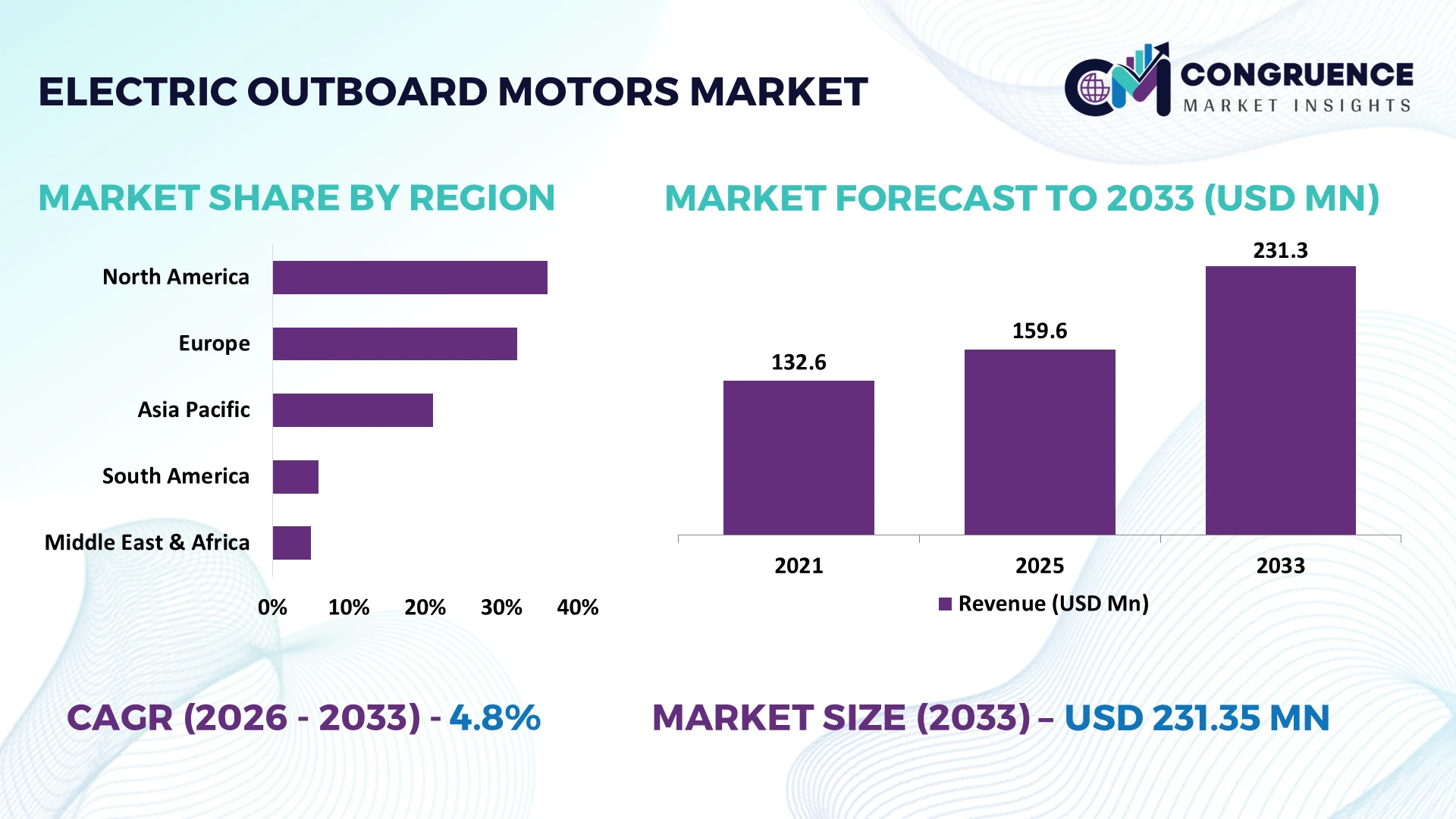
The Global Electric Outboard Motors Market was valued at USD 159.6 Million in 2025 and is anticipated to reach a value of USD 231.3 Million by 2033 expanding at a CAGR of 4.75% between 2026 and 2033. Market expansion is driven by zero-emission boating regulations, improvements in lithium-ion battery energy density, expanding marina charging infrastructure, and the electrification of recreational boats, fishing vessels, and inland waterway fleets.
The United States represents a strategically important electric outboard motor market, supported by approximately 11.7 million registered recreational vessels and extensive marina infrastructure. Compared with Norway, where electric ferry deployment and emission-free fjord policies accelerate marine electrification, the United States offers greater recreational boat replacement potential. Federal clean-energy incentives and private investment support battery integration, propulsion efficiency, and charging development.
Manufacturers prioritizing modular battery platforms, established dealer networks, and reliable charging partnerships are positioned to capture higher-value electric marine propulsion opportunities.
Market Size & Growth: USD 159.6 million in 2025, reaching USD 231.3 million by 2033 at 4.75% CAGR, supported by emission-free boating regulations and battery-powered propulsion adoption.
Top Growth Drivers: Three structural drivers include zero-emission waterway requirements, lithium-ion battery efficiency improvements exceeding 90%, and electric drivetrain efficiencies approaching 85–90%.
Short-Term Forecast: By 2028, advanced battery integration targets 10–15% improvements in usable energy density, supporting longer operating ranges and reduced charging interruptions.
Emerging Technologies: AI-enabled energy management, 48V battery architectures, and high-efficiency permanent-magnet motors are reshaping advanced marine propulsion systems.
Regional Leaders: Indicative 2033 allocations place North America at USD 83.3 million, Europe at USD 78.6 million, and Asia Pacific at USD 48.6 million, supported by recreational boating, emission regulations, and coastal fleet electrification, respectively.
Consumer/End-User Trends: Electric propulsion delivers approximately 85–95% motor efficiency, attracting recreational boaters, fishing operators, and environmentally regulated tourism fleets.
Pilot/Case Example: Norway's 2026 zero-emission requirements for passenger vessels in designated World Heritage fjords demonstrate regulatory-driven deployment of cleaner marine propulsion.
Competitive Landscape: Torqeedo, ePropulsion, Mercury Marine, Yamaha Motor, and Vision Marine Technologies compete through battery integration, propulsion performance, and distribution coverage.
Regulatory & ESG Impact: Zero direct exhaust emissions and reduced underwater noise strengthen electric outboard adoption in protected waterways and environmentally sensitive tourism destinations.
Investment & Funding: Vision Marine Technologies' previously announced USD 2.8 million private placement illustrates financing activity supporting electric propulsion commercialization.
Innovation & Future Outlook: Advanced 48V systems, modular battery swapping, and connected diagnostics are shifting competition toward integrated propulsion ecosystems and lifecycle performance.
Electric outboard motors are gaining commercial relevance across recreational boating, freshwater fishing, lake tourism, and small passenger vessels. Modern brushless electric propulsion systems achieve motor efficiencies exceeding 85%, supporting quieter operation and reduced routine maintenance. Norway's emission-free waterway initiatives and European battery supply-chain localization reinforce the transition toward connected, energy-efficient marine propulsion solutions and differentiated equipment strategies.
Electric outboard motors are becoming strategically important as marine equipment manufacturers reposition product portfolios around emission compliance, energy efficiency, and digitally integrated propulsion. The transition from conventional gasoline outboards toward battery-electric systems is restructuring component procurement, dealer servicing, and marina infrastructure investment. Norway's emission-free fjord requirements and tightening environmental restrictions across European inland waterways are accelerating technology qualification and fleet replacement decisions.
Modern brushless electric motors typically achieve 85–95% conversion efficiency, compared with approximately 20–30% overall thermal efficiency for conventional gasoline engines. This advantage improves low-speed energy utilization and reduces maintenance requirements. North America benefits from extensive recreational boating infrastructure, while Europe leads regulatory-driven adoption. China contributes battery manufacturing scale and increasingly competitive electric drivetrain components. During 2027–2029, improved battery management and modular charging systems are expected to support more consistent fleet utilization.
Electric-powered rental boats operating on lakes and protected waterways demonstrate practical deployment advantages through reduced noise, simplified servicing, and predictable charging schedules. Manufacturers including Torqeedo, ePropulsion, and Mercury Marine are strengthening integrated propulsion offerings, dealer support, and battery partnerships. Competitive advantage increasingly depends on delivering complete, serviceable electric boating ecosystems rather than standalone motors.
Stricter environmental requirements for inland waterways, recreational lakes, and protected coastal destinations are accelerating electric outboard motor adoption. Modern electric drivetrains deliver approximately 85–95% motor efficiency, while eliminating direct exhaust emissions during operation. Compared with gasoline propulsion, electric motors substantially reduce low-speed noise and routine mechanical servicing. Norway's zero-emission requirements for designated World Heritage fjords demonstrate how regulatory intervention influences marine propulsion investment. Boat manufacturers are responding through integrated battery-electric packages, lightweight propulsion assemblies, and dealer training programs. Mercury Marine and Torqeedo are expanding electric propulsion capabilities to address regulated recreational boating applications. The strategic advantage lies in matching vessel performance with environmental compliance, particularly where access restrictions determine commercial operating opportunities.
Battery acquisition costs, limited marina charging capacity, and energy storage constraints continue restricting electric outboard deployment. Lithium-ion battery packs typically deliver approximately 150–250 Wh/kg at pack level, considerably below the usable energy density of gasoline. Although electric motors achieve efficiency exceeding 85%, sustained high-speed operation increases energy consumption and reduces practical cruising range. China's dominant position in global lithium-ion battery manufacturing also exposes international marine equipment suppliers to concentrated sourcing risks. Smaller marinas frequently lack dedicated high-capacity charging infrastructure, increasing installation expenses for rental fleets. Manufacturers are addressing these limitations through standardized 48V battery systems, alternative cell suppliers, modular battery configurations, and charging partnerships. Battery replacement economics remain a decisive purchasing consideration for cost-sensitive boat operators.
Modular energy storage and connected propulsion management create opportunities in fishing tourism, lake transport, and small commercial boating fleets. Advanced lithium iron phosphate batteries commonly support approximately 2,000–5,000 charging cycles under suitable operating conditions, strengthening lifecycle economics for frequently used vessels. Electric motor efficiencies exceeding 90% in optimized operating ranges also improve energy utilization during low-speed maneuvering. India's expanding inland waterway modernization initiatives offer opportunities for localized electric propulsion assembly and charging partnerships. Manufacturers are investing in interchangeable battery modules, remote diagnostics, and digitally optimized power management. Battery-sharing models can reduce vessel downtime by separating charging schedules from operating schedules. Companies combining propulsion hardware with fleet monitoring and service contracts gain stronger recurring commercial relationships.
Scaling electric outboard technology requires reliable integration of battery management systems, waterproof electronics, thermal controls, and vessel communication networks. Marine propulsion equipment must withstand prolonged exposure to saltwater, vibration, and variable operating loads. High-efficiency electric motors frequently exceed 90% efficiency, yet propulsion reliability depends on the performance of connected batteries, controllers, and cooling components. Battery systems operating near 80% depth of discharge require carefully managed thermal and charging conditions to preserve service life. Japan's demanding marine equipment quality standards and established boating infrastructure reinforce the importance of component validation. Manufacturers are strengthening corrosion-resistant designs, predictive maintenance software, and technician certification programs. Long-term competitiveness depends on standardized diagnostics, dependable warranty performance, and consistent service availability across geographically dispersed marina networks.
Integrated Propulsion Packages Replace Standalone Motors: Electric outboard manufacturers are increasingly bundling motors, batteries, throttles, and digital displays into unified propulsion systems. Modern brushless motors achieve approximately 85–95% efficiency, while 48V architectures simplify component integration. Torqeedo and ePropulsion are expanding integrated product ecosystems, reducing installation complexity and improving dealer servicing efficiency. Standardized interfaces are becoming important differentiators for boatbuilders managing multiple vessel configurations.
Higher Voltage Systems Reshape Performance: Manufacturers are moving beyond conventional low-voltage configurations toward higher-power electric propulsion platforms. At equivalent power, 96V architectures carry approximately 50% less current than 48V systems, reducing conductor requirements and resistive losses. Mercury Marine and Yamaha are advancing higher-output electric propulsion technologies. This transition supports larger recreational vessels while encouraging investment in thermal management, marine-grade connectors, and integrated electronic controls.
Connected Diagnostics Transform Marine Servicing: Digital monitoring systems increasingly track battery state of charge, propulsion temperature, and operating efficiency. Lithium iron phosphate batteries commonly support 2,000–5,000 charging cycles under appropriate conditions, making lifecycle monitoring commercially valuable. Manufacturers are integrating connected displays and diagnostic interfaces to improve maintenance planning, warranty assessment, and fleet visibility. The emerging advantage is service-data ownership, which strengthens aftermarket relationships beyond initial equipment sales.
Localized Distribution Strengthens Customer Support: Marine propulsion suppliers are restructuring distribution around certified installers, battery servicing, and replacement-part availability. Typical lithium-ion battery warranties span approximately 2–5 years, while electric motors eliminate routine oil changes and fuel-system maintenance. European manufacturers are strengthening dealer training and regional service capabilities. Faster technical support improves customer confidence and reduces downtime for recreational boat owners and commercial rental operators.
Low-power electric outboard motors, typically rated below 5 kW, represent an estimated 46.5% of the market in 2025, supported by widespread deployment across dinghies, fishing boats, inflatable vessels, and recreational tenders. Their dominance reflects lower battery requirements, lightweight installation, and compatibility with portable charging systems. Medium-power motors ranging from 5 kW to 20 kW serve recreational cruisers, pontoon boats, and small passenger vessels, balancing propulsion performance with battery capacity and operating range.
High-power electric outboard motors above 20 kW represent the fastest-expanding category as manufacturers address larger recreational craft and commercial applications. Advanced electric drivetrains achieve approximately 85–95% motor efficiency, strengthening their appeal for premium vessel integration. Mercury Marine, Vision Marine Technologies, and Yamaha are developing higher-output propulsion platforms with improved thermal management and digital controls. Investment priorities are shifting toward high-voltage electronics, integrated batteries, and scalable propulsion architectures that support multiple vessel classes.
Recreational boats account for approximately 61.4% of electric outboard motor applications in 2025, supported by strong demand from leisure boating, lake cruising, fishing, and small private vessels. Their leading position reflects established marina infrastructure, relatively predictable operating distances, and growing adoption of quieter propulsion systems. Commercial boats represent approximately 24.3% of applications, with electric propulsion increasingly deployed in tourism vessels, rental fleets, and short-distance passenger transport. Military boats and other specialized applications account for smaller shares, emphasizing low-noise operation, maneuverability, and mission-specific performance.
Commercial boats represent the fastest-growing application as operators prioritize scheduled charging, predictable operating costs, and fleet standardization. Electric propulsion systems achieving approximately 90% motor efficiency offer advantages during low-speed passenger transportation and repeated docking operations. Manufacturers are responding through modular battery integration, remote fleet diagnostics, and partnerships with commercial boatbuilders. The strongest deployment opportunities are emerging in tourism corridors and inland waterways where fixed routes simplify energy planning and charging infrastructure investment.
Individual boat owners represent the leading electric outboard motor end-user category, supported by recreational fishing, private cruising, and small-vessel ownership. Their purchasing decisions emphasize propulsion reliability, installation simplicity, low noise, and accessible servicing. Commercial marine operators form an important secondary customer group, particularly in short-distance passenger transportation and utility operations. Rental and tourism operators increasingly prioritize standardized propulsion equipment, while government and defense organizations focus on specialized low-noise and environmentally compliant vessels.
Rental and tourism operators represent the fastest-growing end-user category as fleet electrification enables centralized charging, predictable maintenance schedules, and improved vessel utilization. Electric motors typically achieve 85–95% efficiency, while lithium iron phosphate batteries can support approximately 2,000–5,000 charging cycles under suitable operating conditions. Manufacturers are developing fleet-specific battery packages, connected monitoring systems, and service agreements. Torqeedo and ePropulsion are strengthening integrated solutions for commercial users. Competitive differentiation increasingly depends on lifecycle support, battery replacement planning, and dependable service networks rather than motor performance alone.
North America accounted for the largest market share at 36.0% in 2025 however, Asia-Pacific is expected to register the fastest growth, expanding at a CAGR of 6.8% between 2026 and 2033.
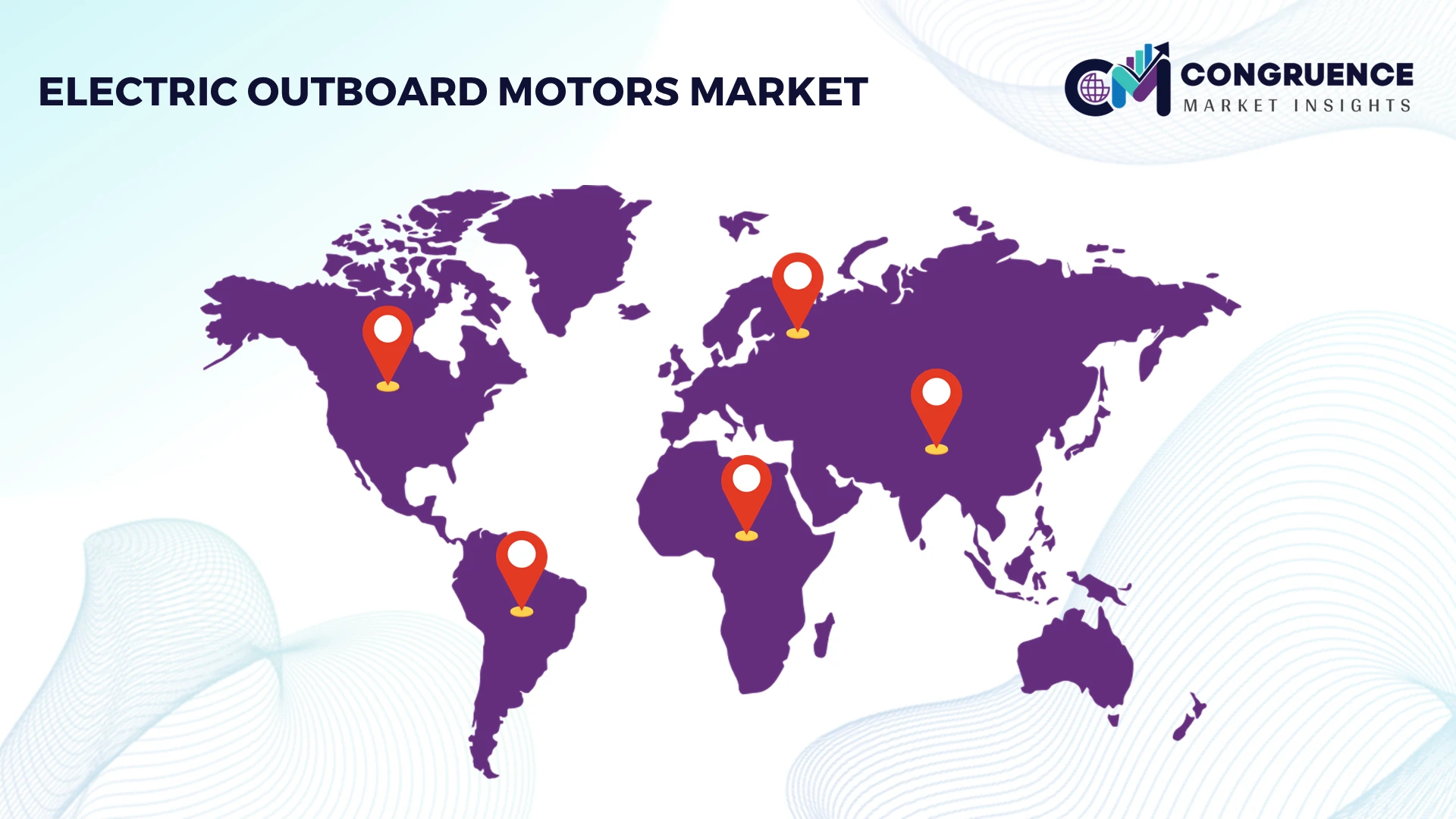
North America accounted for approximately 36.0% of the global electric outboard motors market in 2025, supported by established recreational boating infrastructure, advanced marine equipment manufacturing, and increasing adoption of battery-electric propulsion. The United States dominates regional demand through recreational fishing, pontoon boating, and inland waterway applications, while Canada contributes through lake tourism and environmentally sensitive boating destinations. Mercury Marine's Avator electric propulsion portfolio demonstrates the region's transition toward integrated battery systems and digitally controlled outboards. Modern electric motors achieve approximately 85–95% efficiency, strengthening their suitability for low-speed recreational applications. Manufacturers are expanding dealer certification, modular battery integration, and connected diagnostics capabilities. Regional competitiveness increasingly depends on aftermarket service coverage, charging accessibility, and compatibility with existing recreational vessel platforms rather than standalone motor performance.
United States Market Outlook: The United States benefits from a substantial installed recreational boating fleet, with approximately 11.7 million registered recreational vessels supporting propulsion replacement opportunities. Wisconsin-based Mercury Marine strengthens domestic electric outboard development through its Avator product family, combining integrated battery management, digital controls, and established marine distribution networks. Electric propulsion suppliers are targeting fishing boats, tenders, and pontoon vessels where predictable operating distances support battery-electric adoption. Dealer training and retrofit compatibility remain important competitive priorities.
Europe represented approximately 32.0% of the global electric outboard motors market in 2025, supported by strict environmental requirements, established boating industries, and advanced electric marine propulsion development. Germany, Norway, the Netherlands, and France represent important deployment and manufacturing centers. Germany's Torqeedo and emerging electric propulsion specialists are advancing integrated motors, battery management, and digital control systems for recreational and commercial applications. Norway's 2026 zero-emission requirements for passenger vessels operating in designated World Heritage fjords reinforce investment in cleaner marine technologies. Dutch inland waterways and recreational boating infrastructure provide additional opportunities for low-noise electric propulsion. Manufacturers are strengthening regional distribution, battery certification, and vessel integration partnerships. Europe's competitive advantage lies in regulatory alignment, engineering specialization, and established marine equipment supply chains, particularly where environmental restrictions influence vessel access and operating permissions.
Germany Market Outlook: Germany holds a strategic position through established marine engineering capabilities, electric drivetrain expertise, and advanced battery integration. Torqeedo's electric propulsion portfolio includes systems ranging from portable low-power outboards to higher-output marine applications. German manufacturers benefit from automotive electrification expertise, precision electronics suppliers, and established recreational boating distribution networks. Investment priorities include standardized propulsion interfaces, corrosion-resistant components, and improved system monitoring, strengthening the country's position in premium electric marine equipment.
Asia-Pacific accounted for approximately 21.0% of the global electric outboard motors market in 2025, supported by expanding marine manufacturing capabilities, competitive battery supply chains, and increasing interest in electric recreational vessels. China provides significant advantages through lithium-ion battery production, electric motor manufacturing, and integrated power electronics supply. Japan contributes advanced marine engineering through Yamaha Motor and established propulsion technology expertise, while Australia supports demand from recreational fishing and coastal boating. China's battery manufacturing ecosystem enables suppliers to develop modular propulsion platforms and reduce component procurement complexity. Electric drivetrain efficiencies approaching 90% strengthen the technical case for smaller marine vessels. Manufacturers are investing in localized assembly, battery management software, and export-oriented distribution. Regional expansion increasingly depends on translating manufacturing scale into certified marine-grade products with dependable service networks.
China Market Outlook: China represents the region's strongest manufacturing base, supported by its dominant position in global lithium-ion battery production, which accounts for more than 70% of worldwide manufacturing capacity. Domestic electric propulsion suppliers, including ePropulsion, benefit from integrated battery sourcing, permanent-magnet motor production, and established electronics manufacturing clusters. The country's competitive advantage lies in scalable component procurement and product development efficiency. Manufacturers are strengthening international dealer networks, product certification, and modular battery technologies to expand overseas marine equipment sales.
South America represented approximately 6.0% of the global electric outboard motors market in 2025, supported by emerging demand from freshwater tourism, recreational fishing, and environmentally sensitive inland transportation. Brazil dominates regional opportunities through extensive river networks, recreational boating activity, and established marine equipment distribution. Argentina and Chile contribute specialized demand from lake tourism, fishing operations, and protected coastal environments. The Amazon basin and other inland waterways offer opportunities for low-speed electric propulsion where short routes and predictable operating schedules support battery utilization. However, limited marina charging infrastructure and imported battery costs constrain broader deployment. Manufacturers are responding through portable battery systems, local distributor partnerships, and simplified propulsion packages. Commercial opportunities are strongest in tourism fleets and smaller recreational vessels where centralized charging reduces infrastructure complexity.
Brazil Market Outlook: Brazil represents South America's principal electric outboard opportunity through its extensive inland navigation network and established recreational boating industry. The Amazon River system extends approximately 6,400 kilometers, highlighting the scale of waterway transportation infrastructure, although electric propulsion is currently more practical for short-distance operations. Brazilian marine equipment distributors are positioned to expand electric motor availability through imported propulsion systems and localized servicing. Tourism operators and freshwater fishing businesses represent promising customers for portable, low-maintenance electric outboards.
The Middle East & Africa region accounted for approximately 5.0% of the global electric outboard motors market in 2025, supported by waterfront tourism investment, marina modernization, and growing interest in environmentally responsible marine transportation. The United Arab Emirates and Saudi Arabia represent important investment centers, while South Africa contributes established recreational boating and marine equipment distribution capabilities. Saudi Arabia's Red Sea tourism developments are creating opportunities for low-noise marine propulsion in environmentally sensitive coastal environments. The UAE's expanding marina infrastructure supports premium recreational vessel electrification and integrated marine technology adoption. Manufacturers are prioritizing partnerships with tourism developers, marina operators, and specialized marine distributors. Regional demand remains concentrated in premium recreational boating and managed commercial fleets, where dedicated charging facilities and predictable operating schedules support electric propulsion deployment.
United Arab Emirates Market Outlook: The UAE benefits from established maritime infrastructure, luxury recreational boating activity, and investment in waterfront development. Dubai Harbour Marina provides approximately 700 berths, demonstrating the country's capacity to support advanced recreational marine services. Electric outboard manufacturers are targeting yacht tenders, marina utility vessels, and tourism applications where quiet operation and reduced exhaust emissions offer practical advantages. Partnerships with marina operators and marine equipment distributors are strengthening access to charging solutions, installation services, and specialized maintenance capabilities.
The electric outboard motors market features competition between established marine manufacturers Mercury Marine and Yamaha Motor, specialized propulsion innovators Torqeedo and ePropulsion, and performance-focused Vision Marine Technologies. The leading five manufacturers collectively hold an estimated 55% market share, indicating moderate concentration. Competition centers on propulsion efficiency, battery integration, pricing, and distribution reach. Advanced electric motors achieve 85–95% efficiency, while optimized brushless architectures reduce mechanical energy losses by approximately 15% compared with less efficient designs. Mercury Marine leverages established dealer networks, whereas ePropulsion emphasizes integrated batteries and modular propulsion platforms. Vision Marine targets high-output applications through proprietary drivetrain technology. Manufacturers are expanding marine partnerships, strengthening battery sourcing, and integrating connected diagnostics. Competitive differentiation is shifting from standalone motor specifications toward complete propulsion ecosystems. Battery certification, service infrastructure, and warranty obligations remain substantial entry barriers. Winning requires dependable propulsion performance, scalable component procurement, and comprehensive aftermarket support across diverse boating applications and markets worldwide.
Torqeedo GmbH
ePropulsion Technology Limited
Brunswick Corporation (Mercury Marine)
Yamaha Motor Co., Ltd.
Vision Marine Technologies Inc.
Elco Motor Yachts
Flux Marine
RAD Propulsion
Pure Watercraft
Golden Motor Technology Co., Ltd.
Aquamot GmbH
TEMO SAS
Brushless permanent-magnet motors and lithium-ion battery systems dominate current electric outboard development, delivering approximately 85–95% motor efficiency compared with 20–30% thermal efficiency in conventional gasoline engines. Integrated electronic speed controllers optimize torque delivery, while regenerative capabilities remain limited by marine operating conditions. Manufacturers increasingly combine propulsion units, battery management systems, and digital displays into standardized platforms. Torqeedo, ePropulsion, and Mercury Marine benefit from reduced installation complexity and improved aftermarket serviceability. These technologies strengthen performance consistency across recreational fishing boats, tenders, and inland waterway vessels.
Emerging technologies include lithium iron phosphate batteries, higher-voltage architectures, and connected propulsion diagnostics. Advanced battery systems support approximately 2,000–5,000 charging cycles under suitable operating conditions, improving lifecycle planning for commercial fleets. Moving from 48V to 96V systems reduces electrical current by 50% at equivalent power, enabling lighter conductors and improved thermal management. Manufacturers are investing in modular battery interfaces, predictive maintenance software, and integrated charging solutions.
Between 2026 and 2028, disruptive development will concentrate on intelligent energy management, high-output electric drivetrains, and software-defined propulsion controls. Automated power optimization improves operational visibility, while connected diagnostics strengthen fleet maintenance scheduling. Companies combining efficient hardware with dependable battery ecosystems will secure stronger competitive positioning.
November 2025 ePropulsion introduced its Spirit 2 electric outboard, featuring a 2 kW motor and 3 kW Boost Mode. The product strengthens portable propulsion performance for tenders, fishing boats, and recreational vessels, expanding the company's compact electric outboard portfolio. Source: epropulsion.com.
March 2025 Yamaha Motor announced the Japanese introduction of its next-generation HARMO electric propulsion system, integrating Helm Master EX controls. Following its 2024 European launch, the system improves vessel compatibility and expands joystick-controlled electric propulsion capabilities across recreational marine applications. Source: global.yamaha-motor.com.
March 2026 Vision Marine Technologies introduced a six-year limited powertrain warranty for its E-Motion 180E electric outboard, rated at 180 horsepower. The extended coverage strengthens customer confidence in high-voltage propulsion and differentiates the company's premium marine electrification offering. Source: visionmarinetechnologies.com.
May 2026 Mercury Marine launched a promotional initiative for its Avator 7.5e electric outboard, offering a $500 rebate and five-year factory warranty through October. The program reduces acquisition costs and strengthens dealer-led adoption of compact electric propulsion systems. Source: mercurymarine.com.
The Electric Outboard Motors Market Report provides comprehensive analysis of global industry developments, competitive positioning, and technology adoption between 2026 and 2033. The study evaluates propulsion types, including low-power, medium-power, and high-power electric outboards, alongside recreational, commercial, military, and specialized marine applications. End-user coverage includes individual boat owners, commercial operators, rental and tourism fleets, and government organizations. Regional assessment examines North America, Europe, Asia-Pacific, South America, and the Middle East & Africa, covering manufacturing concentration, charging infrastructure, and marine electrification initiatives.
The report evaluates lithium-ion battery integration, brushless motors, high-voltage propulsion architectures, and connected marine control systems. Quantitative indicators include regional market distribution, propulsion efficiency exceeding 85%, and evolving fleet deployment patterns. Competitive benchmarking assesses technology differentiation, distribution partnerships, and aftermarket capabilities, supporting investment decisions, geographic expansion, product development, and long-term strategic positioning.
| Report Attribute / Metric | Details |
|---|---|
| Market Revenue (2025) | USD 159.6 Million |
| Market Revenue (2033) | USD 231.3 Million |
| CAGR (2026–2033) | 4.75% |
| Base Year | 2025 |
| Forecast Period | 2026–2033 |
| Historic Period | 2021–2025 |
| Segments Covered |
By Type
By Application
By End-User
|
| Key Report Deliverables | Revenue Forecast; Market Trends; Growth Drivers & Restraints; Technology Insights; Segmentation Analysis; Regional Insights; Competitive Landscape; Regulatory & ESG Overview; Recent Developments |
| Regions Covered | North America; Europe; Asia-Pacific; South America; Middle East & Africa |
| Key Players Analyzed | Torqeedo GmbH; ePropulsion Technology Limited; Brunswick Corporation (Mercury Marine); Yamaha Motor Co., Ltd.; Vision Marine Technologies Inc.; Elco Motor Yachts; Flux Marine; RAD Propulsion; Pure Watercraft; Golden Motor Technology Co., Ltd.; Aquamot GmbH; TEMO SAS |
| Customization & Pricing | Available on Request (10% Customization Free) |




