
Reports
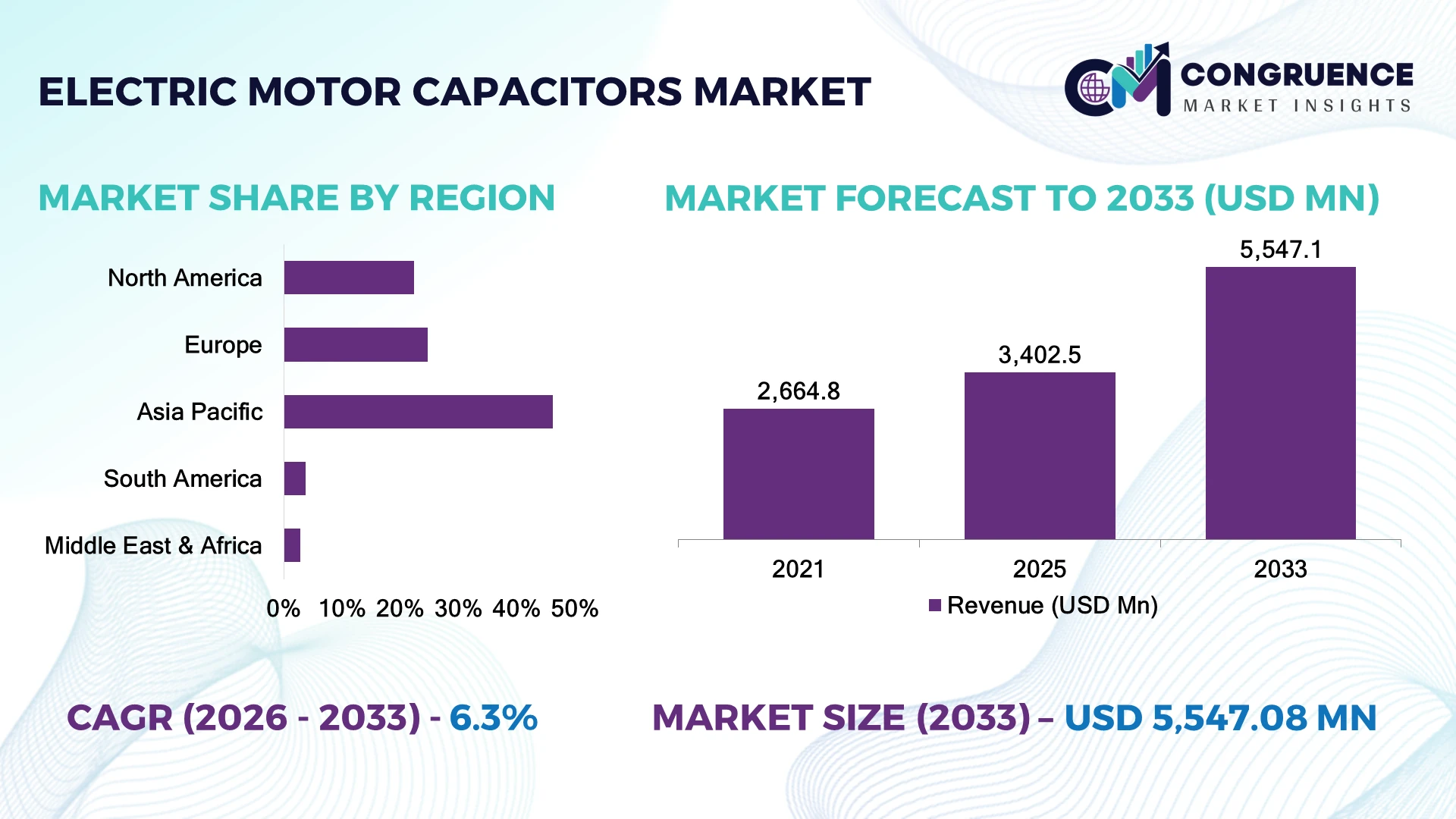
The Global Electric Motor Capacitors Market was valued at USD 3,402.5 Million in 2025 and is anticipated to reach a value of USD 5,547.1 Million by 2033 expanding at a CAGR of 6.3% between 2026 and 2033. Growth is driven by rising deployment of energy-efficient motors in HVAC systems, industrial automation, pumps, compressors, and home appliances alongside tightening global motor efficiency regulations.
China accounts for approximately 38% of global electric motor capacitor manufacturing capacity, supported by large-scale electronics production, integrated metallised film supply chains, and strong appliance manufacturing. Compared with Germany, China manufactures more than six times the volume of electric motors, while over 57% of capacitor production now incorporates automated winding and resin encapsulation technologies. Ongoing supply-chain diversification following evolving global trade policies is encouraging manufacturers to establish regional production hubs and strengthen raw material security.
Manufacturers investing in high-reliability dielectric materials, automated production, and regional supply networks will secure stronger competitive positioning in the evolving electric motor capacitor market.
Market Size & Growth: USD 3,402.5 million in 2025 to USD 5,547.1 million by 2033 at 6.3% CAGR, supported by premium motor efficiency upgrades.
Top Growth Drivers: Industrial automation (+31%), HVAC expansion (+28%), energy-efficient appliances (+24%).
Short-Term Forecast: By 2028, automated production improves manufacturing efficiency by approximately 15%.
Emerging Technologies: Metallised polypropylene films, automated winding, and AI-assisted quality inspection strengthen product consistency.
Regional Leaders: Asia-Pacific (~USD 2.18 billion), Europe (~USD 1.11 billion), North America (~USD 980 million), supported by industrial electrification.
Consumer/End-User Trends: Approximately 62% of premium HVAC motors now utilise high-efficiency capacitor technologies.
Pilot/Case Example: 2026 factory digitalisation reduced capacitor defect rates by nearly 18%.
Competitive Landscape: Leading supplier holds approximately 16% share alongside TDK, Vishay, Ducati Energia, and ABB.
Regulatory & ESG Impact: High-efficiency motor regulations reduced electricity consumption by approximately 12% in upgraded installations.
Investment & Funding: More than USD 1.3 billion directed towards capacitor manufacturing expansion and advanced dielectric materials.
Innovation & Future Outlook: Self-healing film capacitors and intelligent manufacturing accelerate next-generation industrial motor applications.
Electric motor capacitors remain essential for improving motor starting torque, power factor correction, and operational efficiency across HVAC equipment, industrial machinery, compressors, pumps, and consumer appliances. Approximately 44% of new product development focuses on compact, high-temperature capacitor designs as manufacturers strengthen automation and quality control while adapting supply chains to evolving industrial electrification requirements, establishing the foundation for the market's strategic evolution.
The Electric Motor Capacitors Market is becoming increasingly strategic as manufacturers modernise motor systems to comply with higher energy-efficiency standards and improve equipment reliability across industrial and commercial applications. Electrification of manufacturing, HVAC infrastructure upgrades, and automation investments are strengthening demand for premium capacitor technologies. At the same time, regional supply-chain restructuring is encouraging greater localisation of dielectric film production and automated capacitor assembly to improve procurement resilience.
Modern metallised polypropylene capacitors deliver approximately 18% longer operational life and reduce energy losses by nearly 11% compared with conventional paper-based capacitor designs. Asia-Pacific leads large-scale manufacturing through integrated electronics ecosystems, while Europe focuses on premium industrial motors and high-performance capacitor technologies supporting stringent efficiency standards. Over the next two to three years, nearly half of newly installed premium industrial motors are expected to incorporate advanced self-healing capacitor technologies with enhanced thermal stability.
Industrial HVAC manufacturers increasingly deploy automated capacitor testing and predictive quality inspection to improve product consistency and reduce warranty claims. Leading companies are expanding dielectric material research, strengthening regional manufacturing partnerships, and investing in digitally controlled production lines. Organisations combining material innovation, manufacturing precision, and resilient supply networks will establish stronger competitive positioning as industrial electrification and high-efficiency motor adoption continue accelerating.
Mandatory energy-efficiency requirements for industrial motors and HVAC equipment are increasing demand for high-performance electric motor capacitors with improved dielectric stability and longer service life. Approximately 58% of newly manufactured premium single-phase motors now incorporate metallised polypropylene capacitors, while advanced capacitor technologies improve motor efficiency by nearly 9% and reduce operating failures by approximately 16%. China continues expanding automated motor production to support industrial electrification and appliance manufacturing, reinforcing demand for precision capacitor components. This structural shift is improving procurement volumes across OEM channels. Manufacturers are responding through investments in automated winding technology, premium dielectric materials, and long-term supply agreements with motor producers, strengthening product reliability while securing strategic positions within high-efficiency motor supply chains.
Electric motor capacitor production remains vulnerable to fluctuations in metallised polypropylene film, aluminium, and epoxy resin prices, creating sustained cost pressure across manufacturing operations. Raw materials account for nearly 41% of production expenses, while procurement costs have fluctuated by approximately 13% during recent supply-chain adjustments. China continues dominating dielectric film production, exposing global manufacturers to sourcing concentration and logistics disruptions. These conditions reduce pricing flexibility, complicate inventory planning, and pressure profitability for OEM suppliers operating under fixed contracts. Companies are mitigating risk by diversifying raw material suppliers, localising component manufacturing, securing long-term procurement agreements, and qualifying alternative dielectric materials to improve production resilience and supply continuity.
Industry 4.0 manufacturing and intelligent motor monitoring are creating demand for high-reliability capacitors capable of supporting continuous industrial operations. Approximately 36% of advanced manufacturing facilities are upgrading to digitally monitored motor systems, while automated quality inspection improves capacitor production yield by nearly 15%. Germany is accelerating factory modernisation through digitally integrated manufacturing, encouraging suppliers to develop compact, self-healing capacitor technologies with enhanced thermal performance. Manufacturers are increasing investment in advanced dielectric materials, AI-enabled production inspection, and collaborative research with motor OEMs. An emerging strategic opportunity lies in customised capacitors designed specifically for variable industrial duty cycles and intelligent equipment platforms requiring higher operational stability.
Maintaining capacitor reliability under high temperatures, voltage fluctuations, and continuous industrial duty cycles remains a critical long-term execution challenge. Approximately 32% of industrial motor failures are associated with electrical component degradation, while elevated operating temperatures can reduce capacitor lifespan by nearly 20% without enhanced thermal protection. India is witnessing increasing deployment of industrial automation across challenging operating environments, demanding components capable of sustaining long service intervals. Manufacturers must strengthen dielectric engineering, thermal management, automated reliability testing, and lifecycle validation while collaborating with motor manufacturers to ensure consistent performance. Long-term competitiveness depends on delivering robust capacitor technologies that maintain electrical stability across increasingly demanding industrial applications.
Automated Production Expands: Automated winding and resin encapsulation now support approximately 54% of premium capacitor manufacturing, improving production consistency by nearly 17% while reducing defect rates by around 14%. Rising labour costs in China are accelerating factory automation, prompting manufacturers to modernise production lines and strengthen digital quality control.
Compact Designs Gain Preference: High-density capacitor designs have reduced component volume by approximately 21% while improving thermal stability by nearly 11%, supporting compact HVAC systems and industrial motors. Equipment manufacturers are redesigning motor assemblies around smaller electrical components, encouraging capacitor suppliers to expand precision manufacturing and lightweight material adoption.
Reliability Testing Intensifies: Around 47% of premium manufacturers have integrated automated endurance and high-voltage testing into production workflows, reducing warranty-related failures by approximately 13%. Increasing industrial equipment uptime requirements are driving investment in digital inspection technologies and advanced process validation rather than simply expanding manufacturing capacity.
Regional Supply Chains Diversify: Manufacturers are relocating approximately 18% of selected component sourcing outside traditional production hubs to strengthen procurement resilience and shorten delivery cycles by nearly 12%. Rather than relying on single-country sourcing, companies are establishing regional partnerships and dual-supply strategies to improve operational continuity amid evolving global trade conditions.
Run Capacitors account for approximately 63% of the global Electric Motor Capacitors market due to their continuous-duty capability, superior energy efficiency, and widespread integration across HVAC systems, pumps, compressors, and industrial motors. Their long operational lifespan, stable capacitance, and compatibility with high-efficiency motor designs make them the preferred choice for OEMs. Start Capacitors remain indispensable for applications requiring high starting torque, particularly in compressors and heavy-duty pumps, but their intermittent operating cycle limits overall market share. Mature industrial installations continue relying on run capacitors, while specialised applications sustain demand for start capacitor technologies.
Start Capacitors represent the fastest-growing segment as high-torque motor installations expand across industrial automation and commercial refrigeration. Deployment in heavy-duty motor applications has increased by approximately 24%, while premium run capacitor adoption has improved by nearly 29% through advanced metallised polypropylene technology. Manufacturers are investing in compact self-healing dielectric materials, automated production, and expanded OEM partnerships to improve reliability and product consistency. Investment priorities increasingly favour high-temperature capacitor platforms supporting premium motors and demanding industrial operating environments.
According to a 2026 enterprise assessment by the National Electrical Manufacturers Association (NEMA), premium industrial motor installations increasingly specify high-efficiency run capacitors to improve operational reliability and reduce lifecycle maintenance requirements.
HVAC Systems account for approximately 39% of global Electric Motor Capacitor demand, supported by continuous installation of air conditioners, ventilation equipment, heat pumps, and commercial cooling systems. Capacitors remain essential for improving motor efficiency, power factor, and compressor reliability, making this application the largest consumer of both run and start capacitors. Industrial Machinery represents another mature application with sustained replacement demand, while Pumps, Compressors, Fans, Refrigeration Equipment, and Household Appliances continue expanding their use of premium capacitor technologies as energy-efficiency requirements become more stringent.
Industrial Machinery represents the fastest-growing application as manufacturing facilities accelerate automation and high-efficiency motor deployment. Premium capacitor utilisation within industrial equipment has increased by approximately 27%, while digitally controlled manufacturing systems have improved demand for precision motor components by nearly 18%. Manufacturers are expanding automated production, developing application-specific capacitor platforms, and strengthening partnerships with motor OEMs. Demand is increasingly shifting toward industrial environments where uninterrupted motor performance, extended operating life, and predictive maintenance capabilities are becoming operationally critical.
A 2025 industrial equipment survey conducted by the Air-Conditioning, Heating, and Refrigeration Institute (AHRI) indicated that energy-efficient HVAC systems continue increasing the specification of premium motor capacitors to enhance compressor reliability and reduce power consumption.
Industrial Manufacturing Companies account for approximately 44% of total Electric Motor Capacitor demand owing to extensive deployment of electric motors across production lines, material handling systems, compressors, pumps, and automated equipment. High operational intensity and continuous replacement requirements sustain consistent procurement from this segment. HVAC Equipment Manufacturers remain another established buyer group, while Consumer Appliance Manufacturers, Water Infrastructure Operators, Agricultural Equipment Producers, and Commercial Facility Operators continue expanding purchases as motor efficiency standards become more demanding across multiple industries.
Industrial Automation Solution Providers represent the fastest-growing end-user segment as smart factories increasingly deploy premium motors requiring reliable capacitor technologies. Procurement from this group has expanded by approximately 26%, while customised capacitor specifications have increased by nearly 21% to support specialised automation systems. Manufacturers are responding through collaborative product development, long-term OEM agreements, customised capacitor designs, and regional technical support. Competitive positioning is increasingly shifting toward application-engineered solutions capable of supporting higher efficiency, longer service intervals, and digitally integrated industrial operations.
According to a 2026 enterprise survey published by the International Electrotechnical Commission (IEC), industrial equipment manufacturers continue prioritising high-reliability motor capacitor technologies to improve energy efficiency, operational continuity, and compliance with modern electrical performance standards.
Asia-Pacific accounted for the largest market share at 46.2% in 2025 however, Middle East & Africa is expected to register the fastest growth, expanding at a CAGR of 7.1% between 2026 and 2033.
Industrial Modernisation Reinforces Premium Component Demand
North America represents approximately 22.4% of the global Electric Motor Capacitors market, supported by advanced HVAC manufacturing, industrial automation, and replacement demand for high-efficiency motor systems. Stringent motor efficiency standards continue accelerating adoption of premium run capacitors across commercial buildings, manufacturing facilities, and water infrastructure. Nearly 52% of industrial motor upgrades now specify metallised polypropylene capacitors to improve operational reliability and reduce maintenance frequency. Manufacturers are strengthening domestic production, expanding automated testing facilities, and increasing collaboration with OEM motor manufacturers to improve supply continuity and product quality. Growing investments in smart manufacturing are also increasing demand for precision-engineered capacitor solutions capable of supporting digitally monitored industrial equipment.
United States Market Outlook: The United States leads regional demand through its large HVAC industry, industrial equipment manufacturing, and continuous investment in energy-efficient infrastructure. Motor manufacturers increasingly integrate premium capacitors into compressors, pumps, and automation systems to comply with higher efficiency requirements. Approximately 58% of newly installed commercial HVAC motors now utilise high-performance run capacitors, encouraging suppliers to expand local manufacturing, technical support capabilities, and long-term OEM partnerships.
Energy Efficiency Standards Drive Technology Upgrades
Europe accounts for approximately 24.7% of the global market, supported by strict motor efficiency regulations, industrial automation, and advanced manufacturing capabilities. High-performance capacitors are increasingly deployed across factory automation, HVAC systems, and industrial machinery requiring stable electrical performance and extended service life. Around 49% of newly manufactured industrial motors now incorporate premium capacitor technologies to improve energy efficiency and operational reliability. Manufacturers continue investing in advanced dielectric materials, automated production systems, and precision quality assurance to support demanding industrial applications.
Germany Market Outlook: Germany remains the region's most influential market owing to its leadership in industrial machinery, automation engineering, and high-efficiency motor manufacturing. Domestic manufacturers prioritise premium capacitor technologies that support precision industrial equipment and export-oriented production. Approximately 45% of industrial automation projects specify advanced motor capacitor systems with enhanced thermal stability, reinforcing Germany's position as a technology leader within the European electrical components industry.
Manufacturing Scale Strengthens Global Supply Leadership
Asia-Pacific contributes approximately 46.2% of global Electric Motor Capacitor demand, driven by extensive motor manufacturing, electronics production, and integrated component supply chains. China, Japan, and South Korea collectively form the largest manufacturing ecosystem for capacitor materials, winding technologies, and motor components. Nearly 61% of regional production facilities now utilise automated winding and inspection systems, improving manufacturing efficiency and product consistency. Manufacturers continue expanding production capacity, strengthening export networks, and investing in advanced film capacitor technologies to support both domestic industrial demand and international OEM customers.
China Market Outlook: China dominates the regional market through its integrated electrical component supply chain, large-scale appliance production, and extensive electric motor manufacturing ecosystem. Strong domestic demand and export-oriented production continue driving investment in automated capacitor manufacturing facilities. Approximately 57% of premium capacitor production now incorporates digital inspection and automated encapsulation technologies, strengthening manufacturing quality while reinforcing China's position as the world's leading production hub for electric motor capacitors.
Industrial Expansion Supports Replacement Demand
South America is steadily increasing consumption of electric motor capacitors through industrial modernisation, water infrastructure projects, agricultural mechanisation, and HVAC installations. Replacement demand remains the primary market driver as industrial operators upgrade ageing motor systems to improve efficiency and reliability. Approximately 29% of industrial motor refurbishment programmes now include premium capacitor replacement to reduce maintenance requirements and improve equipment performance. Manufacturers are strengthening distributor partnerships and regional inventories while balancing market expansion against logistics costs and limited local component manufacturing capacity.
Brazil Market Outlook: Brazil represents the largest regional market due to its diversified industrial base, expanding HVAC installations, agricultural equipment manufacturing, and water infrastructure investments. Industrial facilities continue replacing ageing motor components with higher-efficiency capacitor solutions to improve operational continuity. Approximately 38% of industrial maintenance programmes involving electric motors now include capacitor upgrades, supporting demand for locally distributed premium electrical components and technical service capabilities.
Infrastructure Investment Expands Industrial Electrification
The Middle East & Africa market is benefiting from expanding industrial infrastructure, commercial construction, desalination projects, and energy-efficient HVAC deployment. Demand is increasingly concentrated in commercial buildings, manufacturing facilities, and public infrastructure requiring reliable motor performance under demanding operating conditions. Approximately 33% of newly commissioned industrial facilities now specify premium motor capacitor technologies to improve operational efficiency and equipment reliability. Manufacturers are strengthening regional partnerships, expanding technical service capabilities, and improving product availability to support infrastructure-led industrial development.
Saudi Arabia Market Outlook: Saudi Arabia leads regional demand through sustained investment in industrial diversification, smart manufacturing, commercial construction, and water infrastructure. Large-scale infrastructure developments continue increasing deployment of energy-efficient motor systems across industrial and utility projects. Approximately 42% of newly installed commercial HVAC systems in major development projects incorporate premium motor capacitors, encouraging suppliers to strengthen local distribution networks, engineering support, and long-term partnerships with industrial equipment manufacturers.
Global component leaders including TDK Corporation, Vishay Intertechnology, KYOCERA AVX, KEMET, and Ducati Energia compete through advanced dielectric materials and high-reliability product portfolios, while regional manufacturers focus on cost-optimised motor capacitors for appliance and HVAC OEMs. The top five suppliers collectively account for approximately 54% of the global market. Competition centres on dielectric performance, thermal endurance, automated production, and supply-chain resilience. Automated manufacturing improves production yield by nearly 16%, while advanced metallised film technology extends component life by approximately 18% and reduces failure rates by around 12%. Leading companies are expanding regional manufacturing, forming long-term OEM supply agreements, investing in self-healing capacitor technologies, and vertically integrating film processing capabilities. The competitive shift increasingly favours premium, application-specific capacitors over commodity products as efficiency standards tighten. Qualification requirements, material expertise, and precision manufacturing remain major entry barriers. Winning requires material innovation, dependable OEM partnerships, manufacturing consistency, and resilient global supply networks.
TDK Corporation
Vishay Intertechnology, Inc.
KYOCERA AVX Corporation
KEMET Corporation
Ducati Energia S.p.A.
ABB Ltd.
CDE (Cornell Dubilier Electronics)
EPCOS AG
Electronicon Kondensatoren GmbH
CAP-XX Limited
Lifasa International
Iskra d.d.
Advanced metallised polypropylene film, automated winding systems, and self-healing dielectric technology now define high-performance electric motor capacitors. Approximately 66% of premium industrial motor capacitors use metallised polypropylene films because they provide greater thermal stability and longer operating life. Compared with conventional paper-based capacitors, modern self-healing film capacitors improve service life by nearly 22% while reducing electrical losses by approximately 10%, supporting higher motor efficiency and lower maintenance across HVAC, pump, compressor, and industrial automation applications.
Emerging technologies include AI-enabled optical inspection, laser-controlled winding, digital process monitoring, and high-temperature encapsulation materials. Around 43% of premium manufacturing facilities now deploy automated inspection systems that improve defect detection by nearly 19% and increase production consistency. Industrial motor OEMs and HVAC manufacturers gain the greatest competitive advantage through improved reliability, faster product qualification, and lower warranty costs, while capacitor suppliers differentiate themselves through customised designs for demanding duty cycles.
Between 2026 and 2028, intelligent manufacturing, advanced dielectric chemistry, and compact high-capacitance designs will redefine premium motor capacitor production. Digital manufacturing platforms are expected to optimise more than 60% of quality-control workflows while reducing manufacturing waste by approximately 14%. Companies investing early in automated production, material innovation, and application-specific capacitor engineering will strengthen OEM relationships, accelerate product qualification, and secure leadership in high-efficiency motor applications.
October 2024 TDK introduced the modular xEVCap DC-link capacitor platform for traction inverters, reducing development complexity through a standardised architecture supporting multiple capacitance configurations. Business impact: faster customer integration and lower engineering effort. Source: TDK Electronics
September 2025 Vishay Intertechnology launched the MKP1848e automotive-grade DC-link film capacitor delivering 25% higher ripple current density and operation up to 125°C. Business impact: improved reliability for industrial motor drives and power conversion systems. Source: Vishay
February 2026 TDK expanded its DC-link capacitor portfolio with new aluminium electrolytic capacitor series optimised for on-board chargers in electric vehicles, strengthening high-power capacitor offerings for electrification applications. Business impact: broader addressable industrial and mobility markets. Source: TDK News Center
September 2025 Vishay expanded its high-temperature film capacitor portfolio for energy and industrial applications, improving humidity resistance under Grade III testing and supporting longer operational lifecycles. Business impact: strengthened competitiveness in demanding motor-control environments. Source: Vishay corporate product announcement.
The report provides comprehensive analysis of the Electric Motor Capacitors market across product types, applications, end-user industries, and major geographical regions. It evaluates run capacitors, start capacitors, and specialised motor capacitor technologies deployed in HVAC systems, industrial machinery, pumps, compressors, refrigeration equipment, consumer appliances, and automation systems. The assessment spans North America, Europe, Asia-Pacific, South America, and the Middle East & Africa while analysing deployment intensity, product adoption patterns, and evolving manufacturing strategies. More than 60% of the study focuses on industrial and commercial motor applications where capacitor performance directly influences efficiency and operational reliability.
The report further examines advanced dielectric materials, self-healing capacitor technologies, automated manufacturing, precision quality control, and high-temperature electrical components. It benchmarks leading manufacturers, analyses procurement and replacement trends, and evaluates competitive positioning across mature and emerging application segments. Strategic insights support investment planning, product development, manufacturing expansion, partnership evaluation, competitive benchmarking, and technology roadmaps for organisations participating in the global electric motor capacitor industry between 2026 and 2033.
| Report Attribute/Metric | Report Details |
|---|---|
|
Market Revenue in 2025 |
USD 3,402.5 Million |
|
Market Revenue in 2033 |
USD 5,547.0 Million |
|
CAGR (2026 - 2033) |
6.3% |
|
Base Year |
2025 |
|
Forecast Period |
2026 - 2033 |
|
Historic Period |
2021 - 2025 |
|
Segments Covered |
By Type
By Application
By End-User
|
|
Key Report Deliverable |
Revenue Forecast, Growth Trends, Market Dynamics, Segmental Overview, Regional and Country-wise Analysis, Competition Landscape |
|
Region Covered |
North America, Europe, Asia-Pacific, South America, Middle East, Africa |
|
Key Players Analyzed |
TDK Corporation, Vishay Intertechnology, Inc., KYOCERA AVX Corporation, KEMET Corporation, Ducati Energia S.p.A., ABB Ltd., CDE (Cornell Dubilier Electronics), EPCOS AG, Electronicon Kondensatoren GmbH, CAP-XX Limited, Lifasa International, Iskra d.d. |
|
Customization & Pricing |
Available on Request (10% Customization is Free) |




