
Reports
The Global Electric Lighter Market was valued at USD 2733 Million in 2025 and is anticipated to reach a value of USD 3683.14 Million by 2033 expanding at a CAGR of 3.8% between 2026 and 2033. Growth is driven by fuel-free plasma-arc ignition, USB-C rechargeable batteries, windproof performance, automated low-cost manufacturing, and consumer migration from disposable butane lighters toward reusable electronic formats.
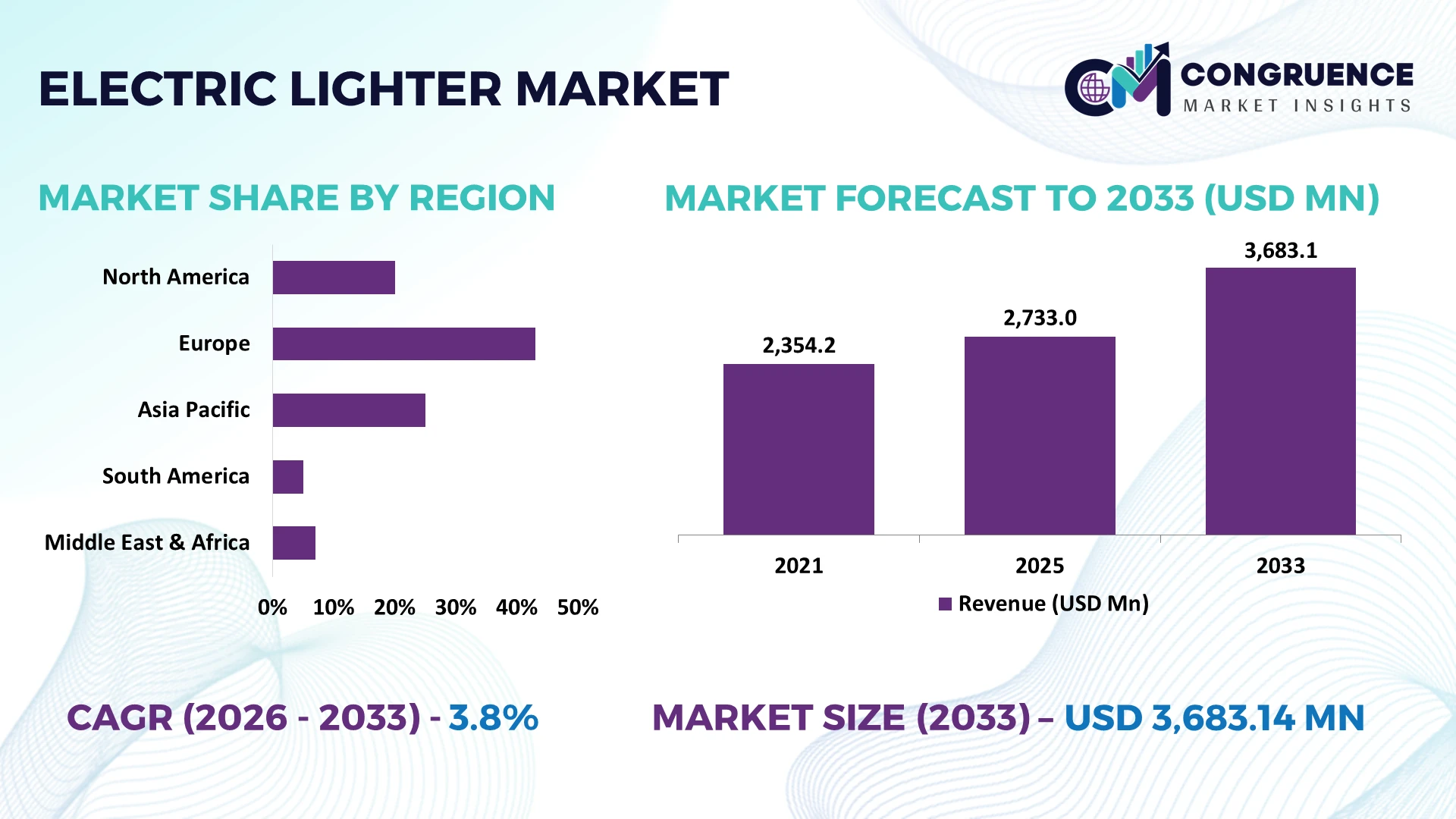
China is the dominant global production center, led by Shaodong, Hunan, where more than 15 billion lighters are manufactured annually, representing about 70% of worldwide lighter supply; leading plants operate six automated assembly lines and export over 99% of output. Hunan exported 3.89 billion lighters in 2025, up 21.3%, compared with far smaller manufacturing footprints in the United States and Europe. Trade diversification toward Belt and Road markets, amid tariff and geopolitical supply-chain pressure, is reinforcing China's scale advantage in rechargeable ignition electronics.
Electric lighter suppliers that combine Chinese manufacturing scale with diversified export channels, USB-C product upgrades, and proprietary safety engineering hold the clearest cost and speed advantage.
Market Size & Growth: USD 2.733 billion in 2025 reaches USD 3.683 billion by 2033 at 3.8%, supported by rechargeable plasma-arc adoption and declining reliance on refillable fuel systems.
Top Growth Drivers: Rechargeable adoption contributes an estimated 38%, windproof plasma functionality 31%, and replacement of disposable fuel formats 24% to category expansion.
Short-Term Forecast: By 2028, higher-capacity batteries and USB-C charging are positioned to improve usable ignition cycles per charge by approximately 20%.
Emerging Technologies: Dual-arc plasma, intelligent battery indicators, IP56 sealing, and automatic 7–8-second shutoff systems are redefining advanced electric lighter performance.
Regional Leaders: Modeled 2033 demand reaches approximately USD 1.55 billion in Asia-Pacific, USD 0.88 billion in North America, and USD 0.77 billion in Europe.
Consumer/End-User Trends: Current rechargeable models commonly deliver 150–500+ ignitions per charge, reducing dependence on repeated butane purchases.
Pilot/Case Example: In 2025, Dongyi Electric operated 6 automated production lines and shipped more than 1 million lighters daily, demonstrating high-throughput manufacturing economics.
Competitive Landscape: BIC remains the broader lighter-category benchmark, while Zippo, S.T. Dupont, Tesla Coil Lighters, and specialized Chinese OEMs intensify rechargeable competition; top electric brands remain fragmented below 30% combined.
Regulatory & ESG Impact: Rechargeable architectures eliminate 100% of direct butane refilling during normal use, strengthening reusable-product positioning as waste and transport controls tighten.
Investment & Funding: Shaodong’s manufacturing ecosystem supports over 15 billion units of annual lighter capacity, with investment increasingly directed toward automation, rechargeable electronics, molds, and export diversification.
Innovation & Future Outlook: By 2030, USB-C, dual-arc ignition, battery diagnostics, waterproof housings, and integrated LED functions will shift premium competition toward multifunctional, reusable ignition platforms.
The Electric Lighter Market is shifting toward USB-C rechargeable plasma devices for kitchens, outdoor recreation, candles, emergency kits, and everyday carry applications. Current products provide approximately 150–500+ ignitions per charge, while dual-arc electrodes, battery displays, safety locks, flexible necks, and waterproof housings are expanding functional differentiation. China’s Shaodong manufacturing cluster remains strategically critical, although geopolitical and tariff pressures are encouraging diversified export and sourcing strategies. This combination of reusable technology and manufacturing scale establishes the foundation for the market’s strategic evolution.
Electric lighters are becoming strategically important as ignition products shift from fuel-dependent consumables toward rechargeable electronics, forcing traditional lighter manufacturers to compete on battery reliability, plasma-arc performance, charging architecture, and automated production. China’s Shaodong cluster supplies about 70% of global lighter output, but tariff uncertainty and export-market diversification are pushing manufacturers to build more flexible sourcing, assembly, and distribution networks across Asia and major consumer markets.
Automation illustrates the competitive economics. At Dongyi Electric, production cost per conventional lighter fell from RMB 0.20 to RMB 0.015 after successive automation upgrades, a 92.5% reduction, while workforce requirements dropped 85%. Output simultaneously increased from 1 million to 5 million units daily. Electric-lighter producers can apply the same manufacturing discipline to electrodes, PCBs, battery modules, and housings. China leads scale; Europe emphasizes product durability, electrical safety, and USB-C interoperability.
During 2026–2028, investment will concentrate on dual-arc systems, battery indicators, automatic shutoff, waterproof housings, and standardized USB-C charging. A practical production line can combine robotic assembly with sensor-based ignition testing, reducing manual inspection while improving consistency. Suppliers that unite automated manufacturing, compliant battery engineering, and diversified export channels will establish the strongest long-term position.
Reusable plasma ignition is the principal structural driver as consumers replace butane refilling with lithium-powered, wind-resistant electric arcs. Modern rechargeable models routinely provide 150–500 ignition cycles per charge, while dual-arc configurations improve ignition contact coverage by approximately 50% versus single-arc architectures. China’s Shaodong cluster already supplies roughly 70% of global lighter output, giving manufacturers immediate access to plastics, electrodes, batteries, PCBs, and automated assembly expertise. Production modernization provides additional leverage: leading factories have reduced certain lighter-production costs by more than 90% through automation. Manufacturers are responding by shifting engineering budgets toward USB-C charging, battery-status displays, safety locks, and flexible-neck utility designs. The strategic advantage comes from combining consumable replacement with electronics manufacturing economics, creating higher product differentiation without abandoning mass-market production scale.
Rechargeable architecture removes fuel dependency but introduces lithium-cell procurement, transport documentation, charging circuitry, and electronic-quality requirements that inexpensive mechanical lighters avoid. Shaodong manufacturers export more than 99% of output at leading facilities, increasing exposure to cross-border battery-shipping rules, customs documentation, and destination-market certification. Automated production has reduced labor requirements by approximately 85%, yet battery cells, PCBs, and protection circuits remain more specification-sensitive than molded fuel-lighter components. European moves toward standardized charging and stricter electronic-product sustainability also increase design discipline for rechargeable devices. Manufacturers are reducing exposure through qualified battery suppliers, modular USB-C boards, standardized cells, regional compliance testing, and multiple logistics partners. The non-obvious constraint is therefore not ignition technology itself; it is maintaining low consumer pricing while absorbing electronics-grade quality assurance and international battery-transport requirements.
The strongest opportunity lies in transforming electric lighters from cigarette-lighting substitutes into multifunctional ignition tools for candles, kitchens, barbecues, camping, fireplaces, and emergency kits. Flexible-neck models can extend reach by more than 100 mm, while IP56-class housings and automatic 7–8-second shutdown functions improve suitability for outdoor and household environments. USB-C standardization further removes proprietary charging friction as consumer electronics converge around common interfaces. China’s lighter cluster already distributes products across more than 120 countries and regions, giving established exporters a ready channel for higher-spec rechargeable formats. Companies are developing dual-arc electrodes, LED flashlights, digital battery displays, waterproof enclosures, and replaceable modules while expanding through private-label and outdoor-retail partnerships. The strategic opportunity is higher value per manufacturing line: electronics-led differentiation can lift product functionality without requiring an entirely new distribution infrastructure.
Scaling electric lighters requires manufacturers to maintain electrode spacing, battery output, insulation, charging stability, and automatic cutoff performance across millions of low-cost units. Shaodong produces about 15 billion lighters annually, while leading factories can manufacture up to 5 million units per day; applying comparable throughput to electronics-intensive products magnifies small component defects quickly. Automation has cut workforce requirements by roughly 85%, but plasma products still require tighter PCB, battery, and high-voltage quality control than conventional disposable formats. Moisture ingress, electrode carbon buildup, degraded cells, and inconsistent arc strength can shorten service life and undermine reusable-product positioning. Manufacturers must therefore invest in end-of-line electrical testing, battery protection circuits, automated arc inspection, waterproofing validation, and supplier traceability. Long-term competitiveness depends on reproducing China’s manufacturing speed without allowing quality variance to erase the reliability advantage promised by rechargeable technology.
USB-C Charging Becomes Standard: Electric lighter portfolios are rapidly replacing micro-USB interfaces with USB-C charging, while 44% of recently introduced rechargeable models already feature USB charging and about 31% incorporate battery indicators. Manufacturers are redesigning PCBs and housings around common charging components, reducing connector complexity, accelerating sourcing, and improving compatibility with existing consumer-device chargers.
Dual-Arc Designs Gain Premium Positioning: Dual-arc architectures are moving beyond novelty products as brands target wind resistance, broader ignition contact, and faster lighting performance. Electric arc products account for roughly 61% of current category usage, while advanced dual-arc variants increasingly include 7–8-second automatic shutoff and waterproof casings. Suppliers are expanding higher-spec SKUs and consolidating electrode, battery, and safety-control sourcing.
Outdoor Formats Become More Rugged: Product development is increasingly aligned with camping, barbecue, and emergency-use workflows rather than cigarette ignition alone. U.S. outdoor participation reached 183.2 million people in 2025, equal to 59% of Americans aged six or older. Brands are responding with flexible necks exceeding 100 mm, IP56-style protection, LED lighting, and stronger enclosures, raising utility across weather-exposed applications.
Automation Reshapes Cost Structures: Chinese lighter manufacturing is shifting toward higher automation as labor economics and export competition intensify. Advanced Shaodong plants have reduced certain unit production costs by approximately 92.5%, cut labor requirements 85%, and increased daily output to 5 million units. Electric-lighter producers are extending automation into PCB placement, electrode alignment, arc testing, and battery assembly to protect margins.
Arc Lighters account for an estimated 34% of the Electric Lighter Market by type, supported by mature component availability, scalable electronic architecture, strong wind resistance, and broad application across household and personal ignition. Plasma Lighters follow at approximately 27%, benefiting from their flameless positioning and recognizable technology proposition. Coil Lighters maintain a smaller established base where direct resistance heating and simple electronic layouts provide lower manufacturing complexity, although exposed heating elements limit versatility compared with protected arc systems.
Dual-Arc Lighters are the fastest-growing type because two crossing arcs enlarge the ignition contact area and strengthen operation in wind-exposed environments. USB Rechargeable Lighters are also gaining importance as standardized charging reduces ownership friction and removes disposable fuel dependency. Recently introduced electric lighter ranges increasingly combine USB charging, battery indicators, auto-shutoff, and waterproofing, with approximately 44% of newer products incorporating USB capability. Manufacturers are therefore prioritizing dual-arc platforms, USB-C circuitry, modular batteries, and automated electrode assembly, shifting investment toward multifunctional rechargeable designs rather than basic heating-coil formats.
Household Lighting represents an estimated 32% of Electric Lighter Market applications because rechargeable ignition devices are repeatedly used for candles, gas appliances, incense, emergency lighting tasks, and other domestic ignition needs. Candle Lighting accounts for approximately 25%, supported by flexible-neck electric designs that improve reach into deeper containers. Fireplace Lighting remains a comparatively mature niche, where extended stems and wind-resistant arcs provide safety advantages over compact pocket formats.
Outdoor Use is the fastest-growing application as waterproof construction, dual-arc ignition, and integrated LED functions make electric lighters more practical for camping and recreational environments. Barbecue Grilling is also strengthening because extended-neck models improve separation between the user and ignition point. In the United States, outdoor recreation participation reached 183.2 million people during 2025, representing 59% of the population aged six and older. Manufacturers are expanding ruggedized products, flexible-neck platforms, safety locks, and weather-resistant housings, placing greater development emphasis on multi-use ignition rather than single-purpose household devices.
Households represent approximately 55% of Electric Lighter Market end-user demand because cooking, candle use, incense, fireplaces, and routine utility tasks create the broadest recurring ignition requirement. Specialty Retailers remain strategically important for premium, novelty, outdoor, and rechargeable products, while Grill Users favor extended-neck formats with safety switches and wind-resistant arcs. Hospitality Businesses use rechargeable lighters selectively for candles, tabletop ambience, kitchens, and event operations, where device durability and standardized charging influence purchasing decisions.
Outdoor Enthusiasts are the fastest-growing end-user group as camping participation and multifunctional equipment adoption expand. U.S. outdoor recreation participation reached 59% in 2025 and has added nearly 30 million participants since 2019, strengthening the addressable audience for waterproof, dual-arc, flashlight-equipped products. Manufacturers are targeting this segment through IP-rated housings, larger batteries, flexible stems, bundled charging cables, and outdoor-retailer partnerships. Household buyers remain volume-critical, but higher-value product development is moving toward enthusiasts and specialty channels where durability, weather resistance, and multifunctionality support stronger differentiation.
Asia-Pacific accounted for the largest market share at 43% in 2025 however, Asia-Pacific is expected to register the fastest growth, expanding at a CAGR of 4.7% between 2026 and 2033.
Rechargeable Utility Formats Reshape Retail Demand
North America represents approximately 25% of 2025 market demand, supported by high household consumption of candles, barbecue equipment, outdoor products, and rechargeable consumer electronics. U.S. outdoor participation reached 183.2 million people in 2025, equivalent to 59% of the population aged six and above, creating a substantial user base for windproof and waterproof ignition equipment. Product portfolios are shifting toward USB-C charging, flexible-neck electrodes, dual-arc systems, safety locks, and battery-status indicators. E-commerce and outdoor-specialty channels accelerate product replacement and enable smaller technology brands to compete against established lighter manufacturers. Imported Chinese components remain important, but tariff and logistics exposure is encouraging inventory diversification. Suppliers are consequently emphasizing multi-use products delivering 150–500+ ignitions per charge, reducing dependence on conventional butane formats.
United States Market Outlook: The United States combines extensive household consumption with a large outdoor recreation economy and established barbecue culture. More than 175 million Americans participated in outdoor recreation during 2024, reinforcing demand for weather-resistant ignition equipment. Brands are targeting this installed consumer base through extended-neck rechargeable lighters, IP-rated housings, child-safety switches, Amazon distribution, and partnerships with camping and grilling retailers.
Charging Standardization Accelerates Product Redesign
Europe accounts for approximately 22% of 2025 demand, with Germany, France, the United Kingdom, Italy, and Spain providing the principal consumer markets. The structural transition toward USB-C is particularly relevant because EU common-charger requirements now cover multiple categories of rechargeable portable electronics, establishing stronger consumer expectations for standardized charging interfaces. Electric-lighter suppliers are consequently replacing proprietary and micro-USB connections while improving battery-management circuitry, automatic shutoff, and product durability. Europe’s sustainability agenda also favors reusable ignition systems that eliminate routine butane refilling, although electronic products introduce battery-management and recycling obligations. Premium suppliers compete through metal housings, longer operating life, wind-resistant arcs, and safety engineering rather than lowest-cost hardware. Distribution is increasingly split between digital marketplaces, household-goods retailers, outdoor specialists, and premium accessory channels, requiring differentiated specifications and packaging.
Germany Market Outlook: Germany provides a strategically attractive combination of purchasing power, mature e-commerce infrastructure, outdoor participation, and strong consumer-product compliance expectations. Rechargeable lighter suppliers benefit from widespread USB-C familiarity and demand for durable household equipment. Successful products increasingly combine electronic safety cutoffs, battery indicators, recyclable packaging, and documented electrical compliance, creating higher entry requirements than price-led marketplace competition alone.
China Controls Manufacturing Scale and Automation
Asia-Pacific commands approximately 43% of 2025 demand while providing the industry's decisive manufacturing infrastructure. Shaodong in China produces more than 15 billion lighters annually, equivalent to roughly 70% of worldwide lighter supply, and exports products to more than 120 countries and territories. Its vertically concentrated ecosystem covers molds, plastic components, ignition mechanisms, electrodes, electronics, packaging, and automated assembly. Advanced factories have increased production capacity from around 1 million to 5 million units daily while reducing labor requirements approximately 85%, demonstrating the scale economics available to rechargeable-product manufacturers. Japan and South Korea strengthen premium electronics capability, while India provides an expanding digitally connected consumer base. Chinese suppliers are upgrading from disposable production toward USB-C boards, plasma modules, dual-arc electrodes, automated inspection, and ODM services, reinforcing Asia-Pacific’s cost and commercialization-speed advantage.
China Market Outlook: China remains indispensable to electric lighter supply chains because Shaodong combines enormous lighter capacity with Shenzhen and Guangdong electronics capabilities. Hunan exported 3.89 billion lighters in 2025, increasing 21.3%. Linking established lighter production with nearby battery, PCB, USB-C, and semiconductor suppliers enables manufacturers to shorten development cycles and scale new rechargeable configurations rapidly.
Digital Retail Broadens Rechargeable Product Access
South America represents approximately 5% of 2025 market demand, led by Brazil’s household, barbecue, outdoor recreation, and e-commerce channels. Rechargeable plasma products are gaining visibility through marketplaces where consumers can compare dual-arc, flexible-neck, battery-display, and waterproof configurations directly against conventional fuel lighters. Brazil’s population exceeds 200 million, creating significant potential scale, but imported battery electronics remain exposed to currency movements, freight costs, duties, and uneven specialty-retail distribution. Consequently, affordable USB rechargeable and single-arc products retain stronger positioning than highly engineered premium models. Suppliers are using marketplace fulfillment, localized Portuguese packaging, multi-product bundles, and distributor inventories to reduce delivery friction. Argentina, Chile, and Colombia provide secondary demand pockets, particularly for household and outdoor formats. Competitive execution depends on balancing electronic functionality with price points suitable for locally constrained discretionary spending.
Brazil Market Outlook: Brazil offers the region’s strongest commercial platform through population scale, established e-commerce networks, barbecue culture, and widespread household ignition requirements. Suppliers increasingly use domestic marketplace fulfillment rather than relying exclusively on cross-border shipping. Products combining flexible stems, USB charging, charge indicators, and safety locks offer a practical middle tier between disposable lighters and expensive premium plasma devices.
E-Commerce Expands Premium Ignition Access
Middle East & Africa represents approximately 5% of 2025 market demand, with the UAE, Saudi Arabia, South Africa, and major urban markets concentrating rechargeable-lighter adoption. Gulf countries offer stronger premium potential through high digital-commerce penetration, outdoor leisure spending, hospitality activity, and established import infrastructure. Wind-resistant plasma ignition is particularly relevant for camping, barbecue, and outdoor entertainment, while rechargeable designs fit increasingly electronics-oriented consumer purchasing patterns. Dubai functions as an important re-export hub connecting Asian manufactured goods with Gulf and African distribution channels. Across African markets, however, purchasing-power differences and fragmented retail infrastructure maintain stronger competition from inexpensive conventional lighters. Suppliers are responding with tiered product portfolios, distributor partnerships, localized marketplace listings, bulk shipments, and multifunctional designs combining arc ignition with LED lighting. Import efficiency and durable battery performance remain central to profitable deployment.
United Arab Emirates Market Outlook: The UAE provides the strongest premium distribution platform because Dubai combines international logistics, tourism, hospitality, modern retail, and cross-border e-commerce. High outdoor temperatures place additional emphasis on battery quality and storage specifications. Suppliers targeting UAE consumers increasingly differentiate through dual-arc ignition, waterproof construction, USB-C charging, premium metal finishes, and camping-oriented multifunctionality.
BIC, Zippo, S.T. Dupont, Tesla Coil Lighters, and Chinese OEM manufacturers compete across distinct positions, with established lighter brands defending distribution while electronics-led suppliers attack through rechargeable functionality. The top five branded participants hold an estimated 27% combined share, leaving private-label production structurally important. Chinese OEMs compete aggressively on cost, with automated lighter manufacturing cutting certain unit-production expenses by over 90%, while premium brands command approximately 25–40% higher pricing through materials, design, warranties, and safety engineering. Technology specialists differentiate through dual-arc electrodes, USB-C charging, waterproofing, and 150–500+ ignitions per charge. Players are expanding marketplace distribution, ODM partnerships, automated assembly, and vertically integrated component sourcing. Competition is shifting from mechanical ignition reliability toward battery endurance and electronic safety. Lithium-cell compliance, quality consistency, and intellectual-property differentiation remain entry pressures. Winning requires automated cost control, dependable electronics, differentiated industrial design, certified battery systems, rapid product iteration, and diversified international distribution capabilities.
BIC
Zippo Manufacturing Company
S.T. Dupont
Colibri
Clipper
XIKAR
Tesla Coil Lighters
Saberlight
TROPRO
RONXS
SUPRUS
Leejie
MEIRUBY
TACKLIFE
Current electric lighter technology centers on rechargeable plasma-arc ignition, USB-C power, lithium batteries, safety locks, and battery indicators. Dual-arc architectures widen ignition contact versus single-arc designs, improving ignition coverage by roughly 50%, while automated lighter manufacturing has raised per-worker productivity about 30-fold in Shaodong plants. Deployment is moving beyond pocket formats into candle, kitchen, barbecue, and outdoor products, with models commonly delivering 100–500 ignitions per charge. This gives electronics-capable manufacturers stronger differentiation than conventional fuel-lighter suppliers.
Emerging systems combine waterproof housings, power management, automatic 7–10-second cutoff, LED illumination, and modular rechargeable inserts. Automated welding and assembly have reduced labor cost per lighter from approximately RMB0.10 to below RMB0.02, an improvement exceeding 80% versus legacy manual production. Sensor-based end-of-line inspection improves consistency at million-unit scale. Manufacturers controlling batteries, PCBs, electrodes, molds, and automated assembly benefit most because component integration shortens product-development cycles and protects margins.
Disruptive development through 2026–2028 will concentrate on USB-C standardization, higher-cycle batteries, replaceable arc modules, advanced electrode control, and automated electrical testing. Integration with multifunctional outdoor tools will broaden usage while reducing fuel dependence. Suppliers investing now gain faster iteration, better quality control, and defensible performance as electric ignition shifts from novelty hardware toward durable reusable equipment.
June 2024 Hunan Dongyi Electric advanced factory automation in Shaodong, lifting welding output from 1 million to 5 million lighters daily while reducing staffing from more than 200 workers to 30. The shift materially strengthened China’s cost and production-scale advantage. Source: Global Times
May 2025 Hunan Dongyi Electric operated six automated production lines and shipped more than 1 million lighters daily, with over 99% of output exported. Full order books through October demonstrated sustained international demand and reinforced Shaodong’s highly export-oriented manufacturing resilience. Source: Hunan Government
July 2026 Zippo documented its Double Arc Rechargeable Lighter Insert, featuring double-tap ignition, rechargeable operation, and automatic shutdown after 10 seconds. The platform extends Zippo’s reusable windproof cases into electric ignition, strengthening modular product upgrades without replacing the outer lighter. Source: Zippo
April 2026 TRUE Utility introduced the Plasma Lighter XRL, combining rechargeable plasma-arc ignition with flameless, fuel-free and windproof operation. The launch moved outdoor fire-starting toward reusable electronic hardware and expanded electric ignition beyond household use into rugged utility applications globally. Source: FOG HORN
The Electric Lighter Market Report evaluates Plasma Lighters, Arc Lighters, Coil Lighters, Dual-Arc Lighters, and USB Rechargeable Lighters across Candle Lighting, Outdoor Use, Barbecue Grilling, Fireplace Lighting, and Household Lighting. End-user analysis covers Households, Outdoor Enthusiasts, Grill Users, Hospitality Businesses, and Specialty Retailers. Arc Lighters represent an estimated 34% type share, while households account for approximately 55% of end-user demand.
Geographic coverage spans North America, Europe, Asia-Pacific, South America, and Middle East & Africa, including China’s manufacturing concentration and major consumer markets. Technology assessment covers plasma arcs, dual-electrode ignition, USB-C charging, lithium batteries, automatic cutoff, waterproofing, battery indicators, and automated production. The 2026–2033 framework evaluates sourcing resilience, product differentiation, channel expansion, manufacturing automation, niche outdoor applications, and competitive positioning to support investment planning, geographic expansion, partnership decisions, and long-term portfolio strategy.
| Report Attribute/Metric | Report Details |
|---|---|
Market Revenue in 2025 | USD 2733 Million |
Market Revenue in 2033 | USD 3683.14 Million |
CAGR (2026 - 2033) | 3.8% |
Base Year | 2025 |
Forecast Period | 2026 - 2033 |
Historic Period | 2021 - 2025 |
Segments Covered | By Type
By Application
By End-User
|
Key Report Deliverable | Revenue Forecast, Growth Trends, Market Dynamics, Segmental Overview, Regional and Country-wise Analysis, Competition Landscape |
Region Covered | North America, Europe, Asia-Pacific, South America, Middle East, Africa |
Key Players Analyzed | BIC, Zippo Manufacturing Company, S.T. Dupont, Colibri, Clipper, XIKAR, Tesla Coil Lighters, Saberlight, TROPRO, RONXS, SUPRUS, Leejie, MEIRUBY, TACKLIFE |
Customization & Pricing | Available on Request (10% Customization is Free) |




