
Reports
The Global Electric Lawn Mower Market was valued at USD 10,504.6 Million in 2025 and is anticipated to reach a value of USD 16,243.9 Million by 2033 expanding at a CAGR of 5.6% between 2026 and 2033. Growth is being driven by higher-capacity cordless batteries, wider shared battery platforms, and rules and incentives that are shifting residential and commercial buyers away from gasoline equipment.
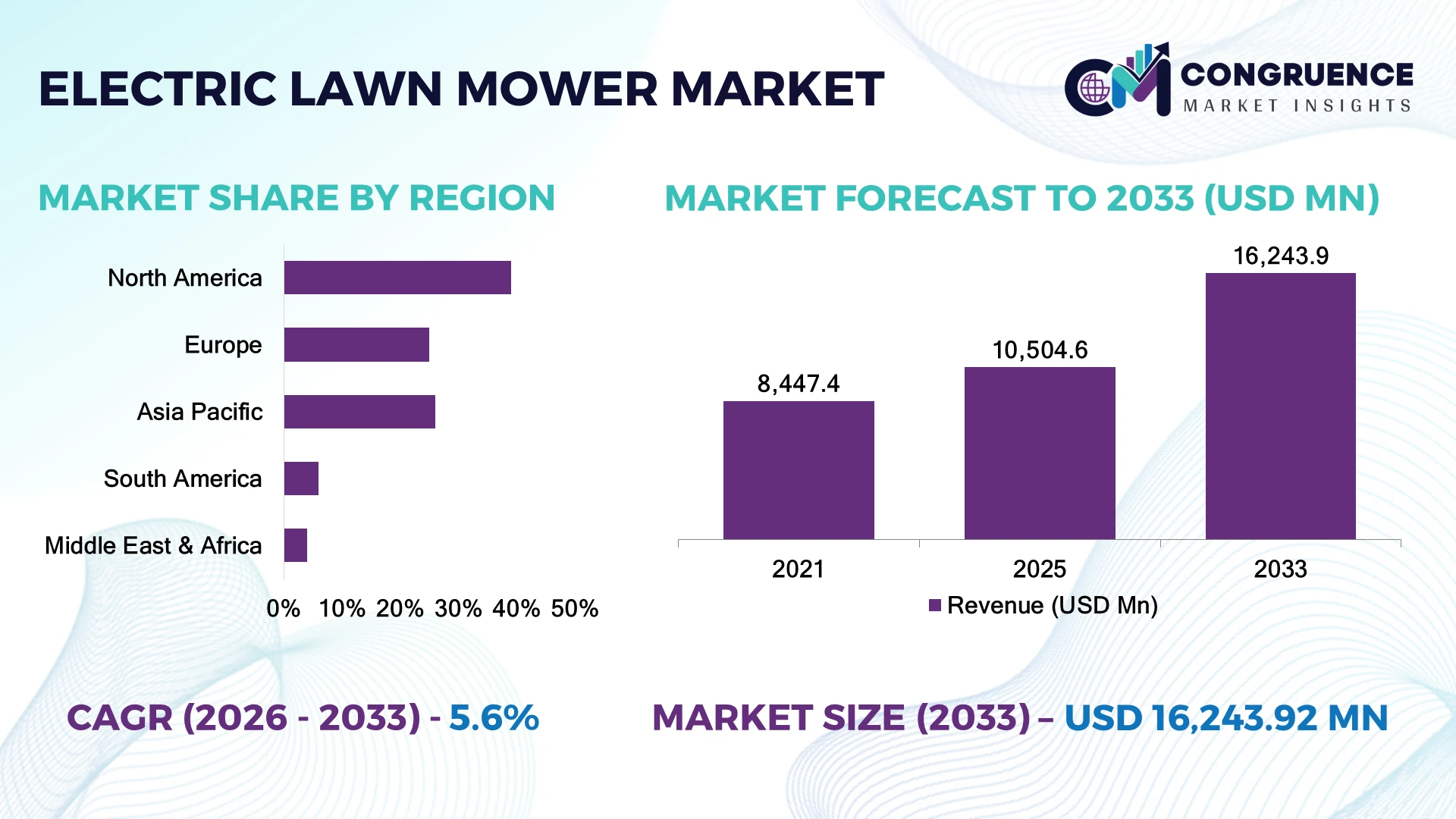
The United States anchors North America, which represented about 39% of the global electric lawn mower market in 2025. Residential landscaping, commercial groundskeeping, and municipal parks are key demand channels. In the Bay Area, a 2026 replacement pilot offers commercial operators vouchers of USD 700 to USD 15,000 per machine; cordless walk-behind models accounted for 54.3% of the market in 2025. China’s battery manufacturing base gives Asia-Pacific a different advantage: production scale.
For market entry and expansion decisions, prioritize cordless platforms and fleet-ready models, while aligning regional investment with local service networks, procurement incentives, and battery supply.
• Market Size & Growth: USD 10.50 billion in 2025 is forecast to reach USD 16.24 billion by 2033 at 5.6%; battery-platform improvements support replacement demand.
• Top Growth Drivers: Battery cost and energy density (+2.8%), small-engine rules (+2.2%), and lower operating costs (+1.9%) lead modeled growth drivers.
• Short-Term Forecast: Municipal and government demand is projected to expand 13.3% annually through 2031, accelerating public-fleet replacement.
• Emerging Technologies: Wire-free robotic navigation, AI vision, and higher-voltage brushless platforms extend automation to larger lawns and commercial sites.
• Regional Leaders: At the 2025 regional mix, 2033 constant-share benchmarks are USD 6.3 billion for North America, USD 4.9 billion for Europe, and USD 3.9 billion for Asia-Pacific; adoption centers on cordless retail, robotic mowing, and battery manufacturing, respectively. These are calculated benchmarks, not independent regional forecasts.
• Consumer/End-User Trends: Residential DIY buyers held 71.2% of 2025 demand; cordless walk-behind models led product formats at 54.3%.
• Pilot/Case Example: In 2025, Stowe priced three 72-inch electric mowers at USD 31,050 each versus USD 18,000 for gas units, a 72.5% premium that exposed a procurement barrier.
• Competitive Landscape: Husqvarna led with an estimated 18% share, followed by Toro at 15%; Deere, Bosch, and Greenworks compete across key segments.
• Regulatory & ESG Impact: Bay Area replacement vouchers reach USD 15,000 per machine, directly supporting commercial conversion to zero-emission equipment.
• Investment & Funding: Public replacement support ranges from USD 700 to USD 15,000 per unit, directing funding toward commercial fleet upgrades.
• Innovation & Future Outlook: Through 2028, competitive advantage will shift toward integrated battery ecosystems, dependable runtime, and navigation that reduces labor-intensive mowing.
Demand is concentrated in residential lawns, professional landscaping, and public grounds where noise, fuel handling, and maintenance affect operating choices. New wire-free robotic mowers combine mapped routes with vision-based obstacle detection, while shared battery systems let buyers use one platform across mowers and other outdoor tools. In 2026, local replacement incentives are making fleet transition a procurement decision as well as a product choice. That sets up a strategic focus on lifecycle economics and deployment readiness.
Electric lawn mowers are becoming strategically important because battery platforms now connect product design, service economics, and emissions compliance. Manufacturers that build common batteries across mowers, trimmers, and blowers can increase repeat purchases and simplify dealer inventory. In California’s Bay Area, commercial landscapers can access equipment replacement vouchers, turning clean-air policy into a near-term sales channel.
The strongest regional positions differ: North America leads in market scale and residential replacement, Europe has an established base for robotic mowing, and Asia-Pacific combines expanding demand with battery manufacturing capacity. A University of Illinois analysis of one commercial riding-mower operation found electric mowing cost USD 108 annually at its assumed electricity rate, more than 32 times less than gasoline operation. That case shows the potential operating-cost advantage, while municipal bids also reveal that electric equipment can carry a substantial upfront premium.
Over the next two to three years, wire-free navigation, higher-voltage batteries, and fleet charging plans will determine which models can move from residential lawns to larger sites. For example, public parks departments can pilot battery mowers on routine routes, track charge cycles and downtime, then scale purchases where coverage meets operating needs. Companies are directing investment toward battery ecosystems, dealer support, and commercial partnerships; those capabilities will define durable competitive positioning.
Staffing constraints are pushing landscaping firms toward equipment that reduces repetitive operator hours. In a 2025 industry survey, 51% of contractors cited staffing as a significant risk to meeting business goals; U.S. grounds-maintenance employment is also projected to grow 5% from 2025 to 2035. This combination raises the value of automating routine mowing routes. John Deere’s 2025 reveal of a battery-electric autonomous commercial mower shows how established manufacturers are responding with machine vision and autonomy. The operational advantage is strongest at campuses and large managed properties, where repeatable routes make automation easier to schedule and measure. Companies that pair mower launches with dealer training and fleet support can address labor pressure while building commercial customer relationships.
Upfront cost remains a barrier, particularly for buyers comparing electric models with familiar gas equipment. A 2024 consumer study found nearly 65% of push mowers remained gas-powered, while gas-mower buyers were 2.5 times more likely to identify price as their primary purchase factor. Robotic mowing has an even narrower base: about 5% of mower shoppers had purchased a robotic model. These figures point to a conversion problem at the point of sale, not a lack of product awareness. Manufacturers are responding with entry-level cordless lines, bundled batteries, and financing options. The strategic priority is to reduce first-purchase friction while preserving margin; pushing premium automation before proving value on smaller lawns risks extending replacement cycles.
Higher-voltage electric platforms create room to serve golf courses, institutional grounds, and professional landscapers whose duty cycles exceed typical residential use. In 2025, 37–60-volt models represented 46.5% of the electric mower market, while above-60-volt systems are forecast to expand 15.2% annually through 2031. The opportunity is to package longer runtime with swappable batteries, fast charging, and fleet scheduling rather than sell a larger mower alone. Manufacturers can use partnerships with battery suppliers and grounds-management software providers to validate coverage per shift. For buyers, the strongest business case is converting high-frequency mowing routes first, where utilization spreads battery and charging infrastructure costs across more operating hours.
Electric mower performance still varies with terrain, grass conditions, cutting load, and charging access. One 2026 product review reported a riding mower rated for up to four acres per charge, with a 3.5-hour recharge; another battery zero-turn model covered 1.25 acres versus two acres for its predecessor, a 37.5% reduction. These model-specific results show why headline runtime cannot substitute for route testing. Manufacturers need to validate acreage per shift, charging turnaround, and battery performance on slopes and wet grass. Commercial buyers should pilot equipment across representative sites before standardizing fleets. Reliable deployment depends on matching deck size and spare-battery capacity to actual mowing schedules.
• Robotic Mowers Gain Share: Husqvarna’s robotic mower sales rose 15% in the second quarter of 2025, while 20–25 Chinese competitors intensified entry-level competition. Established brands are strengthening navigation, dealer service, and model coverage to defend premium positioning as lower-priced entrants expand choice.
• Battery Sourcing Rebalances: In 2025, battery packs in China were priced 30% below North American levels and 35% below European levels. A U.S. tariff increase on Chinese lithium-ion batteries, from 7.5% to 25% in January 2026, is prompting importers to diversify sourcing and reassess pack configurations.
• Shared Packs Shape Design: John Deere’s Z370RS uses six removable 56-volt batteries compatible with other EGO tools. The architecture links mower purchases to broader battery ecosystems, encouraging manufacturers to compete through cross-tool compatibility and giving existing platform owners a simpler upgrade path.
• Wire-Free Navigation Expands: Boundary-wire systems held 45.1% of the U.K. robotic mower market in 2025, while vision and camera navigation is forecast to expand 18.9% annually through 2031. Manufacturers are adding camera-based mapping to reduce installation work and simplify deployment across complex lawns.
Cordless walk-behind leads; robotics redirects investment
Cordless walk-behind mowers lead by type, accounting for about 54.3% of 2025 market share. Their dominance reflects broad residential fit, retailer availability, and battery compatibility across outdoor tools; 37–60-volt models alone represented 46.5%, balancing runtime and purchase cost. Corded walk-behind units retain a low-cost niche for small plots near power outlets, but tethering limits reach and weakens their replacement case as cordless prices improve.
Robotic and autonomous mowers are the fastest-growing type as wire-free navigation and vision systems reduce setup friction and enable scheduled, unattended cutting. Ride-on, stand-on, and zero-turn electric models serve larger estates and contractor fleets, where high-voltage packs and rapid charging matter more than compact storage. Manufacturers are prioritizing interchangeable batteries for walk-behind lines while investing in RTK, camera systems, and commercial-grade platforms for automation. This mix shifts incremental product investment from basic corded refreshes toward cordless ecosystems and robotics, while preserving ride-on capacity for high-acreage buyers.
Home lawn care leads; managed sites drive fleet change
Residential lawn maintenance remains the leading application. In the wider powered-mower category, household use represents about 65% of application demand, a useful benchmark for electric deployment concentration. Cordless walk-behind models suit routine residential work because homeowners can store, start, and charge them without fuel handling. Commercial landscaping and contractor-managed properties are the fastest-strengthening applications as labor availability, noise limits, and service contracts favor quieter fleets and planned mowing cycles.
Municipal parks, campuses, golf courses, and sports turf remain smaller but operationally important applications: larger areas require ride-on, stand-on, or robotic units with dependable duty cycles. European equipment data show cordless outdoor-power-equipment use rose from 28% to 48% between 2019 and 2024. Manufacturers are responding with larger decks, swappable packs, fleet charging, and route automation; channel partners are bundling service support. Investment is shifting toward professional platforms that meet uptime requirements alongside consumer products designed for household convenience.
Homeowners anchor volume; fleets set the next test
Residential do-it-yourself buyers remain the largest end-user group, at approximately 71.2% of electric mower demand. Homeowners replace aging equipment through retail channels and often favor products compatible with batteries they already own. Professional landscaping contractors are the fastest-shifting buyer group: they assess runtime per crew, charging windows, service access, and noise constraints across multiple sites rather than purchase price alone. Municipal and government fleets, golf courses, and sports facilities make smaller, specification-led purchases tied to acreage and maintenance schedules.
Adoption evidence points to a practical conversion threshold: 24% of battery-equipment adopters in a U.S. professional survey named air-pollution reduction as their strongest reason, while 18% prioritized reliability. Among gas-only operators, 70% said they would consider battery equipment if work-capacity concerns were resolved. Manufacturers are targeting distinct buyers with high-voltage commercial decks, spare-pack bundles, dealer service, and financing, while residential brands emphasize shared-battery platforms. Competitive opportunity is shifting toward contractor and public buyers that can scale repeat deployments once uptime is validated.
North America accounted for the largest market share at 39% in 2025 however, Asia-Pacific is expected to register the fastest growth, expanding at a CAGR of 16.8% between 2026 and 2033.

Domestic production is moving into commercial battery platforms
North America’s position rests on deep homeowner demand, established outdoor-equipment dealers, and a large professional landscaping base. The market shift is extending from cordless walk-behind products into commercial zero-turn equipment, where buyers need higher capacity and local service support. In January 2026, Honda began U.S. production of its ProZision battery-powered zero-turn line at its North Carolina facility. The 54-inch and 60-inch models use five 48-volt brushless motors, linking regional manufacturing with professional-grade electrification. This production step gives dealers a locally built commercial option and lets Honda apply its existing power-equipment footprint to a new product category. For suppliers, availability of service, parts, and trained technicians will remain central to scaling commercial adoption.
United States Market Outlook: The United States combines a mature lawn-care market with a sizeable replacement pool: gasoline models still accounted for 39.3% of the broader U.S. lawn-mower market in 2025. That installed base creates conversion potential, but commercial buyers will assess electric models on acreage covered per shift, charging logistics, and service access. Domestic production of professional battery mowers gives manufacturers an opportunity to shorten replenishment cycles and build customer support around locally assembled equipment.
Noise rules and automation shape product selection
European demand is supported by established battery-equipment brands, dense dealer networks, and purchasing preferences shaped by urban noise controls and sustainability policies. Germany, the United Kingdom, and the Nordic countries are important deployment centers, with robotic and compact cordless products suited to smaller residential plots and noise-sensitive sites. Product investment is also shifting toward automation: Husqvarna reported that electrified solutions represented 44% of its motorized product sales in 2024 and expanded its robotic mower lineup for the following gardening season. For suppliers, Europe rewards product breadth and reliable navigation alongside cutting performance; success depends on adapting equipment and service to varied garden sizes, local rules, and established battery platforms.
Germany Market Outlook: Germany is a key national market, accounting for 28% of Europe’s electric lawn mower market. Its engineering base and established garden-equipment sector support both premium product development and commercial servicing. Germany also held 17.45% of Europe’s robotic lawn mower market in 2025, reflecting strong acceptance of automated equipment. Manufacturers can use the country as a test market for navigation, battery, and dealer-service improvements before expanding products across Europe.
Manufacturing scale supports faster product localization
Asia-Pacific is the fastest-advancing regional market, with demand shaped by expanding residential landscaping, commercial green-space investment, and a broad supplier base for batteries and electronics. China’s manufacturing ecosystem strengthens cost and component access, while Japan and Australia provide more established buyers for quiet, compact, and automated equipment. Robotic mower adoption is adding momentum: the Asia-Pacific robotic lawn mower market is projected to expand 13.2% annually through 2031. Companies are positioning through local distribution, e-commerce, and product variants suited to different property sizes. The region’s strategic advantage is the ability to combine manufacturing scale with design localization; suppliers that match product specifications and service coverage to national markets can broaden adoption beyond premium urban buyers.
China Market Outlook: China accounts for 36% of the Asia-Pacific electric lawn mower market. Its battery and electronics supply chains support domestic producers and export-oriented brands, while a large manufacturing base enables faster model iteration. Companies serving China can use local sourcing and digital retail to widen access to cordless models, then adapt proven designs for export markets. The opportunity is strongest where product reliability, battery compatibility, and after-sales support can match the price advantage of local production.
Early electrification depends on practical operating economics
South America remains an emerging market for electric lawn mowers, with demand concentrated in urban residential properties, commercial landscaping, hospitality, sports facilities, and institutional grounds. The broader regional mower market remains heavily weighted toward combustion equipment: gasoline and other non-electric models held 90.2% of the South and Central American market in 2024. That installed base makes replacement gradual and places emphasis on purchase price, spare-battery access, and local repair capability. Manufacturers and distributors are best positioned to build demand through targeted portfolios for smaller sites and professional operators, supported by demonstrations and dependable parts supply. Brazil is the main market anchor, while currency volatility and import costs can complicate consistent pricing across the region.
Brazil Market Outlook: Brazil offers a favorable electricity context for mower electrification: renewables accounted for 89.2% of its electricity mix, according to its national climate commitment. That gives electric equipment a strong operational emissions profile when charged from the grid. Suppliers can focus on commercial landscaping, golf courses, hotels, and premium residential properties, where utilization can justify battery investment. Local distribution and repair partnerships will be important for managing imported-equipment costs and supporting buyers outside major cities.
Public-space investment creates targeted procurement demand
Demand across the Middle East and Africa is tied to new parks, hospitality developments, sports grounds, and managed residential landscapes. Saudi Arabia’s municipal program shows how public-space investment can translate into equipment opportunities: in 2025, the government reported more than 185 contracts for municipal parks. These projects increase requirements for routine grounds maintenance, but high temperatures, dust, irrigation needs, and uneven charging access influence equipment selection and duty cycles. Suppliers should target defined sites with stable maintenance contracts and pair electric mowers with service, battery replacement, and operator training. That approach reduces procurement risk for facility managers while giving manufacturers a practical route to establish support networks in markets where adoption is still concentrated in premium and institutional settings.
Saudi Arabia Market Outlook: Saudi Arabia is a strategic country market as municipalities expand green spaces and private-sector participation in park operations. A 2025 agreement identified investment opportunities for at least 30 public parks, creating a pipeline for grounds-maintenance equipment procurement. Mower suppliers can engage developers and maintenance contractors early, specifying electric equipment alongside landscaping and site-operation plans. Winning these projects will depend on demonstrating equipment performance under heat and dust conditions and maintaining reliable local service.
Competition is split between global full-line OEMs and specialists. Husqvarna and Bosch compete in robotic navigation; Deere and Toro target commercial ride-on and turf fleets; Honda and STIHL defend dealer-led residential and professional segments, while TTI and Stanley Black & Decker use broad battery-tool ecosystems and retail reach. A direct electric-mower estimate places the top five near 50% of shipments, indicating moderate concentration; reported shares put Husqvarna at 18% and Toro at 15%. OEMs are investing in wire-free navigation, removable packs, local production, and service networks. Toro expands autonomous offerings, Deere pilots vision-guided mowing, and battery suppliers secure OEM contracts; these moves shift leverage toward firms controlling software, packs, and dealer-led uptime guarantees across commercial mowing fleets. Chinese entrants are pressing established brands on entry price. Battery sourcing, dealer coverage, and verified runtime are major entry barriers. Winning requires reliable performance, platform compatibility, and service economics that defend premium prices.
Current platforms pair brushless motors with lithium-ion packs and shared battery ecosystems, shifting value from engine output to runtime, charging logistics, and cross-tool compatibility. In a tested EGO model, a 30-inch deck cut about 30% more area per pass than a typical 21-inch deck; wider coverage improves route productivity but requires matching mower size to site access. Battery-powered equipment now represents roughly one-third of the installed outdoor-power-equipment base, signaling a transition beyond early adopters. Owners should track pack replacement intervals alongside route-level productivity and charging costs.
Emerging systems combine RTK or satellite navigation, virtual boundaries, edge-AI cameras, and fleet applications. Husqvarna’s 560 EPOS is designed for slopes up to 50%, while vision-assisted navigation maintains operation when satellite signals weaken. These capabilities reduce perimeter-wire installation and manual supervision on complex grounds; robotic specialists and OEMs with dealer service coverage gain the strongest differentiation.
From 2026 to 2028, buyers will prioritize interoperable packs, route telemetry, and autonomy that works across mixed terrain. Operators should pilot against labor hours per acre, charging downtime, and missed-cut rates before fleet conversion. OEMs that connect battery, navigation, and service data will defend premium positioning; legacy engine-led brands face pressure to build software and battery partnerships now.
January 2026 Honda began U.S. production of ProZision battery zero-turn mowers in North Carolina. Its 54- and 60-inch models use five 48-volt motors, extending local manufacturing into professional electric grounds equipment with domestic dealer and service support. Source: hondanews.com. hondanews.com
January 2025 John Deere revealed a battery-electric autonomous commercial mower at CES, using four stereo-camera pairs for full-field sensing. The product extends machine-vision automation into grounds maintenance, targeting repetitive mowing routes and reducing continuous operator oversight at scale. Source: deere.com. John Deere UK
March 2025 Husqvarna introduced three AI-ready commercial robotic mowers, integrating EPOS virtual boundaries and a platform designed for later camera-based obstacle avoidance. Launch targets sports turf and facilities, giving dealers autonomous options for large managed grounds and estates. Source: husqvarna.com. Husqvarna UK
August 2026 Greenworks’ MaximusZ mower was reviewed with six battery packs totaling 56 amp-hours and a four-acre claimed charge range. The configuration extends high-capacity battery mowing for large properties, though runtime varies with terrain and cutting conditions. Source: theverge.com. theverge.com
The report maps electric lawn mowers by product type—walk-behind, riding, and robotic—and by power architecture, including corded and battery platforms. Application coverage spans residential lawns, golf courses, sports turf, municipal grounds, and commercial landscaping; end users include homeowners, contractors, facility operators, and public agencies. Regional analysis compares North America, Europe, Asia-Pacific, South America, and Middle East & Africa, with country-level manufacturing, adoption, distribution, and policy context.
Technology coverage includes lithium-ion systems, brushless motors, battery-management software, RTK navigation, machine vision, and autonomous fleet controls. Segment indicators, such as cordless walk-behind share at 54.3% and residential use at 71.2%, help assess near-term exposure. The analysis supports 2026–2033 investment screening, market-entry selection, channel partnerships, product positioning, and capacity planning, while identifying underserved professional applications and service-led business models.
| Report Attribute/Metric | Report Details |
|---|---|
|
Market Revenue in 2025 |
USD 10,504.6 Million |
|
Market Revenue in 2033 |
USD 16,243.9 Million |
|
CAGR (2026 - 2033) |
5.6% |
|
Base Year |
2025 |
|
Forecast Period |
2026 - 2033 |
|
Historic Period |
2021 - 2025 |
|
Segments Covered |
By Type
By Application
By End-User
|
|
Key Report Deliverable |
Revenue Forecast, Growth Trends, Market Dynamics, Segmental Overview, Regional and Country-wise Analysis, Competition Landscape |
|
Region Covered |
North America, Europe, Asia-Pacific, South America, Middle East, Africa |
|
Key Players Analyzed |
Deere & Company, Husqvarna Group, The Toro Company, Honda Motor Co., Ltd., STIHL Holding AG & Co. KG, Robert Bosch GmbH, Stanley Black & Decker, Inc., Techtronic Industries Company Limited, Kubota Corporation, AriensCo, Makita Corporation, Chervon Holdings Ltd. |
|
Customization & Pricing |
Available on Request (10% Customization is Free) |




