
Reports
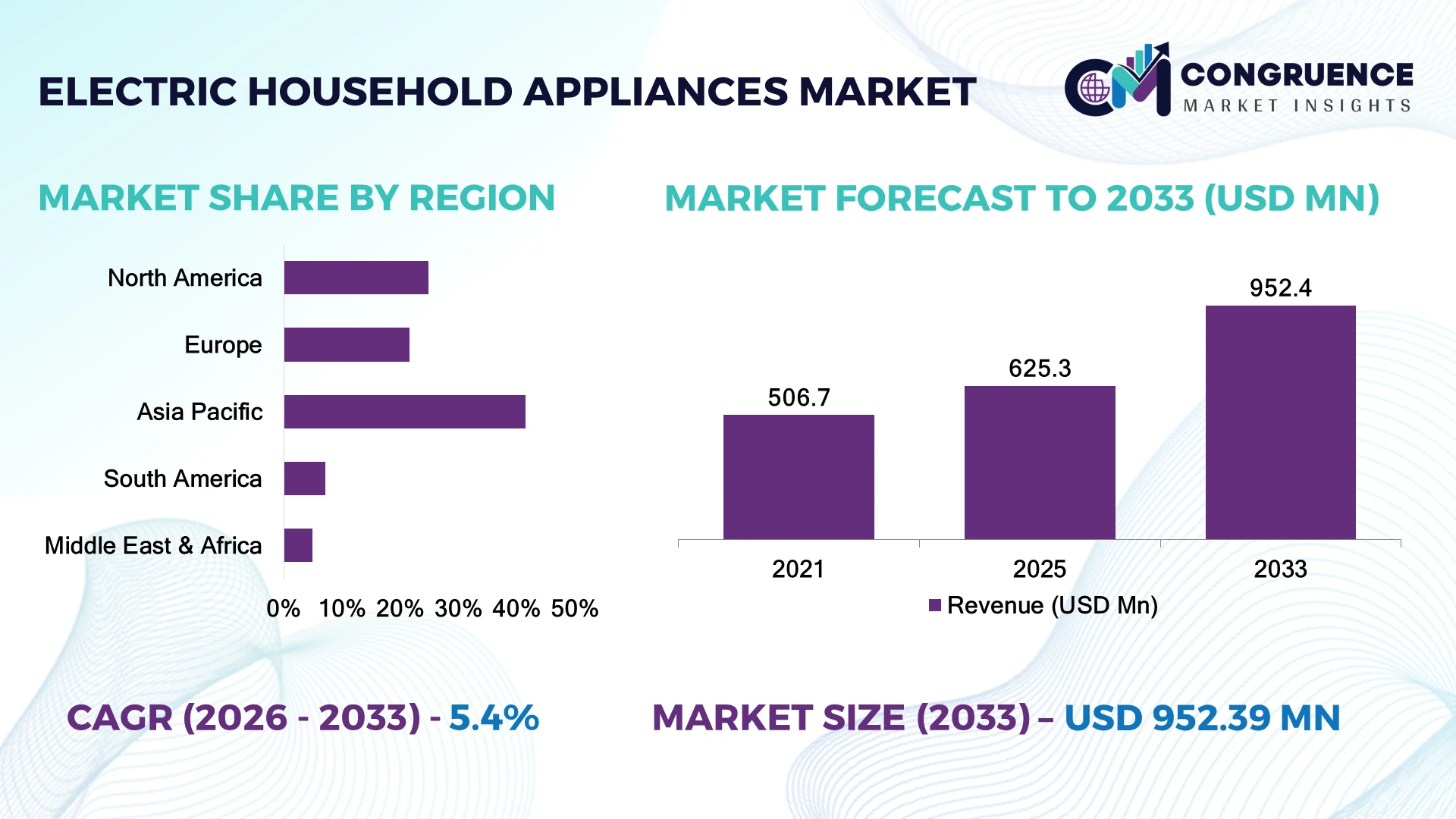
The Global Electric Household Appliances Market was valued at USD 625.3 Million in 2025 and is anticipated to reach a value of USD 952.4 Million by 2033 expanding at a CAGR of 5.4% between 2026 and 2033. Growth is being driven by inverter-based appliances, connected home controls, energy-efficiency upgrades, and localized component manufacturing.
China remains the dominant manufacturing base, supported by deep electronics, motor, compressor, and appliance-component supply chains, while India is rapidly strengthening localized production. India's white-goods PLI program now covers 85 companies with ₹11,198 crore of committed investment, targeting ₹1.90 lakh crore of cumulative production; domestic value addition is targeted at 75–80%. India therefore represents a stronger manufacturing-expansion opportunity than mature markets, where replacement demand and efficiency regulation dominate.
Strategically, manufacturers should prioritize localized components, high-efficiency platforms, and digitally enabled appliances to protect margins and supply continuity.
Market Size & Growth: USD 625.3 Million in 2025 to USD 952.4 Million by 2033 at 5.4% CAGR, driven by inverter systems, connected controls, and appliance replacement.
Top Growth Drivers: Energy efficiency +8–12%, smart-appliance adoption +10–15%, and localized manufacturing +12–18%.
Short-Term Forecast: By 2028, automated diagnostics can reduce service intervention costs 10–15% while connected controls improve energy optimization 8–12%.
Emerging Technologies: AI diagnostics, IoT connectivity, BLDC motors, inverter compressors, and sensor-based load optimization are reshaping premium appliance platforms.
Regional Leaders: Asia-Pacific is projected near USD 360 Million, North America around USD 250 Million, and Europe approximately USD 190 Million, with smart-appliance integration accelerating across replacement purchases.
Consumer/End-User Trends: Connected appliance adoption is increasing 10–15% annually in digitally mature urban households, particularly across premium refrigerators, washing machines, and air conditioners.
Pilot/Case Example: 2025 India PLI expansion committed ₹1,914 crore across 13 applicants, strengthening component localization and manufacturing depth.
Competitive Landscape: Haier, Whirlpool, LG, Samsung, and Midea anchor global competition, with premium manufacturers increasingly differentiating through connected ecosystems and energy performance.
Regulatory & ESG Impact: EU tumble-dryer rules introduced in 2025 target 15 TWh of cumulative energy savings and 1.7 Mt CO₂-equivalent reductions by 2040.
Investment & Funding: India's white-goods program has attracted ₹11,198 crore of committed investment, accelerating compressor, motor, heat-exchanger, control, and PCB localization.
Innovation & Future Outlook: Appliance competition is shifting toward AI-enabled maintenance, recyclable materials, modular repairability, lower standby consumption, and integrated home-energy management.
The Electric Household Appliances Market is increasingly concentrated around energy-efficient refrigerators, washing machines, air conditioners, vacuum cleaners, cooking appliances, and connected home devices. Inverter and BLDC technologies can reduce operating electricity consumption by approximately 10–30% versus conventional configurations. Supply-chain localization is also accelerating, particularly for compressors, motors, control assemblies, and heat exchangers, creating a stronger transition toward regionally integrated appliance manufacturing.
Electric household appliances are becoming strategic manufacturing assets rather than simple consumer durables because energy efficiency, electronics integration, component localization, and repairability increasingly determine product competitiveness. The supply chain is being restructured around regional component ecosystems, particularly in India, where the white-goods PLI program is targeting domestic value addition of 75–80%.
Technology is widening the performance gap between conventional and advanced appliances. Inverter compressors, BLDC motors, variable-speed drives, and intelligent load sensing can deliver approximately 10–30% lower electricity consumption than comparable fixed-speed configurations, while connected diagnostics reduce service visits and improve lifecycle management. Asia-Pacific emphasizes manufacturing scale and component localization, whereas Europe places greater weight on energy efficiency, repairability, and circularity. From July 2026, EU repair rules require manufacturers to support repairable products with accessible services and spare parts.
Over the next 2–3 years, manufacturers will increasingly allocate capital toward localized motors, compressors, control electronics, software platforms, and energy-management capabilities. Haier's ₹800 crore India investment, including a 2.5-million-unit annual AC plant and PCB production, illustrates the shift toward vertically integrated regional manufacturing. Competitive advantage will increasingly depend on component control, energy performance, software integration, and lifecycle economics rather than appliance hardware alone.
Energy-efficiency standards and electricity-cost sensitivity are accelerating replacement toward inverter compressors, BLDC motors, and variable-speed drives, with advanced configurations delivering 10–30% lower electricity consumption than fixed-speed systems. Connected appliance adoption is expanding by roughly 10–15% annually in digitally mature households, while automated diagnostics can reduce service intervention by 10–15%. India’s localization program is reinforcing this transition by encouraging domestic production of compressors, motors, control electronics, and heat exchangers. Manufacturers are responding through localized component plants, smart-control platforms, and integrated appliance ecosystems. The non-obvious advantage is margin protection: higher-efficiency products create differentiation while reducing customers’ lifecycle costs, allowing manufacturers to defend premium pricing rather than compete solely on hardware specifications.
Advanced appliances remain exposed to semiconductor, copper, aluminum, compressor, and electronic-control costs, with electronic components representing roughly 10–20% of appliance manufacturing costs and material inputs accounting for 50–65% depending on product category. Supply disruptions can increase component lead times by 15–30%, forcing manufacturers to hold additional inventory and absorb procurement volatility. China-based electronics and motor ecosystems remain difficult to replicate quickly, while import-dependent markets face currency and logistics exposure. Manufacturers are reducing risk through dual sourcing, localized PCB and motor production, longer-term supplier contracts, and platform standardization. The strategic pressure is shifting from lowest-cost procurement toward bill-of-material resilience, because a single constrained controller or compressor can interrupt an otherwise localized assembly operation.
AI-based load optimization, predictive maintenance, and adaptive operating cycles are creating new value beyond conventional energy-efficiency upgrades. Intelligent controls can reduce unnecessary energy consumption by 8–15%, while predictive diagnostics can lower avoidable service interventions by 15–25%. India, Japan, and South Korea provide strong commercialization environments because connected-home infrastructure and appliance electronics are advancing simultaneously. Manufacturers are positioning through cloud platforms, semiconductor partnerships, embedded sensors, and software-enabled service models. A less obvious opportunity lies in fleet-level analytics: connected appliances can generate operational data that supports warranty optimization, spare-parts forecasting, and targeted upgrades. Companies that control the appliance-data layer can therefore extend monetization beyond the initial hardware sale.
Connected appliances increasingly combine sensors, Wi-Fi modules, cloud platforms, mobile applications, and third-party ecosystems, raising software-management complexity. Firmware and connectivity components can account for 5–15% of premium appliance development effort, while integration testing can extend launch schedules by 10–20% when platforms are not standardized. Europe’s evolving connected-product and repair requirements are also increasing expectations for software support and lifecycle transparency. Manufacturers must maintain secure authentication, over-the-air updates, interoperability, and long-term software support alongside conventional appliance engineering. Companies are responding through common operating platforms, cybersecurity partnerships, modular electronics, and centralized firmware management. The strategic challenge is sustaining connected functionality throughout a 7–12-year appliance lifecycle without allowing software maintenance costs to erode hardware margins.
Smart Controls Move On-Device: Appliance manufacturers are shifting intelligence toward embedded controllers, sensors, and edge processing, with connected functionality expanding roughly 10–15% annually and automated diagnostics reducing service intervention 10–15%. India and South Korea are seeing faster integration of Wi-Fi, app controls, and energy monitoring. Companies are standardizing software platforms to reduce development duplication and accelerate multi-product launches.
Efficiency Becomes Design Constraint: Energy-performance requirements are increasingly influencing compressors, motors, insulation, heating elements, and control algorithms before product launch. Inverter and BLDC architectures deliver approximately 10–30% lower electricity consumption than conventional fixed-speed designs. European regulatory tightening is reinforcing redesign activity, while manufacturers are increasing high-efficiency component sourcing and engineering products around measurable lifecycle consumption rather than purchase price alone.
Localization Shifts Component Economics: Appliance manufacturers are expanding regional sourcing for compressors, motors, PCBs, heat exchangers, and electronic controls as geopolitical uncertainty exposes concentrated supply chains. Localization programs can reduce component lead times by 15–30% and lower logistics exposure. Indian manufacturers are increasing domestic production while global companies establish supplier clusters closer to assembly plants, improving inventory responsiveness and reducing dependence on distant component ecosystems.
Repairability Enters Product Architecture: Repairability is increasingly influencing appliance design, particularly in European markets, where spare-part availability and product-life requirements are becoming operational considerations. Modular assemblies can reduce replacement complexity by 20–30% and shorten service handling times by 10–20%. Manufacturers are responding with standardized fasteners, replaceable electronic modules, diagnostic software, and longer spare-parts planning, shifting after-sales strategy toward lifecycle service economics.
Refrigeration Anchors Volume While Cooling Accelerates Premiumization
Refrigerators & Freezers represent the leading product type, accounting for approximately 28–30% of global electric household appliance demand. Their dominance reflects high household penetration, continuous operation, replacement requirements, and strong integration of inverter compressors and digital temperature controls. Air Conditioners & Air Coolers form the fastest-shifting category, with adoption expanding approximately 8–12% as hotter operating environments, low-penetration markets, and inverter technology improve lifecycle economics. Washing Machines & Dryers maintain a substantial installed base, while Kitchen Major Appliances, Dishwashers & Water Heaters, Water Purifiers, and Small Household Appliances serve more specialized purchasing needs.
The strategic mix is moving toward higher-efficiency, higher-ticket configurations. Inverter-based refrigeration and cooling products can reduce electricity consumption by approximately 10–30%, while front-load washing machines can reduce water consumption by up to 50% in suitable operating cycles. Manufacturers are therefore directing investment toward compressors, BLDC motors, electronic controls, and connected features rather than basic capacity expansion. Premium product penetration is particularly strengthening in China, India, Japan, and urban Southeast Asia.
India's 2025 appliance market benchmark placed refrigerators at 29.9% share, while air conditioners were identified as the faster-expanding product category, reinforcing the shift toward cooling-led premium appliance demand.
Cooling and Climate Comfort Reshape Appliance Demand
Cooling & Climate Comfort is the leading application, representing approximately 30–35% of global electric household appliance demand because air conditioners, coolers, and related equipment combine high electricity consumption with relatively low penetration in emerging households. Food Preservation & Cooking follows through refrigerators, freezers, ovens, microwaves, and induction equipment. Laundry & Fabric Care remains a mature application, while Cleaning & Household Utility is emerging through vacuum cleaners, robotic cleaners, water-treatment equipment, and other labor-saving appliances.
The fastest-changing application is Cooling & Climate Comfort, where inverter technology, variable-speed compressors, and improved refrigerant systems are shifting purchasing criteria from initial price toward operating cost. Energy-efficient configurations can lower electricity consumption by approximately 10–30%, while smart scheduling can further optimize operation by roughly 5–10%. Companies are expanding cooling portfolios, localizing compressor production, and bundling connected controls. In contrast, Laundry & Fabric Care increasingly competes through automation and water efficiency, while Cleaning & Household Utility benefits from robotics and sensor-based navigation. This divergence is redirecting product-development budgets toward climate-control electronics and intelligent household automation.
A 2025 India appliance-market assessment identified air conditioners as a particularly strong expansion category, while refrigerators and washing machines remained established volume anchors, confirming increasing concentration around climate comfort and efficiency-led replacement.
Residential Buyers Remain Dominant as Commercial Demand Diversifies
Residential households represent the dominant end-user group, accounting for approximately 88–92% of electric household appliance demand. The concentration reflects replacement cycles, new-home furnishing, household penetration, and increasing multi-appliance ownership. Commercial users, including hospitality, offices, retail facilities, and healthcare establishments, form a smaller but strategically important segment because procurement emphasizes energy consumption, uptime, service contracts, and standardized equipment. Institutional and government users remain more specialized, with demand linked to public facilities, educational infrastructure, and managed housing.
Commercial demand is the faster-changing segment, expanding its adoption of high-efficiency cooling, refrigeration, laundry, and water-management equipment as operating costs receive greater procurement weight. Commercial buyers can prioritize lifecycle efficiency improvements of approximately 10–25% over basic purchase-price reductions, while centralized monitoring can reduce avoidable service interventions by roughly 10–15%. Residential manufacturers are responding through financing, omnichannel distribution, connected ecosystems, and tiered product ranges; commercial suppliers increasingly emphasize project-based contracts, maintenance packages, and customized specifications. The competitive opportunity is therefore shifting from unit sales toward recurring service, replacement, and energy-management relationships.
India's H1 2025 appliance and electronics market was estimated at approximately 92% B2C and 8% B2B, illustrating the continuing dominance of household buyers while highlighting a distinct commercial procurement channel with different reliability and efficiency requirements.
Asia-Pacific accounted for the largest market share at 41.5% in 2025 however, North America is expected to register the fastest growth, expanding at a CAGR of 6.1% between 2026 and 2033.
Connected Replacement Demand Drives Premium Appliance Mix
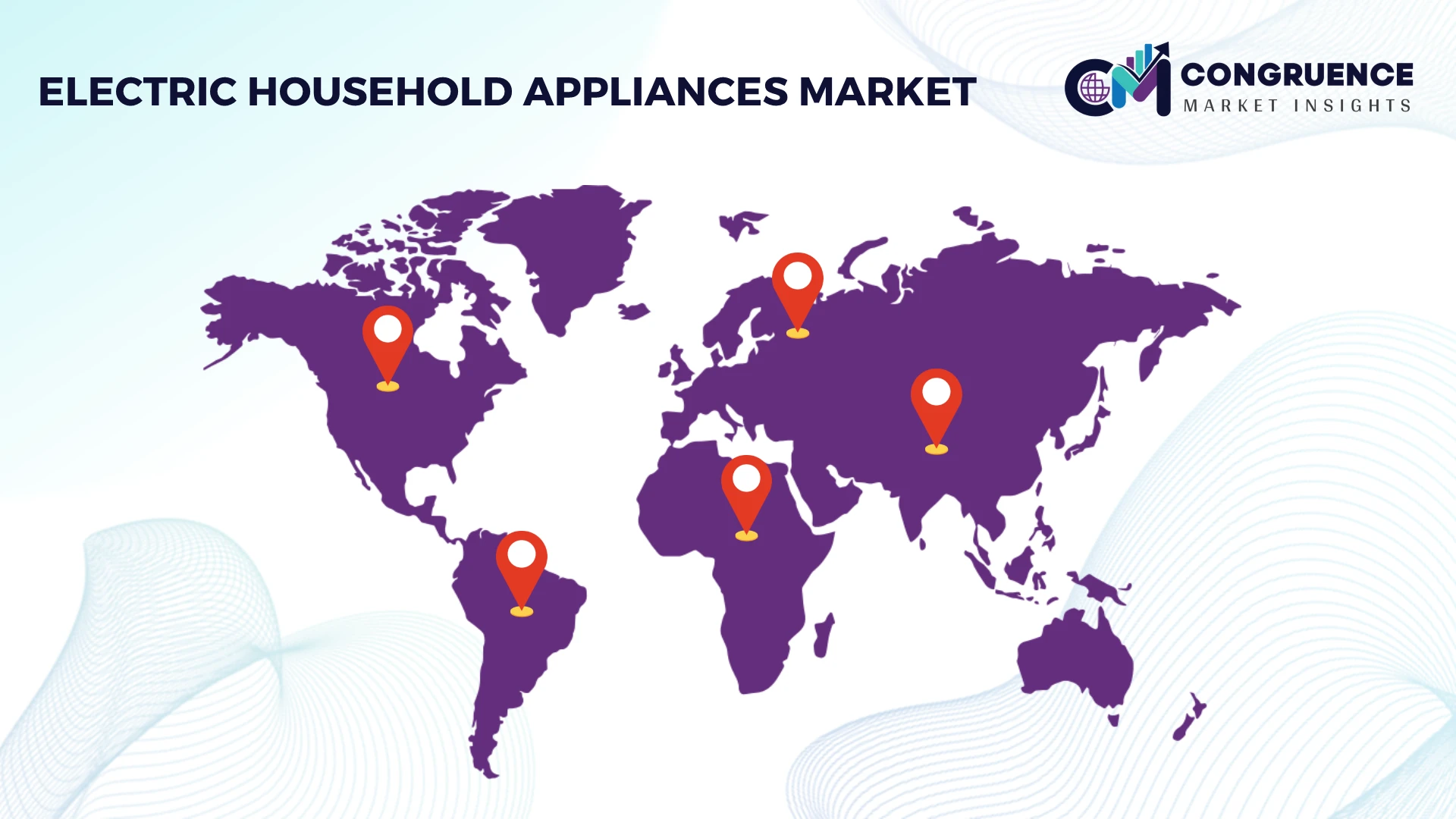
North America represents approximately 24.8% of the global Electric Household Appliances Market, supported by high household appliance penetration, replacement demand, smart-home integration, and established retail infrastructure. The United States dominates regional consumption, with premium refrigerators, connected laundry equipment, heat-pump appliances, and energy-efficient cooling systems gaining share. Online appliance purchasing and omnichannel fulfillment are also reshaping inventory allocation, with manufacturers increasingly linking product availability to regional distribution hubs. Smart and connected features are expanding within premium categories, while variable-speed compressors and sensor-based controls are becoming important differentiation points. Manufacturers are responding through software-enabled product platforms, localized service networks, and energy-efficiency upgrades rather than relying exclusively on capacity expansion. The region's strategic advantage is its large installed base, which creates recurring replacement opportunities and supports premiumization.
U.S. Market Outlook: The United States is the region's principal demand center and a major technology-testing market for connected appliances, AI-enabled controls, and energy-efficient product architectures. Its established retail, logistics, financing, and after-sales infrastructure supports rapid commercialization of premium appliances. The U.S. market reached approximately USD 91 billion in 2025 under a broader appliance-market scope, demonstrating substantial purchasing scale. Manufacturers are increasingly prioritizing connected ecosystems and efficient replacement products to capture higher-value household spending.
Regulation Accelerates Energy and Repairability Redesign
Europe accounts for approximately 21.6% of global demand, with Germany, France, Italy, the United Kingdom, and Spain forming major appliance markets. Regulatory modernization is reshaping product engineering through tighter energy-performance, durability, spare-parts, and repairability requirements. The EU's updated tumble-dryer measures became applicable in July 2025 and are projected to deliver 15 TWh of cumulative energy savings by 2040. Manufacturers are therefore redesigning motors, heat-pump systems, controls, and service architectures while increasing attention to lifecycle economics. The regulatory shift is particularly important because product differentiation increasingly depends on energy labels and repairability rather than styling alone.
Germany Market Outlook: Germany provides Europe's strongest industrial and engineering base for household appliances, supported by advanced manufacturing, automation, energy-efficiency expertise, and established premium appliance brands. Manufacturers operating in Germany increasingly integrate efficient motors, heat-pump technology, modular electronics, and repair-oriented designs. EU requirements covering spare parts and repair information are reinforcing this engineering direction, creating an advantage for companies with established service infrastructure and vertically coordinated product-development capabilities.
Manufacturing Scale and Component Localization Reinforce Leadership
Asia-Pacific holds approximately 41.5% of the global Electric Household Appliances Market, making it the largest regional production and consumption base. China, Japan, South Korea, and India provide the strongest combination of appliance manufacturing, electronics supply chains, component production, and expanding household penetration. China retains substantial manufacturing depth across compressors, motors, PCBs, displays, and power electronics, while India is rapidly building a localized white-goods ecosystem. India's PLI program has attracted ₹11,198 crore of committed investment from 85 companies, with domestic value addition targeted to rise toward 75–80%. This shift strengthens regional supply resilience and creates opportunities for component suppliers alongside finished-appliance manufacturers.
China Market Outlook: China remains the region's largest manufacturing and technology center, supported by integrated appliance-component clusters and extensive export infrastructure. Its ecosystem spans motors, compressors, power electronics, displays, plastics, and precision components, enabling rapid product iteration and cost optimization. Chinese manufacturers are also accelerating smart-appliance integration, allowing connected controls and automated operating modes to move from premium products into broader price tiers. This manufacturing density gives domestic and international brands access to shorter component cycles and scalable production platforms.
Brazil Leads Through Urban Replacement and Local Assembly
South America represents approximately 7.2% of global demand, with Brazil accounting for the largest portion through its population scale, urban housing base, retail infrastructure, and established appliance manufacturing ecosystem. Refrigeration, cooking appliances, washing machines, air conditioners, and small kitchen appliances form the principal demand pool. Currency volatility and imported-component exposure continue to influence product pricing, encouraging manufacturers to increase domestic sourcing where commercially viable. Brazil's large urban centers also support omnichannel retail and regional service networks, while energy-efficiency considerations increasingly influence refrigerator and air-conditioner purchases. Companies are strengthening local distribution, inventory planning, and after-sales capabilities rather than relying entirely on imported finished goods. The key opportunity is combining local manufacturing economics with efficient, connected product platforms.
Brazil Market Outlook: Brazil is South America's principal appliance manufacturing and consumption hub, supported by large urban markets, established retailers, domestic assembly capabilities, and a broad installed base. São Paulo and other industrial centers provide strong logistics and supplier access, allowing manufacturers to localize selected components while maintaining imported technology inputs. Companies with domestic service networks gain an advantage because installation, warranty support, and spare-parts availability strongly influence appliance purchasing decisions across geographically dispersed markets.
Housing Investment and Cooling Infrastructure Reshape Demand
Middle East & Africa accounts for approximately 4.9% of global Electric Household Appliances demand, with Saudi Arabia, the UAE, South Africa, and Israel representing the strongest commercial centers. Residential construction, hospitality projects, urbanization, and climate-driven cooling requirements support demand for air conditioners, refrigerators, washing machines, and water-heating equipment. Saudi Arabia's domestic-appliance industry generated approximately USD 1.5 billion in production value in 2025, while investments represented 54.8% of total industry demand. This investment intensity is strengthening local production and distribution infrastructure. Manufacturers are responding through regional warehouses, localized service operations, energy-efficient cooling platforms, and partnerships with developers and retail groups.
Saudi Arabia Market Outlook: Saudi Arabia provides the region's strongest industrial and investment platform, supported by housing development, retail modernization, industrial diversification, and substantial appliance demand. Domestic production reached approximately USD 1.5 billion in 2025, while imports still represented 44.5% of market size, creating a clear localization opportunity. Manufacturers can strengthen competitive positioning through local assembly, regional distribution centers, spare-parts networks, and high-efficiency cooling products suited to the Kingdom's operating environment.
LG, Samsung, Haier, Midea, and Whirlpool compete as global appliance leaders, while regional manufacturers and private-label assemblers challenge them on price and localization. The top five control approximately 38% share. Competition centers on price, energy efficiency, connectivity, supply security, and speed; inverter platforms cut electricity use 10–30%, while localized components can reduce lead times 15–30%. Samsung is expanding AI-enabled appliances and digital financing, Haier is adding Indian AC capacity and injection molding, LG is increasing localization, and Midea is scaling AI across manufacturing and connected homes. The competitive shift is moving from hardware differentiation toward software ecosystems, component control, and lifecycle services. Entry barriers include compressor and motor engineering, retail access, certification, service networks, and electronics integration. Cost pressure remains intense in entry tiers, while premium players defend margins through AI, energy management, and customization. Winning requires localized supply, efficient platforms, strong distribution, software capability, and rapid product adaptation across markets.
LG Electronics
Samsung Electronics
Haier Smart Home
Midea Group
Whirlpool Corporation
Panasonic Holdings
Bosch Home Appliances
Electrolux Group
BSH Hausgeräte
Arçelik
Hisense Home Appliances
Godrej Appliances
IFB Industries
Voltas
Inverter compressors, BLDC motors, variable-speed drives, heat-pump systems, and sensor-based controls are now core efficiency technologies. Compared with fixed-speed architectures, inverter and BLDC systems typically reduce electricity consumption 10–30% while improving load matching and operating stability. Smart controls are moving into mainstream premium appliances, with connected functionality increasingly deployed across refrigerators, washing machines, air conditioners, and cooking equipment. Manufacturers benefit through differentiated energy performance and lower lifecycle service costs.
AI-enabled diagnostics, adaptive wash cycles, predictive maintenance, and edge sensing represent the next technology layer. Intelligent controls can reduce avoidable service interventions 10–20%, while adaptive operating algorithms improve energy optimization 5–15%. Samsung, LG, and Midea are integrating appliance intelligence with cloud platforms and home ecosystems, shifting competition from individual products toward coordinated device performance. Software-enabled features also create recurring engagement after purchase.
From 2026–2028, autonomous household orchestration, digital twins, advanced heat pumps, low-GWP refrigerants, and recyclable materials will gain strategic importance. AI orchestration can reduce manual household interactions by 20–30% in suitable workflows, while heat-pump drying can substantially reduce energy consumption versus conventional resistance heating. Global leaders with integrated hardware, software, and manufacturing ecosystems will benefit most; regional manufacturers can compete by localizing components and adopting standardized platforms quickly at scale.
April 2026 Samsung expanded digital financing for refrigerators, washing machines, ACs and microwaves across 8,000+ Indian stores, with approvals in about 5 minutes. The initiative lowers purchase friction, broadens premium-appliance access, and strengthens omnichannel conversion for connected products. Source: samsung.com
September 2025 Haier committed over ₹1,000 crore to expand Greater Noida manufacturing, adding 2.5 million annual AC capacity and injection molding. Total AC capacity will reach 4 million units, deepening localization, shortening production cycles, and reducing imported-component dependence. Source: haier.com
October 2025 LG launched its Essential Series after studying more than 1,200 Indian households, introducing four locally adapted appliances. The portfolio targets low water pressure, energy efficiency, and affordability, strengthening entry-tier competitiveness while accelerating India-specific product development. Source: lg.com
June 2026 LG outlined its AI Home roadmap integrating AI appliances, ThinQ AI orchestration, and autonomous robots, with Homey supporting more than 50,000 devices. The ecosystem shifts competition toward coordinated household automation, software integration, and lifecycle engagement beyond standalone appliances. Source: lg.com
The report covers refrigerators and freezers, air conditioners and air coolers, washing machines and dryers, kitchen major appliances, dishwashers and water heaters, water purifiers, and small household appliances. Application analysis spans cooling and climate comfort, food preservation and cooking, laundry and fabric care, and cleaning and household utility. End-user coverage includes residential, commercial, and institutional buyers, with attention to connected, energy-efficient, and premium appliance categories.
Regional assessment covers North America, Europe, Asia-Pacific, South America, and Middle East & Africa, with country-level analysis for major manufacturing and consumption hubs. Technology coverage includes inverter systems, BLDC motors, heat pumps, AI-enabled controls, IoT connectivity, predictive diagnostics, and home-energy management. The report supports investment planning, localization decisions, expansion strategy, supplier assessment, competitive positioning, and product-roadmap priorities through 2026–2033, including emerging opportunities in software-enabled appliances and lifecycle services.
| Report Attribute/Metric | Report Details |
|---|---|
|
Market Revenue in 2025 |
USD 625.3 Million |
|
Market Revenue in 2033 |
USD 952.4 Million |
|
CAGR (2026 - 2033) |
5.4% |
|
Base Year |
2025 |
|
Forecast Period |
2026 - 2033 |
|
Historic Period |
2021 - 2025 |
|
Segments Covered |
By Type
By Application
By End-User
|
|
Key Report Deliverable |
Revenue Forecast, Growth Trends, Market Dynamics, Segmental Overview, Regional and Country-wise Analysis, Competition Landscape |
|
Region Covered |
North America, Europe, Asia-Pacific, South America, Middle East, Africa |
|
Key Players Analyzed |
LG Electronics, Samsung Electronics, Haier Smart Home, Midea Group, Whirlpool Corporation, Panasonic Holdings, Bosch Home Appliances, Electrolux Group, BSH Hausgeräte, Arçelik, Hisense Home Appliances, Godrej Appliances, IFB Industries, Voltas |
|
Customization & Pricing |
Available on Request (10% Customization is Free) |




