
Reports
The Global Electric Hoist Market was valued at USD 2,498.1 Million in 2025 and is anticipated to reach a value of USD 3,804.8 Million by 2033 expanding at a CAGR of 5.4% between 2026 and 2033. Factory automation, warehouse modernization, and replacement of labor-intensive lifting systems are accelerating adoption of advanced electric hoists with variable-speed and remote-control capabilities.
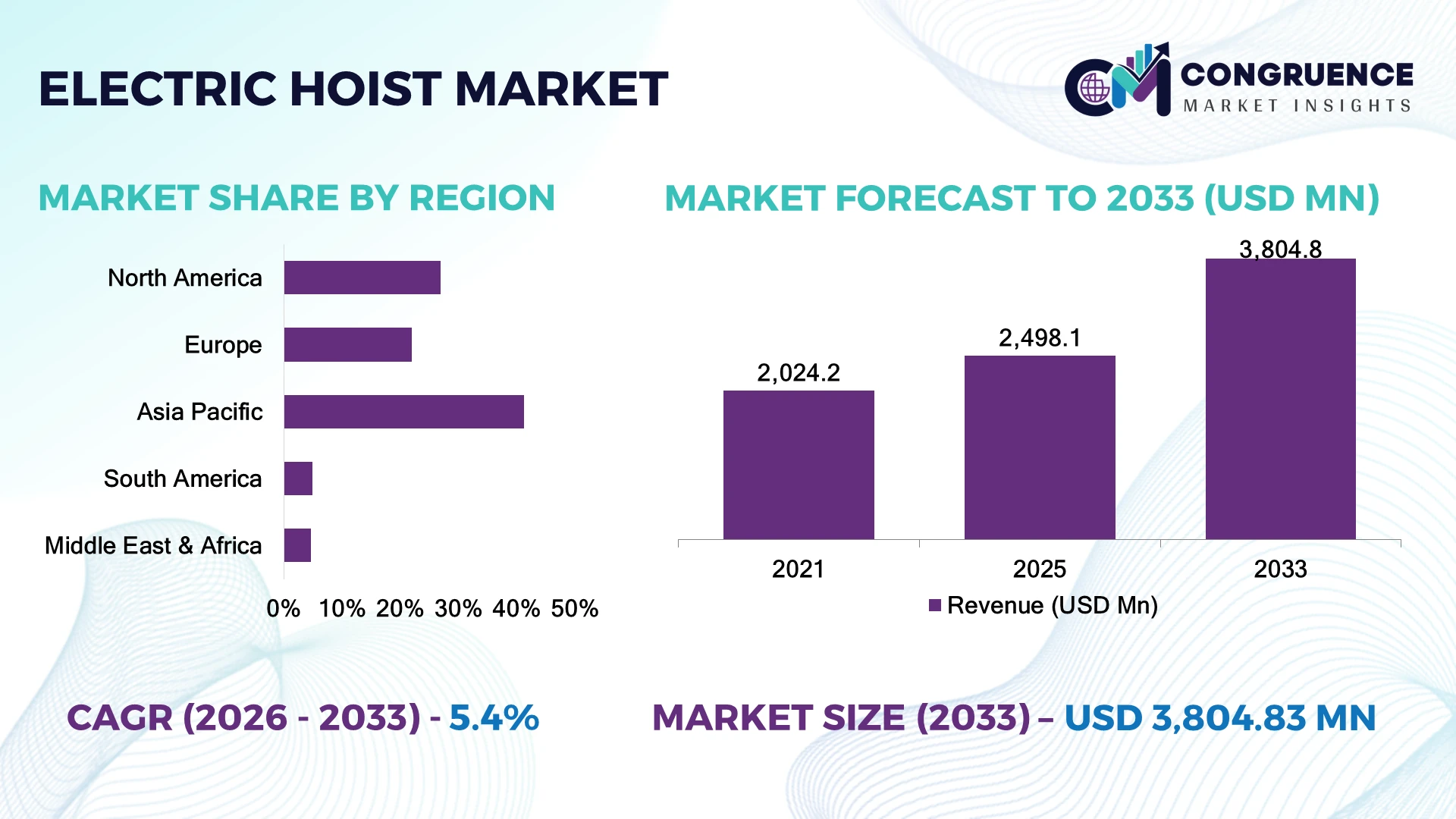
The United States remains a major country market, estimated at USD 556.1 million in 2025, supported by automotive, aerospace, construction, energy, and logistics applications. China combines large-scale manufacturing with more than 34% of global electric wire-rope hoist installations in manufacturing and port-logistics facilities. Asia-Pacific holds approximately 41.3% regional share, compared with 22.6% for North America, while U.S.-China trade-policy tensions are encouraging localized sourcing and service networks.
Strategic implication: suppliers with localized production, smart controls, and strong aftermarket coverage are best positioned to capture modernization-led procurement.
Market Size & Growth: USD 2,498.1M in 2025 to USD 3,804.8M by 2033 at 5.4%, driven by factory automation and warehouse modernization.
Top Growth Drivers: Automation 32%; infrastructure 27%; logistics 21%.
Short-Term Forecast: By 2028, smart-control adoption rises 15%, while VFD retrofits improve energy efficiency 18%.
Emerging Technologies: IoT monitoring, AI load analytics, regenerative drives; smart configurations improve uptime 5–8%.
Regional Leaders: Asia-Pacific USD 1.57B, Europe USD 1.03B, North America USD 0.86B by 2033; automation adoption leads APAC.
Consumer/End-User Trends: Manufacturing represents 35% of application demand, with warehouses prioritizing remote-control systems.
Pilot/Case Example: 2025 Konecranes deployment spans 80kg–5,000kg capacities, with components rated maintenance-free up to 10 years.
Competitive Landscape: Konecranes, Columbus McKinnon, KITO, Ingersoll Rand, and Hitachi collectively hold about 40–45%, competing through smart controls and service networks.
Regulatory & ESG Impact: OSHA requires rated loads and applicable inspection, testing, maintenance, and operating compliance; regenerative systems target 15–25% lower hoisting energy.
Investment & Funding: Columbus McKinnon committed USD 2.7B for Kito Crosby, targeting USD 70M annual cost synergies and greater global lifting scale.
Innovation & Future Outlook: 2026–2028 shifts toward connected hoists, predictive maintenance, anti-sway control, and integrated crane software, rewarding suppliers with lifecycle service capabilities.
Demand is concentrating around automated factories, warehouses, ports, and construction sites requiring precise, repeatable lifting. IoT-enabled controls, VFDs, regenerative drives, and remote diagnostics are moving electric hoists toward connected material-handling systems. Smart configurations can improve uptime by 5–8%, while nearshoring is strengthening regional service and spare-parts requirements, creating a clear transition toward lifecycle-managed lifting solutions.
Electric hoists are becoming strategic assets as manufacturers, warehouses, ports, and construction operators replace labor-intensive lifting with controlled material movement. Nearshoring and supply-chain resilience are increasing investment in localized production, while OSHA compliance reinforces replacement and modernization cycles in the United States. Suppliers compete on uptime, safety, digital controls, and service responsiveness rather than lifting capacity alone.
Technology is widening the gap between legacy contactor systems and modern VFD architectures. VFD retrofits can reduce crane and hoist energy consumption by roughly 18–22%, while regenerative drives can reduce hoisting energy consumption by 15–25%. Europe emphasizes compliance and precision, whereas Asia-Pacific combines manufacturing scale with faster automation deployment, creating distinct product and channel priorities.
Over the next 2–3 years, connected monitoring, anti-sway control, remote diagnostics, and predictive maintenance will become core modernization features. Konecranes’ 2025 INASUS deployment integrated 18 D-series electric chain hoists across 12 workstation systems and six console cranes. Companies should prioritize modular platforms, regional service coverage, and digital partnerships. Winners will sell measurable uptime and integration, not hardware alone.
Factory automation is accelerating electric hoist deployment as manufacturers seek precise, repeatable lifting with fewer manual interventions. Automated production environments can reduce material-handling labor requirements by 20–30%, while variable-frequency drives improve motion-control efficiency by approximately 18–22%. Germany’s automotive and machinery plants are increasingly integrating hoists with automated workstation and crane controls. This shift is moving procurement from standalone lifting equipment toward connected material-handling systems. Konecranes, Columbus McKinnon, and KITO are responding with smart controls, remote diagnostics, and modular hoist platforms. The strongest strategic opportunity lies in retrofitting existing cranes rather than relying exclusively on greenfield installations, allowing operators to modernize lifting performance without replacing entire material-handling infrastructure.
Electric hoist manufacturers face persistent exposure to motors, gearboxes, brakes, controllers, and precision components, with electronic component costs remaining 10–15% above pre-disruption benchmarks in several industrial supply chains. Imported control systems can represent 15–20% of equipment value, increasing vulnerability to currency and logistics volatility. India-based assemblers remain particularly exposed where specialized motors and drives are sourced internationally. Companies are responding through dual sourcing, localized machining, longer-term supplier contracts, and standardized component architectures. The non-obvious pressure is specification fragmentation: customized lifting capacities and control configurations increase inventory complexity and reduce purchasing leverage. Manufacturers that rationalize platforms can lower component variety by 10–15%, improving production scheduling and aftermarket parts availability.
The largest near-term opportunity lies in converting conventional hoists into connected assets through sensors, variable-frequency drives, load monitoring, and predictive-maintenance software. IoT-enabled monitoring can reduce unplanned downtime by approximately 15–20%, while condition-based maintenance can cut maintenance expenditure by 10–15%. Japan’s highly automated factories provide a strong deployment model because existing lifting equipment can be digitally upgraded without extensive structural modification. Manufacturers are developing retrofit kits, cloud dashboards, and service partnerships that create recurring aftermarket revenue streams. A particularly attractive niche is mid-capacity warehouse and production hoists, where digital retrofits deliver measurable operational improvements without the capital burden of complete crane replacement.
Connected electric hoists increasingly operate alongside PLCs, warehouse-management systems, crane controls, and industrial networks, creating integration complexity across heterogeneous equipment. Approximately 30–40% of installed industrial lifting assets still operate with limited digital connectivity, constraining standardized data collection and predictive analytics. Cybersecurity requirements add another layer as remote diagnostics expand across connected facilities. U.S. and European operators also face shortages of technicians capable of servicing drives, controls, brakes, and industrial communication systems. Companies are addressing these constraints through modular control architectures, technician certification, remote-support platforms, and partnerships with automation integrators. The critical long-term challenge is interoperability: suppliers that cannot integrate legacy equipment with modern control environments risk losing entire modernization contracts despite competitive hardware pricing.
Smart Monitoring Moves Mainstream: Connected load cells, temperature sensors, and condition-monitoring modules are moving from premium installations into mainstream industrial hoists. Adoption of digital monitoring is approaching 20–25% in advanced manufacturing applications, while predictive diagnostics can reduce unplanned downtime by 15–20%. Manufacturers are bundling sensors with service contracts and remote-support platforms, shifting purchasing decisions toward lifecycle performance rather than initial equipment price.
Variable-Speed Control Expands: Variable-frequency drives are increasingly replacing fixed-speed control on precision lifting equipment, improving positioning accuracy and reducing energy consumption by approximately 18–22%. Adoption is strongest in automotive, aerospace, and automated warehouses where repetitive lifting cycles dominate. Suppliers are standardizing VFD-equipped platforms and offering retrofit packages, allowing operators to modernize installed cranes without replacing structural assemblies or complete lifting systems.
Compact Hoists Gain Warehouses: Compact electric chain hoists are gaining traction in space-constrained fulfillment centers and workstation environments, with lightweight configurations representing roughly 25–30% of new installations in selected automated facilities. Their smaller footprint supports higher workstation density and faster equipment relocation. Manufacturers are responding with modular suspension systems, wireless controls, and quick-install accessories, reducing installation disruption while supporting increasingly flexible warehouse layouts.
Safety Controls Become Differentiators: Advanced overload protection, emergency stopping, anti-collision controls, and controlled-start systems are becoming decisive specifications as workplace-safety enforcement intensifies. Electronic safety functions can reduce overload-related operating incidents by approximately 20–30% when correctly integrated with monitoring systems. Suppliers are embedding these functions into standard control packages, particularly for North American and European industrial buyers, turning compliance-oriented features into measurable procurement differentiators.
Electric wire rope hoists represent the leading type at approximately 48% share, supported by higher lifting capacity, longer travel distances, and suitability for continuous-duty applications. Their installed base is concentrated in steel plants, automotive factories, shipyards, ports, and heavy engineering facilities where loads frequently exceed 5 tons. Electric chain hoists account for roughly 40%, retaining an advantage in compact workstations and repetitive low-to-medium-load handling. Specialty and explosion-proof configurations comprise the balance and command premium pricing where hazardous-area certification or application-specific engineering is required.
Electric chain hoists are gaining faster adoption in flexible manufacturing and warehouse workcells, with demand supported by compact footprints and easier installation. Their adoption is increasing by approximately 6–8% annually in automated workstation environments, while smart-control configurations are penetrating around 20–25% of advanced installations. Manufacturers are therefore expanding modular chain platforms while integrating VFDs, wireless controls, overload monitoring, and predictive-maintenance capabilities into wire-rope systems.
The International Federation of Robotics reported 542,000 industrial robots installed globally in 2024, with China alone accounting for 54%, reinforcing the automation-intensive manufacturing environments where digitally integrated electric hoists are increasingly deployed.
Factories represent the leading application at approximately 34% share, reflecting extensive hoist deployment across assembly lines, maintenance bays, fabrication cells, and heavy-component handling. Construction follows at about 24%, where portable and high-capacity systems support structural assembly and equipment positioning. Warehousing and logistics account for roughly 18% and are the fastest-growing application, driven by higher throughput requirements, constrained labor availability, and increasing automation of fulfillment operations.
Warehouse deployment is shifting toward compact chain hoists, remote controls, and crane-integrated systems, with smart-enabled installations growing approximately 7–10% faster than conventional configurations. Construction buyers remain more price-sensitive, while automotive and machinery plants prioritize positioning accuracy and duty-cycle performance. Mining, marine, energy, and other specialized applications collectively maintain strategic relevance through severe-duty requirements. Suppliers are responding with application-specific packages, modular controls, and service agreements that reduce commissioning time and improve equipment availability.
The International Federation of Robotics recorded 401,665 industrial robot installations across Asia in 2024, representing 74% of global deployments, highlighting the concentration of automated production environments requiring integrated lifting and material-handling equipment.
Manufacturing is the leading end-user group, accounting for approximately 38% of electric hoist demand because automotive, metalworking, machinery, electronics, and general industrial plants require repeated lifting throughout production and maintenance cycles. Construction and infrastructure represent about 24%, while logistics and warehousing contribute approximately 17%. Manufacturing buyers emphasize duty classification, positioning accuracy, controls integration, and lifecycle service, whereas construction procurement remains more focused on mobility, capacity, and installation flexibility.
Logistics and warehousing are the fastest-shifting end-user segment, with automated facilities increasing smart-hoist adoption by approximately 8–10% as material-flow systems become more interconnected. Energy, mining, marine, and specialized industries maintain smaller but higher-value requirements for explosion-proof, severe-duty, and corrosion-resistant equipment. Suppliers are targeting manufacturers through crane-system integration and predictive-service contracts, while warehouse operators receive compact modular packages. The competitive priority is shifting toward lifecycle uptime, interoperability, and application engineering rather than lowest purchase price.
The International Federation of Robotics reported that China installed 295,045 industrial robots in 2024, equal to 54% of worldwide deployments, demonstrating the scale of automated manufacturing infrastructure supporting demand for integrated lifting and material-handling systems.
Asia-Pacific accounted for the largest market share at 41.3% in 2025 however, South America is expected to register the fastest growth, expanding at a CAGR of 6.4% between 2026 and 2033.
North America represents approximately 27% of global electric hoist demand, supported by established automotive, aerospace, metal fabrication, warehousing, and energy infrastructure. The United States concentrates regional procurement, with demand increasingly shifting toward VFD-equipped hoists, remote diagnostics, overload monitoring, and crane-integrated controls. Replacement activity is particularly strong in mature manufacturing facilities where operators modernize lifting systems without reconstructing supporting infrastructure. Smart-enabled configurations account for roughly 25% of new industrial installations, reflecting stronger emphasis on uptime and predictive maintenance. Canada contributes through mining, metals, and infrastructure projects, while Mexico is gaining importance as nearshoring expands manufacturing capacity. Suppliers are strengthening local service networks, spare-parts inventories, and retrofit partnerships. The strategic advantage increasingly lies in lifecycle support and controls integration rather than basic lifting capacity.
U.S. Market Outlook: The United States remains the region’s principal demand center because of its extensive manufacturing base and aging material-handling infrastructure. Automotive, aerospace, steel, logistics, and power facilities increasingly specify digitally controlled lifting equipment. Manufacturing automation investment supports higher-duty installations, while OSHA compliance requirements reinforce inspection, maintenance, and modernization spending across established industrial sites.
Europe accounts for approximately 22% of global electric hoist demand, supported by Germany, Italy, France, and the United Kingdom’s machinery, automotive, steel, and logistics industries. Germany leads advanced deployment, with buyers emphasizing variable-speed control, load monitoring, energy efficiency, and functional safety. Around 30% of new premium industrial hoist installations incorporate connected monitoring or advanced control features. EU machinery-safety requirements and energy-efficiency priorities are encouraging replacement of older electromechanical systems. Manufacturers are responding with modular platforms, digital service contracts, and retrofit packages that preserve existing crane structures while upgrading controls and diagnostics.
Germany Market Outlook: Germany is Europe’s strongest market because its automotive, machine-tool, metalworking, and industrial automation ecosystems require highly precise lifting systems. Manufacturers increasingly integrate hoists with PLC-controlled production cells and automated material flow. Approximately 25% of industrial lifting procurement is linked to modernization or automation projects, creating strong demand for programmable controls, condition monitoring, and specialized engineering support.
Asia-Pacific commands approximately 41.3% of global electric hoist demand, with China, Japan, South Korea, and India driving manufacturing-intensive deployment. China dominates through automotive, electronics, steel, machinery, ports, and warehouse construction, while India is expanding demand through infrastructure and industrial-capacity additions. Automated facilities increasingly specify variable-speed drives, wireless controls, and integrated overload protection, with smart-enabled systems representing approximately 20–25% of new premium installations. China’s industrial robot installations reached 295,000 units in 2024, reinforcing automation-intensive environments where precision lifting is increasingly integrated with production workflows. Suppliers are expanding domestic manufacturing, distributor networks, and localized technical support to capture high-volume industrial procurement.
China Market Outlook: China provides the region’s strongest manufacturing ecosystem, combining large-scale equipment production with extensive industrial automation deployment. Its 295,000 industrial robot installations in 2024 demonstrate the scale of automated factories requiring synchronized material handling. Domestic hoist manufacturers benefit from established component supply chains, competitive production costs, and proximity to automotive, electronics, steel, and logistics customers.
South America represents a smaller but strategically important electric hoist market, with Brazil accounting for the largest demand concentration across mining, steel, automotive, construction, ports, and energy infrastructure. Industrial modernization is increasing demand for higher-duty wire-rope hoists and variable-speed systems, while warehouse automation remains less developed than in North America or China. Approximately 15–20% of new industrial installations incorporate advanced electronic controls, leaving substantial retrofit potential. Brazil’s infrastructure pipeline and mining investments support project-based procurement, although imported components expose buyers to currency and logistics volatility. Suppliers are responding through local distributors, regional service agreements, and inventory localization. The strongest opportunity is aftermarket modernization of installed lifting assets rather than purely greenfield demand.
Brazil Market Outlook: Brazil is the region’s principal market because of its diversified industrial base and extensive mining, steel, automotive, and port infrastructure. Heavy industries require high-capacity lifting equipment for maintenance and material movement, while infrastructure investment supports project-based demand. Local service capability is becoming a procurement differentiator as operators seek shorter repair cycles and better spare-parts availability.
Middle East & Africa demand is concentrated in Saudi Arabia, the UAE, South Africa, and major oil, gas, construction, logistics, and metals projects. Gulf industrial diversification is creating requirements for heavy-duty electric hoists, explosion-resistant configurations, and remote monitoring in new processing and infrastructure facilities. Approximately 20% of premium project specifications now emphasize digital monitoring or advanced safety controls. Saudi Arabia’s industrial and infrastructure expansion is strengthening procurement pipelines, while South Africa contributes mining-driven demand. Suppliers are responding through project partnerships, local distributors, engineering support, and stocked critical spares. The region’s competitive opportunity is concentrated in specialized, high-capacity systems where certification, harsh-environment performance, and service responsiveness command greater value than basic equipment pricing.
Saudi Arabia Market Outlook: Saudi Arabia offers the strongest regional opportunity because industrial diversification is expanding manufacturing, logistics, energy, and infrastructure capacity. Large project environments increasingly require high-capacity lifting equipment with advanced safety and monitoring systems. Localized service partnerships and faster spare-parts availability are becoming important competitive advantages as project operators prioritize equipment uptime and compliance.
Konecranes, Columbus McKinnon, KITO, Ingersoll Rand, and Hitachi compete globally, while regional Chinese and European hoist makers attack price-sensitive projects. The top five players collectively hold approximately 40–45% share. Competition centers on price, smart controls, service speed, supply reliability, and customization. Connected features command premium positioning, while localized sourcing can reduce equipment costs by 8–12%. Konecranes is expanding through acquisitions, Columbus McKinnon emphasizes integrated motion-control portfolios, and KITO targets precision chain-hoist applications. The competitive shift is moving from standalone hardware toward connected lifting ecosystems and lifecycle service. Entry barriers include certification, engineering capability, distributor coverage, installed-base support, and dependable component sourcing. Regional manufacturers retain an advantage in cost-sensitive procurement, but global OEMs defend premium accounts through digital diagnostics and aftermarket contracts. Winning requires scalable manufacturing, rapid customization, certified safety systems, strong local service, and software-enabled uptime that converts equipment sales into long-term customer relationships across industrial end-use segments at scale.
Konecranes Plc
Columbus McKinnon Corporation
KITO Corporation
Ingersoll Rand Inc.
Hitachi Industrial Equipment Systems Co., Ltd.
ABUS Kransysteme GmbH
Street Crane Company Limited
Donati Sollevamenti S.r.l.
GIS AG
Liftket Hoffmann GmbH
GH Cranes & Components
J.D. Neuhaus GmbH & Co. KG
Eepos GmbH
Current electric hoists increasingly use variable-frequency drives, electronic overload protection, remote diagnostics, and IoT sensors. VFD control can reduce lifting energy consumption by 18–22%, while condition monitoring cuts unplanned downtime by 15–20%. Smart configurations now appear in roughly 20–25% of premium industrial installations, giving suppliers stronger lifecycle-service differentiation.
Emerging systems combine anti-sway control, load-cell analytics, wireless operation, and predictive maintenance with PLC and warehouse-management integration. Compared with conventional fixed-speed controls, advanced motion systems improve positioning accuracy by approximately 20% and can shorten handling cycles by 8–12%. Konecranes, Demag, and KITO benefit where automated factories prioritize repeatability, diagnostics, and lower intervention requirements.
From 2026–2028, disruptive development will center on AI-assisted condition prediction, digital twins, regenerative drives, and modular retrofit controllers. Regenerative systems can reduce hoisting energy consumption by 15–25%, while predictive algorithms target 10–15% lower maintenance costs. Adoption will expand fastest in automotive, logistics, metals, and process industries. Suppliers with open interfaces and retrofit-compatible architectures gain advantage because they can upgrade installed equipment without full crane replacement, accelerating modernization while protecting customer capital. This favors suppliers that combine hardware, software, controls integration, and service networks, because technology differentiation increasingly determines specification wins and aftermarket retention across industrial sites during modernization.
February 2025 Konecranes launched its D-series electric chain hoist, covering 80 kg–5,000 kg across seven frame sizes. The modular platform reduces maintenance requirements, supporting manufacturing and automotive customers seeking compact, high-performance lifting equipment with availability planned through 2026. Source: konecranes.com (Konecranes)
March 2025 Demag relaunched its DH hoist range with a new DH 400 size, revised drive concept, and doubled service life in the largest size. The expanded range strengthens heavy-mission positioning for demanding lifting and precise positioning applications. Source: demagcranes.com (demagcranes.com)
June 2025 Kito India deployed an ER2SG electric chain hoist for a public-sector excavator manufacturer in Bangalore, using a 2-ton capacity unit with IP55 enclosure and IP65 controls. The installation supports reliable outdoor lifting in dusty, high-temperature operations. Source: kito.co.in (World’s Leading Chain Hoist- Kito)
December 2025 Eepos installed a Kito electric chain hoist within an aluminium crane system, delivering 1,000 kg lifting capacity across a 20 m runway and 6 m bridge. The project demonstrates integrated, space-efficient material handling for industrial operations. Source: hoistmagazine.com (hoistmagazine.com)
The Electric Hoist Market Report covers electric chain and wire-rope hoists across manufacturing, construction, warehousing and logistics, mining, energy, marine, and specialized lifting applications. The study evaluates demand across North America, Europe, Asia-Pacific, South America, and Middle East & Africa, with country-level analysis of major industrial hubs, infrastructure programs, and automation-intensive markets.
Coverage includes conventional and VFD-controlled systems, IoT monitoring, remote diagnostics, anti-sway control, predictive maintenance, regenerative drives, and retrofit architectures. Manufacturing represents approximately 38% of end-user demand, while Asia-Pacific contributes about 41% of global demand. The report supports investment planning, regional expansion, product prioritization, partnership decisions, aftermarket strategy, competitive positioning, and technology selection, while identifying niche opportunities in hazardous environments, compact workstations, automated warehouses, and digitally integrated lifting systems through 2026–2033.
| Report Attribute/Metric | Report Details |
|---|---|
|
Market Revenue in 2025 |
USD 2,498.1 Million |
|
Market Revenue in 2033 |
USD 3,804.8 Million |
|
CAGR (2026 - 2033) |
5.4% |
|
Base Year |
2025 |
|
Forecast Period |
2026 - 2033 |
|
Historic Period |
2021 - 2025 |
|
Segments Covered |
By Type
By Application
By End-User
|
|
Key Report Deliverable |
Revenue Forecast, Growth Trends, Market Dynamics, Segmental Overview, Regional and Country-wise Analysis, Competition Landscape |
|
Region Covered |
North America, Europe, Asia-Pacific, South America, Middle East, Africa |
|
Key Players Analyzed |
Konecranes Plc, Columbus McKinnon Corporation, KITO Corporation, Ingersoll Rand Inc., Hitachi Industrial Equipment Systems Co., Ltd., ABUS Kransysteme GmbH, Street Crane Company Limited, Donati Sollevamenti S.r.l., GIS AG, Liftket Hoffmann GmbH, GH Cranes & Components, J.D. Neuhaus GmbH & Co. KG, Eepos GmbH |
|
Customization & Pricing |
Available on Request (10% Customization is Free) |




