
Reports
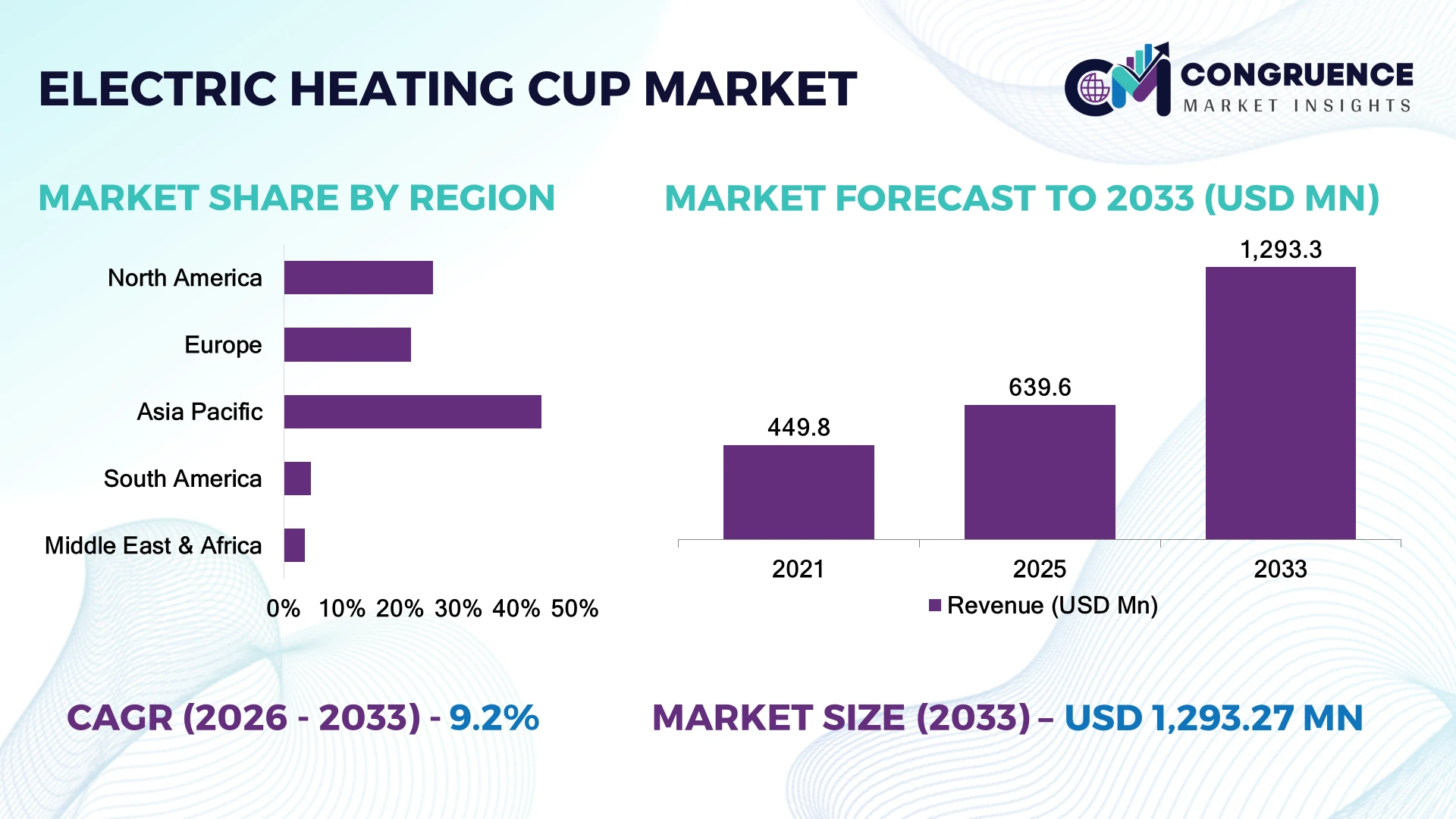
The Global Electric Heating Cup Market was valued at USD 639.6 Million in 2025 and is anticipated to reach a value of USD 1,293.3 Million by 2033 expanding at a CAGR of 9.2% between 2026 and 2033. Growing demand for portable beverage appliances, USB-C fast-heating technologies, and compact travel-friendly consumer electronics is accelerating innovation and premium product adoption across residential, office, and mobility applications.
China dominates the global electric heating cup market with approximately 44% manufacturing capacity, supported by mature small-appliance clusters, advanced battery integration, and extensive OEM production. Domestic brands have increased smart temperature-control adoption to nearly 58%, compared with approximately 34% in Japan, where premium insulated designs lead innovation. Amid continued supply-chain diversification following global trade realignments, manufacturers are expanding automated production while improving energy efficiency and export competitiveness.
Manufacturers that combine intelligent temperature management, certified safety systems, and diversified manufacturing networks will secure stronger long-term market positioning.
Market Size & Growth: USD 639.6 Million in 2025 to USD 1,293.3 Million by 2033 at 9.2% CAGR, driven by portable smart beverage appliances.
Top Growth Drivers: Smart temperature control 41%, travel usage 33%, premium lifestyle products 26%.
Short-Term Forecast: By 2028, heating efficiency improves 22% while standby energy consumption declines 18%.
Emerging Technologies: AI temperature regulation, USB-C fast charging, graphene heating elements improve performance.
Regional Leaders: Asia-Pacific leads, North America expands premium adoption, Europe accelerates energy-efficient product demand.
Consumer/End-User Trends: Nearly 48% of urban consumers prefer portable heated beverage solutions for commuting and office use.
Pilot/Case Example: 2026 smart insulated cup launches reduced heating time by approximately 27% using optimized heating modules.
Competitive Landscape: Leading brands collectively hold nearly 46% market share through innovation and design differentiation.
Regulatory & ESG Impact: BPA-free materials and energy-efficient electronics reduce product energy consumption by approximately 15%.
Investment & Funding: More than USD 220 Million supports smart appliance manufacturing, automation, and regional expansion.
Innovation & Future Outlook: App-connected heating control, wireless charging, and modular battery platforms redefine premium portable beverage appliances.
The Electric Heating Cup Market is evolving through demand from commuters, business travelers, students, and hybrid workplaces seeking portable beverage convenience. Smart temperature memory, OLED displays, and rapid-heating ceramic elements are becoming standard in premium models. Approximately 36% of new product launches now incorporate intelligent temperature control, while manufacturers continue strengthening localized production strategies amid evolving global electronics supply chains, setting the foundation for broader strategic market expansion.
The electric heating cup market has become strategically important as portable consumer electronics converge with smart lifestyle appliances. Competition increasingly depends on intelligent temperature management, compact energy systems, and premium user experience rather than basic heating functionality. Supply-chain diversification across Asia and increasing certification requirements for portable electrical products are encouraging manufacturers to modernize production, strengthen component sourcing, and accelerate innovation cycles.
Modern graphene and PTC ceramic heating technologies improve thermal efficiency by approximately 24% compared with conventional resistance heating while reducing energy consumption by nearly 18%. China continues leading high-volume manufacturing and product diversification, whereas Japan and South Korea emphasize premium engineering, safety electronics, and advanced insulation technologies. Over the next two to three years, more than 45% of premium product launches are expected to integrate digital temperature presets, USB-C charging compatibility, and enhanced battery management systems.
Manufacturers are expanding partnerships with consumer electronics suppliers while investing in automated assembly and intelligent quality inspection. For example, portable heating cups designed for business travel increasingly combine rapid heating with vacuum insulation to extend beverage temperature retention throughout the workday. Companies that integrate smart connectivity, energy-efficient heating platforms, and resilient supply networks will establish stronger competitive differentiation and sustained operational advantage.
Demand is accelerating as consumers prioritize portable appliances that combine convenience, energy efficiency, and intelligent temperature management. Nearly 49% of premium electric heating cup launches now incorporate digital temperature control, while USB-C charging compatibility has expanded by approximately 35% across new product portfolios. In China, advanced small-appliance manufacturing clusters continue accelerating innovation through automated production and integrated electronics. This shift improves product differentiation, shortens development cycles, and strengthens premium pricing opportunities. Manufacturers are responding by investing in graphene heating elements, precision temperature sensors, and battery optimization technologies while expanding collaborations with consumer electronics suppliers to improve safety, portability, and charging compatibility across global markets.
Lithium battery pricing volatility and differing electrical certification requirements continue creating structural challenges for manufacturers. Battery components account for approximately 28% of production costs in premium models, while compliance testing can extend product commercialization timelines by nearly 20%. Japan and European markets maintain strict electrical safety and food-contact certification requirements that increase engineering complexity for exporters. These constraints pressure margins, delay product launches, and limit rapid international expansion. Companies are reducing risk through localized component sourcing, long-term battery procurement agreements, standardized modular electronics, and alternative heating architectures that improve manufacturing flexibility while minimizing dependence on single-source suppliers.
The strongest opportunity lies in transforming electric heating cups into connected personal beverage management devices. App-enabled temperature scheduling and adaptive heating systems can improve energy utilization by approximately 22%, while personalized temperature profiles increase premium product adoption by nearly 30%. South Korea is accelerating development of compact IoT-enabled consumer appliances through continued electronics innovation. Manufacturers are investing in Bluetooth connectivity, wireless charging compatibility, AI-assisted temperature optimization, and modular battery platforms. An emerging opportunity exists in integrating heating cups with broader smart office and travel ecosystems, creating recurring accessory sales and stronger long-term customer engagement beyond standalone hardware.
Maintaining high heating efficiency, battery endurance, and food-grade safety within compact product dimensions remains a significant engineering challenge. Approximately 33% of customer complaints involve battery runtime or heating consistency, while miniaturized electronics increase thermal management complexity by nearly 25%. South Korea's premium electronics manufacturers continue raising consumer expectations for intelligent portable appliances with extended operating life. Companies must optimize insulation materials, embedded electronics, firmware reliability, and battery management without increasing product weight or manufacturing complexity. Success depends on sustained investment in advanced materials, intelligent power management, automated quality validation, and strategic technology partnerships that ensure consistent global product performance.
Smart Temperature Control Expands Intelligent temperature memory and digital display systems now appear in approximately 46% of newly launched premium products, improving beverage consistency while reducing unnecessary reheating by nearly 20%. Manufacturers are integrating precision sensors and automated calibration to differentiate products as consumers increasingly expect personalized heating experiences.
USB-C Charging Standardizes USB-C compatibility has expanded across nearly 40% of new electric heating cups, simplifying charging with existing consumer electronics. Standardized charging improves convenience, lowers accessory costs, and accelerates product adoption among mobile professionals. Companies are redesigning internal power architectures to improve compatibility while reducing component complexity.
Premium Materials Gain Preference Stainless steel interiors, ceramic coatings, and BPA-free materials now represent approximately 57% of premium product launches. Higher-quality insulation extends heat retention by nearly 24%, improving energy efficiency during daily use. Manufacturers continue restructuring supply chains to secure advanced material availability while strengthening premium brand positioning.
Travel-Oriented Designs Accelerate Compact leak-proof designs optimized for commuting and business travel have increased by approximately 32% across global product portfolios. Lightweight construction, improved sealing technologies, and faster heating systems enhance portability without sacrificing performance. Companies are expanding travel-focused product lines through automated manufacturing, ergonomic redesign, and partnerships with lifestyle electronics distributors.
Rechargeable electric heating cups accounted for approximately 57% of the market in 2025, maintaining leadership through cordless operation, portability, and compatibility with modern mobile lifestyles. Integrated lithium battery systems, intelligent temperature control, and USB-C charging have strengthened adoption among commuters and business travelers. Plug-in electric heating cups continue serving offices, hotels, and residential environments where continuous power availability supports extended heating performance. Vacuum-insulated smart models are steadily gaining attention by combining heat retention with energy-efficient operation, creating higher-value product positioning in premium retail channels.
Battery-powered smart heating cups represent the fastest-growing type, supported by increasing demand for connected personal appliances and portable convenience. Smart-enabled models have expanded by nearly 33% over the past two years, while products featuring digital temperature displays account for approximately 41% of premium launches. Manufacturers are investing in graphene heating elements, intelligent battery management systems, and wireless charging compatibility while forming electronics partnerships to improve safety and product differentiation. Investment priorities are shifting toward multifunctional smart beverage devices that combine mobility, efficiency, and personalized temperature management.
Industry observations published by the USB Implementers Forum during 2025 indicate continued expansion of USB Type-C charging adoption across portable consumer electronics, encouraging wider integration of standardized charging interfaces in smart personal appliances.
Travel and commuting applications represented approximately 39% of total demand in 2025 as professionals, students, and frequent travelers increasingly preferred portable beverage heating solutions. Compact form factors, leak-resistant construction, and rapid heating capabilities make electric heating cups highly suitable for daily mobility. Office applications remain a mature segment where prolonged work schedules support continuous beverage warming, while residential use continues expanding through demand for convenient personal kitchen appliances and compact countertop solutions.
Office applications are emerging as the fastest-growing segment as hybrid working models and flexible workplaces increase demand for desktop beverage appliances. Adoption within office environments has increased by approximately 28%, while intelligent temperature management features improve user satisfaction by nearly 24%. Companies are introducing app-enabled controls, automated shutoff systems, and premium insulated designs while expanding distribution through workplace electronics and lifestyle retail channels. Demand is strengthening where convenience, workplace productivity, and personalized appliance experiences converge.
Enterprise workplace studies released by the International Facility Management Association during 2025 highlighted increasing employee preference for compact personal appliances that improve workplace convenience while complying with modern office electrical safety practices.
Individual consumers accounted for approximately 63% of market demand in 2025, driven by widespread adoption among urban professionals, students, and frequent travelers seeking convenient portable beverage solutions. Daily commuting, hybrid work routines, and growing preference for premium personal appliances continue strengthening consumer demand. Corporate buyers remain an important segment through employee wellness initiatives and promotional procurement, while hospitality businesses increasingly deploy electric heating cups to enhance premium guest experiences and personalized in-room services.
Hospitality operators represent the fastest-growing end-user group as hotels, serviced apartments, and premium accommodation providers enhance customer experience through smart room amenities. Procurement within this segment has increased by nearly 26%, while customized branding programs have expanded by approximately 21%. Manufacturers are responding with tailored hospitality product lines, private-label partnerships, and extended warranty programs that strengthen long-term institutional relationships. Future demand is shifting toward premium, connected beverage solutions that deliver both operational efficiency and differentiated customer experiences.
A 2025 enterprise hospitality survey reported increasing investment in smart in-room guest amenities, with portable personal appliances identified as an important contributor to improving overall guest satisfaction and premium service differentiation.
Asia-Pacific accounted for the largest market share at 44.2% in 2025 however, North America is expected to register the fastest growth, expanding at a CAGR of 10.0% between 2026 and 2033.
Smart Portable Appliance Adoption Strengthens Premium Market
North America continues to strengthen its position through high adoption of premium portable appliances, widespread USB-C ecosystem compatibility, and strong demand from commuters, remote workers, and travelers. The region represents approximately 25.6% of global market demand, while rechargeable models account for nearly 63% of regional sales. Retailers are expanding premium product portfolios featuring intelligent temperature control, battery optimization, and safety certification. Manufacturers are prioritizing product differentiation through smart features, extended battery life, and rapid charging instead of competing solely on pricing. Rising workplace mobility and outdoor recreational activities continue supporting consistent replacement demand for technologically advanced electric heating cups.
United States Market Outlook: The United States remains the regional leader because of mature consumer electronics distribution, high disposable income, and rapid adoption of connected lifestyle products. More than 68% of premium electric heating cup purchases occur through online retail channels, while companies continue introducing app-enabled models with intelligent thermal control, USB-C fast charging, and enhanced battery safety features to strengthen premium market positioning.
Sustainability and Energy Efficiency Drive Product Evolution
Europe is characterized by strong consumer preference for energy-efficient portable appliances and compliance with stringent electrical safety standards. Premium insulated electric heating cups equipped with intelligent temperature regulation account for approximately 41% of new product introductions across major European markets. Manufacturers increasingly integrate recyclable materials, modular components, and improved insulation technology to reduce energy consumption while extending product lifespan. Product innovation is shifting toward durability, repairability, and certified safety performance, reinforcing demand among environmentally conscious consumers and premium appliance buyers.
Germany Market Outlook: Germany leads the regional market through advanced consumer appliance engineering, established manufacturing capabilities, and rigorous product certification requirements. Premium rechargeable models continue gaining market share as consumers prioritize high-quality construction, precise temperature control, and long product life. Domestic distributors increasingly focus on sustainable packaging and energy-efficient designs to strengthen competitive differentiation.
Manufacturing Leadership Supports Global Market Expansion
Asia-Pacific dominates the global market through integrated electronics manufacturing, large-scale battery production, and efficient supply chain infrastructure. The region contributes approximately 44.2% of total market demand while accounting for the majority of global production capacity. More than 55% of newly launched electric heating cups incorporate digital temperature control and rechargeable lithium battery systems. Continuous investment in automated manufacturing and electronics integration enables companies to reduce production costs while accelerating product development and export competitiveness across international markets.
China Market Outlook: China serves as the industry's principal manufacturing hub through vertically integrated electronics production, mature supplier ecosystems, and large export capacity. More than 65% of globally traded smart electric heating cup products are manufactured within China. Producers continue investing in automated assembly, advanced battery integration, and intelligent heating technologies to support both OEM production and global branded product expansion.
Digital Retail Accelerates Consumer Market Penetration
South America is experiencing growing demand through expanding e-commerce platforms, rising urban disposable incomes, and increasing consumer acceptance of portable smart appliances. Online channels account for approximately 34% of premium appliance purchases, encouraging international brands to strengthen regional distribution partnerships. Import-based supply remains dominant, although distributors continue improving logistics efficiency and localized after-sales support. Companies increasingly target urban professionals and travel-focused consumers with rechargeable, compact, and energy-efficient product offerings.
Brazil Market Outlook: Brazil represents the largest regional market because of its expanding consumer electronics sector and broad digital retail infrastructure. International manufacturers continue strengthening local distribution partnerships while introducing premium rechargeable heating cups tailored to urban lifestyles. Improved warranty programs and omnichannel retail expansion are enhancing customer confidence and repeat purchasing behavior across major metropolitan areas.
Premium Retail Networks Expand Product Accessibility
The Middle East & Africa market is advancing through premium electronics retail expansion, modern shopping infrastructure, and rising consumer demand for convenient portable appliances. Organized retail channels contribute approximately 29% of premium appliance sales, while rechargeable models continue gaining popularity among business travelers and urban consumers. International brands are strengthening regional logistics capabilities, localized customer support, and certified product offerings to improve market penetration and long-term brand recognition.
United Arab Emirates Market Outlook: The United Arab Emirates functions as the regional commercial gateway because of its advanced retail ecosystem, high purchasing power, and concentration of international consumer electronics brands. Premium electric heating cups are frequently introduced through UAE distribution networks before broader regional expansion. Tourism-driven retail demand and strong cross-border trade continue reinforcing the country's strategic importance within the regional market.
Global lifestyle brands including Ember Technologies, Xiaomi, Zojirushi, and Joyoung compete directly with cost-efficient Chinese OEM manufacturers, while premium smart appliance innovators challenge conventional insulated drinkware suppliers through connected features rather than pricing. The top five participants collectively account for approximately 48% of global market share, reflecting moderate concentration with strong brand differentiation. Technology, battery endurance, and thermal precision drive purchasing decisions, with premium models delivering nearly 20% longer heat retention and fast-charging reducing recharge time by approximately 30%. Manufacturers compete through new product launches, cross-border e-commerce expansion, proprietary heating algorithms, and vertically integrated electronics sourcing to improve cost control. Competition is shifting toward intelligent temperature management, USB-C compatibility, and certified safety performance as consumers increasingly prioritize quality over entry-level pricing. Battery sourcing, electronics integration expertise, and international compliance certification remain significant entry barriers. Winning requires superior thermal performance, reliable battery technology, scalable manufacturing, rapid innovation cycles, and trusted global distribution.
Ember Technologies
Xiaomi Corporation
Zojirushi Corporation
Joyoung Co., Ltd.
Deerma Technology
Bear Electric Appliance Co., Ltd.
Midea Group
Panasonic Corporation
Tiger Corporation
THERMOS L.L.C.
Hamilton Beach Brands
Cuckoo Electronics
SHARP Corporation
LOCK&LOCK Co., Ltd.
Smart temperature-control systems are becoming the core technology differentiator, combining PID heating algorithms, digital sensors, and lithium battery management systems to maintain beverage temperatures within ±1°C. Approximately 61% of newly introduced premium models incorporate intelligent temperature regulation, improving heating consistency by nearly 18% while reducing unnecessary energy consumption by around 12%. USB-C fast charging and vacuum-insulated stainless-steel construction are increasingly integrated into premium product portfolios, strengthening portability and user convenience.
AI-assisted power management, Bluetooth connectivity, and adaptive thermal learning are emerging as the next competitive technologies. Compared with conventional thermostat-controlled products, intelligent heating platforms improve battery utilization by approximately 25% and shorten charging time by nearly 30%. Premium brands benefit most because software-driven personalization, firmware updates, and connected mobile applications create stronger customer retention and higher product differentiation than hardware-only competitors.
Between 2026 and 2028, manufacturers are expected to accelerate integration of solid-state battery technologies, low-power microcontrollers, and advanced thermal insulation materials. Adoption of connected smart features is projected to exceed 70% within premium product categories, enabling predictive temperature adjustment, longer operating cycles, and improved safety diagnostics. Companies investing early in integrated electronics, proprietary heating software, and intelligent energy optimization will secure stronger competitive positioning as consumers increasingly prioritize smart functionality over conventional heating performance.
March 2024 Ember Technologies highlighted expansion beyond consumer drinkware into precision temperature-controlled healthcare transport after surpassing 3 million smart mugs sold, demonstrating technology diversification and strengthening long-term commercial opportunities. Source: techcrunch.com (TechCrunch)
July 2024 Bell Design and Zojirushi introduced the POWER SPOT MUG using 50W wireless power transfer with app-controlled heating up to 63°C, advancing cable-free beverage warming and premium smart drinkware innovation. Source: news.mynavi.jp (マイナビニュース)
May 2024 Xiaomi expanded its premium insulated drinkware portfolio with the Mijia Light Enjoy Thermal Flask, capable of maintaining beverage temperature for 6 hours, reinforcing its portable beverage ecosystem and consumer appliance portfolio. Source: gizmochina.com (Gizmochina)
October 2024 Xiaomi introduced the Mijia Portable Instant Hot Water Dispenser featuring 3-second ceramic heating and five programmable temperature settings, strengthening portable heating technology leadership and expanding adjacent on-the-go beverage preparation solutions. Source: product announcement.
The report provides comprehensive analysis of rechargeable and plug-in electric heating cups across household, office, travel, hospitality, and commercial applications. It evaluates performance across major end-user categories, regional demand patterns, manufacturing ecosystems, distribution channels, and evolving smart appliance technologies. More than 60% of current product innovation focuses on intelligent temperature control, rechargeable battery integration, USB-C charging compatibility, and enhanced thermal insulation, reflecting changing consumer purchasing priorities and premium product positioning.
The study delivers strategic insights across North America, Europe, Asia-Pacific, South America, and the Middle East & Africa, examining deployment trends, competitive positioning, technology adoption, and manufacturing concentration between 2026 and 2033. It supports investment planning through assessment of product differentiation, supply chain evolution, premiumization strategies, and regional expansion opportunities. Coverage extends to emerging smart connected drinkware, advanced battery technologies, intelligent heating platforms, and evolving consumer lifestyle applications that are reshaping long-term market competitiveness.
| Report Attribute/Metric | Report Details |
|---|---|
|
Market Revenue in 2025 |
USD 639.6 Million |
|
Market Revenue in 2033 |
USD 1,293.3 Million |
|
CAGR (2026 - 2033) |
9.2% |
|
Base Year |
2025 |
|
Forecast Period |
2026 - 2033 |
|
Historic Period |
2021 - 2025 |
|
Segments Covered |
By Type
By Application
By End-User
|
|
Key Report Deliverable |
Revenue Forecast, Growth Trends, Market Dynamics, Segmental Overview, Regional and Country-wise Analysis, Competition Landscape |
|
Region Covered |
North America, Europe, Asia-Pacific, South America, Middle East, Africa |
|
Key Players Analyzed |
Ember Technologies, Xiaomi Corporation, Zojirushi Corporation, Joyoung Co., Ltd., Deerma Technology, Bear Electric Appliance Co., Ltd., Midea Group, Panasonic Corporation, Tiger Corporation, THERMOS L.L.C., Hamilton Beach Brands, Cuckoo Electronics, SHARP Corporation, LOCK&LOCK Co., Ltd. |
|
Customization & Pricing |
Available on Request (10% Customization is Free) |




