
Reports
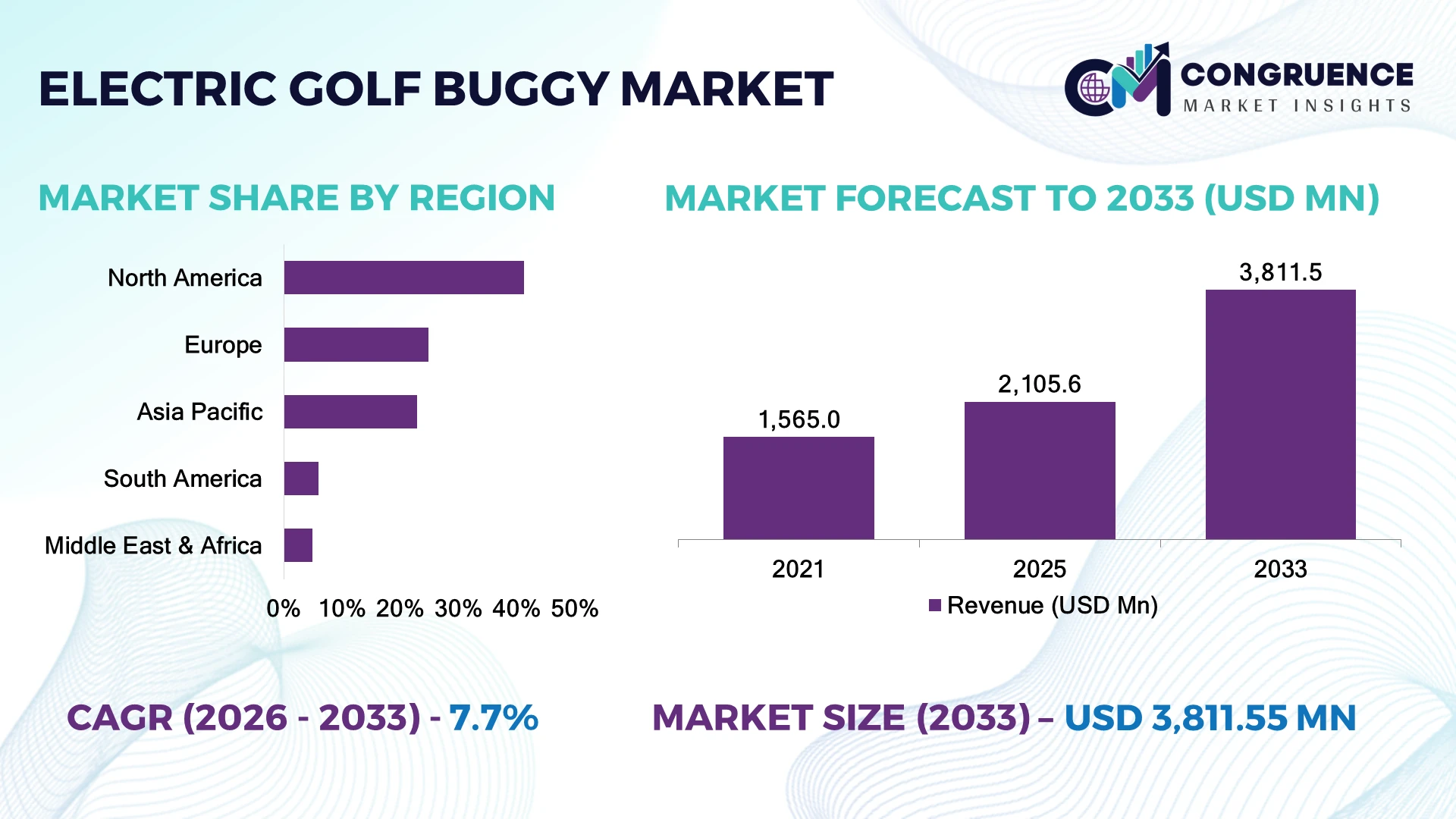
The Global Electric Golf Buggy Market was valued at USD 2,105.6 Million in 2025 and is anticipated to reach a value of USD 3,811.5 Million by 2033 expanding at a CAGR of 7.7% between 2026 and 2033. Growth is driven by rapid lithium-ion battery adoption, expansion of golf tourism, and increasing deployment of electric utility vehicles across resorts, gated communities, airports, and commercial campuses.
The United States accounts for approximately 34% of global electric golf buggy demand, supported by more than 16,000 golf facilities, extensive resort infrastructure, and accelerated fleet electrification programmes. Compared with Japan, the United States operates over four times more golf courses, while nearly 48% of newly procured fleet vehicles now feature lithium-ion battery systems. Continued supply-chain diversification following global trade realignments is encouraging manufacturers to regionalise battery sourcing and vehicle assembly for improved production resilience.
Manufacturers prioritising battery technology, connected fleet management, and regional production expansion are best positioned to strengthen long-term market leadership.
Market Size & Growth: USD 2,105.6 million in 2025 to USD 3,811.5 million by 2033 at 7.7% CAGR, driven by lithium-ion fleet replacement and resort electrification.
Top Growth Drivers: Lithium-ion adoption (+42%), golf tourism (+27%), commercial mobility (+23%).
Short-Term Forecast: By 2028, fleet operating costs decline approximately 16% through battery efficiency improvements.
Emerging Technologies: Connected telematics, lithium-ion batteries, and predictive fleet diagnostics accelerate smart vehicle management.
Regional Leaders: North America (~USD 1.42 billion), Europe (~USD 760 million), Asia-Pacific (~USD 720 million), supported by expanding electric mobility adoption.
Consumer/End-User Trends: Approximately 61% of premium golf clubs now prioritise lithium-ion fleet procurement.
Pilot/Case Example: 2026 resort fleet modernisation improved vehicle utilisation by nearly 21%.
Competitive Landscape: Market leader controls approximately 19% share alongside Club Car, Yamaha Golf-Car, E-Z-GO, and Garia.
Regulatory & ESG Impact: Fleet electrification reduced operational emissions by approximately 24% across upgraded facilities.
Investment & Funding: More than USD 1.5 billion committed to battery manufacturing, production expansion, and fleet modernisation.
Innovation & Future Outlook: Connected fleet ecosystems and intelligent charging infrastructure redefine operational efficiency.
Electric golf buggies are expanding beyond golf courses into hospitality, airports, industrial campuses, residential communities, and tourism destinations. Approximately 37% of new fleet demand now originates from non-golf applications as operators prioritise quieter, lower-maintenance electric mobility. Battery localisation initiatives and intelligent fleet management platforms are strengthening operational resilience, setting the foundation for the market's evolving strategic direction.
The Electric Golf Buggy Market has evolved into a strategic segment of low-speed electric mobility as commercial operators prioritise lower operating costs, digital fleet management, and sustainability targets. Fleet replacement programmes across golf clubs, resorts, airports, and mixed-use communities are accelerating procurement of advanced electric vehicles equipped with connected monitoring systems. At the same time, battery supply-chain regionalisation is encouraging manufacturers to strengthen local assembly and component sourcing to improve production resilience.
Modern lithium-ion electric golf buggies deliver approximately 28% longer operating range and reduce maintenance requirements by nearly 35% compared with traditional lead-acid platforms. North America continues leading fleet replacement through established golf infrastructure, while Asia-Pacific is expanding manufacturing capacity and commercial deployment across tourism and urban mobility applications. Over the next two to three years, nearly half of newly purchased commercial fleets are expected to integrate telematics, smart charging, and remote fleet diagnostics.
A practical example is resort operators deploying connected electric buggy fleets that optimise vehicle allocation, battery charging schedules, and preventive maintenance through centralised fleet management platforms. Manufacturers are expanding battery partnerships, investing in modular vehicle architectures, and increasing regional production capacity to support commercial customers. Companies combining battery innovation, digital fleet services, and scalable manufacturing will establish stronger competitive positioning as electric mobility extends well beyond traditional golf course applications.
Fleet replacement across golf courses, resorts, airports, and gated communities is accelerating demand for electric golf buggies equipped with lithium-ion batteries and connected fleet management systems. Approximately 48% of newly procured commercial golf buggies now utilise lithium-ion powertrains, while fleet operating costs decline by nearly 18% through improved energy efficiency and reduced maintenance. In the United States, hospitality operators are replacing ageing lead-acid fleets to align with sustainability targets and lower lifecycle costs. This transition improves vehicle uptime, extends fleet availability, and reduces maintenance downtime. Manufacturers are expanding battery production partnerships, increasing regional assembly capacity, and investing in modular vehicle platforms with integrated telematics. Companies combining battery innovation with digital fleet services are securing long-term contracts across commercial mobility applications.
Dependence on lithium-ion battery materials and electronic control components continues creating structural pressure across the electric golf buggy supply chain. Battery systems account for nearly 34% of total vehicle manufacturing costs, while component procurement expenses fluctuate by approximately 12% due to raw material pricing and logistics disruptions. China remains a critical supplier of battery cells and electronic modules, exposing manufacturers to procurement uncertainty during supply-chain adjustments. These conditions compress margins, complicate inventory planning, and delay fleet deliveries for commercial buyers. Companies are responding by localising battery assembly, diversifying cell suppliers, securing long-term procurement agreements, and adopting modular battery architectures that simplify sourcing while improving production flexibility.
Connected mobility platforms are transforming electric golf buggies into intelligent fleet assets serving hospitality, industrial, and urban mobility applications. Approximately 39% of premium fleet operators now deploy telematics-enabled vehicles, reducing idle time by nearly 17% and improving fleet utilisation by approximately 22%. Japan is expanding smart tourism infrastructure where digitally managed electric mobility solutions support integrated resort operations. Manufacturers are investing in cloud-based fleet software, AI-assisted battery diagnostics, and autonomous low-speed vehicle technologies while forming partnerships with software developers and charging infrastructure providers. A significant emerging opportunity lies in subscription-based fleet management services that generate recurring revenue while improving operational efficiency for commercial customers.
As electric golf buggies become increasingly connected, integrating telematics, charging infrastructure, fleet software, and battery management systems creates substantial execution complexity. Approximately 44% of large commercial fleet operators require interoperability with existing asset management platforms, while software integration extends deployment schedules by nearly 16%. The United States is witnessing rising demand for cybersecure fleet connectivity that protects operational data without affecting vehicle availability. Manufacturers must strengthen software engineering, cybersecurity capabilities, and charging compatibility while collaborating with digital mobility providers. Long-term competitiveness depends on delivering interoperable vehicle ecosystems capable of supporting scalable fleet management across multiple commercial environments without increasing operational complexity.
Battery Swaps Gain Momentum: Lithium-ion battery deployment now exceeds 52% of new commercial fleet purchases, while charging time has declined by approximately 28% compared with previous-generation systems. Resort operators are replacing ageing lead-acid fleets to improve vehicle availability, prompting manufacturers to expand battery partnerships and increase regional assembly capacity.
Connected Fleet Management Expands: Around 43% of premium fleet operators utilise telematics platforms that improve vehicle utilisation by nearly 20% and reduce maintenance interventions by approximately 16%. Labour shortages across hospitality operations are accelerating digital fleet monitoring, encouraging manufacturers to integrate predictive diagnostics and remote fleet management into standard vehicle offerings.
Utility Applications Diversify: Nearly 35% of newly deployed electric golf buggies now operate outside traditional golf courses in airports, industrial parks, healthcare campuses, and residential communities. Fleet operators are prioritising configurable cargo variants, prompting manufacturers to broaden product portfolios and establish partnerships with commercial mobility distributors.
Lightweight Platforms Improve Efficiency: Advanced aluminium chassis and composite body structures reduce vehicle weight by approximately 14% while extending battery range by nearly 12%. Manufacturers are restructuring production around modular vehicle architectures that simplify customisation, shorten assembly cycles, and improve supply-chain flexibility as commercial buyers increasingly demand application-specific electric mobility solutions.
Lithium-Ion Electric Golf Buggies account for approximately 61% of the market as golf clubs, resorts, airports, and commercial fleet operators increasingly prioritise lower maintenance requirements, longer operating range, and faster charging. Their superior lifecycle performance and lower total cost of ownership have accelerated replacement of conventional lead-acid fleets. Lead-Acid Electric Golf Buggies continue serving cost-sensitive buyers and smaller golf facilities where upfront acquisition cost remains the primary purchasing criterion. Although lead-acid platforms retain strategic relevance in developing markets, procurement is increasingly shifting toward premium battery technologies as commercial operators evaluate lifecycle efficiency instead of initial purchase price.
Solar-Assisted Electric Golf Buggies represent the fastest-growing segment as operators pursue energy-efficient mobility solutions for large resorts and eco-tourism destinations. Adoption of solar-assisted charging solutions has increased by approximately 26%, while lithium-ion fleet deployment has expanded by nearly 32% across premium golf facilities. Manufacturers are accelerating investments in battery innovation, lightweight vehicle platforms, and intelligent energy management systems while forming partnerships with battery suppliers to strengthen supply resilience. Capital allocation increasingly favours scalable lithium-powered fleets capable of supporting connected fleet management and extended operating schedules.
According to a 2026 enterprise assessment by the National Golf Foundation, an increasing share of newly procured commercial golf vehicle fleets now utilise lithium-ion battery technology as operators prioritise lower lifecycle maintenance and improved fleet availability.
Golf Courses account for approximately 56% of global Electric Golf Buggy demand due to continuous fleet replacement, premium golf tourism, and expanding investments in course modernisation. Fleet operators increasingly prioritise electric vehicles capable of supporting longer operating hours with reduced maintenance requirements. Resorts and Hotels represent another mature application where electric golf buggies provide guest mobility across integrated hospitality complexes, while Airports, Industrial Facilities, Residential Communities, and Educational Campuses continue adopting electric mobility solutions for internal transportation and operational efficiency.
Resorts and Integrated Tourism Facilities represent the fastest-growing application as luxury hospitality developments expand low-emission transport services. Deployment within hospitality environments has increased by approximately 29%, while telematics-enabled fleet utilisation has improved operational efficiency by nearly 19%. Manufacturers are responding by introducing application-specific vehicle configurations, connected fleet platforms, and expanded after-sales support for commercial operators. Demand is increasingly strengthening across multi-purpose mobility environments where electric golf buggies serve both passenger transportation and light utility functions, making operational flexibility a key purchasing criterion.
A 2025 industry survey conducted by the Golf Course Superintendents Association of America indicated that golf facilities continue prioritising electric fleet replacement programmes to reduce maintenance costs, improve operational efficiency, and enhance player experience.
Golf Clubs and Golf Course Operators account for approximately 52% of market demand, supported by recurring fleet replacement cycles, intensive daily vehicle utilisation, and premium customer service expectations. Large golf destinations maintain extensive vehicle fleets requiring predictable maintenance schedules and reliable battery performance, making this segment the dominant purchaser. Resort and Hospitality Operators continue representing a mature customer base, while Airports, Industrial Enterprises, Real Estate Developers, and Municipal Authorities are steadily expanding procurement for internal mobility and site transportation requirements.
Commercial Mobility Operators represent the fastest-growing end-user group as electric golf buggies gain acceptance across mixed-use developments, tourism destinations, healthcare campuses, and business parks. Procurement from this segment has increased by approximately 28%, while customised fleet configurations have expanded by nearly 22% to address diverse operational requirements. Manufacturers are strengthening partnerships with hospitality groups, offering flexible fleet leasing programmes, and developing configurable vehicle platforms to improve customer retention. Competitive positioning is increasingly shifting toward integrated mobility solutions supported by connected fleet services and long-term maintenance agreements.
According to a 2026 enterprise survey published by the Club Management Association of America (CMAA), golf club operators continue increasing investment in connected electric vehicle fleets to improve operational efficiency, member services, and long-term fleet management.
North America accounted for the largest market share at 41.3% in 2025 however, Asia-Pacific is expected to register the fastest growth, expanding at a CAGR of 8.9% between 2026 and 2033.

Fleet Electrification Reshapes Commercial Mobility
North America contributes approximately 41.3% of the global Electric Golf Buggy market, supported by the world's highest concentration of golf courses, established resort infrastructure, and expanding adoption across airports, gated communities, universities, and commercial campuses. Fleet modernisation programmes increasingly prioritise lithium-ion vehicles equipped with telematics and predictive maintenance capabilities. Nearly 64% of premium golf clubs now procure connected electric buggies as standard fleet replacements, while commercial operators have improved fleet utilisation by approximately 18% through digital vehicle management platforms. Manufacturers continue expanding regional assembly operations, strengthening battery supply partnerships, and investing in intelligent fleet software that improves operational efficiency and reduces vehicle downtime across high-utilisation environments.
United States Market Outlook: The United States dominates regional demand through its extensive golf industry, hospitality sector, and growing commercial low-speed mobility market. Large resort operators and private golf clubs continue replacing ageing fleets with connected lithium-ion vehicles that reduce maintenance requirements and improve customer experience. Approximately 58% of newly purchased commercial golf buggy fleets now feature integrated telematics and intelligent battery management, encouraging manufacturers to expand domestic production, service infrastructure, and fleet leasing programmes.
Sustainable Mobility Drives Fleet Modernisation
Europe accounts for approximately 24.8% of the global market, supported by expanding golf tourism, hospitality investments, and sustainability-focused transport policies. Premium golf clubs, resorts, and leisure destinations increasingly adopt electric golf buggies to reduce operating emissions and improve visitor mobility. Around 46% of newly deployed commercial fleets now utilise lithium-ion battery technology, improving charging efficiency and lowering maintenance frequency. Manufacturers are strengthening regional distribution networks, introducing lightweight vehicle platforms, and expanding custom vehicle offerings tailored to hospitality, municipal, and recreational applications.
United Kingdom Market Outlook: The United Kingdom remains Europe's leading market due to its mature golf industry, premium resort infrastructure, and increasing investment in sustainable leisure facilities. Fleet operators continue modernising vehicle inventories to improve operational efficiency and visitor services. Approximately 43% of golf clubs undertaking fleet renewal projects now prioritise lithium-ion electric buggies with fleet monitoring capabilities, supporting demand for connected mobility solutions and enhanced after-sales service networks.
Manufacturing Scale Accelerates Market Expansion
Asia-Pacific represents approximately 22.9% of the global Electric Golf Buggy market, driven by expanding vehicle manufacturing, golf tourism, smart resort development, and low-speed electric mobility adoption. China and Japan continue strengthening production capacity while Southeast Asian hospitality investments increase demand for premium electric fleets. Approximately 34% of regional commercial fleet purchases now incorporate connected vehicle management systems, improving fleet visibility and maintenance planning. Manufacturers are expanding battery production, increasing export-oriented assembly, and investing in modular vehicle platforms suited to diverse commercial mobility applications.
China Market Outlook: China leads the regional market through its integrated electric vehicle supply chain, battery manufacturing capabilities, and expanding tourism infrastructure. Domestic manufacturers continue strengthening export competitiveness while supplying commercial operators across Asia-Pacific. Approximately 39% of newly manufactured electric golf buggies incorporate lithium-ion battery systems with smart battery management technology, reinforcing China's position as a strategic production and innovation hub for low-speed electric mobility.
Tourism Infrastructure Expands Commercial Demand
South America is experiencing growing adoption of electric golf buggies across golf resorts, hospitality developments, gated communities, and recreational facilities. Commercial operators increasingly favour electric fleets due to lower operating costs and quieter operation, although charging infrastructure remains uneven across several markets. Approximately 27% of new hospitality mobility projects now specify electric golf buggies for guest transportation and facility operations. Manufacturers are expanding distributor partnerships, improving regional service capabilities, and offering application-specific vehicle configurations to strengthen market penetration while addressing local infrastructure constraints.
Brazil Market Outlook: Brazil represents the region's largest market through its expanding golf tourism sector, luxury resorts, residential developments, and recreational infrastructure. Hospitality operators increasingly deploy electric golf buggies for internal transportation and premium guest services. Approximately 36% of new resort mobility fleets now utilise lithium-ion electric buggies, encouraging suppliers to strengthen local dealer networks, maintenance services, and commercial fleet support programmes.
Tourism Investments Strengthen Electric Mobility
The Middle East & Africa market is expanding through large-scale tourism developments, luxury hospitality projects, golf course construction, and smart urban mobility initiatives. Premium resorts increasingly deploy electric golf buggies across integrated hospitality environments where low-emission transportation aligns with operational sustainability objectives. Approximately 31% of newly developed resort projects now include dedicated electric mobility fleets for guest transportation and facility management. Manufacturers are strengthening regional partnerships, expanding technical support capabilities, and introducing premium vehicle configurations tailored to luxury tourism and commercial mobility applications.
United Arab Emirates Market Outlook: The United Arab Emirates leads regional demand through continuous investment in luxury resorts, golf destinations, mixed-use developments, and smart mobility infrastructure. Hospitality operators increasingly integrate connected electric golf buggies into guest transport and property management operations. Approximately 41% of premium hospitality developments now specify intelligent electric buggy fleets featuring fleet management systems and lithium-ion battery technology, encouraging manufacturers to establish regional distribution, technical service, and fleet support operations.
Global leaders Club Car, Yamaha Motor, E-Z-GO, and Garia compete through premium technology, fleet management, and dealer networks, while regional manufacturers challenge primarily with lower pricing and customised commercial vehicles. The top five companies collectively account for approximately 58% of the global market. Competition centres on battery technology, vehicle durability, connected fleet software, and after-sales support. Lithium-ion platforms reduce maintenance costs by nearly 30%, while connected fleet management improves utilisation by approximately 18% and modular vehicle architectures shorten production cycles by around 15%. Leading manufacturers are expanding battery partnerships, strengthening dealer ecosystems, investing in telematics, and vertically integrating battery management technologies, whereas regional brands focus on application-specific designs and cost efficiency. The competitive shift favours software-enabled fleet ecosystems over hardware differentiation alone. Brand reputation, battery sourcing, service infrastructure, and fleet financing remain key entry barriers. Winning requires scalable manufacturing, intelligent fleet solutions, reliable dealer support, and strong commercial customer relationships.
Club Car
Yamaha Motor Co., Ltd.
E-Z-GO
Garia
HDK Electric Vehicles
STAR EV Corporation
Marshell Green Power
Evolution Electric Vehicles
ICON EV
Columbia Vehicle Group
Cruise Car Inc.
Xiamen Dalle Electric Car Co., Ltd.
Lithium-ion batteries, regenerative braking, and cloud-connected fleet management have become the defining technologies in modern electric golf buggies. Approximately 64% of newly delivered commercial fleets now utilise lithium-ion systems because they extend operating range and reduce maintenance. Compared with lead-acid platforms, lithium-ion configurations improve usable driving range by nearly 28% while lowering scheduled maintenance requirements by approximately 35%, enabling higher fleet availability for golf courses, resorts, airports, and commercial campuses.
Emerging technologies include AI-enabled fleet analytics, smart battery management systems, over-the-air diagnostics, and lightweight aluminium-composite chassis. Around 41% of premium fleet operators now deploy telematics to optimise charging schedules, reduce idle time, and improve vehicle utilisation by nearly 19%. Hospitality operators and fleet leasing companies gain the greatest operational advantage through predictive maintenance and centralised fleet visibility, while manufacturers strengthen competitiveness by integrating software subscriptions with vehicle sales and after-sales services.
Between 2026 and 2028, intelligent charging infrastructure, autonomous low-speed navigation, and vehicle-to-fleet connectivity will reshape commercial mobility operations. Smart charging algorithms are expected to optimise more than 65% of fleet charging cycles while reducing electricity consumption by approximately 14%. Manufacturers investing early in connected software ecosystems, modular battery platforms, and digital fleet services will strengthen customer retention, expand recurring service revenue, and secure long-term leadership beyond conventional golf course applications.
April 2024 Club Car and Garia announced an exclusive Formula 2 partnership, supplying premium electric vehicles for championship operations and hospitality. The agreement expanded international brand visibility across 14 race weekends, strengthening premium mobility positioning. Source: Club Car
March 2025 Yamaha Motor launched the G30Es and G31EPs five-seat electric golf cars featuring an in-house lithium-ion battery and AC motor that reduces power consumption by approximately 30% versus previous models. Business impact: higher operating efficiency and longer battery life. Source: Yamaha Motor
August 2025 E-Z-GO introduced the enhanced 2026 RXV electric golf car with Samsung SDI ELiTE lithium battery technology and upgraded suspension, improving fleet reliability and operator comfort for commercial golf facilities. Source: PR Newswire
September 2025 Club Car delivered nearly 500 golf and utility vehicles for the Ryder Cup at Bethpage Black, reinforcing its capability to support large-scale tournament fleet operations and premium event mobility. Source: Club Car newsroom.
The report provides comprehensive analysis of the Electric Golf Buggy market across battery technologies, vehicle configurations, applications, end-user industries, and major geographical markets. It evaluates lithium-ion, lead-acid, and solar-assisted platforms serving golf courses, resorts, airports, industrial facilities, residential communities, and commercial campuses. Coverage spans North America, Europe, Asia-Pacific, South America, and the Middle East & Africa, with more than 60% of the assessment focused on commercial fleet deployment, electrification trends, and connected mobility applications shaping procurement decisions.
The study examines battery innovation, telematics, fleet management software, smart charging infrastructure, lightweight vehicle engineering, and digital maintenance technologies alongside competitive positioning of leading manufacturers. It analyses adoption patterns, fleet replacement strategies, distribution networks, and customer purchasing behaviour while identifying emerging commercial mobility opportunities beyond traditional golf applications. The report supports investment planning, product development, regional expansion, partnership evaluation, competitive benchmarking, and long-term strategic positioning for organisations participating in the electric low-speed mobility ecosystem between 2026 and 2033.
| Report Attribute/Metric | Report Details |
|---|---|
|
Market Revenue in 2025 |
USD 2,105.6 Million |
|
Market Revenue in 2033 |
USD 3,811.54 Million |
|
CAGR (2026 - 2033) |
7.7% |
|
Base Year |
2025 |
|
Forecast Period |
2026 - 2033 |
|
Historic Period |
2021 - 2025 |
|
Segments Covered |
By Type
By Application
By End-User
|
|
Key Report Deliverable |
Revenue Forecast, Growth Trends, Market Dynamics, Segmental Overview, Regional and Country-wise Analysis, Competition Landscape |
|
Region Covered |
North America, Europe, Asia-Pacific, South America, Middle East, Africa |
|
Key Players Analyzed |
Club Car, Yamaha Motor Co., Ltd., E-Z-GO, Garia, HDK Electric Vehicles, STAR EV Corporation, Marshell Green Power, Evolution Electric Vehicles, ICON EV, Columbia Vehicle Group, Cruise Car Inc., Xiamen Dalle Electric Car Co., Ltd. |
|
Customization & Pricing |
Available on Request (10% Customization is Free) |




