
Reports
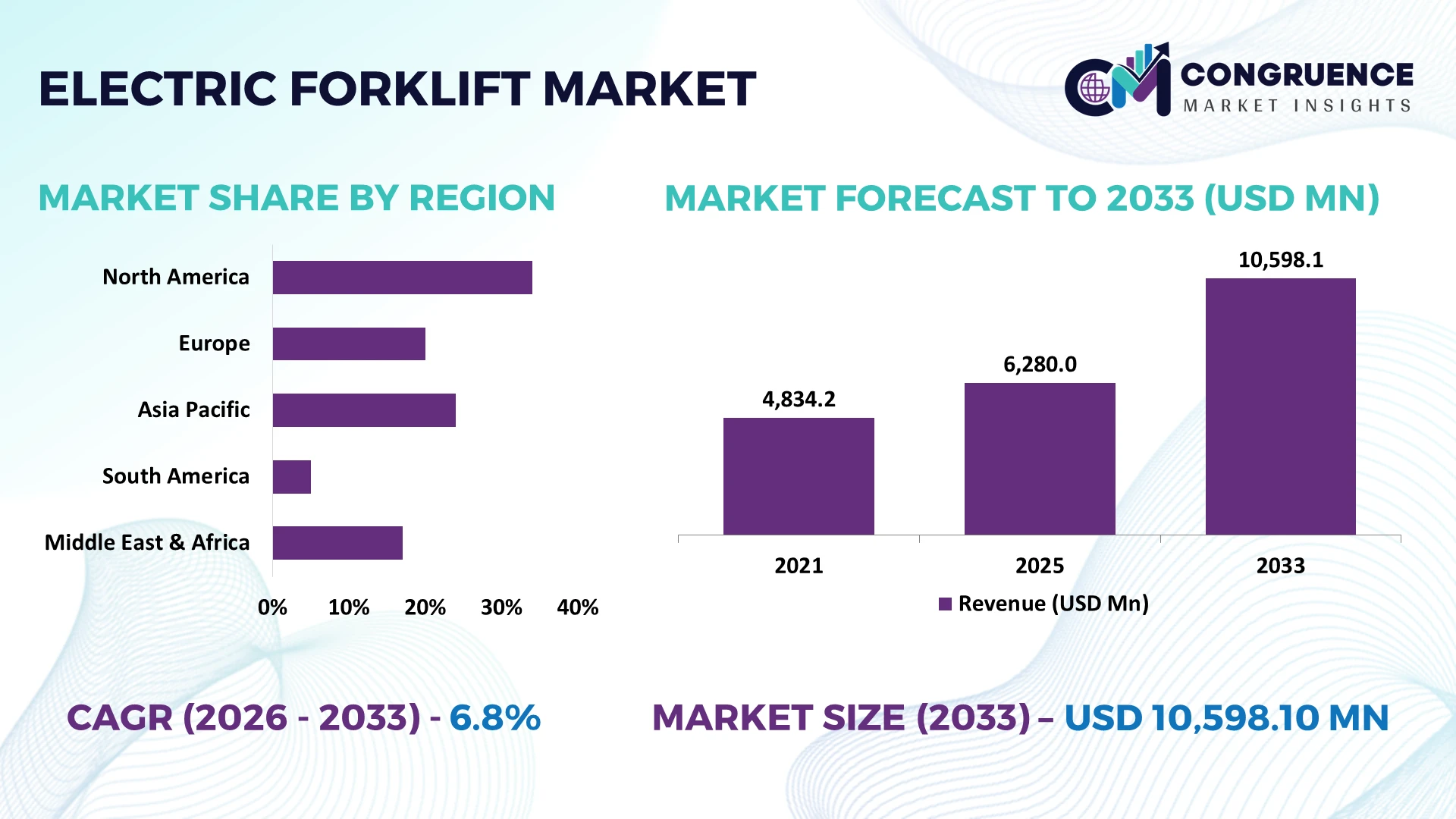
The Global Electric Forklift Market was valued at USD 6280 Million in 2025 and is anticipated to reach a value of USD 10598.1 Million by 2033 expanding at a CAGR of 6.76% between 2026 and 2033. Growth is being driven by lithium-ion fleet conversion, warehouse automation, tighter indoor-emission standards, and rising deployment of electric counterbalance and narrow-aisle forklifts across high-throughput logistics operations.
China remains the dominant electric forklift manufacturing and deployment market, contributing approximately 38–42% of global unit activity and benefiting from extensive battery, motor, and material-handling supply chains. Lithium-powered units already exceed 50% of new electric forklift demand in several Chinese industrial clusters, while the United States remains stronger in premium fleet-management and automation integration. Red Sea logistics disruption has further strengthened localized equipment sourcing and battery supply strategies.
Strategically, suppliers combining battery technology, automated fleet control, localized manufacturing, and fast-charging infrastructure will secure the strongest position as warehouse operators shift from equipment replacement toward integrated electrified logistics systems.
Market Size & Growth: USD 6,280 million in 2025 advances toward USD 10,598.1 million by 2033 at 6.76%, supported by lithium-ion conversion and automated warehouse modernization.
Top Growth Drivers: Electric fleet replacement contributes roughly 42%, warehouse automation 33%, and emissions-driven equipment substitution 25% of incremental demand momentum.
Short-Term Forecast: By 2028, lithium-ion fleet deployment is positioned to reduce charging downtime by approximately 30–40% and maintenance requirements by nearly 20% versus conventional lead-acid systems.
Emerging Technologies: AI fleet orchestration, autonomous navigation, lithium-iron-phosphate batteries, and opportunity charging are driving 10–15% improvements in equipment utilization across advanced warehouse environments.
Regional Leaders: By 2033, Asia-Pacific approaches USD 4.56 billion, North America USD 2.86 billion, and Europe USD 2.33 billion, led respectively by manufacturing scale, automation intensity, and regulatory electrification.
End-User Trends: More than 60% of large warehouse operators increasingly prioritize electric forklifts for indoor material handling because zero tailpipe emissions improve air quality and support multi-shift operations.
Pilot/Case Example: Toyota’s 2025 electric-product expansion included a 295,000-square-foot U.S. manufacturing facility designed to strengthen electric forklift production and improve localized supply responsiveness.
Competitive Landscape: Toyota Industries holds an estimated 18–20% global positioning, competing with KION, Jungheinrich, Hyster-Yale, Crown Equipment, and leading Chinese manufacturers including Heli and Hangcha.
Regulatory & ESG Impact: Electric forklifts can eliminate 100% of on-site tailpipe emissions, strengthening adoption across food, pharmaceutical, cold-storage, and enclosed manufacturing environments subject to tighter workplace-emission controls.
Investment & Funding: Nearly USD 100 million is being invested in Toyota Material Handling’s new U.S. electric-product factory, demonstrating accelerated capital allocation toward localized electrified material-handling capacity.
Innovation & Future Outlook: Lithium-ion batteries now support roughly 4–5 operating hours after around 1 hour of charging, pushing fleets toward opportunity charging, autonomous movement, and digitally optimized energy management.
The Electric Forklift Market is shifting toward lithium-ion power, autonomous navigation, connected fleet management, and fast-charging infrastructure across warehouses, manufacturing plants, cold storage, and e-commerce fulfillment centers. Lithium-ion batteries already represent about 25% of Toyota electric forklift orders in the UK, while labor constraints and tighter emissions requirements are accelerating automation. This operational transition directly strengthens the strategic case for integrated electric material-handling ecosystems.
Electric forklifts are becoming strategic infrastructure as warehouses move from isolated material-handling equipment toward electrified, software-managed fleets. E-commerce fulfillment, manufacturing automation and indoor-emission requirements are accelerating this transition, while lithium-ion supply chains are becoming more localized. China leads manufacturing scale, whereas the United States and Germany emphasize connected fleet management, safety systems and automated intralogistics.
Lithium-ion technology materially changes fleet economics: batteries typically reach full charge within 1–2 hours versus roughly 8 hours for conventional lead-acid systems, while eliminating battery watering and reducing scheduled maintenance. Opportunity charging also supports multi-shift utilization without dedicated battery-change rooms. Through 2026–2028, lithium-ion penetration in new electric fleets should exceed 40% across advanced warehouse operations, accompanied by wider telematics and automated-guided forklift deployment.
A practical transition is occurring in U.S. distribution centers, where operators combine electric forklifts, fast chargers and warehouse-management software to coordinate utilization around loading peaks. Manufacturers are expanding localized electric-product capacity while partnering with battery and automation specialists. Competitive leadership will therefore depend less on truck hardware alone and more on integrated energy management, uptime, autonomous capability and lifecycle service.
Lithium-ion conversion is restructuring electric forklift operations because high-throughput warehouses require faster charging, longer availability and less battery maintenance. Lithium systems commonly deliver 95–98% charging efficiency versus approximately 80–85% for lead-acid batteries and can reach full charge within 1–2 hours rather than 8 hours. Opportunity charging further eliminates lengthy battery-change workflows. In the United States, e-commerce fulfillment and multi-shift distribution are pushing fleet operators toward equipment that remains productive through short breaks. Manufacturers are responding with integrated lithium-ion trucks, onboard battery-management systems and high-frequency chargers. Toyota, Jungheinrich and KION are expanding electric portfolios around this architecture. The strategic advantage extends beyond energy efficiency: removing battery-change rooms releases valuable warehouse floor space for storage, picking or automation infrastructure.
Fleet electrification remains constrained by charging infrastructure, electrical-service capacity and higher initial lithium-ion equipment costs. Lithium-powered forklifts can carry purchase premiums of approximately 20–40% over comparable lead-acid configurations, while industrial charging installations add electrical, ventilation and facility-modification requirements. Peak charging can also increase site demand charges by 10–20% where fleets recharge simultaneously. Older warehouses in the United States and Europe often lack sufficient distribution-board capacity for rapid fleet conversion, extending implementation schedules. Operators are reducing exposure through phased replacements, charger load-balancing and energy-management software, while manufacturers increasingly package trucks, batteries and charging systems under lifecycle contracts. The less obvious constraint is therefore building power availability: forklift availability can improve substantially, yet poorly coordinated charging can transfer operational bottlenecks from the battery room directly to the facility’s electrical infrastructure.
Autonomous forklifts create a high-value pathway by combining electrification with navigation software, machine vision and warehouse orchestration. Automated units can improve material-movement productivity by approximately 20–30% in repetitive workflows, while optimized routing can reduce empty travel by 10–20%. Labor-intensive markets such as the United States, Japan and Germany are particularly attractive as warehouses struggle to staff repetitive pallet transport across multiple shifts. Between 2026 and 2028, deployment will increasingly move from isolated autonomous trucks toward mixed fleets coordinated through warehouse-management and fleet-control platforms. Toyota, KION, Jungheinrich and automation specialists are investing in autonomous mobile technologies, sensor fusion and integration partnerships. A non-obvious opportunity lies in charging automation: self-dispatching forklifts can recharge during low-workload intervals, converting battery management from a manual task into a software-controlled productivity lever.
Scaling connected electric forklifts creates execution complexity across software integration, cybersecurity, technician capability and mixed-fleet interoperability. Automated forklifts can require positioning accuracy within approximately 10–20 millimeters for precision pallet handling, while warehouse layouts, Wi-Fi coverage and changing pedestrian traffic can disrupt navigation consistency. Connected fleets also generate thousands of operational data points per truck daily, increasing requirements for secure device management and actionable analytics. Germany’s highly automated warehouses illustrate the challenge: adding autonomous trucks without integrating warehouse-management, traffic-control and safety systems can create congestion rather than productivity gains. Manufacturers must strengthen APIs, cybersecurity controls, technician training and simulation-based commissioning while customers standardize fleet data. The strategic challenge is orchestration, not electrification itself; companies that cannot integrate human-operated, autonomous and charging workflows consistently will struggle to capture the expected 15–25% productivity improvement from advanced fleets.
Battery Chemistry Diversifies Rapidly: LFP batteries are gaining preference in high-cycle electric forklifts because usable lifetimes can exceed 3,000 cycles, charging efficiency reaches roughly 95%, and opportunity charging can restore substantial capacity within 30–60 minutes. Chinese manufacturers are integrating battery packs internally, while Western OEMs are expanding battery partnerships. The shift reduces battery-change labor and improves fleet availability without requiring autonomous operation.
Telematics Becomes Fleet Standard: Connected forklifts increasingly capture utilization, impact, energy and operator data, with optimized fleets recording 10–20% lower idle time and up to 15% higher asset utilization. Large U.S. distribution operators are consolidating truck data into centralized dashboards. OEMs are embedding wireless fleet-management platforms and predictive diagnostics, turning replacement decisions from fixed schedules toward actual operating-hour and condition data.
Safety Systems Move Onboard: Pedestrian detection, speed zoning, 360-degree cameras and proximity sensors are moving from premium options into enterprise fleet specifications. Advanced assistance can reduce collision-related incidents by approximately 20–30%, while electronically controlled zones automatically lower travel speeds by 30–50% around intersections. Tightening workplace-safety requirements are prompting Toyota, Jungheinrich and KION to integrate sensor-based controls directly into electric truck architectures.
Localized Production Gains Priority: Supply-chain disruption is accelerating regional sourcing of electric trucks, batteries and critical components. Toyota Material Handling’s new U.S. electric-products facility spans approximately 295,000 square feet, while manufacturers are shortening battery and electronics supply routes. Localization reduces lead-time exposure and improves parts availability; non-obviously, it also enables OEMs to configure trucks closer to customer-specific mast, battery and attachment requirements.
Class III electric motor hand and rider trucks lead the market with an estimated 35–40% share, reflecting their extensive deployment in warehouses, loading docks, retail distribution and short-distance pallet movement. Their compact architecture, comparatively low acquisition cost and compatibility with dense material-flow environments make them scalable across fleets ranging from individual facilities to nationwide distribution networks. Class I electric rider trucks hold approximately 25–30%, benefiting from expanding lithium-ion adoption in indoor manufacturing and warehousing where conventional internal-combustion equipment is increasingly displaced.
Class II is the fastest-growing category as narrow-aisle warehouses pursue higher storage density and vertical utilization. Reach trucks and order pickers can support aisle widths roughly 30–40% narrower than conventional counterbalance layouts, increasing usable storage capacity without expanding buildings. Class IV and Class V remain predominantly internal-combustion classifications, limiting their direct electric-forklift relevance under the provided segmentation. OEM investment is consequently concentrating on Class I–III electrification, lithium-ion integration, operator-assistance systems and application-specific configurations.
Warehousing represents the leading electric forklift application with approximately 35–40% of market deployment, driven by intensive pallet movement, indoor operating requirements and multi-shift equipment utilization. Distribution centers increasingly combine counterbalance trucks, reach trucks and pallet movers within integrated fleets, creating concentrated demand for common battery and charging architectures. Manufacturing accounts for approximately 25–30%, where electric forklifts support line feeding, finished-goods movement and enclosed production environments without tailpipe emissions. Retail Distribution remains a mature application centered on replenishment and regional fulfillment.
Logistics is the fastest-growing application as third-party logistics providers expand high-throughput fulfillment networks and increasingly measure equipment productivity by operating hour rather than fleet size. Cold Storage also strengthens demand because electric drivetrains eliminate combustion emissions inside temperature-controlled facilities, although batteries require thermal management. Companies are responding with cold-rated lithium systems, connected fleet platforms and compact equipment. Telematics-based optimization can reduce idle time by 10–20%, improving throughput while allowing operators to identify underutilized trucks before expanding fleets.
Warehousing is the largest electric forklift end-user group, accounting for an estimated 35–40% of fleet demand because distribution centers operate high-frequency pallet workflows across receiving, storage, picking and dispatch. Equipment utilization frequently exceeds 2,000 operating hours annually at intensive facilities, strengthening lifecycle economics for low-maintenance electric powertrains. Manufacturing represents approximately 25–30%, with buyers prioritizing counterbalance performance, attachments and reliable multi-shift operation. Retail Distribution uses smaller and more varied fleets optimized around replenishment peaks and regional fulfillment schedules.
Logistics is the fastest-expanding buyer group as 3PL operators standardize equipment across multi-customer warehouses and seek measurable cost per pallet movement. Cold Storage remains a technically specialized buyer segment requiring sealed electronics, corrosion resistance and battery-temperature control. Manufacturers are targeting these users with fleet leasing, lithium battery warranties, telematics subscriptions and application-specific truck configurations. The competitive shift is toward lifecycle ecosystems: large buyers increasingly evaluate charging infrastructure, service response and fleet analytics alongside purchase price, rewarding suppliers capable of supporting entire operating networks.
Asia-Pacific accounted for the largest market share at 43% in 2025 however, Asia-Pacific is expected to register the fastest growth, expanding at a CAGR of 8.1% between 2026 and 2033.
Warehouse Modernization Accelerates Fleet Electrification
North America accounts for approximately 27% of global electric forklift demand, with deployment concentrated across e-commerce fulfillment, third-party logistics, food distribution and advanced manufacturing. Electric equipment represents more than 70% of U.S. industrial-truck factory shipments, reflecting the structural transition away from combustion-powered indoor fleets. Lithium-ion trucks, telematics, operator-assistance systems and opportunity charging are increasingly specified together as enterprises optimize lifecycle productivity rather than acquisition price. Distribution centers are also replacing battery-change rooms with decentralized charging points, freeing warehouse floor space. Toyota Material Handling’s approximately 295,000-square-foot electric-products manufacturing facility in Indiana strengthens localized equipment supply and reduces dependence on extended component logistics. Labor availability remains another operational catalyst, encouraging fleet managers to combine electrification with semi-automated pallet movement and centralized utilization monitoring.
United States Market Outlook: The United States leads regional deployment through extensive warehouse infrastructure, high labor costs and rapid investment in fulfillment automation. More than 70% of industrial-truck shipments are electric, while large operators increasingly integrate lithium-ion charging, telematics and safety controls. Domestic manufacturing expansion by established OEMs strengthens parts availability, customization and lifecycle service, reinforcing electric forklifts as core logistics infrastructure.
Zero-Emission Intralogistics Reshapes Fleets
Europe represents approximately 22% of global electric forklift activity, supported by mature warehouse automation, stringent workplace-emission requirements and dense manufacturing networks. Germany, France, Italy and the United Kingdom are replacing internal-combustion equipment in enclosed facilities while integrating electric forklifts with warehouse-management and energy-control platforms. Electric trucks already account for more than 70% of industrial-truck orders across several mature European markets, with lithium-ion penetration strengthening in multi-shift operations. Manufacturers are also deploying pedestrian detection, geofencing and automated speed control to address increasingly complex human-machine environments. European battery regulation is pushing greater attention toward lifecycle traceability and battery management, encouraging OEMs to standardize lithium architectures and recycling partnerships. Jungheinrich and KION are expanding integrated automation capabilities, shifting competition toward complete intralogistics ecosystems combining trucks, software, charging and service.
Germany Market Outlook: Germany remains Europe’s strategic center through its automotive, machinery, chemical and logistics infrastructure and the presence of major material-handling technology suppliers. Automated warehouses increasingly combine reach trucks, electric counterbalance equipment and software-controlled material flows. German buyers prioritize energy efficiency, safety integration and lifecycle service, supporting sophisticated fleets capable of operating alongside conveyors, robotics and automated storage systems.
Chinese Scale Redefines Electric Equipment Economics
Asia-Pacific commands approximately 43% of global electric forklift demand, supported by China’s unmatched industrial-truck manufacturing scale, battery ecosystem and expanding logistics infrastructure. Chinese manufacturers increasingly integrate lithium cells, battery-management systems, motors and controllers domestically, shortening production cycles and strengthening export competitiveness. Electrification is particularly advanced in warehouse trucks, where lithium-powered configurations have moved rapidly into mainstream procurement. China’s industrial vehicle industry ships more than one million forklifts annually across powertrain categories, providing substantial manufacturing leverage for Heli, Hangcha and other domestic suppliers. Japan and South Korea differentiate through automation, precision manufacturing and advanced safety systems, while India is expanding electric fleets across organized warehousing and manufacturing. OEMs are scaling LFP platforms, overseas distribution networks and localized service operations as competition shifts from low-cost equipment toward technology-supported global fleet ownership.
China Market Outlook: China combines the world’s largest forklift manufacturing base with dominant lithium-ion battery supply chains, creating a structural cost and scaling advantage. Domestic manufacturers increasingly export lithium-powered counterbalance and warehouse trucks while adding telematics, fast charging and automated navigation. Strong component localization enables Chinese suppliers to shorten configuration cycles and compete internationally on both acquisition economics and increasingly sophisticated fleet technology.
Modern Logistics Drives Selective Electrification
South America contributes approximately 4% of global electric forklift demand, led by Brazil’s warehousing, automotive, food-processing and retail-distribution sectors. Fleet electrification remains concentrated around large industrial corridors and modern logistics properties where reliable electrical infrastructure supports lithium-ion charging. Brazil’s logistics-property inventory exceeds 30 million square meters, creating a sizeable addressable environment for electric pallet trucks, reach trucks and counterbalance equipment. Imported components and currency volatility remain operational constraints, making lifecycle service and parts availability critical procurement considerations. Large operators are increasingly replacing lead-acid fleets selectively rather than undertaking immediate site-wide conversion, prioritizing trucks with the highest operating hours. Suppliers are responding through local dealer networks, rental models and maintenance contracts, while lithium systems are gaining traction where multi-shift utilization justifies higher initial equipment costs.
Brazil Market Outlook: Brazil anchors regional electric forklift adoption through São Paulo, Minas Gerais, Paraná and other high-density industrial and distribution corridors. Modern logistics facilities increasingly specify electric warehouse equipment to support enclosed operations and high pallet throughput. Local service capability is strategically important because imported electronics and battery components can extend replacement lead times, favoring OEMs with established dealer inventories and technical support.
Logistics Megaprojects Modernize Material Handling
Middle East & Africa accounts for approximately 4% of global electric forklift demand, with deployment increasingly concentrated in Gulf logistics hubs, ports, manufacturing zones and temperature-controlled distribution. Saudi Arabia and the United Arab Emirates are investing heavily in logistics infrastructure under economic-diversification programs, creating modern facilities designed around electrified equipment rather than legacy combustion fleets. Saudi Arabia’s logistics strategy targets development of 59 logistics zones by 2030, expanding the addressable base for electric counterbalance trucks, reach trucks and pallet movers. UAE free zones and high-throughput distribution centers are simultaneously adopting lithium-ion equipment where opportunity charging supports extended shifts. Suppliers are strengthening regional dealerships, battery-service capability and fleet-rental offerings. Across Africa, adoption remains more selective because charging infrastructure and equipment financing vary substantially, concentrating advanced electric fleets in South Africa and major commercial hubs.
Saudi Arabia Market Outlook: Saudi Arabia represents the strongest long-term deployment platform as new logistics parks, industrial zones and distribution centers are built around modern material-flow requirements. The planned network of 59 logistics zones expands opportunities for electric warehouse fleets, while Vision 2030 industrial diversification strengthens equipment demand beyond traditional oil-linked sectors. Suppliers with local service, charging expertise and fleet-financing capability hold a clear execution advantage.
Toyota Industries, KION, Jungheinrich, Hyster-Yale and Hangcha define competition between established global intralogistics leaders and rapidly scaling Chinese manufacturers. The top five control approximately 48% of electric forklift activity, creating concentrated technology and distribution advantages. Toyota and KION compete through integrated fleets, automation and service networks, while Hangcha pressures incumbents with lithium-focused pricing typically 10–20% lower in comparable configurations. Jungheinrich differentiates through warehouse integration and energy systems; Hyster-Yale targets application customization and heavy-duty electrification. Lithium-ion systems reduce charging time by roughly 70–80% versus conventional lead-acid workflows, making battery integration a decisive competitive lever. Players are expanding factories, automation partnerships, software platforms and localized service networks as competition shifts from standalone trucks toward connected fleet ecosystems. Battery expertise, safety certification, dealer coverage and lifecycle support create substantial entry barriers. Winning now requires competitive acquisition economics, dependable local service, integrated charging, digital fleet intelligence and scalable automation capabilities globally.
Toyota Industries Corporation
KION Group
Jungheinrich AG
Hyster-Yale Materials Handling
Hangcha Group
Anhui Heli
Crown Equipment Corporation
Mitsubishi Logisnext
Komatsu Ltd.
Hyundai Material Handling
Doosan Bobcat
EP Equipment
Noblelift Intelligent Equipment
Clark Material Handling
Current technology centers on lithium-ion powertrains, regenerative braking, telematics, and integrated battery-management systems. Lithium-ion trucks use roughly 20% less energy than comparable lead-acid models and support fast intermediate charging, raising fleet availability in multi-shift warehouses. Integrated thermal management, sealed AC motors, and predictive diagnostics also reduce maintenance interruptions, giving operators lower lifecycle complexity and consistent performance.
Emerging systems combine AI-enabled pedestrian detection, digital twins, automated navigation, and warehouse-management integration. New electric counterbalance designs deliver up to 15% higher throughput, while compact architectures improve space efficiency by about 15% versus earlier platforms. Compared with legacy lead-acid fleets, modern lithium systems cut energy consumption around 20% and eliminate watering workflows. Adoption is accelerating across high-intensity distribution centers, where connected trucks increasingly operate as software-managed assets rather than standalone equipment.
From 2026–2028, high-voltage electric forklifts, autonomous orchestration, and AI-assisted safety will reshape heavy-duty and narrow-aisle operations. Digital-twin simulation will let operators test traffic flows, charging schedules, and robot coordination before deployment, reducing commissioning risk. OEMs controlling batteries, motors, software, and service networks gain the strongest competitive advantage because integration shortens troubleshooting and improves uptime. Acting now positions fleets for lower energy use, safer operations, faster automation scaling, and stronger compatibility with next-generation warehouses.
August 2026 Toyota Material Handling opened its 295,000-square-foot Indiana factory dedicated to Toyota and Raymond electric forklifts, adding 140 jobs and expanding localized production capacity. The investment strengthens delivery speed and North American electrification readiness for fleet customers. Source: toyotaforklift.com
November 2025 Hyster launched J45-70A electric counterbalance forklifts spanning 4,500–7,000-pound capacities, with configurable lead-acid, TPPL, or lithium-ion power and IP67-sealed drive systems. The platform broadens zero-emission deployment across demanding industrial operations while improving safety, uptime, and application flexibility. Source: forkliftaction.com
January 2025 KION partnered with NVIDIA and Accenture to develop AI-powered robots and industrial digital twins for automated warehouses, integrating forklifts, cameras, and robotics. The collaboration improves simulation-led warehouse design and accelerates scalable intelligent intralogistics deployment globally today. Source: kiongroup.com
February 2026 Jungheinrich introduced the EFG 5 electric counterbalance series for 4–5-ton loads, delivering up to 15% higher throughput and optional AI-based pedestrian detection. The launch extends electrification into heavy-duty applications previously dominated by combustion forklifts at scale. Source: jungheinrich.com
The Electric Forklift Market report examines Class I, Class II, Class III, Class IV, and Class V equipment across Warehousing, Manufacturing, Logistics, Cold Storage, and Retail Distribution applications and end-users. Analysis covers lithium-ion and lead-acid architectures, regenerative braking, telematics, fast charging, AI-enabled safety, autonomous navigation, and high-voltage systems. Electric equipment already represents more than 70% of industrial-truck shipments in mature markets, making electrification central to fleet planning.
Regional coverage spans North America, Europe, Asia-Pacific, South America, and Middle East & Africa, with country-level assessment of manufacturing scale, charging infrastructure, automation deployment, labor economics, and supply-chain localization. The report evaluates established OEMs, Chinese cost leaders, automation specialists, and emerging connected-fleet ecosystems, supporting 2026–2033 decisions on capacity expansion, technology partnerships, fleet replacement, localization, competitive positioning, and entry into heavy-duty electric and automated material-handling applications.
| Report Attribute/Metric | Report Details |
|---|---|
Market Revenue in 2025 | USD 6280 Million |
Market Revenue in 2033 | USD 10598.1 Million |
CAGR (2026 - 2033) | 6.76% |
Base Year | 2025 |
Forecast Period | 2026 - 2033 |
Historic Period | 2021 - 2025 |
Segments Covered | By Type
By Application
By End-User
|
Key Report Deliverable | Revenue Forecast, Growth Trends, Market Dynamics, Segmental Overview, Regional and Country-wise Analysis, Competition Landscape |
Region Covered | North America, Europe, Asia-Pacific, South America, Middle East, Africa |
Key Players Analyzed | Toyota Industries Corporation, KION Group, Jungheinrich AG, Hyster-Yale Materials Handling, Hangcha Group, Anhui Heli, Crown Equipment Corporation, Mitsubishi Logisnext, Komatsu Ltd., Hyundai Material Handling, Doosan Bobcat, EP Equipment, Noblelift Intelligent Equipment, Clark Material Handling |
Customization & Pricing | Available on Request (10% Customization is Free) |




