
Reports
The Global Electric Fence Market was valued at USD 475.0 Million in 2025 and is anticipated to reach a value of USD 729.0 Million by 2033 expanding at a CAGR of 5.5% between 2026 and 2033. Growth is driven by livestock containment, border and perimeter-security modernization, solar-powered energizers, and IoT-enabled fence monitoring, with agriculture accounting for about 48% of global electric-fencing demand and permanent systems representing roughly 75% of installations.
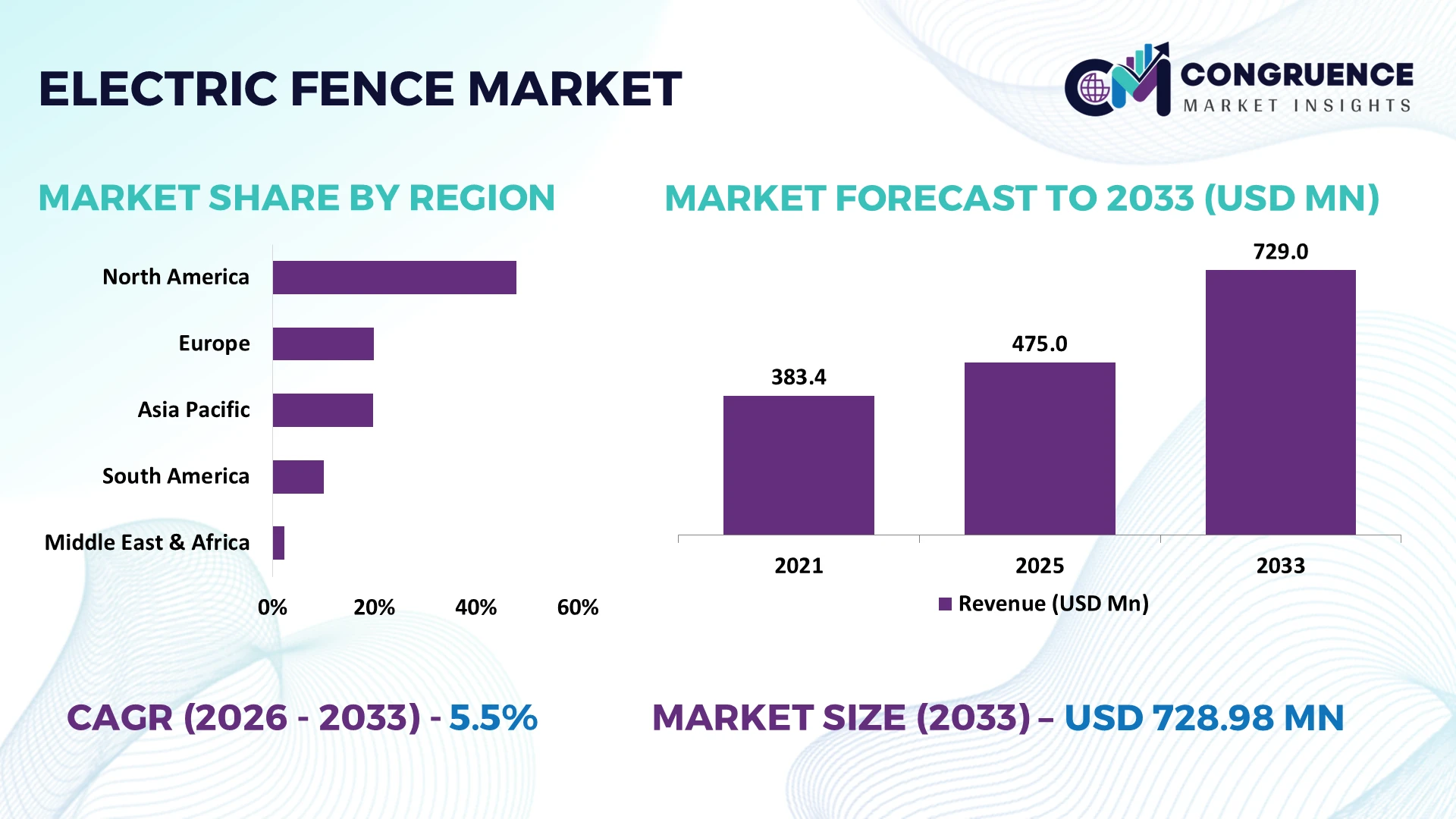
The United States remains a dominant country market, supported by commercial ranching, warehouse security, wildlife management, and border infrastructure, while India is emerging as a high-growth deployment base. North America held approximately 47.7% of the electric-fencing market in 2024, compared with substantially smaller individual country markets elsewhere. Solar-powered systems already represent about 28% of installations, strengthening off-grid deployment across farms and remote security sites.
Strategically, manufacturers should prioritize smart energizers, solar architectures, remote diagnostics, and localized distribution to capture the shift from conventional perimeter barriers toward connected, low-maintenance protection systems.
Market Size & Growth: USD 475.0 million in 2025 is projected to reach USD 729.0 million by 2033 at 5.5%, supported by solar energizers and smart perimeter monitoring.
Top Growth Drivers: Agriculture 48%, permanent fencing 75%, and solar-powered installations 28% define the strongest demand pillars.
Short-Term Forecast: By 2028, smart monitoring penetration is positioned to lift inspection efficiency by approximately 15% as remote diagnostics replace manual checks.
Emerging Technologies: IoT controllers, AI-assisted breach detection, mobile alerts, and solar-battery energizers are converting conventional fences into connected security assets.
Regional Leaders: North America is projected at roughly USD 330 million, Europe at USD 165 million, and Asia Pacific at USD 145 million by 2033, with solar and IoT adoption accelerating.
Consumer/End-User Trends: Agriculture represents about 48% of demand, led by livestock containment, crop protection, and wildlife exclusion across large farming operations.
Pilot/Case Example: In 2024, IoT-enabled fencing partnerships targeted real-time monitoring, supporting faster fault identification and reducing dependence on physical inspections.
Competitive Landscape: Gallagher, Tru-Test Group, and Woodstream collectively account for approximately 55%, followed by Electric Guard Dog and Premier1Supplies.
Regulatory & ESG Impact: Solar-powered energizers already represent about 28% of installations, reducing grid dependence and improving deployment feasibility for remote agricultural and conservation sites.
Investment & Funding: Global electric-fencing technology investment increased approximately 27% in 2023, with more than USD 480 million directed toward hardware upgrades and smart-security integration.
Innovation & Future Outlook: Next-generation systems are shifting toward remote diagnostics, low-impedance energizers, AI-supported intrusion detection, and integrated farm-security platforms, strengthening recurring service opportunities.
Electric Fence Market demand is increasingly concentrated in agriculture, livestock protection, wildlife management, and commercial perimeter security, with approximately 48% of global application demand linked to agriculture. Solar-powered systems are gaining operational relevance because remote farms and conservation sites often lack dependable grid access, while IoT-enabled controllers are improving fault visibility and maintenance planning. The market is consequently moving toward integrated fencing ecosystems rather than standalone wire-and-energizer installations.
Electric fencing is becoming strategically important because agricultural operators, logistics facilities, conservation projects, and security installations increasingly require perimeter systems that combine physical deterrence with continuous monitoring. Permanent fencing represents approximately 75% of the market, creating a substantial installed base for smart energizer upgrades, remote diagnostics, and replacement components.
Technology adoption is changing operating economics. Solar-powered systems account for roughly 28% of installations and eliminate dependence on fixed-grid infrastructure at remote sites, while IoT controllers provide real-time voltage and fault alerts instead of relying entirely on manual inspections. North America remains the largest established market, while Asia Pacific is developing a broader combination of agricultural, wildlife, and security deployments.
Over the next 2–3 years, suppliers are expected to increase investment in connected energizers, mobile monitoring, and hybrid solar-battery architectures. A practical deployment model is livestock fencing integrated with remote alerts, allowing operators to identify voltage loss without physically inspecting extensive perimeters. Companies are therefore expanding through technology partnerships, localized distribution, and integrated security offerings, making interoperability and service capability increasingly important competitive advantages.
Agricultural modernization and security infrastructure upgrades are shifting electric fencing from basic containment toward connected perimeter management. Agriculture represents approximately 48% of global demand, while permanent systems account for nearly 75%, creating a large installed base for digital upgrades. Solar-powered energizers already represent about 28% of installations, improving feasibility across remote farms and wildlife zones. In the United States, large ranches increasingly combine energizers with remote voltage monitoring, while India is expanding fencing around agricultural and infrastructure sites. Companies are responding with IoT controllers, mobile alerts, and low-impedance energizers. The non-obvious opportunity is the installed-base upgrade cycle: manufacturers can monetize existing fencing through connected components rather than relying solely on new perimeter construction.
Electric-fence deployment remains constrained by installation complexity, grounding requirements, terrain variability, and inconsistent power infrastructure. Approximately 53% of users report installation complexity, while 46% identify maintenance as a challenge and 41% experience power-supply disruptions. These constraints increase commissioning time and service costs, particularly across remote agricultural properties. In India and parts of Africa, grid limitations also make conventional AC energizers less practical. Suppliers are reducing exposure through solar-powered and battery-supported systems, modular components, installer partnerships, and localized service networks. The critical operational insight is that energizer reliability alone does not guarantee system performance; grounding, vegetation management, conductor continuity, and field maintenance determine the effective protection level.
Solar-powered and digitally monitored fencing creates an opportunity to address remote agriculture, wildlife conservation, and decentralized security applications. Solar systems already account for about 28% of installations, while smart monitoring adoption is approaching 54% in some market assessments. Wildlife-control applications are particularly attractive because real-time alerts can reduce response times when animals breach protected agricultural boundaries. India, Australia, and African agricultural markets offer substantial deployment potential where grid infrastructure is uneven. Companies are positioning through solar-battery energizers, mobile applications, cloud diagnostics, and technology partnerships. A non-obvious opportunity lies in recurring service models: monitoring subscriptions, predictive maintenance, and replacement analytics can generate revenue beyond the initial hardware sale.
Long-term competitiveness increasingly depends on integrating energizers, sensors, mobile platforms, batteries, and perimeter-security software without creating fragmented operating environments. Around 47% of emerging systems use IoT-enabled controls, while smart monitoring adoption is reported at approximately 54%, increasing the importance of interoperability and cybersecurity. Remote installations also face weather exposure, vegetation interference, battery degradation, and inconsistent cellular connectivity. These pressures can undermine monitoring continuity even when the physical fence remains operational. Companies must therefore invest in standardized communication protocols, ruggedized electronics, cybersecurity controls, and technician training. The strategic challenge is moving beyond device connectivity toward dependable end-to-end system availability, particularly for critical agricultural, infrastructure, and conservation deployments.
Smart Monitoring Moves Mainstream: IoT-enabled energizers, mobile alerts, and remote diagnostics are moving from premium installations into mainstream farm and security deployments, with smart-monitoring penetration approaching 54% in some assessments. Companies are integrating cloud dashboards and fault alerts to reduce manual inspections, while U.S. operators increasingly combine electric fencing with perimeter-intrusion detection systems.
Permanent Systems Gain Scale: Permanent fences represented about 60% of 2025 market demand in one current assessment, while other industry estimates place the share substantially higher for established agricultural installations. Higher-tensile conductors, multi-wire configurations, and automated voltage monitoring are improving reliability; suppliers are responding with pre-engineered grounding kits and longer-life components as installation labor becomes a larger procurement consideration.
Solar Deployment Expands Remotely: Solar-powered configurations are gaining traction across off-grid farms, wildlife reserves, and remote security sites, with solar systems accounting for roughly 28% of installations in one market assessment. Battery-supported energizers are reducing dependence on grid infrastructure, while manufacturers are expanding hybrid power portfolios and distributor networks in Australia, India, and African agricultural markets.
Flexible Fencing Gains Adoption: Portable systems accounted for about 40% of 2025 demand, reflecting rotational grazing, temporary containment, and seasonal land-use requirements. A 2025 university extension analysis cited by industry research found portable fencing offered lower switching costs and faster ROI than GPS-collar alternatives on 200–2,000-head grazing operations. Suppliers are consequently expanding lightweight reels, modular posts, and rapid-deployment kits.
Permanent Fence remains the leading type, accounting for approximately 60% of the 2025 market in a current industry assessment, compared with about 40% for Portable Fence. Its dominance reflects longer service life, lower recurring maintenance, stronger perimeter integrity, and suitability for large livestock holdings and fixed security boundaries. Permanent systems also integrate more readily with multi-zone energizers, monitoring devices, and intrusion-detection infrastructure.
Portable Fence is the faster-moving format within flexible agricultural operations because producers can rapidly reposition paddocks and containment areas without reconstructing infrastructure. Its approximately 40% share demonstrates that mobility is already commercially significant rather than niche. Companies are therefore balancing investment between high-durability permanent systems and lightweight portable kits, with product development increasingly focused on faster installation, lower switching costs, and solar-compatible energizers.
Agriculture is the leading application, representing approximately 50.2% of the 2025 market, substantially ahead of Wild Animals at 19.8%, Pets at 15.1%, Security at 10.0%, and Others at 5.0%. Agricultural demand is concentrated around livestock containment, rotational grazing, crop protection, and perimeter control, where long fence runs and recurring operational use favor reliable energizers and durable conductors.
Wild Animals is the most strategically important secondary application, with wildlife reserves and agricultural boundaries increasingly using electric fencing to manage human-animal conflict. Security applications remain smaller but operationally intensive because integration with perimeter-intrusion systems raises installation requirements. Companies are consequently tailoring products by application rather than using one standardized configuration, combining portable solutions for agriculture with monitored permanent systems for wildlife and security deployments.
For the end-user structure, Agriculture is the principal buyer group in the broader electric-fencing industry, followed by Commercial, Residential, Security & Defense, and Transportation users. Agriculture captures the strongest deployment intensity because livestock farms require extensive perimeter coverage, continuous containment, and replacement components. Commercial users—including warehouses, retail facilities, hospitality sites, and industrial properties—prioritize intrusion deterrence, while Residential demand centers on property boundaries and pet containment.
Security & Defense represents a smaller but higher-specification purchasing group, where reliability, zoning, alarm integration, and perimeter monitoring carry greater weight than initial equipment cost. Transportation applications across highways and railways add another specialized demand pool. Companies are therefore segmenting portfolios by operating environment, offering high-capacity agricultural systems alongside monitored security architectures and application-specific installation packages.
North America accounted for the largest market share at 47.9% in 2025 however, Asia Pacific is expected to register the fastest growth, expanding at a CAGR of 7.9% between 2026 and 2033.
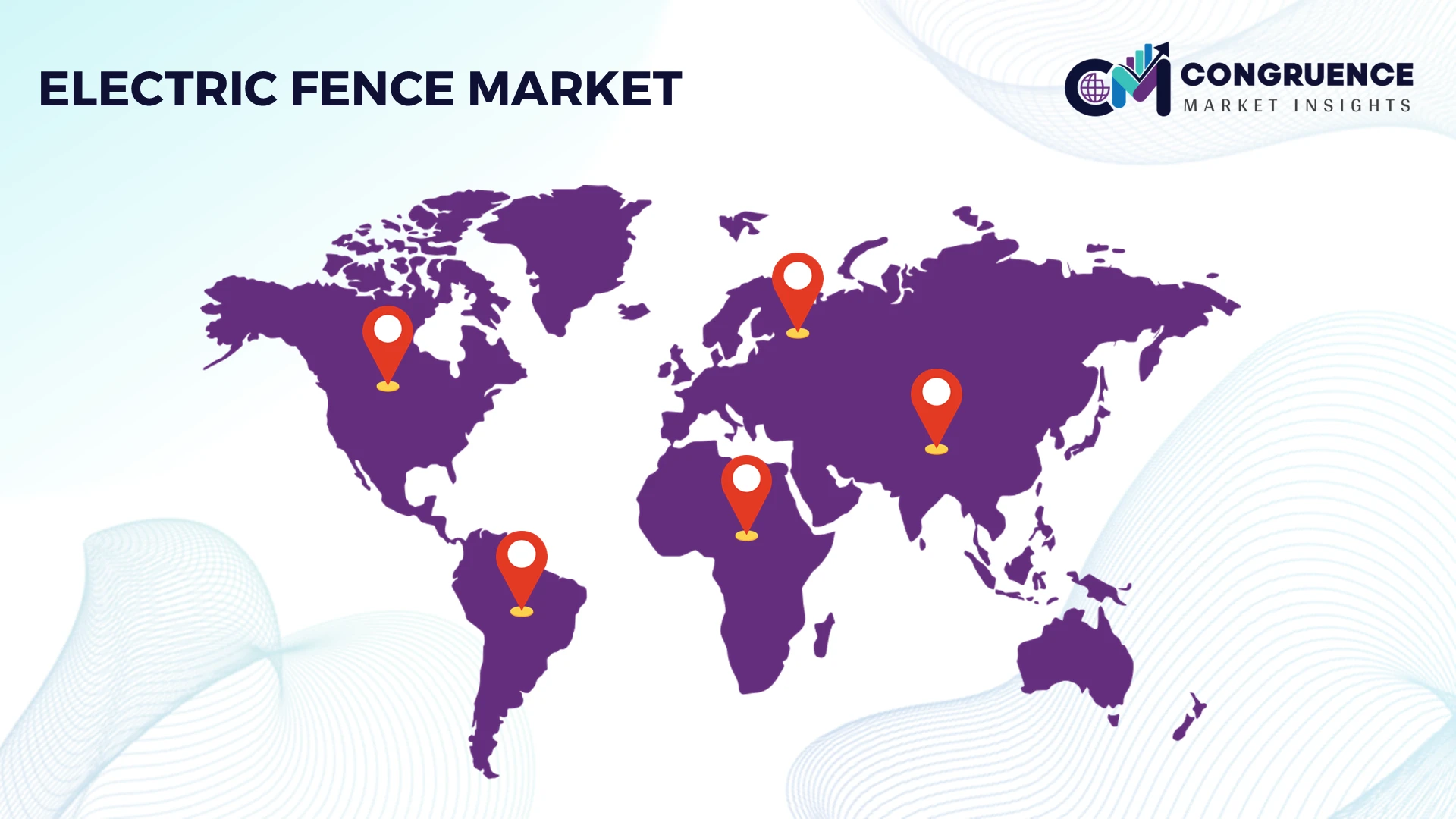
North America held approximately 47.9% of the global electric fence market in 2025, supported by extensive cattle ranching, commercial agriculture, wildlife management, and property-security applications. The United States represents the regional center of demand, with more than 94 million cattle creating sustained requirements for perimeter containment and rotational grazing infrastructure. Solar-powered energizers, remote voltage monitoring, and low-impedance systems are increasingly integrated into established fencing networks. The region also benefits from mature dealer networks and specialized installation services, allowing suppliers to shorten deployment cycles and strengthen aftermarket revenue. Companies are prioritizing smart energizers, replacement components, and farm-management integrations rather than relying exclusively on new fence installations.
United States Market Outlook: The United States remains the principal country market, supported by large-scale ranching, advanced agricultural infrastructure, and conservation-focused fencing programs. More than 94 million cattle underpin substantial recurring demand for permanent and portable systems. Suppliers are expanding dealer coverage and combining energizers with remote monitoring to improve maintenance visibility across large properties.
Europe represented approximately 19.9% of the global market in 2025, with demand concentrated across Germany, France, the United Kingdom, Ireland, and other livestock-producing markets. Mature agricultural infrastructure supports replacement demand, while animal-welfare requirements and environmental management practices are increasing attention to controlled fencing systems. Germany and France remain important markets for permanent installations around livestock operations, while wildlife-management projects are expanding specialized deployment. Solar-compatible energizers and durable polymer insulators are gaining relevance as operators seek lower-maintenance equipment. Companies are responding through certified components, installer partnerships, and systems designed for integration with modern farm-management workflows.
Germany Market Outlook: Germany provides a strong European base through intensive livestock production, established agricultural-equipment distribution, and stringent operating requirements. Demand increasingly favors reliable permanent fencing, high-quality energizers, and components capable of maintaining performance under variable weather conditions. Manufacturers are strengthening local partnerships and product compliance capabilities to secure replacement and modernization contracts.
Asia-Pacific accounted for approximately 19.8% of the global electric fence market in 2025 and represents the fastest-expanding major regional market. India, China, Australia, and New Zealand combine extensive agricultural land with rising livestock-management requirements and expanding perimeter-security applications. Australia and New Zealand have mature electric-fencing practices, while India and China are increasing adoption through agricultural modernization and infrastructure development. Solar-powered systems are particularly relevant where grid availability is inconsistent, while portable fencing supports rotational grazing and flexible farm layouts. Manufacturers are increasing local distribution, adapting energizer capacities to regional conditions, and developing lower-maintenance systems for large rural deployments.
India Market Outlook: India offers significant expansion potential because of its extensive agricultural base, livestock population, and growing use of perimeter protection around farms and infrastructure. Solar-powered energizers are particularly relevant for rural installations with inconsistent electricity access. Suppliers are strengthening regional distributor networks, simplifying installation requirements, and developing cost-efficient systems suited to smaller farms and larger commercial agricultural operations.
South America represented approximately 10.1% of the global electric fence market in 2025, with Brazil accounting for the largest share of regional demand. Extensive cattle ranching across Mato Grosso, Goiás, and other agricultural zones creates strong requirements for long-distance perimeter containment, rotational grazing, and livestock management. Brazil's large agricultural properties favor permanent systems, while portable fencing supports subdivision of grazing areas. However, remote terrain and uneven infrastructure increase the importance of solar-powered energizers and durable components. Suppliers are responding through regional distributors, livestock-equipment partnerships, and products designed for long fence runs. The strategic opportunity is concentrated in reducing installation and maintenance requirements across geographically dispersed ranching operations.
Brazil Market Outlook: Brazil is the region's most strategically significant market because of its extensive cattle industry and large agricultural properties. Cattle inventories exceeding 230 million head support sustained fencing requirements across major ranching states. Manufacturers are emphasizing high-capacity energizers, solar power systems, and durable conductors capable of supporting extensive perimeter networks with limited grid dependence.
Middle East & Africa accounted for approximately 2.3% of the global electric fence market in 2025, but demand is becoming more specialized across commercial agriculture, wildlife conservation, property protection, and critical infrastructure. South Africa provides an established agricultural and security market, while Kenya and other East African countries are increasing deployment around wildlife conservancies and agricultural boundaries. Solar-powered systems are particularly valuable where grid reliability remains uneven. Security applications also favor monitored permanent installations with stronger intrusion-detection integration. Companies are responding with solar-battery configurations, ruggedized energizers, regional installation partnerships, and distributor-led models that reduce service requirements across remote sites.
South Africa Market Outlook: South Africa represents the region's most established market, combining commercial agriculture, livestock production, wildlife management, and extensive perimeter-security requirements. The country's large rural properties favor durable permanent fencing and solar-compatible energizers. Suppliers are increasingly combining electric fencing with alarm and monitoring systems, strengthening demand for integrated solutions rather than standalone fencing hardware.
Gallagher and Tru-Test compete as global technology-led leaders, while Woodstream, Premier1Supplies, and Kencove contest North American farm and livestock accounts through distribution, affordability, and practical product breadth. The top five manufacturers control approximately 42.7% of global market revenue, leaving substantial room for regional specialists and niche suppliers. Competition is shifting from basic energizers toward connected, solar-enabled systems: about 62% of systems integrate solar power, 54% incorporate smart monitoring, and 47% use IoT-enabled controls. Gallagher and Tru-Test emphasize remote diagnostics; Woodstream competes through broad charger portfolios, while Premier1Supplies and Kencove differentiate through portable fencing, solar kits, and fast availability. Players are expanding dealer coverage, adding digital monitoring, and bundling energizers, conductors, testers, and accessories to increase customer retention. The main entry barrier is trusted field performance combined with technical support, distribution density, and capabilities. Winning now requires reliable hardware, connected functionality, cost-efficient deployment, and rapid regional service.
Gallagher
Tru-Test Group
Woodstream
Electric Guard Dog
Parker McCrory
Premier1Supplies
Kencove
PetSafe
Dare Products
Mpumalanga
High Tech Pet
Shenzhen Tongher Technology
Shenzhen Lanstar
Solar-powered energizers are moving from niche infrastructure to mainstream remote-farm equipment, with roughly 62% of systems incorporating solar power. Modern controllers reduce grid dependence and can cut energy consumption by up to 40% versus conventional powered installations. The immediate winners are agricultural and wildlife applications where grid access is unreliable.
Smart monitoring is the most consequential upgrade. About 54% of systems now incorporate monitoring capabilities, while IoT-enabled controls reach roughly 47%. Compared with traditional walk-the-fence inspection, connected nodes can reduce manual inspection requirements by about 90% in documented deployments and deliver voltage alerts continuously. Tru-Test’s network records up to 12,000 volts and supports multi-node coverage, turning fencing into a monitored asset.
The disruptive phase is integration: solar power, cloud diagnostics, mobile alerts, fault detection, and smart energizers increasingly operate as one system. Smart energizers already represent roughly 44% of installations, creating a performance gap between basic hardware and connected platforms. From 2026–2028, technology leaders can defend premium positioning through predictive maintenance, lower field labor, and faster fault response, while cost-focused suppliers must add modular connectivity without materially increasing installation complexity. Acting now matters because retrofit-ready monitoring can upgrade installed fences without replacing the entire perimeter or core hardware.
April 2025 — Gallagher Group acquired full ownership of Gallagher Europe, consolidating European operations under one shareholder. Gallagher Europe retained its name, team and processes, while its 130-plus employees and distribution network strengthened centralized control and regional execution. Source: gallagher.eu
August 2025 — Gallagher partnered with Mossy Oak Gamekeepers to launch a Food Plot Fencing Kit protecting up to one acre. The partnership expanded wildlife-management reach and created a targeted crop-protection offer for hunting customers in America. Source: am.gallagher.com
2025 — Tru-Test introduced Farm Network Fence Monitoring, using solar-powered nodes and cloud alerts for continuous fence-voltage monitoring. Each node measures up to 12,000 volts, while gateways support 50 pastures, shifting maintenance toward remote fault detection systems. Source: tru-test.com
2025 — Premier1Supplies updated its PRS Pro 100 solar energizer with a tan exterior designed to reduce vandal visibility. The unit delivers 1.0 released joule, uses a 15-watt monocrystalline panel and supports two miles of cattle fence. Source: premier1supplies.com
The Global Electric Fence Market Report covers permanent and portable fencing systems across agriculture, wild-animal control, pet containment, security, and other specialized applications. It evaluates end-user demand patterns, deployment configurations, energizers, conductors, monitoring equipment, solar power, IoT connectivity, remote diagnostics, and emerging smart-fence architectures across North America, Europe, Asia Pacific, South America, and the Middle East & Africa.
The report examines leading companies, regional supply structures, product positioning, adoption patterns, technology transitions, and niche opportunities including off-grid farms, wildlife corridors, rotational grazing, and remote perimeter protection. With smart monitoring integrated into approximately 54% of systems and solar power present in about 62%, the analysis helps investors prioritize technology-led opportunities, supports geographic expansion and channel strategy, benchmarks competitive positioning, and identifies practical deployment priorities shaping market direction between 2026 and 2033.
| Report Attribute / Metric | Details |
|---|---|
| Market Revenue (2025) | USD 475.0 Million |
| Market Revenue (2033) | USD 729.0 Million |
| CAGR (2026–2033) | 5.5% |
| Base Year | 2025 |
| Forecast Period | 2026–2033 |
| Historic Period | 2021–2025 |
| Segments Covered |
By Type
By Application
By End User
|
| Key Deliverables | Revenue Forecast; Market Trends; Growth Drivers & Restraints; Technology Insights; Segmentation Analysis; Regional Insights; Competitive Landscape; Regulatory & ESG Overview; Recent Developments |
| Regions Covered | North America; Europe; Asia Pacific; South America; Middle East & Africa |
| Companies Profiled | Gallagher; Tru-Test Group; Woodstream; Electric Guard Dog; Parker McCrory; Premier1Supplies; Kencove; PetSafe; Dare Products; Mpumalanga; High Tech Pet; Shenzhen Tongher Technology; Shenzhen Lanstar |
| Customization & Pricing | Available on Request (10% Customization Free) |




