
Reports
The Global Electric Drive Truck Market was valued at USD 1,408.2 Million in 2025 and is anticipated to reach a value of USD 6,095.5 Million by 2033 expanding at a CAGR of 20.1% between 2026 and 2033. Growth is being accelerated by falling battery costs, stricter heavy-duty emission standards, fleet electrification targets, and the expanding economics of zero-emission freight operations.
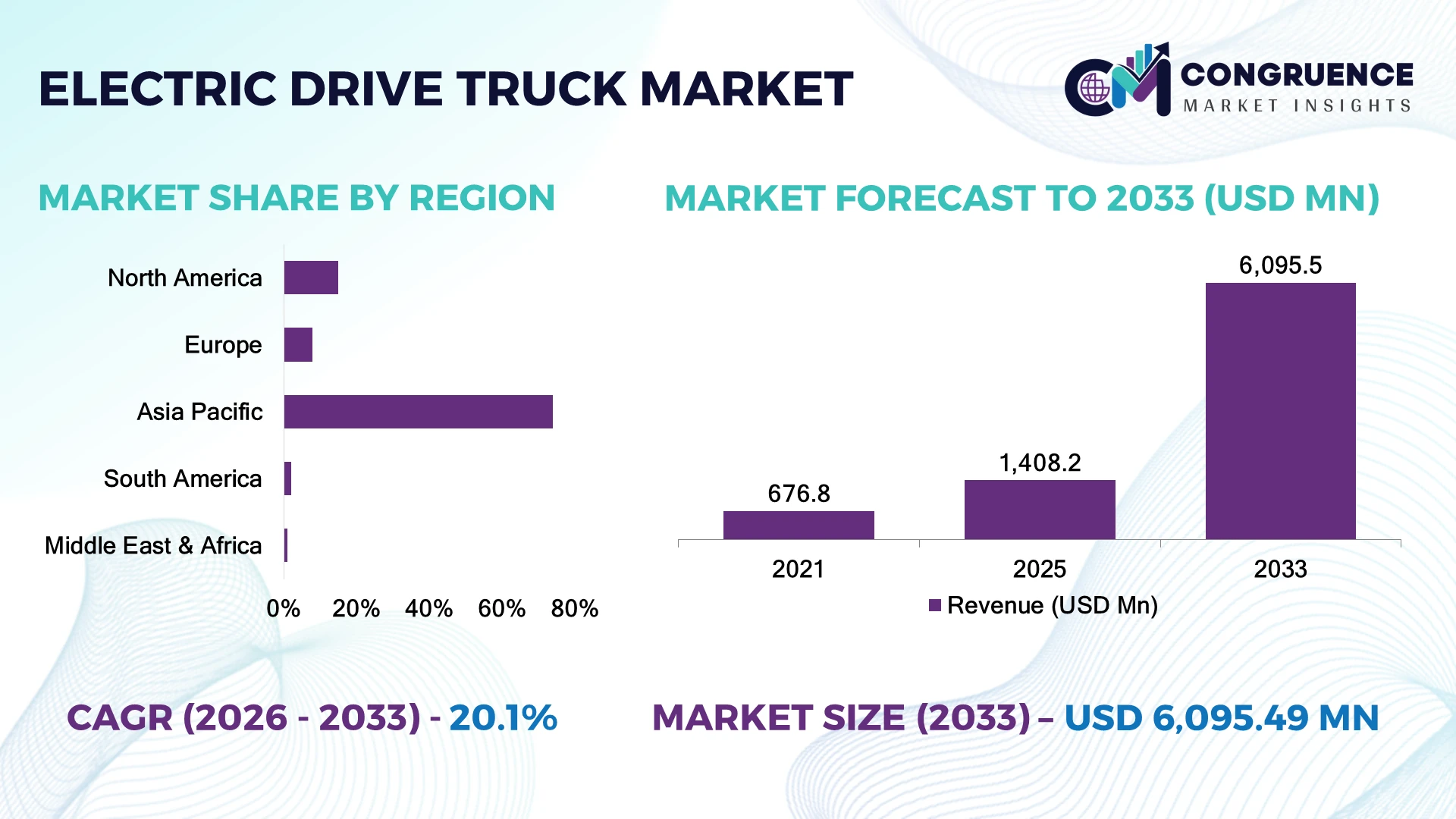
China dominates electric truck deployment, accounting for more than 90% of global electric truck sales in 2025, with electric trucks representing about 25% of new truck sales nationally. By comparison, adoption remains materially lower in Europe and the United States, where charging infrastructure and long-haul economics constrain fleet conversion. China’s integrated battery-to-chassis supply chain gives manufacturers a decisive cost and deployment advantage amid shifting global trade policies.
Strategic decisions increasingly depend on localized production, charging ecosystems, battery sourcing, and route-specific fleet economics rather than vehicle technology alone.
Market Size & Growth: USD 1,408.2 million in 2025 to USD 6,095.5 million by 2033 at 20.1% CAGR, driven by fleet electrification and battery-cost improvements.
Top Growth Drivers: 35% fleet electrification; 28% battery-cost improvement; 22% emissions-policy pressure.
Short-Term Forecast: By 2028, fleet charging utilization is targeted to rise 20–30%, improving vehicle availability.
Emerging Technologies: Battery swapping, megawatt charging, AI fleet routing and advanced thermal management are reshaping heavy-duty operations.
Regional Leaders: China leads with >90% global electric-truck sales; Europe accelerates depot charging; North America expands corridor-based deployments.
Consumer/End-User Trends: Fleet operators increasingly prioritize total-cost economics, with electric trucks reaching operational cost parity on selected Chinese routes.
Pilot/Case Example: 2025 Chinese fleet deployments pushed electric truck penetration above 20%, demonstrating rapid commercial-scale adoption.
Competitive Landscape: XCMG, SANY, FAW Jiefang, Shacman and Yutong are strengthening China’s integrated electric-truck ecosystem.
Regulatory & ESG Impact: EU heavy-duty CO₂ standards require 15% reduction from 2025 and 43% by 2030.
Investment & Funding: Charging-network and battery infrastructure investments are shifting toward high-utilization freight corridors and industrial depots.
Innovation & Future Outlook: Battery swapping, megawatt charging and AI-based energy management will increasingly determine fleet competitiveness through 2030.
The Electric Drive Truck Market is becoming concentrated around high-utilization freight applications where predictable routes allow charging assets to operate at higher utilization. In China, electric trucks already represent roughly one-quarter of new truck sales, while battery swapping is gaining relevance for mining, port, construction, and short-haul logistics fleets. In 2026, global manufacturers are increasingly pairing vehicle launches with charging partnerships, localized battery sourcing, and fleet-management software to overcome infrastructure constraints. The strategic transition is therefore shifting from simply replacing diesel powertrains toward redesigning freight operations around energy availability, route density, and asset utilization.
Electric drive trucks are becoming a strategic asset for freight operators because energy economics, emissions compliance, and vehicle utilization are converging. China illustrates the shift most clearly: electric truck sales more than doubled in 2025, while one in four newly sold trucks became electric. Europe is progressing through regulatory pressure, whereas North American adoption remains more concentrated around predictable regional-haul and depot-based operations.
Technology economics increasingly favor electric platforms on high-utilization routes. Battery-electric trucks can achieve lower operating costs than diesel alternatives where charging is scheduled around fleet cycles, while battery swapping can reduce refueling downtime substantially. Compared with conventional diesel fleets, regenerative braking and electric drivetrains also reduce mechanical energy losses and routine powertrain maintenance requirements.
Through 2026–2028, fleet operators are prioritizing depot charging, megawatt-class charging, battery swapping, telematics and AI route optimization. A practical example is China's mining and industrial logistics sector, where predictable routes make centralized energy infrastructure commercially viable. European operators are simultaneously adapting to tighter heavy-duty CO₂ requirements and charging-network constraints. Competitive advantage will increasingly come from combining electric trucks with optimized routes, energy contracts, charging infrastructure and digital fleet orchestration rather than treating vehicle procurement as a standalone decision.
China’s rapid commercial electrification is the strongest structural catalyst for electric drive trucks, with electric trucks accounting for roughly 25% of new truck sales in 2025 and electric heavy-truck sales more than doubling during the year. Tighter European heavy-duty CO₂ requirements are simultaneously pushing fleet operators toward zero-emission platforms, while depot-based logistics offers predictable charging cycles. Battery-electric drivetrains can reduce energy and maintenance expenditure by approximately 20–30% on high-utilization routes versus diesel configurations. Manufacturers are responding by expanding electric portfolios, integrating battery systems, and partnering with charging providers. The non-obvious advantage is route predictability: fleets with fixed daily cycles can achieve substantially higher charger utilization, improving the economics of both vehicles and infrastructure.
Charging infrastructure remains the principal structural constraint, particularly for long-haul fleets requiring high-power charging. Public heavy-duty charging coverage remains materially below passenger-vehicle infrastructure, while battery materials can represent more than 30% of vehicle manufacturing cost. Battery-electric trucks also typically carry higher upfront capital requirements than comparable diesel models, creating financing pressure for smaller operators. In North America, fragmented charging standards and utility interconnection timelines can delay fleet deployment, while European operators face uneven corridor readiness. Supply-chain exposure to lithium, nickel, graphite, and battery cells adds cost volatility. Manufacturers are mitigating these pressures through localized battery sourcing, long-term material contracts, modular battery architectures, and partnerships with utilities and charging-network operators.
Battery swapping creates a distinct opportunity in mining, ports, construction, and regional freight, where predictable routes can support centralized energy infrastructure. Swapping can reduce energy replenishment downtime by more than 70% compared with conventional charging cycles, while AI-based route optimization can lower energy consumption by approximately 8–15%. China is already demonstrating commercial viability through high-utilization industrial fleets, creating a model for emerging markets with concentrated logistics corridors. Megawatt charging, vehicle-to-grid integration, and battery-health analytics represent additional value pools as fleet electrification scales. Companies are investing in proprietary battery platforms, charging alliances, and fleet-management software rather than competing solely on vehicle hardware. The strongest opportunity lies in selling an integrated energy-and-mobility solution that increases asset utilization.
Large-scale deployment requires coordination across vehicles, chargers, utilities, software, maintenance teams, and electricity contracts, making fleet integration significantly more complex than diesel replacement. Approximately 15–25% of fleet operating workflows can require redesign when charging schedules, route planning, and energy management are integrated into dispatch systems. Skilled technicians remain another constraint as high-voltage maintenance capabilities lag conventional powertrain expertise. Cybersecurity exposure also increases as connected trucks exchange operational data with charging infrastructure and cloud platforms. In the United States and Europe, grid connection and permitting requirements can extend infrastructure deployment timelines, reducing fleet rollout consistency. Manufacturers and fleet operators must therefore invest in technician training, interoperable software, cybersecurity controls, and utility partnerships to achieve reliable multi-site deployment.
Battery Swapping Gains Ground: China’s mining and logistics fleets are accelerating battery-swapping deployment because energy replenishment can be completed in a fraction of conventional charging time, with downtime reductions exceeding 70% in suitable operations. Manufacturers are standardizing removable battery architectures and partnering with energy operators, shifting competition toward infrastructure interoperability and fleet availability.
Megawatt Charging Reshapes Freight: High-power charging is moving from demonstration projects toward commercial fleet planning, with megawatt-class systems targeting substantially shorter charging windows for heavy-duty vehicles. Depot operators are increasingly designing electrical capacity around 1–2 MW charging loads, while European regulatory pressure is accelerating corridor planning. Truck makers are coordinating with utilities to reduce grid-connection bottlenecks.
AI Optimizes Fleet Energy: Fleet-management platforms increasingly combine telematics, traffic conditions, payload data, weather, and battery state to optimize routes and charging. AI-based energy optimization can reduce consumption by approximately 8–15% on suitable duty cycles. Operators are integrating predictive maintenance and charging automation to improve vehicle availability, while software increasingly becomes a differentiator alongside battery capacity.
Localized Supply Chains Expand: Battery and power-electronics sourcing is becoming more geographically diversified as manufacturers respond to trade-policy changes and mineral-processing concentration. Localization initiatives can reduce component lead times by approximately 10–20% while improving production planning. North American and European manufacturers are expanding regional battery partnerships, whereas Chinese producers retain strong vertical integration from cells through electric drivetrains.
Battery-electric trucks represent the dominant type, accounting for approximately 97% of global electric truck sales in 2025. Their advantage comes from mature battery supply chains, lower drivetrain complexity, and stronger cost economics on predictable routes. Electric heavy freight trucks reached a 9% sales share globally, while medium freight trucks also reached 9%, confirming that electrification is moving beyond light commercial applications. Fuel-cell electric trucks remain strategically relevant for long-haul and high-payload duty cycles, but their commercial base remains considerably smaller. Plug-in hybrid configurations retain a transitional role where charging availability is inconsistent.
Battery-electric remains the fastest-scaling segment, with heavy freight sales nearly tripling year-on-year in 2025. Battery-swapping configurations represented approximately 15% of China’s electric truck sales, highlighting a distinct adoption pathway for ports, mining and industrial corridors. Manufacturers are increasing investment in LFP batteries, modular packs, swapping compatibility and high-power charging, while fuel-cell developers are targeting applications where range and refueling speed outweigh infrastructure simplicity.
The International Energy Agency reported that global electric truck sales exceeded 400,000 units in 2025, with battery-electric models accounting for 97% of sales.
Port logistics, mining, steel production and other short, predictable industrial routes represent the leading application cluster, accounting for an estimated 45% of electric truck deployments. High route repeatability allows operators to centralize charging or battery swapping and maintain high asset utilization. Urban and regional distribution follows, supported by fixed depot cycles and increasingly stringent emissions controls, while long-haul freight remains comparatively constrained by charging duration, payload sensitivity and corridor infrastructure.
Mining and port applications are emerging as the fastest-growing use cases, with adoption concentrated around industrial hubs where vehicles can operate continuously between fixed points. Battery swapping is particularly relevant because it separates vehicle utilization from charging duration. Urban logistics fleets are increasingly integrating telematics and automated charging schedules, while long-haul operators are prioritizing higher-energy-density batteries and megawatt charging. Companies are therefore shifting investment toward application-specific vehicle configurations rather than standardized electric platforms.
In 2025, the International Energy Agency found that many Chinese electric trucks were concentrated on predictable routes around ports, mining areas, steel production sites and industrial hubs, reinforcing the commercial advantage of route-specific electrification.
Commercial fleet operators represent the dominant end-user group, capturing approximately 60% of electric drive truck deployments because centralized procurement, high annual mileage and controlled routes create stronger total-cost economics. Logistics companies, industrial fleets and municipal operators increasingly evaluate vehicles alongside charging infrastructure, electricity contracts and fleet-management software. Smaller owner-operators remain more price-sensitive, making upfront vehicle cost and financing conditions more important than lifecycle efficiency.
Mining and construction companies form the fastest-growing specialized buyer group, where fixed routes, high utilization and centralized depots support rapid electrification. Their purchasing behavior differs from logistics fleets because uptime and payload availability carry greater weight than maximum driving range. Approximately 70% of purchasing decisions in high-utilization fleets increasingly incorporate charging availability and energy-management requirements alongside vehicle specifications. Manufacturers are responding with customized battery capacities, swapping-enabled platforms, service agreements and bundled charging partnerships, positioning ecosystem integration as a stronger differentiator than vehicle price alone.
The International Energy Agency reported that electric heavy-freight truck sales in China reached 28% of total heavy-freight truck sales in 2025, demonstrating how high-utilization commercial applications are becoming the principal electrification pathway.
Asia-Pacific accounted for the largest market share at 74% in 2025 however, North America is expected to register the fastest growth, expanding at a CAGR of 22.4% between 2026 and 2033.
Depot Electrification Shifts Toward High-Utilization Freight
North America is transitioning from pilot-scale electric truck deployments toward commercially structured fleet programs, with California remaining the principal deployment hub for zero-emission medium- and heavy-duty vehicles. The United States produced approximately 12,000 electric trucks in 2025, with medium-duty models representing most domestic production and nearly all exports. Fleet adoption remains concentrated around urban delivery, ports, municipal operations, and regional-haul routes where depot charging supports predictable duty cycles. Utility interconnection, charger availability, and battery sourcing are becoming decisive procurement criteria. Manufacturers are therefore combining vehicle sales with charging partnerships, energy-management software, and regional service networks. The competitive priority is shifting from vehicle range alone toward total fleet uptime, charging utilization, and localized after-sales support.
United States Market Outlook: The United States remains North America's principal technology and manufacturing base for electric drive trucks, supported by established commercial-vehicle production, major logistics corridors, and growing zero-emission fleet programs. California accounted for 60.5% of U.S. zero-emission medium-duty truck registrations in 2025, demonstrating strong geographic concentration. Domestic manufacturers are increasingly integrating battery-electric platforms with depot charging and fleet telematics, while localized component sourcing strengthens supply resilience. The country's strategic advantage lies in combining large freight volumes with sophisticated fleet-management infrastructure, creating commercially attractive conditions for regional-haul electrification.
Regulation Accelerates Commercial Fleet Conversion
Europe is moving from demonstration fleets toward regulatory-driven commercial deployment, with electric trucks reaching approximately 5.6% of new truck registrations after the first 2025 heavy-duty CO₂ target took effect. Germany, France, Sweden, and the Netherlands form the principal deployment markets, supported by mature logistics infrastructure and manufacturer-led fleet programs. The European Union now has more than 1,000 charging points specifically serving electric trucks, strengthening the foundation for regional-haul operations. Manufacturers are prioritizing battery-electric platforms, megawatt charging compatibility, and integrated service packages. The strategic challenge is maintaining cost competitiveness while meeting increasingly stringent emissions requirements and reducing dependence on non-European battery supply chains.
Germany Market Outlook: Germany is Europe's most strategically significant market because of its manufacturing concentration, dense freight corridors, and presence of major commercial-vehicle producers. The country's industrial base supports rapid integration of electric powertrains into established truck manufacturing and fleet-service networks. German operators increasingly prioritize depot-based charging for regional distribution, while long-distance fleets require higher-power corridor infrastructure. Approximately 70% of electric trucks sold in the European Union in 2025 used battery cells produced by manufacturers headquartered in China, Japan, or South Korea, making battery localization and supplier diversification important strategic priorities for German manufacturers.
China Establishes the Global Scale Advantage
Asia-Pacific dominates electric drive truck deployment, with China generating the overwhelming majority of regional sales and establishing the world's most integrated electric-truck ecosystem. Global electric truck sales exceeded 400,000 units in 2025, while one in four trucks sold in China was electric. Chinese deployments are concentrated in ports, mining, steel production, construction, and short-haul logistics, where predictable routes maximize battery utilization. CATL supplied approximately 80% of China's electric truck batteries, reinforcing strong domestic supply-chain integration. Manufacturers are scaling battery-swapping systems, high-power charging, and application-specific chassis designs, making China the principal benchmark for commercial electric-truck economics and deployment speed.
China Market Outlook: China represents the strongest national market because electric trucks have moved beyond pilot programs into high-volume commercial deployment. Electric heavy-freight truck sales reached approximately 230,000 units in 2025, nearly tripling from 2024, while heavy-freight electrification reached about 9% globally and substantially higher levels in selected Chinese applications. Mining, steel, ports, and construction fleets are driving adoption because centralized routes reduce charging uncertainty. Chinese manufacturers also benefit from vertically integrated battery, chassis, electronics, and vehicle-production ecosystems, enabling faster product iteration and more competitive fleet pricing.
Industrial Corridors Create Targeted Electrification
South America remains an emerging electric drive truck market, with Brazil providing the strongest commercial foundation through its automotive manufacturing base, logistics network, and expanding local EV production. Adoption is concentrated in urban delivery, municipal fleets, ports, and controlled industrial routes rather than long-haul freight. Brazil's established ethanol and automotive ecosystem creates a distinctive competitive environment in which battery-electric trucks compete with alternative low-carbon powertrains. Local manufacturing is becoming strategically important as global manufacturers seek shorter supply chains and lower import exposure. Companies are prioritizing fleet partnerships and localized assembly rather than broad nationwide deployment, allowing infrastructure investment to follow commercially viable routes.
Brazil Market Outlook: Brazil offers the strongest South American platform because of its large commercial-vehicle market, established automotive manufacturing infrastructure, and rapidly expanding EV industrial base. New local production capacity is strengthening supplier localization and reducing dependence on imported vehicles. Brazil's major logistics corridors around São Paulo, Minas Gerais, and southern industrial centers provide concentrated opportunities for depot-based electric trucking. The country's developing charging ecosystem is better suited initially to urban and regional-haul fleets than long-distance operations. Manufacturers are therefore targeting delivery fleets, municipal applications, and industrial logistics where predictable routes can support higher charger utilization.
Infrastructure-Led Fleets Drive Selective Deployment
The Middle East & Africa market is developing through infrastructure modernization, logistics-zone investment, mining operations, and government-backed sustainability programs. Adoption remains concentrated in the United Arab Emirates, Saudi Arabia, and selected African industrial corridors, where controlled freight routes simplify charging deployment. Dubai and Abu Dhabi are prioritizing cleaner commercial mobility alongside broader smart-infrastructure programs, while mining economies create opportunities for high-utilization electric haulage. Battery-electric trucks remain better suited to short and medium-distance applications because charging infrastructure outside major industrial hubs is limited. Manufacturers are responding through fleet pilots, charging partnerships, and application-specific vehicle packages. Strategic deployment is increasingly tied to industrial zones rather than nationwide infrastructure coverage.
United Arab Emirates Market Outlook: The United Arab Emirates is the region's strongest launch market because its logistics infrastructure, port activity, planned urban development, and high concentration of commercial fleets support controlled electrification. Dubai's freight ecosystem provides suitable conditions for depot-based electric trucks serving distribution centers, ports, and urban delivery routes. The country's high-power grid infrastructure and investment capacity also support rapid charger installation compared with less-developed African markets. Fleet operators are increasingly evaluating electric trucks alongside charging-as-a-service and energy-management models, creating opportunities for manufacturers that can provide complete vehicle-and-infrastructure packages rather than standalone trucks.
China-based OEMs such as BYD, SANY, XCMG, FAW Jiefang and Yutong compete directly with European leaders including Volvo and Daimler, while battery specialists such as CATL compete indirectly through powertrain and swapping ecosystems. The top five manufacturers control an estimated 55–65% of global electric heavy-truck sales, with competition concentrated in China. Price remains decisive, with Chinese platforms often achieving 10–20% lower acquisition costs, while battery efficiency and charging performance create 8–15% operating advantages on suitable routes. European players differentiate through safety, range, service coverage and fleet integration. Competition is shifting toward vertical battery integration, localized production, charging partnerships and battery swapping. SANY is expanding overseas, Daimler is integrating electric trucks into conventional assembly, and CATL is standardizing swap systems. Entry barriers remain high because certification, service networks, battery sourcing and charging infrastructure require substantial capital. Winning requires cost-efficient vehicles, reliable energy ecosystems, localized support and application-specific engineering across target markets.
BYD
SANY Heavy Industry
XCMG
FAW Jiefang
Yutong Group
Volvo Trucks
Daimler Truck
Scania
PACCAR
Tesla
Tata Motors
Ashok Leyland
Nikola Corporation
Battery-electric powertrains are the dominant technology, representing 97% of global electric truck sales in 2025. LFP batteries, silicon-enhanced cells, regenerative braking and integrated e-axles are improving energy and durability, while thermal management supports faster charging. Compared with diesel drivetrains, optimized electric propulsion can reduce energy consumption by 15–30% on suitable routes. Fleet operators benefit most where routes are predictable and annual mileage is high.
Battery swapping is becoming the most disruptive infrastructure technology for high-utilization fleets. CATL’s standardized swap architecture targets coverage of 80% of China’s trunk-transport capacity by 2030, while swapping can cut replenishment downtime by more than 70% versus conventional charging. Megawatt Charging System technology is moving toward long-haul deployment, with charging power above 1 MW reducing charging windows. Chinese OEMs benefit from vertically integrated batteries, while European manufacturers gain through safety, service and vehicle-platform integration.
During 2026–2028, AI energy management, digital twins and predictive battery diagnostics will connect vehicles with chargers, utilities and fleet software. Optimized charging schedules can reduce infrastructure costs by roughly 5–10% and peak-power requirements by around 20%. Companies investing now in interoperable charging, battery analytics and software-defined fleet control will secure asset utilization, faster deployment and stronger lifecycle economics as electric freight scales.
April 2025 Volvo Trucks surpassed 5,000 battery-electric trucks delivered across 50 countries, with vehicles covering nearly 170 million commercial kilometers. The milestone strengthened Volvo’s global fleet positioning, validated multi-market deployment, and supported broader electric truck portfolio expansion. Source: Volvo Trucks
May 2025 CATL launched its 75# standardized heavy-duty battery-swap block and targeted a network covering 80% of China’s trunk-transport capacity by 2030. The initiative strengthens swapping interoperability, standardization, infrastructure utilization, and accelerates infrastructure-led fleet electrification across freight corridors. Source: CATL
December 2025 Mercedes-Benz Trucks began series production of the second-generation eActros 400 at Wörth, expanding battery-electric configurations while integrating electric assembly into regular production. Daimler reported nearly 50% European heavy-duty electric-truck share in Q3, reinforcing manufacturing leadership. Source: Daimler Truck
August 2025 GreenLine announced a $45.7 million investment to expand electric trucking for Hindustan Zinc, including commercial-scale battery swapping. The program targets mine-to-smelter logistics and strengthens India’s heavy-duty electrification ecosystem through localized fleet deployment and charging infrastructure development.
The Electric Drive Truck Market Report covers the competitive evolution of battery-electric, hybrid-electric and fuel-cell electric truck platforms across medium-duty, heavy-duty and specialized vehicle configurations. Analysis evaluates applications including urban distribution, regional freight, long-haul logistics, mining, construction, ports and municipal operations, with emphasis on route characteristics, charging requirements, payload economics and fleet utilization.
The report provides regional assessment across North America, Europe, Asia-Pacific, South America, and the Middle East & Africa, including country-level deployment patterns and infrastructure readiness. Technology coverage includes LFP and advanced battery systems, e-axles, regenerative braking, battery swapping, megawatt charging, AI fleet optimization and predictive battery analytics. Competitive analysis of 13 major participants supports investment planning, localization decisions, charging-network strategy, partnerships, fleet expansion and technology positioning through 2026–2033.
| Report Attribute/Metric | Report Details |
|---|---|
|
Market Revenue in 2025 |
USD 1,408.2 Million |
|
Market Revenue in 2033 |
USD 6,095.5 Million |
|
CAGR (2026 - 2033) |
20.1% |
|
Base Year |
2025 |
|
Forecast Period |
2026 - 2033 |
|
Historic Period |
2021 - 2025 |
|
Segments Covered |
By Type
By Application
By End-User
|
|
Key Report Deliverable |
Revenue Forecast, Growth Trends, Market Dynamics, Segmental Overview, Regional and Country-wise Analysis, Competition Landscape |
|
Region Covered |
North America, Europe, Asia-Pacific, South America, Middle East, Africa |
|
Key Players Analyzed |
BYD, SANY Heavy Industry, XCMG, FAW Jiefang, Yutong Group, Volvo Trucks, Daimler Truck, Scania, PACCAR, Tesla, Tata Motors, Ashok Leyland, Nikola Corporation |
|
Customization & Pricing |
Available on Request (10% Customization is Free) |




