
Reports
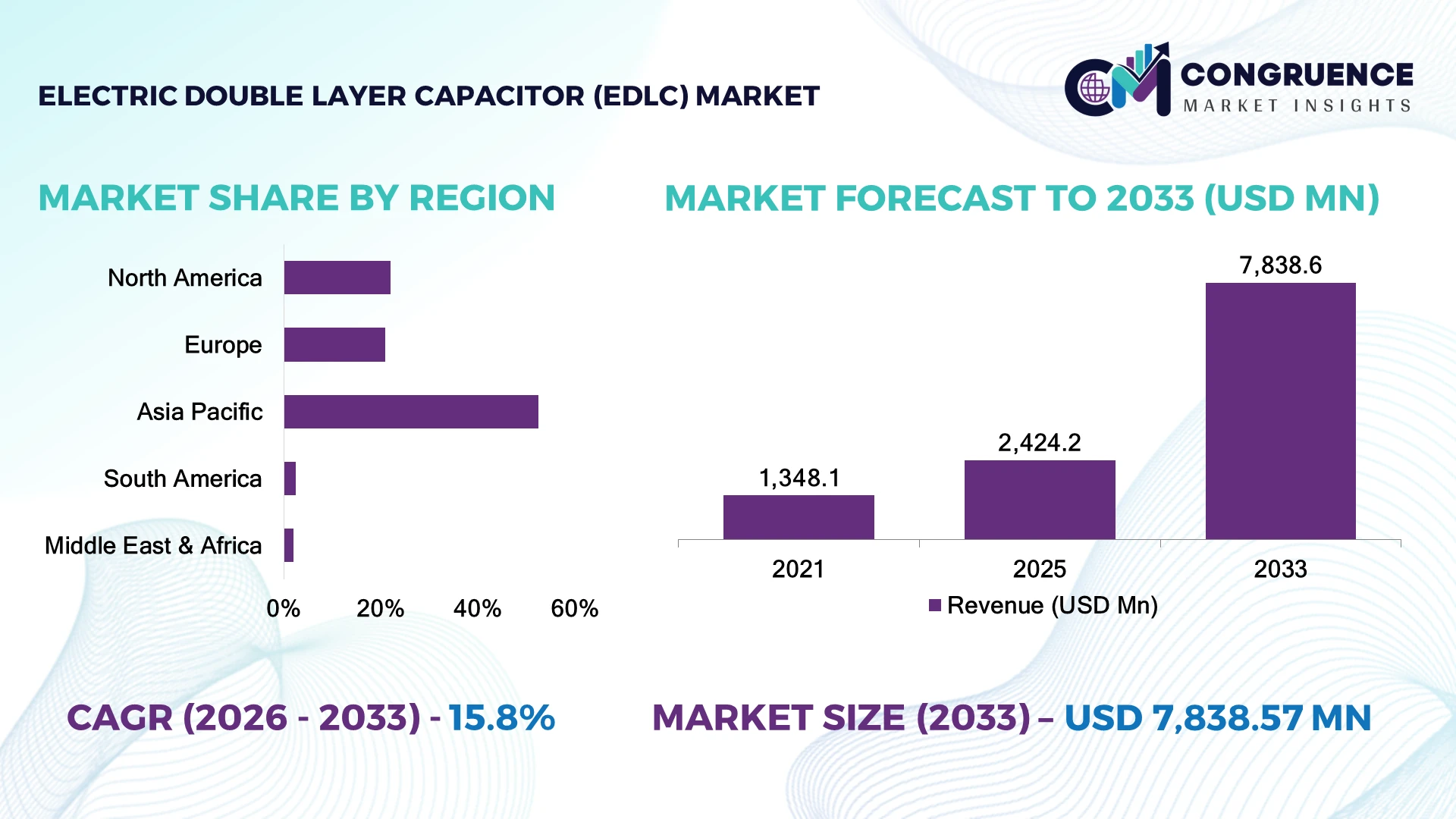
The Global Electric Double Layer Capacitor (EDLC) Market was valued at USD 2,424.2 Million in 2025 and is anticipated to reach a value of USD 7,838.6 Million by 2033 expanding at a CAGR of 15.8% between 2026 and 2033. Growth is driven by rapid electrification of transportation, renewable energy storage integration, regenerative braking systems, and high-power industrial electronics requiring ultra-fast charge and discharge capabilities.
China accounts for approximately 43% of global EDLC manufacturing capacity, supported by large-scale electric vehicle production, renewable energy investments, and advanced electronics manufacturing. Production capacity is nearly 3.1 times higher than South Korea, while automated electrode manufacturing improves production efficiency by approximately 26%. Ongoing supply-chain diversification and strategic energy storage investments following global critical mineral realignments in 2026 continue accelerating deployment of high-performance capacitor technologies across transportation and industrial applications.
Manufacturers investing in advanced carbon materials, automated production, and localized supply chains will strengthen competitive positioning across high-growth energy storage and power electronics markets.
Market Size & Growth: USD 2,424.2 million in 2025 reaching USD 7,838.6 million by 2033 at 15.8% CAGR, driven by vehicle electrification and renewable energy storage.
Top Growth Drivers: Electric vehicles (+29%), industrial automation (+23%), renewable energy integration (+21%).
Short-Term Forecast: By 2028, power density improves 18% while manufacturing cost declines 15%.
Emerging Technologies: Graphene electrodes, AI-assisted manufacturing, and hybrid supercapacitor architectures accelerate performance.
Regional Leaders: Asia-Pacific (~USD 4.2 billion), Europe (~USD 1.6 billion), North America (~USD 1.3 billion), supported by electrification initiatives.
Consumer/End-User Trends: Nearly 64% of new industrial energy storage projects integrate fast-response capacitor technologies.
Pilot/Case Example: A 2026 smart rail deployment reduced regenerative energy losses by approximately 22%.
Competitive Landscape: Top five manufacturers control nearly 58% market share through material innovation and manufacturing scale.
Regulatory & ESG Impact: Energy-efficient power systems reduce peak energy losses by approximately 17%.
Investment & Funding: More than USD 3.8 billion supports advanced materials, production expansion, and strategic partnerships.
Innovation & Future Outlook: Solid-state integration, intelligent energy management, and high-density carbon materials redefine market leadership.
The Electric Double Layer Capacitor (EDLC) market is advancing through next-generation carbon electrode materials, intelligent power management systems, and hybrid energy storage architectures supporting transportation, industrial automation, and renewable energy applications. Approximately 46% of newly designed high-power systems now integrate EDLC modules for rapid power delivery, while supply-chain localization initiatives continue strengthening manufacturing resilience, creating the foundation for broader strategic adoption.
Electric Double Layer Capacitors have become strategically important as industries prioritize rapid energy delivery, longer operating life, and resilient power management across electrified transportation, industrial automation, and renewable energy infrastructure. Supply-chain restructuring and expanding grid modernization programs are encouraging manufacturers to strengthen regional production capabilities while reducing dependence on single-source material suppliers. Fast-response energy storage is increasingly viewed as a competitive differentiator rather than a supporting component.
Modern EDLC systems deliver charging cycles approximately 35% faster than conventional rechargeable battery technologies for high-power burst applications while extending operational lifecycle by nearly 30% under repetitive charge-discharge conditions. China leads high-volume manufacturing and production scale, whereas Japan maintains leadership in premium materials engineering and capacitor reliability for automotive and industrial applications. Over the next two to three years, more than half of newly developed industrial power management systems are expected to incorporate hybrid capacitor architectures alongside battery technologies.
Manufacturers are expanding electrode material production, strengthening partnerships with automotive OEMs, and investing in automated fabrication technologies to improve energy density and manufacturing efficiency. Deployment across regenerative braking systems, smart grids, and backup power applications continues accelerating. Organizations combining advanced material science, localized manufacturing, and intelligent power management integration will establish durable competitive advantages as high-performance energy storage becomes central to electrification strategies.
Electric vehicle manufacturers, rail operators, and industrial equipment suppliers are expanding EDLC deployment to support rapid charge-discharge cycles, regenerative braking, and voltage stabilization. Approximately 67% of newly developed hybrid energy storage architectures now integrate EDLC modules, while regenerative braking systems improve energy recovery efficiency by nearly 24% and reduce peak battery loading by approximately 19%. China's continued investment in electric mobility and grid modernization is accelerating demand for advanced capacitor technologies capable of handling high-frequency power fluctuations. This transition is driving manufacturers to expand electrode production, strengthen partnerships with automotive OEMs, and invest in automated manufacturing. Competitive leadership increasingly depends on delivering high-power energy storage with longer operational lifecycles and lower maintenance requirements.
EDLC manufacturers continue facing structural challenges associated with the cost and availability of activated carbon, graphene derivatives, specialty electrolytes, and aluminum foils. Nearly 41% of total production costs are linked to electrode materials, while premium conductive carbon prices remain approximately 18% above pre-disruption levels due to evolving global critical mineral supply dynamics. South Korea's advanced materials sector continues addressing procurement risks through localized processing and long-term sourcing agreements. Rising material costs affect pricing competitiveness, compress manufacturing margins, and slow adoption in cost-sensitive industrial applications. Companies are mitigating these pressures through supplier diversification, recycling initiatives, alternative carbon formulations, and greater vertical integration across electrode manufacturing.
The convergence of EDLC technology with lithium-ion batteries, solid-state energy storage, and AI-driven power management platforms is creating high-value commercial opportunities. Approximately 48% of next-generation industrial energy storage projects now evaluate hybrid capacitor architectures, while intelligent energy management improves power utilization efficiency by nearly 22%. Japan is advancing high-performance carbon materials and hybrid storage systems for automotive and smart infrastructure applications. Manufacturers are increasing investment in graphene research, expanding strategic partnerships with battery developers, and commercializing integrated energy storage platforms. A key strategic opportunity lies in supplying compact hybrid systems that reduce battery degradation while extending equipment reliability across demanding industrial and transportation environments.
Integrating EDLC modules into increasingly complex electric vehicle platforms, renewable energy systems, and industrial automation equipment remains a significant long-term execution challenge. Approximately 33% of system developers continue encountering compatibility issues between capacitor management systems and existing battery control architectures, while integration engineering extends development cycles by nearly 17%. Germany's rapid expansion of electrified industrial machinery has intensified demand for standardized power management interfaces and thermal optimization solutions. Inconsistent integration affects system efficiency, scalability, and lifecycle performance. Manufacturers must invest in interoperable control software, standardized module designs, and collaborative engineering partnerships to ensure seamless deployment across diverse high-power applications.
Graphene Electrode Commercialization Accelerates: Advanced graphene-enhanced electrodes are improving power density by approximately 23% while reducing internal resistance by nearly 16%. Industrial electrification and performance requirements are encouraging manufacturers to scale advanced material production, expand material partnerships, and automate electrode fabrication for higher manufacturing consistency.
Hybrid Storage Systems Expand: Industrial and transportation projects increasingly combine EDLC modules with lithium-ion batteries, increasing hybrid deployment by approximately 31% and extending battery service life by nearly 20%. Grid modernization and electric mobility programs are prompting energy storage suppliers to develop integrated platforms optimized for fast-response power delivery.
Automated Production Gains Momentum: Smart manufacturing technologies have improved electrode coating precision by approximately 19% while reducing material waste by nearly 14%. Labor availability challenges and quality consistency requirements are driving companies to deploy AI-assisted production monitoring, robotic assembly, and digital process control across capacitor manufacturing facilities.
Compact Module Design Advances: Equipment manufacturers are introducing higher-capacitance modules with approximately 18% lower installation volume and nearly 15% greater packaging efficiency for industrial automation and electric mobility applications. This design evolution enables easier integration into space-constrained systems, encouraging OEM partnerships and accelerating adoption across rail, automotive, and renewable energy infrastructure.
Wound Electric Double Layer Capacitors account for approximately 54% of the global Electric Double Layer Capacitor (EDLC) market due to their high energy density, robust thermal stability, and suitability for automotive, industrial, and renewable energy applications. Their scalable manufacturing process and long operating life make them the preferred choice for high-power energy storage systems. Coin-type EDLCs continue serving compact consumer electronics and IoT devices, while module-based capacitor assemblies are expanding across transportation and grid-support applications requiring higher power output and simplified system integration.
Module-based EDLCs represent the fastest-growing segment as electrified transportation and industrial automation increasingly demand scalable energy storage architectures. Integrated modules improve installation efficiency by approximately 23%, while standardized designs reduce engineering complexity by nearly 18%. Manufacturers are investing in automated module assembly, advanced carbon electrode development, and partnerships with automotive OEMs to accelerate commercialization. Investment priorities continue shifting toward high-capacitance, application-specific modules capable of supporting regenerative braking, grid stabilization, and industrial power buffering.
A 2026 assessment published by the International Electrotechnical Commission highlighted increasing deployment of modular EDLC architectures across transportation and industrial power systems to improve system reliability, maintenance efficiency, and integration flexibility.
Automotive applications account for approximately 46% of global Electric Double Layer Capacitor (EDLC) demand, supported by regenerative braking systems, engine start-stop functions, voltage stabilization, and hybrid energy storage. Vehicle electrification and stricter efficiency requirements continue concentrating deployment across passenger vehicles, commercial fleets, and rail transportation. Industrial equipment remains a mature application segment utilizing EDLCs for power backup and peak-load management, while renewable energy systems are steadily increasing adoption for grid balancing and rapid response power delivery.
Renewable energy and smart grid applications represent the fastest-growing segment as utilities integrate intermittent solar and wind generation with high-response energy storage technologies. Hybrid EDLC systems improve transient power management by approximately 21%, while reducing battery cycling by nearly 19%. Manufacturers are expanding energy storage partnerships, integrating intelligent power electronics, and developing utility-scale capacitor modules. Demand is increasingly shifting toward infrastructure projects where rapid charging capability and long service life provide measurable operational advantages over conventional storage solutions.
A 2025 enterprise survey by the International Energy Agency identified increasing deployment of fast-response capacitor technologies within renewable energy integration projects to strengthen grid stability and improve power quality during fluctuating generation cycles.
Automotive manufacturers account for approximately 44% of global Electric Double Layer Capacitor (EDLC) procurement due to large-scale deployment in electric vehicles, hybrid platforms, and regenerative braking systems. High production volumes, stringent power management requirements, and continuous electrification investments sustain demand for advanced capacitor technologies. Industrial manufacturers remain significant buyers for automation and backup power applications, while utility operators continue expanding deployment in smart grid infrastructure and distributed energy systems.
Renewable energy developers represent the fastest-growing end-user group as utility-scale storage projects increasingly require rapid-response power conditioning and voltage stabilization. Hybrid capacitor systems improve grid response efficiency by approximately 22%, while reducing maintenance requirements by nearly 17% compared with conventional power buffering solutions. Manufacturers are targeting these customers through customized module configurations, strategic utility partnerships, and integrated energy management platforms. Competitive positioning is steadily shifting toward application-specific solutions optimized for long-duration infrastructure performance and flexible power delivery.
A 2026 industry assessment by the International Renewable Energy Agency observed accelerating deployment of hybrid capacitor-based energy storage systems across renewable energy infrastructure to improve grid responsiveness, frequency regulation, and operational resilience.
Asia-Pacific accounted for the largest market share at 52.4% in 2025 however, North America is expected to register the fastest growth, expanding at a CAGR of 16.5% between 2026 and 2033.
Grid Modernization Accelerates High-Power Storage Adoption
North America represents a strategically important Electric Double Layer Capacitor (EDLC) market, driven by rapid electrification, renewable energy integration, and advanced industrial automation. The region accounts for approximately 22% of global demand, supported by expanding deployment of fast-response energy storage systems across electric vehicles, smart grids, and industrial power infrastructure. Nearly 58% of newly commissioned grid modernization projects now evaluate hybrid capacitor technologies for voltage stabilization and peak power management. Manufacturers continue strengthening partnerships with automotive OEMs, utility operators, and industrial equipment suppliers while expanding localized production and advanced materials research to improve supply resilience and system performance.
United States Market Outlook: The United States dominates the regional market through large-scale electric vehicle manufacturing, advanced grid modernization programs, and extensive industrial automation investments. Automotive manufacturers increasingly integrate EDLC modules into regenerative braking and power management architectures, while utilities expand deployment for grid resilience. Approximately 63% of advanced energy storage pilot installations now incorporate capacitor-assisted power management, reinforcing the country's leadership in commercial deployment and next-generation power electronics innovation.
Sustainable Electrification Strengthens Energy Storage Innovation
Europe accounts for approximately 21% of global Electric Double Layer Capacitor demand, supported by strict decarbonization targets, electric mobility expansion, and modernization of industrial energy infrastructure. Automotive manufacturers are increasingly integrating EDLC technologies into hybrid power systems to improve regenerative energy capture and operational efficiency. Approximately 41% of newly developed industrial power management solutions incorporate advanced capacitor technologies for fast-response applications. Companies continue investing in localized production, advanced carbon materials, and collaborative technology development to strengthen supply security and manufacturing competitiveness.
Germany Market Outlook: Germany remains the region's technological leader through its advanced automotive manufacturing base, industrial automation expertise, and strong investment in energy-efficient mobility solutions. Vehicle manufacturers and industrial equipment suppliers continue integrating high-performance EDLC modules into electrified platforms and intelligent manufacturing systems. Deployment of advanced capacitor technologies has improved regenerative energy utilization by approximately 20%, supporting higher system efficiency and operational reliability.
Manufacturing Scale Drives Global Leadership
Asia-Pacific dominates the Electric Double Layer Capacitor market through its extensive manufacturing ecosystem, advanced electronics industry, and rapidly expanding electric vehicle production. The region contributes approximately 52.4% of global market activity, supported by high-volume production of advanced carbon materials and capacitor components. Automated manufacturing has increased production efficiency by nearly 26%, while localized supply chains continue improving delivery performance for automotive and industrial customers. Manufacturers are expanding electrode production capacity, strengthening regional supplier ecosystems, and investing in intelligent manufacturing technologies to support rising demand across transportation and renewable energy applications.
China Market Outlook: China leads the global market through integrated capacitor manufacturing, large-scale electric vehicle production, and strong investment in renewable energy infrastructure. Approximately 43% of worldwide EDLC manufacturing capacity is concentrated in the country, supported by advanced electrode production and vertically integrated supply chains. Continued expansion of domestic energy storage manufacturing is strengthening export competitiveness and accelerating commercialization of next-generation capacitor technologies.
Industrial Electrification Supports Emerging Demand
South America is gradually expanding EDLC adoption as industrial automation, renewable energy deployment, and electric mobility investments strengthen demand for high-power energy storage. Brazil accounts for the largest regional deployment through its established automotive manufacturing sector and increasing modernization of industrial facilities. Approximately 19% of newly commissioned renewable energy projects are evaluating capacitor-assisted power management to improve grid responsiveness. Manufacturers continue expanding regional distribution partnerships, technical support capabilities, and localized integration services while addressing infrastructure constraints and dependence on imported components.
Brazil Market Outlook: Brazil remains the leading regional market through expanding automotive manufacturing, renewable energy investment, and modernization of industrial power infrastructure. Industrial operators are increasingly deploying EDLC systems for voltage stabilization and backup power in manufacturing facilities. Growing collaboration between energy developers and component suppliers is strengthening technical expertise while supporting broader adoption of advanced energy storage technologies across industrial applications.
Infrastructure Investment Expands Advanced Power Systems
The Middle East & Africa market is progressing through utility modernization, renewable energy investment, and expansion of critical infrastructure requiring reliable power management technologies. Increasing deployment of solar energy projects and industrial electrification initiatives is strengthening demand for EDLC solutions capable of rapid charge-discharge performance. Approximately 16% of newly developed utility-scale energy infrastructure now incorporates advanced capacitor technologies for power quality improvement. Manufacturers are expanding technical partnerships, regional service capabilities, and engineering support to strengthen project execution and long-term operational reliability.
Saudi Arabia Market Outlook: Saudi Arabia has emerged as the region's most strategically important market through large-scale renewable energy investments, industrial diversification, and expanding smart infrastructure projects. Energy developers continue evaluating EDLC technologies for hybrid storage systems supporting grid stability and industrial resilience. Increasing deployment of intelligent energy management platforms is accelerating adoption of advanced capacitor solutions while strengthening the country's transition toward high-efficiency power infrastructure.
Global leaders Panasonic Industry, Skeleton Technologies, Eaton, Kyocera, and CAP-XX compete against regional capacitor manufacturers, while advanced material innovators challenge cost-focused volume suppliers through superior power density and lifecycle performance. The top five players collectively command approximately 57% of the market. Competition centers on electrode technology, manufacturing efficiency, supply-chain resilience, and application-specific customization. Advanced carbon materials improve power density by nearly 22%, automated production lowers manufacturing costs by approximately 16%, and localized supply chains reduce delivery lead times by almost 19%. Companies are expanding production capacity, securing raw material partnerships, vertically integrating electrode manufacturing, and co-developing automotive and grid-storage solutions with OEMs. The competitive landscape is shifting from discrete component sales toward integrated energy storage platforms optimized for transportation, industrial automation, and AI-enabled power systems. Proprietary carbon formulations, qualification cycles, and manufacturing expertise remain major entry barriers. Winning requires scalable production, differentiated materials, strategic partnerships, and seamless system integration.
Panasonic Industry Co., Ltd.
Skeleton Technologies
Eaton Corporation
Kyocera Corporation
CAP-XX Limited
LS Mtron Ltd.
VINATech Co., Ltd.
Nippon Chemi-Con Corporation
Supreme Power Solutions Co., Ltd.
ELNA Co., Ltd.
Cornell Dubilier Electronics
Jianghai Capacitor Co., Ltd.
Next-generation EDLC technology is advancing through graphene-enhanced electrodes, activated carbon optimization, hybrid capacitor architectures, and AI-assisted manufacturing. Graphene-based electrode designs improve power density by approximately 24%, while automated coating processes reduce production waste by nearly 15%. Around 62% of newly developed high-performance EDLC platforms now integrate advanced carbon materials, enabling longer operational life and improved thermal stability. These technologies provide manufacturers with lower production variability, higher product consistency, and stronger differentiation in automotive, industrial, and renewable energy applications.
Hybrid battery-capacitor systems, intelligent battery management integration, and digital manufacturing represent the strongest emerging technologies. Compared with conventional activated-carbon EDLCs, hybrid architectures deliver approximately 28% higher usable energy density while maintaining rapid charge-discharge capability. Automotive OEMs, renewable energy integrators, and industrial automation suppliers gain the greatest competitive advantage because integrated energy storage platforms reduce battery stress and improve system responsiveness across demanding operating environments.
Between 2026 and 2028, AI-driven manufacturing, localized electrode production, and advanced nanocarbon materials will reshape product competitiveness. Manufacturers investing early in automated fabrication, application-specific module design, and integrated energy management ecosystems will shorten product qualification cycles, strengthen supply resilience, and capture growing demand from electric mobility, AI infrastructure, and intelligent power electronics markets.
December 2024 – Hybrid battery-supercapacitor grid-forming project was connected to China's transmission network, validating commercial deployment of combined energy storage architecture for grid applications. The project demonstrated commercial-scale hybrid storage integration, strengthening confidence in utility deployment.
January 2025 – Panasonic partnered with a European automotive OEM to co-develop next-generation 48 V EDLC modules for mild hybrid vehicles, strengthening electrified powertrain capabilities and accelerating commercialization of advanced automotive energy storage systems.
March 2025 – Skeleton Technologies announced a USD 50 million investment to triple capacity at its Leipzig SkelGrid 2.0 facility, strengthening European supercapacitor manufacturing and supporting increasing demand from frequency regulation and industrial energy storage markets.
April 2026 – Panasonic introduced new EDLC solutions for AI data centers, reporting approximately 67% reduction in transient input current swings during representative configurations, improving power stability and enabling higher rack density for next-generation computing infrastructure. Source: Panasonic Industry
The report provides a comprehensive assessment of the global Electric Double Layer Capacitor (EDLC) market across major product types, applications, end-user industries, and regional markets. It evaluates wound, coin-type, and module-based EDLC technologies deployed across automotive, industrial equipment, renewable energy, consumer electronics, transportation, and smart grid infrastructure. The analysis further examines advanced carbon materials, hybrid energy storage architectures, AI-enabled manufacturing, and integrated power management technologies shaping next-generation capacitor development.
The study delivers strategic intelligence covering competitive positioning, technology adoption, deployment trends, and investment priorities across North America, Europe, Asia-Pacific, South America, and the Middle East & Africa. More than 60% of emerging high-power energy storage projects are transitioning toward hybrid capacitor integration, reflecting changing infrastructure requirements between 2026 and 2033. The report supports product portfolio optimization, regional expansion planning, partnership evaluation, supply-chain strategy, and long-term investment decisions while identifying emerging application areas and evolving competitive opportunities across the global EDLC ecosystem.
| Report Attribute/Metric | Report Details |
|---|---|
|
Market Revenue in 2025 |
USD 2,424.2 Million |
|
Market Revenue in 2033 |
USD 7,838.6 Million |
|
CAGR (2026 - 2033) |
15.8% |
|
Base Year |
2025 |
|
Forecast Period |
2026 - 2033 |
|
Historic Period |
2021 - 2025 |
|
Segments Covered |
By Type
By Application
By End-User
|
|
Key Report Deliverable |
Revenue Forecast, Growth Trends, Market Dynamics, Segmental Overview, Regional and Country-wise Analysis, Competition Landscape |
|
Region Covered |
North America, Europe, Asia-Pacific, South America, Middle East, Africa |
|
Key Players Analyzed |
Panasonic Industry Co., Ltd., Skeleton Technologies, Eaton Corporation, Kyocera Corporation, CAP-XX Limited, LS Mtron Ltd., VINATech Co., Ltd., Nippon Chemi-Con Corporation, Supreme Power Solutions Co., Ltd., ELNA Co., Ltd., Cornell Dubilier Electronics, Jianghai Capacitor Co., Ltd. |
|
Customization & Pricing |
Available on Request (10% Customization is Free) |




