
Reports
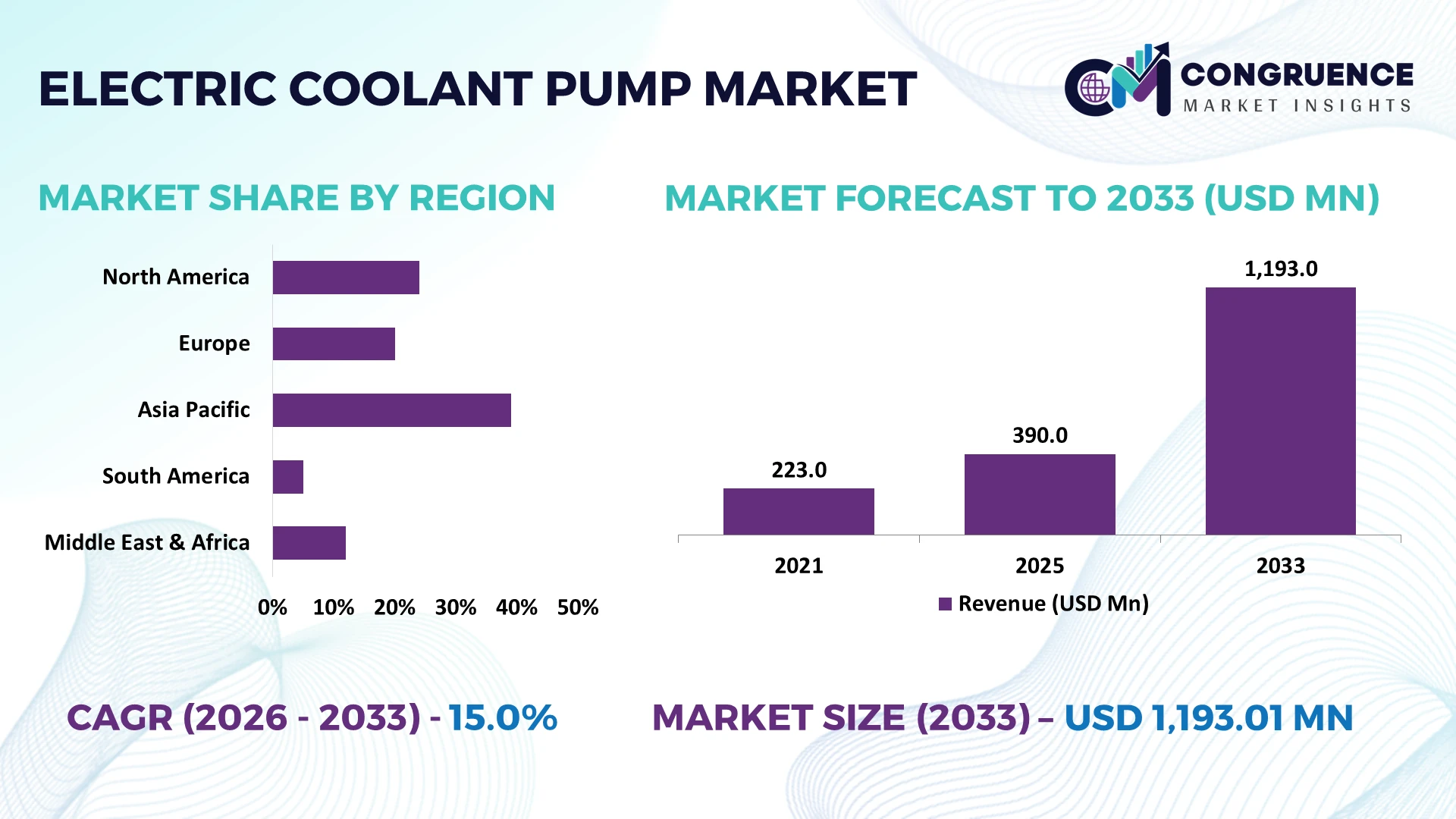
The Global Electric Coolant Pump Market was valued at USD 390 Million in 2025 and is anticipated to reach a value of USD 1193.01 Million by 2033 expanding at a CAGR of 15% between 2026 and 2033. Growth is driven by battery-electric vehicle thermal-management intensity, higher fast-charging heat loads, multi-loop cooling architectures, and OEM replacement of mechanically driven pumps with electronically controlled brushless units.
China dominates electric coolant pump demand, supported by approximately 75% of global electric-car production and EVs representing nearly 55% of domestic new-car sales in 2025. Its battery, power-electronics, automotive, and thermal-management supply chains support high-volume pump integration, while domestic OEM investment increasingly targets integrated cooling modules, intelligent flow control, and fast-charging thermal systems. China’s EV penetration exceeds the United States by more than 45 percentage points, while EU countervailing measures on Chinese EVs and shifting automotive trade policies are accelerating localized component sourcing and regional thermal-management manufacturing.
Strategically, suppliers controlling brushless motor technology, electronic diagnostics, compact modular architecture, and localized OEM production will secure the strongest position as electric coolant pumps become core components of EV battery and power-electronics reliability.
Market Size & Growth: USD 390 million in 2025 reaches USD 1.19 billion by 2033 at 15%, driven by EV thermal-management complexity and fast-charging requirements.
Top Growth Drivers: EV penetration contributes approximately 48%, thermal-system electrification 32%, and fast-charging deployment 20% of incremental demand momentum.
Short-Term Forecast: By 2028, integrated thermal architectures are positioned to reduce coolant-pump count by approximately 25% while improving system packaging efficiency.
Emerging Technologies: Brushless DC motors, LIN/PWM diagnostics, and intelligent variable-speed control support pump service lives approaching 38,000–41,000 operating hours.
Regional Leaders: By 2033, Asia-Pacific approaches USD 561 million, Europe USD 286 million, and North America USD 251 million as EV-specific cooling deployment intensifies.
Consumer/End-User Trends: Electric vehicles represented roughly 25% of global new-car sales in 2025, directly increasing battery, inverter, motor, and charging-circuit cooling requirements.
Pilot/Case Example: Advanced integrated thermal modules reduce pump requirements from 4 units to 3, a 25% component reduction that cuts packaging complexity.
Competitive Landscape: Bosch holds an estimated 12% position, competing with Rheinmetall, MAHLE, Continental, and Hanon Systems through electronics integration and scalable pump platforms.
Regulatory & ESG Impact: Advanced thermal-management modules can improve cold-weather EV driving range by up to 20%, supporting tighter vehicle-efficiency and CO₂-performance targets.
Investment & Funding: More than USD 500 million in thermal-management and electrification capacity programs is supporting localized pumps, heat exchangers, electronics, and integrated modules.
Innovation & Future Outlook: Next-generation pumps span roughly 40–350 W electrical classes, shifting competition toward modular, diagnostics-enabled systems supporting battery cooling and high-power charging.
The Electric Coolant Pump Market is increasingly tied to battery-electric vehicles, hybrid powertrains, charging thermal management, power electronics, and integrated heat-pump systems. Electric cars represented about 25% of global new-car sales in 2025, intensifying demand for electronically controlled coolant circulation. Brushless motors, LIN/PWM communication, and modular thermal units are now reshaping sourcing strategies as OEMs localize critical EV thermal-management components.
Electric coolant pumps are becoming strategically critical as EV thermal management shifts from auxiliary cooling toward continuous control of batteries, motors, inverters, cabin systems, and fast-charging loads. Global electric-car sales exceeded 21 million units in 2025, representing roughly 25% of new-car sales, while China produced nearly 75% of electric cars. This scale is forcing OEMs to localize pump electronics, motors, housings, and thermal modules.
Electronically controlled brushless pumps outperform mechanically driven systems by matching coolant flow directly to thermal load instead of operating continuously with engine speed. Modern designs provide variable-speed control, integrated diagnostics, and service lives approaching 41,000 hours, reducing parasitic energy losses and improving thermal response. China leads deployment scale, while Europe emphasizes integrated heat-pump architectures and North America increasingly prioritizes fast-charging and high-output EV platforms.
Through 2026–2028, investment will concentrate on 110–200 W pump classes, LIN/PWM communication, predictive diagnostics, and pre-integrated thermal modules. Bosch already offers modular pumps capable of cooling batteries, powertrains, and dual electric axles. Suppliers are expanding electronics integration and OEM co-development. Competitive advantage will increasingly depend on delivering fewer, smarter pumps that control multiple thermal circuits while reducing packaging complexity and energy consumption.
Rapid EV production is structurally increasing electric coolant pump deployment because batteries, inverters, motors, and fast-charging systems require independently controlled thermal circuits. Electric cars represented about 25% of global new-car sales in 2025, while China accounted for nearly 75% of global EV production and approximately 55% of domestic new-car sales. Battery-electric vehicles also represented 65% of electric-car sales, increasing continuous cooling intensity relative to conventional drivetrains. Chinese OEMs are consequently integrating multiple electronically controlled pumps, valves, and heat exchangers into centralized thermal architectures. Component suppliers are expanding brushless motor platforms, high-power pump variants, and localized manufacturing. The strategic shift is from engine-dependent coolant circulation toward software-controlled thermal management, making pump response speed and electronic integration increasingly important vehicle-performance attributes rather than secondary component specifications.
Electric coolant pumps carry higher electronic and material complexity than conventional mechanical pumps because they integrate brushless motors, control boards, sensors, communication interfaces, and sealed housings. Modern automotive units operate across roughly 110–200 W electrical classes and withstand ambient temperatures approaching 120°C, increasing semiconductor, magnet, polymer, and validation requirements. China supplied nearly 75% of global EV production in 2025, creating significant concentration in upstream EV-component manufacturing and exposing Western OEMs to localization and trade-policy pressure. Semiconductor availability and permanent-magnet sourcing therefore directly affect pump production economics. Suppliers are reducing exposure through dual sourcing, localized electronics assembly, modular designs, and standardized controllers. The non-obvious restraint is qualification cost: changing a low-cost electronic component can trigger extensive automotive durability and EMC revalidation, limiting rapid supplier substitution even when cheaper alternatives exist.
Integrated thermal management creates a high-value opportunity to replace separate pumps, valves, hoses, and controllers with pre-engineered modules. Bosch’s latest electric coolant pump platforms support up to 200 W electrical input, approximately 65 W hydraulic output, and service lives reaching 41,000 hours, enabling one scalable architecture across multiple EV cooling duties. China offered nearly 700 electric-car models by the end of 2025, 60% more than conventional-car models, increasing OEM demand for modular components adaptable across vehicle platforms. Suppliers are responding with pump-valve integration, software-calibrated flow control, diagnostics, and subsystem partnerships. The strategic opportunity extends beyond unit sales: companies supplying complete thermal modules gain greater vehicle content per platform while reducing OEM engineering interfaces, assembly steps, hose routing, and validation workload. This shifts value from commodity pumping hardware toward integrated thermal-system engineering.
Future electric coolant pumps must operate reliably across increasingly complex battery, motor, inverter, charging, and cabin thermal circuits without creating noise, cavitation, diagnostic faults, or coolant-flow instability. Current pump platforms target service lives of 38,000–41,000 hours and temperatures up to 120°C, while high-performance units must simultaneously support dual electric axles and fast-charging battery cooling. These requirements sharply increase software calibration, electromagnetic compatibility, thermal cycling, and hydraulic validation workloads. China’s rapidly expanding EV model portfolio, approaching 700 models in 2025, further multiplies vehicle-specific packaging and calibration requirements. Suppliers must invest in simulation, hardware-in-loop testing, standardized communication protocols, and predictive diagnostics. The long-term challenge is platform consistency: companies that cannot reuse validated pump architectures across multiple vehicle programs face higher engineering cost, slower launches, and weaker OEM sourcing competitiveness.
Higher-Voltage Pumps Enter EV Platforms: Electric coolant pumps are moving toward 48 V architectures as battery packs, inverters, and fast-charging systems generate greater thermal loads. Advanced units now reach approximately 200 W electrical input, 65 W hydraulic output, and 41,000-hour operating life. Suppliers are scaling electronically commutated motors and high-temperature electronics to increase coolant throughput without proportionally increasing pump dimensions or energy consumption.
Digital Diagnostics Move Into Pumps: LIN and PWM interfaces are replacing basic on-off pump operation, enabling continuously variable flow, fault reporting, dry-run protection, and vehicle-level diagnostics. Electronically controlled units can vary output across virtually 0–100% of commanded speed instead of following engine RPM. Bosch, Rheinmetall, and other suppliers are embedding controllers and diagnostic functions, reducing troubleshooting time while supporting software-defined thermal strategies.
Heat-Pump Architectures Reshape Coolant Routing: EV manufacturers are integrating battery, cabin, motor, and power-electronics temperature control as heat-pump adoption expands. Advanced systems can improve winter driving range by approximately 10–20%, while optimized architectures consolidate several previously independent coolant circuits. Suppliers are responding with reversible-flow pumps, compact valve assemblies, and coordinated controllers, increasing component value even where physical pump counts decline.
Localization Alters Thermal Supply Networks: China produced approximately 75% of global electric cars in 2025, while EVs represented roughly 55% of its domestic car sales. European trade measures and automaker localization strategies are consequently reshaping pump sourcing. Thermal-management suppliers are expanding local electronics assembly, motor production, automated testing, and regional engineering, reducing logistics exposure while accelerating OEM validation and platform launches.
Electric Pumps account for approximately 38% of the defined type mix, supported by independent coolant circulation, variable-speed operation, compact packaging, and compatibility with electrified powertrains. Mechanical Pumps retain approximately 24% because conventional and hybrid powertrains continue using established belt- or engine-driven architectures. Centrifugal Pumps represent around 18%, benefiting from efficient continuous coolant circulation, while Positive Displacement Pumps retain specialized relevance where predictable flow under changing pressure is required.
Brushless DC Pumps are the fastest-growing type as EV manufacturers prioritize efficiency, controllability, durability, and electronic diagnostics. Modern automotive BLDC coolant pumps can achieve operating lives approaching 40,000 hours while eliminating brush wear and enabling LIN/PWM communication. Suppliers are shifting engineering resources from standalone mechanical hardware toward electronically commutated motors, integrated controllers, and scalable 12–48 V platforms. Centrifugal architectures increasingly incorporate BLDC drives, demonstrating that pump mechanism and motor technology are converging. Investment therefore favors electronically controlled platforms capable of serving batteries, power electronics, HVAC loops, and propulsion systems through shared hardware.
Battery Thermal Management represents approximately 39% of Electric Coolant Pump Market applications because cell temperature directly affects charging speed, range, degradation, and safety. Powertrain Cooling accounts for roughly 26%, serving electric motors, conventional propulsion components, and hybrid architectures. Electronics Cooling contributes approximately 16% as higher-output inverters and onboard chargers require dedicated thermal control, while HVAC Systems represent about 13%. Fuel Cell Cooling remains smaller but strategically important because stack temperature uniformity directly influences electrochemical performance and durability.
Battery Thermal Management is also the fastest-growing application as higher charging power compresses heat generation into shorter periods. Optimal lithium-ion operation typically requires battery temperatures around 20–40°C, making precise coolant flow increasingly important during high-power charging and extreme weather. Manufacturers are integrating variable-speed pumps with battery-management software, chillers, heat exchangers, and multi-way valves. Electronics Cooling is simultaneously strengthening as silicon-carbide power electronics raise system power density. Suppliers are responding with higher-flow pumps, improved sealing, quieter motors, and shared thermal modules that dynamically allocate coolant across competing temperature zones.
Electric Vehicle Manufacturers represent approximately 37% of Electric Coolant Pump Market demand, reflecting multiple liquid-cooling requirements across battery packs, electric motors, inverters, chargers, and cabin thermal systems. Passenger Vehicle Manufacturers account for approximately 29%, supported by hybridization and electronically controlled auxiliary cooling. Commercial Vehicle Manufacturers represent about 16%, while Automotive Component Suppliers account for roughly 12% through integrated thermal-module production. Fuel Cell System Manufacturers retain a smaller but technically demanding position requiring precise stack-temperature management.
Electric Vehicle Manufacturers are also the fastest-growing buyer group because dedicated EV architectures increasingly require several independently controlled coolant circuits. China accounted for approximately 75% of global electric-car production in 2025, giving domestic manufacturers exceptional purchasing scale and encouraging component localization. Suppliers are targeting EV OEMs through platform-specific pump calibration, localized engineering, long-term sourcing agreements, and integrated pump-valve modules. Commercial vehicle buyers increasingly prioritize durability and high thermal capacity, whereas component suppliers demand standardized interfaces. Competitive positioning therefore depends on balancing customization with reusable pump architectures that reduce qualification time across multiple vehicle platforms.
Asia-Pacific accounted for the largest market share at 47% in 2025 however, Asia-Pacific is expected to register the fastest growth, expanding at a CAGR of 17.8% between 2026 and 2033.
High-Power EV Platforms Raise Cooling Intensity
North America represents approximately 21% of Electric Coolant Pump Market demand, with the United States driving deployment through battery-electric vehicles, plug-in hybrids, electric pickups, and localized battery manufacturing. U.S. electric-car sales exceeded 1.6 million units in 2025, requiring electronically controlled circulation across batteries, inverters, traction motors, chargers, and heat-pump systems. Increasing 400–800 V vehicle architectures are raising thermal loads during high-power charging, shifting pump specifications toward variable-speed brushless motors and diagnostic communication. Automotive manufacturing clusters across Michigan, Tennessee, Kentucky, Georgia, and the Carolinas are supporting localized thermal-system sourcing. Suppliers are expanding pump-controller integration, automated end-of-line testing, and OEM-specific calibration. Policy uncertainty around electrification incentives increases program-selection discipline, favoring modular pumps transferable between hybrid and fully electric platforms.
United States Market Outlook: The United States combines large light-vehicle production, expanding battery factories, high-output electric pickups, and growing fast-charging infrastructure. More than 60% of new EVs available domestically support DC fast charging above 150 kW, increasing battery-cooling intensity. Suppliers positioned near Midwest and Southeast automotive corridors gain shorter validation cycles, localized engineering support, and stronger access to OEM thermal-management programs.
Integrated Thermal Systems Replace Auxiliary Cooling
Europe accounts for approximately 24% of global electric coolant pump demand, supported by Germany, France, the United Kingdom, Sweden, and Central European vehicle-production clusters. Battery-electric vehicles represented about 17% of EU new-car registrations in 2025, while plug-in hybrids added further electronically controlled cooling requirements. EU fleet-emission regulations are accelerating vehicle electrification and pushing OEMs toward heat pumps, centralized thermal modules, and energy-efficient coolant circulation. German suppliers Bosch, Rheinmetall, MAHLE, and Continental possess established engineering relationships across pump motors, controllers, valves, and heat exchangers. New thermal architectures increasingly combine cabin, battery, motor, and inverter temperature management, reducing redundant hardware while increasing control complexity. Suppliers are responding through integrated pump-valve modules, 48 V architectures, quieter brushless drives, and localized electronics manufacturing. Efficiency, durability, and system integration increasingly outweigh standalone pump pricing in European sourcing decisions.
Germany Market Outlook: Germany remains Europe's principal electric coolant pump engineering center through its premium OEM base and dense thermal-component ecosystem. Battery-electric vehicles represented approximately 19% of German new-car registrations in 2025. Bosch, Rheinmetall and MAHLE provide domestic expertise spanning electric pumps, thermal modules, electronics, and heat-management systems, enabling earlier supplier participation in vehicle-platform engineering and validation.
China Converts EV Scale Into Component Leadership
Asia-Pacific commands approximately 47% of the Electric Coolant Pump Market, primarily because China combines dominant EV production with extensive battery, electronics, motor, magnet, and automotive-component supply chains. China produced nearly 75% of global electric cars in 2025, while electric models represented approximately 55% of domestic new-car sales. This manufacturing density supports rapid adoption of electronically controlled coolant pumps across batteries, traction systems, charging circuits, and cabin heat pumps. Japan and South Korea add high-value automotive electronics and thermal-management engineering, while India provides expanding EV and component-manufacturing capacity. Chinese OEMs increasingly use centralized thermal architectures and higher-voltage charging, pushing suppliers toward compact BLDC pumps, LIN-controlled electronics, and automated manufacturing. Local manufacturers are competing aggressively on integration and cost, forcing international suppliers to localize engineering, sourcing, and production closer to vehicle assembly hubs.
China Market Outlook: China provides unmatched deployment scale, with electric-car sales exceeding 13 million units in 2025 and domestic electric models approaching 55% of new-car sales. Shanghai, Guangdong, Zhejiang, Jiangsu, and Anhui form critical EV manufacturing corridors. Suppliers capable of integrating pumps with valves, controllers, heat exchangers, and localized electronics gain stronger access to rapidly refreshed domestic vehicle platforms.
Hybridization Creates Practical Electrification Pathway
South America accounts for approximately 3% of global electric coolant pump demand, with Brazil dominating automotive production and electrified-vehicle deployment. Brazil registered more than 170,000 electrified light vehicles during 2024, demonstrating accelerating adoption across battery-electric, plug-in hybrid, and hybrid architectures. Hybridization is particularly relevant because it introduces electronically controlled auxiliary cooling without requiring an immediate transition to fully electric vehicle production. São Paulo and surrounding automotive clusters provide established component-manufacturing and engineering infrastructure, while Chinese OEM investment is increasing localized electrified-vehicle assembly. Electric coolant pump suppliers are therefore targeting flexible platforms serving hybrids and EVs, rather than dedicated BEV-only products. Import dependence for advanced electronics and relatively uneven charging infrastructure remain constraints. Localization of controllers, motors, plastic housings, and final assembly provides the clearest route to lower logistics exposure and stronger OEM sourcing positions.
Brazil Market Outlook: Brazil combines annual light-vehicle production above 2 million units with rapidly expanding electrified-vehicle availability. BYD and GWM manufacturing investments are strengthening localized EV and hybrid supply chains, increasing demand for thermal components. Suppliers that adapt coolant pumps for flex-fuel hybrids, plug-in hybrids, and battery-electric vehicles can address Brazil's distinctive multi-powertrain transition without maintaining entirely separate product families.
EV Investment Creates New Thermal Ecosystems
Middle East & Africa represents approximately 5% of Electric Coolant Pump Market demand, led by the UAE, Saudi Arabia, Israel, Morocco, and South Africa. Saudi Arabia is developing domestic EV manufacturing through investments involving Lucid and Ceer, while Morocco has established a large automotive export base serving European manufacturers. High ambient temperatures exceeding 40°C across Gulf markets intensify battery, inverter, and cabin cooling requirements, increasing the operational importance of reliable variable-speed coolant circulation. Morocco's automotive factories provide an emerging localization route for thermal components, while South Africa maintains established vehicle assembly and supplier infrastructure. Pump manufacturers are targeting heat-resistant electronics, high-temperature seals, enhanced motor durability, and localized distribution. The strategic shift is from imported replacement components toward OEM-oriented thermal-system sourcing as new EV assembly and battery-related investments create regional component ecosystems.
Saudi Arabia Market Outlook: Saudi Arabia is establishing an EV manufacturing base through Lucid's assembly operation and Ceer's planned domestic production ecosystem. Lucid's Jeddah facility has an initial capacity of 5,000 vehicles annually, with expansion plans targeting 155,000 units. Extreme operating temperatures increase battery and power-electronics cooling requirements, creating a demanding qualification environment for electric pumps, controllers, seals, and thermal modules.
Bosch, Rheinmetall, MAHLE, Continental and Hanon Systems compete for global OEM thermal-management programs, while Chinese suppliers challenge established groups through localized production and cost-efficient electric pump platforms. The top five players collectively control approximately 48% of organized demand, reflecting strong engineering and vehicle-platform relationships. Bosch holds roughly 12%, while leading peers individually command about 7–11%. Competition centers on brushless-motor efficiency, 12–48 V scalability, diagnostics, durability and system integration; advanced pumps approach 41,000 operating hours while integrated architectures can reduce component counts by approximately 25%. Suppliers are expanding localized manufacturing, co-developing thermal modules with OEMs, integrating controllers and securing electronics supply. Competition is shifting from standalone pumps toward pump-valve-controller assemblies and centralized thermal management. Automotive qualification cycles, software integration, electromagnetic compatibility and validated durability create substantial entry barriers. Winning requires reusable pump platforms, localized engineering, competitive electronics sourcing, diagnostic capability and integration expertise that reduces OEM validation time across multiple vehicle architectures globally.
Robert Bosch GmbH
Rheinmetall AG
MAHLE GmbH
Continental AG
Hanon Systems
Aisin Corporation
DENSO Corporation
Gates Corporation
Schaeffler AG
Bühler Motor GmbH
Vitesco Technologies
Valeo
Johnson Electric Holdings
Concentric AB
Current electric coolant pump technology centers on brushless DC motors, variable-speed control, enabling coolant delivery independent of engine speed. MAHLE electric pumps provide up to 1 kW output, supporting up to 5% lower CO2 emissions versus conventional pumping. Hanon Systems spans 10–1,000 W, giving OEMs scalable hardware for batteries, inverters, fuel cells, and powertrains while reducing mechanical losses directly.
Emerging technology is shifting toward integrated thermal modules combining pumps, valves, heat exchangers, sensors, controllers, and compressors. MAHLE’s integrated architecture reduces coolant pumps from four to three, a 25% hardware reduction, while heat-pump integration can improve cold-weather EV range by up to 20%. Compared with legacy mechanically driven pumps, electronically controlled pumps deliver coolant only when required, eliminating continuous engine-speed dependency and improving energy utilization. OEMs benefit through lower packaging, assembly and calibration complexity.
Disruptive development centers on software-coordinated thermal management, high-voltage pumps, predictive diagnostics and rare-earth-free motor designs. TI Fluid Systems’ 12 V eCP spans 60–230 W while eliminating rare-earth magnets, reducing sourcing exposure. From 2026–2028, 800 V charging, centralized thermal control, and pre-integrated modules will accelerate qualification. Suppliers combining pump electronics, software, valves, localized manufacturing gain advantage because OEM purchasing is shifting from individual components toward validated thermal subsystems.
March 2024 — SPAL Automotive expanded its 24-V brushless electric coolant pump range for trucks, buses and off-highway vehicles, adding PWM and CAN-bus continuous-speed control plus IP68/IP6K9K protection, improving thermal-system efficiency and durability in demanding electrified applications. Source: PowerProgress
June 2024 — Rheinmetall secured an order for several million electric coolant pumps for hybrid vehicles, with production continuing through 2030. Available power classes span 50–2,000 W, strengthening its long-term electrification position with a major international automaker. Source: Rheinmetall
May 2025 — MAHLE’s locally produced thermal system entered Mahindra’s BE 6 and XEV 9e platform after 24 months of development, reducing electric-compressor power consumption by 15–20% and strengthening India-based coolant-pump and thermal-control manufacturing capabilities. Source: MAHLE
September 2026 — Bosch announced expansion of its thermal-management aftermarket portfolio, introducing 12 electric main water-pump part numbers for BMW, Mercedes-Benz and Toyota applications by year-end, extending independent engine-speed cooling capability across modern hybrid and electrified powertrains. Source: Bosch
The Electric Coolant Pump Market Report examines Mechanical Pumps, Electric Pumps, Brushless DC Pumps, Centrifugal Pumps, and Positive Displacement Pumps across Battery Thermal Management, Powertrain Cooling, Electronics Cooling, HVAC Systems, and Fuel Cell Cooling. Electric Pumps represent approximately 38% of the defined type mix, while Battery Thermal Management contributes about 39% of application demand, reflecting increasing electrification of vehicle cooling circuits.
End-user coverage includes Passenger Vehicle Manufacturers, Commercial Vehicle Manufacturers, Electric Vehicle Manufacturers, Automotive Component Suppliers, and Fuel Cell System Manufacturers across North America, Europe, Asia-Pacific, South America, and Middle East & Africa. Technology assessment covers BLDC motors, 12–48 V architectures, 800 V thermal systems, intelligent flow control, diagnostics, integrated pump-valve modules, and rare-earth-free designs. The 2026–2033 outlook supports investment planning, manufacturing localization, OEM partnership strategies, portfolio prioritization, competitive benchmarking, and identification of high-value thermal-management opportunities.
| Report Attribute/Metric | Report Details |
|---|---|
Market Revenue in 2025 | USD 390 Million |
Market Revenue in 2033 | USD 1193.01 Million |
CAGR (2026 - 2033) | 15% |
Base Year | 2025 |
Forecast Period | 2026 - 2033 |
Historic Period | 2021 - 2025 |
Segments Covered | By Type
By Application
By End-User
|
Key Report Deliverable | Revenue Forecast, Growth Trends, Market Dynamics, Segmental Overview, Regional and Country-wise Analysis, Competition Landscape |
Region Covered | North America, Europe, Asia-Pacific, South America, Middle East, Africa |
Key Players Analyzed | Robert Bosch GmbH, Rheinmetall AG, MAHLE GmbH, Continental AG, Hanon Systems, Aisin Corporation, DENSO Corporation, Gates Corporation, Schaeffler AG, Bühler Motor GmbH, Vitesco Technologies, Valeo, Johnson Electric Holdings, Concentric AB |
Customization & Pricing | Available on Request (10% Customization is Free) |




