
Reports
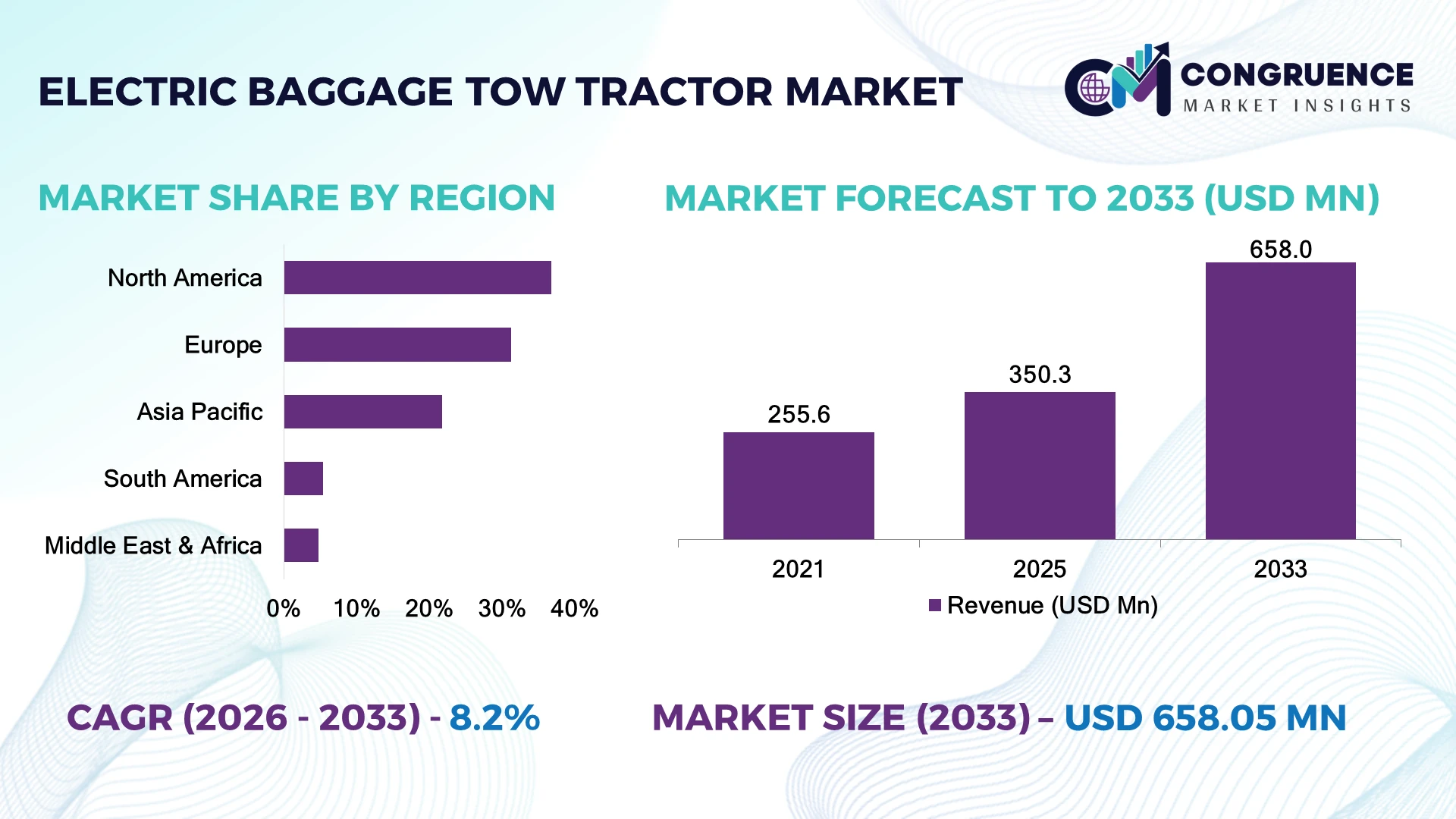
The Global Electric Baggage Tow Tractor Market was valued at USD 350.3 Million in 2025 and is anticipated to reach a value of USD 658.0 Million by 2033 expanding at a CAGR of 8.2% between 2026 and 2033. Growth is driven by airport fleet electrification, zero-emission ground-support requirements, rising baggage volumes, and replacement of diesel tow tractors with battery-electric platforms.
China represents the dominant manufacturing base, accounting for approximately 30% of global electric baggage tow tractor supply, supported by established battery, motor, and GSE component ecosystems. The United States represents a leading deployment market at roughly 25% of demand, driven by airport modernization and sustainability programs. Lithium-ion platforms now deliver approximately 20–30% lower energy and maintenance costs than comparable diesel units, while 2026 airport decarbonization programs are accelerating fleet replacement.
Strategic implication: manufacturers combining lithium-ion powertrains, fast charging, autonomous-ready controls, and airport service networks are positioned to capture fleet-conversion programs.
Market Size & Growth: USD 350.3 Million in 2025 to USD 658.0 Million by 2033 at 8.2% CAGR, driven by airport electrification and lithium-ion fleet replacement.
Top Growth Drivers: Airport electrification 10–14%; diesel replacement 8–12%; automated baggage handling 7–10%.
Short-Term Forecast: By 2028, lithium-ion platforms can reduce energy and routine maintenance costs by 20–30% versus comparable diesel equipment.
Emerging Technologies: Lithium-ion batteries, fast charging, telematics, regenerative braking, and autonomous-ready drive controls are reshaping electric GSE.
Regional Leaders: North America approaches USD 230 Million; Europe exceeds USD 170 Million; Asia-Pacific approaches USD 165 Million, supported by airport electrification.
Consumer/End-User Trends: Airport operators and ground handlers increasingly target 30–50% electric penetration in new baggage-tractor fleet purchases.
Pilot/Case Example: 2026 airport fleet-electrification programs are targeting approximately 15–25% lower ground-support energy consumption through electric tractor deployment and centralized charging.
Competitive Landscape: TLD leads specialized electric GSE positioning at approximately 12% share, competing with MULAG, JBT AeroTech, Kalmar, and Toyota Industries.
Regulatory & ESG Impact: Zero-emission GSE programs can reduce direct equipment-related operating emissions by approximately 60–90% when electricity replaces diesel combustion.
Investment & Funding: More than USD 400 Million in combined airport GSE electrification, charging infrastructure, and fleet-modernization commitments is supporting procurement and infrastructure upgrades.
Innovation & Future Outlook: Next-generation platforms emphasize autonomous towing, battery swapping, predictive maintenance, fast charging, and integrated airport fleet-management systems.
The Electric Baggage Tow Tractor Market is concentrated across passenger airports, cargo terminals, airline ground operations, and third-party ground-handling fleets, with lithium-ion models increasingly replacing lead-acid platforms. Electric tractors can deliver approximately 20–30% lower operating costs through reduced fuel and maintenance requirements. In 2026, airport operators are pairing tractors with charging-management systems and telematics as zero-emission ground-support requirements tighten, creating demand for connected, fleet-scale solutions and supporting the broader transition toward automated airport ground operations.
Electric baggage tow tractors are becoming strategically important because ground-support equipment is moving from a fuel-cost procurement model toward an integrated electrification and fleet-efficiency model. Airports increasingly evaluate tractors through total cost of ownership, charging compatibility, uptime, emissions, and fleet-management capability rather than purchase price alone. This shift makes electric GSE a core component of airport modernization strategies.
Lithium-ion systems provide a measurable advantage over conventional lead-acid configurations through faster charging, higher usable energy, and reduced maintenance intervention. Advanced electric platforms can lower energy and routine maintenance expenditure by approximately 20–30%, while telematics can improve fleet utilization by 5–10%. North America emphasizes large-airport fleet conversion, Europe places greater emphasis on emissions compliance, and China benefits from battery and electric-drive manufacturing depth.
During 2026–2028, airport operators are expected to prioritize fast-charging infrastructure, modular battery systems, predictive maintenance, and autonomous-ready tractors. A practical deployment model combines centralized charging with telematics to schedule tractors around baggage peaks and reduce idle time. Manufacturers are consequently expanding charging partnerships, airport service networks, and software capabilities. Competitive advantage will increasingly depend on delivering complete electric-GSE ecosystems rather than standalone towing equipment.
Airport operators are replacing diesel baggage tractors with battery-electric equipment as decarbonization targets, air-quality requirements, and lower operating costs converge. Electric tractors can reduce energy and routine maintenance expenditure by approximately 20–30%, while regenerative braking can improve energy efficiency by 8–12% in stop-start apron operations. U.S. airports are accelerating zero-emission ground-support programs, while European airports are integrating electric GSE into broader decarbonization plans. Companies are responding through lithium-ion platforms, fast-charging partnerships, and expanded airport service networks. The non-obvious shift is that electrification is increasingly evaluated at fleet level: centralized charging, telematics, and duty-cycle optimization can determine economic returns more than tractor purchase price alone, encouraging manufacturers to sell complete charging-and-fleet-management solutions.
Airport electrification is constrained by charging capacity, apron electrical infrastructure, battery downtime, and interoperability across mixed GSE fleets. High-utilization baggage tractors can require charging infrastructure capable of supporting multiple vehicles simultaneously, while poorly matched charging schedules can reduce equipment availability by 5–10%. Battery replacement can also represent 15–25% of long-term equipment cost, particularly for intensive duty cycles. Smaller airports face greater infrastructure-per-unit costs because chargers cannot always be utilized continuously. Operators are mitigating these constraints through depot charging, opportunity charging, modular battery systems, and long-term service contracts. Manufacturers are standardizing charging interfaces and battery-management systems, while airport operators increasingly coordinate electrical upgrades with terminal modernization. The strategic constraint is infrastructure sequencing: buying electric tractors before securing adequate grid capacity can create underutilized fleets.
Autonomous and semi-autonomous baggage tractors create an important opportunity to improve apron productivity as airports address labor shortages and increasingly structured baggage flows. Automated towing can reduce operator involvement by approximately 30–50% on suitable repetitive routes, while fleet telematics can improve vehicle utilization by 5–10%. Germany, Japan, and Singapore are particularly relevant testbeds because automated airport logistics can operate within controlled routes and digitally mapped aprons. Manufacturers are integrating obstacle detection, geofencing, fleet dispatch, and remote supervision into electric platforms rather than developing standalone autonomous vehicles. The non-obvious opportunity is shared fleet utilization: airports can dynamically assign tractors according to baggage peaks, reducing idle equipment requirements. Companies are therefore investing in autonomy software, sensor partnerships, and airport digital-twin ecosystems that create recurring technology and service revenue alongside hardware sales.
The long-term challenge is integrating electric tractors into airports where diesel, lead-acid, lithium-ion, autonomous, and manually operated GSE coexist. Fleet-management platforms can require integration across multiple equipment protocols, while telematics deployment can increase system complexity by 10–20%. Autonomous-ready tractors also require reliable positioning, obstacle detection, communications, and airport-specific route mapping, with environmental conditions such as rain, dust, and low visibility affecting sensor performance. U.S. and European airports increasingly require interoperability with baggage-handling and apron-management systems, raising engineering and cybersecurity requirements. Companies must therefore invest in open APIs, standardized vehicle interfaces, redundant safety systems, and airport integration partnerships. The strategic risk is not individual tractor performance but inconsistent fleet-level orchestration, making software compatibility and lifecycle support critical to long-term competitiveness.
Lithium-Ion Replaces Lead-Acid Fleets: Airport operators are increasingly selecting lithium-ion tractors because charging time can fall by approximately 30–50% and usable battery availability can improve 10–20% versus older lead-acid configurations. The transition is also reducing battery-maintenance requirements. Manufacturers are redesigning battery compartments, expanding modular packs, and partnering with charging providers to support high-utilization apron fleets.
Telematics Moves Into Daily Dispatch: Connected tractors are increasingly equipped with GPS, battery-state monitoring, fault diagnostics, and utilization tracking. Fleet operators can improve asset utilization by approximately 5–10% while reducing unplanned maintenance intervention by 5–8%. U.S. ground handlers are using fleet data to match tractor deployment with baggage peaks, shifting purchasing decisions toward connected platforms rather than standalone electric vehicles.
Fast Charging Reshapes Apron Scheduling: High-throughput airports are integrating opportunity charging into baggage operations, allowing tractors to recharge during planned turnaround periods rather than returning to centralized depots. Well-designed charging schedules can increase equipment availability by approximately 8–12% and reduce idle fleet requirements by 5–10%. Manufacturers are responding with higher-power charging compatibility and battery-management software.
Compact Tractors Gain Airport Preference: Narrow-body electric tractors are gaining attention where congested aprons and tighter service lanes restrict maneuverability. Compact platforms can reduce turning-space requirements by approximately 10–15% while improving positioning around aircraft stands. The operational shift is particularly relevant at space-constrained airports, prompting manufacturers to develop shorter wheelbases, tighter steering geometry, and improved visibility without sacrificing towing capacity.
Lithium-ion electric baggage tow tractors account for approximately 52–56% of global electric baggage tow tractor demand, supported by higher energy density, faster charging, lower maintenance requirements, and suitability for intensive airport duty cycles. Lead-acid models retain roughly 28–32% share because of lower acquisition costs and established charging infrastructure, particularly at smaller airports and in cost-sensitive markets. Fuel-cell and other advanced electric configurations remain niche at approximately 10–15%, but attract strategic investment where long operating hours and rapid refueling are priorities. Lithium-ion platforms can reduce charging downtime by approximately 30–50% versus conventional lead-acid systems, strengthening their economics for high-utilization fleets.
Advanced lithium-ion and emerging fuel-cell platforms are the fastest-changing segment, with adoption accelerating as airports prioritize zero-emission operations and higher vehicle availability. Manufacturers are developing modular battery packs, fast-charging compatibility, battery-management software, and hydrogen-ready platforms. Investment is shifting toward energy storage and fleet integration rather than basic tractor mechanics. For airport operators, the critical purchasing metric is increasingly productive operating hours per vehicle, not initial equipment price.
ACI World reported that global passenger traffic reached 9.4 billion in 2024, reinforcing the operational pressure on airports to expand ground-handling capacity while improving fleet efficiency and turnaround performance.
Baggage handling represents approximately 55–60% of electric baggage tow tractor demand, making it the dominant application because tractors operate continuously between aircraft stands, baggage halls, sorting areas, and loading zones. Cargo and freight handling contributes approximately 22–26%, while passenger-service and other airport logistics applications account for around 15–20%. Baggage operations favor compact electric tractors because predictable routes and repetitive duty cycles allow operators to optimize charging, dispatch, and vehicle utilization. Telematics can improve fleet utilization by approximately 5–10%, while regenerative braking can reduce energy consumption by 8–12% in stop-start apron operations.
Cargo and freight handling is the fastest-growing application, expanding as airports increase dedicated logistics capacity and e-commerce-related air freight activity. Heavy-duty towing requires greater traction, battery capacity, and continuous-duty capability than conventional baggage movements, encouraging manufacturers to introduce higher-capacity platforms. Companies are responding with stronger drivetrains, modular batteries, towing-capacity upgrades, and fleet-management integration. The strategic shift is toward application-specific tractors rather than one platform serving every airport task, enabling higher utilization and better total-cost economics.
IATA reported that global air cargo demand increased 11.3% year over year in 2025, with full-year demand reaching a record level and reinforcing the need for efficient ground-support equipment at cargo-intensive airports.
Third-party ground handling companies account for approximately 48–52% of electric baggage tow tractor demand, reflecting their large multi-airport fleets, intensive equipment utilization, and direct responsibility for baggage and ramp operations. Airport authorities represent roughly 30–34%, while airlines account for approximately 15–20%. Ground handlers have stronger incentives to electrify because fuel, maintenance, labor productivity, and fleet uptime directly affect contract economics. Electric tractors can reduce routine operating costs by approximately 20–30%, strengthening payback where utilization is high.
Airport authorities represent the fastest-changing end-user group as sustainability targets increasingly influence procurement standards for concessionaires and service providers. Airlines remain strategically important, particularly where carriers operate dedicated ramp fleets or impose environmental requirements on handling partners. Manufacturers are therefore tailoring financing, leasing, maintenance contracts, and charging packages to different procurement models. The commercial shift is toward fleet-as-a-service and integrated GSE management, allowing operators to avoid large upfront infrastructure commitments while suppliers secure longer service relationships and recurring equipment replacement cycles.
Airports Council International's 2025 Airport Economics Report highlights the increasing financial pressure on airports to balance infrastructure investment, operational efficiency, and sustainability, strengthening the business case for lower-operating-cost ground-support fleets.
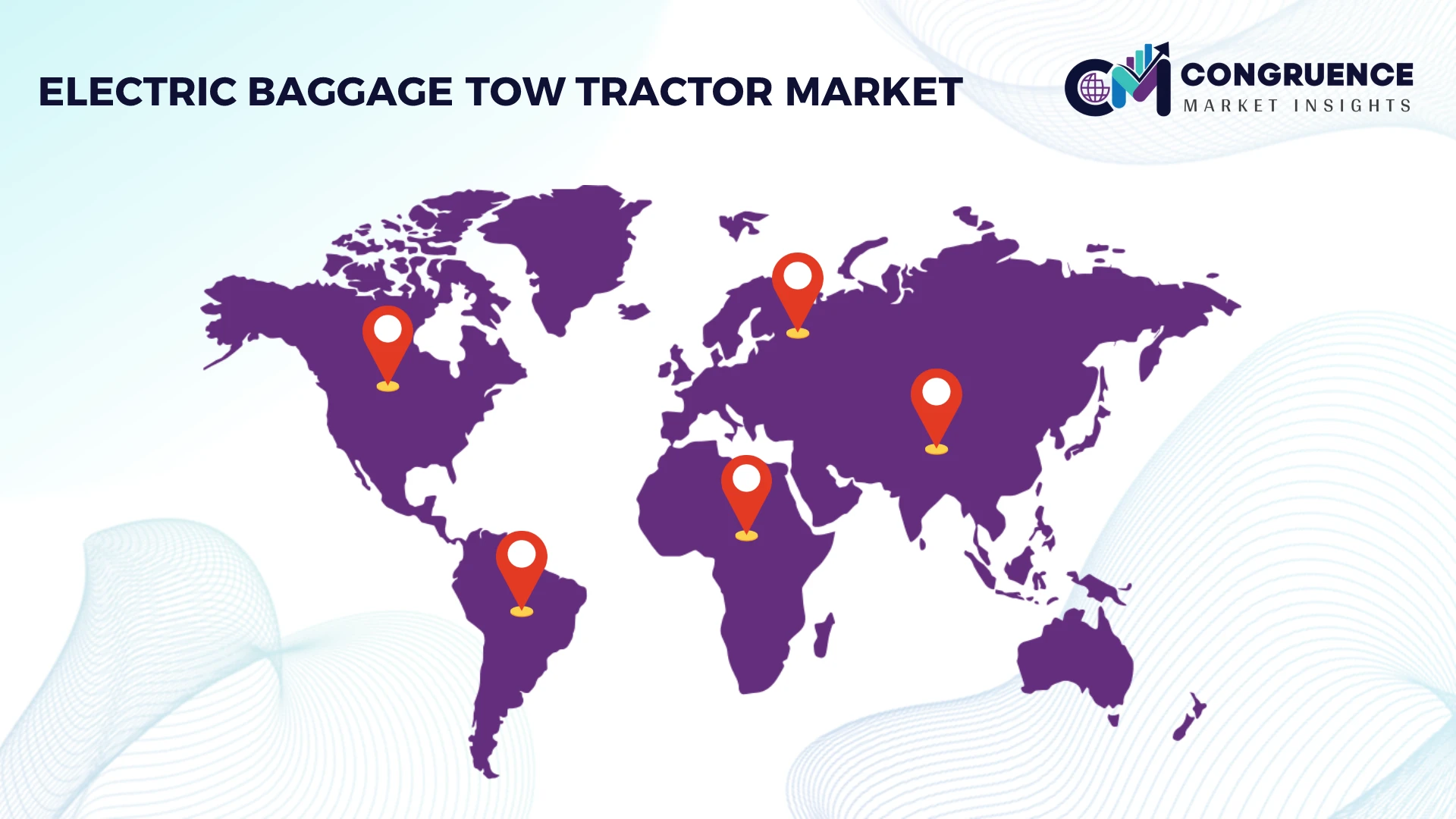
North America accounted for the largest market share at 36.8% in 2025 however, Asia-Pacific is expected to register the fastest growth, expanding at a CAGR of 9.4% between 2026 and 2033.
Large-airport electrification accelerates fleet replacement
North America represents approximately 36.8% of global electric baggage tow tractor demand, supported by high passenger throughput, established GSE procurement structures, and aggressive airport decarbonization programs. The United States dominates regional deployment, with major hubs increasingly replacing diesel tractors through phased fleet electrification. Electric platforms can reduce energy and routine maintenance costs by approximately 20–30%, improving total-cost economics for high-utilization ramp fleets. Canada is also advancing zero-emission airport equipment adoption through airport sustainability programs. Airports and ground handlers are investing in depot charging, lithium-ion fleets, telematics, and preventive maintenance systems rather than purchasing tractors independently. Manufacturers are expanding U.S. service networks and partnering with charging providers. The key operational shift is toward fleet-level electrification, where charging infrastructure, uptime analytics, and service coverage increasingly determine equipment selection.
United States Market Outlook: The United States is the region's principal deployment market because of its extensive airport network and high-volume baggage-handling operations. Major airports increasingly incorporate electric GSE into sustainability and modernization programs, with high-utilization tractors offering approximately 20–30% lower operating costs than comparable diesel equipment. Manufacturers are strengthening local inventory, financing, maintenance support, and charging partnerships to accelerate fleet conversion.
Zero-emission GSE becomes procurement standard
Europe represents approximately 31.2% of global electric baggage tow tractor demand, supported by stringent emissions objectives, airport sustainability commitments, and mature GSE suppliers. Germany, France, the United Kingdom, and the Netherlands are important deployment centers, with airports progressively replacing combustion-powered ramp equipment. Electric tractors can reduce direct equipment emissions by approximately 60–90% when charged with low-carbon electricity while reducing routine maintenance requirements by roughly 15–25%. Airports are increasingly integrating chargers into apron modernization rather than treating electrification as an equipment-only upgrade. Manufacturers are responding with lithium-ion platforms, opportunity-charging systems, telematics, and autonomous-ready tractors. Procurement is shifting toward lifecycle emissions and energy efficiency, giving technologically integrated suppliers an advantage over low-cost equipment vendors.
Germany Market Outlook: Germany is strategically important because of its advanced airport infrastructure, strong industrial GSE ecosystem, and emphasis on energy efficiency. Frankfurt and Munich provide high-throughput operating environments where electric tractors benefit from predictable routes and centralized charging. German suppliers are also well positioned to develop compact, high-efficiency platforms, supporting approximately 5–10% better fleet utilization through telematics-enabled dispatch and maintenance planning.
Airport expansion strengthens localized GSE manufacturing
Asia-Pacific accounts for approximately 21.8% of global electric baggage tow tractor demand and is the fastest-changing regional market as China, India, Japan, South Korea, and Southeast Asia expand airport capacity. China combines substantial airport infrastructure with domestic battery and electric-drive manufacturing, while India is adding airport capacity and modernizing ground operations. Electric tractors can reduce energy and maintenance expenditure by 20–30%, strengthening adoption as airports scale passenger and cargo operations. Manufacturers are increasingly localizing batteries, motors, controllers, and fabricated chassis to shorten lead times by approximately 10–20%. Chinese suppliers benefit from component integration and cost competitiveness, while Japanese and Korean manufacturers emphasize reliability and automation. The strategic shift is toward locally supported electric GSE ecosystems rather than imported standalone tractors.
China Market Outlook: China provides the region's strongest manufacturing and deployment platform, combining extensive airport infrastructure with a deep electric-vehicle supply chain. Domestic battery and power-electronics availability supports competitive electric GSE pricing and faster product customization. Major airports are increasingly integrating connected fleet systems and lithium-ion equipment, while manufacturers can leverage domestic component sourcing to shorten production cycles and support large fleet orders.
Airport modernization opens selective electrification
South America contributes approximately 5.4% of global electric baggage tow tractor demand, with Brazil accounting for the largest share through its extensive airport network and concession-driven modernization. São Paulo, Rio de Janeiro, and Brasília provide the strongest deployment environments because high passenger volumes support better utilization of electric equipment. Electric tractors can reduce routine energy and maintenance costs by approximately 20–30%, although charging infrastructure remains less developed outside major hubs. Airport concessionaires increasingly evaluate equipment through lifecycle economics and sustainability commitments, creating opportunities for fleet electrification. Manufacturers are responding through distributor partnerships, leasing models, localized maintenance, and modular charging packages. The market is therefore developing through targeted hub deployment rather than uniform national conversion, with airport density determining the commercial viability of electric fleets.
Brazil Market Outlook: Brazil is the strategic center of South American electric baggage tow tractor adoption because major airports operate under sophisticated concession structures and handle substantial passenger and cargo volumes. São Paulo's major airport cluster provides particularly favorable conditions for centralized charging and high equipment utilization. Suppliers are targeting concessionaires with leasing, maintenance, and charging packages that reduce upfront infrastructure barriers and accelerate electric fleet replacement.
Megahub investment accelerates zero-emission GSE
Middle East & Africa represents approximately 4.8% of global electric baggage tow tractor demand, but Gulf aviation investment creates high-value deployment opportunities. Saudi Arabia, the United Arab Emirates, and Qatar are expanding airport capacity and modernizing ground-support fleets around major aviation hubs. New-generation electric tractors can reduce direct operating emissions by approximately 60–90% and routine maintenance requirements by 15–25%, strengthening their fit with large airport sustainability programs. Gulf airports also benefit from centralized infrastructure, making depot charging easier to scale than fragmented regional networks. Manufacturers are responding through airport partnerships, regional service centers, high-temperature battery-management systems, and fast-charging configurations. The strategic opportunity is concentrated in newly developed terminals and megahubs where electric infrastructure can be incorporated from the design stage rather than retrofitted later.
Saudi Arabia Market Outlook: Saudi Arabia offers the strongest regional opportunity through airport expansion, aviation-sector investment, and major tourism and logistics programs. New airport infrastructure enables charging systems and electric GSE to be designed into apron operations from the outset. High ambient temperatures also make thermal battery management critical, encouraging suppliers to differentiate through cooling systems, battery monitoring, and service agreements tailored to demanding operating conditions.
TLD, Textron GSE, MULAG, Kalmar Motor, and Charlatte compete across electric baggage tractors, with European engineering-led suppliers facing U.S. and Asian cost-focused manufacturers. The top five are estimated to control about 48% combined share. Competition centers on battery performance, towing capacity, charging speed, service coverage, and customization; lithium-ion systems can reduce operating costs 20–30%, while opportunity charging can improve fleet availability 8–12%. TLD is advancing high-voltage platforms and autonomous-ready telematics, Textron GSE is refreshing lithium-electric tractors, MULAG emphasizes modular electric drivetrains, and Kalmar Motor combines electric propulsion with range-extender options. Regional manufacturers compete through localized components and lower acquisition costs. The competitive shift is toward integrated GSE platforms combining tractors, charging, telematics, and autonomous functions. Entry barriers include airport qualification, safety validation, service infrastructure, and fleet interoperability. Winning requires reliable electric performance, rapid charging, application-specific engineering, strong airport support, and software integration that converts equipment purchases into measurable fleet productivity gains.
TLD
Textron Ground Support Equipment
MULAG Fahrzeugwerk
Kalmar Motor
Charlatte Manutention
Goldhofer Airport Technology
Harlan Global Manufacturing
Aurrigo International
Toyota Industries Corporation
Weihai Guangtai Airport Equipment
Jiangsu Tianyi Airport Equipment
Eagle Industries-DWI
Electric baggage tractors are moving from basic battery propulsion toward high-voltage lithium-ion systems, regenerative braking, telematics, and opportunity charging. Lithium-ion platforms can improve usable energy availability by 10–20% and reduce charging downtime 30–50% versus older lead-acid configurations. Adoption is strongest at high-utilization airports where predictable duty cycles justify charging infrastructure.
Autonomous towing is emerging through sensor fusion, geofencing, fleet-management software, and remote supervision. TLD’s EZTow supports manual through driverless operation and 24/7 duty cycles, while Aurrigo’s Auto-DollyTug combines electric towing with autonomous ULD handling. Automated workflows can reduce operator involvement 30–50% on suitable repetitive routes and improve fleet utilization 5–10%, creating an advantage for airports addressing labor constraints.
By 2026–2028, high-voltage charging, battery analytics, collision avoidance, and interoperable APIs will become increasingly important. Textron’s 2026 TUG MX4 emphasizes future technology integration, while TLD’s JST-E-HV uses a CATL high-voltage battery and Link telematics. Compared with conventional manually dispatched tractors, connected electric fleets can improve utilization 5–10% and reduce unplanned maintenance 5–8%. Suppliers combining hardware, software, charging, and service will gain the strongest competitive position.
July 2026 Textron GSE introduced the TUG MX4 lithium-electric baggage tractor, engineered around customer input and future technology integration. Its reinforced steel construction targets demanding ramp operations, strengthening Textron’s electric portfolio and positioning it for airline and ground-handler fleet modernization. Source: textron.com
September 2026 Kalmar Motor relaunched its FB150 electric tow tractor with lead-acid or lithium-ion battery options, targeting lower acquisition barriers. The refreshed platform supports aircraft through the narrow-body segment, expanding electric towing accessibility across airport and industrial applications. Source: vestergaardcompany.com
January 2024 Aurrigo and Changi Airport Group began testing the electric autonomous Auto-DollyTug, combining baggage towing with ULD carrying and robotic loading. The third-generation vehicle introduced sideways driving and autonomous loading, expanding automation possibilities for constrained aircraft turnaround operations. Source: aurrigo.com
November 2024 Cebu Pacific deployed 13 electric luggage tractors across Ninoy Aquino International Airport Terminals 2 and 3. The fleet deployment replaced fossil-fuel-dependent ramp equipment, providing a measurable operational step toward lower-emission ground handling and supporting broader airport electrification across Manila operations. Source: dailytribune.net
The Electric Baggage Tow Tractor Market Report evaluates battery-electric, lithium-ion, lead-acid, hybrid-ready, and emerging alternative-power configurations across baggage handling, cargo movement, aircraft support, and airport logistics. End-user coverage includes airlines, airport authorities, third-party ground handlers, cargo operators, and specialized GSE fleets, with emphasis on high-utilization operations where electric platforms can reduce operating costs by approximately 20–30%.
Regional analysis covers North America, Europe, Asia-Pacific, South America, and Middle East & Africa, including the United States, Germany, China, India, Brazil, Saudi Arabia, and major aviation hubs. Technology coverage includes high-voltage batteries, fast charging, regenerative braking, telematics, autonomous towing, collision avoidance, and fleet-management software. The report supports investment planning, fleet-conversion strategy, manufacturing expansion, charging infrastructure decisions, competitive positioning, and technology prioritization through 2033.
| Report Attribute/Metric | Report Details |
|---|---|
|
Market Revenue in 2025 |
USD 350.3 Million |
|
Market Revenue in 2033 |
USD 658.0 Million |
|
CAGR (2026 - 2033) |
8.2% |
|
Base Year |
2025 |
|
Forecast Period |
2026 - 2033 |
|
Historic Period |
2021 - 2025 |
|
Segments Covered |
By Type
By Application
By End-User
|
|
Key Report Deliverable |
Revenue Forecast, Growth Trends, Market Dynamics, Segmental Overview, Regional and Country-wise Analysis, Competition Landscape |
|
Region Covered |
North America, Europe, Asia-Pacific, South America, Middle East, Africa |
|
Key Players Analyzed |
TLD, Textron Ground Support Equipment, MULAG Fahrzeugwerk, Kalmar Motor, Charlatte Manutention, Goldhofer Airport Technology, Harlan Global Manufacturing, Aurrigo International, Toyota Industries Corporation, Weihai Guangtai Airport Equipment, Jiangsu Tianyi Airport Equipment, Eagle Industries-DWI |
|
Customization & Pricing |
Available on Request (10% Customization is Free) |




