
Reports
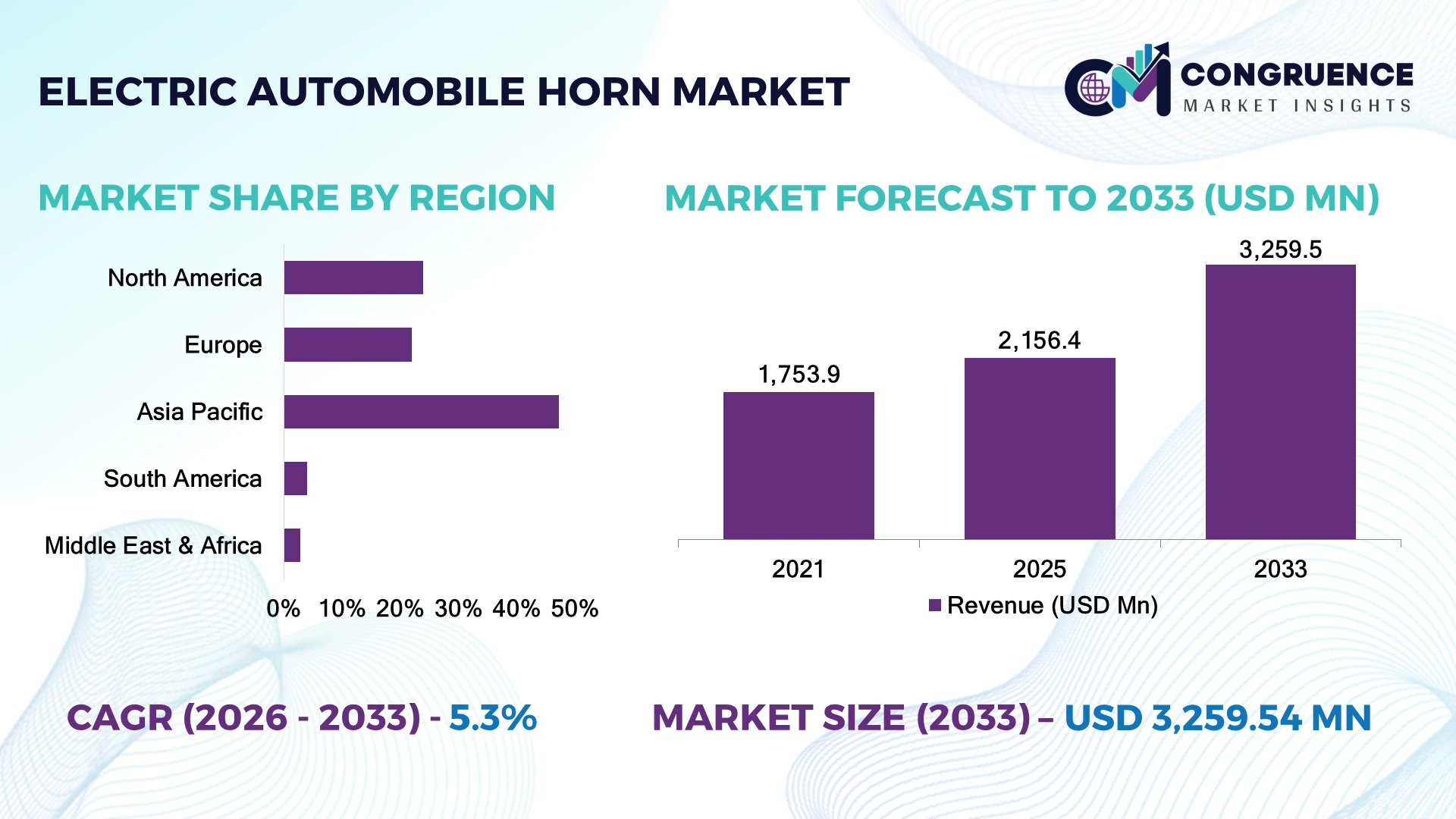
The Global Electric Automobile Horn Market was valued at USD 2,156.4 Million in 2025 and is anticipated to reach a value of USD 3,259.5 Million by 2033 expanding at a CAGR of 5.3% between 2026 and 2033. Growth is driven by accelerating electric vehicle production, stricter vehicle safety regulations, and increasing integration of lightweight, high-efficiency electronic acoustic systems into passenger and commercial vehicles.
China leads the global Electric Automobile Horn market with approximately 42% of manufacturing capacity, supported by large-scale electric vehicle production, vertically integrated automotive supply chains, and continuous investment in intelligent automotive components. Manufacturing output is nearly 2.8 times higher than Germany, while automated production processes improve assembly efficiency by approximately 19%. Supply-chain diversification following global trade realignments in 2026 is encouraging complementary manufacturing expansion across Southeast Asia without weakening China's production leadership.
Manufacturers investing in intelligent horn technologies, localized production, and automotive OEM partnerships will secure stronger long-term competitive positioning.
Market Size & Growth: USD 2,156.4 million in 2025 reaching USD 3,259.5 million by 2033 at 5.3% CAGR, supported by EV production and automotive safety upgrades.
Top Growth Drivers: EV production (+24%), vehicle safety compliance (+18%), lightweight component adoption (+15%).
Short-Term Forecast: By 2028, automated horn manufacturing improves production efficiency by 14% while defect rates decline 11%.
Emerging Technologies: Smart electronic horns, lightweight composites, and automated acoustic calibration enhance product performance.
Regional Leaders: Asia-Pacific (~USD 1.6 billion), Europe (~USD 0.7 billion), North America (~USD 0.5 billion), supported by EV manufacturing expansion.
Consumer/End-User Trends: Nearly 61% of new EV platforms incorporate compact electronic horn modules.
Pilot/Case Example: A 2026 OEM manufacturing program reduced assembly time by approximately 13% through modular horn integration.
Competitive Landscape: Top five suppliers control nearly 56% of OEM demand through technology and manufacturing scale.
Regulatory & ESG Impact: Lightweight horn systems reduce component weight by approximately 9%, supporting vehicle efficiency targets.
Investment & Funding: More than USD 1.4 billion supports automotive electronics expansion and manufacturing localization.
Innovation & Future Outlook: Intelligent acoustic control and software-integrated vehicle alert systems strengthen next-generation product differentiation.
The Electric Automobile Horn market is evolving through intelligent acoustic engineering, lightweight electronic architectures, and closer integration with advanced vehicle electrical systems. Approximately 37% of newly developed electric vehicle platforms now adopt compact electronic horn modules optimized for lower power consumption and simplified assembly. Ongoing automotive supply-chain localization and stricter vehicle safety standards continue accelerating innovation, setting the stage for deeper strategic transformation across global automotive manufacturing.
The Electric Automobile Horn market has become strategically important as vehicle manufacturers prioritize lightweight components, intelligent electronic architectures, and standardized safety systems across expanding electric vehicle portfolios. Automotive supply-chain restructuring and increasing localization of electronic component manufacturing are reshaping sourcing strategies, supplier relationships, and investment priorities. Electric horns are evolving from basic signaling devices into integrated electronic modules designed for modern vehicle platforms.
Modern electronic horn systems consume approximately 18% less electrical power and reduce component weight by nearly 12% compared with conventional electromechanical designs while maintaining consistent acoustic performance. China leads large-scale manufacturing through integrated automotive supply chains, whereas Germany focuses on premium engineering, acoustic optimization, and advanced automotive electronics. Over the next two to three years, modular electronic horn platforms and intelligent diagnostic capabilities are expected to become standard across next-generation electric vehicles.
Automotive OEMs are expanding partnerships with electronic component manufacturers, increasing localized production, and integrating horn modules within centralized vehicle electrical architectures to simplify assembly operations. Suppliers are investing in automated acoustic testing, precision manufacturing, and digital quality control to improve product consistency. Companies combining engineering reliability, scalable manufacturing, and strong OEM relationships will establish sustainable competitive advantages as intelligent vehicle electronics become increasingly central to automotive platform development.
The rapid standardization of electric vehicle architectures is accelerating demand for compact, lightweight, and electronically controlled horn systems. Approximately 67% of newly developed EV platforms now utilize integrated electronic horn modules, while lightweight designs reduce component weight by nearly 11% and lower electrical consumption by approximately 16%. China's expanding EV manufacturing ecosystem continues driving high-volume OEM sourcing, supported by greater localization of automotive electronics following 2026 supply-chain restructuring. This shift enables manufacturers to simplify vehicle assembly while improving quality consistency. Automotive suppliers are expanding automated production lines, investing in acoustic calibration technologies, and strengthening OEM partnerships to secure long-term supply contracts. A key strategic advantage increasingly lies in delivering standardized horn modules compatible across multiple vehicle platforms.
Dependence on semiconductors, precision relays, and specialized electromagnetic materials continues creating structural constraints for electric automobile horn manufacturers. Electronic components account for nearly 29% of production costs, while fluctuations in copper and magnetic material prices have increased procurement expenses by approximately 13%. India-based automotive component suppliers continue experiencing supply balancing challenges for premium electronic assemblies as global vehicle electrification accelerates. These pressures reduce manufacturing flexibility, compress supplier margins, and complicate OEM pricing negotiations. Companies are mitigating exposure through localized sourcing, multi-country procurement strategies, long-term supply agreements, and standardized electronic platforms that improve component interchangeability while strengthening supply-chain resilience.
Vehicle intelligence is creating opportunities for electronically programmable horn systems integrated with advanced driver assistance and centralized vehicle control units. Approximately 34% of next-generation electric vehicle development programs now evaluate software-controlled acoustic modules, while digital diagnostics reduce maintenance inspection time by nearly 18%. Japan is advancing intelligent automotive electronics through closer integration of safety systems and software-defined vehicle architectures. Manufacturers are increasing R&D investment, collaborating with automotive software developers, and expanding modular electronic platforms compatible with multiple vehicle segments. A non-obvious opportunity lies in fleet management, where predictive diagnostics reduce maintenance downtime and improve lifecycle reliability for commercial electric vehicles.
Increasing diversity in electric vehicle electrical architectures is making horn system integration more complex across global OEM platforms. Approximately 26% of engineering validation cycles involve software and electrical compatibility testing, while platform-specific customization increases development effort by nearly 17%. The transition toward centralized electronic control units is placing additional pressure on suppliers to ensure seamless integration without compromising acoustic compliance or system reliability. Companies must expand software validation capabilities, strengthen engineering collaboration with OEMs, and invest in automated testing infrastructure. Long-term competitiveness depends on scalable product architectures that minimize customization while supporting evolving vehicle electronics and international safety requirements.
Lightweight Module Integration Expands: Automotive manufacturers are increasing adoption of compact horn assemblies, reducing component weight by approximately 10% while improving installation efficiency by nearly 14%. Platform standardization across electric vehicles is simplifying assembly workflows, prompting suppliers to automate production and redesign products for modular vehicle architectures.
Automated Acoustic Quality Testing: Manufacturers are deploying automated sound calibration systems that improve production consistency by approximately 19% while reducing end-of-line inspection time by nearly 15%. Rising quality requirements from global OEMs are accelerating investment in digital testing technologies and precision manufacturing throughout automotive component facilities.
Localized Manufacturing Accelerates: Supply-chain diversification is increasing localized automotive electronics production by approximately 22%, reducing logistics lead times by nearly 16%. Manufacturers are expanding regional component sourcing, strengthening supplier partnerships, and restructuring procurement networks to improve operational continuity amid evolving global trade and industrial policy changes.
Software-Ready Horn Architectures: Electronic horn systems compatible with centralized vehicle control units have expanded by approximately 28%, while diagnostic-enabled modules reduce maintenance verification time by nearly 17%. Suppliers are aligning product development with software-defined vehicle platforms, creating greater long-term differentiation through intelligent electronics rather than conventional hardware-only performance.
Electronic electric automobile horns account for approximately 64% of the global market, driven by their compact design, lower power consumption, seamless integration with electric vehicle electrical architectures, and consistent acoustic performance. Their compatibility with modern vehicle control units and lightweight construction makes them the preferred choice for passenger EVs and next-generation automotive platforms. Electromagnetic horns continue serving conventional vehicle platforms due to their cost efficiency and proven durability, while dual-tone horns retain strategic relevance in premium vehicles requiring enhanced sound projection and regulatory compliance.
Programmable smart horn systems represent the fastest-growing type as software-defined vehicles increasingly require configurable electronic components. Advanced programmable units improve diagnostic capability by approximately 21% while reducing calibration time by nearly 17% through digital acoustic tuning. Manufacturers are investing in intelligent electronics, expanding modular product portfolios, and strengthening OEM engineering partnerships to accelerate deployment across multiple vehicle platforms. Investment priorities are steadily shifting toward software-compatible horn modules capable of supporting evolving vehicle electrical architectures without increasing assembly complexity.
According to a 2026 industry assessment published by SAE International, automotive manufacturers are accelerating deployment of electronically integrated vehicle components to simplify electrical architectures and improve system-level diagnostic capability across next-generation electric vehicles.
Passenger vehicles account for approximately 73% of Electric Automobile Horn demand due to high global production volumes, rapid electric vehicle adoption, and increasing integration of electronic safety components within compact vehicle platforms. Standardized horn modules simplify assembly while improving acoustic consistency across multiple vehicle models. Commercial vehicles remain an established segment supported by fleet modernization and regulatory safety requirements, whereas specialty electric vehicles continue expanding in municipal and industrial mobility applications.
Commercial electric vehicles represent the fastest-growing application as logistics operators and public transportation providers accelerate fleet electrification. Fleet-oriented electronic horn systems improve maintenance efficiency by approximately 16%, while modular electrical integration reduces installation complexity by nearly 14%. Manufacturers are scaling commercial product lines, introducing heavy-duty electronic horn platforms, and expanding partnerships with commercial vehicle OEMs. Demand is increasingly shifting toward intelligent, durable horn assemblies capable of supporting higher operational intensity and predictive maintenance requirements across professional transportation fleets.
A 2025 enterprise survey conducted by the International Organization of Motor Vehicle Manufacturers highlighted continued growth in electronic component integration across passenger and commercial electric vehicle production, reinforcing demand for standardized automotive safety systems.
Automotive OEMs account for approximately 82% of Electric Automobile Horn procurement because factory-installed horn systems require standardized quality, regulatory compliance, and platform-specific engineering integration. Large-scale vehicle production enables consistent procurement volumes and long-term supply agreements, encouraging suppliers to prioritize automated manufacturing and dedicated engineering support. The aftermarket continues serving replacement demand for aging vehicle fleets, while specialty vehicle manufacturers procure customized horn solutions for niche transportation applications.
The aftermarket represents the fastest-growing end-user segment as electric vehicle ownership expands and consumers increasingly seek premium replacement components with improved durability and electronic compatibility. Aftermarket electronic horn demand has increased by approximately 19%, while online automotive parts distribution has improved product accessibility by nearly 23%. Suppliers are strengthening distribution partnerships, expanding digital sales channels, and introducing vehicle-specific replacement kits to improve installation efficiency. Competitive positioning increasingly depends on broad product compatibility, reliable performance, and responsive aftermarket service rather than price alone.
A 2026 automotive supplier assessment released by CLEPA indicated that OEMs continue prioritizing standardized electronic component sourcing and long-term supplier collaboration to improve production efficiency and platform consistency across electrified vehicle programs.
Asia-Pacific accounted for the largest market share at 47.2% in 2025 however, North America is expected to register the fastest growth, expanding at a CAGR of 5.8% between 2026 and 2033.

Electrified Vehicle Production Strengthens Component Integration
North America represents a technologically advanced market for Electric Automobile Horns, supported by accelerating electric vehicle production, increasing localization of automotive electronics, and stronger OEM-supplier collaboration. The region contributes approximately 24% of global market demand, driven by widespread integration of electronically controlled horn systems into battery electric and hybrid vehicle platforms. Nearly 58% of newly launched EV models now utilize compact electronic horn assemblies designed for lightweight vehicle architectures. Automotive manufacturers are expanding domestic component sourcing and increasing automated production investments, with advanced assembly systems improving manufacturing efficiency by approximately 15%. The focus has shifted toward standardized electronic modules that simplify vehicle integration while improving production consistency and long-term serviceability.
United States Market Outlook: The United States leads the regional market through its advanced automotive manufacturing ecosystem, rapid electric vehicle deployment, and strong investment in automotive electronics. Vehicle manufacturers increasingly integrate software-compatible electronic components to support centralized electrical architectures. More than 65% of domestic EV production incorporates advanced electronic safety modules, encouraging suppliers to expand engineering partnerships, automated testing facilities, and localized production capabilities that strengthen long-term OEM supply relationships.
Regulatory Compliance Drives Premium Component Innovation
Europe accounts for approximately 22% of global Electric Automobile Horn demand, supported by stringent vehicle safety regulations, premium automotive manufacturing, and rapid electrification of passenger vehicles. Automotive suppliers increasingly focus on lightweight electronic horn assemblies compatible with advanced electrical platforms and sustainable manufacturing practices. Approximately 41% of premium electric vehicle programs now specify electronically optimized horn systems that improve integration efficiency and reduce component complexity. Manufacturers continue investing in digital quality assurance, acoustic testing automation, and localized engineering capabilities to strengthen product consistency and regulatory compliance.
Germany Market Outlook: Germany remains the region's strategic hub through its premium automotive manufacturing base, advanced engineering capabilities, and strong supplier ecosystem. Leading OEMs increasingly require electronically integrated horn systems compatible with software-defined vehicle platforms. Automated component validation and precision manufacturing continue improving production quality, while engineering collaboration between automotive manufacturers and Tier-1 suppliers accelerates innovation across next-generation vehicle electronics.
Manufacturing Scale Anchors Global Supply Leadership
Asia-Pacific dominates the Electric Automobile Horn market with approximately 47.2% of global activity, supported by extensive vehicle production, integrated automotive supply chains, and large-scale electronic component manufacturing. Automated manufacturing has improved production efficiency by nearly 20%, while localized supplier ecosystems continue reducing procurement lead times. The region benefits from expanding electric vehicle production and strong OEM demand for standardized electronic horn modules. Manufacturers are increasing automation, strengthening export capabilities, and investing in advanced acoustic testing to improve product quality across domestic and international automotive programs.
China Market Outlook: China serves as the industry's primary manufacturing center through vertically integrated automotive supply chains and the world's largest electric vehicle production base. Approximately 42% of global electric automobile horn manufacturing capacity is concentrated in the country, supported by advanced electronics production and continuous investment in intelligent automotive components. Suppliers continue expanding automated production facilities and strengthening long-term partnerships with domestic and international vehicle manufacturers.
Vehicle Modernization Supports Component Demand
South America is witnessing steady demand for Electric Automobile Horns as automotive production gradually modernizes and electric mobility initiatives gain momentum across major economies. Brazil accounts for the largest share of regional demand, supported by expanding passenger vehicle manufacturing and increasing localization of automotive components. Nearly 18% of newly introduced electrified vehicle platforms now utilize advanced electronic horn systems. Manufacturers are strengthening regional distribution networks, improving inventory management, and establishing localized supplier partnerships to reduce logistics costs while addressing infrastructure limitations and import dependencies.
Brazil Market Outlook: Brazil leads regional demand through its established automotive manufacturing sector and expanding vehicle assembly operations. Increasing production of hybrid and electric vehicles is encouraging greater adoption of electronically integrated safety components. Automotive suppliers continue investing in localized manufacturing, technical support, and aftermarket distribution, improving product availability and strengthening supply-chain resilience for domestic vehicle manufacturers.
Automotive Modernization Encourages Technology Adoption
The Middle East & Africa market is advancing through expanding vehicle ownership, automotive assembly investments, and gradual adoption of electric mobility solutions. Demand for Electric Automobile Horns is increasingly supported by modernization of commercial vehicle fleets and improving automotive service infrastructure. Approximately 16% of newly established vehicle assembly operations now include localized sourcing of selected electronic components. Manufacturers are strengthening regional partnerships, expanding technical service capabilities, and improving supply-chain efficiency to support long-term market development and operational reliability.
United Arab Emirates Market Outlook: The United Arab Emirates has emerged as the region's leading market because of its advanced automotive distribution infrastructure, growing electric vehicle adoption, and investment in smart mobility initiatives. Premium vehicle imports and expanding electric vehicle registrations continue driving demand for high-performance electronic horn systems. Strong logistics capabilities and favorable business conditions encourage international automotive component suppliers to strengthen regional operations and technical support networks.
Global suppliers including Uno Minda, Robert Bosch, FORVIA HELLA, Mitsuba Corporation, and FIAMM compete for OEM vehicle programs, while regional manufacturers challenge through cost-efficient production and localized supply. Premium engineering specialists compete against high-volume component manufacturers, and Tier-1 suppliers compete directly with regional sourcing partners for platform nominations. The top five players collectively command approximately 58% of global market share. Competition centers on acoustic performance, platform compatibility, manufacturing efficiency, and delivery reliability. Automated production improves quality consistency by nearly 18%, modular horn architectures reduce assembly complexity by approximately 14%, and localized sourcing lowers logistics costs by around 16%. Companies are expanding production capacity, strengthening OEM partnerships, investing in automated acoustic validation, and increasing vertical integration across electronics manufacturing. Competition is shifting toward software-compatible electronic horn modules rather than conventional electromechanical products. High qualification standards and OEM validation cycles remain major entry barriers. Winning requires scalable manufacturing, engineering reliability, platform flexibility, and long-term OEM integration.
Uno Minda Limited
Robert Bosch GmbH
FORVIA HELLA GmbH & Co. KGaA
Mitsuba Corporation
FIAMM Energy Technology S.p.A.
Imasen Electric Industrial Co., Ltd.
Hamanakodenso Co., Ltd.
Maruko Keihoki Co., Ltd.
Seger Horns
INFAC Corporation
Nikko Corporation
Miyamoto Electric Horn Co., Ltd.
Electric Automobile Horn technology is rapidly transitioning toward electronically controlled, lightweight, and platform-integrated acoustic systems optimized for electric vehicles. Digital acoustic calibration improves sound consistency by approximately 19%, while lightweight engineering reduces component weight by nearly 12%, supporting vehicle efficiency objectives. Around 66% of newly developed electric vehicle platforms now utilize electronically integrated horn modules that simplify installation and improve compatibility with centralized vehicle electrical architectures, creating measurable manufacturing and operational advantages for automotive OEMs.
Emerging technologies include programmable acoustic controllers, solid-state driver electronics, predictive diagnostics, and software-compatible vehicle communication modules. Compared with conventional electromechanical horn assemblies, intelligent electronic horn systems reduce electrical power consumption by approximately 18% while improving diagnostic efficiency by nearly 21%. Automotive suppliers with advanced electronics expertise and automated testing capabilities gain the strongest competitive advantage because software integration increasingly influences OEM sourcing decisions more than standalone hardware performance.
Between 2026 and 2028, software-defined vehicle architectures, centralized electronic control units, and intelligent diagnostic platforms will reshape horn system development. Manufacturers investing in automated acoustic validation, modular electronics, and standardized vehicle interfaces will accelerate product qualification across multiple vehicle platforms. Early adoption strengthens engineering flexibility, reduces production complexity, improves lifecycle reliability, and positions suppliers to capture higher-value contracts as intelligent automotive electronics become standard across global electric vehicle manufacturing.
September 2024 – Uno Minda highlighted India's improving competitiveness in EV component manufacturing, emphasizing localized automotive electronics and supply-chain capabilities supporting future horn and safety component production. The strategy strengthens domestic sourcing resilience and export readiness. Source: Uno Minda Newsroom. (Uno Minda)
January 2025 – India's Bharat Mobility Global Expo showcased Uno Minda's focus on next-generation automotive technologies and advanced vehicle components, reinforcing investments in connected and safety-oriented mobility solutions across OEM platforms. Business impact: accelerated technology partnerships and product portfolio expansion. Source: Uno Minda Newsroom. (Uno Minda)
March 2026 – Uno Minda launched a new trumpet horn range for passenger and commercial vehicles, introducing five models, including electronic variants with integrated control chips and plug-and-play installation. The launch strengthened its aftermarket portfolio and road-safety positioning. Source: HT Auto. (HT Auto)
May 2026 – Uno Minda announced a ₹550 crore investment to establish a second EV powertrain facility in Maharashtra, expanding electronics-heavy automotive manufacturing capabilities and strengthening long-term supply-chain integration for advanced vehicle components. Source: Uno Minda Newsroom
This report delivers a comprehensive assessment of the global Electric Automobile Horn market across product types, vehicle applications, end-user groups, and major regional markets. It evaluates electronic, electromagnetic, dual-tone, and programmable horn technologies deployed across passenger vehicles, commercial vehicles, and specialty mobility applications. The study also analyzes lightweight materials, automated acoustic testing, intelligent electronics, software-compatible architectures, and manufacturing innovations shaping future automotive safety component development.
The report provides strategic intelligence for business planning between 2026 and 2033 by examining deployment trends, technology adoption, supplier positioning, and regional manufacturing dynamics. More than 60% of next-generation vehicle platforms emphasize electronically integrated safety components, while standardized modular architectures continue improving production efficiency and supply-chain resilience. The analysis supports investment decisions, product development, competitive benchmarking, localization strategies, OEM partnership evaluation, and expansion planning by identifying high-priority market segments, emerging technology shifts, and evolving procurement patterns across the global automotive components industry.
| Report Attribute/Metric | Report Details |
|---|---|
|
Market Revenue in 2025 |
USD 2,156.4 Million |
|
Market Revenue in 2033 |
USD 3,259.5 Million |
|
CAGR (2026 - 2033) |
5.3% |
|
Base Year |
2025 |
|
Forecast Period |
2026 - 2033 |
|
Historic Period |
2021 - 2025 |
|
Segments Covered |
By Type
By Application
By End-User
|
|
Key Report Deliverable |
Revenue Forecast, Growth Trends, Market Dynamics, Segmental Overview, Regional and Country-wise Analysis, Competition Landscape |
|
Region Covered |
North America, Europe, Asia-Pacific, South America, Middle East, Africa |
|
Key Players Analyzed |
Uno Minda Limited, Robert Bosch GmbH, FORVIA HELLA GmbH & Co. KGaA, Mitsuba Corporation, FIAMM Energy Technology S.p.A., Imasen Electric Industrial Co., Ltd., Hamanakodenso Co., Ltd., Maruko Keihoki Co., Ltd., Seger Horns, INFAC Corporation, Nikko Corporation, Miyamoto Electric Horn Co., Ltd. |
|
Customization & Pricing |
Available on Request (10% Customization is Free) |




