
Reports
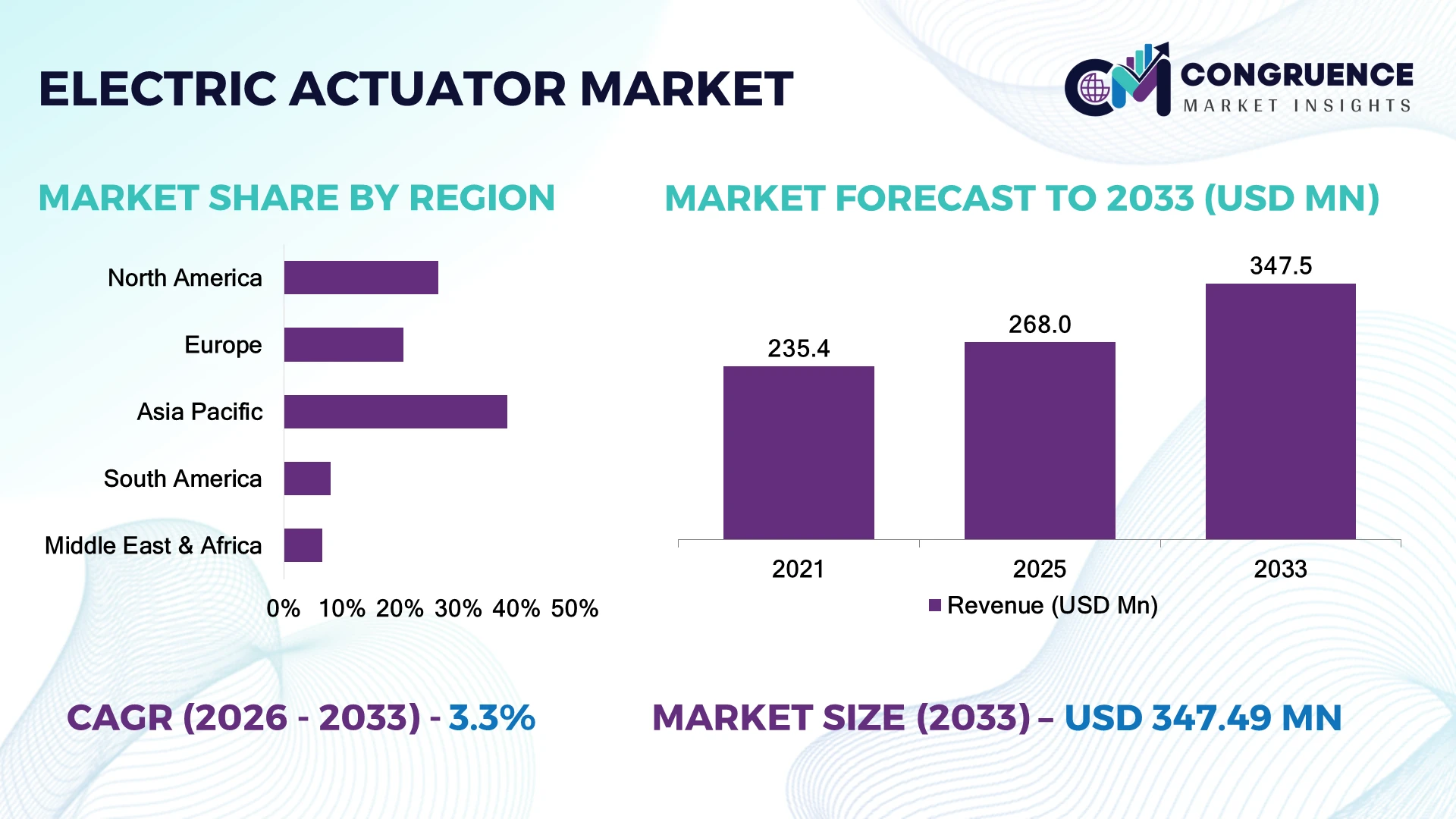
The Global Electric Actuator Market was valued at USD 268.0 Million in 2025 and is anticipated to reach a value of USD 347.5 Million by 2033 expanding at a CAGR of 3.3% between 2026 and 2033. Growth is driven by the replacement of pneumatic and hydraulic motion systems with programmable electric actuation across automated manufacturing, robotics, automotive production, and energy infrastructure.
China represents the dominant manufacturing and deployment hub, accounting for approximately 11% of the global market, supported by robotics, automotive, water treatment, and renewable-energy investments. India follows with around 9%, while Japan holds about 8%, with robotics and precision automation sustaining adoption. China’s industrial modernization under Made in China 2025 reinforces its scale advantage.
Strategic implication, suppliers should prioritize China-scale manufacturing, India’s expanding automation base, and digitally integrated actuator platforms to secure long-term industrial contracts.
Market Size & Growth: USD 268.0 million in 2025 is projected to reach USD 347.5 million by 2033 at a 3.3% CAGR, supported by industrial automation and electrification.
Top Growth Drivers: Industrial automation accounts for approximately 35% of demand influence, automotive electrification 28%, and energy-efficient motion control 22%.
Short-Term Forecast: By 2028, smart actuator deployment is expected to improve motion-control efficiency by 10–15% while reducing maintenance interventions by nearly 8%.
Emerging Technologies: AI-enabled diagnostics, IoT-connected actuators, closed-loop positioning, and advanced lightweight materials are reshaping precision automation.
Regional Leaders: Asia Pacific is projected at approximately USD 138 million by 2033, Europe at USD 91 million, and North America at USD 76 million, with robotics and smart-factory adoption accelerating.
Consumer/End-User Trends: Approximately 40% of industrial users increasingly prioritize programmable electric actuation for precision, repeatability, and lower auxiliary energy consumption.
Pilot/Case Example: In 2025, automated manufacturing deployments using intelligent electric actuators achieved operational-efficiency improvements of approximately 12% through coordinated motion control and predictive maintenance.
Competitive Landscape: Leading suppliers collectively control roughly 35% of the market, with Siemens, ABB, Emerson, Schneider Electric, and Rockwell Automation competing through automation integration, precision control, and product expansion.
Regulatory & ESG Impact: Industrial decarbonization programs and energy-efficiency requirements are accelerating replacement of compressed-air systems, with electric actuation delivering efficiency above 85% in suitable applications.
Investment & Funding: More than USD 1.4 trillion in China’s smart-manufacturing initiatives is strengthening automation ecosystems, while manufacturers expand actuator capacity and technology partnerships.
Innovation & Future Outlook: Next-generation systems will combine AI diagnostics, sensor fusion, edge connectivity, and predictive control, shifting competition from standalone components toward integrated motion-control ecosystems.
Electric actuator demand is strengthening across automotive assembly, robotics, water treatment, HVAC, aerospace, and energy infrastructure, where precision positioning and programmable control increasingly determine operating performance. Approximately 40% of industrial users prioritize energy-efficient motion technologies, while supply-chain localization is gaining importance as manufacturers diversify sourcing following geopolitical disruptions and regional production shifts. These developments are directing strategic investment toward intelligent, serviceable actuator platforms.
Electric actuators are becoming strategically important because manufacturers are replacing energy-intensive pneumatic and hydraulic systems with precise, programmable motion technologies that integrate directly with automation architectures. This shift strengthens production flexibility while reducing dependence on centralized compressed-air infrastructure. China is prioritizing large-scale automation, while India is rapidly expanding smart manufacturing, automotive production, and infrastructure modernization.
Technology economics increasingly favor electric systems in precision applications. Electric actuators can exceed 85% conversion efficiency, while pneumatic systems experience substantial energy losses through compression, leakage, and pressure maintenance. Over the next 2–3 years, industrial users are expected to increase connected-actuator deployment, with predictive-maintenance functionality targeting roughly 8–15% reductions in unplanned intervention requirements.
Operationally, automotive and electronics plants are integrating servo-driven actuators with PLC, MES, and robotic systems to coordinate high-speed assembly. Companies are responding by expanding localized manufacturing, developing sensor-integrated products, and forming automation partnerships rather than competing solely on component pricing. The strategic advantage will increasingly rest on interoperability, diagnostics, lifecycle efficiency, and integrated motion-control capability.
Industrial automation is accelerating the replacement of pneumatic motion systems with programmable electric actuators, particularly in automotive, electronics, packaging, and robotics. Electric systems commonly achieve efficiencies above 85%, while connected control can reduce maintenance interventions by approximately 8–15%. China’s manufacturing modernization and India’s smart-factory investments are strengthening demand for servo-driven positioning and digitally monitored motion systems. The shift is also supported by decarbonization pressure following the global push to reduce industrial energy intensity. Manufacturers are responding through localized actuator production, sensor integration, and partnerships with robotics and PLC suppliers. The non-obvious advantage is infrastructure simplification: electric actuation eliminates centralized compressed-air requirements, allowing factories to redesign production cells around decentralized, software-controlled motion.
High-performance electric actuators remain constrained by the cost of motors, precision gears, sensors, controllers, and specialized electronics. Advanced systems can carry initial equipment premiums of approximately 10–20% compared with basic pneumatic alternatives, while imported components expose manufacturers to currency and logistics volatility. China remains a critical production center for motors, electronics, and automation components, creating supply-chain concentration concerns during geopolitical disruptions. These pressures directly affect project payback periods and procurement schedules, particularly for price-sensitive manufacturers. Companies are reducing exposure through dual sourcing, regional assembly, longer-term component contracts, and standardized platforms. A key operational insight is that modular actuator architectures increasingly allow manufacturers to substitute individual components without redesigning complete motion-control systems.
The strongest opportunity lies in combining electric actuators with AI diagnostics, industrial IoT, and closed-loop control. Connected actuator adoption is positioned to improve maintenance planning by approximately 10–15%, while advanced positioning systems can deliver accuracy improvements of 5–10% in demanding automated processes. India offers an important expansion opportunity as automotive, electronics, aerospace, and infrastructure investments increase automation intensity. China is simultaneously creating opportunities for high-volume localized production. Manufacturers are investing in embedded sensors, edge analytics, and interoperable control interfaces while partnering with robotics and industrial-software providers. A differentiated opportunity is lifecycle-based actuator service, where suppliers monetize predictive maintenance, remote diagnostics, replacement planning, and performance optimization rather than relying exclusively on hardware sales.
Connected electric actuators introduce integration challenges across PLCs, robotic controllers, MES platforms, industrial networks, and cybersecurity architectures. Approximately 20–30% of modernization effort in complex automated facilities can be associated with integration, commissioning, and system validation rather than hardware installation. Workforce shortages in industrial controls and mechatronics further complicate deployment consistency. Increasing connectivity also expands the cybersecurity surface, particularly where actuator data enters cloud or edge platforms. Companies must invest in standardized communication protocols, secure firmware, technician training, and system-level testing. The strategic challenge is no longer simply achieving mechanical precision; manufacturers must maintain synchronized, secure operation across thousands of connected motion points without creating excessive commissioning or maintenance complexity.
Smart Diagnostics Gain Ground: IIoT-enabled actuators are moving from premium installations into mainstream factory upgrades, with intelligent systems targeting 8–15% lower maintenance intervention and approximately 10% better equipment availability. Manufacturers are embedding sensors, Ethernet connectivity, and condition monitoring directly into actuator packages, reducing dependence on separate diagnostic hardware. The shift is particularly visible in automotive and electronics plants where predictive maintenance is becoming a standard automation requirement.
Linear Systems Expand Rapidly: Linear electric actuators are gaining preference for precise positioning, material handling, and robotic movement, with the segment holding roughly 45–58% share across recent market assessments. Adoption is accelerating as manufacturers replace mechanically complex pneumatic arrangements with programmable motion systems. Suppliers are responding with compact servo cylinders, integrated feedback systems, and higher-load designs, while India and China are expanding localized actuator production to reduce lead times and imported-component exposure.
Digital Connectivity Reshapes Procurement: EtherNet/IP, fieldbus integration, remote diagnostics, and software-configurable motion are increasingly influencing purchasing decisions, with connected systems targeting 8–15% reductions in unplanned maintenance requirements. Companies are shifting from component-only procurement toward integrated actuator-and-controller packages, strengthening partnerships between actuator manufacturers, PLC suppliers, and robotics providers. This creates a non-obvious competitive shift: interoperability is increasingly becoming a purchasing criterion alongside torque, force, and positioning accuracy.
Electrification Accelerates Retrofitting: Industrial users are increasingly replacing pneumatic and hydraulic equipment with electric alternatives as energy-efficiency requirements and compressed-air costs intensify. More than 50% of new industrial installations in some market assessments now specify electric motion solutions, while automated warehouses are increasingly adopting electric actuation to reduce maintenance requirements. Manufacturers are prioritizing retrofit-ready designs, modular interfaces, and localized inventories as supply-chain restructuring and industrial reshoring increase the value of faster equipment replacement.
Linear electric actuators represent the leading type, accounting for approximately 58% of the market in one 2025 assessment, supported by broad use in valve positioning, material handling, assembly equipment, and robotic positioning. Their scalable force delivery, straightforward installation, and compatibility with programmable controls give them an advantage over rotary designs in applications requiring repeatable straight-line movement. Other assessments place linear actuators at approximately 45%, reflecting differences in market scope. Rotary actuators retain strong relevance for quarter-turn and multi-turn valve operations, especially in process industries.
Linear systems are also the fastest-moving type as factories increase servo-based automation and demand tighter positioning control. Adoption is strengthening in China, India, automotive manufacturing, and electronics production, where programmable motion is replacing fixed mechanical mechanisms. Companies are investing in integrated sensors, compact servo cylinders, and higher-force platforms, while rotary actuator suppliers are emphasizing torque density and digital diagnostics. The business implication is clear: investment is shifting toward flexible linear platforms that can serve multiple machine architectures rather than single-purpose actuation.
Industrial automation is the leading application, representing approximately 42% of the market in 2025, driven by widespread integration across assembly lines, robotics, material handling, and process-control equipment. Automotive follows with roughly 26% in comparable actuator applications, while aerospace and defense, oil and gas, water and wastewater, and other specialized uses maintain strategically important demand. Industrial automation benefits from high equipment utilization and repeatable motion requirements, making electric actuation particularly valuable where positioning accuracy and cycle consistency directly affect throughput.
Automation remains the strongest deployment base, while logistics and material-handling applications are gaining momentum as fulfillment centers increase conveyor, sorting, and automated storage capacity. Companies are scaling actuator integration with PLCs, robotic controllers, and warehouse automation platforms rather than deploying isolated components. Automotive manufacturers are prioritizing high-cycle servo systems, while water and wastewater operators increasingly value remote monitoring and low-maintenance valve control. This divergence is shifting investment toward application-specific actuator packages instead of standardized hardware alone.
Manufacturing is the leading end-user, representing approximately 46% of market adoption in 2025, reflecting intensive deployment across automotive, electronics, machinery, packaging, and robotics. High-cycle production environments require precise, repeatable movement, creating stronger actuator utilization than lower-frequency infrastructure applications. Energy and utilities form another significant buyer group because electric actuators provide dependable valve and damper control, while transportation applications are expanding as vehicle electrification and automated mobility systems increase actuator content.
Manufacturing remains the mature demand base, but energy and utilities are emerging as an increasingly important growth pocket because water infrastructure, renewable-energy installations, and process facilities require remotely controlled equipment. Companies are tailoring products around duty cycle, environmental protection, diagnostics, and network connectivity, while system integrators are becoming more influential in large automation projects. Approximately 65% of large manufacturing facilities in one recent assessment were reported to operate digitally controlled motion systems integrated with MES or IIoT platforms, reinforcing the shift toward connected procurement.
Asia Pacific accounted for the largest market share at approximately 38.4% in 2025 however, North America is expected to register the fastest growth, expanding at a CAGR of approximately 7.2% between 2026 and 2033.

North America remains the second-largest market, with approximately 26.5% share across closely defined actuator-market assessments. The United States dominates regional demand through aerospace, defense, automotive, robotics, oil and gas, and high-precision manufacturing. Industrial automation spending and reshoring initiatives are increasing demand for servo-driven and digitally connected actuators, particularly where manufacturers require high repeatability and reduced maintenance. The region also benefits from established engineering integrators and localized technical-service networks. In 2025, U.S. industrial automation investment increased by approximately 20%, strengthening demand for electronically controlled motion systems. Manufacturers are responding through domestic production expansion, strategic automation partnerships, and integrated actuator-controller platforms. The regional competitive advantage lies less in high-volume manufacturing than in high-value applications requiring precision, cybersecurity, lifecycle support, and system interoperability.
United States Market Outlook: The United States represents the principal North American demand center, supported by aerospace and defense programs, advanced automotive manufacturing, robotics, and industrial modernization. More than 20% growth in industrial automation investment during 2025 strengthened the deployment environment for electric motion-control equipment. U.S. manufacturers are increasingly prioritizing locally supported systems with digital diagnostics, high positioning accuracy, and secure industrial-network integration.
Europe represents a substantial mature market, with approximately 20.5% share in closely related actuator categories. Germany, France, Italy, and the United Kingdom anchor demand through automotive manufacturing, machinery production, process industries, and advanced factory automation. Energy-efficiency requirements and industrial decarbonization policies are encouraging manufacturers to replace energy-intensive pneumatic systems with electronically controlled motion solutions. European producers are also emphasizing compact designs, predictive diagnostics, and interoperable automation platforms. Germany’s strong Industry 4.0 ecosystem continues to concentrate investment around digitally integrated production lines, while manufacturers increasingly prioritize lifecycle efficiency rather than initial equipment cost. Companies are responding through R&D partnerships, localized engineering, and higher-value actuator platforms capable of integrating with existing factory-control architectures.
Germany Market Outlook: Germany remains Europe’s most strategically significant market because of its concentration of automotive OEMs, industrial machinery manufacturers, robotics integrators, and Industry 4.0 deployments. Its manufacturing ecosystem places strong emphasis on precision motion, energy efficiency, and interoperable control systems. The country’s industrial base therefore supports premium electric-actuator adoption where productivity, repeatability, and equipment integration outweigh basic component pricing.
Asia Pacific is the global leader, accounting for approximately 38.4% of the electric actuator market in 2025. China, Japan, South Korea, and India provide the strongest demand concentration through automotive production, electronics manufacturing, robotics, machinery, infrastructure, and process industries. China holds the leading country position, while India is strengthening its industrial automation base through manufacturing localization and electrification initiatives. The region also possesses a major advantage in actuator components, motors, electronics, and precision manufacturing, supporting shorter supply chains and competitive production economics. China’s manufacturing modernization programs and India’s expanding electronics and automotive ecosystems are increasing demand for programmable actuation. Companies are scaling local production, forming automation partnerships, and integrating sensors and connectivity into standard actuator platforms. The region’s key advantage is the combination of manufacturing volume, component availability, and rapidly expanding automation deployment.
China Market Outlook: China is the most strategically significant country in Asia Pacific, supported by its extensive automotive, electronics, machinery, robotics, and infrastructure manufacturing base. China accounted for approximately 36.9% of Asian industrial actuator demand in 2025, reinforcing its position as the region’s principal deployment and production hub. Large-scale smart-manufacturing investment continues to encourage domestic actuator production, automation integration, and supplier localization.
South America represents a smaller but strategically relevant actuator market, with approximately 8.0% share across related linear and actuator categories. Brazil dominates regional demand through mining, oil and gas, food processing, automotive production, water infrastructure, and industrial machinery. Electric actuators are increasingly deployed where remote control, valve automation, and reduced maintenance requirements improve operational reliability. Mining and energy projects are particularly relevant because harsh operating environments favor durable, digitally monitored actuation systems. However, infrastructure modernization and imported component dependence continue to influence project economics and delivery schedules. Companies are responding through distributor partnerships, localized technical support, and application-specific product configurations. Brazil’s industrial concentration creates a stronger opportunity for high-duty-cycle and process-control actuators than for broad consumer-oriented deployment, making sector specialization an important competitive strategy.
Brazil Market Outlook: Brazil is the region’s principal market because of its diversified industrial base and large-scale mining, energy, food-processing, automotive, and water infrastructure activities. Demand is increasingly concentrated in process-control and industrial automation applications where remote actuation reduces manual intervention. Suppliers are strengthening local distribution and service networks to address long equipment cycles and the logistical complexity of serving geographically dispersed industrial facilities.
Middle East & Africa remains a smaller market, representing approximately 6.6% of global actuator demand in closely related categories, but its project-driven deployment creates attractive opportunities in energy, water, desalination, petrochemicals, and infrastructure. Saudi Arabia and the UAE are leading investment centers, with large-scale industrial and infrastructure programs increasing demand for remotely controlled valves, dampers, and process equipment. Electric actuation is gaining relevance where operators require precise positioning, reduced manual intervention, and centralized monitoring. Water scarcity and desalination investment provide an additional structural demand base, particularly for automated flow-control systems. Companies are responding through EPC partnerships, regional service centers, and products designed for high-temperature and dusty environments. The region’s non-obvious advantage is the concentration of large infrastructure projects, allowing suppliers to secure high-volume contracts through a limited number of strategic engineering and procurement relationships.
Saudi Arabia Market Outlook: Saudi Arabia represents the region’s strongest strategic opportunity because industrial diversification, energy infrastructure, water projects, and large-scale urban development are increasing demand for automated equipment. Electric actuators are particularly relevant to remotely operated process systems and water infrastructure. Suppliers are positioning through EPC relationships and localized technical support, with project-based procurement favoring vendors capable of providing complete automation packages rather than standalone actuators.
Emerson, ABB, Siemens, Rockwell Automation, Rotork, and AUMA compete: automation groups challenge dedicated valve-actuation specialists, while Japanese and regional motion suppliers compete on cost and machine integration. The top five players command an estimated 24% combined share, indicating concentration without dominance. Competition centers on technology, reliability, customization, and supply reach. Smart connectivity can improve commissioning and diagnostics by 10–20%, while designs reduce maintenance requirements by roughly 8–15%. Global players leverage integrated automation platforms; specialists differentiate through actuator depth, certification, and field-service responsiveness. Players are expanding localized production, partnering with automation platforms, embedding sensors, and integrating predictive diagnostics. Rotork’s Rockwell partnership illustrates the shift toward ecosystem-based selling, while AUMA emphasizes safety-certified intelligent actuation. Supply-chain localization is becoming a competitive weapon as customers demand shorter lead times. Entry barriers remain high because qualification, installed-base support, and application engineering require years of expertise. Winning requires trusted certification, interoperable technology, regional service, and supply.
Emerson Electric Co.
ABB Ltd.
Siemens AG
Rockwell Automation, Inc.
Rotork plc
AUMA Riester GmbH & Co. KG
Flowserve Corporation
Parker Hannifin Corporation
Festo SE & Co. KG
SMC Corporation
Moog Inc.
Honeywell International Inc.
Smart actuators are becoming the core technology shift, combining embedded sensors, digital feedback, edge diagnostics, and industrial Ethernet, enabling real-time condition monitoring and remote configuration across production networks. Connected systems can reduce unplanned maintenance by 8–15% and improve commissioning efficiency by 10–20%. Adoption is strongest in automated manufacturing, process plants, and digitally managed water infrastructure, giving suppliers stronger lifecycle-service opportunities.
Servo-driven electric actuation increasingly replaces conventional pneumatic systems where precision and energy performance matter. Electric platforms can exceed 85% efficiency, while compressed-air systems often lose substantial energy through generation and leakage. New closed-loop actuators improve positioning accuracy by roughly 5–10%, enabling faster robotic handling and tighter machine tolerances. Siemens, ABB, Rockwell Automation, and Mitsubishi Electric benefit as customers consolidate motion hardware with controllers and software.
From 2026–2028, AI-assisted diagnostics, digital twins, cybersecurity, and predictive control will shift purchasing toward integrated actuator ecosystems. AI-supported monitoring can reduce diagnostic response time by 15–25%, while modular electronics simplify upgrades. The competitive advantage moves toward suppliers that combine mechanical reliability with interoperable software, secure connectivity, and regional service. Companies should act now because retrofit cycles increasingly lock in communication protocols and supplier platforms for years, strengthening suppliers materially.
January 2024 Emerson introduced Fisher easy-Drive 200R electric actuator for butterfly and ball valves, consuming less than 0.4 watts while holding position. The launch targets remote oil and gas sites, reducing control emissions and simplifying calibration through digital configuration software. Source: emerson.com
June 2025 Rotork joined Rockwell Automation’s Technology Partner Program, integrating the IQ3 Pro electric actuator with EtherNet/IP across North America, EMEA, and APAC. The partnership expands specification access for engineers and further strengthens Rotork’s connected-actuation positioning within industrial automation projects. Source: rotork.com
November 2025 AUMA launched TIGRON SIL, an explosion-proof electric actuator certified for safety applications up to SIL 3. The platform supports four configurable safety functions, strengthening deployment in hydrogen, process, and critical infrastructure projects worldwide requiring certified functional safety requirements. Source: auma.com
January 2025 AUMA supplied 241 electric actuators for Stockholm Exergi’s Kraftvärmeverk 1 retrofit. Profinet-enabled actuators automate valves after conversion toward renewable fuels, extending plant service life by 20 years and supporting reliable heat and electricity generation during winter energy demand. Source: auma.com
The report covers the Global Electric Actuator Market across linear and rotary configurations, with segmentation by type, application, and end-user. Coverage evaluates industrial automation, automotive, aerospace and defense, energy and power, water and wastewater, oil and gas, and other specialized applications. The analysis tracks manufacturing, infrastructure, retrofit, and smart-factory deployment patterns across major economies.
Regional coverage spans North America, Europe, Asia Pacific, South America, and the Middle East & Africa, with detailed country-level perspectives for major production and consumption hubs. The scope also examines servo control, IoT connectivity, predictive diagnostics, digital interfaces, energy-efficient architectures, and safety-certified systems. Competitive assessment covers leading global manufacturers, specialized actuator suppliers, partnerships, product innovation, localization, and ecosystem strategies. The findings support investment planning, market-entry decisions, expansion priorities, procurement strategy, and competitive positioning from 2026 through 2033.
| Report Attribute / Metric | Details |
|---|---|
| Market Revenue (2025) | USD 268.0 Million |
| Market Revenue (2033) | USD 347.5 Million |
| CAGR (2026–2033) | 3.3% |
| Base Year | 2025 |
| Forecast Period | 2026–2033 |
| Historic Period | 2021–2025 |
| Segments Covered |
By Type
By Application
By End-User
|
| Key Deliverables | Revenue Forecast; Market Trends; Growth Drivers & Restraints; Technology Insights; Segmentation Analysis; Regional Insights; Competitive Landscape; Regulatory & ESG Overview; Recent Developments |
| Regions Covered | North America; Europe; Asia-Pacific; South America; Middle East & Africa |
| Companies Profiled | Emerson Electric Co.; ABB Ltd.; Siemens AG; Rockwell Automation, Inc.; Rotork plc; AUMA Riester GmbH & Co. KG; Flowserve Corporation; Parker Hannifin Corporation; Festo SE & Co. KG; SMC Corporation; Moog Inc.; Honeywell International Inc. |
| Customization & Pricing | Available on Request (10% Customization Free) |




