
Reports
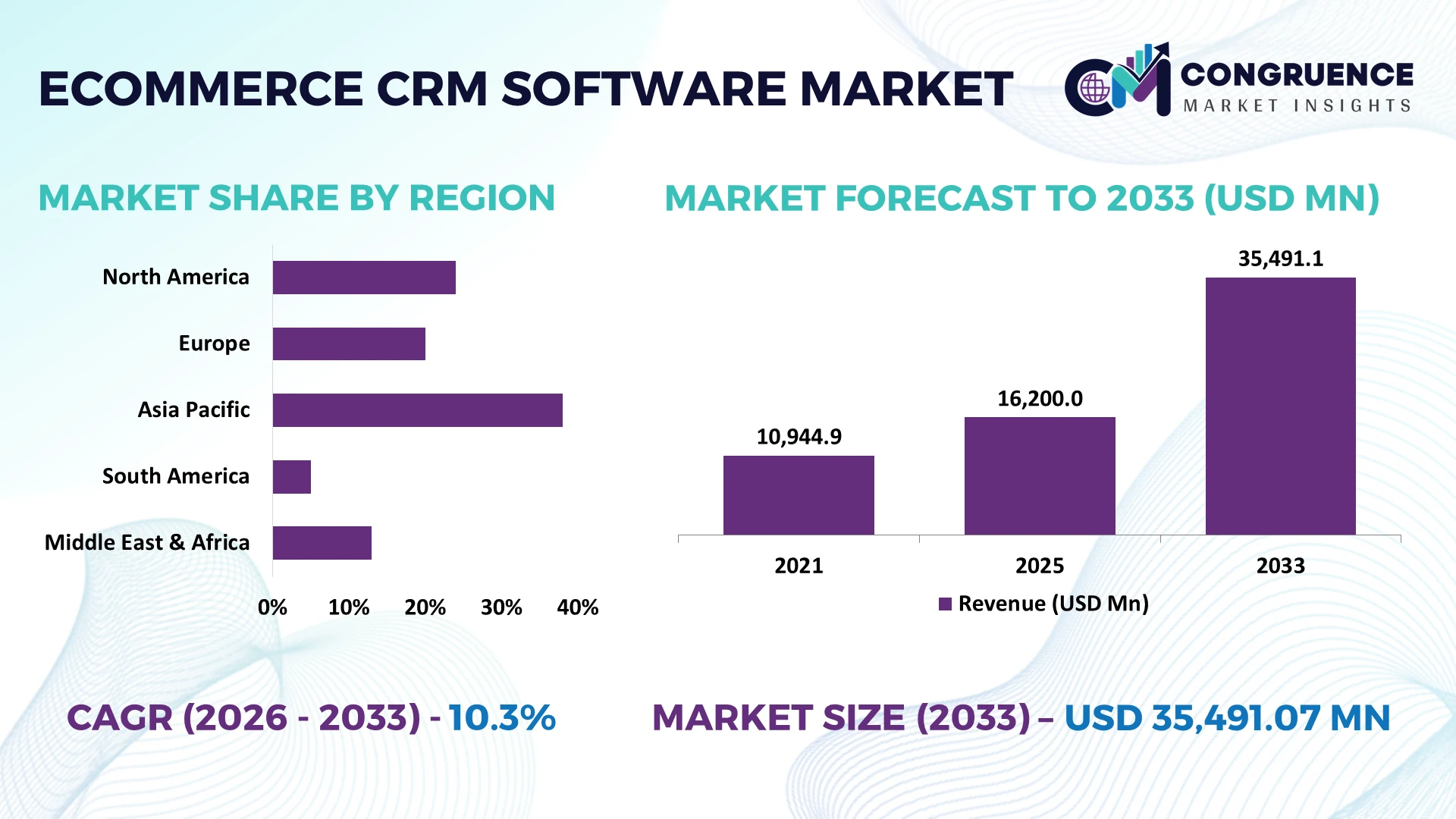
The Global Ecommerce CRM Software Market was valued at USD 16200 Million in 2025 and is anticipated to reach a value of USD 35491.07 Million by 2033 expanding at a CAGR of 10.3% between 2026 and 2033. Growth is driven by AI-powered customer engagement, omnichannel commerce integration, first-party data strategies, and enterprise investment in predictive sales automation across digital retail ecosystems.
The United States leads the global Ecommerce CRM Software Market with approximately 34% market share, supported by over 78% enterprise CRM integration across large online retailers, sustained cloud software investment, and strong adoption within retail, consumer goods, and direct-to-consumer industries. Compared with Germany, where enterprise deployment remains near 61%, U.S. businesses benefit from faster AI implementation following accelerated digital transformation and supply chain restructuring after ongoing global trade realignments in 2026.
Organizations prioritizing scalable CRM platforms with embedded AI, automation, and unified customer intelligence gain stronger retention, higher operational efficiency, and faster competitive execution across expanding digital commerce channels.
Market Size & Growth: USD 16,200 million in 2025, reaching USD 35,491.07 million by 2033 at a CAGR of 10.3%, driven by AI-enabled customer lifecycle management and omnichannel retail expansion.
Top Growth Drivers: AI-based personalization improves campaign conversion by 28%, marketing automation reduces manual workloads by 35%, and unified customer data platforms increase retention by 22%.
Short-Term Forecast: By 2028, CRM workflow automation cuts response time by 32% while improving sales productivity by approximately 26% across digital commerce operations.
Emerging Technologies: Generative AI, predictive analytics, and conversational automation accelerate deployment, with AI-enabled CRM adoption exceeding 55% among enterprise ecommerce organizations.
Regional Leaders: North America approaches USD 13.4 billion, Europe exceeds USD 8.6 billion, and Asia-Pacific nears USD 9.8 billion, supported by cloud-first retail expansion and regional digital commerce investment.
Consumer/End-User Trends: More than 68% of online retailers prioritize personalized customer journeys, increasing repeat purchase rates by approximately 24%.
Pilot/Case Example: In 2026, an AI-driven CRM deployment reduced customer support handling time by 31% while increasing qualified lead conversion by 19%.
Competitive Landscape: The top vendor group controls roughly 41% of the global market, with leading participants including Salesforce, Microsoft, SAP, Oracle, and HubSpot.
Regulatory & ESG Impact: Privacy-focused CRM architecture reduces compliance-related operational risk by nearly 27% while supporting evolving international data governance requirements.
Investment & Funding: More than USD 5.4 billion supports cloud CRM expansion, AI partnerships, and platform integration as enterprises diversify regional digital infrastructure.
Innovation & Future Outlook: Next-generation autonomous CRM, real-time predictive intelligence, and composable commerce architectures strengthen customer value optimization and enterprise scalability.
Ecommerce CRM Software Market demand continues to strengthen across direct-to-consumer brands, marketplaces, subscription commerce, and omnichannel retailers seeking intelligent customer engagement. AI-powered recommendation engines, conversational assistants, and real-time analytics now support over 60% of advanced CRM implementations, while growing emphasis on first-party data management reflects evolving global privacy requirements and resilient digital supply-chain operations, setting the stage for broader strategic market transformation.
The Ecommerce CRM Software Market has become strategically important as retailers compete through personalized engagement, unified customer intelligence, and faster decision-making rather than product assortment alone. Infrastructure modernization, expanding digital commerce ecosystems, and stricter customer data governance are reshaping platform investments across enterprise and mid-market businesses. In 2026, continued supply-chain restructuring has accelerated demand for CRM platforms capable of synchronizing customer, inventory, and fulfillment data, reducing operational delays while improving cross-channel responsiveness.
AI-enabled CRM platforms process customer interactions approximately 35% faster than legacy rule-based systems while lowering manual campaign management effort by nearly 30% through predictive automation and real-time analytics. The United States continues to lead large-scale enterprise deployment, whereas India records faster implementation among digitally native retailers supported by expanding cloud infrastructure and API-driven commerce platforms. More than 58% of new ecommerce CRM implementations now prioritize embedded AI capabilities, and enterprise adoption of unified customer data environments is expected to exceed 65% within the next two to three years.
A practical example is the deployment of AI-powered CRM integrated with warehouse management and customer support systems, enabling order visibility, automated service workflows, and personalized marketing from a single platform. Companies are expanding technology partnerships, increasing investment in composable commerce architectures, and strengthening cloud integration ecosystems to improve scalability. Businesses establishing intelligent CRM infrastructure today secure stronger customer retention, faster operational execution, and a more defensible competitive position in global digital commerce.
Enterprise adoption of AI-powered Ecommerce CRM platforms has become the primary structural driver as retailers seek unified customer engagement across digital channels. Nearly 72% of large online merchants now prioritize centralized customer data, while AI-enabled personalization improves campaign conversion by approximately 26% and reduces customer service response times by 31%. In the United States, increasing digital commerce infrastructure investment and evolving consumer privacy requirements are accelerating migration from fragmented legacy systems to integrated CRM ecosystems. This shift improves operational coordination between marketing, sales, and fulfillment. Leading vendors are responding through AI innovation, cloud expansion, strategic partnerships with commerce platforms, and industry-specific CRM solutions, creating stronger customer retention while improving enterprise productivity and long-term operational resilience.
Interoperability remains a major structural limitation as many enterprises operate disconnected ERP, inventory, payment, and customer service environments. Approximately 43% of mid-sized retailers report extended deployment timelines due to integration complexity, while customization costs increase implementation budgets by nearly 24%. Germany and Japan continue to face modernization challenges within established enterprise technology environments where legacy infrastructure limits seamless CRM deployment. Data localization requirements and evolving privacy regulations further increase implementation effort for multinational organizations. Companies are reducing operational risk by adopting modular cloud architectures, standardized APIs, localized data hosting, and long-term technology integration partnerships that improve deployment consistency while limiting disruption to existing ecommerce operations.
Next-generation automation presents significant opportunities as enterprises transition toward predictive customer engagement and autonomous commerce operations. AI-assisted customer journey orchestration improves marketing efficiency by approximately 34%, while intelligent recommendation engines increase repeat purchases by nearly 22%. India is emerging as a strategic expansion market due to rapid digital merchant growth, government-backed digital infrastructure initiatives, and increasing cloud adoption among small and medium-sized enterprises. Companies are investing in generative AI, conversational commerce, low-code CRM customization, and ecosystem partnerships that simplify deployment across marketplaces and direct-to-consumer channels. A non-obvious advantage lies in unified customer intelligence supporting inventory optimization alongside personalized engagement, improving both operational efficiency and customer lifetime value.
Long-term competitiveness depends on securely scaling CRM environments while maintaining consistent performance across increasingly complex digital commerce ecosystems. Around 47% of enterprises identify cybersecurity and customer data governance as leading barriers to advanced CRM deployment, while shortages of AI and cloud integration specialists extend implementation schedules by nearly 21%. In the United Kingdom, stricter digital compliance expectations require continuous platform upgrades and stronger governance frameworks, increasing operational complexity. Companies must strengthen zero-trust security architectures, invest in workforce development, expand cloud-native infrastructure, and collaborate with technology partners to ensure reliable scalability. Successfully addressing these execution challenges enables sustainable innovation, protects customer trust, and strengthens competitive differentiation in increasingly data-driven ecommerce markets.
AI-Native CRM Workflows Accelerate Enterprise ecommerce platforms are embedding generative AI directly into CRM environments to automate lead qualification, customer engagement, and campaign optimization. Around 61% of newly deployed enterprise CRM systems now include embedded AI functions, while automated customer interactions reduce service handling time by nearly 30% and improve campaign execution speed by 24%. Rising labor costs and increasing demand for faster digital operations are encouraging companies to expand AI partnerships and automate routine workflows without increasing headcount.
Composable Commerce Integration Expands Retailers are replacing monolithic software stacks with API-driven CRM ecosystems that integrate commerce, payment, fulfillment, and analytics platforms. Nearly 57% of enterprise deployments now prioritize modular integration, reducing implementation time by approximately 27% while improving operational flexibility by 22%. Large retailers in Germany are restructuring technology architectures to support faster software upgrades, prompting CRM providers to strengthen cloud partnerships and develop standardized integration frameworks for enterprise customers.
Privacy-Centric Customer Data Management Tightening customer data governance requirements are shifting CRM investment toward consent management, first-party data collection, and secure identity resolution. More than 64% of ecommerce enterprises now prioritize privacy-focused CRM capabilities, while centralized customer profiles improve marketing accuracy by roughly 21%. Organizations are redesigning data workflows and strengthening compliance automation, creating a competitive advantage through trusted customer relationships rather than relying on third-party tracking technologies.
Real-Time Omnichannel Decision Intelligence Businesses increasingly connect CRM platforms with inventory, logistics, and customer support systems to enable synchronized operational decisions. Approximately 54% of enterprise retailers use real-time customer intelligence across multiple sales channels, reducing order resolution time by 25% and improving repeat purchase rates by 19%. Following continued supply-chain adjustments in 2026, companies are expanding cloud infrastructure, investing in predictive analytics, and building strategic technology alliances to improve fulfillment accuracy and customer experience simultaneously.
Cloud-Based solutions dominate the Ecommerce CRM Software Market with an estimated 56% market share due to superior scalability, lower infrastructure requirements, seamless software updates, and strong integration with ecommerce ecosystems. Enterprises increasingly prefer cloud deployment because implementation cycles are approximately 30% shorter than traditional installations while enabling centralized customer intelligence across multiple business units. Hybrid deployment is the fastest-growing segment as organizations balance regulatory compliance with operational flexibility by combining cloud scalability and on-premises control. More than 42% of large enterprises now deploy hybrid CRM architectures to support sensitive customer information and regional data governance requirements.
On-Premises solutions remain strategically important for organizations operating under strict compliance or customized infrastructure environments, particularly within established enterprise ecosystems. Mobile-Based CRM platforms continue gaining traction as field sales teams and retail managers demand real-time customer visibility, increasing mobile CRM usage by nearly 26% across distributed operations. CRM vendors are expanding cloud-native capabilities, strengthening hybrid interoperability, and investing in mobile-first product development to align with evolving enterprise deployment strategies and long-term digital transformation priorities.
Customer Management remains the largest application segment, accounting for approximately 38% of total deployment due to its central role in customer retention, personalization, and lifecycle engagement. Organizations increasingly consolidate customer interactions into unified platforms, improving retention rates by nearly 23% while reducing duplicate customer records by approximately 28%. Marketing Automation represents the fastest-growing application as AI-powered campaign orchestration and behavioral segmentation become essential for improving conversion efficiency. Businesses are integrating customer intelligence with marketing workflows to deliver personalized engagement across digital commerce channels.
Sales Automation continues expanding through predictive lead scoring, workflow automation, and opportunity management, improving sales productivity by nearly 25%. Customer Support remains strategically relevant as enterprises deploy intelligent chatbots and knowledge automation to reduce response times. Order Management is increasingly integrated with CRM environments to synchronize customer communication and fulfillment visibility throughout the purchase journey. Vendors continue expanding automation capabilities, investing in AI-driven personalization, and strengthening platform interoperability to address increasingly complex ecommerce operations.
Retail represents the leading end-user segment with approximately 44% market share, supported by extensive omnichannel operations, high customer interaction volumes, and continuous digital engagement requirements. Large retail enterprises increasingly deploy advanced CRM platforms to unify physical and online customer experiences, improving repeat purchase rates by nearly 22% while increasing marketing efficiency by approximately 27%. Fashion & Apparel is the fastest-growing end-user segment as brands accelerate direct-to-consumer strategies, personalized recommendations, and loyalty-driven engagement through AI-enabled CRM platforms.
Consumer Goods companies continue strengthening CRM investments to improve distributor coordination and direct customer relationships across digital channels. Electronics manufacturers increasingly integrate CRM with after-sales service and warranty management to improve customer lifetime value. Healthcare organizations are selectively adopting ecommerce CRM capabilities for digital patient engagement and personalized communication while maintaining regulatory compliance. Software providers are responding through industry-specific product customization, strategic implementation partnerships, flexible pricing models, and ecosystem expansion that addresses distinct operational requirements across each end-user category.
North America accounted for the largest market share at 38% in 2025 however, Asia-Pacific is expected to register the fastest growth, expanding at a 12.4% between 2026 and 2033.
AI-Driven Enterprise CRM Modernization Strengthens Market Leadership
North America maintains the leading position through advanced cloud infrastructure, mature ecommerce ecosystems, and widespread enterprise investment in AI-enabled customer engagement platforms. The region represents approximately 38% of global deployment activity, supported by strong adoption across retail, consumer goods, and digital marketplace operators. More than 70% of large online retailers operate integrated CRM platforms connected with marketing automation, customer analytics, and fulfillment systems. During 2026, several enterprise software partnerships expanded AI-based customer intelligence capabilities, reducing implementation cycles by nearly 24% through standardized cloud integration. Organizations continue prioritizing unified customer data environments to improve personalization, operational visibility, and customer retention while accelerating digital commerce modernization.
United States Market Outlook: The United States remains the regional technology leader due to extensive enterprise cloud adoption, sophisticated ecommerce infrastructure, and continuous investment in AI-driven business applications. Approximately 78% of enterprise retailers utilize integrated CRM ecosystems supporting omnichannel operations, predictive analytics, and automated customer engagement. Strong venture investment, advanced digital payment infrastructure, and expanding software partnerships continue strengthening enterprise deployment, making the country the primary innovation hub for next-generation Ecommerce CRM Software solutions.
Privacy-Centric Digital Transformation Reshapes Enterprise Deployment
Europe continues strengthening Ecommerce CRM Software adoption through digital modernization, enterprise cloud migration, and rigorous customer data governance. The region contributes approximately 27% of global implementation activity, supported by strong retail digitization and advanced enterprise software ecosystems. More than 62% of large organizations prioritize CRM platforms with integrated privacy management and automated compliance capabilities. Infrastructure modernization and API-driven software integration are reducing deployment complexity by nearly 20%, enabling organizations to unify customer engagement across digital sales channels. CRM vendors increasingly expand regional cloud infrastructure and enterprise partnerships to address evolving regulatory expectations while improving operational efficiency.
Germany Market Outlook: Germany serves as Europe's largest enterprise CRM deployment market through its advanced manufacturing economy, digital retail sector, and strong enterprise software adoption. Nearly 64% of large retailers have integrated cloud-enabled CRM systems with supply-chain and customer analytics platforms. Ongoing industrial digitalization, investment in secure cloud environments, and enterprise automation initiatives continue reinforcing Germany's strategic importance within the European Ecommerce CRM Software landscape.
Digital Commerce Expansion Accelerates Enterprise Adoption
Asia-Pacific represents the fastest-expanding Ecommerce CRM Software market, supported by rapid ecommerce penetration, expanding cloud infrastructure, and growing digital entrepreneurship. The region accounts for approximately 29% of global CRM deployment activity while recording the strongest enterprise implementation momentum. More than 60% of new ecommerce businesses adopt cloud-native CRM platforms during their early operational stages, reducing deployment complexity by approximately 28%. Technology providers continue investing in localized cloud infrastructure, AI integration, and strategic platform partnerships to support increasing digital commerce activity across high-growth economies.
India Market Outlook: India has emerged as the region's most dynamic deployment market, driven by rapid digital commerce expansion, government-supported digital infrastructure, and widespread cloud adoption among small and medium-sized enterprises. Approximately 65% of mid-sized online retailers now prioritize AI-enabled CRM implementation to improve customer engagement and operational efficiency. Strong software development capabilities, expanding SaaS ecosystems, and growing enterprise technology investment position India as a major long-term innovation and deployment center.
Cloud Adoption Expands Across Digital Retail
South America is experiencing increasing Ecommerce CRM Software adoption as digital retail infrastructure improves and businesses modernize customer engagement operations. The region represents approximately 6% of global market activity, with enterprise cloud migration steadily replacing fragmented legacy customer management systems. Around 52% of new CRM deployments are cloud-based, improving implementation speed by nearly 23%. Expanding fintech ecosystems, improving logistics capabilities, and regional technology partnerships are encouraging broader CRM integration across ecommerce operations. Infrastructure limitations remain in selected markets, but continued digital investment supports sustained enterprise adoption.
Brazil Market Outlook: Brazil leads regional CRM deployment through its large ecommerce sector, expanding digital payment ecosystem, and growing enterprise cloud adoption. More than 58% of enterprise retailers have integrated CRM platforms with digital marketing and customer support functions to improve customer retention and sales efficiency. Domestic technology investment, stronger cloud infrastructure, and increasing AI adoption continue reinforcing Brazil's position as South America's primary Ecommerce CRM Software market.
Digital Infrastructure Investment Drives Enterprise Transformation
The Middle East & Africa market continues expanding as governments and enterprises accelerate cloud modernization and digital commerce initiatives. The region contributes approximately 5% of global deployment activity, supported by increasing investment in smart infrastructure and enterprise digital transformation. Nearly 48% of newly deployed ecommerce platforms now integrate CRM applications during initial implementation, improving customer engagement efficiency by approximately 21%. Regional technology partnerships and expanding hyperscale cloud infrastructure continue strengthening enterprise software deployment while supporting long-term digital economy objectives.
United Arab Emirates Market Outlook: The United Arab Emirates leads regional adoption through advanced digital infrastructure, strong cloud investment, and a rapidly expanding ecommerce ecosystem. Around 63% of large digital retailers have implemented integrated CRM platforms supporting omnichannel customer engagement and AI-enabled analytics. Government-backed digital transformation initiatives, international technology partnerships, and favorable enterprise investment conditions continue positioning the UAE as the region's principal Ecommerce CRM Software innovation and deployment hub.
The competitive landscape is led by Salesforce, Microsoft, Oracle, SAP, and HubSpot, competing directly against agile cloud-native vendors such as Zoho and Freshworks for enterprise and mid-market ecommerce customers. The top five providers collectively control approximately 58% of the market, with competition centered on AI functionality, integration depth, deployment speed, and platform customization rather than pricing alone. AI-enabled workflow automation improves customer engagement efficiency by nearly 30%, while low-code implementation reduces deployment time by approximately 25%, creating measurable differentiation. Established technology leaders expand through strategic cloud partnerships, ecosystem integration, and industry-specific product development, whereas emerging vendors emphasize faster implementation and cost-efficient subscription models. Technology convergence between CRM, commerce, and analytics platforms continues accelerating market consolidation. High integration complexity, enterprise switching costs, and strict customer data governance requirements remain major barriers for new entrants. Winning requires scalable AI capabilities, seamless interoperability, rapid deployment, and continuous innovation aligned with enterprise digital commerce priorities.
Salesforce
Microsoft
Oracle
SAP
HubSpot
Zoho Corporation
Freshworks
Adobe
Creatio
SugarCRM
Pipedrive
Zendesk
monday.com
Pegasystems
Artificial intelligence, cloud-native architecture, and unified customer data platforms define the current technology foundation of the Ecommerce CRM Software Market. AI-powered recommendation engines improve campaign conversion by approximately 28%, while workflow automation reduces manual customer management effort by nearly 32%. Around 68% of enterprise ecommerce CRM deployments now operate on cloud infrastructure with API-based integration linking commerce, payment, logistics, and marketing systems. These technologies enable faster customer insights, lower operational complexity, and more consistent omnichannel engagement, giving retailers measurable competitive advantages through real-time decision-making and scalable digital operations.
Emerging technologies between 2026 and 2028 include generative AI assistants, autonomous sales agents, predictive customer lifetime value analytics, and composable CRM architectures. More than 57% of newly deployed enterprise platforms incorporate embedded AI capabilities, while real-time behavioral analytics improves customer segmentation accuracy by nearly 24%. Compared with legacy rule-based CRM systems, AI-native platforms process customer interactions approximately 35% faster and reduce campaign optimization costs by around 22%. Organizations adopting integrated CRM ecosystems also strengthen inventory coordination, personalized engagement, and customer retention through synchronized operational intelligence.
Disruptive innovation is shifting competition toward intelligent automation rather than traditional customer record management. Early adopters implementing autonomous CRM workflows are expected to increase by over 65% by 2028, benefiting global retailers, digital marketplaces, and subscription commerce operators. Vendors are expanding strategic AI partnerships, strengthening low-code integration capabilities, and embedding predictive analytics directly into ecommerce workflows. Companies acting now secure stronger operational scalability, faster deployment cycles, and superior customer intelligence before AI-native CRM platforms become the enterprise standard.
April 2026 Salesforce and Google Cloud expanded their strategic partnership to connect Agentforce with Google Cloud AI services, enabling AI agents to execute end-to-end enterprise workflows across platforms while reducing context switching through unified data integration. Business impact: stronger enterprise automation and productivity. Source: salesforce.com
April 2026 Microsoft announced Dynamics 365 Release Wave 1, introducing broad AI-driven CRM and business application enhancements with production deployment beginning on April 1 across global regions. Business impact: faster enterprise adoption and standardized intelligent CRM operations. Source: learn.microsoft.com
April 2026 HubSpot introduced its Legacy CRM Card View Swapping Tool, allowing developers to migrate existing CRM interfaces without disrupting customer environments before scheduled platform changes. The migration supports 100% preservation of existing CRM view placement. Business impact: lower migration risk and smoother platform modernization. Source: developers.hubspot.com
September 2025 HubSpot unveiled Data Hub, enhanced Smart CRM capabilities, AI agents, and more than 200 product updates during INBOUND 2025 to strengthen unified customer intelligence and AI-assisted workflows. Business impact: improved personalization and enterprise productivity across digital commerce operations. Source: techradar.com
This report provides comprehensive analysis of the Ecommerce CRM Software Market across Cloud-Based, On-Premises, Hybrid, and Mobile-Based deployment models, covering Customer Management, Sales Automation, Marketing Automation, Customer Support, and Order Management applications. The assessment evaluates demand across Retail, Consumer Goods, Healthcare, Fashion & Apparel, and Electronics while examining more than 10 major technology providers and evolving enterprise deployment strategies. Approximately 68% of current enterprise implementations emphasize cloud-native and AI-enabled CRM environments, reflecting accelerating digital commerce transformation.
The report delivers detailed regional assessment across North America, Europe, Asia-Pacific, South America, and the Middle East & Africa, highlighting deployment patterns, technology adoption, competitive positioning, and operational developments between 2026 and 2033. It also examines emerging technologies, AI integration, automation trends, customer data platforms, and ecosystem partnerships to support investment planning, product expansion, competitive benchmarking, digital transformation strategies, and long-term enterprise decision-making across rapidly evolving ecommerce environments.
| Report Attribute/Metric | Report Details |
|---|---|
Market Revenue in 2025 | USD 16200 Million |
Market Revenue in 2033 | USD 35491.07 Million |
CAGR (2026 - 2033) | 10.3% |
Base Year | 2025 |
Forecast Period | 2026 - 2033 |
Historic Period | 2021 - 2025 |
Segments Covered | By Type
By Application
By End-User
|
Key Report Deliverable | Revenue Forecast, Growth Trends, Market Dynamics, Segmental Overview, Regional and Country-wise Analysis, Competition Landscape |
Region Covered | North America, Europe, Asia-Pacific, South America, Middle East, Africa |
Key Players Analyzed | Salesforce, Microsoft, Oracle, SAP, HubSpot, Zoho Corporation, Freshworks, Adobe, Creatio, SugarCRM, Pipedrive, Zendesk, monday.com, Pegasystems |
Customization & Pricing | Available on Request (10% Customization is Free) |




