
Reports
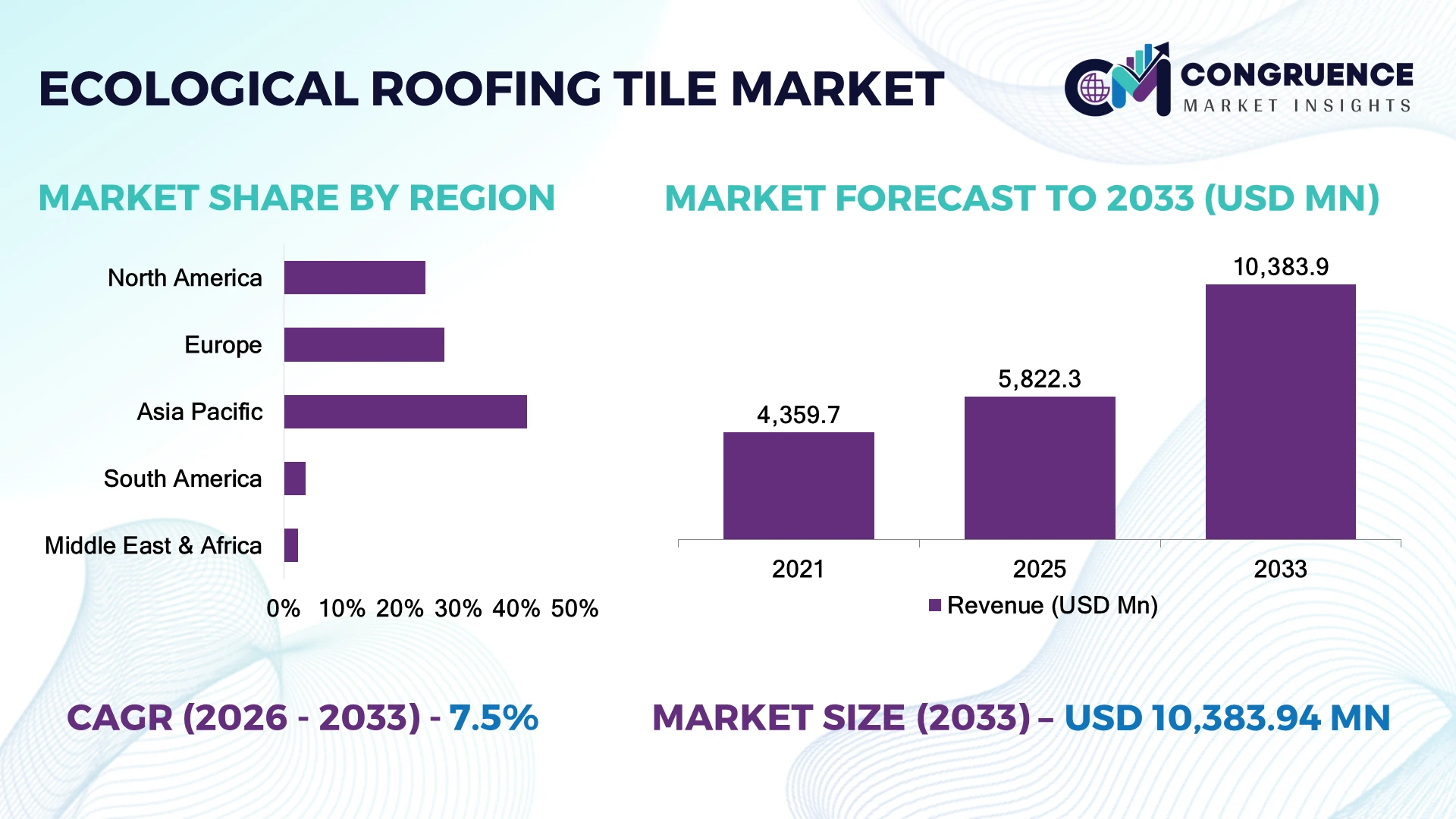
The Global Ecological Roofing Tile Market was valued at USD 5,822.3 Million in 2025 and is anticipated to reach a value of USD 10,383.9 Million by 2033 expanding at a CAGR of 7.5% between 2026 and 2033. Growth is driven by stricter low-carbon building regulations, rising adoption of recycled construction materials, and rapid deployment of energy-efficient residential and commercial roofing systems.
China accounts for approximately 31% of global ecological roofing tile manufacturing capacity, supported by large-scale green building programmes, recycled construction material investments, and automated tile production technologies. More than 57% of newly approved public buildings in major urban centres incorporate sustainable roofing specifications. Compared with Italy's premium clay-based ecological roofing segment, China leads in manufacturing scale and cost competitiveness. Continued supply-chain diversification following global trade adjustments during 2025–2026 has accelerated regional production investments and material localisation.
Manufacturers combining recycled material innovation, automated production, and certified sustainable roofing solutions will secure stronger positions across future construction and renovation projects.
Market Size & Growth: USD 5,822.3 Million in 2025, reaching USD 10,383.9 Million by 2033 at a CAGR of 7.5%, supported by sustainable construction and recycled material adoption.
Top Growth Drivers: Green building regulations (+34%), recycled material utilisation (+29%), energy-efficient housing (+26%).
Short-Term Forecast: By 2028, automated tile manufacturing improves production efficiency by 18% while reducing material waste by 15%.
Emerging Technologies: AI-enabled quality inspection, recycled composite materials, and advanced reflective coatings improve product performance.
Regional Leaders: Asia-Pacific exceeds USD 4.8 Billion, Europe approaches USD 2.6 Billion, North America surpasses USD 1.9 Billion through green renovation projects.
Consumer/End-User Trends: Approximately 61% of premium residential developments specify environmentally certified roofing systems.
Pilot/Case Example: In 2026, a sustainable housing programme reduced roof installation waste by 17% using modular ecological roofing systems.
Competitive Landscape: Leading suppliers hold nearly 39% market share, led by BMI Group, Wienerberger, Terreal, Boral, and Marley.
Regulatory & ESG Impact: Ecological roofing solutions reduce roof-related lifecycle carbon emissions by approximately 24%.
Investment & Funding: More than USD 1.6 Billion supports recycled material production, manufacturing expansion, and green construction partnerships.
Innovation & Future Outlook: Bio-based binders, solar-compatible roofing tiles, and circular manufacturing are reshaping premium roofing markets.
Ecological roofing tiles are increasingly deployed across residential housing, commercial buildings, public infrastructure, and heritage renovation projects where durability, thermal efficiency, and environmental performance are critical. Advanced recycled composites and reflective surface technologies have improved roof energy performance by approximately 19%, while stricter sustainable building standards and evolving construction supply chains continue accelerating adoption, creating a strong foundation for long-term strategic market expansion.
The Ecological Roofing Tile market has become strategically important as governments, developers, and property owners prioritise low-carbon construction and climate-resilient building materials. Regulatory changes supporting energy-efficient buildings, combined with modernisation of residential housing and commercial infrastructure, are shifting procurement from conventional roofing materials toward recyclable, durable, and thermally efficient ecological roofing systems. Competitive advantage increasingly depends on material innovation, certified environmental performance, and manufacturing efficiency.
Modern automated production using recycled mineral composites improves manufacturing efficiency by approximately 20% while reducing production waste by nearly 16% compared with conventional roofing tile manufacturing. Italy continues leading premium clay-based ecological roofing innovation, whereas China dominates large-scale recycled composite production through integrated manufacturing ecosystems. Over the next two to three years, more than 46% of newly introduced premium roofing products are expected to incorporate enhanced reflective coatings or recycled raw materials to meet evolving sustainability requirements.
Manufacturers are expanding recycled material processing, partnering with green building developers, and investing in solar-compatible roofing systems that improve long-term building performance. Ecological roofing tiles are increasingly deployed across residential renovation, industrial facilities, and public infrastructure projects requiring extended durability and lower maintenance. Companies combining sustainable material innovation, automated production, and resilient supply networks will establish stronger competitive positioning as environmental compliance becomes a decisive purchasing criterion.
Mandatory energy-efficiency regulations and low-carbon construction policies are accelerating deployment of ecological roofing tiles across residential and commercial projects. Approximately 52% of newly certified green buildings now specify environmentally sustainable roofing materials, while recycled-content roofing adoption has increased by nearly 28% over the past two years. Germany and France continue strengthening building efficiency requirements, encouraging developers to replace conventional roofing with thermally efficient ecological alternatives. This regulatory shift reduces lifecycle environmental impact while improving long-term building performance. Manufacturers are expanding recycled raw material processing, investing in advanced coating technologies, and partnering with sustainable housing developers. A notable strategic advantage lies in securing environmental certifications early, enabling suppliers to qualify for premium public-sector and institutional construction contracts.
Stable procurement of recycled aggregates, polymers, and mineral-based raw materials remains a structural constraint for ecological roofing tile manufacturers. Recycled inputs account for nearly 43% of production materials, while procurement costs for selected recycled components have fluctuated by approximately 16% because of inconsistent collection and processing infrastructure. Several European manufacturers continue facing shortages of high-quality recycled feedstock as circular construction supply chains mature. These disruptions reduce production efficiency, complicate inventory planning, and increase contract pricing uncertainty. Companies are responding through regional recycling partnerships, long-term procurement agreements, and investments in dedicated material recovery facilities. Manufacturers with integrated recycling operations achieve greater production stability and stronger margin protection than competitors dependent on external material suppliers.
Integration of ecological roofing tiles with rooftop solar systems is creating a differentiated growth opportunity beyond traditional roofing applications. Approximately 36% of new low-rise residential developments now evaluate solar-ready roofing systems during project planning, while integrated roofing solutions reduce installation complexity by nearly 18% compared with separate structural modifications. Japan and the Netherlands continue encouraging building-integrated renewable technologies that complement sustainable roofing materials. Manufacturers are investing in modular roof designs, advanced fastening systems, and digital installation planning platforms. An emerging strategic opportunity lies in developing multifunctional roofing tiles combining thermal efficiency, rainwater management, and photovoltaic compatibility within a single certified building envelope solution.
Delivering consistent durability, thermal performance, and weather resistance across diverse climatic environments remains a major execution challenge. Approximately 48% of infrastructure projects require region-specific performance certification, while advanced durability testing extends product qualification timelines by nearly 21%. Roofing systems deployed in tropical climates, coastal zones, and freeze-thaw environments require different engineering specifications, increasing manufacturing complexity and product development costs. These technical requirements complicate portfolio standardisation and reduce production flexibility. Companies must strengthen material science capabilities, expand climate simulation testing, and collaborate with certification agencies to accelerate product validation. Long-term competitiveness depends on developing adaptable ecological roofing systems without compromising manufacturing efficiency or environmental performance.
Reflective Surface Technologies Expand: High-reflectance ecological roofing tiles have experienced approximately 27% higher adoption in urban residential developments, lowering rooftop heat absorption by nearly 18%. Building energy regulations and rising cooling costs are accelerating deployment, prompting manufacturers to scale advanced coating technologies and optimise production processes for climate-responsive roofing solutions.
Circular Material Integration Advances: Recycled mineral and construction waste utilisation has increased by approximately 24%, while factory waste recovery has improved by nearly 17%. Manufacturers are restructuring supply agreements with demolition contractors and recycling companies, strengthening circular production models that reduce dependence on virgin raw materials while improving resource efficiency.
Digital Manufacturing Improves Quality: Automated moulding, robotic handling, and AI-assisted inspection now support approximately 41% of premium roofing tile production, reducing dimensional variation by nearly 15% and improving manufacturing throughput by around 19%. Labour shortages in mature construction markets are encouraging producers to accelerate factory automation and digital quality assurance programmes.
Lightweight Modular Roof Systems: Lightweight ecological roofing systems have reduced roof installation time by approximately 22% while lowering structural load requirements by nearly 14%. Developers increasingly specify modular roofing for renovation projects where installation speed is operationally critical. Manufacturers are expanding prefabricated product portfolios and strengthening partnerships with modular housing specialists to improve project delivery efficiency.
Clay ecological roofing tiles account for approximately 46% of the global market, maintaining leadership through long service life, natural thermal insulation, aesthetic versatility, and compatibility with green building standards. Their proven durability and low maintenance requirements continue supporting widespread adoption across residential housing, heritage restoration, and premium commercial developments. Concrete ecological roofing tiles remain highly competitive in cost-sensitive projects due to manufacturing scalability and structural strength, while recycled composite tiles continue gaining acceptance where circular construction objectives influence procurement decisions.
Recycled composite ecological roofing tiles represent the fastest-growing segment as developers increasingly prioritise recycled content and lightweight construction. Adoption of recycled composite systems has increased by approximately 27%, while demand for high-reflectance roofing materials has expanded by nearly 21%. Manufacturers are investing in recycled polymer technologies, bio-based additives, and automated moulding processes while forming partnerships with recycling companies to strengthen raw material availability. Investment priorities are steadily shifting from traditional production toward circular manufacturing platforms capable of supporting certified low-carbon construction projects.
A 2026 industry assessment by the World Green Building Council highlighted that building products with verified recycled content and enhanced energy performance continue gaining preference across sustainable construction specifications.
Residential construction accounts for approximately 54% of ecological roofing tile demand, driven by new housing developments, roof replacement programmes, and increasing homeowner investment in energy-efficient building materials. Government-supported housing upgrades and stricter building efficiency requirements continue concentrating demand within single-family homes and multi-unit residential projects. Commercial buildings represent a mature application focused on lifecycle performance and environmental compliance, while public infrastructure projects increasingly specify ecological roofing systems to meet sustainability objectives.
Commercial construction is emerging as the fastest-growing application segment as developers integrate environmentally certified roofing into offices, educational facilities, healthcare buildings, and mixed-use projects. Adoption across commercial developments has increased by approximately 24%, while modular roof system deployment has improved installation productivity by nearly 19%. Manufacturers are expanding customised roofing portfolios, integrating digital design support, and increasing production of reflective and solar-compatible roofing products. Demand is becoming operationally critical where long-term maintenance savings and environmental certification directly influence project economics.
According to findings released during a 2025 international construction industry survey, sustainable roofing materials have become a standard specification in a growing share of environmentally certified commercial building projects.
Residential developers account for approximately 49% of ecological roofing tile purchases due to large deployment volumes across housing communities, urban redevelopment projects, and premium residential construction. Procurement is increasingly influenced by thermal efficiency, lifecycle durability, and environmental certification requirements rather than initial material cost alone. Commercial developers continue strengthening demand through sustainable office and retail developments, while government agencies remain important buyers for schools, healthcare facilities, and public infrastructure modernisation.
Government and institutional buyers represent the fastest-growing end-user segment as public investment increasingly prioritises resilient, energy-efficient, and environmentally compliant buildings. Procurement from this segment has increased by approximately 23%, while specification of recycled-content roofing materials has risen by nearly 18%. Manufacturers are responding through project-specific product customisation, strategic partnerships with infrastructure contractors, and expanded certified product portfolios. Future demand is shifting toward buyers seeking integrated sustainability performance, long-term operational savings, and compliance with evolving green construction frameworks.
A 2026 enterprise assessment conducted by an international green building industry organisation found that public-sector construction programmes increasingly prioritise certified sustainable roofing materials for long-life infrastructure projects.
Asia-Pacific accounted for the largest market share at 41.8% in 2025 however, Middle East & Africa is expected to register the fastest growth, expanding at a CAGR of 8.3% between 2026 and 2033.
Green Building Renovation Drives Premium Roofing Adoption
North America represents approximately 24.3% of the global Ecological Roofing Tile market, supported by accelerating residential roof replacement, commercial building retrofits, and stricter energy-efficiency standards. Developers are increasingly specifying ecological roofing materials that combine thermal performance with extended service life and recycled content. Nearly 46% of sustainable residential renovation projects now incorporate environmentally certified roofing systems. Manufacturers are expanding automated production lines and introducing reflective roofing technologies that reduce lifecycle maintenance costs. Investment in resilient housing and climate-adaptive infrastructure continues strengthening demand for premium ecological roofing solutions across urban and suburban construction markets.
United States Market Outlook: The United States leads regional deployment through large-scale residential renovation, green building certification programmes, and increasing adoption of energy-efficient roofing systems. Domestic manufacturers continue investing in recycled raw material processing and advanced surface coating technologies to improve product durability. Approximately 58% of ecological roofing tile installations are associated with residential renovation and premium housing developments, reinforcing the country's position as the primary innovation and consumption centre within North America.
Circular Construction Standards Reshape Roofing Materials
Europe accounts for approximately 27.6% of the Ecological Roofing Tile market, supported by ambitious building decarbonisation initiatives, circular economy policies, and extensive renovation of ageing housing stock. Manufacturers continue increasing recycled material utilisation while developing durable roofing systems that meet demanding environmental certification standards. Around 44% of sustainable building refurbishment projects specify ecological roofing products to improve thermal efficiency and reduce material waste. Product innovation increasingly focuses on recyclable compositions, long-term durability, and compatibility with low-carbon construction practices.
Germany Market Outlook: Germany remains the region's largest market due to its advanced construction materials industry, strong regulatory framework, and high adoption of sustainable building technologies. Domestic manufacturers continue modernising production facilities with energy-efficient manufacturing systems and recycled mineral processing. Nearly 51% of environmentally certified residential developments incorporate ecological roofing materials, reflecting the country's leadership in sustainable construction and industrial innovation.
Large-Scale Manufacturing Supports Market Leadership
Asia-Pacific remains the leading production and consumption hub for ecological roofing tiles because of rapid urban development, integrated ceramic manufacturing, and expanding sustainable housing programmes. China, India, and Japan continue investing in environmentally responsible construction materials while strengthening domestic manufacturing capacity. Approximately 63% of regional ecological roofing tile production is concentrated within integrated manufacturing clusters, enabling competitive pricing and efficient supply chains. Companies are expanding automated production facilities and increasing exports of recycled and energy-efficient roofing products to international construction markets.
China Market Outlook: China dominates global production through extensive ceramic manufacturing infrastructure, growing recycled material utilisation, and strong policy support for green buildings. Manufacturers continue deploying intelligent manufacturing systems and advanced kiln technologies to improve production efficiency. More than 55% of ecological roofing tile output is supplied to residential and public infrastructure projects, reinforcing China's position as the industry's principal manufacturing and deployment centre.
Sustainable Housing Programmes Expand Market Demand
South America is experiencing steady adoption of ecological roofing tiles as governments and private developers prioritise affordable housing, climate-resilient construction, and infrastructure modernisation. Residential construction remains the largest deployment area, while commercial projects increasingly adopt sustainable roofing materials to improve long-term operating performance. Approximately 29% of new housing developments now evaluate environmentally certified roofing systems during project planning. Manufacturers are expanding local distribution networks and strengthening partnerships with regional construction firms despite logistical and raw material supply challenges.
Brazil Market Outlook: Brazil leads regional demand owing to its large residential construction sector, established ceramic tile manufacturing industry, and increasing investment in sustainable housing. Domestic producers continue upgrading production facilities with energy-efficient kilns and recycled raw material integration. Nearly 48% of ecological roofing tile consumption is linked to residential construction programmes, strengthening Brazil's role as the principal production and consumption market in South America.
Climate-Resilient Infrastructure Strengthens Premium Roofing Demand
The Middle East & Africa market is gaining momentum through major infrastructure programmes, sustainable urban developments, and increasing demand for thermally efficient roofing systems capable of withstanding harsh climatic conditions. High solar exposure and rising building efficiency standards continue supporting adoption of reflective ecological roofing products. Approximately 33% of newly commissioned commercial developments now specify environmentally efficient roofing materials. Manufacturers are establishing regional partnerships, expanding distribution capabilities, and introducing climate-adapted product portfolios to strengthen project delivery and market penetration.
United Arab Emirates Market Outlook: The United Arab Emirates serves as the region's strategic market through ambitious smart city developments, premium real estate projects, and strict sustainable construction requirements. Developers increasingly specify ecological roofing systems that improve thermal performance while reducing cooling demand in large commercial and residential buildings. Around 42% of newly approved green-certified developments incorporate environmentally sustainable roofing materials, demonstrating the country's leadership in climate-responsive construction and advanced building technologies.
Global leaders including Wienerberger, BMI Group, Marley, Tejas Borja, and Brava Roof Tile compete against regional clay tile manufacturers and recycled roofing innovators through product performance, sustainability credentials, and manufacturing scale. The top five suppliers collectively control approximately 42% of the global market. Competition centres on recycled material integration, thermal efficiency, certified durability, and distribution reach rather than price alone. Automated manufacturing improves production efficiency by nearly 19%, recycled-content formulations reduce embodied carbon by approximately 22%, and integrated logistics shorten delivery cycles by around 14%. Leading manufacturers are expanding production capacity, acquiring roofing specialists, investing in solar-compatible roofing systems, and strengthening contractor partnerships, while regional producers compete through customised architectural designs and local supply responsiveness. Competitive momentum is shifting toward integrated sustainable roofing solutions and circular manufacturing. Certification requirements, capital-intensive production facilities, and premium distribution networks remain major barriers. Winning requires certified sustainable products, manufacturing efficiency, resilient supply chains, and strong installer ecosystems.
Wienerberger AG
BMI Group
Marley Ltd.
Tejas Borja S.A.
Brava Roof Tile
Eagle Roofing Products
Westlake Royal Building Products
Ludowici Roof Tile
Verea Clay Tiles
Erlus AG
Nelskamp GmbH
Crown Roof Tiles
MCA Clay Roof Tile
Advanced clay processing, recycled composite formulations, automated pressing systems, and high-reflectance surface coatings currently define ecological roofing tile manufacturing. Intelligent kiln control improves production efficiency by approximately 18%, while advanced reflective coatings reduce rooftop heat absorption by nearly 16%. Around 56% of premium roofing manufacturers have adopted automated inspection and digitally controlled firing systems, improving dimensional consistency and reducing production waste. These technologies strengthen product durability, optimise energy performance, and create operational advantages for manufacturers supplying sustainable construction projects.
Emerging technologies include bio-based binders, AI-enabled quality inspection, photovoltaic-compatible roof tiles, and closed-loop recycled mineral processing. Compared with conventional kiln operations, digitally optimised manufacturing improves energy efficiency by approximately 23% while reducing material rejection by nearly 17%. Global manufacturers with integrated production facilities benefit through lower operating costs and faster product certification, while specialist premium roofing suppliers strengthen differentiation through multifunctional roofing systems combining sustainability and energy generation.
Between 2026 and 2028, electric kiln technology, circular raw material recovery, and digitally integrated production management will redefine manufacturing competitiveness. Nearly 48% of newly modernised roofing plants are expected to incorporate advanced automation and predictive maintenance systems. Companies investing in low-carbon production, integrated solar roofing technologies, and intelligent manufacturing today will strengthen regulatory compliance, reduce operating costs, and secure long-term competitive positioning as sustainable building specifications become increasingly stringent.
March 2024 Wienerberger completed the acquisition of Terreal operations in France, Italy, Spain, and the United States, adding 28 production sites and strengthening integrated roofing and solar solutions across key construction markets. Business impact: expanded manufacturing scale and product portfolio. Source: wienerberger.com
April 2024 Wienerberger commenced construction of a state-of-the-art concrete roof tile plant in Hungary with annual production capacity of 3 million square metres using CO₂-neutral manufacturing technologies. Business impact: strengthened sustainable production efficiency and export capability. Source: wienerberger.com
May 2026 Wienerberger UK began constructing the world's first fully electric tunnel kiln for clay roof tile manufacturing, targeting a 75% reduction in Scope 1 carbon emissions at the production line. Business impact: accelerated industrial decarbonisation and lower-carbon roofing products. Source: wienerberger UK
January 2026 Wienerberger UK published factory-level Environmental Product Declarations for domestically manufactured roof tiles, providing verified lifecycle environmental data for architects and contractors. Business impact: improved specification transparency and strengthened sustainable procurement across commercial building projects. Source: Wienerberger UK Annual Sustainability Update.
This report provides comprehensive analysis of the Ecological Roofing Tile market across material types, applications, end-user industries, and major geographic markets. It evaluates clay, concrete, recycled composite, and other ecological roofing solutions deployed across residential, commercial, industrial, and public infrastructure projects. The study also examines manufacturing technologies, circular material integration, certification standards, deployment patterns, and evolving procurement priorities influencing sustainable roofing adoption worldwide.
The report assesses advanced production technologies, automated manufacturing, photovoltaic-compatible roofing systems, and low-carbon material innovations expected to shape industry development between 2026 and 2033. More than 55% of premium construction projects increasingly prioritise environmentally certified roofing solutions with improved thermal efficiency and lifecycle performance. Strategic insights support investment planning, product development, regional expansion, supplier benchmarking, competitive positioning, and technology adoption by identifying high-potential applications, emerging business opportunities, leading manufacturers, and evolving operational requirements across the global ecological roofing value chain.
| Report Attribute/Metric | Report Details |
|---|---|
|
Market Revenue in 2025 |
USD 5,822.3 Million |
|
Market Revenue in 2033 |
USD 10,383.9 Million |
|
CAGR (2026 - 2033) |
7.5% |
|
Base Year |
2025 |
|
Forecast Period |
2026 - 2033 |
|
Historic Period |
2021 - 2025 |
|
Segments Covered |
By Type
By Application
By End-User
|
|
Key Report Deliverable |
Revenue Forecast, Growth Trends, Market Dynamics, Segmental Overview, Regional and Country-wise Analysis, Competition Landscape |
|
Region Covered |
North America, Europe, Asia-Pacific, South America, Middle East, Africa |
|
Key Players Analyzed |
Wienerberger AG, BMI Group, Marley Ltd., Tejas Borja S.A., Brava Roof Tile, Eagle Roofing Products, Westlake Royal Building Products, Ludowici Roof Tile, Verea Clay Tiles, Erlus AG, Nelskamp GmbH, Crown Roof Tiles, MCA Clay Roof Tile |
|
Customization & Pricing |
Available on Request (10% Customization is Free) |




