
Reports
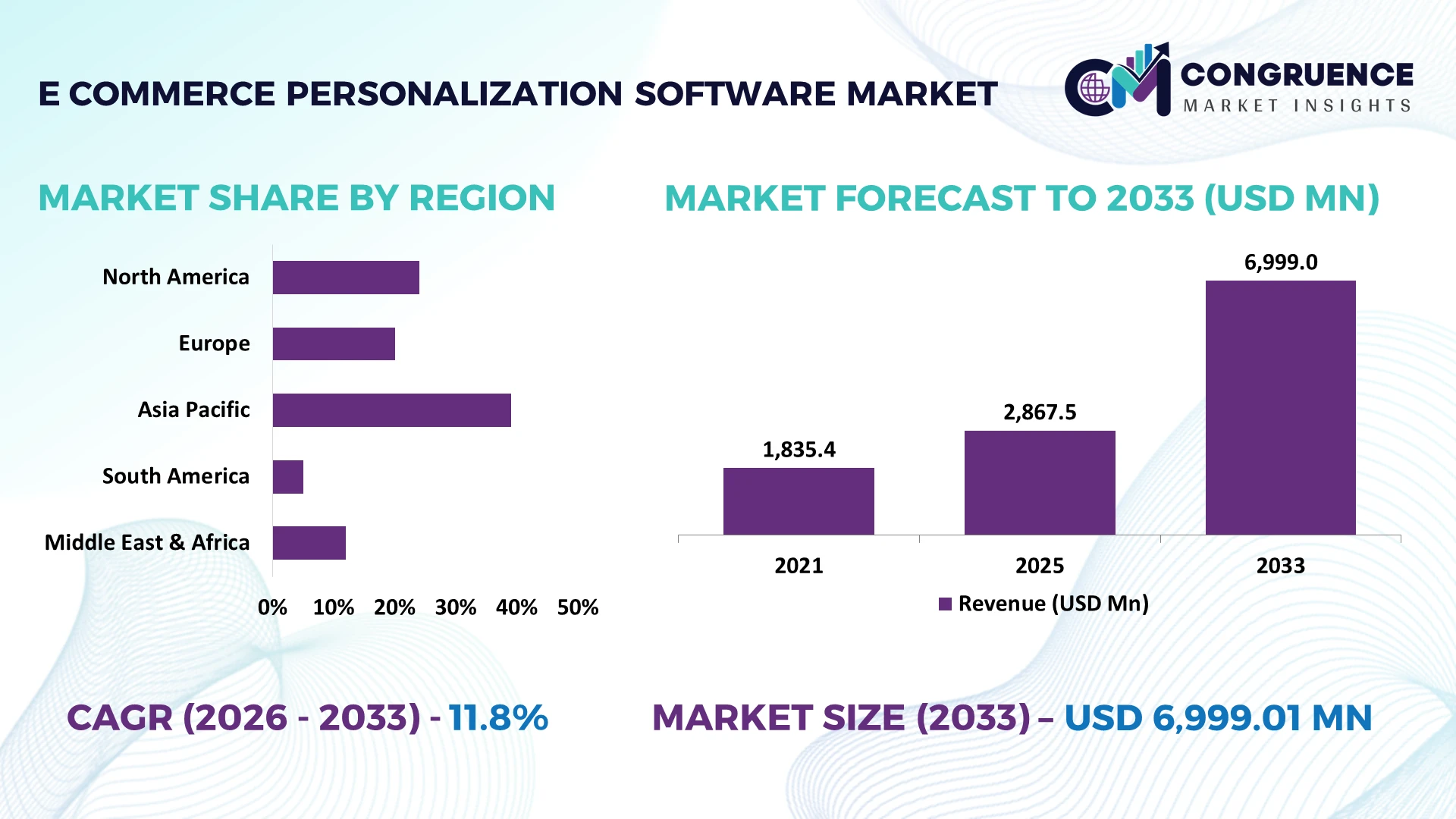
The Global E-Commerce Personalization Software Market was valued at USD 2867.49 Million in 2025 and is anticipated to reach a value of USD 6999.01 Million by 2033 expanding at a CAGR of 11.8% between 2026 and 2033. Growth is driven by AI recommendation engines, first-party customer data platforms, real-time behavioral targeting, and conversational commerce, with 73% of e-commerce leaders prioritizing AI-powered personalization and 67% prioritizing AI conversational shopping experiences.
The United States remains the dominant adoption hub, supported by advanced retail, fashion, consumer electronics, marketplaces, and D2C ecosystems. The country accounts for approximately 73% of tracked Dynamic Yield customers, compared with about 6% in the UK. AI and agents influenced around 20% of global Cyber Week purchases in 2025, while privacy regulation and the EU AI Act are accelerating investment in consent-aware personalization infrastructure.
Strategic implication: Vendors integrating real-time AI decisioning, unified first-party data, privacy controls, and omnichannel orchestration will gain a stronger competitive position in enterprise e-commerce deployments.
Market Size & Growth: USD 2,867.49 million in 2025 is projected to reach USD 6,999.01 million by 2033 at 11.8% CAGR, supported by AI-driven product discovery, real-time recommendations, and automated customer journey optimization.
Top Growth Drivers: AI-powered personalization at 73%, conversational shopping at 67%, and personalized recommendation priorities at 65% are accelerating enterprise investment in intelligent e-commerce engagement platforms.
Short-Term Forecast: By 2027, advanced personalization deployments are positioned to deliver 10–15% performance improvement through automated recommendations, individualized promotions, predictive segmentation, and real-time content sequencing.
Emerging Technologies: Generative AI, agentic commerce, predictive recommendation engines, and real-time customer data platforms are reshaping personalization, while AI and agents influenced approximately 20% of global Cyber Week purchases in 2025.
Regional Leaders: North America represents approximately 36% of market activity, while Europe and Asia-Pacific are expanding through privacy-first personalization and mobile commerce; modeled 2033 values approach USD 2.55 billion, USD 1.75 billion, and USD 1.89 billion, respectively.
Consumer/End-User Trends: Around 69% of consumers expect brands to anticipate their needs with timely, relevant offers, while only 35% believe companies currently deliver these experiences effectively, creating substantial personalization deployment whitespace.
Pilot/Case Example: During 2025 Cyber Week, retailers deploying Salesforce Agentforce and branded AI agents recorded sales growth 32% faster than retailers without comparable agentic commerce capabilities.
Competitive Landscape: Salesforce represents approximately 18% of selected enterprise personalization deployments, while Adobe, Dynamic Yield, Optimizely, Bloomreach, and Oracle strengthen competition through integrated AI, experimentation, customer data, and journey-orchestration capabilities.
Regulatory & ESG Impact: Approximately 87% of consumers prioritize responsible personal-data handling, yet only 46% believe brands perform effectively, increasing demand for consent management, explainable AI, governance, and privacy-compliant personalization architectures.
Investment & Funding: Around 93% of retailers report increasing personalization investment, directing technology budgets toward unified engagement platforms, customer data infrastructure, AI automation, and first-party data strategies as third-party identifier dependence declines globally.
Innovation & Future Outlook: Only 11% of surveyed U.S. consumers accept AI independently making purchase decisions, reinforcing a strategic shift toward human-controlled AI assistants for product discovery, comparison, recommendations, and high-growth agentic commerce.
E-commerce personalization software demand is concentrating around AI product recommendations, intelligent search, dynamic merchandising, customer-data activation, and conversational commerce. AI and autonomous agents already influence approximately 20% of purchases during major digital shopping periods. Privacy-first architectures are also gaining priority as global data rules tighten, positioning agent-assisted discovery and real-time decisioning at the center of the next strategic phase.
E-commerce personalization software is becoming strategic infrastructure as retailers compete on discovery speed, conversion quality, retention, and customer lifetime value rather than assortment alone. Around 71% of consumers expect personalized interactions, while 76% express frustration when they do not receive them. Simultaneously, tighter privacy regimes in the European Union, California, and other digital markets are shifting investment from third-party tracking toward consented first-party data, customer data platforms, and privacy-aware AI decisioning.
AI-native personalization creates a measurable operating advantage over legacy rules-based merchandising. Advanced personalization can generate roughly 10–15% performance improvement, while automated recommendation engines process behavioral signals continuously instead of relying on manually configured segments and campaigns. The United States leads enterprise deployment and experimentation, whereas European retailers place greater emphasis on consent management and explainable targeting. China provides a contrasting pathway, where mobile commerce, super-app ecosystems, livestreaming, and algorithmic product discovery support personalization at enormous transaction scale.
Through 2028, retailers will increasingly connect generative AI, predictive search, loyalty data, and real-time decision engines. During 2025 Cyber Week, retailers using agentic capabilities recorded sales growth 32% faster than peers without comparable tools, demonstrating practical deployment value. Enterprises are consequently redirecting budgets toward unified data architectures, AI partnerships, and omnichannel orchestration. Competitive advantage will increasingly depend on converting permissioned customer signals into accurate, immediate, and scalable individualized experiences.
AI adoption is converting personalization from campaign-based targeting into continuous commerce decisioning. Approximately 71% of consumers expect personalized interactions, 67% of e-commerce leaders prioritize conversational shopping, and 73% prioritize AI-powered personalization. This shift is accelerating deployment of recommendation engines, predictive search, dynamic merchandising, and real-time customer segmentation. In the United States, retailers are simultaneously strengthening first-party data infrastructure as third-party identifier dependence declines and privacy requirements tighten. The cause-and-effect is direct: richer behavioral signals improve relevance, stronger relevance supports conversion and retention, and automation reduces manual merchandising workloads. Large retailers are responding by integrating customer data platforms with generative AI and experimentation systems, while software vendors are expanding partnerships across commerce, CRM, advertising, and cloud ecosystems. The strategic differentiator is increasingly decision speed, not simply data volume.
Personalization performance remains constrained by fragmented customer records, inconsistent consent signals, and increasingly restrictive data governance. About 87% of consumers consider responsible personal-data handling important, yet only 46% believe brands execute it effectively, while 76% become frustrated when personalization fails. European Union requirements under GDPR and the AI Act raise governance expectations for automated profiling, transparency, and data processing, increasing implementation complexity for multinational merchants. Poorly synchronized CRM, commerce, loyalty, advertising, and offline datasets directly weaken recommendation accuracy and increase integration costs. Companies are responding by consolidating customer identities, deploying consent-management layers, reducing reliance on third-party identifiers, and moving sensitive decisioning toward controlled first-party environments. The operational constraint is therefore not insufficient customer data; it is the cost and complexity of making fragmented data permissioned, interoperable, timely, and commercially actionable.
Agentic commerce represents a high-value opportunity beyond conventional recommendation widgets. AI and agents influenced approximately 20% of purchases during 2025 Cyber Week, while retailers deploying agentic capabilities recorded sales growth 32% faster than peers without comparable implementations. Yet only 11% of surveyed U.S. consumers currently accept AI independently making purchase decisions, revealing a more valuable near-term opportunity in assisted discovery rather than fully autonomous purchasing. India offers additional whitespace as expanding digital payments, marketplace participation, and mobile-first shopping generate richer behavioral datasets for localized recommendations. Vendors are investing in conversational product discovery, multimodal search, autonomous merchandising, and AI-assisted comparison tools while partnering with payment, commerce, and customer-data ecosystems. The non-obvious advantage lies in reducing product-selection friction: platforms controlling the discovery layer can influence purchase consideration before shoppers reach conventional search or category pages.
The long-term challenge is maintaining personalization accuracy, latency, security, and brand consistency as AI systems operate across millions of customer interactions. Around 69% of consumers expect brands to anticipate their needs, yet only 35% believe companies currently deliver effectively, exposing a substantial execution gap. Meanwhile, the 11% willingness among U.S. consumers to delegate purchase decisions to AI demonstrates persistent trust limitations around autonomous agents. Generative models also introduce hallucination, product-data inconsistency, cybersecurity, and model-governance risks that legacy recommendation engines faced less intensely. Companies must therefore connect clean product catalogs, identity systems, inventory availability, pricing engines, and governance controls before scaling agentic experiences. Investment is shifting toward model monitoring, retrieval-grounded AI, cybersecurity, human oversight, and cloud infrastructure. Sustainable leadership will depend on producing personalization that remains accurate under scale, not merely deploying more sophisticated algorithms.
AI Referral Traffic Reshapes Discovery: Generative-AI-driven traffic to U.S. retail websites increased 4,700% year over year by July 2025, while AI-referred visitors showed 10% higher engagement and 32% longer sessions. Retailers are restructuring acquisition workflows around AI-visible catalogs, enriched product feeds, and personalized landing experiences, reducing dependence on conventional search-led discovery.
Real-Time Personalization Moves On-Site: Only 39% of organizations currently personalize web experiences during browsing, while 31% dynamically update offers and 26% operate always-on customer journeys. Enterprises are connecting behavioral event streams with decision engines, inventory, loyalty, and experimentation systems to eliminate batch processing and shorten the interval between customer intent detection and individualized execution.
Privacy Controls Enter Personalization Workflows: Consumer trust is becoming an operational design requirement: 29% identify privacy as an AI-shopping concern, 24% cite recommendation bias, and 23% report insufficient trust. EU regulatory pressure is pushing retailers toward consent-aware profiles, explainable recommendations, and governed first-party datasets, prompting software providers to embed identity resolution and privacy controls directly into personalization workflows.
Guided Interfaces Replace Manual Prompting: Integrated commerce AI is gaining ground over standalone chatbot interaction: 52% of shoppers use recommended-for-you features, 52% use image search, while 36% use generative AI chatbots. Retailers are consequently deploying visual discovery, automated review synthesis, and intent-based interfaces. The non-obvious shift is toward invisible personalization that minimizes prompting rather than forcing shoppers into conversational workflows.
Personalization Platforms represent the leading type, accounting for approximately 30–32% of market deployment, as enterprises favor unified environments capable of coordinating recommendations, segmentation, experimentation, content, and omnichannel decisioning. Their advantage comes from reducing fragmented point solutions and connecting customer signals with commerce execution. Recommendation Engines remain a mature segment, supported by high-volume product discovery and cross-sell workflows; personalized recommendation features are already used by approximately 52% of AI-assisted shoppers.
AI-Based Personalization is the fastest-growing type as enterprises move beyond predefined rules toward intent prediction, generative experiences, and real-time decisioning. Customer Data Platforms remain strategically important for identity resolution and first-party profile activation, particularly as privacy requirements tighten. Behavioral Analytics supplies the event-level intelligence required by both established and AI-native systems. Vendors are consequently embedding AI models into broader personalization suites while strengthening CDP, experimentation, and analytics integrations. Investment is shifting from isolated recommendation functionality toward interoperable decisioning architectures capable of coordinating the complete customer journey.
Product Recommendations remain the leading application, representing approximately 32–35% of personalization software usage because recommendations can be deployed across homepages, category pages, product pages, carts, and post-purchase journeys. Their measurable connection to conversion and basket expansion sustains investment among large digital retailers. Personalized offers also influence buying behavior strongly, with historical commerce studies showing 61% of consumers become more likely to purchase after receiving relevant promotions.
Personalized Search is emerging as the fastest-growing application as natural-language queries, semantic retrieval, image search, and generative AI change product discovery. AI-driven traffic to U.S. retail sites increased 4,700% year over year by July 2025, demonstrating how quickly discovery pathways are changing. Targeted Promotions remain important for loyalty and retention, while Personalized Content increasingly adapts banners, landing pages, and messaging to individual intent. Dynamic Pricing occupies a more controlled role because transparency and governance requirements restrict unrestricted algorithmic deployment. Retailers are integrating search, recommendations, promotions, and content decisioning into coordinated real-time workflows rather than managing each application independently.
Fashion & Apparel represents the leading end-user segment at approximately 28–30%, supported by large assortments, rapid inventory rotation, size and style variation, and frequent digital customer interactions. Personalization improves outfit discovery, complementary-product recommendations, fit guidance, and lifecycle targeting, making the category highly dependent on behavioral data. Around 41% of consumers indicate willingness to use AI assistants for clothing-related inspiration, research, or shopping, reinforcing the segment’s digital engagement advantage.
Beauty & Cosmetics is the fastest-growing end-user group as virtual consultation, shade matching, replenishment prediction, personalized routines, and social-commerce discovery become integrated into purchasing journeys. Approximately 34% of consumers express interest in AI-assisted health and beauty shopping. Consumer Electronics remains important for specification comparison and accessory recommendations, while Grocery & Food increasingly uses repeat-purchase and basket data for individualized offers. Home & Lifestyle benefits from visual search and room-based discovery. Vendors are developing category-specific recommendation models and partnering with commerce platforms to improve contextual relevance, shifting competitive investment toward verticalized personalization rather than universal algorithms.
North America accounted for the largest market share at 36.4% in 2025 however, Asia-Pacific is expected to register the fastest growth, expanding at a CAGR of 25.2% between 2026 and 2033.
AI-Native Commerce Moves Into Production
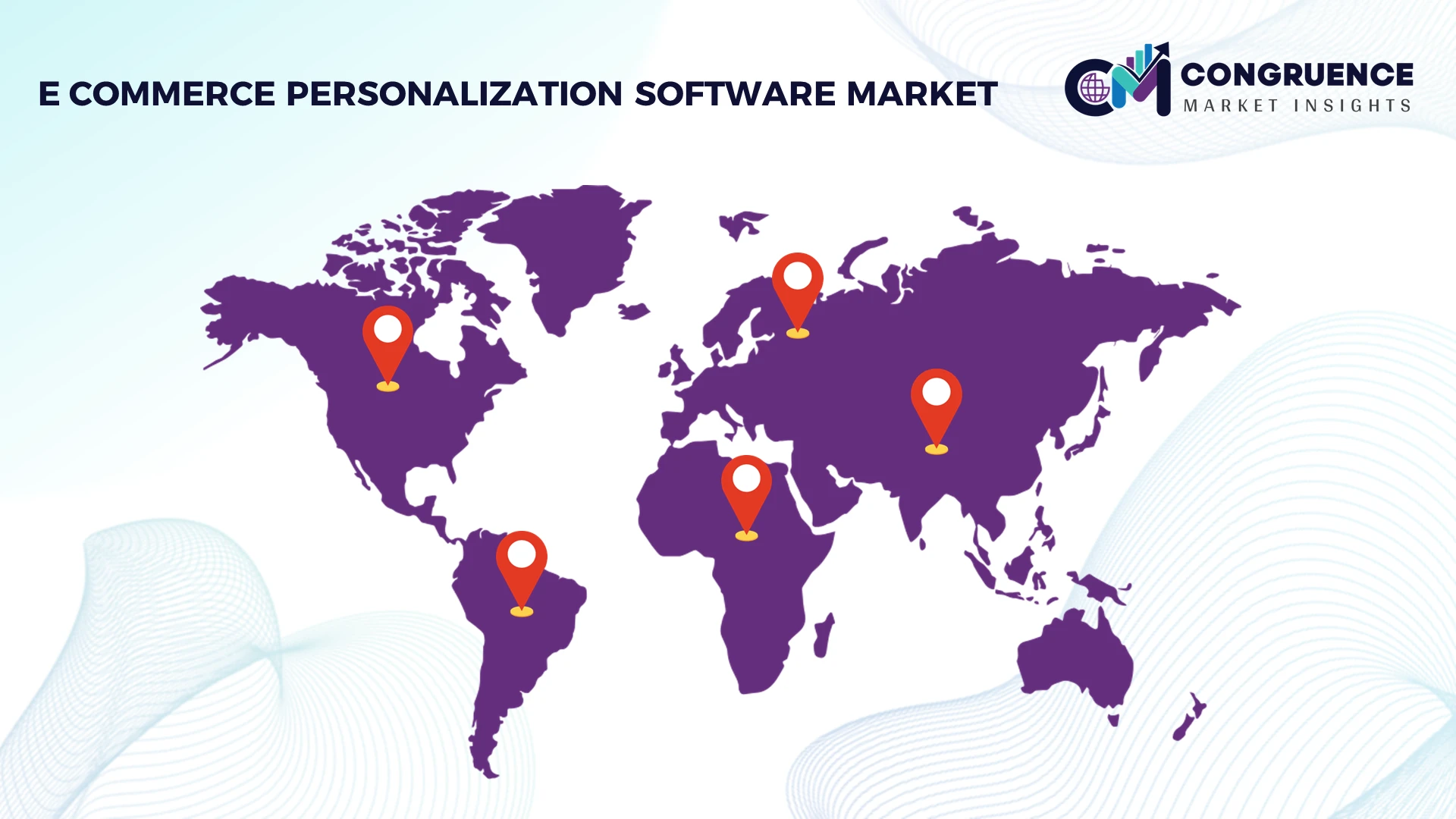
North America commands approximately 36.4% of personalization software activity, anchored by large U.S. retailers, mature cloud infrastructure, extensive customer-data platforms, and rapid deployment of AI-assisted product discovery. U.S. generative-AI referrals to retail websites increased 4,700% year over year by July 2025, while AI-referred shoppers recorded 10% higher engagement and 32% longer visits than conventional traffic. By the 2025 holiday season, AI referrals converted 31% better than other traffic sources, changing personalization from a merchandising enhancement into an acquisition and conversion layer. Enterprises are restructuring product catalogs for machine readability, connecting first-party profiles with recommendation engines, and deploying real-time decisioning across web, mobile, email, and loyalty channels. Investment is increasingly directed toward generative search optimization and agent-ready commerce infrastructure rather than standalone recommendation widgets.
United States Market Outlook: The United States holds the region’s strongest enterprise deployment concentration, supported by hyperscale cloud infrastructure and digitally mature retail operations. Approximately 39% of surveyed U.S. consumers had used AI for online shopping by 2026, and 85% of those users reported improved experiences. Retailers are consequently prioritizing AI-visible product data, automated experimentation, personalized search, and cross-channel identity resolution.
Governed AI Reshapes Retail Personalization
Europe represents approximately 28% of global personalization software deployment, with the United Kingdom, Germany, and France forming the principal enterprise adoption hubs. Personalization investment increasingly combines generative AI with consent management, first-party identity resolution, and explainable decisioning as GDPR and the EU AI Act strengthen governance requirements. By 2026, 84% of surveyed consumers across major European markets used AI in everyday activities and 38% used it for product research or purchasing decisions. However, only about 15% had used AI tools directly on retailer websites, exposing significant deployment whitespace. Retailers are therefore modernizing commerce stacks around conversational search, recommendation orchestration, and permissioned customer profiles. European AI investment remains operationally uneven: 44% of surveyed retail AI investment focuses on marketing versus only 7% on omnichannel operations, highlighting a coming shift toward production-scale customer journey infrastructure.
United Kingdom Market Outlook: The UK combines mature online retail penetration with aggressive enterprise experimentation in AI-assisted commerce. John Lewis incorporated AI shopping capabilities into its broader £800 million transformation program, while Tesco tested a generative AI assistant with approximately 280,000 employees. These deployments create a practical foundation for personalized basket building, discovery, loyalty activation, and increasingly automated customer journeys.
Mobile Scale Accelerates Intelligent Commerce
Asia-Pacific accounts for approximately 24% of personalization software activity and combines enormous mobile-commerce volumes with rapidly expanding AI infrastructure. China, India, Japan, South Korea, and Southeast Asian markets are shifting personalization toward super-app journeys, conversational discovery, visual search, localized recommendations, and real-time promotional decisioning. Japan provides measurable operational evidence: Isetan Mitsukoshi achieved approximately 1.4-times higher click-through and cart-addition rates and a 1.3-times conversion improvement after introducing AI personalization. China’s integrated marketplace, payments, logistics, and social-commerce infrastructure enables personalization engines to process unusually dense transactional signals, while India’s mobile-first merchants increasingly adopt cloud customer engagement platforms. Vendors are expanding localized language models, commerce APIs, and marketplace integrations rather than simply replicating Western web-personalization architectures. The strategic advantage is scale: high-frequency digital interactions create faster feedback loops for recommendation and behavioral models.
China Market Outlook: China offers the strongest combination of digital-commerce scale, integrated payments, cloud computing, and AI development within Asia-Pacific. Major platforms are embedding generative and agentic capabilities directly into shopping workflows, while heavy AI infrastructure investment expands inference capacity. Integrated ecosystems spanning discovery, payment, fulfillment, and customer engagement allow personalization models to learn and execute with significantly fewer channel breaks.
Payment Digitization Deepens Customer Intelligence
South America represents roughly 5% of personalization software activity, with Brazil providing the largest addressable deployment base. Mobile commerce, marketplaces, social discovery, instant payments, and digitally active consumers are creating richer real-time behavioral signals for recommendation and promotion engines. In Brazil, 94 million consumers were expected to shop online in 2025, while mobile internet access reached approximately 89%. Personalization influenced purchasing decisions for 68% of Brazilian consumers, and 50% reported AI-related shopping experiences, eight percentage points above the previous year. Merchants are connecting payment behavior, marketplace interactions, loyalty data, and messaging channels to customer profiles. Infrastructure fragmentation and uneven data maturity still limit sophisticated orchestration outside major enterprises, encouraging vendors to offer modular cloud deployments, localized integrations, and lower-complexity automation suited to mid-market retailers.
Brazil Market Outlook: Brazil is the region’s personalization anchor because digital payments and marketplace concentration provide unusually actionable commerce data. Pix represented about 50.5% of payments among surveyed small and medium businesses by late 2024, while major retailers increasingly integrate instant payment behavior with promotions and customer analytics. This ecosystem favors personalization tools optimized for mobile, social commerce, localized offers, and rapid checkout journeys.
Digital Infrastructure Unlocks Personalized Commerce
Middle East & Africa represents approximately 3% of global personalization software deployment, but Gulf economies are building unusually advanced foundations for data-driven commerce. Saudi Arabia and the UAE lead through cloud modernization, digital payments, marketplace expansion, and government-backed digital transformation. Saudi electronic payments reached 85% of total retail payments in 2025, up from 79% in 2024, with 14.6 billion electronic transactions processed during the year. Such transaction density strengthens the behavioral datasets available for individualized offers, loyalty activation, and predictive recommendations. The Saudi Central Bank’s standardized e-commerce payment interface further improves integration between domestic and global payment networks. Retailers and technology providers are responding through cloud partnerships, Arabic-language AI, omnichannel customer platforms, and localized recommendation models, while fragmented infrastructure and lower digital maturity continue to constrain deployment across several African economies.
Saudi Arabia Market Outlook: Saudi Arabia provides the strongest near-term enterprise environment through Vision 2030 digitalization and rapidly modernizing payment infrastructure. Electronic retail transactions increased from 12.6 billion in 2024 to 14.6 billion in 2025. Retailers can increasingly combine authenticated payment signals, loyalty information, mobile behavior, and commerce histories, strengthening real-time segmentation and personalized customer engagement across digital channels.
Adobe, Salesforce, SAP, Optimizely, Bloomreach, and specialist AI platforms compete for enterprise personalization workloads, with integrated experience-cloud leaders challenging commerce-native innovators on orchestration depth and deployment speed. The top five vendors account for approximately 57% of tracked market activity, creating moderate concentration around established customer-data ecosystems. Competition increasingly centers on AI accuracy, integration breadth, latency, and customization: 65% of consumers expect personalized recommendations, while only 41% believe brands deliver them effectively, leaving a 24-point execution gap. Cloud deployment exceeds 68%, rewarding vendors offering rapid API-based implementation and scalable decisioning. Adobe and Salesforce extend unified data and journey stacks; Optimizely emphasizes experimentation; Bloomreach advances commerce search; SAP integrates personalization with enterprise workflows. Partnerships with cloud, commerce, and data platforms are replacing isolated deployments as agentic AI disrupts conventional recommendation engines. Data interoperability, implementation complexity, and privacy governance remain entry barriers. Winning requires accurate real-time decisioning, open integration, trusted AI governance, and demonstrable conversion improvement across channels.
Adobe
Salesforce
SAP
Oracle
Optimizely
Bloomreach
Insider
Braze
Coveo
Nosto
Algonomy
Kameleoon
Monetate
CleverTap
Current personalization stacks combine real-time customer data platforms, predictive recommendation engines, semantic search, and journey orchestration. AI-driven recommendation systems can lift conversion performance by about 10–15%, while edge delivery and automated experimentation reduce campaign latency by roughly 20%. Adoption is broadening as retailers connect commerce, CRM, loyalty, and inventory data into unified decision layers, giving large enterprises faster merchandising and higher customer lifetime value.
Emerging technologies center on generative AI, multimodal search, agentic shopping assistants, and model-context integrations. Conversational discovery can increase engagement by more than 10%, while AI-referred shoppers have shown conversion advantages above 30% versus conventional traffic. Compared with legacy rules-based personalization, real-time AI decisioning can improve response speed by roughly 25–30%. Cloud-native retailers, marketplaces, and digitally mature brands benefit most because existing first-party data and APIs accelerate deployment.
Disruptive change will come from autonomous agents coordinating search, recommendations, promotions, and checkout across external AI channels. By 2026–2028, deployment will shift from isolated widgets toward governed, interoperable agent ecosystems linked through APIs and model-context protocols. Companies acting now can lower manual merchandising effort by 15–20%, improve consistency across channels, and secure stronger visibility as product discovery moves beyond retailer websites. This makes data architecture a competitive operating asset.
October 2024 Optimizely launched Optimizely Personalization with contextual bandits, edge delivery, collaboration, and testing integration; only 9% of organizations had real-time personalization deployed. The release improved 1:1 experience execution and reduced fragmented campaign workflows across complex enterprise programs. Source: optimizely.com
December 2024 Salesforce surpassed 1,000 paid Agentforce deals, while its AI applications cut human staffing for simple customer queries by 50%. The milestone validated enterprise demand for autonomous personalization and strengthened Salesforce’s position in AI-led commerce operations globally. Source: reuters.com
October 2025 Bloomreach joined MACH Alliance’s inaugural AI Hackathon, where four teams targeted composable-commerce use cases and MACH-mature organizations were twice as likely to deploy AI successfully. The initiative advanced cross-brand personalization and production-ready agent collaboration at scale. Source: machalliance.org
June 2026 Adobe introduced GenStudio for Commerce Media Networks plus six new AI-enabled campaign capabilities, including simulated audiences and MCP workflows. The expansion connected personalization, content production, targeting, and measurement, strengthening enterprise control over commerce-media execution at scale. Source: adobe.com
The report examines the E-Commerce Personalization Software Market across Recommendation Engines, Personalization Platforms, Customer Data Platforms, Behavioral Analytics, and AI-Based Personalization, alongside applications spanning Product Recommendations, Personalized Search, Dynamic Pricing, Targeted Promotions, and Personalized Content. End-user coverage includes Fashion & Apparel, Consumer Electronics, Grocery & Food, Beauty & Cosmetics, and Home & Lifestyle, with analysis across North America, Europe, Asia-Pacific, South America, and Middle East & Africa.
The study evaluates deployment patterns, technology integration, competitive positioning, regional adoption, and emerging areas such as agentic commerce, multimodal discovery, model-context integrations, and privacy-aware first-party data activation. Quantitative indicators include segment shares, enterprise adoption signals, and deployment concentration where relevant. The 2026–2033 outlook supports investment planning, market-entry assessment, partnership strategy, product prioritization, and competitive benchmarking by identifying where personalization infrastructure, AI decisioning, and localized digital-commerce ecosystems are becoming strategically important.
| Report Attribute/Metric | Report Details |
|---|---|
Market Revenue in 2025 | USD 2867.49 Million |
Market Revenue in 2033 | USD 6999.01 Million |
CAGR (2026 - 2033) | 11.8% |
Base Year | 2025 |
Forecast Period | 2026 - 2033 |
Historic Period | 2021 - 2025 |
Segments Covered | By Type
By Application
By End-User
|
Key Report Deliverable | Revenue Forecast, Growth Trends, Market Dynamics, Segmental Overview, Regional and Country-wise Analysis, Competition Landscape |
Region Covered | North America, Europe, Asia-Pacific, South America, Middle East, Africa |
Key Players Analyzed | Adobe, Salesforce, SAP, Oracle, Optimizely, Bloomreach, Insider, Braze, Coveo, Nosto, Algonomy, Kameleoon, Monetate, CleverTap |
Customization & Pricing | Available on Request (10% Customization is Free) |




