
Reports
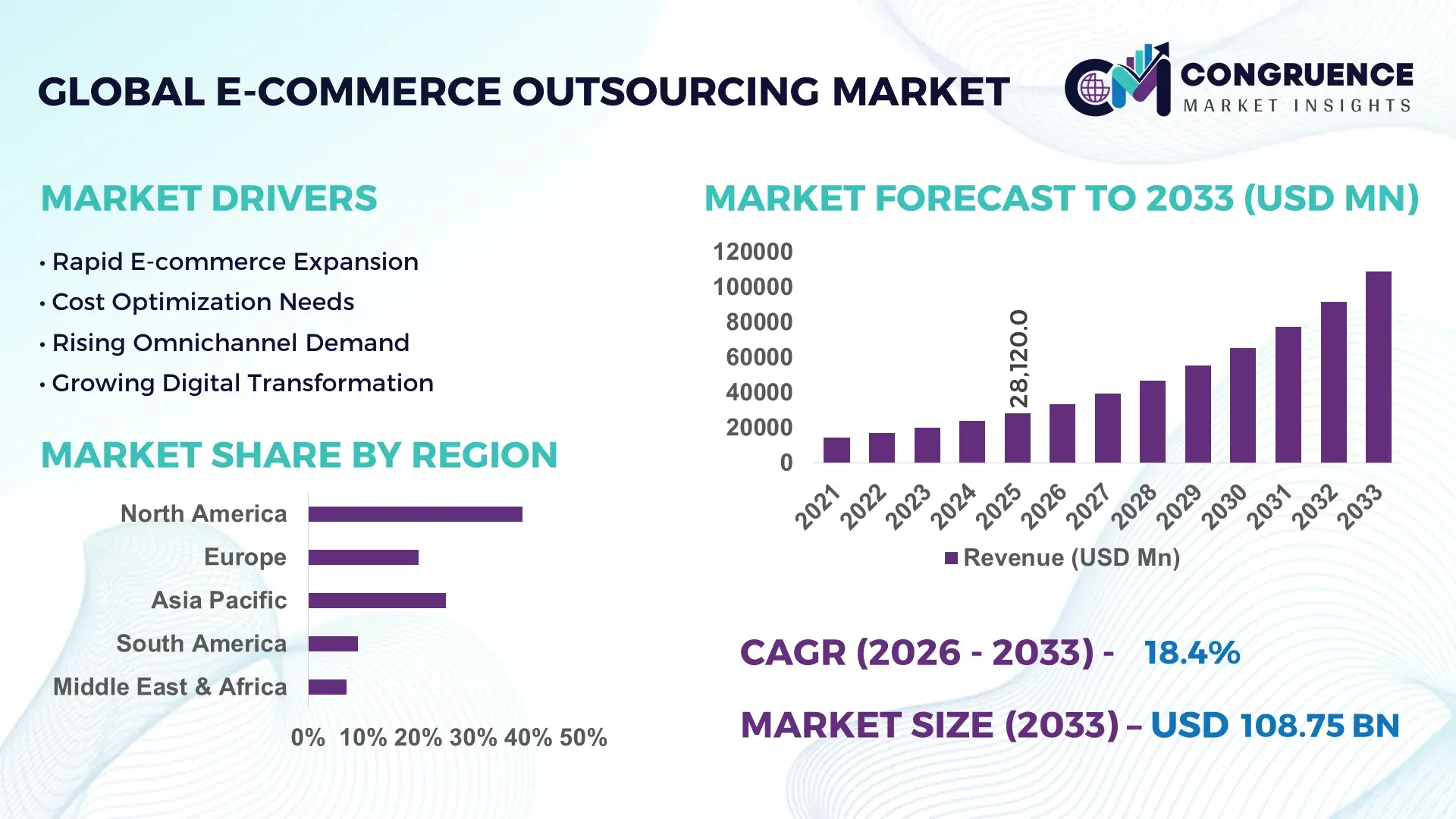
The Global E-commerce Outsourcing Market was valued at USD 28120 Million in 2025 and is anticipated to reach a value of USD 108746.62 Million by 2033 expanding at a CAGR of 18.42% between 2026 and 2033. Growth is being driven by AI-enabled customer support outsourcing, cross-border marketplace management, fulfillment optimization, and rising merchant demand for scalable omnichannel operations across global digital commerce ecosystems.
The United States remains the dominant market, accounting for approximately 31% of global outsourcing demand, supported by large-scale retail, direct-to-consumer, and marketplace ecosystems. Over 72% of enterprise e-commerce brands utilize outsourced functions for customer service, catalog management, or fulfillment operations. Compared with the United Kingdom, where adoption is estimated near 54% among mid-sized online retailers, the U.S. benefits from stronger technology investments exceeding USD 20 billion annually in digital commerce infrastructure. Ongoing supply-chain diversification following Red Sea shipping disruptions has further accelerated outsourced operational models.
Organizations expanding internationally are prioritizing outsourcing partners with automation capabilities, multilingual support, and integrated marketplace management to improve scalability and operational resilience.
Market Size & Growth: USD 28,120 Million in 2025 projected to reach USD 108,746.62 Million by 2033 at 18.42% CAGR, driven by AI-enabled process automation and omnichannel commerce expansion.
Top Growth Drivers: AI-assisted support productivity +35%, cross-border e-commerce transactions +28%, outsourced fulfillment efficiency +22%.
Short-Term Forecast: By 2028, outsourced order-processing costs decline by 18% while fulfillment accuracy improves by 24%.
Emerging Technologies: AI chatbots, robotic process automation, and predictive analytics increase workflow efficiency by 20–40% across outsourced operations.
Regional Leaders: North America exceeds USD 38 billion, Asia-Pacific surpasses USD 32 billion, and Europe reaches USD 22 billion by 2030, supported by marketplace digitization and regional expansion.
Consumer/End-User Trends: More than 68% of online retailers outsource at least one critical e-commerce function to improve speed and scalability.
Pilot/Case Example: In 2026, AI-driven customer service deployment reduced response times by 45% and increased resolution rates by 30%.
Competitive Landscape: Top providers collectively hold approximately 27% market share; competition centers on automation, analytics, fulfillment, and multilingual capabilities.
Regulatory & ESG Impact: Automated compliance tools reduce data-processing errors by 25% while supporting stricter privacy and cross-border trade requirements.
Investment & Funding: Global investments exceed USD 8 billion, with partnerships and platform integration initiatives driving capacity expansion.
Innovation & Future Outlook: Generative AI, autonomous workflow orchestration, and predictive fulfillment systems improve operational efficiency by over 30%, reshaping competitive differentiation.
E-commerce outsourcing has evolved from transactional support toward integrated digital commerce management. Demand is strongest across marketplace operations, customer experience management, catalog optimization, and fulfillment coordination. AI-powered automation now handles nearly 40% of routine support interactions, improving service consistency and processing speed. At the same time, supply-chain diversification and stricter cross-border compliance requirements are encouraging retailers to adopt specialized outsourcing partners with advanced analytics and multilingual capabilities, setting the stage for deeper strategic transformation across the market.
E-commerce outsourcing is becoming a strategic operating model rather than a cost-management function as retailers, brands, and marketplaces compete on speed, customer experience, and cross-border scalability. The market is benefiting from supply-chain restructuring, rising digital commerce penetration, and increasing demand for specialized operational expertise. More than 65% of mid-to-large online retailers now outsource at least one core process, including fulfillment, customer support, catalog management, or marketplace operations, enabling faster market entry and improved operational flexibility.
Technology modernization is reshaping outsourcing economics. AI-enabled customer service platforms process routine inquiries up to 40% faster than legacy manual support environments while reducing handling costs by approximately 25%. The United States leads in advanced outsourcing adoption through integrated automation and analytics deployment, while India continues expanding as a global delivery hub with strong talent availability and multilingual support capabilities. This combination is accelerating end-to-end service integration across e-commerce ecosystems.
Over the next two to three years, outsourced fulfillment automation, predictive inventory management, and marketplace optimization services are expected to become standard deployment priorities. A practical example is the growing use of AI-driven order management systems that reduce fulfillment exceptions by nearly 30%. Companies are increasing investments in automation partnerships, cloud infrastructure, and specialized service networks to strengthen competitive positioning, improve operational resilience, and support sustainable long-term digital commerce expansion.
The primary growth driver is the rapid adoption of AI-enabled and specialized outsourcing services across digital commerce operations. Nearly 68% of enterprise retailers now outsource customer support, catalog management, or marketplace administration to improve operational efficiency. AI-assisted workflows have reduced average response times by approximately 35%, while automated order-processing systems improve fulfillment accuracy by more than 20%. In the United States, increasing marketplace complexity and omnichannel retail expansion are pushing brands toward external operational partners. The cause is rising transaction volumes and customer expectations; the impact is greater demand for scalable expertise. Companies are responding through acquisitions, automation investments, and strategic partnerships that combine technology platforms with managed services, creating stronger operational differentiation and faster execution capabilities.
Growing regulatory requirements and fragmented technology environments remain significant structural restraints. Approximately 42% of retailers report integration challenges between e-commerce platforms, ERP systems, and outsourced service providers. Data governance requirements have increased compliance-related operating costs by nearly 15% for cross-border digital commerce activities. In countries such as Germany, stricter data protection frameworks require additional monitoring and security controls, increasing deployment complexity. These constraints directly affect scalability, implementation timelines, and operating margins. To reduce risk, companies are adopting localized data-processing frameworks, diversifying service provider networks, and negotiating long-term technology integration agreements. A key operational insight is that interoperability limitations often create greater costs than labor expenses, making system alignment a critical competitive factor.
The strongest opportunity lies in advanced automation, predictive analytics, and next-generation marketplace management solutions. AI-powered demand forecasting can improve inventory accuracy by approximately 25%, while automated product-content optimization increases conversion performance by more than 15%. India and Indonesia are emerging as high-potential outsourcing destinations due to expanding digital infrastructure and skilled workforce availability. The rise of generative AI, autonomous workflow orchestration, and real-time commerce analytics is creating new service categories beyond traditional support functions. Companies are positioning through platform partnerships, proprietary analytics development, and ecosystem expansion strategies. A less obvious opportunity is the growing demand for outsourced compliance and localization services, which help brands enter new international markets faster while reducing operational complexity.
Long-term market expansion depends on solving execution challenges associated with security, workforce specialization, and multichannel integration. More than 50% of large retailers operate across multiple marketplaces, websites, and social commerce platforms, increasing operational complexity. Cybersecurity incidents targeting digital commerce ecosystems have risen by roughly 20% over recent years, creating higher requirements for outsourced service providers. In the United Kingdom, talent shortages in advanced analytics and AI operations are affecting service scalability and deployment consistency. These pressures impact competitiveness, service quality, and long-term client retention. Companies must invest in workforce upskilling, cybersecurity infrastructure, and standardized integration architectures. A critical strategic insight is that future leadership will depend not only on labor scale but also on the ability to deliver secure, technology-integrated commerce operations at enterprise level.
AI-Native Service Delivery Expansion: Enterprise outsourcing contracts increasingly include AI-enabled customer support, catalog optimization, and workflow automation. Automated service workflows now handle nearly 40% of repetitive commerce tasks, while response times have improved by approximately 35%. Rising labor costs and ongoing workforce shortages are accelerating deployment. Companies are restructuring service models around automation platforms, integrating predictive analytics, and forming technology partnerships to increase processing capacity without proportional workforce expansion.
Cross-Border Commerce Localization Growth: International marketplace expansion is driving demand for multilingual support, localized content management, and regional compliance services. More than 55% of large online sellers now operate across multiple countries, while localization outsourcing projects have increased by nearly 30%. New digital trade requirements and changing customs processes are creating operational complexity. Providers are expanding delivery centers, strengthening regional partnerships, and developing specialized compliance capabilities to support faster market entry and reduced operational friction.
Integrated Fulfillment Network Adoption: Retailers are consolidating fulfillment, inventory visibility, and logistics management under unified outsourcing frameworks. Integrated fulfillment deployments have improved order accuracy by approximately 25% and reduced delivery exceptions by nearly 20%. Supply-chain disruptions over recent years exposed the limitations of fragmented vendor ecosystems. Companies are responding through warehouse technology integration, strategic logistics partnerships, and end-to-end operational coordination to improve resilience and execution consistency.
Performance-Based Contract Transformation: Outsourcing agreements are shifting from labor-focused pricing toward outcome-based service models linked to operational metrics. Nearly 45% of new enterprise contracts now incorporate KPIs related to fulfillment speed, conversion optimization, and customer retention. A less obvious trend is the growing use of shared-risk commercial structures. Service providers are investing in analytics, automation, and operational benchmarking capabilities to demonstrate measurable business outcomes and secure long-term client relationships.
Fulfillment Services represent the leading segment due to their direct impact on delivery speed, order accuracy, and customer satisfaction. Large retailers increasingly outsource warehousing, packaging, returns management, and last-mile coordination to improve scalability during demand fluctuations. More than 60% of enterprise e-commerce brands outsource at least part of their fulfillment operations, while integrated fulfillment models improve order accuracy by approximately 25%. Customer Support Services remain strategically important as brands seek multilingual engagement and round-the-clock service coverage. Catalog Management continues supporting marketplace expansion by improving product visibility and content consistency across channels.
IT Services are the fastest-growing segment as companies modernize commerce infrastructure and integrate AI-enabled workflows. Adoption of outsourced cloud management, cybersecurity services, and platform integration has increased by nearly 30% over recent years. Marketing Services are also gaining importance through performance-driven customer acquisition strategies and personalization initiatives. Providers are expanding automation capabilities, investing in platform partnerships, and developing integrated service portfolios. Investment priorities are shifting from standalone support functions toward technology-enabled outsourcing ecosystems capable of delivering operational visibility, process optimization, and scalable commerce execution.
Order Processing remains the dominant application because it directly influences transaction execution, customer satisfaction, and operational continuity. High transaction volumes across online retail channels have increased reliance on outsourced order verification, payment processing, and workflow management services. Automated order-processing environments improve processing speed by approximately 30% while reducing manual errors by nearly 20%. Inventory Management continues to gain strategic relevance as retailers seek real-time stock visibility and demand forecasting capabilities. Logistics Management remains critical for supporting fast delivery expectations and cross-border fulfillment requirements.
Customer Engagement is the fastest-growing application as brands prioritize retention, personalization, and omnichannel customer experiences. AI-enabled engagement platforms have increased service productivity by more than 25%, supporting higher interaction volumes without equivalent workforce expansion. Digital Marketing outsourcing is evolving through advanced analytics, campaign optimization, and marketplace advertising management. Companies are expanding integrated commerce platforms that connect order management, customer engagement, and inventory functions into unified operational ecosystems. Demand is increasingly concentrated in applications that directly improve transaction efficiency, customer lifetime value, and fulfillment performance.
Online Marketplaces represent the leading end-user segment due to their large transaction volumes, complex seller ecosystems, and extensive operational requirements. Marketplace operators depend heavily on outsourced fulfillment, catalog management, customer support, and technology services to maintain scalability. More than 65% of large marketplace operators utilize specialized outsourcing partners for at least one mission-critical operational function. Retail Companies remain significant buyers because of ongoing omnichannel expansion and increasing customer service expectations. Consumer Goods Brands continue expanding outsourcing adoption to support direct-to-consumer strategies and marketplace participation.
Healthcare Retailers are emerging as the fastest-growing end-user group, driven by stricter compliance requirements, digital pharmacy expansion, and growing online healthcare purchasing activity. Outsourced support adoption within healthcare-focused commerce operations has increased by nearly 28%. Fashion Retailers are investing in catalog optimization and customer engagement services to manage high product turnover, while Electronics Retailers prioritize fulfillment precision and inventory visibility. Service providers are responding through industry-specific solutions, customized pricing models, and strategic ecosystem partnerships. Competitive positioning is increasingly determined by the ability to deliver tailored operational capabilities aligned with sector-specific requirements.
North America accounted for the largest market share at 36% in 2025 however, Asia-Pacific is expected to register the fastest growth, expanding at a CAGR of 20.8% between 2026 and 2033.
AI-Led Commerce Operations Transformation
North America maintains leadership through high enterprise outsourcing penetration, advanced digital commerce infrastructure, and extensive adoption of automation technologies. The region accounts for approximately 36% of global market activity, supported by large-scale retailers, marketplaces, and direct-to-consumer brands. AI-enabled customer support, fulfillment orchestration, and catalog automation have become standard deployment priorities. More than 70% of enterprise retailers outsource at least one operational function to improve scalability and service performance. Strategic partnerships between commerce platforms and specialized service providers are expanding integrated outsourcing ecosystems. Companies increasingly prioritize operational resilience, real-time analytics, and omnichannel execution capabilities to manage growing transaction complexity and customer experience requirements.
United States Market Outlook: The United States remains the region's operational center due to its concentration of large retailers, marketplace operators, and digital commerce technology providers. Enterprise adoption of outsourced commerce services exceeds 72% among major online retailers. Strong cloud infrastructure, AI deployment capabilities, and fulfillment network density support advanced outsourcing models. Businesses continue investing in automation partnerships and integrated commerce operations to improve execution speed, customer retention, and marketplace competitiveness.
Compliance-Driven Service Modernization
Europe is characterized by strong demand for outsourced customer engagement, marketplace management, and regulatory compliance services. The region contributes approximately 27% of global market activity and benefits from mature e-commerce ecosystems across major economies. Data governance requirements and consumer protection standards are accelerating demand for specialized outsourcing providers capable of managing operational complexity. Adoption of automated workflow platforms has improved service efficiency by nearly 25% across large enterprises. Organizations increasingly seek integrated providers capable of combining compliance management, multilingual support, and digital commerce operations within unified service frameworks.
Germany Market Outlook: Germany leads regional deployment due to its strong retail infrastructure, advanced logistics networks, and significant cross-border e-commerce activity. More than 60% of large online merchants utilize outsourced operational services to support marketplace expansion and customer engagement requirements. The country's emphasis on process efficiency, technology integration, and data security creates favorable conditions for high-value outsourcing partnerships focused on operational excellence and compliance management.
Scale-Driven Digital Commerce Expansion
Asia-Pacific is the fastest-expanding market due to rapid digital adoption, expanding online retail ecosystems, and increasing demand for cost-efficient operational support. The region represents nearly 30% of global market activity and serves as a major delivery hub for outsourced customer support, IT services, and marketplace management. Outsourcing deployment volumes have increased by more than 28% across major digital commerce economies. Businesses are leveraging large talent pools, competitive operating structures, and growing technology capabilities to support international commerce operations. Investment in AI-enabled service delivery and cloud-based commerce infrastructure continues strengthening the region's strategic position.
India Market Outlook: India is the region's leading outsourcing destination, supported by extensive service delivery capacity, multilingual workforce availability, and expanding technology expertise. The country hosts a substantial share of global digital commerce support operations, with enterprise outsourcing adoption continuing to rise across customer engagement and platform management functions. Growing investments in AI, cloud infrastructure, and automation platforms are enabling providers to move beyond labor-based services toward technology-enabled commerce operations.
Marketplace Expansion Driving Demand
South America is experiencing increasing demand for outsourced commerce services as online retail penetration expands across key economies. The region contributes approximately 5% of global market activity and is benefiting from greater adoption of marketplace-based retail models. Retailers are outsourcing customer support, fulfillment coordination, and digital marketing activities to improve operational efficiency and market responsiveness. Outsourced service deployment has increased by nearly 18% among large online merchants. Infrastructure variability and logistics challenges remain constraints, encouraging businesses to partner with specialized providers that offer localized operational expertise and scalable execution capabilities.
Brazil Market Outlook: Brazil dominates regional demand through its large consumer market, expanding e-commerce sector, and increasing investment in digital commerce infrastructure. Marketplace participation continues rising among retailers seeking broader customer reach and improved operational efficiency. Outsourcing providers are expanding localized service capabilities and logistics partnerships to address fulfillment complexity. Strong adoption of digital payment systems and online retail channels supports continued demand for specialized operational services.
Digital Infrastructure Investment Momentum
The Middle East & Africa market is being shaped by digital transformation programs, expanding online retail activity, and increasing investment in technology infrastructure. The region accounts for approximately 2% of global market activity but demonstrates rising demand for outsourced customer support, marketplace operations, and fulfillment management services. E-commerce platform deployments and digital commerce modernization initiatives are increasing across major economies. Strategic investments in cloud infrastructure and logistics capabilities are improving operational readiness, while businesses seek external expertise to accelerate digital commerce execution and improve service quality.
United Arab Emirates Market Outlook: The United Arab Emirates serves as the region's primary digital commerce hub due to advanced connectivity infrastructure, supportive business regulations, and strong investment activity. Online retail operators increasingly utilize outsourced service models to support cross-border commerce and multilingual customer engagement. Digital economy initiatives and logistics modernization programs continue strengthening the country's attractiveness as a center for technology-enabled commerce operations and regional service delivery.
The market is led by global outsourcing specialists such as Accenture, Teleperformance, Concentrix, Infosys, and Wipro, competing directly with regional commerce service providers and niche marketplace management firms. Global leaders focus on enterprise-scale contracts, while regional operators compete through localized expertise, language capabilities, and cost-efficient delivery. The top five players collectively control approximately 32% of market activity, creating a moderately consolidated structure. Competition centers on automation capabilities, fulfillment efficiency, customer experience performance, and platform integration depth. AI-enabled service models improve productivity by 25–40%, while automated workflows reduce processing costs by nearly 20%. Companies are strengthening positions through strategic acquisitions, technology partnerships, cloud-based commerce platforms, and integrated service portfolios. The competitive shift is moving from labor arbitrage toward technology-led operational outcomes. Entry barriers include platform integration expertise, enterprise trust, and scalable delivery infrastructure. Winning requires combining automation, analytics, omnichannel execution, and measurable operational performance within a unified commerce services ecosystem.
Accenture
Concentrix
Teleperformance
Infosys
Wipro
Genpact
Tata Consultancy Services (TCS)
Cognizant
Tech Mahindra
Capgemini
HCLTech
TaskUs
EXL Service
Sutherland Global Services
Artificial intelligence, robotic process automation (RPA), and cloud-native commerce platforms are the core technologies transforming e-commerce outsourcing operations. AI-powered customer support systems now handle approximately 35% of routine interactions, while workflow automation reduces processing time by nearly 25%. More than 60% of large outsourcing providers have integrated AI-assisted ticket management, catalog optimization, and order-processing tools into service delivery environments. The business impact is measurable through lower operational costs, faster response cycles, and improved service consistency across high-volume commerce operations.
Emerging technologies include generative AI, predictive analytics, digital twins for fulfillment planning, and advanced API-based platform integration. Predictive inventory analytics improves forecasting accuracy by approximately 20%, while intelligent workflow orchestration enhances operational efficiency by nearly 15%. Adoption of agentic AI systems has accelerated across enterprise commerce environments, with deployment rates exceeding 40% among technology-focused outsourcing providers. Companies are increasingly integrating customer engagement, fulfillment management, and marketplace operations into unified data-driven ecosystems to improve visibility and execution speed.
Between 2026 and 2028, autonomous commerce operations and AI agents will become major competitive differentiators. Compared with legacy rule-based support systems, AI-enabled service environments deliver up to 30% higher productivity and significantly faster issue resolution. Large enterprise retailers and marketplace operators benefit most because scale amplifies automation gains. Providers investing early in AI infrastructure, cybersecurity, and intelligent orchestration platforms will secure stronger client retention, higher operational efficiency, and greater competitive advantage.
March 2024 – Accenture completed the acquisition of GemSeek, strengthening AI-powered customer experience analytics capabilities for digital commerce operations. The transaction added more than 170 analytics specialists and proprietary technology assets, enhancing customer insight generation and operational optimization for enterprise clients. Source: accenture.com
August 2024 – Accenture completed the acquisition of Logic, a retail technology services company serving more than 150 retail clients globally. The deal added approximately 800 retail technology professionals, expanding capabilities in merchandising, analytics, cloud services, and AI-enabled retail transformation.
May 2026 – Concentrix expanded its partnership with NiCE and achieved Platinum status in the NiCE 360 Partner Program, accelerating deployment of agentic AI solutions across customer service environments. The initiative strengthens enterprise automation capabilities and improves issue-resolution performance in regulated industries. Source: concentrix.com
May 2026 – TaskUs reported AI Services revenue growth exceeding 30% year-over-year for the sixth consecutive quarter, driven by expanding demand for AI model support, AI safety services, and AI-enabled customer experience operations. The development reinforces the industry's shift toward technology-led outsourcing models. Source: taskus.com
The report provides comprehensive analysis of the global E-commerce Outsourcing Market across key service categories including Fulfillment Services, Customer Support Services, IT Services, Marketing Services, and Catalog Management. It evaluates major applications such as Order Processing, Inventory Management, Digital Marketing, Customer Engagement, and Logistics Management while assessing demand patterns across Retail Companies, Consumer Goods Brands, Fashion Retailers, Electronics Retailers, Healthcare Retailers, and Online Marketplaces. The study covers more than 30% enterprise adoption benchmarks, outsourcing deployment trends, automation penetration levels, and evolving service delivery models.
The report further examines regional dynamics across North America, Europe, Asia-Pacific, South America, and the Middle East & Africa, highlighting operational hubs, technology adoption patterns, and investment priorities. Special focus is placed on AI-enabled customer experience management, workflow automation, predictive analytics, cloud integration, and marketplace optimization. Strategic insights support expansion planning, partnership evaluation, competitive benchmarking, service portfolio development, and technology investment decisions shaping market evolution between 2026 and 2033.
| Report Attribute/Metric | Report Details |
|---|---|
|
Market Revenue in 2025 |
USD 28120 Million |
|
Market Revenue in 2033 |
USD 108746.62 Million |
|
CAGR (2026 - 2033) |
18.42% |
|
Base Year |
2025 |
|
Forecast Period |
2026 - 2033 |
|
Historic Period |
2021 - 2025 |
|
Segments Covered |
By Type
By Application
By End-User
|
|
Key Report Deliverable |
Revenue Forecast, Growth Trends, Market Dynamics, Segmental Overview, Regional and Country-wise Analysis, Competition Landscape |
|
Region Covered |
North America, Europe, Asia-Pacific, South America, Middle East, Africa |
|
Key Players Analyzed |
Accenture, Concentrix, Teleperformance, Infosys, Wipro, Genpact, Tata Consultancy Services (TCS), Cognizant, Tech Mahindra, Capgemini, HCLTech, TaskUs, EXL Service, Sutherland Global Services |
|
Customization & Pricing |
Available on Request (10% Customization is Free) |




