
Reports
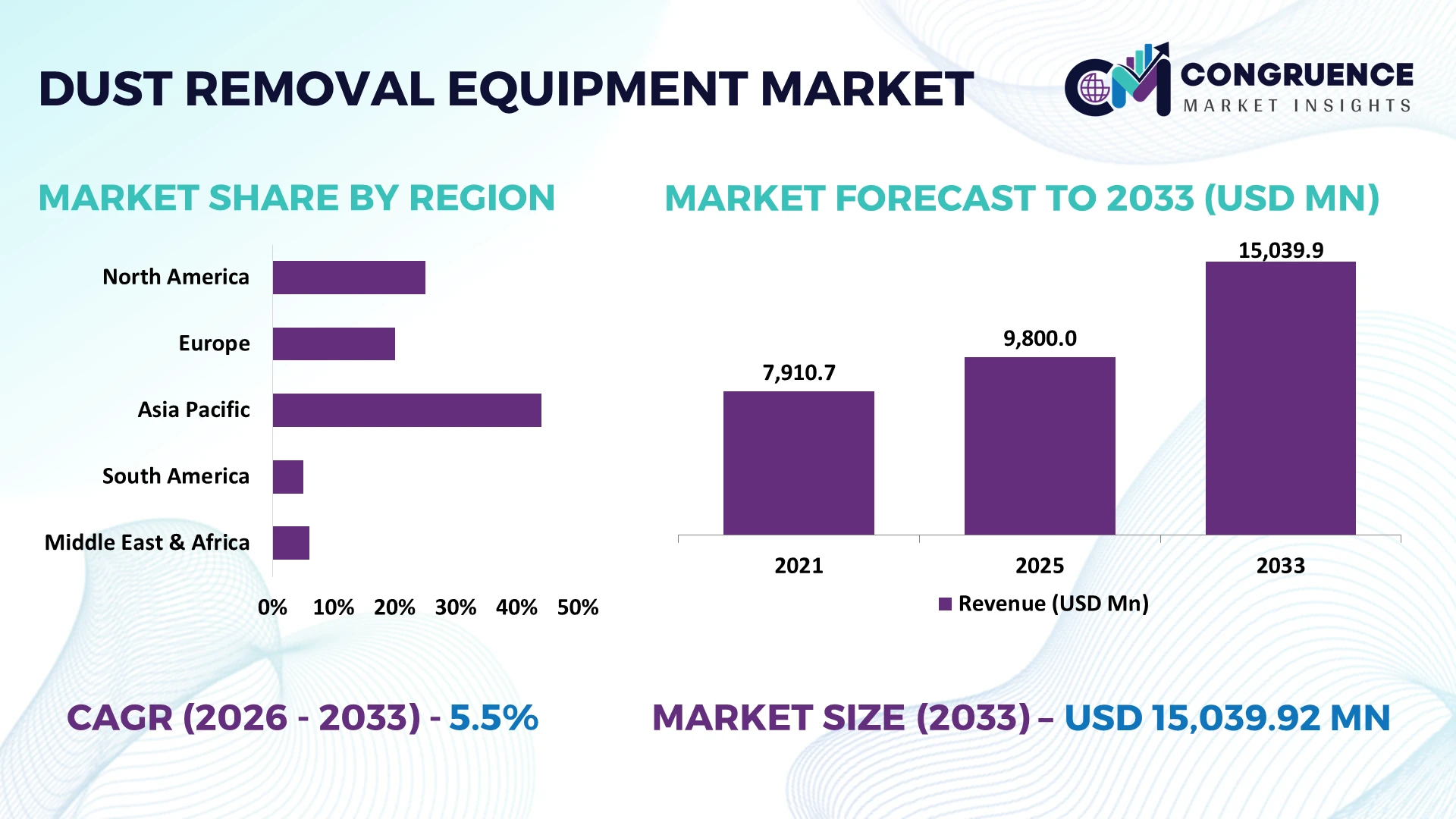
The Global Dust Removal Equipment Market was valued at USD 9800 Million in 2025 and is anticipated to reach a value of USD 15039.92 Million by 2033 expanding at a CAGR of 5.5% between 2026 and 2033. Growth is driven by cement and steel emission-control retrofits, combustible-dust mitigation, automated manufacturing ventilation, and replacement of legacy collectors with high-efficiency baghouse and cartridge systems.
China accounts for an estimated 32% of global dust removal equipment demand, anchored by roughly 1 billion tonnes of annual crude steel output and more than 1.8 billion tonnes of cement production. Large industrial sites increasingly deploy baghouses exceeding 99% particulate capture alongside automated pulse cleaning. India, comparatively, produces over 150 million tonnes of crude steel annually and is accelerating pollution-control investment across cement, metals, and thermal power. China's industrial modernization and geopolitical emphasis on domestic manufacturing reinforce localized filtration-equipment supply chains.
Strategically, suppliers should prioritize high-efficiency filter media, automated cleaning, explosion protection, sensor-based maintenance, and localized aftermarket capacity near major cement, steel, mining, and manufacturing clusters.
Market Size & Growth: USD 9,800 million in 2025 reaches USD 15,039.92 million by 2033 at 5.5% CAGR, driven by industrial emission-control modernization.
Top Growth Drivers: Above 99% particulate capture, 10–15% energy optimization, and 20–30% longer filter life strengthen replacement economics.
Short-Term Forecast: By 2028, sensor-controlled cleaning can reduce compressed-air and fan energy consumption by approximately 10–15%.
Emerging Technologies: AI diagnostics, IoT differential-pressure sensing, nanofiber media, and automated pulse cleaning increasingly support above 99% collection efficiency.
Regional Leaders: Asia-Pacific approaches USD 6.5 billion, North America USD 3.3 billion, and Europe USD 3.0 billion by 2033, led by retrofit automation.
Consumer/End-User Trends: Cement, metals, woodworking, and food processors increasingly specify collectors delivering 99%+ filtration with automated condition monitoring.
Pilot/Case Example: 2025 smart baghouse deployments demonstrated approximately 15% lower cleaning-air consumption through differential-pressure-controlled pulse sequencing.
Competitive Landscape: Donaldson holds an estimated 12% position, competing with Nederman, Camfil, Parker Hannifin, and Thermax across industrial filtration applications.
Regulatory & ESG Impact: Advanced collectors capture more than 99% of process dust, supporting tighter occupational exposure and industrial particulate-control requirements.
Investment & Funding: More than USD 50 billion in industrial modernization programs globally supports filtration upgrades alongside automation, electrification, and manufacturing-capacity expansion.
Innovation & Future Outlook: Connected collectors target 10–20% maintenance reductions through predictive diagnostics, remote monitoring, automated cleaning, and longer-life advanced filter media.
The Dust Removal Equipment Market serves cement plants, steel mills, foundries, mines, woodworking facilities, pharmaceutical production, food processing, and automated manufacturing where airborne particulate directly affects compliance, worker exposure, equipment reliability, and product quality. Modern baghouses, cartridge collectors, cyclones, wet scrubbers, and centralized extraction systems increasingly integrate IoT sensors and variable-speed fans. Intelligent pressure-drop control can reduce filtration energy consumption by approximately 10–15%. Tightening occupational dust standards and manufacturing localization are also shifting procurement toward connected systems with locally stocked filters, faster maintenance, and application-specific explosion protection, establishing the strategic priorities shaping competitive development.
Dust removal equipment is becoming strategic infrastructure as manufacturers connect particulate control with worker safety, process reliability, product quality, and plant automation. China's large steel and cement base and India's manufacturing expansion sustain equipment-intensive demand, while tighter occupational exposure requirements are shifting procurement from standalone collectors toward digitally monitored extraction networks. Supply-chain localization is simultaneously increasing demand for domestically stocked filters, motors, valves, and replacement components.
Modern variable-speed collectors using differential-pressure-controlled cleaning can consume 10–15% less filtration energy than fixed-speed, timer-cleaned legacy systems while maintaining particulate capture above 99%. China leads deployment scale across metals and cement; North America emphasizes combustible-dust protection and connected manufacturing, while Europe prioritizes energy-efficient extraction. Through 2026–2028, sensor-equipped collectors should increasingly replace fixed-maintenance systems as plants target 10–20% fewer unnecessary filter interventions.
A metalworking facility integrating cartridge collectors with machining cells can activate extraction according to production load instead of continuously operating every fan. Suppliers are therefore investing in IoT controls, nanofiber media, variable-frequency drives, explosion isolation, and localized service networks. Competitive advantage increasingly belongs to companies converting dust collection from compliance hardware into measurable plant-efficiency infrastructure.
Worker-exposure regulation is shifting dust collection from discretionary plant equipment toward engineered production infrastructure. Modern cartridge and baghouse collectors routinely capture above 99% of airborne particulate, while optimized source-capture systems can reduce uncontrolled workplace dust concentrations by more than 90%. In the United States, OSHA's respirable crystalline silica limit of 50 micrograms per cubic meter has intensified engineering controls across construction-material, stone, foundry, and manufacturing operations. India's expanding cement and metals capacity adds large-scale industrial extraction requirements. The operational insight is that source capture protects machinery and products alongside workers, broadening equipment economics beyond compliance. Donaldson, Nederman, Camfil, and other suppliers are expanding application-specific collectors, high-efficiency media, extraction arms, and automated monitoring systems to secure recurring filter and service demand.
Dust collectors create continuous operating expenditure through fan electricity, compressed-air cleaning, filter replacement, and maintenance. Filtration and duct pressure losses can account for 10–20% of ventilation-system energy consumption where collectors are poorly sized, while heavily loaded filters can raise pressure drop by more than 25% before replacement or cleaning restores airflow. Energy-intensive cement and steel operators in India face particular sensitivity because large centralized systems run for extended production shifts. Specialized nanofiber, antistatic, and high-temperature media also carry higher replacement costs than conventional filters, complicating adoption at smaller facilities. Manufacturers are addressing ownership costs through variable-frequency drives, localized consumable production, differential-pressure cleaning, longer-term supply contracts, and modular collector sizing. Correct airflow engineering therefore has greater economic significance than simply selecting higher filtration capacity.
IoT-enabled differential-pressure sensing, airflow analytics, predictive filter monitoring, and variable-speed controls are creating opportunities beyond equipment sales. Automated fan control can reduce energy consumption by approximately 10–15%, while condition-based servicing can lower unnecessary maintenance interventions by 10–20%. India's manufacturing automation and China's large installed collector base provide substantial opportunities for retrofitting sensors onto equipment that remains mechanically serviceable. Through 2026–2028, cloud-connected filtration dashboards will increasingly integrate dust collectors with plant maintenance systems, allowing filter loading and fan performance to trigger work orders automatically. Suppliers are investing in connected controllers, remote diagnostics, smart valves, and subscription-based maintenance. The less obvious opportunity is aftermarket digitalization: manufacturers can convert installed collectors into recurring monitoring, consumables, and service relationships without requiring customers to replace complete filtration systems.
Dust characteristics vary sharply by particle size, abrasiveness, moisture, combustibility, temperature, and process chemistry, making standardized collector configurations operationally risky. Fine particulate below 10 micrometers can penetrate unsuitable media, while excessive loading can increase pressure drop by 20–30% and reduce extraction airflow at critical capture points. Combustible applications add another engineering layer because metal, wood, food, and chemical dust require explosion venting, isolation, grounding, or suppression. U.S. manufacturers must increasingly align collection systems with evolving combustible-dust safety requirements while integrating sensors into existing plant controls. Poor duct balancing can undermine even high-efficiency filters by failing to capture emissions at source. Suppliers must strengthen application testing, airflow modeling, explosion-protection partnerships, commissioning expertise, and technician training. Long-term differentiation depends on guaranteeing complete extraction-system performance rather than filter efficiency alone.
Modular Collectors Replace Central Systems: Manufacturers are moving extraction closer to dust-generating machinery instead of relying exclusively on large centralized networks. Modular cartridge units can shorten duct runs by 30–50%, reduce associated pressure losses by 10–20%, and isolate maintenance without stopping complete extraction networks. U.S. metalworking and automated production facilities are adopting cell-level collectors as production layouts become more flexible. Equipment manufacturers are responding with compact collectors, integrated fans, standardized controls, and expandable modules.
Explosion Protection Becomes Integrated: Combustible-dust management is increasingly incorporated during collector design rather than added after commissioning. Food, woodworking, metals, and chemical processors are specifying explosion venting, isolation valves, flameless vents, and antistatic media alongside filtration efficiencies exceeding 99%. Properly engineered source extraction can remove more than 90% of airborne process dust before dispersion. Suppliers are partnering with explosion-protection specialists and packaging filtration and isolation equipment as coordinated safety systems.
Advanced Media Extends Service Cycles: Nanofiber and surface-loaded cartridge media are replacing conventional depth-loading filters where fine particulate rapidly increases resistance. Application-specific media can extend effective filter life by approximately 20–30% while reducing stabilized pressure drop by 10–15%. Cement, mining, and metal-processing operators are increasingly evaluating filters through lifecycle airflow stability rather than purchase price. Manufacturers are expanding nanofiber, abrasion-resistant, hydrophobic, and high-temperature portfolios to capture higher-margin replacement demand.
Local Aftermarket Networks Expand: Supply-chain disruption has pushed industrial operators toward locally stocked cartridges, bags, valves, and replacement components. Plants increasingly target critical filtration spares availability above 95% while reducing imported-component lead times by 20–40%. India and China are attracting localized consumable production near cement, steel, and manufacturing clusters. Global suppliers are expanding distributors, service centers, and regional inventories, making aftermarket responsiveness an increasingly important equipment-selection criterion.
Baghouse filters lead the market with an estimated 34% share, reflecting their ability to handle high dust volumes across cement, steel, power, chemicals, and mining operations. Properly configured baghouses achieve particulate collection above 99% and accommodate large process-gas flows, giving them a scale advantage over compact collectors. Electrostatic precipitators retain a substantial position in power and heavy industry where enormous gas volumes favor low-pressure-drop collection. Cyclone collectors remain economically important as pre-cleaners, removing approximately 70–90% of larger particles before downstream filtration and reducing consumable loading.
Cartridge collectors are the fastest-growing type as factories prioritize compact footprints, modular installation, and high-efficiency fine-dust capture. Advanced cartridge media can deliver above 99% efficiency while occupying materially less floor space than conventional baghouses for suitable applications. Wet scrubbers retain strategic value for hot, sticky, combustible, or chemically reactive particulate streams. Suppliers are concentrating investment on nanofiber cartridges, abrasion-resistant bags, intelligent cleaning controls, and hybrid collector configurations, shifting competition toward application-specific lifecycle economics.
Process dust control accounts for approximately 36% of application demand because dust generation occurs directly at crushing, grinding, cutting, mixing, conveying, and machining points across heavy industry. Capturing particulate at source can remove more than 90% before workplace dispersion while protecting downstream machinery and products. Flue gas cleaning represents approximately 25% of demand, concentrated in power, cement, steel, and chemical combustion processes where large gas volumes require baghouses, precipitators, or wet scrubbers. Material handling remains essential around transfer points, conveyors, silos, and loading stations.
Workplace air filtration is the fastest-growing application as manufacturers increasingly supplement source extraction with ambient filtration around occupied production areas. Bulk solids processing requires specialized collection around powders where product recovery and contamination control influence equipment selection. Suppliers are deploying modular collectors, extraction hoods, airflow controls, and connected differential-pressure monitoring. Investment is shifting toward integrated capture networks because controlling particulate near its generation point reduces both housekeeping requirements and secondary airborne exposure.
The cement industry leads end-user demand with approximately 29% share because particulate collection is required across quarry crushing, raw milling, kiln systems, clinker cooling, conveying, and cement grinding. Modern baghouses can exceed 99% collection efficiency, while cyclones frequently remove 70–90% of coarse particulate before final filtration. Power generation represents another mature equipment base, particularly around coal handling, ash management, and flue-gas cleaning. Steel producers require high-volume extraction around furnaces, casting, sintering, and material-transfer operations where abrasive dust increases equipment wear.
Mining is the fastest-growing end-user segment as higher material throughput and mechanized crushing increase requirements for extraction at crushers, screens, conveyors, and transfer points. Chemical plants emphasize corrosion resistance and containment where powders present toxicity or reactivity risks. Equipment companies are targeting these industries with abrasion-resistant media, heavy-duty housings, wet collection, modular cartridges, and service agreements. Competitive investment is shifting toward application engineering that reduces maintenance exposure while maintaining airflow under severe dust loading.
Asia-Pacific accounted for the largest market share at 42% in 2025 however, Asia-Pacific is expected to register the fastest growth, expanding at a CAGR of 6.7% between 2026 and 2033.

Connected Extraction Reshapes Factory Modernization
North America represents approximately 24% of global dust removal equipment demand, with the United States concentrating installations across metalworking, cement, chemicals, food processing, woodworking, mining, and advanced manufacturing. Factory modernization is shifting procurement from fixed-speed centralized collectors toward modular cartridge units, variable-frequency drives, differential-pressure controls, and connected filtration. U.S. cement production remains near 90 million tonnes annually, supporting substantial baghouse and material-handling extraction requirements. Combustible-dust management also increases specifications for explosion isolation, flameless venting, and antistatic media. Manufacturers increasingly integrate collectors directly with production cells, allowing extraction airflow to track machine utilization rather than operate continuously. Donaldson, Camfil, Parker Hannifin, and Nederman compete through advanced media, connected controls, and aftermarket networks. The operational priority is moving from maximum airflow toward maintaining verified capture performance at minimum energy intensity.
United States Market Outlook: The United States combines stringent occupational exposure requirements with a large installed base of factories requiring replacement filters and collector modernization. OSHA's respirable crystalline silica permissible exposure limit of 50 micrograms per cubic meter reinforces source-capture investment across foundries, mineral processing, construction materials, and engineered-stone operations. Digitally monitored cartridge collectors and explosion-protected extraction systems consequently command increasing procurement attention.
Energy Efficiency Rewrites Extraction Economics
Europe accounts for approximately 22% of global demand, led by Germany, Italy, France, the United Kingdom, and Poland across machinery, metals, chemicals, cement, woodworking, and material processing. High industrial electricity costs are making pressure-drop management, variable-speed extraction, and filter-life optimization central purchasing criteria rather than secondary engineering considerations. Connected fan control can reduce extraction energy requirements by approximately 10–15% where airflow demand varies across production shifts. European occupational safety and industrial emissions frameworks simultaneously reinforce high-efficiency particulate capture and combustible-dust management. Germany's extensive machinery and manufacturing base supports adoption of decentralized extraction units integrated directly with production equipment. Suppliers are responding with energy-optimized fans, modular collectors, high-surface-area cartridges, ATEX-compatible systems, and remote condition monitoring. Lifecycle energy consumption increasingly differentiates technically comparable systems because continuous ventilation creates recurring operating exposure.
Germany Market Outlook: Germany's manufacturing economy combines automotive production, machinery, chemicals, metals, woodworking, and precision processing, creating diverse extraction requirements. Manufacturing contributes roughly one-fifth of national economic output, sustaining dense deployment of industrial ventilation equipment. Buyers increasingly specify ATEX-compatible collectors, automated airflow regulation, high-efficiency media, and condition monitoring to reconcile worker protection with plant energy-management targets.
Manufacturing Scale Anchors Equipment Deployment
Asia-Pacific commands approximately 42% of global demand, reflecting China's unmatched steel, cement, mining, electronics, and general manufacturing scale alongside India's accelerating industrial expansion. China produces close to 1 billion tonnes of crude steel and more than 1.8 billion tonnes of cement annually, generating extensive requirements for baghouses, electrostatic precipitators, cyclones, and material-handling extraction. India contributes over 150 million tonnes of annual crude steel output while expanding cement, mining, metals, and engineered manufacturing capacity. Procurement is shifting toward locally manufactured collectors and consumables as operators reduce replacement-part lead times and imported-component exposure. Chinese suppliers compete aggressively on production economics, while international manufacturers differentiate through nanofiber media, explosion protection, digital monitoring, and application engineering. Large installed fleets make aftermarket filters, valves, cages, and predictive maintenance increasingly important alongside new equipment.
China Market Outlook: China offers the world's deepest industrial dust-control installed base because cement, steel, nonferrous metals, chemicals, mining, and manufacturing operate at exceptional scale. Manufacturing represents more than one-quarter of national economic output. Domestic filter-media and equipment production strengthens replacement availability, while stricter factory air-quality requirements support intelligent pulse cleaning, high-efficiency cartridges, and centralized monitoring across large industrial sites.
Mining and Materials Sustain Heavy-Duty Demand
South America represents approximately 6% of global demand, with Brazil and Chile concentrating equipment requirements across mining, cement, steel, pulp, chemicals, and bulk-material handling. Brazil produces roughly 30 million tonnes of crude steel annually and maintains extensive cement and mineral-processing infrastructure, supporting demand for baghouses, cyclones, and cartridge collectors. Chile's copper industry creates severe abrasive-dust environments across crushing, screening, conveying, and concentrate handling. Mining applications increasingly require rugged collectors capable of maintaining airflow despite high particle loading. Imported equipment costs and replacement-part lead times constrain advanced-system deployment outside major industrial centers, strengthening the business case for locally stocked consumables. Suppliers are expanding distributor networks, refurbishment services, filter inventories, and modular equipment configurations. Regional procurement consequently favors maintainability and spare-parts accessibility alongside filtration efficiency.
Brazil Market Outlook: Brazil combines the region's broadest manufacturing base with large iron ore, steel, cement, food-processing, and chemical industries. Cement output exceeds 60 million tonnes annually, creating recurring extraction requirements from quarrying through grinding and packing. Local service capability, abrasion-resistant media, modular baghouses, and readily available replacement filters provide suppliers with stronger differentiation than imported equipment specifications alone.
Industrial Diversification Broadens Extraction Investment
Middle East & Africa represents approximately 6% of global demand, with Saudi Arabia, the UAE, South Africa, Egypt, and mineral-producing African economies supporting cement, mining, metals, chemicals, and bulk-material applications. Saudi Arabia's industrial diversification is expanding mining and downstream processing, creating new requirements for crushers, conveyors, furnaces, and material-transfer extraction. The country produces more than 50 million tonnes of cement annually, sustaining substantial installed filtration capacity. South Africa adds mining-intensive demand across coal, platinum-group metals, iron ore, and mineral processing, where abrasive dust places high loads on collectors. Harsh ambient conditions increase requirements for durable housings, abrasion-resistant media, and reliable fan systems. Suppliers are strengthening regional distribution, consumable inventories, and technical partnerships because maintenance responsiveness directly affects equipment availability at geographically dispersed industrial sites.
Saudi Arabia Market Outlook: Saudi Arabia's mining, cement, metals, and industrial-development programs are expanding dust-generating processing capacity beyond established hydrocarbon activities. Vision 2030-backed mineral development strengthens requirements for crushing, conveying, grinding, and material-handling extraction. Suppliers offering heavy-duty collectors, high-temperature filtration, explosion protection, localized service, and stocked consumables are positioned for increasingly complex industrial projects.
Donaldson, Nederman, Camfil, Parker Hannifin, and Thermax compete across industrial dust collection, while application specialists challenge global suppliers through customization and localized service. The top five players collectively control approximately 38% of demand, reflecting fragmentation across industries and geographies. Donaldson competes through cartridge technology and aftermarket scale; Nederman emphasizes connected extraction; Camfil targets high-efficiency filtration; Thermax leverages heavy-industry engineering. Advanced media can extend filter life by 20–30%, while variable-speed controls reduce extraction energy approximately 10–15% and optimized cleaning lowers compressed-air consumption by 10–20%. Suppliers are expanding service centers, digital monitoring, explosion-protection partnerships, and localized consumables manufacturing. Competition is shifting from collector hardware toward lifecycle airflow performance and recurring aftermarket support. Application engineering, certified combustible-dust protection, installed-base access, and replacement-filter availability create entry pressure. Winning requires verified capture efficiency, energy optimization, process-specific engineering, rapid service, connected diagnostics, and dependable consumables availability across industrial operating cycles.
Donaldson Company, Inc.
Nederman Holding AB
Camfil
Parker Hannifin Corporation
Thermax Limited
Absolent Air Care Group
Keller Lufttechnik GmbH + Co. KG
Schenck Process
CECO Environmental
Dürr Group
Imperial Systems, Inc.
RoboVent
AAF International
FLSmidth
Current dust removal equipment increasingly combines nanofiber cartridge media, variable-frequency fans, differential-pressure controls, automated pulse cleaning, and connected monitoring. High-efficiency panel filtration reaches 99.97% capture at 0.3 microns, while compact cartridge architectures require up to 40% fewer filters than conventional designs. Connected dashboards track pressure drop and collector condition continuously, improving maintenance planning and protecting production uptime.
Emerging systems integrate cloud analytics, smart pulse controllers, ePTFE membranes, modular point-of-use collectors, and combustible-dust protection. Compared with traditional baghouses, compact PowerCore-type collectors can occupy 50% less space, while advanced pulse systems deliver 27% more cleaning energy to media. Nanofiber surface loading stabilizes airflow and extends service intervals, benefiting manufacturers where floor space, labor availability, and filter-change downtime directly influence operating economics.
Disruptive development through 2026–2028 will center on predictive filtration, AI-assisted airflow optimization, digital compliance records, and integrated explosion-safety monitoring. Smart collectors will increasingly connect filtration data with plant maintenance platforms, shifting service from fixed schedules toward condition-based intervention. Suppliers combining collector hardware, proprietary media, sensors, controls, and aftermarket support gain the strongest competitive position. Operators should prioritize connected architectures now because energy optimization, fewer filter changes, and verified dust-control performance increasingly determine lifecycle cost and production resilience across demanding industrial applications.
August 2025 – Donaldson introduced the Contura Pulse Controller with iCue Connected Technology, integrating sensors and cloud analytics on selected collectors across North America and Europe, providing real-time data that strengthens proactive maintenance, uptime management, and compliance tracking. Source: OHS
October 2025 – Camfil APC launched Gold Series III with OptiCone cartridges and OmniPleat media, building on more than 20 years of Gold Series operation while improving pulse-cleaning distribution, pressure-drop control, energy efficiency, maintenance accessibility, and filter life. Source: Camfil
October 2024 – RoboVent opened an 89,600-square-foot manufacturing facility in New Baltimore, Michigan, nearly doubling its previous footprint after almost 30 years in Sterling Heights, expanding industrial dust-collection production capacity and supporting growing customer requirements across manufacturing applications. Source: Processing
August 2024 – Nederman acquired Duroair Technologies for approximately CAD 11 million enterprise value, adding climate-controlled filtration and containment systems for aerospace, defense, and manufacturing while strengthening its North American extraction portfolio and creating opportunities for international expansion. Source: Cision
The report evaluates Baghouse Filters, Cartridge Collectors, Cyclone Collectors, Electrostatic Precipitators, and Wet Scrubbers across Process Dust Control, Flue Gas Cleaning, Material Handling, Bulk Solids Processing, and Workplace Air Filtration. End-user coverage spans Cement, Power Generation, Steel, Chemical, and Mining industries. Baghouse filters represent approximately 34% of type demand, while process dust control accounts for about 36% of application deployment.
Regional assessment covers North America, Europe, Asia-Pacific, South America, and Middle East & Africa, including manufacturing clusters, mining corridors, heavy-industry sites, and localized aftermarket networks. Technology coverage includes nanofiber media, connected differential-pressure monitoring, variable-frequency fans, automated pulse cleaning, modular point-of-use collectors, and combustible-dust protection. The 2026–2033 framework supports investment planning, manufacturing localization, product development, service-network expansion, competitive benchmarking, and positioning around connected filtration, energy-efficient extraction, and high-performance replacement consumables.
| Report Attribute/Metric | Report Details |
|---|---|
Market Revenue in 2025 | USD 9800 Million |
Market Revenue in 2033 | USD 15039.92 Million |
CAGR (2026 - 2033) | 5.5% |
Base Year | 2025 |
Forecast Period | 2026 - 2033 |
Historic Period | 2021 - 2025 |
Segments Covered | By Type
By Application
By End-User
|
Key Report Deliverable | Revenue Forecast, Growth Trends, Market Dynamics, Segmental Overview, Regional and Country-wise Analysis, Competition Landscape |
Region Covered | North America, Europe, Asia-Pacific, South America, Middle East, Africa |
Key Players Analyzed | Donaldson Company, Inc., Nederman Holding AB, Camfil, Parker Hannifin Corporation, Thermax Limited, Absolent Air Care Group, Keller Lufttechnik GmbH + Co. KG, Schenck Process, CECO Environmental, Dürr Group, Imperial Systems, Inc., RoboVent, AAF International, FLSmidth |
Customization & Pricing | Available on Request (10% Customization is Free) |




