
Reports
The Global Duck Plucker Machine Market was valued at USD 141 Million in 2025 and is anticipated to reach a value of USD 209.91 Million by 2033 expanding at a CAGR of 5.1% between 2026 and 2033. Automation across poultry processing plants, stricter food safety compliance, and high-capacity stainless-steel plucking systems are accelerating equipment replacement cycles and improving processing productivity.
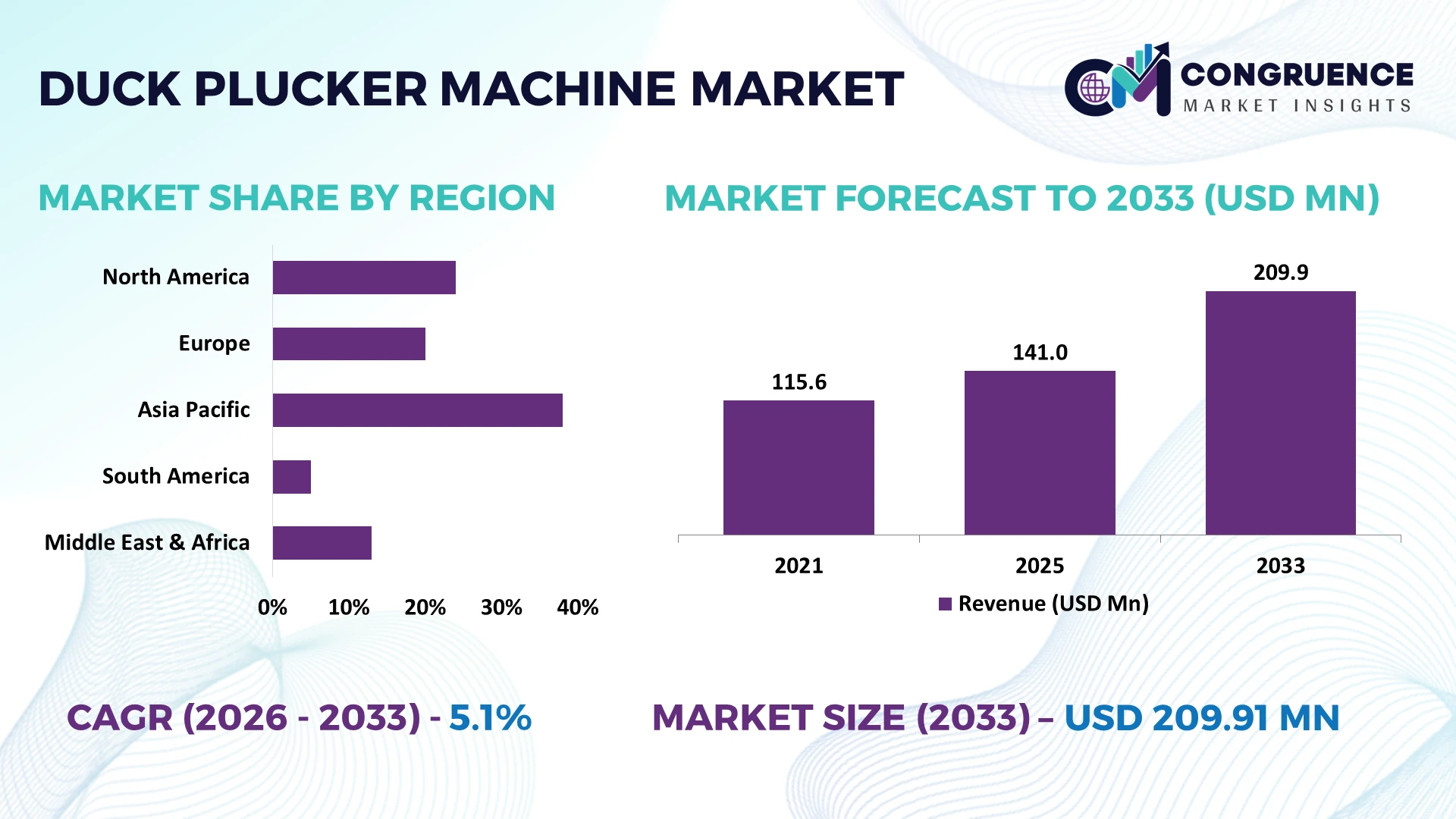
China dominates with approximately 38% of global production capacity, supported by over USD 320 million in poultry processing equipment modernization and widespread deployment across integrated poultry facilities. Automated duck processing exceeds 60% in China compared with nearly 44% in Vietnam, while 2026 regional supply-chain diversification has strengthened equipment sourcing across Asia-Pacific, reinforcing manufacturing resilience and export competitiveness.
Manufacturers investing in intelligent, energy-efficient duck plucker machines are positioned to capture higher-value contracts in industrial poultry processing and export-oriented markets.
Market Size & Growth: USD 141 Million in 2025 reaching USD 209.91 Million by 2033 at 5.1% CAGR, driven by automated poultry processing upgrades.
Top Growth Drivers: Processing automation (+22%), labor savings (+18%), and hygiene compliance investments (+16%) sustain market expansion.
Short-Term Forecast: By 2028, processing efficiency rises 20% while operating costs decline approximately 14%.
Emerging Technologies: AI monitoring, smart motor controls, and water-saving drum systems improve productivity by nearly 18%.
Regional Leaders: Asia Pacific (~USD 92 Million), Europe (~USD 49 Million), North America (~USD 43 Million), supported by factory automation.
Consumer Trends: Around 61% of commercial processors prioritize automated feather-removal equipment for higher throughput.
Pilot Example: A 2026 automated processing installation reduced feather-removal time by 25% and increased output by 17%.
Competitive Landscape: Top manufacturers hold nearly 45% market share, led by Zhengzhou Allance, Taizy Machinery, Hightop Machinery, Jianhua Machinery, and Longer Machinery.
Regulatory & ESG: Energy-efficient systems reduce electricity consumption by approximately 13% while supporting stricter food-processing standards.
Investment & Funding: More than USD 180 million supports manufacturing expansion, strategic partnerships, and regional production diversification.
Innovation & Future Outlook: Predictive maintenance and modular automated processing systems reduce equipment downtime by nearly 21%.
Demand for advanced duck plucker machines is expanding across commercial poultry processors, integrated farms, and export-focused meat facilities seeking higher throughput and hygiene consistency. Smart motor controls and water-efficient plucking technologies improve operational performance by approximately 18%, while evolving food-processing standards and regional supply-chain optimization continue reshaping equipment procurement, leading into broader strategic market opportunities.
The Duck Plucker Machine Market is becoming strategically important as poultry processors prioritize automation, labor optimization, and food safety compliance to improve production economics. Processing facilities are restructuring supply chains by sourcing equipment closer to manufacturing hubs while investing in automated slaughter lines that reduce dependence on seasonal labor. Equipment suppliers are increasingly competing through intelligent controls, modular machine designs, and lower operating costs rather than price alone, strengthening long-term competitive differentiation.
Modern automated duck plucker machines equipped with variable-speed drives and precision rubber finger systems improve feather-removal efficiency by approximately 20% while reducing water consumption by nearly 15% compared with conventional manually adjusted systems. China continues leading large-scale deployment through integrated poultry processing complexes, whereas Poland is expanding adoption through export-oriented poultry modernization and premium processing standards. Over the next two to three years, automated equipment installations are expected to exceed 65% among newly commissioned industrial poultry facilities, reflecting accelerating digital equipment adoption.
A 2026 poultry processor upgrading to integrated plucking and conveyor automation reduced processing downtime by 18% while improving product consistency across multiple production lines. Manufacturers are expanding distributor partnerships, localizing component sourcing, and increasing investment in smart maintenance capabilities to strengthen aftermarket support. Companies combining automation, service networks, and operational efficiency will secure stronger competitive positioning as industrial poultry processing continues to modernize.
Industrial poultry processors are replacing labor-intensive feather-removal operations with automated duck plucker machines to improve throughput, hygiene, and production consistency. Automated processing increases operational efficiency by nearly 22%, while labor requirements decline by approximately 18% and product rejection rates fall by around 10%. China's poultry processing modernization and stricter food safety inspections continue accelerating equipment replacement across large processing facilities. Manufacturers are responding by introducing modular stainless-steel systems, expanding local assembly capacity, and partnering with poultry equipment integrators. A key strategic advantage lies in combining automated plucking with integrated processing lines, allowing processors to shorten production cycles while maintaining consistent export-quality standards and improving overall plant utilization.
Fluctuating stainless-steel prices and dependence on imported motors, bearings, and industrial control components continue affecting equipment manufacturing economics. Material costs have increased approximately 12% over recent procurement cycles, while component lead times remain nearly 20% longer than pre-disruption averages for several international suppliers. Smaller poultry processors in countries including Indonesia and Bangladesh face slower equipment adoption due to higher capital requirements and limited financing access. Manufacturers are reducing exposure through localized sourcing, long-term supplier contracts, and standardized machine platforms that simplify production and maintenance. Improving component availability and procurement stability has become essential for maintaining competitive pricing and supporting scalable industrial deployment.
The integration of intelligent sensors, predictive maintenance software, and energy-efficient drive systems is creating new opportunities beyond traditional mechanical processing. Smart equipment reduces unexpected maintenance events by approximately 25% while improving machine utilization by nearly 16%. Japan and South Korea are accelerating investment in digitally connected poultry processing facilities that prioritize production monitoring and traceability. Equipment manufacturers are increasing R&D spending, forming automation partnerships, and developing remote diagnostic platforms that strengthen long-term customer relationships. An emerging strategic opportunity lies in subscription-based maintenance services, enabling suppliers to generate recurring revenue while helping processors optimize operational efficiency and reduce lifecycle ownership costs.
Expanding automated poultry processing requires skilled technicians capable of integrating plucking machines with conveyors, chilling systems, and digital production controls. More than 30% of medium-sized processors report shortages of automation maintenance personnel, while commissioning periods for integrated processing lines remain approximately 15% longer where technical expertise is limited. Germany's highly automated poultry facilities highlight the importance of standardized industrial communication and workforce training for reliable operations. Manufacturers are addressing these challenges through operator certification programs, digital service platforms, and collaborative engineering partnerships. Long-term competitiveness will depend on delivering interoperable equipment ecosystems that simplify deployment, minimize operational disruption, and sustain consistent production performance across diverse processing environments.
Smart Processing Line Integration: Duck plucker machines are increasingly deployed as part of fully synchronized poultry processing lines, reducing manual handling by nearly 28% and improving line balancing by around 18%. Labor shortages across China and Eastern Europe continue accelerating integrated equipment adoption. Manufacturers are expanding automation partnerships and offering complete processing solutions instead of standalone machines, enabling faster installation and higher plant productivity.
Water-Efficient Equipment Designs: Processing facilities are replacing conventional washing systems with recirculating water technologies that reduce water consumption by approximately 20% while lowering cleaning downtime by nearly 14%. Tightening environmental compliance and rising utility costs are driving procurement decisions. Equipment suppliers are redesigning drum assemblies, improving spray systems, and introducing low-maintenance components to strengthen operational efficiency and sustainability.
Localized Manufacturing Expansion: Supply-chain diversification is encouraging equipment production closer to key poultry-processing clusters, reducing delivery lead times by nearly 25% and lowering logistics costs by approximately 12%. Vietnam and Türkiye are strengthening regional manufacturing capabilities as buyers seek shorter procurement cycles. Companies are establishing local assembly partnerships and expanding component sourcing networks to improve delivery reliability and aftermarket responsiveness.
Predictive Maintenance Adoption: Embedded sensors and remote equipment diagnostics now reduce unexpected maintenance events by roughly 23% while increasing machine availability by around 16%. Large poultry processors are shifting toward preventive service contracts rather than reactive repairs. Equipment manufacturers are scaling digital monitoring platforms, expanding technical support partnerships, and introducing subscription-based maintenance services that improve customer retention and long-term equipment performance.
Fully Automatic duck plucker machines account for approximately 41% of total market demand because they deliver high processing throughput, consistent feather removal, and seamless integration with conveyor-based poultry processing lines. Large commercial processors increasingly prioritize these systems to reduce labor dependency while improving hygiene compliance and production efficiency. Drum Type machines remain strategically important for high-volume operations due to their durability and continuous processing capability. Manual machines continue serving small poultry farms with limited processing volumes, while Semi-Automatic equipment provides a cost-effective transition for medium-sized enterprises upgrading production capacity.
Drum Type machines represent the fastest-growing segment as processors expand industrial-scale operations requiring higher throughput and lower maintenance frequency. Deployment of automated Drum Type systems has increased by nearly 19%, while integrated production lines improve operational efficiency by approximately 21%. Manufacturers are expanding modular product portfolios, strengthening automation partnerships, and introducing energy-efficient drive systems to improve lifecycle performance. Investment priorities are increasingly shifting toward scalable equipment platforms capable of supporting export-oriented poultry processing facilities and future production expansion.
Poultry Processing represents approximately 52% of equipment deployment as integrated processing plants continue modernizing production to improve throughput, hygiene, and product consistency. Automated duck plucker machines have become operationally essential within high-volume processing facilities, reducing manual handling while supporting standardized processing workflows. Commercial Slaughtering remains the second-largest application, benefiting from increasing investments in export-oriented processing infrastructure. Farm Processing continues serving localized production, while Meat Processing facilities are expanding equipment deployment where diversified poultry product lines require flexible processing capabilities.
Commercial Slaughtering is emerging as the fastest-growing application as automation deployment increases by nearly 20% across newly modernized facilities. Processing efficiency improves by approximately 18% through integrated plucking and conveyor systems, encouraging processors to replace standalone equipment. Manufacturers are responding by offering configurable processing lines, localized technical support, and application-specific machine designs that improve operational flexibility. Demand is steadily shifting toward integrated processing environments where productivity, hygiene, and equipment compatibility directly influence long-term operating performance.
Meat Processing Plants account for approximately 39% of total equipment demand because they operate high-capacity production lines requiring continuous processing, standardized hygiene, and minimal downtime. Their purchasing decisions emphasize automation compatibility, equipment durability, and lifecycle operating efficiency. Slaughterhouses remain another major buyer due to ongoing processing modernization, while Poultry Farms continue adopting compact systems suitable for decentralized operations. Food Processing Companies increasingly integrate duck plucker machines into diversified poultry production facilities to strengthen supply reliability and product quality.
Food Processing Companies represent the fastest-growing end-user segment as integrated poultry manufacturing expands across value-added product categories. Automated equipment deployment has increased by approximately 18%, while smart maintenance capabilities reduce service interruptions by nearly 16%. Manufacturers are introducing customized equipment packages, strengthening distributor partnerships, and offering flexible financing models to accelerate adoption. Competitive positioning increasingly depends on delivering scalable equipment ecosystems that support multiple processing environments while reducing ownership costs and improving long-term operational resilience.
Asia-Pacific accounted for the largest market share at 46% in 2025 however, North America is expected to register the fastest growth, expanding at a 5.8% CAGR between 2026 and 2033.

Automation-Led Processing Modernization
North America continues strengthening its position through industrial poultry processing modernization, automated slaughtering infrastructure, and high food safety compliance requirements. The region represents approximately 23% of global equipment deployment, supported by increasing replacement of aging processing systems with automated feather-removal technologies. Nearly 58% of newly installed industrial poultry processing lines incorporate automated plucking equipment to improve throughput and reduce labor dependency. Equipment suppliers are expanding service partnerships, integrating predictive maintenance capabilities, and strengthening regional distribution networks to reduce equipment downtime. Growing investment in digitally connected processing facilities is improving production visibility while encouraging manufacturers to deliver modular equipment compatible with complete processing lines.
United States Market Outlook: The United States remains the region's largest market due to advanced poultry processing infrastructure, established food equipment manufacturers, and continuous investment in industrial automation. More than 62% of large poultry processing facilities utilize automated feather-removal systems integrated with conveyor operations. Companies continue upgrading processing plants through intelligent control systems, localized technical support, and aftermarket service expansion, strengthening operational reliability and long-term equipment replacement demand.
Efficiency and Compliance Drive Equipment Upgrades
Europe maintains a strong position through strict food-processing standards, energy-efficient equipment adoption, and modernization of poultry processing facilities. The region contributes nearly 21% of global deployment, with processors increasingly replacing conventional equipment to improve hygiene consistency and operational efficiency. Automated processing installations have expanded by approximately 17% across industrial facilities as manufacturers respond to sustainability requirements and labor constraints. Equipment suppliers are introducing water-saving systems, modular processing configurations, and digital monitoring technologies that reduce operating costs while supporting regulatory compliance. Investment continues to prioritize production efficiency rather than capacity expansion alone.
Poland Market Outlook: Poland has emerged as Europe's leading growth center for duck processing equipment because of its export-oriented poultry industry and expanding processing infrastructure. Automated processing systems are installed across approximately 55% of large poultry facilities, encouraging manufacturers to establish local distribution partnerships and technical service networks. Continued investment in export-quality processing standards supports sustained equipment modernization across commercial operations.
Manufacturing Scale Supports Market Leadership
Asia-Pacific remains the global production and deployment center for duck plucker machines, accounting for approximately 46% of total market activity. Large poultry processing industries, competitive manufacturing capabilities, and integrated supply chains continue supporting extensive equipment deployment. More than 60% of industrial poultry processing facilities in major manufacturing economies operate automated feather-removal systems, while localized equipment production shortens procurement cycles by nearly 20%. Manufacturers are expanding production capacity, increasing automation investment, and strengthening export networks to meet rising industrial demand. Continuous processing modernization reinforces the region's leadership in both manufacturing and technology adoption.
China Market Outlook: China dominates the regional market through extensive poultry processing infrastructure, large-scale equipment manufacturing, and integrated industrial supply chains. Approximately 38% of global duck plucker machine production originates from China, supported by continuous factory automation and expanding export capability. Domestic manufacturers continue investing in intelligent machine controls, production efficiency, and overseas distributor partnerships to strengthen international competitiveness.
Commercial Processing Expands Equipment Demand
South America is experiencing steady equipment adoption as commercial poultry processors modernize production facilities and improve export competitiveness. The region contributes approximately 7% of global deployment, with automated processing installations increasing by nearly 15% across industrial poultry operations. Infrastructure improvements and greater investment in integrated slaughtering facilities are supporting equipment replacement, although logistics limitations and financing constraints continue affecting smaller processors. Manufacturers are strengthening dealer networks, expanding localized technical services, and introducing cost-efficient automated solutions tailored to regional processing requirements.
Brazil Market Outlook: Brazil represents the largest market in South America because of its extensive poultry production capacity and export-focused processing industry. More than half of large commercial poultry facilities have upgraded automated processing systems over recent years to improve productivity and food safety performance. Equipment suppliers continue expanding regional partnerships, spare-parts availability, and operator training programs to support long-term industrial deployment.
Processing Infrastructure Gains Investment Momentum
The Middle East & Africa market is advancing through food security initiatives, poultry processing modernization, and investment in domestic meat production infrastructure. The region accounts for approximately 3% of global equipment deployment, with industrial processing installations increasing by around 13% as governments encourage local food manufacturing. New processing facilities increasingly specify automated feather-removal systems to improve operational consistency and reduce labor dependence. Equipment suppliers are entering strategic partnerships with regional distributors while expanding maintenance support to strengthen long-term customer retention and project execution.
Saudi Arabia Market Outlook: Saudi Arabia leads regional investment through expanding poultry processing capacity, industrial diversification initiatives, and modern food manufacturing infrastructure. Automated processing equipment deployment has increased by approximately 18% within newly commissioned poultry facilities. International manufacturers are collaborating with local partners to improve equipment availability, technical training, and lifecycle support, strengthening the country's position as the primary regional investment destination.
Competition is led by Zhengzhou Allance, Zhengzhou Taizy Machinery, Zhengzhou Longer Machinery, Hightop Machinery, and Jianhua Machinery, with global equipment suppliers competing against regional manufacturers focused on cost-efficient production and localized service. The top five players collectively account for approximately 45% of market activity. Competition centers on automation capability, processing efficiency, customization, and delivery speed rather than pricing alone. Advanced automated systems improve processing efficiency by nearly 20%, while localized manufacturing reduces delivery lead times by approximately 18% and aftermarket response times by around 25%. Companies are expanding production capacity, forming distributor partnerships, investing in intelligent machine controls, and strengthening vertical integration to secure component availability. The competitive landscape is shifting toward integrated processing solutions combining automation, predictive maintenance, and lifecycle services. High engineering requirements, food-processing compliance, and established distribution networks create significant entry barriers. Winning requires scalable automation, reliable service infrastructure, continuous product innovation, and resilient supply-chain execution.
Zhengzhou Allance Machinery Co., Ltd.
Zhengzhou Taizy Machinery Co., Ltd.
Zhengzhou Longer Machinery Co., Ltd.
Hightop Machinery
Jianhua Machinery
Romiter Machinery Co., Ltd.
Zhengzhou AG Machinery & Equipment Co., Ltd.
Shandong Sensitar Machinery Manufacturing Co., Ltd.
Henan Honest Food Machinery Co., Ltd.
Bayle SA
Foodmate B.V.
Meyn Food Processing Technology B.V.
Linco Food Systems A/S
Zhengzhou Yize Machinery Co., Ltd.
Automated drum-based duck plucker machines equipped with variable-frequency drives, precision rubber finger assemblies, and PLC-controlled processing have become the operational benchmark for industrial poultry processors. These systems improve feather-removal efficiency by approximately 20% while reducing electricity consumption by nearly 12% compared with conventional fixed-speed equipment. Around 62% of newly commissioned commercial poultry processing lines now integrate automated plucking systems with conveyor, washing, and chilling equipment, enabling higher throughput, lower labor dependency, and consistent carcass quality. This integration strengthens plant utilization while reducing manual intervention across high-volume facilities.
Emerging technologies include AI-enabled equipment diagnostics, IoT-based machine monitoring, predictive maintenance, and closed-loop water management. Predictive maintenance reduces unplanned downtime by nearly 18%, while intelligent process controls improve operational accuracy by approximately 15%. Adoption has exceeded 35% among large integrated poultry processors seeking higher equipment availability and lower servicing costs. Digital production dashboards also improve maintenance scheduling, allowing manufacturers and processors to optimize spare-parts planning and extend equipment operating life without disrupting production workflows.
Between 2026 and 2028, modular smart processing platforms and remote lifecycle management will reshape competitive positioning. Compared with legacy standalone machines, connected systems deliver approximately 25% higher operational efficiency and reduce maintenance response time by nearly 20%. Manufacturers investing in software-enabled equipment, automation partnerships, and digital aftermarket services will secure stronger customer retention, while processors adopting intelligent processing technologies gain measurable productivity, compliance, and cost advantages before automation becomes the industry baseline.
May 2024 Foodmate launched the global Duravant Lifecycle Services network, expanding aftermarket support through unified maintenance, spare parts, and technical assistance across poultry processing operations, strengthening equipment uptime and lifecycle performance for industrial customers. Source: foodmateglobal.com
February 2025 Foodmate introduced the ULTiMATE performance upgrade, increasing whole-leg deboner production speed from 6,000 to 7,200 legs per hour, representing a 20% capacity improvement that enables processors to enhance throughput without replacing installed equipment. Source: foodmate.nl
June 2026 Foodmate and VP Soluções strengthened a strategic partnership to expand poultry processing innovation and regional customer support across Latin America, improving localized deployment capabilities and aftermarket responsiveness for industrial processors. Source: foodmateglobal.com
June 2026 Meyn unveiled the Maestro M4.0 Pro Series featuring the Eviscerator Prime, achieving over 99% evisceration performance across birds with up to 20% weight variation while enabling water savings of up to 15%, improving operational consistency and processing efficiency. Source: meyn.com
The report provides comprehensive analysis of the Duck Plucker Machine Market across Manual, Semi-Automatic, Fully Automatic, and Drum Type equipment, covering Poultry Processing, Meat Processing, Commercial Slaughtering, and Farm Processing applications together with demand across Poultry Farms, Meat Processing Plants, Slaughterhouses, and Food Processing Companies. Regional assessment spans North America, Europe, Asia-Pacific, South America, and the Middle East & Africa, evaluating manufacturing concentration, technology deployment, supply-chain developments, and enterprise expansion strategies. More than 60% of industrial poultry processors are transitioning toward automated processing systems, reflecting accelerating equipment modernization.
The study evaluates competitive positioning, equipment innovation, automation trends, intelligent processing technologies, deployment patterns, and emerging niche opportunities supporting industrial poultry operations between 2026 and 2033. It benchmarks leading manufacturers, analyzes regional investment priorities, and examines operational efficiency improvements, digital integration, and aftermarket service evolution. The report enables manufacturers, distributors, investors, and equipment suppliers to identify expansion opportunities, optimize product strategies, strengthen competitive positioning, and align future investments with evolving industrial processing requirements and technology adoption patterns.
| Report Attribute/Metric | Report Details |
|---|---|
Market Revenue in 2025 | USD 141 Million |
Market Revenue in 2033 | USD 209.91 Million |
CAGR (2026 - 2033) | 5.1% |
Base Year | 2025 |
Forecast Period | 2026 - 2033 |
Historic Period | 2021 - 2025 |
Segments Covered | By Type
By Application
By End-User
|
Key Report Deliverable | Revenue Forecast, Growth Trends, Market Dynamics, Segmental Overview, Regional and Country-wise Analysis, Competition Landscape |
Region Covered | North America, Europe, Asia-Pacific, South America, Middle East, Africa |
Key Players Analyzed | Zhengzhou Allance Machinery Co., Ltd., Zhengzhou Taizy Machinery Co., Ltd., Zhengzhou Longer Machinery Co., Ltd., Hightop Machinery, Jianhua Machinery, Romiter Machinery Co., Ltd., Zhengzhou AG Machinery & Equipment Co., Ltd., Shandong Sensitar Machinery Manufacturing Co., Ltd., Henan Honest Food Machinery Co., Ltd., Bayle SA, Foodmate B.V., Meyn Food Processing Technology B.V., Linco Food Systems A/S, Zhengzhou Yize Machinery Co., Ltd. |
Customization & Pricing | Available on Request (10% Customization is Free) |




