
Reports
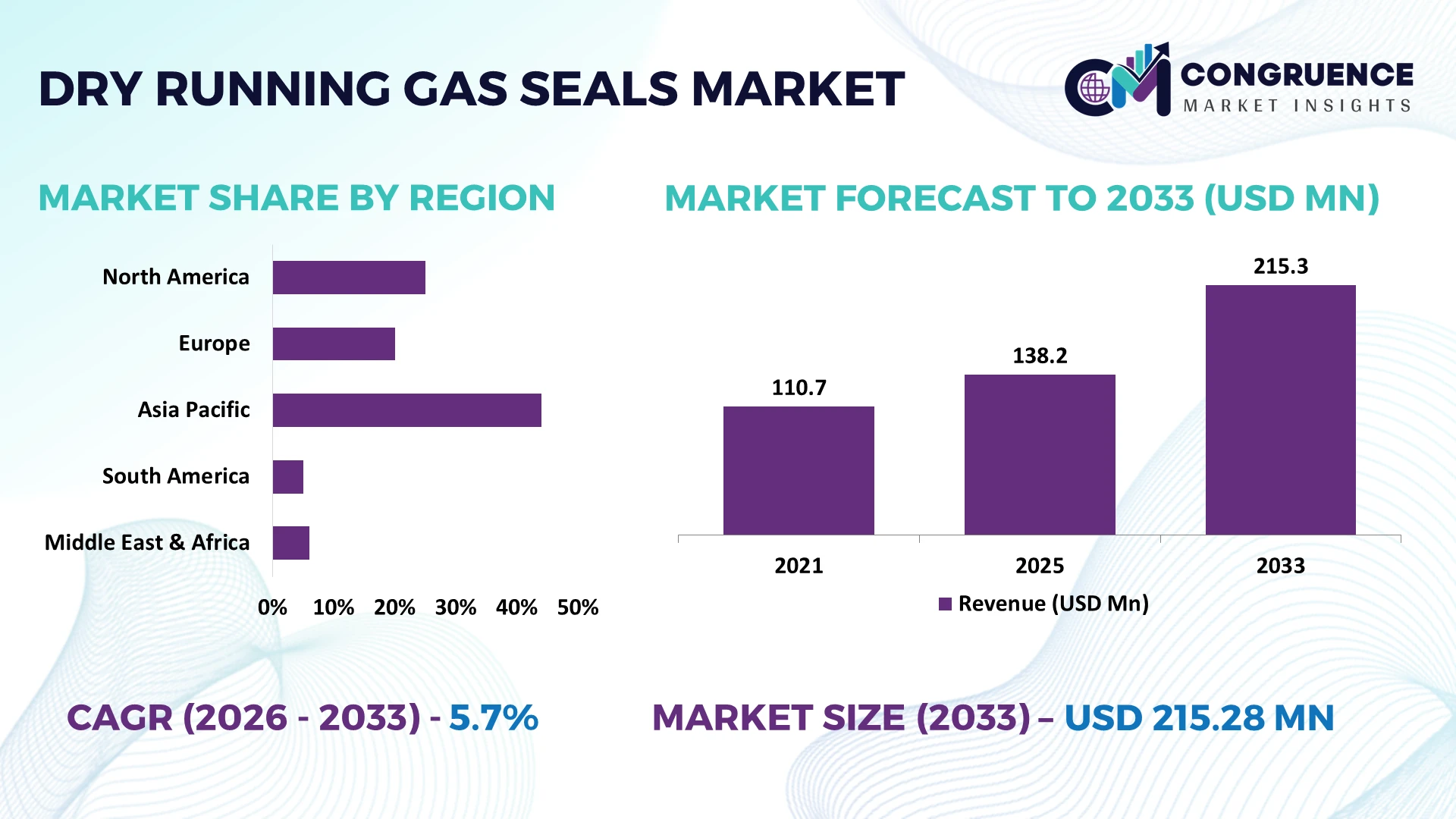
The Global Dry Running Gas Seals Market was valued at USD 138.16 Million in 2025 and is anticipated to reach a value of USD 215.28 Million by 2033 expanding at a CAGR of 5.7% between 2026 and 2033. Growth is driven by wet-seal compressor retrofits, methane-abatement mandates, LNG capacity additions, hydrogen and CO₂ compression, and refinery operators extending centrifugal-compressor maintenance intervals.
The United States represents an estimated 25% of global demand, anchored by extensive gas transmission, LNG, refining, petrochemical, and upstream compressor infrastructure. U.S. marketed natural-gas production averaged a record 118.5 Bcf/d in 2025, with Appalachia, Permian, and Haynesville supplying 67%. By comparison, Middle Eastern operators are accelerating retrofit adoption; an Oman installation achieved 98% emissions reduction and 2% lower turbine gas consumption. Geopolitical pressure on global gas supply security further strengthens investment in reliable compression assets.
Strategically, suppliers should prioritize retrofit engineering, emissions-control integration, and high-pressure sealing platforms for LNG, pipeline, hydrogen, and carbon-management projects.
Market Size & Growth: USD 138.16 million in 2025 reaches USD 215.28 million by 2033 at 5.7% CAGR, supported by wet-to-dry compressor conversion.
Top Growth Drivers: Methane reduction up to 95%, nitrogen savings up to 80%, and maintenance intervals extending beyond 7 years strengthen adoption.
Short-Term Forecast: By 2028, advanced separation-seal installations can reduce auxiliary nitrogen consumption by up to 80%, materially lowering compressor operating requirements.
Emerging Technologies: Non-contacting faces, coaxial separation seals, digital condition monitoring, and advanced carbon materials support compressor pressures exceeding 420 barg.
Regional Leaders: North America approaches USD 65 million, Asia-Pacific USD 55 million, and Europe USD 43 million by 2033 as compressor modernization advances.
Consumer/End-User Trends: Wet-to-dry retrofits can reduce fugitive methane emissions by up to 95%, strengthening adoption among pipeline, LNG, and processing operators.
Pilot/Case Example: A Louisiana pipeline retrofit extended mean time between repair from 3 to 7 years while delivering approximately USD 332,000 annual operating savings.
Competitive Landscape: John Crane holds an estimated 25% share, competing with EagleBurgmann, Flowserve, AESSEAL, and Garlock through reliability, retrofit capability, and engineering support.
Regulatory & ESG Impact: Proven wet-to-dry upgrades have eliminated approximately 278,000 tonnes of CO₂-equivalent emissions annually across deployed compressor applications.
Investment & Funding: Global LNG investment exceeds USD 250 billion across projects under development, strengthening long-cycle demand for high-pressure compressor sealing and aftermarket services.
Innovation & Future Outlook: Next-generation seals operate above 420 barg and down to −160°C, extending addressable deployment into LNG, hydrogen, CCUS, and advanced compression systems.
The Dry Running Gas Seals Market is shifting toward non-contacting sealing systems engineered for natural-gas pipelines, LNG trains, refineries, petrochemical plants, hydrogen compression, and carbon-capture infrastructure. Advanced face materials, coaxial separation seals, seal-gas recovery, and digital condition monitoring are improving compressor reliability while reducing auxiliary consumption. Modern wet-to-dry retrofits can cut fugitive methane emissions by up to 95%, creating a compelling operational case alongside tightening emissions requirements. As LNG supply security and methane control receive greater geopolitical attention, procurement priorities are moving toward high-pressure capability, retrofit compatibility, and lifecycle reliability, setting the foundation for strategic market positioning.
Dry running gas seals are becoming strategically important as compressor operators prioritize methane control, uptime, and lower auxiliary-system dependence across pipelines, LNG, refining, and petrochemical assets. Wet-to-dry seal conversion can eliminate about 95% of seal-related methane emissions, turning compressor sealing into an operational and compliance decision. Tighter methane regulation in the United States and Europe is accelerating replacement of oil-based sealing architectures and increasing demand for engineered retrofit packages.
Compared with conventional wet seals, dry gas seals eliminate circulating seal oil and can extend mean time between repair from roughly 3 years to 7 years in suitable compressor applications. Advanced separation-seal designs can also reduce nitrogen consumption by up to 80%. The United States offers the largest installed compressor retrofit base, while China and the Middle East combine new LNG, refining, and petrochemical capacity with growing high-pressure sealing requirements.
A practical Louisiana pipeline conversion demonstrated approximately USD 332,000 in annual operating savings alongside longer maintenance intervals. Through 2026–2028, suppliers are concentrating engineering investment on high-pressure faces, digital condition monitoring, hydrogen compatibility, and retrofit services. Competitive positioning will increasingly depend on proving lifecycle reliability, emissions reduction, and application-specific engineering across existing compressor fleets.
Methane-abatement requirements are converting dry gas seals from reliability components into strategic emissions-control assets. Wet-to-dry conversions can reduce compressor seal methane emissions by approximately 95%, while advanced separation arrangements lower nitrogen consumption by as much as 80%. In the United States, oil and gas operations face tighter methane-performance requirements, increasing scrutiny of centrifugal-compressor venting and leakage. This creates a direct economic link between emissions compliance and compressor modernization: operators reduce fugitive losses while eliminating oil-system maintenance. Long service intervals further strengthen lifecycle economics, with selected conversions extending repair intervals from about 3 to 7 years. Seal manufacturers are responding with retrofit engineering, condition-monitoring packages, tandem configurations, and application-specific face technologies. The strategic advantage lies in upgrading installed compressors without replacing the complete rotating asset.
Dry gas seal deployment remains constrained where legacy compressors lack suitable seal cavities, clean buffer-gas infrastructure, or stable operating conditions. Converting an existing wet-seal compressor can require piping modifications, control-system changes, filtration equipment, and precision rotor assessment, increasing shutdown complexity. Gas cleanliness is critical because particulate contamination at concentrations below 1% can still damage micrometer-scale sealing interfaces, while pressure excursions exceeding design limits accelerate face deterioration. In mature U.S. and European plants, planned turnaround windows frequently determine whether conversions proceed because unplanned compressor downtime carries substantial production penalties. Suppliers are mitigating these constraints through engineered cartridge retrofits, modular gas-conditioning panels, remote diagnostics, and preassembled systems. Standardizing retrofit interfaces is therefore more commercially important than simply reducing seal acquisition cost.
Hydrogen, carbon capture, LNG, and high-pressure gas processing are creating technically differentiated opportunities for next-generation dry running seals. Advanced designs already operate above 420 barg, while specialized materials support cryogenic service approaching −160°C, expanding applicability beyond conventional natural-gas compression. Hydrogen presents a particularly demanding opportunity because its low molecular weight intensifies leakage-control requirements, making face geometry, secondary sealing, and materials engineering strategically valuable. Europe is accelerating hydrogen-network development, while U.S. carbon-management projects are increasing demand for reliable CO₂ compression. Digital monitoring adds another layer: vibration, pressure, temperature, and leakage data enable condition-based servicing rather than fixed maintenance intervals. Manufacturers are expanding R&D around high-pressure faces, hydrogen-compatible materials, sensor integration, and retrofit packages. Suppliers that combine sealing hardware with diagnostics can capture higher-value lifecycle relationships rather than competing primarily on replacement components.
The central execution challenge is maintaining non-contacting seal stability across compressor startups, shutdowns, pressure reversals, contamination events, and rapidly changing process conditions. Dry gas seal faces operate with running clearances measured in only a few micrometers, making filtration quality and control-system response critical to reliability. Advanced applications exceeding 420 barg intensify mechanical loading, while cryogenic duties approaching −160°C introduce thermal distortion and material-compatibility risks. Hydrogen further complicates deployment because leakage management becomes more demanding than with heavier hydrocarbon gases. Operators therefore require specialized commissioning, diagnostics, and technician expertise rather than conventional mechanical-seal maintenance alone. Manufacturers must invest in test facilities, digital monitoring, contamination-resistant architectures, training, and compressor-OEM partnerships. Long-term differentiation will depend on maintaining predictable seal behavior through transient conditions, not simply achieving rated performance during steady-state operation.
Cartridge Architectures Simplify Maintenance: Operators are standardizing preassembled cartridge sealing systems to shorten compressor interventions and reduce installation variability. Cartridge configurations can cut seal-change labor by approximately 20–30%, while factory-set assemblies reduce alignment-dependent commissioning steps. Refineries and chemical plants are integrating modular seal panels with standardized connections during planned turnarounds. Manufacturers are responding with drop-in cartridges, standardized gland dimensions, and engineered retrofit packages that reduce field assembly requirements and accelerate equipment return to service.
Condition Monitoring Becomes More Granular: Seal management is moving beyond basic pressure alarms toward continuous leakage, temperature, vibration, and differential-pressure monitoring. Predictive workflows can reduce unplanned maintenance interventions by approximately 15–25% and extend inspection intervals by 10–20% where operating data is integrated with compressor analytics. U.S. LNG and pipeline operators are increasingly connecting seal instrumentation to plant asset-management systems. Suppliers are adding sensor-ready hardware, remote diagnostics, and automated anomaly detection to strengthen aftermarket service relationships.
Advanced Face Materials Gain Priority: Silicon carbide, engineered carbon, specialized coatings, and optimized face geometries are increasingly specified for abrasive, corrosive, and thermally demanding services. High-performance designs now address pressures above 400 bar, while specialized sealing technologies support temperatures approaching −160°C. Chemical and LNG operators are tightening material-selection procedures as process severity rises. Seal companies are expanding material testing and application engineering, reducing premature face degradation while differentiating products through reliability rather than component pricing.
Localization Reshapes Aftermarket Strategies: Supply-chain disruption has increased emphasis on regional repair centers, locally stocked cartridges, and rapid-response engineering. Operators targeting equipment availability above 95% cannot tolerate extended imported-component lead times during compressor outages. Indian and Middle Eastern service hubs are consequently gaining importance for petrochemical and gas-processing customers. Global manufacturers are expanding authorized service partnerships, localized inventories, and refurbishment capability, shifting competitive advantage toward turnaround speed and installed-base support.
Cartridge seals represent the leading type, accounting for approximately 35% of Dry Running Gas Seals Market demand, supported by preassembled construction, repeatable installation, and reduced field-adjustment requirements. Their standardized architecture is particularly valuable on critical rotating equipment where turnaround duration directly affects plant availability. Single mechanical seals retain approximately 25% share in less demanding duties because of simpler construction and lower initial cost, while double mechanical seals maintain relevance where hazardous or difficult process fluids require additional containment.
Split seals are positioned as the fastest-growing type because installation around existing shafts can eliminate major equipment disassembly, potentially reducing maintenance intervention time by 30–50% in suitable applications. Bellows seals retain strategic relevance in high-temperature or chemically aggressive services where flexible metallic elements accommodate thermal movement. Manufacturers are directing product investment toward modular cartridges, engineered face materials, compact split configurations, and standardized retrofit dimensions, shifting purchasing decisions from component price toward installation speed and lifecycle availability.
Centrifugal compressors dominate application demand with an estimated 48% share, reflecting extensive deployment across natural-gas transmission, LNG liquefaction, refining, petrochemicals, and process-gas handling. Dry running sealing is particularly valuable on high-speed compressor shafts because non-contacting faces minimize friction during stable operation and control process-gas leakage. Gas turbines represent approximately 18% of application demand, with sealing requirements concentrated around auxiliary systems and high-temperature rotating assemblies. Pumps maintain established usage across chemical and industrial processing.
Expanders are the fastest-growing application as LNG, hydrogen, and energy-recovery systems place greater emphasis on high-speed rotating equipment operating under demanding pressure conditions. Blowers remain a smaller but relevant segment in continuous process-air and gas-handling duties. Suppliers are responding with high-pressure face designs, contamination-resistant architectures, instrumentation packages, and application-engineered cartridges. The investment shift favors sealing systems capable of integrating directly with compressor condition-monitoring platforms and supporting longer maintenance intervals.
Oil and gas represents the leading end-user segment with approximately 44% share, supported by extensive centrifugal-compressor deployment across upstream processing, gathering systems, transmission pipelines, LNG terminals, and storage infrastructure. Continuous-duty compression makes leakage control and seal reliability economically critical because equipment outages directly constrain throughput. Petrochemicals account for approximately 22% of demand, where high operating temperatures, hazardous gases, and tightly integrated production trains support engineered sealing configurations. Chemical processing remains an established market for corrosion-resistant and containment-focused designs.
Power generation is the fastest-growing end-user segment as gas-fired flexibility, hydrogen blending, carbon-management infrastructure, and high-efficiency rotating equipment broaden advanced sealing requirements. Industrial manufacturing remains comparatively fragmented, emphasizing application-specific pumps, blowers, and compressors. Manufacturers are targeting these buyers through compressor-OEM partnerships, retrofit programs, long-term service agreements, condition monitoring, and specialized materials. Competitive investment is moving toward lifecycle contracts that combine sealing hardware, diagnostics, refurbishment, and performance engineering.
North America accounted for the largest market share at 34% in 2025 however, Asia-Pacific is expected to register the fastest growth, expanding at a CAGR of 7.2% between 2026 and 2033.
Compressor Modernization Drives Retrofit Intensity
North America accounts for approximately 34% of global Dry Running Gas Seals Market demand, supported by its extensive natural-gas transmission, LNG, refining, petrochemical, and industrial compressor installed base. U.S. marketed natural-gas production averaged approximately 118.5 Bcf/d in 2025, sustaining intensive centrifugal-compressor utilization across gathering, processing, storage, and interstate pipeline systems. Methane-control requirements are strengthening the economics of replacing oil-based compressor seals with non-contacting dry configurations capable of materially reducing venting. LNG infrastructure along the Gulf Coast adds demand for high-pressure and cryogenic-compatible sealing architectures. Operators increasingly combine cartridge retrofits with filtration, seal-gas conditioning, and continuous leakage monitoring rather than treating seals as standalone components. This integration favors suppliers with compressor engineering expertise, rapid field service, and installed-base knowledge because shutdown duration increasingly influences procurement alongside seal performance.
United States Market Outlook: The United States combines extensive pipeline compression with expanding LNG export infrastructure and stringent methane management. LNG export capacity exceeded 15 Bcf/d during 2025 following new Gulf Coast capacity additions. Operators are prioritizing engineered retrofits, tandem arrangements, remote condition monitoring, and long-term service support to improve compressor availability while controlling fugitive emissions.
Emissions Regulation Reshapes Compressor Engineering
Europe represents approximately 25% of global demand, with Germany, Italy, the United Kingdom, Norway, and France concentrating refinery, chemical, gas-processing, pipeline, and turbomachinery applications. EU methane regulation is shifting procurement toward measurable leakage control and stronger monitoring across energy infrastructure, increasing scrutiny of compressor sealing architecture. At the same time, hydrogen-network planning is forcing suppliers to qualify face materials, secondary seals, and containment systems for smaller gas molecules and changing pressure regimes. Germany's industrial gas, chemical, and rotating-equipment engineering base gives the region significant technology-development capability. European operators increasingly evaluate dry running seals through lifecycle emissions, nitrogen consumption, reliability, and serviceability rather than acquisition price alone. Suppliers are responding through hydrogen-compatible testing, digital condition monitoring, retrofit engineering, and localized service centers, creating an advantage for manufacturers capable of supporting both existing hydrocarbon assets and emerging low-carbon compression infrastructure.
Germany Market Outlook: Germany's chemical and machinery sectors provide a concentrated customer base for engineered compressor and pump sealing systems. The country's planned hydrogen core network extends roughly 9,000 kilometers, creating a substantial future compression ecosystem. Seal manufacturers positioned around hydrogen compatibility, precision engineering, condition monitoring, and OEM integration gain direct access to technically demanding conversion and new-build projects.
Industrial Scale Accelerates High-Specification Adoption
Asia-Pacific accounts for an estimated 24% of global dry running gas seal demand, combining China's petrochemical and LNG infrastructure with India's refining expansion and Japan's high-specification rotating-equipment base. China remains the principal industrial scale market, operating extensive refining, chemical, natural-gas processing, and LNG receiving infrastructure where compressor uptime directly influences plant throughput. India is strengthening demand through refinery modernization, city-gas infrastructure, fertilizer production, petrochemical complexes, and LNG terminals. India's refining capacity exceeds 250 million tonnes annually, creating a substantial installed base of pumps and compressors requiring engineered sealing and aftermarket maintenance. Procurement is simultaneously becoming more localized as operators seek shorter replacement-part lead times and domestic technical support. Global manufacturers are strengthening local repair capability, engineering partnerships, and cartridge availability, while Asian suppliers compete through manufacturing economics and increasingly sophisticated materials and face-design capabilities.
China Market Outlook: China combines more than 18 million barrels per day of refining capacity with extensive petrochemical manufacturing and LNG receiving infrastructure, giving dry running seal suppliers substantial new-build and aftermarket exposure. Domestic equipment localization is intensifying competition, pushing international suppliers toward high-pressure applications, advanced materials, digital diagnostics, and lifecycle services where engineering differentiation remains defensible.
Brazilian Processing Assets Anchor Aftermarket Demand
South America represents approximately 7% of global demand, with Brazil concentrating the strongest requirement through offshore hydrocarbons, refining, petrochemicals, gas processing, pipelines, and industrial manufacturing. Brazil produced more than 3 million barrels per day of crude oil during 2025, with offshore pre-salt fields supplying the majority, creating demanding compression and processing environments where seal reliability directly affects production availability. Expansion of associated-gas handling increases requirements for centrifugal compressors and supporting dry sealing systems. Argentina adds incremental opportunity through Vaca Muerta gas development, although infrastructure bottlenecks and imported-component dependence complicate rapid equipment deployment. Regional operators therefore emphasize serviceability, installed-base compatibility, and replacement-part availability. Seal manufacturers are responding through Brazilian service operations, local repair capability, distributor inventories, and closer collaboration with compressor OEMs, reducing exposure to lengthy international supply chains during critical maintenance events.
Brazil Market Outlook: Brazil's offshore production ecosystem provides the region's strongest technical demand for high-integrity rotating-equipment seals. Pre-salt production represents more than 75% of national oil output, placing compressor reliability under demanding pressure and process conditions. Suppliers with local engineering, refurbishment, offshore-service capability, and rapid cartridge replacement hold a meaningful operational advantage during planned and unplanned maintenance.
Gas Processing Expansion Elevates Reliability Requirements
Middle East & Africa represents approximately 10% of global demand, led by Qatar, Saudi Arabia, the UAE, and major hydrocarbon-processing economies. Qatar's North Field LNG expansion is creating particularly demanding high-pressure compression requirements, while Saudi Arabia continues expanding gas processing and petrochemical integration. Qatar is progressing LNG capacity from 77 million tonnes annually toward 142 million tonnes by 2030, increasing the installed base of compressors requiring high-integrity sealing, monitoring, and aftermarket support. Saudi industrial projects add demand across gas gathering, refining, chemicals, and power applications. Operators increasingly specify complete seal-support packages incorporating filtration, instrumentation, tandem arrangements, and condition monitoring to protect production continuity. International manufacturers are expanding local service centers, repair capabilities, and technical partnerships because rapid turnaround is strategically critical where compressor downtime can constrain entire processing trains.
Qatar Market Outlook: Qatar's LNG expansion makes it the region's most concentrated new-build opportunity for advanced compressor sealing. North Field projects are designed to increase liquefaction capacity by approximately 84% from the established 77-million-tonne base. High-pressure reliability, cryogenic compatibility, OEM qualification, and immediate technical support therefore carry greater procurement weight than component-level pricing.
John Crane, EagleBurgmann, Flowserve, AESSEAL, and Freudenberg compete across compressor, pump, and engineered dry-running sealing applications, while specialist manufacturers challenge them through customization and localized service. The top five suppliers collectively represent approximately 65% of market demand, reflecting strong qualification, installed-base, and aftermarket barriers. John Crane competes through compressor expertise and lifecycle services; EagleBurgmann emphasizes engineered gas-seal systems; Flowserve leverages rotating-equipment integration. Advanced retrofit packages can reduce seal-related methane emissions by roughly 95%, while optimized separation systems cut nitrogen consumption by up to 80%, shifting competition from component pricing toward lifecycle economics. Suppliers are expanding service centers, digital monitoring, hydrogen-compatible materials, and OEM partnerships. Localization is accelerating as customers reduce imported-spares exposure and turnaround delays. Qualification testing, precision face manufacturing, compressor integration, and field-service capability remain decisive entry barriers. Winning requires proven reliability, application engineering, rapid aftermarket response, emissions performance, and digital condition-monitoring capability across critical rotating assets.
John Crane
EagleBurgmann
Flowserve Corporation
AESSEAL plc
Freudenberg Sealing Technologies
Garlock
Flexaseal Engineered Seals and Systems
Chesterton
Meccanotecnica Umbra
Vulcan Engineering
Scenic Precise Element
Anhui YALAN Seal Component
Sinoseal Holding
KSB SE & Co. KGaA
Current dry running gas seal technology centers on non-contacting spiral-groove faces, tandem arrangements, coaxial separation seals, conditioned seal-gas systems, and digital monitoring. Coaxial designs can reduce nitrogen consumption by up to 90%, while controlled differential-pressure operation can eliminate separation-gas loss. More than 1,500 coaxial separation seals are deployed globally, demonstrating commercial maturity across centrifugal compressors where contamination prevention directly protects uptime and maintenance economics.
Emerging platforms combine diamond-like coatings, silicon-carbide faces, acoustic-emission diagnostics, predictive analytics, and contamination-resistant gas conditioning. Compared with conventional carbon-ring separation seals, advanced coaxial technology cuts nitrogen consumption by up to 90% while operating non-contactingly, reducing wear. High-pressure architectures now support approximately 450 bar and temperatures from -200°C to 230°C, expanding applicability across LNG, hydrogen, CO2 reinjection, and severe petrochemical compression duties.
Disruptive development through 2026–2028 will concentrate on zero-emission compressor sealing, supercritical-CO2 compatibility, intelligent fault detection, and integrated seal-health analytics. Digital diagnostics can identify face defects and spring failures before consequential damage, shifting maintenance from scheduled intervention toward condition-based action. Operators with compressor fleets benefit most because avoided shutdowns compound across installed assets. Suppliers integrating seal hardware, gas conditioning, sensing, and lifecycle services gain competitive advantage; investment now builds qualification experience for hydrogen and carbon-management projects.
January 2024 – Rotating Machinery Services upgraded a plastics manufacturer’s single-stage centrifugal compressor from water seals to dry gas seals, engineering the complete seal skid, control panel, overhaul, installation, testing, spare housing, and 1 spare rotor to improve operating reliability. Source: Turbomachinery
April 2024 – John Crane opened its Rio Claro Dry Gas Seal Service Center in Brazil, adding repair, refurbishment, and dynamic-testing capability within a 1,700-square-meter facility, strengthening localized aftermarket support and shortening service pathways for Latin American compressor operators. Source: JohnCrane
January 2025 – Flowserve secured a contract to supply dry gas seals and systems for ADNOC’s carbon-capture initiative through collaboration with Celeros; the project targets capture and storage of 1.5 million tonnes of CO2 annually, expanding seals into decarbonization infrastructure. Source: Flowserve
June 2025 – John Crane launched the Type 93AX Coaxial Separation Seal for energy and process applications, delivering up to 80% lower nitrogen consumption than conventional radial separation seals while maintaining operation through multiple failure scenarios, reducing operating costs and emissions. Source: JohnCrane
The report evaluates dry running gas seals across Single Mechanical Seals, Double Mechanical Seals, Cartridge Seals, Split Seals, and Bellows Seals, with application coverage spanning Centrifugal Compressors, Gas Turbines, Pumps, Blowers, and Expanders. End-user analysis covers Oil and Gas, Chemical Processing, Power Generation, Petrochemicals, and Industrial Manufacturing. Centrifugal compressors represent approximately 48% of application demand, highlighting the importance of critical rotating-equipment reliability.
Geographic coverage includes North America, Europe, Asia-Pacific, South America, and Middle East & Africa, alongside emerging hydrogen, LNG, CO2 compression, and high-pressure applications. Technology assessment covers coaxial separation architectures, advanced face coatings, predictive monitoring, seal-gas conditioning, and zero-emission configurations supporting pressures near 450 bar. The 2026–2033 outlook supports investment planning, product development, aftermarket expansion, regional service localization, partnership strategy, and competitive positioning across new-build and retrofit compressor ecosystems.
| Report Attribute/Metric | Report Details |
|---|---|
Market Revenue in 2025 | USD 138.16 Million |
Market Revenue in 2033 | USD 215.28 Million |
CAGR (2026 - 2033) | 5.7% |
Base Year | 2025 |
Forecast Period | 2026 - 2033 |
Historic Period | 2021 - 2025 |
Segments Covered | By Type
By Application
By End-User
|
Key Report Deliverable | Revenue Forecast, Growth Trends, Market Dynamics, Segmental Overview, Regional and Country-wise Analysis, Competition Landscape |
Region Covered | North America, Europe, Asia-Pacific, South America, Middle East, Africa |
Key Players Analyzed | John Crane, EagleBurgmann, Flowserve Corporation, AESSEAL plc, Freudenberg Sealing Technologies, Garlock, Flexaseal Engineered Seals and Systems, Chesterton, Meccanotecnica Umbra, Vulcan Engineering, Scenic Precise Element, Anhui YALAN Seal Component, Sinoseal Holding, KSB SE & Co. KGaA |
Customization & Pricing | Available on Request (10% Customization is Free) |




